Last reviewed: September 2026
Quick Answer
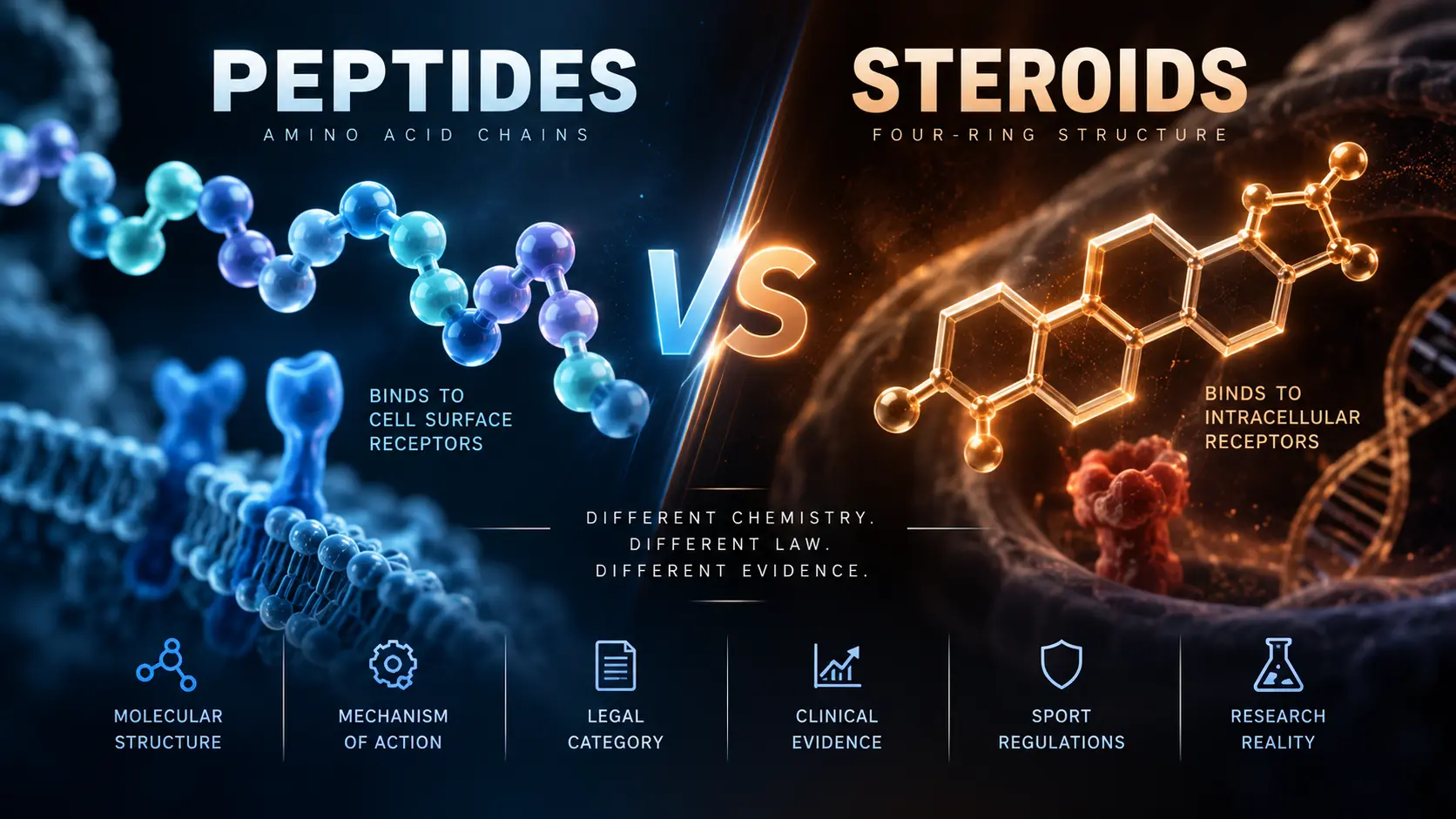
Peptides are not steroids. A steroid is built on a four-ring carbon skeleton and works by binding a receptor inside the cell that switches genes on; a peptide is a chain of amino acids that works by binding a receptor on the cell surface. The peptides vs steroids framing that circulates in gyms, in which peptides are the safer legal alternative, is wrong on both words: research peptides such as ipamorelin, CJC-1295 and BPC-157 are not controlled substances in the United States, but they are also not approved by the FDA for any human use, and every one of them is prohibited at all times in tested sport. What separates them from anabolic steroids is not a better safety record. It is the near-total absence of any long-term human safety record at all.
Key Takeaways
- Federal law defines an anabolic steroid by four criteria, and one of them is that the substance is not dehydroepiandrosterone (DHEA) [1]. DHEA is a steroid hormone that is not an anabolic steroid.
- Anabolic steroids sit in Schedule III at 21 CFR 1308.13(f) [2]. Research peptides sit in no schedule at all, which is a different thing from being lawful to sell for human use.
- Human growth hormone is not scheduled, yet knowingly distributing it for unapproved human use carries up to five years in prison under 21 U.S.C. 333(e) (ten if a minor is involved), and the offence is treated as a felony Controlled Substances Act violation for forfeiture purposes [3].
- BPC-157 is named in section S0 of the WADA 2026 Prohibited List; CJC-1295, ipamorelin, MK-677, GHRP-2 and GHRP-6 are named in S2.2.4; TB-500 and IGF-1 analogues in S2.3 [4].
- In 86 long-term anabolic steroid users, mean left ventricular ejection fraction was 52% against 63% in 54 non-using weightlifters, with coronary plaque volume scaling with lifetime dose [5].
- One of the longest controlled human trials of a growth hormone secretagogue enrolled 65 adults aged 60 to 81. At 12 months the treatment was associated with a 1.1 kg rise in fat-free mass, strength and physical function did not change, and insulin sensitivity fell [6].
- MK-677 (ibutamoren) is not a peptide. It is a non-peptide small molecule that happens to hit the same receptor as ipamorelin.
- The FDA's April 2026 bulk substances page lists BPC-157, CJC-1295 and TB-500 in a table of nominations "withdrawn by the nominators", not as substances cleared on safety grounds [7].
Research Use Only
Every compound discussed here is referenced for research context only. 99 Purity Peptides supplies Research Use Only (RUO) materials. Nothing sold is intended for human or veterinary consumption, and nothing in this article is medical, legal, training or dosing advice. No compound named below is approved by the FDA for any human indication.
How We Graded the Evidence
Claims are ranked by what produced them. A randomized controlled trial in humans outranks an open-label human study, which outranks an animal model, which outranks cell culture. Where a finding comes from swine, rats or a dish, we say so in the same sentence. Where a study is small, old, or from a single research group, we say that too. Legal statements point to the statute, regulation or regulator page rather than to a secondary summary.
Are Peptides Steroids?
No. They are different classes of molecule that happen to be discussed together because both get misused in the same places.
Every steroid is built on the gonane skeleton: three six-carbon rings fused to one five-carbon ring. Testosterone, oxandrolone, trenbolone, cortisol, estradiol and DHEA all share that core (oxandrolone with one ring carbon replaced by oxygen) and differ mainly in what hangs off it. Change a substituent and you move from an anabolic androgen to an anti-inflammatory glucocorticoid without changing the skeleton at all.
A peptide has no rings. It is a linear chain of amino acids joined by peptide bonds, and length is the only thing separating a peptide from a protein. Ipamorelin is five amino acids. BPC-157 is fifteen. CJC-1295 is thirty. Somatropin, the recombinant form of human growth hormone, is 191, long enough that most biochemists call it a protein.
That is the whole answer to the chemistry question, and it takes one paragraph. The reason the question keeps being asked is that the legal and commercial categories do not line up with the chemical ones. "Steroid" in chemistry is far broader than "anabolic steroid" in the Controlled Substances Act, and "peptide" as used in the supplement trade covers at least one compound that is not a peptide.
How Do Peptides and Steroids Act Differently in the Body?
Steroids act inside the cell; peptides act on its surface. That single structural difference drives almost everything else.
Testosterone and its derivatives are lipid-soluble enough to cross the cell membrane unaided. Inside, they bind the androgen receptor, a nuclear receptor that then travels to the nucleus and acts as a transcription factor at androgen response elements. The receptor is expressed in muscle, bone, liver, skin, prostate and brain, which is why the effects are systemic and why they are not selectable.
Growth hormone secretagogues do none of that. Ipamorelin, GHRP-2, GHRP-6 and MK-677 bind GHS-R1a, the ghrelin receptor, on pituitary somatotrophs. CJC-1295, sermorelin and tesamorelin bind the growth hormone releasing hormone receptor on the same cells. Neither class touches muscle tissue directly. They act on the pituitary and ask it to release growth hormone it already makes, which imposes a ceiling that androgens do not have: the pituitary's own secretory capacity. Androgen receptor signalling rises with the amount of androgen present; secretagogue-driven hormone release is bounded by the gland's own capacity. The differences between individual secretagogues in this class are narrower than the marketing suggests, as our ipamorelin and CJC-1295 comparison and the GHRP-6 and ipamorelin comparison set out in detail.
The selectivity claim made for ipamorelin comes from Raun and colleagues in 1998. In conscious swine, ipamorelin released growth hormone without raising ACTH or cortisol above the levels seen with GHRH, even at doses more than 200-fold higher than its ED50 for growth hormone release, while GHRP-6 and GHRP-2 raised both; none of the secretagogues tested changed FSH, LH, prolactin or TSH [8]. Potency was measured in rat pituitary cells and anaesthetised rats, but the selectivity finding itself is swine data. It is not human data, and we found no published human study that tested it.
Two practical consequences follow from structure. Most oral anabolic steroids carry a methyl group at carbon 17, which lets them survive first-pass hepatic metabolism; that same 17-alpha-alkylation is the feature associated with cholestatic liver injury [9]. Peptides have the opposite problem. Gut proteases cut them apart and the intestinal epithelium does not let what survives across in useful quantity [10], which is why almost every research peptide is injected. MK-677 is the exception that proves the rule, and it is orally active precisely because it is not a peptide.
Is It a Peptide, a Steroid, or Neither?
Most of the confusion in this topic collapses once compounds are sorted by what they actually are rather than by where they are sold.
Compound | Chemical class | Primary target | US legal status | WADA 2026 section |
|---|---|---|---|---|
Testosterone | Steroid (anabolic androgenic) | Intracellular androgen receptor | Schedule III anabolic steroid | S1.1 |
Oxandrolone (Anavar) | Steroid, 17-alpha-alkylated | Androgen receptor | Schedule III anabolic steroid | S1.1 |
Trenbolone | Steroid (anabolic androgenic) | Androgen receptor | Schedule III anabolic steroid | S1.1 |
DHEA (prasterone) | Steroid hormone, androgen precursor | Converts to androgens and estrogens | Expressly excluded from the anabolic steroid definition; sold as a supplement | S1.1 |
BPC-157 | Peptide, 15 amino acids | Not established in humans | Not scheduled; not FDA-approved; compounding nomination withdrawn | S0 |
Ipamorelin | Peptide, 5 amino acids | GHS-R1a (ghrelin receptor) | Not scheduled; not FDA-approved; 503B category 2 | S2.2.4 |
CJC-1295 | Peptide, 30 amino acids | GHRH receptor | Not scheduled; not FDA-approved; nomination withdrawn | S2.2.4 |
GHRP-6 | Peptide, 6 amino acids | GHS-R1a | Not scheduled; not FDA-approved; 503B category 2 | S2.2.4 |
IGF-1 LR3 | Protein analogue, 83 amino acids | IGF-1 receptor | Not scheduled; not FDA-approved | S2.3 |
TB-500 | Peptide fragment of thymosin beta-4 | Actin binding | Not scheduled; not FDA-approved; nomination withdrawn | S2.3 |
Somatropin (hGH) | Protein, 191 amino acids | Growth hormone receptor | Prescription drug; 21 U.S.C. 333(e) offence if diverted | S2.2.3 |
Insulin | Protein, 51 amino acids | Insulin receptor | Prescription drug | S4.4.2 |
hCG | Glycoprotein hormone | LH/CG receptor | Prescription drug | S2.2.1 |
MK-677 (ibutamoren) | Non-peptide small molecule | GHS-R1a | Not scheduled; not FDA-approved; 503A and 503B category 2 | S2.2.4 |
RAD-140 | Non-steroidal small molecule (SARM) | Androgen receptor | Not federally scheduled; not FDA-approved | S1.2 |
Two entries in that table are the ones people get wrong. MK-677 is sold, shipped and discussed alongside peptides, and it is not one; it is a spiropiperidine small molecule that binds the same receptor ipamorelin binds, which is a statement about pharmacology, not chemistry. And SARMs such as RAD-140 are not steroids despite acting at the androgen receptor, which is exactly why WADA files them under S1.2, "other anabolic agents", rather than with the steroids in S1.1 [4]. Being non-steroidal is a structural fact about a SARM. It is not a safety claim, and it does not make the compound legal to sell for human use.
Our research peptide glossary covers the naming conventions behind these distinctions, and what research peptides are explains the RUO category itself.
Are Peptides Legal When Steroids Are Not?
Partly, and the word "legal" is carrying more weight in that question than it can hold. There are three separate legal regimes here, and a compound can sit outside one while sitting squarely inside another.
Regime | Governing law | What it actually means |
|---|---|---|
Anabolic steroids | 21 U.S.C. 802(41)(A); 21 CFR 1308.13(f) | Schedule III controlled substances. Possession without a valid prescription is a federal offence. |
Human growth hormone | 21 U.S.C. 333(e) | Not scheduled, but knowing distribution for unapproved human use carries up to five years (ten if a minor is involved), treated as a felony CSA violation for forfeiture purposes, investigated by the DEA. |
Research peptides | Neither of the above | Not controlled substances and not FDA-approved for any indication. Being unscheduled does not make them approved or permit marketing them for human use. |
The statutory definition of anabolic steroid turns on four criteria, which the DEA has set out plainly: the substance is chemically related to testosterone, it is pharmacologically related to testosterone, it is not an estrogen, progestin or corticosteroid, and it is not DHEA [1]. A research peptide fails the first two criteria before anyone reaches the exclusions. That is why ipamorelin is not a controlled substance, and it is a statement about chemical structure, not about risk.
The distinction competitors blur is the one that matters most. Not controlled is not the same as approved, and neither is the same as lawful to sell for human use. A compound can be unscheduled and unapproved at the same time, and those are separate questions from how it may lawfully be sold. BPC-157's regulatory position is the clearest worked example.
Then there is DHEA, which breaks the categories in an instructive way. DHEA is unambiguously a steroid hormone by chemistry. Congress nonetheless wrote it out of the federal definition of anabolic steroid by name, so it is not a Schedule III substance while structurally similar compounds are [1]. And WADA reaches the opposite conclusion: prasterone (DHEA), when administered exogenously, is listed by name in section S1.1 of the 2026 Prohibited List as an anabolic androgenic steroid, prohibited at all times, non-Specified [4]. So DHEA is simultaneously a steroid, not an anabolic steroid, and a banned substance in sport. Our DHEA research chemical guide covers its research context.
One genuinely unsettled question deserves naming rather than papering over. Section 333(e) defines human growth hormone as somatrem, somatropin, or an analogue of either [3]. Whether a growth hormone secretagogue counts as an analogue is a real legal question: a five-amino-acid ghrelin mimetic bears no structural resemblance to a 191-amino-acid protein, but the statute does not define "analogue", and no settled federal authority resolves the point. We take no position on it. Nothing in this section is legal advice.
Are Peptides Banned in Sport, and Can They Be Detected?
Every research peptide named in this article is prohibited at all times, in and out of competition, under the WADA 2026 Prohibited List that took effect on 1 January 2026 [4]. Not in-competition only. At all times. The one qualification is section S2.2.1, whose testosterone-stimulating peptides such as hCG are prohibited in male athletes.
Compounds | Section | Section heading | Status |
|---|---|---|---|
BPC-157 | S0 | Non-approved substances | Specified |
Testosterone, oxandrolone, trenbolone, prasterone (DHEA) | S1.1 | Anabolic androgenic steroids | Non-Specified |
RAD-140, ostarine, LGD-4033 | S1.2 | Other anabolic agents | Non-Specified |
hCG, LH, GnRH agonists, kisspeptin | S2.2.1 | Testosterone-stimulating peptides in males | Non-Specified |
Somatropin, AOD-9604, hGH 176-191 | S2.2.3 | Growth hormone, its analogues and fragments | Non-Specified |
CJC-1293, CJC-1295, sermorelin, tesamorelin | S2.2.4 | GHRH and its analogues | Non-Specified |
Ipamorelin, ibutamoren (MK-677), anamorelin, macimorelin | S2.2.4 | Growth hormone secretagogues and their mimetics | Non-Specified |
GHRP-2 (pralmorelin), GHRP-6, hexarelin | S2.2.4 | GH-releasing peptides | Non-Specified |
IGF-1 and analogues, thymosin-beta4 derivatives including TB-500, MGF | S2.3 | Growth factors and growth factor modulators | Non-Specified |
Insulins and insulin-mimetics | S4.4.2 | Metabolic modulators | Non-Specified |
One detail in that table is easy to miss. BPC-157 is in S0, and every substance in S0 is a Specified Substance, while every substance in S2 is non-Specified [4]. Specified status does not mean a compound is permitted or less serious; WADA says explicitly that specified substances are not less dangerous, only more plausibly consumed for a non-sporting reason. It changes how a case is argued at sanction, nothing more. The practical point for a researcher is that the S0 classification exists because BPC-157 has no regulatory approval anywhere, which is the same fact that puts it outside the FDA's approval framework.
On detection, the blanket claim that peptides do not show up on a drug test is wrong where it matters. WADA-accredited anti-doping laboratories have validated liquid chromatography tandem mass spectrometry methods for these compounds and their metabolites [11]. Anyone competing under anti-doping rules should assume they are detectable. The pharmacology of individual secretagogues is covered in our GHRP-2 and GHRP-6 comparison.
Are Peptides Safer Than Steroids?
The question sets a well-measured harm against a largely unmeasured one, which is not the same as setting a large harm against a small one. The honest answer is that for anabolic steroids we have long-term human data showing damage, and for research peptides we have almost no long-term human data at all.
The steroid side has been measured, repeatedly. Baggish and colleagues imaged 140 male weightlifters aged 34 to 54, comparing 86 men reporting at least two years of cumulative lifetime anabolic steroid use with 54 non-users. Mean left ventricular ejection fraction was 52% in users against 63% in non-users, early relaxation velocity 9.3 against 11.1 cm/s, and median coronary artery plaque volume 3 mL3 against 0, with plaque burden scaling with lifetime dose [5]. Rasmussen and colleagues measured former users years after they stopped: median total testosterone 14.4 nmol/L against 18.8 nmol/L in controls, with 27.2% of former users below the lower reference limit of 12.1 nmol/L against none of the controls, alongside higher rates of erectile dysfunction and reduced libido [12]. Prolonged hypogonadism after withdrawal has been described as an under-recognised problem in its own right [13]. Both of the primary studies are observational and rely on self-reported exposure, which is worth saying plainly. Neither establishes causation on its own, and both recruited weightlifters rather than a general population.
The peptide side has barely been measured at all. One of the longest controlled trials of a growth hormone secretagogue is Nass and colleagues in 2008: a two-year, double-blind, placebo-controlled, modified-crossover randomized trial of oral MK-677 at 25 mg daily in 65 healthy adults aged 60 to 81, with its primary results reported at 12 months. At that point fat-free mass had increased 1.1 kg against a 0.5 kg fall on placebo, while thigh muscle area, muscle strength and physical function did not change. Fasting glucose rose about 5 mg/dL and insulin sensitivity fell [6]. The measured result was a change in body composition without functional benefit and with worse glucose handling, in an older population, from an orally active non-peptide.
For the injectable peptides the record is thinner still. Ipamorelin's published Phase 2 proof-of-concept trial in postoperative ileus enrolled 117 patients (114 treated and analysed) and did not significantly improve time to tolerance of a standardised solid meal [14]; a larger Phase 2 dose-finding trial enrolling 320 patients completed in 2014 without posted results [17]; the FDA's own entry for ipamorelin acetate notes serious adverse events including death in published work where it was given intravenously for gastric motility [7]. The FDA's ibutamoren entry cites a randomized placebo-controlled trial in hip-fracture recovery that was terminated early over a potential congestive heart failure signal [7]. CJC-1295's published human pharmacology consists of two small ascending-dose trials in healthy adults showing growth hormone and IGF-1 elevated for days after a single dose [15] and a study of growth hormone pulsatility in healthy men [18], which tells you the molecule is active and nothing about whether it is safe over years. In July 2006 ConjuChem halted its Phase 2 trial of CJC-1295 in HIV-associated lipodystrophy, which had enrolled 192 participants, after a participant died; contemporaneous reporting stated that the cause of death and its relationship to the study drug were under investigation [16]. We found no public determination of cause, and no later clinical development of CJC-1295. That does not mean CJC-1295 caused the death. It also does not mean the compound was cleared, and pages that report it either way are reporting something that was never established. The CJC-1295 and ipamorelin research overview and the DAC versus no-DAC comparison go further into that pharmacology.
What has been measured | Anabolic steroids | Research peptides and secretagogues |
|---|---|---|
Cardiac imaging in long-term users | Yes, 140 participants [5] | None published |
Endocrine status years after cessation | Yes [12] | Not studied |
Longest controlled human trial | Decades of use in approved indications | Two years (primary results at 12 months), 65 participants, oral MK-677 [6] |
Human RCT for the specific compound | Yes, for several | None for BPC-157, TB-500, IGF-1 LR3 |
Approved human indication | Yes, for several | None |
Our position: unquantified is not the same as low. Nobody has run a Baggish-style imaging study on ten-year secretagogue users, because that cohort has never been assembled and followed. An absence of harm findings in a literature that has never looked for harm is not a safety result, and treating it as one is the single most common error on this topic.
Do Peptides Suppress Testosterone Like Steroids?
Growth hormone secretagogues have no documented direct suppression of the hypothalamic-pituitary-gonadal axis, but "peptides don't suppress testosterone" is false the moment it is stated about peptides as a class.
Exogenous androgens suppress by negative feedback. They act at the hypothalamus and pituitary, gonadotrophin-releasing hormone pulses slow, LH and FSH fall, and testicular production follows them down. Rasmussen and colleagues found gonadotrophins suppressed and inhibin B and anti-Mullerian hormone markedly decreased in current users, consistent with impaired spermatogenesis, with reduced testosterone persisting in a substantial minority of former users years after cessation [12].
Secretagogues act on a different cell type. GHS-R1a and the GHRH receptor are on somatotrophs; the gonadotroph axis is not their target, and Raun's panel found no effect on FSH or LH [8], in swine. Absence of a direct mechanism is a reasonable prior. It is not the same as human longitudinal evidence, and no trial has followed gonadal endpoints in secretagogue users over years.
The class claim fails on its own terms anyway. GnRH agonists such as leuprorelin and goserelin are peptides, and given continuously they shut the HPG axis down completely, which is their clinical purpose. hCG is a glycoprotein hormone acting directly at the LH receptor. WADA groups both in S2.2.1 under the heading "testosterone-stimulating peptides in males" [4]. "Peptide" therefore contains molecules that suppress testosterone, molecules that raise it, and molecules that appear to do neither. The category predicts nothing.
Why Does "Peptide" Not Mean "Safe"?
Peptide is a structural description, not a safety category, and the most dangerous molecules in this space are peptides.
Insulin is a 51-amino-acid protein and one of the most lethal compounds in sport misuse. Erythropoietin is a glycoprotein. Somatropin is a protein, and growth hormone and IGF-1 excess produces the clinical picture of acromegaly. Botulinum toxin is a protein. Every one of those is a peptide or protein by structure, and none of them is safe by virtue of that fact.
Being a peptide also creates its own manufacturing risks, which is the part the "safer alternative" pages never mention. The FDA's stated concerns for these compounds are immunogenicity from aggregation, peptide-related impurities, and difficulty characterising the active ingredient [7]. Those are problems that arise because the molecule is a peptide, not despite it. Ipamorelin and GHRP-2 contain non-natural amino acids that make characterisation harder still, which the agency notes specifically.
The compounding record needs correcting too. In September 2023 the FDA placed a group of these compounds in category 2 of its interim bulk drug substance lists as presenting significant safety risks. As of the page's April 2026 revision, several of them, including BPC-157, CJC-1295, TB-500, AOD-9604, epitalon, KPV and MOTS-C, appear in a separate table for nominations withdrawn by the nominators [7]. The page describes that table only as substances "previously in category 2 of the interim policies" that "were withdrawn by the nominators", and it continues to list the FDA's safety concerns for each of them. Withdrawal is a procedural event initiated by the nominator. It is not a safety clearance, and pages describing these compounds as having been removed from category 2 on the merits are misreading the source. TB-500 and thymosin beta-4 and the IGF-1 LR3 and IGF-1 DES comparison cover the research context for two of them.
What the Evidence Does Not Establish
The limits here are large enough that listing them is not a formality.
- No human study establishes that any growth hormone secretagogue improves or worsens long-term health outcomes. The question has not been asked in a design capable of answering it.
- Baggish and Rasmussen are observational studies of self-reported use in weightlifters. They establish association, they are consistent with each other, and they do not prove causation on their own.
- Nass 2008 tested an oral non-peptide in healthy adults aged 60 to 81. Extrapolating it to injectable peptides in young adults is unsupported, in either direction.
- The selectivity data for ipamorelin, and the great majority of published work on BPC-157 and TB-500, come from animals or cell culture. No human randomized controlled trial establishes an efficacy or safety profile for BPC-157, TB-500 or IGF-1 LR3.
- Whether growth hormone secretagogues fall within the statutory definition of a human growth hormone analogue is genuinely unsettled, and we do not claim otherwise.
- None of the above speaks to what is actually in a given vial. Identity and purity are established by lot testing, not by literature. Our guide to reading a certificate of analysis covers what those documents can and cannot tell you.
Research Materials and Documentation
Everything above is a description of chemistry, law and published evidence, not a recommendation to use anything. For laboratories sourcing reference materials, what matters is identity, purity and traceable lot documentation rather than category labels, and each 99 Purity Peptides lot ships with its own certificate of analysis.
Research-grade compounds referenced in this article: ipamorelin, CJC-1295 with ipamorelin, CJC-1295 no DAC 10mg, CJC-1295 DAC 5mg, GHRP-2 10mg, GHRP-6 10mg, IGF-1 LR3, BPC-157, TB-500 and DHEA 10mg. All are supplied for Research Use Only.
References
- Drug Enforcement Administration. Classification of Three Steroids as Schedule III Anabolic Steroids Under the Controlled Substances Act. Federal Register, December 4, 2009. https://www.federalregister.gov/documents/2009/12/04/E9-28572/classification-of-three-steroids-as-schedule-iii-anabolic-steroids-under-the-controlled-substances
- 21 CFR 1308.13(f), Schedule III anabolic steroids. Electronic Code of Federal Regulations. https://www.ecfr.gov/current/title-21/chapter-II/part-1308/subject-group-ECFRf62f8e189108c4d/section-1308.13
- 21 U.S.C. 333(e), Prohibited distribution of human growth hormone. Office of the Law Revision Counsel. https://uscode.house.gov/view.xhtml?req=%28title%3A21+section%3A333+edition%3Aprelim%29
- World Anti-Doping Agency. World Anti-Doping Code International Standard, Prohibited List 2026. Valid 1 January 2026. https://www.wada-ama.org/sites/default/files/2025-09/2026list_en_final_clean_september_2025.pdf
- Baggish AL, Weiner RB, Kanayama G, et al. Cardiovascular Toxicity of Illicit Anabolic-Androgenic Steroid Use. Circulation. 2017;135(21):1991-2002. PMID 28533317. https://pubmed.ncbi.nlm.nih.gov/28533317/
- Nass R, Pezzoli SS, Oliveri MC, et al. Effects of an Oral Ghrelin Mimetic on Body Composition and Clinical Outcomes in Healthy Older Adults: A Randomized Trial. Ann Intern Med. 2008;149(9):601-611. PMID 18981485. https://www.acpjournals.org/doi/10.7326/0003-4819-149-9-200811040-00003
- US Food and Drug Administration. Certain Bulk Drug Substances for Use in Compounding that May Present Significant Safety Risks. Content current as of April 22, 2026. https://www.fda.gov/drugs/human-drug-compounding/certain-bulk-drug-substances-use-compounding-may-present-significant-safety-risks
- Raun K, Hansen BS, Johansen NL, et al. Ipamorelin, the first selective growth hormone secretagogue. Eur J Endocrinol. 1998;139(5):552-561. PMID 9849822. https://pubmed.ncbi.nlm.nih.gov/9849822/
- National Institute of Diabetes and Digestive and Kidney Diseases. Androgenic Steroids. LiverTox: Clinical and Research Information on Drug-Induced Liver Injury. NCBI Bookshelf NBK548931. https://www.ncbi.nlm.nih.gov/books/NBK548931/
- Drucker DJ. Advances in oral peptide therapeutics. Nat Rev Drug Discov. 2020;19(4):277-289. PMID 31848464. https://pubmed.ncbi.nlm.nih.gov/31848464/
- Semenistaya E, Zvereva I, Thomas A, et al. Determination of growth hormone releasing peptides metabolites in human urine after nasal administration of GHRP-1, GHRP-2, GHRP-6, Hexarelin, and Ipamorelin. Drug Test Anal. 2015;7(10):919-925. PMID 25869809. https://pubmed.ncbi.nlm.nih.gov/25869809/
- Rasmussen JJ, Selmer C, Ostergren PB, et al. Former Abusers of Anabolic Androgenic Steroids Exhibit Decreased Testosterone Levels and Hypogonadal Symptoms Years after Cessation: A Case-Control Study. PLoS One. 2016;11(8):e0161208. PMID 27532478. https://www.ncbi.nlm.nih.gov/pmc/articles/PMC4988681/
- Kanayama G, Hudson JI, DeLuca J, et al. Prolonged hypogonadism in males following withdrawal from anabolic-androgenic steroids: an under-recognized problem. Addiction. 2015;110(5):823-831. PMID 25598171. https://pubmed.ncbi.nlm.nih.gov/25598171/
- Beck DE, Sweeney WB, McCarter MD; Ipamorelin 201 Study Group. Prospective, randomized, controlled, proof-of-concept study of the ghrelin mimetic ipamorelin for the management of postoperative ileus in bowel resection patients. Int J Colorectal Dis. 2014;29(12):1527-1534. PMID 25331030. https://pubmed.ncbi.nlm.nih.gov/25331030/
- Teichman SL, Neale A, Lawrence B, et al. Prolonged stimulation of growth hormone and insulin-like growth factor I secretion by CJC-1295, a long-acting analog of growth hormone-releasing hormone, in healthy adults. J Clin Endocrinol Metab. 2006;91(3):799-805. PMID 16352683. https://pubmed.ncbi.nlm.nih.gov/16352683/
- Bernard EJ. Lipodystrophy study halted after patient death. aidsmap, July 31, 2006. https://www.aidsmap.com/news/jul-2006/lipodystrophy-study-halted-after-patient-death
- ClinicalTrials.gov. NCT01280344: Phase 2 dose-finding study of ipamorelin in postoperative ileus. Completed May 2014; no results posted. https://clinicaltrials.gov/study/NCT01280344
- Ionescu M, Frohman LA. Pulsatile secretion of growth hormone (GH) persists during continuous stimulation by CJC-1295, a long-acting GH-releasing hormone analog. J Clin Endocrinol Metab. 2006;91(12):4792-7. PMID 17018654. https://pubmed.ncbi.nlm.nih.gov/17018654/
Frequently Asked Questions
Are peptides the same as anabolic steroids?
No. Anabolic steroids are built on a four-ring carbon skeleton and bind a receptor inside the cell that acts directly on gene transcription. Peptides are chains of amino acids that bind receptors on the cell surface. The two classes share no structural features, and a compound cannot be both. Legal and sporting status differ between them as well, and in both directions.
Is BPC-157 a steroid?
No. BPC-157 is a fifteen-amino-acid peptide with no ring structure and no androgen receptor activity. It is not a controlled substance in the United States and it is not FDA-approved for any human indication. It is named by WADA in section S0 of the 2026 Prohibited List, the category for substances with no regulatory approval anywhere, and is therefore prohibited at all times in tested sport.
Is ipamorelin a steroid?
No. Ipamorelin is a five-amino-acid peptide that binds GHS-R1a, the ghrelin receptor, on pituitary cells. It does not touch the androgen receptor. Its selectivity profile, in which growth hormone rises without ACTH or cortisol, was established in swine in 1998, and we found no published human study that tested it. It is banned in sport under S2.2.4.
Is CJC-1295 a peptide or a steroid?
A peptide. CJC-1295 is a thirty-amino-acid analogue of growth hormone releasing hormone that binds the GHRH receptor on pituitary somatotrophs. Its published human data are small pharmacology studies in healthy adults. The Phase 2 programme was halted in 2006 after a participant death whose relationship to the drug was never publicly established.
Is HGH a peptide or a steroid?
A peptide, specifically a 191-amino-acid protein. Somatropin is the recombinant form. Legally it occupies its own category: it is not a scheduled controlled substance, but distributing it for uses the FDA has not authorised carries up to five years in prison under 21 U.S.C. 333(e), or ten if a minor is involved, and the offence is treated as a felony Controlled Substances Act violation for forfeiture purposes.
Is Anavar a steroid or a peptide?
Anavar is a brand name for oxandrolone, which is a steroid. It carries a methyl group at carbon 17 that lets it survive first-pass liver metabolism, which is what makes it orally active and what links 17-alpha-alkylated steroids to cholestatic liver injury. It is a Schedule III anabolic steroid in the United States and is listed by WADA under S1.1.
Are SARMs steroids or peptides?
Neither. Selective androgen receptor modulators such as RAD-140, ostarine and LGD-4033 are non-steroidal small molecules that bind the same androgen receptor steroids bind. Not being a steroid is a structural fact, not a safety claim. WADA files them separately under S1.2, "other anabolic agents", and none has FDA approval for any human indication.
Is MK-677 a peptide?
No, despite being sold and discussed alongside peptides. MK-677, or ibutamoren, is a non-peptide small molecule that binds the same ghrelin receptor as ipamorelin. That is why it works orally when the peptides in its class do not. The FDA has placed ibutamoren mesylate in category 2 of both its 503A and 503B interim bulk substance lists.
Are peptides controlled substances in the US?
Research peptides such as ipamorelin, CJC-1295, BPC-157 and TB-500 are not controlled substances and appear in no drug schedule. That is a narrower statement than it sounds. None is FDA-approved for any indication, and several have been identified by the FDA as presenting significant safety risks in compounding. Unscheduled does not mean approved.
Are peptides banned by WADA?
Yes, comprehensively. Growth hormone secretagogues and releasing factors sit in S2.2.4, growth factors including IGF-1 analogues and TB-500 in S2.3, testosterone-stimulating peptides such as hCG in S2.2.1 (in male athletes), and BPC-157 in S0. All are prohibited at all times, in and out of competition, not only on competition day. The 2026 list took effect on 1 January 2026.
Are growth hormone secretagogues the same as growth hormone?
No. Growth hormone is a 191-amino-acid protein; secretagogues such as ipamorelin, GHRP-2 and CJC-1295 are much smaller molecules that signal the pituitary to release its own growth hormone. The law treats them differently too: human growth hormone has its own distribution offence under 21 U.S.C. 333(e), while whether secretagogues count as its "analogues" is legally unsettled. WADA prohibits both under section S2.
Do peptides suppress testosterone?
Some do and some do not, so the class claim is meaningless. Growth hormone secretagogues act on pituitary somatotrophs rather than the gonadal axis and have no documented direct suppressive mechanism, though no long-term human study has looked. But GnRH agonists are peptides that shut the axis down by design, and hCG is a peptide hormone that stimulates it.
Are peptides safer than steroids?
Nobody knows, and the framing is misleading. Anabolic steroid harm has been measured in imaged cohorts and follow-up studies showing reduced cardiac function, accelerated coronary plaque and persistent hypogonadism. Research peptides have almost no long-term human data in either direction. An absence of findings in a literature that has never looked is not evidence of safety.
Is DHEA a steroid?
Yes, and it is also not an anabolic steroid, which is the confusing part. DHEA is a steroid hormone by chemistry, but federal law expressly excludes dehydroepiandrosterone from the definition of anabolic steroid, so it is not a Schedule III substance. WADA disagrees: prasterone, its other name, is listed by name under S1.1 when administered exogenously and is prohibited at all times.
How can a lab verify what is actually in a peptide vial?
Through lot-specific third-party analysis, typically high-performance liquid chromatography for purity and mass spectrometry for identity, reported on a certificate of analysis tied to that lot number rather than to the product line. Published literature tells you about a molecule; it tells you nothing about the contents of a particular vial. Check that the lot number on the certificate matches the vial.