If you've spent any time browsing research peptide catalogs, you've almost certainly run into two nearly identical product names sitting side by side: CJC-1295 No DAC and CJC-1295 with DAC. They share a backbone, a name, and a research history — but they behave in completely different ways once they're part of a study design, and mixing them up is one of the most common (and most avoidable) mistakes researchers make when planning a GHRH-focused protocol.
Featured Products
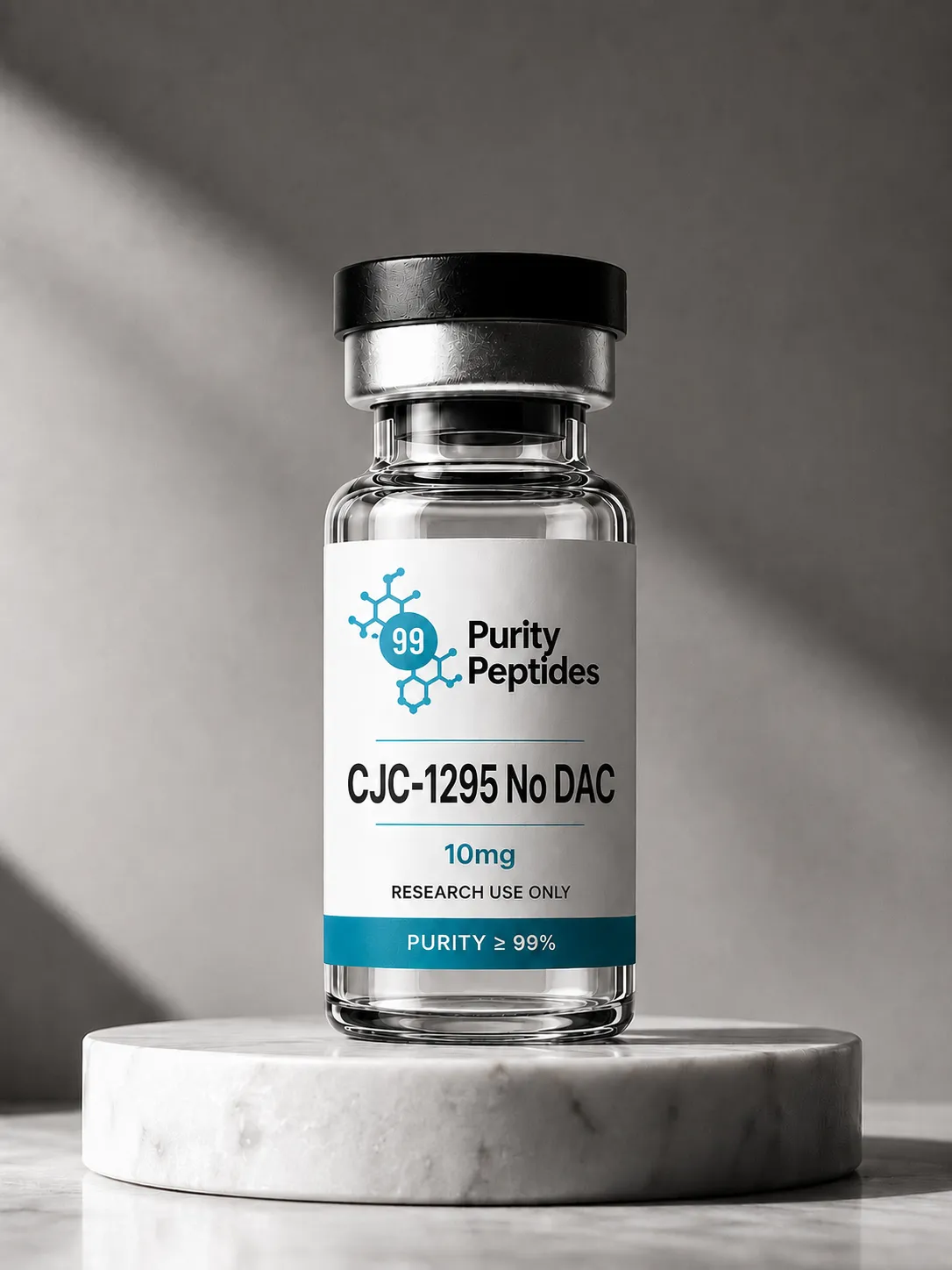
This guide breaks down exactly what separates CJC-1295 no DAC from CJC-1295 with DAC — the chemistry behind the Drug Affinity Complex, the half-life differences reported in the literature, how each variant is typically stored and handled in a laboratory setting, and what to actually check on a Certificate of Analysis before you buy. Whether you're comparing suppliers, designing a study, or just trying to understand what "DAC" even means, you'll find a straightforward, no-fluff answer below.
Compliance note: This article discusses CJC-1295 strictly in the context of laboratory research. All 99 Purity Peptides products are sold for research use only and are not intended for human consumption, diagnostic, or therapeutic use.
What Is CJC-1295? A Quick Primer for Researchers
CJC-1295 is a synthetic analog of growth hormone-releasing hormone (GHRH). It's built from a modified 29-amino acid sequence — commonly referred to as Modified GRF (1-29) — engineered to resist the rapid enzymatic breakdown that limits the activity of natural GHRH.
The confusing part for a lot of researchers is that "CJC-1295" isn't a single molecule. It's an umbrella name covering two distinct research variants that share the same GHRH-analog core but differ by one structural addition: a Drug Affinity Complex (DAC). That one addition changes almost everything about how the compound behaves.
Key takeaway: Whenever a supplier or paper simply says "CJC-1295" with no qualifier, confirm whether they mean the No DAC or with DAC variant. The two are not interchangeable in a study protocol.
What Is CJC-1295 No DAC?
CJC-1295 No DAC — sometimes labeled Modified GRF (1-29) — is the GHRH analog on its own, without the albumin-binding DAC tag attached. Because nothing is anchoring it to a long-lived carrier protein, it clears from a research model quickly, with a reported half-life in the range of about 30 minutes.
That short window is exactly why some study designs prefer it: it produces a sharper, pulse-like activity profile that more closely mirrors the body's natural GHRH release pattern, which matters for research questions built around pulsatility rather than sustained exposure.
Attributes researchers commonly reference for CJC-1295 No DAC:
- Modified GRF (1-29) backbone with no DAC modification
- Short-acting profile — approximate 30-minute reported half-life
- Supplied as a lyophilized (freeze-dried) powder for shelf stability
- Requires refrigerated or frozen storage prior to reconstitution
- Frequently used in comparative protocols alongside GHRP-class secretagogues such as ipamorelin
What Is CJC-1295 with DAC?
CJC-1295 with DAC starts from the same Modified GRF (1-29) backbone, then adds a Drug Affinity Complex — a small maleimidopropionic acid-based tag designed to bind covalently to lysine residues on serum albumin once introduced into a research model. Because albumin itself has a long circulating lifespan, anything chemically anchored to it clears far more slowly.
That single modification is why CJC-1295 with DAC is associated in the literature with a dramatically extended activity window compared to the No DAC version. The compound's original characterization work (Teichman et al., 2006) reported sustained effects lasting several days following a single administration in its study population — commonly cited as roughly six to eight days.
Attributes researchers commonly reference for CJC-1295 with DAC:
- Same Modified GRF (1-29) core sequence, plus the DAC modification
- Long-acting profile — a multi-day reported half-life
- Also supplied lyophilized for stability during shipping and storage
- Common in research designs studying sustained rather than pulsatile GH-axis stimulation
What Does DAC (Drug Affinity Complex) Actually Mean?
DAC stands for Drug Affinity Complex — a delivery technology, not a peptide in its own right. It was originally developed to extend the functional lifespan of short-acting peptides by chemically linking them to a reactive group capable of covalently bonding to circulating albumin.
Think of DAC as a molecular anchor. Once the peptide-DAC complex enters a research model, the DAC portion attaches to albumin already circulating in the bloodstream. Since albumin degrades slowly, the attached peptide effectively hitches a ride on it — remaining active in circulation for days rather than minutes.
This one mechanism accounts for essentially every practical difference between the two CJC-1295 variants discussed in this guide: half-life, dosing frequency referenced in study protocols, and how each is typically framed in published research.
CJC-1295 No DAC vs With DAC: Side-by-Side Comparison
The table below summarizes the core differences reported in peptide research literature and supplier documentation.
Attribute | CJC-1295 No DAC | CJC-1295 with DAC |
|---|---|---|
Core structure | Modified GRF (1-29) | Modified GRF (1-29) + DAC tag |
Albumin binding | None | Covalent binding to serum albumin |
Reported half-life | ~30 minutes | ~6–8 days |
Activity pattern | Pulse-like, short window | Sustained, long window |
Typical research use | Pulsatility-focused study designs | Sustained GH-axis exposure studies |
Storage form | Lyophilized powder | Lyophilized powder |
Common pairing | GHRP-class peptides (e.g., ipamorelin) | Standalone or comparative long-acting protocols |
Half-Life and Stability: Why the Two Variants Behave So Differently
Half-life differences between the two CJC-1295 variants come down entirely to what happens after introduction into a research model, not to any difference in the raw peptide's chemical stability on the shelf. Both variants are equally stable as lyophilized powders when stored correctly and reconstituted freshly for laboratory use.
The difference emerges once the DAC tag is or isn't present to bind serum albumin. Without it (No DAC), the peptide is metabolized and cleared through normal enzymatic pathways within roughly half an hour. With it, the peptide-albumin complex resists clearance because albumin itself is a long-lived transport protein — hence the multi-day activity window reported in the literature for CJC-1295 with DAC.
AI-answer summary: CJC-1295 No DAC has a short reported half-life (~30 minutes) because nothing keeps it in circulation. CJC-1295 with DAC has a long reported half-life (~6–8 days) because its DAC tag binds serum albumin, which degrades slowly.
Storage and Reconstitution Considerations for Laboratory Use
Both CJC-1295 variants arrive as lyophilized powder and should be handled with standard peptide laboratory practices. The guidance below is general laboratory-handling information, not instructions for human use.
Storage Before Reconstitution
- Store lyophilized vials in a freezer or refrigerator, away from light, per the supplier's Certificate of Analysis and product insert.
- Avoid temperature fluctuations — repeated warming and re-cooling of an unopened vial can accelerate peptide degradation over time.
- Keep vials in their original sealed packaging until they're ready to be used in a laboratory protocol.
After Reconstitution
- Reconstituted peptide solutions are less stable than lyophilized powder and should be kept refrigerated and used within the stability window noted on the product documentation.
- Minimize freeze-thaw cycles once a vial has been reconstituted for laboratory work.
- Use sterile technique and bacteriostatic or sterile water as specified by the supplier's handling documentation to reduce the risk of contamination.
Common mistake: Assuming CJC-1295 No DAC and with DAC have the same post-reconstitution stability window. Always check the specific Certificate of Analysis and storage guidance for the variant you're working with.
Purity, COA, and Third-Party Testing: What Serious Researchers Check
Peptide purity has a direct effect on the reliability of any research outcome, which is why experienced researchers treat a Certificate of Analysis (COA) as a non-negotiable part of sourcing CJC-1295 — no DAC or with DAC.
A trustworthy COA should independently verify:
- Purity percentage, ideally 99% or higher, confirmed via HPLC (High-Performance Liquid Chromatography)
- Molecular weight and identity confirmation, typically via mass spectrometry
- Batch or lot number matching the vial received
- Testing performed by an independent, third-party laboratory rather than the manufacturer alone
- A visible testing date, so researchers know the COA reflects the current batch
A Quick Purity Verification Checklist
- Request the COA for the specific batch/lot number on your vial, not a generic or outdated report.
- Confirm the lab that performed the testing is independent of the manufacturer.
- Check that HPLC purity and mass spectrometry identity results are both present.
- Compare the reported molecular weight against published reference data for CJC-1295 No DAC or with DAC.
- Keep a copy of every COA on file for your own research documentation and reproducibility records.
CJC-1295 vs Sermorelin vs Tesamorelin vs Ipamorelin
CJC-1295 is often discussed alongside other GHRH-axis peptides in comparative research. Here's how they generally differ at a structural and pharmacokinetic level, based on published characterizations.
Peptide | Class | Reported Half-Life | Typical Research Angle |
|---|---|---|---|
CJC-1295 No DAC | GHRH analog | ~30 minutes | Pulsatile GHRH stimulation |
CJC-1295 with DAC | GHRH analog + DAC | ~6–8 days | Sustained GHRH stimulation |
Sermorelin | GHRH analog (1-29 fragment) | ~10–20 minutes | Short-acting GHRH baseline studies |
Tesamorelin | Stabilized GHRH analog | ~25–40 minutes | Metabolic and visceral fat research |
Ipamorelin | GHRP (ghrelin receptor agonist) | ~2 hours | Often paired with CJC-1295 in combination protocols |
Because ipamorelin acts on a different receptor pathway (the ghrelin receptor) than CJC-1295 (the GHRH receptor), the two are frequently studied together in combination-protocol research rather than treated as substitutes for one another.
Choosing the Right CJC-1295 Variant for a Study Design
There's no universal "better" option between No DAC and with DAC — the right choice depends entirely on what a study is designed to measure. Use the checklist below to think through the decision.
- Does your protocol require a pulsatile, short-window activity profile, or a sustained, long-window one?
- Is your study design measuring acute response, or cumulative exposure over several days?
- Will the peptide be studied alone, or paired with a GHRP-class compound like ipamorelin?
- Do your reproducibility requirements call for a shorter-acting reference compound (No DAC) or a longer-acting one (with DAC)?
- Has your institution's protocol or IRB/IACUC documentation already specified one variant by name?
Key takeaway: Choose CJC-1295 No DAC for pulsatility-focused designs and shorter observation windows. Choose CJC-1295 with DAC for sustained-exposure designs and multi-day observation windows.
Common Mistakes Researchers Make When Comparing No DAC and With DAC
- Treating "CJC-1295" as one product and not confirming which variant a supplier or paper is actually referencing.
- Assuming both variants share an identical post-reconstitution stability window.
- Skipping the COA request because a listing already states a purity percentage.
- Comparing half-life figures from different sources without checking whether they used the same reference methodology.
- Storing reconstituted peptide at room temperature for convenience rather than following the supplier's cold-chain guidance.
Buying Research-Grade CJC-1295 in the USA: What to Look For
Because CJC-1295 (both variants) is sold as a research chemical rather than an approved pharmaceutical, supplier quality varies widely. A few checks go a long way toward reducing risk in your sourcing process.
- USA-based sourcing and domestic shipping, which typically means shorter transit times and more consistent cold-chain handling.
- A batch-specific Certificate of Analysis available on request or published on the product page.
- Clear labeling stating the product is for research use only, not for human consumption.
- Transparent contact information and a documented shipping/returns policy.
- Consistent third-party testing practices across the supplier's full catalog, not just a single flagship product.
Compliance reminder: All CJC-1295 No DAC and CJC-1295 with DAC products from 99 Purity Peptides are intended strictly for laboratory research use and are not for human consumption, diagnostic, or therapeutic application.
Key Takeaways
- CJC-1295 is an umbrella name for two distinct research variants: No DAC and with DAC — they are not interchangeable.
- CJC-1295 No DAC has a short reported half-life (~30 minutes) and produces a pulse-like activity profile.
- CJC-1295 with DAC binds serum albumin via its Drug Affinity Complex tag, extending its reported half-life to roughly 6–8 days.
- Storage, reconstitution, and stability windows should always be confirmed against the specific product's Certificate of Analysis.
- A trustworthy COA includes HPLC purity data, mass spectrometry identity confirmation, and independent third-party testing.
- The right variant for a study depends on whether the research design calls for pulsatile or sustained GHRH-axis activity.
Frequently Asked Questions
What is the difference between CJC-1295 No DAC and CJC-1295 with DAC?
CJC-1295 No DAC is the unmodified GHRH-analog peptide with a short reported half-life (~30 minutes). CJC-1295 with DAC has an added Drug Affinity Complex tag that binds serum albumin, extending its reported activity window to roughly 6–8 days.
What does "no DAC" mean in CJC-1295?
"No DAC" means the peptide does not carry the Drug Affinity Complex modification — it's the plain Modified GRF (1-29) sequence without an albumin-binding tag.
What does "with DAC" mean in CJC-1295?
"With DAC" means the peptide has been chemically modified with a Drug Affinity Complex tag that covalently binds to serum albumin, extending how long the compound remains active once introduced into a research model.
How should CJC-1295 No DAC be stored?
As a lyophilized powder, it should be kept refrigerated or frozen, away from light, and protected from repeated temperature fluctuations until it's reconstituted for laboratory use.
How should CJC-1295 with DAC be stored?
Storage guidance mirrors the No DAC variant: refrigerated or frozen in its lyophilized form, with minimal temperature cycling, following the specific Certificate of Analysis for the batch.
How long is CJC-1295 stable once reconstituted?
Stability windows vary by supplier and formulation, so always check the specific product's documentation. In general, reconstituted peptide solutions should be refrigerated and used within the window stated on the COA or product insert.
Is CJC-1295 No DAC or with DAC more stable long-term?
In lyophilized (unreconstituted) form, both variants are comparably stable when stored correctly. The major stability and activity difference appears after introduction into a research model, not on the shelf.
What is the molecular formula of CJC-1295?
CJC-1295 No DAC and CJC-1295 with DAC have different molecular formulas and weights because of the added DAC tag. Always reference the Certificate of Analysis for the exact formula and weight of the specific batch you're working with.
Does 99 Purity Peptides provide a Certificate of Analysis?
Yes. Each batch is intended to be accompanied by a Certificate of Analysis documenting purity and identity testing performed by an independent laboratory.
How is CJC-1295 purity verified?
Purity is typically verified through High-Performance Liquid Chromatography (HPLC) for purity percentage and mass spectrometry for molecular identity confirmation, performed by a third-party lab.
Is CJC-1295 sold as research-use-only?
Yes. CJC-1295 No DAC and CJC-1295 with DAC are sold strictly for laboratory research use and are not intended for human consumption, diagnostic, or therapeutic application.
Why do some suppliers only sell CJC-1295 No DAC?
Some suppliers specialize in short-acting research compounds that support pulsatility-focused study designs, or they may simply have chosen to carry one variant based on demand from their research customer base.
Why do some suppliers only sell CJC-1295 with DAC?
Other suppliers focus on sustained-exposure research applications, where the longer reported half-life of the DAC-modified variant is more relevant to the study designs their customers run.
Which CJC-1295 variant has a longer half-life?
CJC-1295 with DAC has the longer reported half-life — roughly 6–8 days — compared to CJC-1295 No DAC's reported half-life of about 30 minutes.
Can CJC-1295 No DAC be combined with other GHRH-axis peptides in research?
It is frequently studied alongside GHRP-class compounds like ipamorelin in comparative research protocols, since the two act on different receptor pathways (GHRH receptor vs. ghrelin receptor).