Last reviewed: October 2026. Every claim below was checked against its primary source on October 5, 2026. FDA lists change without notice, so recheck before relying on any row.
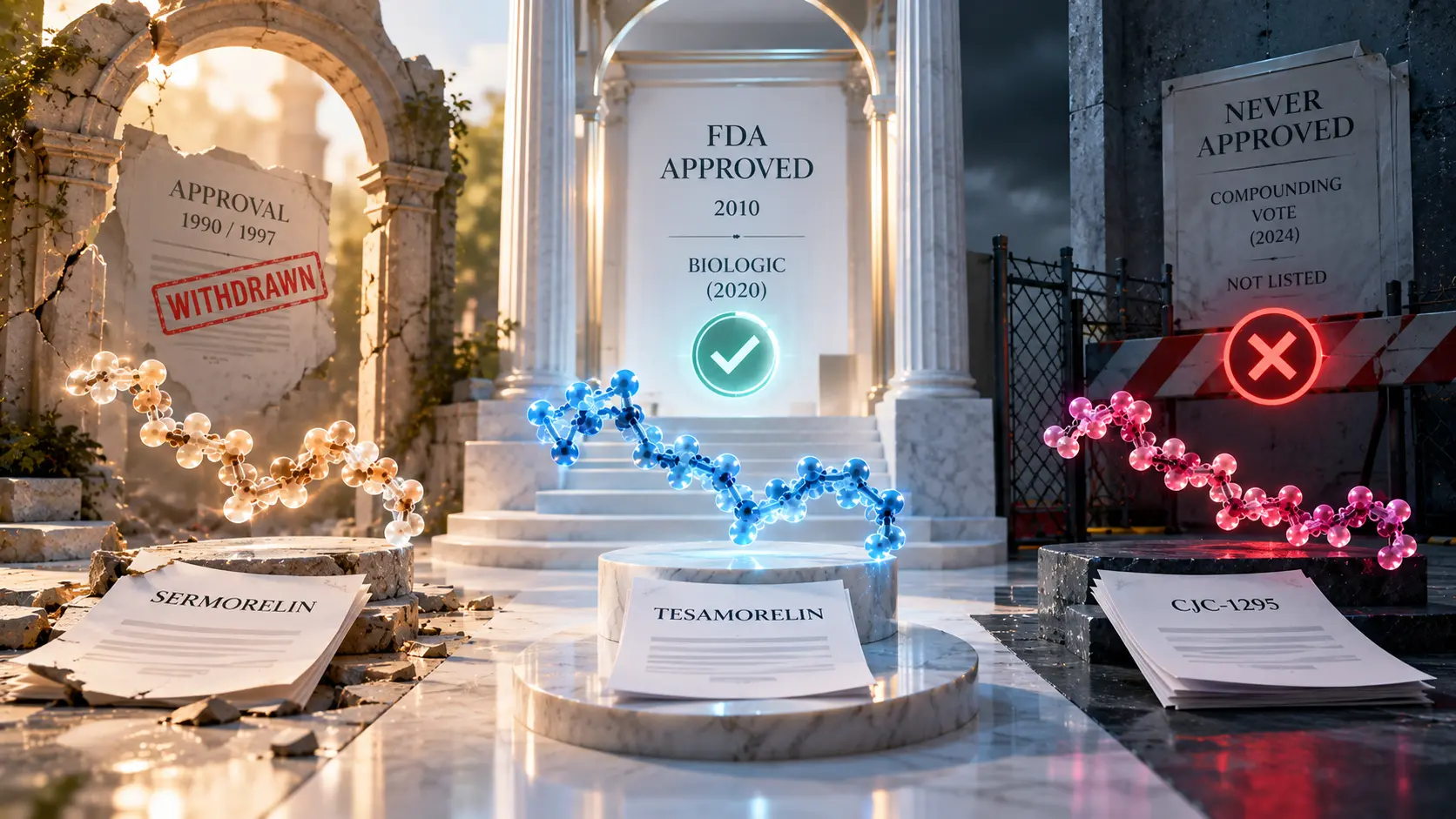
Quick Answer: Tesamorelin is FDA-approved, but since 2020 it has been regulated as a biologic, which puts compounded versions outside federal compounding exemptions. Sermorelin lost both FDA approvals in 2009, yet FDA still lists it as a component of an approved drug. CJC-1295 was never approved and was voted down for compounding. WADA bans all three.
Searches for sermorelin tesamorelin cjc-1295 legal status mostly land on clinic and vendor pages, and several of them get the law wrong. The three peptides also share a receptor and a drug class. However, they sit in three different places in US law. One is an approved prescription drug. Another was approved, then withdrawn. The third was never approved at all.
So this page compares them cell by cell against FDA, Federal Register, DEA and WADA records. It also grades every claim by how firmly the primary record supports it. For how the molecules differ chemically, see the site's sermorelin vs CJC-1295 comparison and its tesamorelin vs sermorelin comparison.
Key Takeaways
- Tesamorelin was approved by FDA on November 10, 2010, and its application was deemed a biologics license on March 23, 2020 [2].
- FDA says biologics with deemed licenses are not eligible for the 503A or 503B compounding exemptions [6].
- Sermorelin was approved twice, in 1990 and 1997, as Geref; FDA withdrew both approvals effective June 18, 2009, at the sponsor's request [1].
- A March 4, 2013 Federal Register notice found Geref was not withdrawn for safety or effectiveness. Its stated effect concerns generic approvals, not compounding [1].
- Sermorelin acetate appears in FDA's 503B Category 1, flagged as a component of an FDA-approved drug [8]. It is not in any 503A category [7].
- CJC-1295 was never approved, and an FDA advisory committee voted against adding any of its five forms to the 503A bulks list [11].
- None of the three is on the DEA controlled substance list dated August 27, 2026, and all three are prohibited at all times under WADA S2.2.4 [14][16].
Research Use Only. Compounds sold by 99 Purity Peptides are supplied strictly for in vitro laboratory research. They are not for human or veterinary consumption. Nothing on this page is medical, dosing or legal advice to any individual.
Sermorelin, Tesamorelin and CJC-1295: Legal Status Side by Side
The table below is the short version of this page. In addition, each cell carries its primary source, so you can check it yourself.
Compound | FDA approval status | US compounding status | DEA status | WADA 2026 status |
|---|---|---|---|---|
Sermorelin | Approved as Geref in 1990 and 1997; both approvals withdrawn effective June 18, 2009 [1] | In no 503A category [7]; in 503B Category 1 as a component of an approved drug [8] | Not listed [14] | Named in S2.2.4; prohibited at all times [16] |
Tesamorelin | Approved November 10, 2010; deemed a biologics license March 23, 2020; currently labeled [2][3] | Biologic, so not eligible for the 503A or 503B exemptions [5][6] | Not listed [14] | Named in S2.2.4; prohibited at all times [16] |
CJC-1295 | Never approved; FDA lists it among withdrawn compounding nominations [10] | Meets none of the 503A bulk-substance routes; committee voted against listing in 2024 [7][11][12] | Not listed [14] | Named in S2.2.4; prohibited at all times [16] |
Only the WADA column is identical. By contrast, every FDA cell differs, and the reasons differ too. The rest of this page explains each row.
Is Sermorelin Legal in the United States?
Sermorelin is not a controlled substance, and it has no FDA-approved product on the market today. Its regulatory history, though, is longer than most pages admit.
FDA approved sermorelin twice under the brand name Geref, both times for EMD Serono [1]. The first approval, NDA 19-863, came on December 28, 1990. That first product was a diagnostic for evaluating whether the pituitary can secrete growth hormone. The second, NDA 20-443, came on September 26, 1997. That product was indicated for children with idiopathic growth hormone deficiency and growth failure.
EMD Serono then discontinued both products in 2008 and asked FDA to withdraw the applications [1]. FDA announced the withdrawal in the Federal Register on May 19, 2009 (74 FR 23407). It took effect on June 18, 2009 [1].
What did the 2013 Federal Register notice actually do?
This is the sermorelin federal register question that ranking pages most often garble. The notice exists. On March 4, 2013, FDA published a determination at 78 FR 14095, Docket FDA-2012-P-1071 [1]. Specifically, it answered a citizen petition filed on October 12, 2012.
FDA concluded that neither Geref product was withdrawn from sale for reasons of safety or effectiveness. As a result, both stay on the Orange Book's Discontinued Drug Product List [1].
The notice then states its own consequence. The determination will allow FDA to approve abbreviated new drug applications (ANDAs), meaning generic versions that reference Geref, if they meet all other requirements [1]. That is the whole effect. The word "compounding" does not appear in the notice.
So pages that cite the 2013 notice as the legal basis for compounded sermorelin are citing the wrong document. The notice opened a generic-approval door. It did not address pharmacies.
Where does sermorelin sit in FDA's compounding lists?
Sermorelin's compounding position comes from a different rule. Section 503A lets a pharmacy compound from a bulk substance only through one of three routes [12]. The substance must meet a USP or National Formulary monograph, or be a component of an FDA-approved drug, or appear on FDA's 503A bulks list.
FDA's own lists point to the second route. Its 503B categories document, updated March 21, 2025, places sermorelin acetate in Category 1 with a double asterisk [8]. That mark designates substances that are components of FDA-approved drugs. By contrast, sermorelin appears in none of the three 503A categories in FDA's list dated May 14, 2026 [7]. It also does not appear on FDA's list of drugs withdrawn for safety or effectiveness, which would bar compounding outright [13].
We found no FDA document applying the component route to sermorelin under 503A specifically. For that reason, we grade this point Medium, not High. Furthermore, every other 503A condition still applies, including a valid prescription for an identified patient [12]. This page does not say any particular compounded product is lawful.
Is Tesamorelin FDA-Approved?
Yes. Tesamorelin is FDA-approved, and it is the only one of the three with a currently marketed approved product.
Drugs@FDA records the original approval on November 10, 2010, under application 022505, held by Theratechnologies [2]. The current labeling, revised in March 2025, covers EGRIFTA WR and refers to a second formulation, EGRIFTA SV [3]. Its approved indication is the reduction of excess abdominal fat in HIV-infected adults with lipodystrophy [3]. The label also states that the product is not indicated for weight loss management [3].
In other words, approval belongs to that product and that indication. It does not attach to the molecule wherever it is sold. Research material is not the approved product and carries no indication.
Why can't an approved drug be compounded?
This is the part almost every comparison page misses. Tesamorelin changed legal category in 2020.
First, the label describes tesamorelin as a 44-amino-acid growth hormone-releasing factor sequence, with a hexenoyl group attached [3]. Federal regulations define a protein as an amino acid polymer of more than 40 amino acids [5]. Proteins, in turn, fall under the biological product rules.
Accordingly, Drugs@FDA now lists tesamorelin under a Biologic License Application. It notes that the former NDA was deemed a BLA on March 23, 2020 [2]. That date was set by the Biologics Price Competition and Innovation Act [4].
FDA spelled out what the change meant for pharmacies. Its March 2020 notice to compounders says transitioning biological products are not eligible for the exemptions in sections 503A and 503B [6]. In short, tesamorelin's approval and its compounding status point in opposite directions. It is approved as a product, but bulk tesamorelin cannot be compounded within those exemptions.
Why Is CJC-1295 Not Compoundable Under 503A?
CJC-1295 fails all three statutory routes for a 503A bulk substance. The site's full CJC-1295 regulatory analysis sets out the dated record; this section gives the summary only.
First, CJC-1295 has no USP monograph and no approved product. FDA evaluated it for the 503A bulks list, a route the statute reserves for substances that are not components of approved drugs [12]. Second, it is not on that list. On December 4, 2024, FDA's Pharmacy Compounding Advisory Committee reviewed five forms and voted against all of them: 0-13, 1-12, 0-13, 0-13 and 0-13 [11].
Third, it holds no interim category. Its nominators withdrew, and FDA's Category 2 page now lists it under "nominated but withdrawn" [10]. That entry still records reported serious adverse events, including increased heart rate and a systemic vasodilatory reaction [10]. CJC-1295 is absent from all three 503A categories in the May 14, 2026 list [7] and from the 503B categories list [8].
Many ranking pages say a prescription changes this. It does not, because the barrier sits on the ingredient, not the paperwork. We found no final FDA rule formally excluding CJC-1295 from the bulks list, which is the one open procedural step.
Why Does One Drug Class Have Three Legal Positions?
Three regulatory switches decide where a GHRH analog lands. Each compound flipped them differently, which is why the class has no single legal answer.
Regulatory switch | Sermorelin | Tesamorelin | CJC-1295 |
|---|---|---|---|
Approval history | Approved 1990 and 1997; withdrawn 2009 [1] | Approved 2010; still marketed [2] | Never approved [10] |
Size and legal category | Peptide drug | Protein, so a biologic since 2020 [2][5] | Peptide drug |
Nomination history | Not nominated in any 503A category; 503B Category 1 [7][8] | Not in any 503A or 503B category [7][8] | 503A nomination withdrawn; committee voted against [10][11] |
Resulting compounding route | Possible via the approved-component route [8][12] | Outside the exemptions [6] | Outside the exemptions [11][12] |
How each switch works
Approval history comes first. An approved drug gives a pharmacy a recognized substance to work from. Sermorelin keeps that status in FDA's lists even after its products left the market, because its withdrawal was not for safety [1][8].
Molecule size matters next, and it explains tesamorelin. The 40-amino-acid line moved it from the drug side to the biologic side [5]. Consequently, the compounding exemptions stopped applying to it [6].
Nomination history decides the rest. A substance that is neither monographed nor an approved component needs a place on FDA's bulks list. CJC-1295 sought one and lost [11].
Finally, an approved drug and a compounded bulk substance are different legal objects. Approval covers a finished product, made by one sponsor, for a labeled use [3]. Compounding is an exemption for a pharmacist preparing a drug for one patient [12]. Neither status says anything about a research reagent.
Are These Peptides Banned by WADA?
Yes, all three. The WADA 2026 Prohibited List, in force from January 1, 2026, names them under S2.2.4, growth hormone releasing factors [16]. The entry gives CJC-1293, CJC-1295, sermorelin and tesamorelin as examples of GHRH analogues.
Moreover, every substance in class S2 is prohibited at all times, in and out of competition [16]. S2 substances are also non-Specified [16].
FDA approval makes no difference here. Approval only matters for S0, the class for substances with no current therapeutic approval [16]. Tesamorelin's approval therefore does not help an athlete, because S2.2.4 names it directly. For the rest of the peptide classes, see the site's WADA banned peptides guide.
Is Any of Them a Controlled Substance?
No. The DEA's alphabetical controlled substance list, dated August 27, 2026, contains no entry for sermorelin, tesamorelin or CJC-1295 [14]. Instead, their restrictions come from FDA drug law, not the Controlled Substances Act.
Which Online Claims Do Not Survive the Primary Record?
The claims below circulate on clinic, vendor and comparison pages. We describe each claim rather than the sites that make it.
Claim seen online | What the primary record shows | Source |
|---|---|---|
CJC-1295 can be legally prepared by a 503A or 503B pharmacy with a prescription | It meets none of the three 503A routes, holds no interim category, and was voted down for the bulks list | [7][11][12] |
Sermorelin is legal to compound because of a 2013 Federal Register determination | The notice concerns generic (ANDA) approvals and never mentions compounding | [1] |
Sermorelin is a Category 1 substance for both 503A and 503B | It is in 503B Category 1 only; it appears in no 503A category | [7][8] |
Sermorelin was first approved by FDA in 1997 | The first approval was December 28, 1990, for a diagnostic product; 1997 added the treatment product | [1] |
Because tesamorelin is FDA-approved, a pharmacy can compound it | Its application became a biologics license in 2020, and FDA says such biologics are not eligible for the exemptions | [2][6] |
An FDA-approved GHRH analog is allowed in sport | WADA names tesamorelin in S2.2.4, on the same line as CJC-1295 | [16] |
Geref was discontinued because of manufacturing problems | FDA's record says only that it was not withdrawn for safety or effectiveness; no business reason is given | [1] |
The second and fifth rows matter most. They are the two errors most likely to lead a reader to treat a compounded product as a lawful copy of an approved one.
How Confident Are These Answers?
The grading below follows the method used in the site's CJC-1295 legal status analysis.
Claim | Grade | Why |
|---|---|---|
Tesamorelin was approved on November 10, 2010 | High | Drugs@FDA action date [2] |
Tesamorelin has been regulated as a biologic since March 23, 2020 | High | Drugs@FDA states it directly [2] |
Compounded tesamorelin falls outside the 503A and 503B exemptions | High | Two FDA documents combine without interpretation [2][6] |
Sermorelin's approvals were withdrawn effective June 18, 2009 | High | Federal Register notice [1] |
The 2013 notice addresses generic approvals, not compounding | High | The notice's own text [1] |
No approved sermorelin product is marketed today | Medium | Withdrawals are documented, but we could not run a Drugs@FDA name search to rule out a later generic [1] |
Sermorelin can serve as a 503A bulk substance via the approved-component route | Medium | FDA flags it as an approved component in its 503B list; no FDA document applies this under 503A directly [8][12] |
CJC-1295 cannot be compounded under 503A | High | Statute, categories list and committee votes [7][11][12] |
FDA has issued a final rule excluding CJC-1295 | Medium (not found) | Committee voted against; no final rule located [11] |
None of the three is a controlled substance | High | DEA list dated August 27, 2026 [14] |
All three are banned in sport at all times | High | WADA 2026 List, S2.2.4 [16] |
The commercial reason Geref was discontinued | Low | No primary source states it [1] |
How we graded the evidence
"High" means a current primary source states the answer directly: an FDA page or database, the Federal Register, a statute, the DEA list or the WADA List. "Medium" means the primary record establishes the direction, but a formal step is outstanding or a direct statement is missing. "Low" means no primary source addresses the point. We used no vendor, clinic or comparison page as evidence.
How Can You Check a Compound's Regulatory Status Yourself?
You can repeat every check on this page in about 15 minutes, using free government sources.
- Drugs@FDA: search by application number (022505 for tesamorelin) to see approval dates, marketing status and any biologics transition [2].
- Federal Register: search the drug name to find withdrawal notices and safety determinations, such as 78 FR 14095 for sermorelin [1].
- FDA's 503A categories list: check Categories 1, 2 and 3 and note the document date [7].
- FDA's 503B categories list: look for the double asterisk that marks approved-drug components [8].
- FDA's Category 2 page: check both the active table and the "nominated but withdrawn" table [10].
- DEA's alphabetical list: confirm whether a substance is scheduled [14].
- WADA Prohibited List: read section S2.2.4 for this class [15][16].
Above all, record the date of each check. Most of these lists are revised without announcement.
What Does "Research Use Only" Mean Legally?
Research Use Only describes the seller's intended use; it is not a legal status for peptides. The phrase comes from a labeling rule for in vitro diagnostic products, 21 CFR 809.10(c) [18]. Regulators instead judge "objective intent" from labeling, advertising, statements and the circumstances of distribution, under 21 CFR 201.128 [17]. The site's guide to whether research peptides are legal covers this in full.
What This Page Does Not Establish
This page reports regulatory facts. It is not legal advice, and it does not resolve any individual's situation.
It does not say whether any particular sale, purchase, prescription or compounded product is lawful. Likewise, state pharmacy law is outside its scope. Nor does it describe how to obtain any of these compounds, and it gives no dosing or administration information.
It also does not establish whether any of them works for any purpose. Tesamorelin's approval covers one labeled indication only [3]. Finally, two points remain open: FDA has not applied the approved-component route to sermorelin under 503A in writing, and no final rule on CJC-1295 has issued. Verification date: October 5, 2026.
Where to Go From Here
For the full CJC-1295 record, including the committee vote tables, read the CJC-1295 legal status analysis. For receptor-level differences, the two pairwise comparisons linked above cover mechanism in detail.
Laboratories comparing these three compounds can review the GHRH Analog Comparator research set. It supplies sermorelin, CJC-1295 No DAC and tesamorelin as lyophilized research materials, each with lot documentation. Before use, check each certificate for identity by mass spectrometry as well as purity; the site's guide to reading a certificate of analysis explains what each field shows.
References
- U.S. Food and Drug Administration. Determination That GEREF (Sermorelin Acetate) Injection, 0.5 Milligrams Base/Vial and 1.0 Milligrams Base/Vial, and GEREF (Sermorelin Acetate) Injection, 0.05 Milligrams Base/Amp, Were Not Withdrawn From Sale for Reasons of Safety or Effectiveness. Federal Register, 78 FR 14095, March 4, 2013. Docket No. FDA-2012-P-1071. https://www.federalregister.gov/documents/2013/03/04/2013-04827/determination-that-geref-sermorelin-acetate-injection-05-milligrams-basevial-and-10-milligrams (official PDF: https://www.govinfo.gov/content/pkg/FR-2013-03-04/pdf/2013-04827.pdf)
- U.S. Food and Drug Administration. Drugs@FDA: Biologic License Application 022505 (Theratechnologies). https://www.accessdata.fda.gov/scripts/cder/daf/index.cfm?event=overview.process&ApplNo=022505
- U.S. Food and Drug Administration. EGRIFTA WR (tesamorelin) for injection, Prescribing Information. Revised March 2025. https://www.accessdata.fda.gov/drugsatfda_docs/label/2025/022505s020lbl.pdf
- U.S. Food and Drug Administration. Drugs@FDA Frequently Asked Questions, question 13 (applications deemed to be BLAs on March 23, 2020). https://www.accessdata.fda.gov/scripts/cder/daf/index.cfm?event=faq.page
- 21 C.F.R. § 600.3(h)(6). Definition of "protein." https://www.ecfr.gov/current/title-21/chapter-I/subchapter-F/part-600/subpart-A/section-600.3
- U.S. Food and Drug Administration. Notice to Compounders: Changes that affect compounding as of March 23, 2020. Content current as of March 5, 2020. https://www.fda.gov/drugs/human-drug-compounding/notice-compounders-changes-affect-compounding-march-23-2020
- U.S. Food and Drug Administration. Bulk Drug Substances Nominated for Use in Compounding Under Section 503A of the FD&C Act (categories list). Updated May 14, 2026. https://www.fda.gov/media/94155/download
- U.S. Food and Drug Administration. Bulk Drug Substances Nominated for Use in Compounding Under Section 503B of the FD&C Act (categories list). Updated March 21, 2025. https://www.fda.gov/media/94164/download
- U.S. Food and Drug Administration. Bulk Drug Substances Used in Compounding Under Section 503B of the FD&C Act. Content current as of January 7, 2025. https://www.fda.gov/drugs/human-drug-compounding/bulk-drug-substances-used-compounding-under-section-503b-fdc-act
- U.S. Food and Drug Administration. Certain Bulk Drug Substances for Use in Compounding that May Present Significant Safety Risks. Content current as of April 22, 2026. https://www.fda.gov/drugs/human-drug-compounding/certain-bulk-drug-substances-use-compounding-may-present-significant-safety-risks
- U.S. Food and Drug Administration. Final Summary Minutes of the Pharmacy Compounding Advisory Committee Meeting, December 4, 2024. https://www.fda.gov/media/185642/download
- 21 U.S.C. § 353a. Pharmacy compounding (FD&C Act section 503A). https://www.law.cornell.edu/uscode/text/21/353a
- 21 C.F.R. § 216.24. Drug products withdrawn or removed from the market for reasons of safety or effectiveness. https://www.ecfr.gov/current/title-21/chapter-I/subchapter-C/part-216/subpart-B/section-216.24
- U.S. Drug Enforcement Administration, Diversion Control Division. Controlled Substances: Alphabetical Order. Dated August 27, 2026. https://www.deadiversion.usdoj.gov/schedules/orangebook/c_cs_alpha.pdf
- World Anti-Doping Agency. The 2026 Prohibited List. Effective January 1, 2026. https://www.wada-ama.org/en/prohibited-list
- Tractatenblad van het Koninkrijk der Nederlanden 2026, nr. 25. Official publication of the 2026 Prohibited List, English text (sections S0, S2, S2.2.4). https://zoek.officielebekendmakingen.nl/trb-2026-25.html
- 21 C.F.R. § 201.128. Meaning of "intended uses." https://www.ecfr.gov/current/title-21/chapter-I/subchapter-C/part-201/subpart-D/section-201.128
- 21 C.F.R. § 809.10. Labeling for in vitro diagnostic products. https://www.ecfr.gov/current/title-21/chapter-I/subchapter-H/part-809/subpart-B/section-809.10
Frequently Asked Questions
Is sermorelin legal to buy in the United States?
Sermorelin is not a federally controlled substance, so it is not a scheduling offense to hold it as a laboratory reagent. However, no FDA-approved sermorelin product is marketed today, because both Geref approvals were withdrawn in 2009. Whether any particular sale or use is lawful depends on intended use and state law, which a general page cannot settle.
Is tesamorelin FDA-approved?
Yes. FDA approved tesamorelin on November 10, 2010, and Drugs@FDA lists its current labeling, revised in March 2025. The approval covers a specific product and one labeled indication. On March 23, 2020, its application was deemed a biologics license because tesamorelin has more than 40 amino acids. Research-grade tesamorelin is not the approved product.
Is CJC-1295 FDA-approved?
No. CJC-1295 has never received FDA approval for any use. FDA evaluated it for the 503A bulks list, a route reserved for substances that are not part of an approved drug. Its Category 2 entry, now in a withdrawn-nominations table, still notes reported serious adverse events and limited clinical data. The full record is in the site's CJC-1295 legal analysis.
Can a compounding pharmacy legally make CJC-1295?
Not within the federal compounding exemptions as of October 2026. CJC-1295 has no monograph, is not part of an approved drug, and is not on the 503A bulks list or in any interim category. FDA's advisory committee voted against listing all five forms in December 2024. A prescription does not fix an ingredient that falls outside the statute.
Is sermorelin the same as tesamorelin?
No. Both act at the growth hormone-releasing hormone receptor, but they are different molecules with different legal positions. Sermorelin is the 29-residue GHRH fragment, while tesamorelin is the full 44-residue sequence with an added hexenoyl group. That size difference made tesamorelin a biologic in 2020. The site's tesamorelin vs sermorelin page covers the chemistry.
Why do these three GHRH analogs have different legal status?
They differ on three regulatory switches: approval history, molecule size and compounding nomination history. Tesamorelin is approved but became a biologic in 2020. Sermorelin was approved, then withdrawn for non-safety reasons, so FDA still treats it as an approved-drug component. CJC-1295 was never approved and lost its bid for the 503A bulks list.
Are these peptides banned by WADA?
Yes. The WADA 2026 Prohibited List names CJC-1293, CJC-1295, sermorelin and tesamorelin in section S2.2.4 as growth hormone-releasing hormone analogues. Every S2 substance is prohibited at all times, in and out of competition. FDA approval does not change this, because approval matters only for WADA's S0 class of non-approved substances.
What does FDA Category 2 mean?
Category 2 is FDA's interim list of nominated bulk substances that raise significant safety risks. FDA does not extend its compounding enforcement discretion to them. Substances whose nominations are withdrawn move to a separate "nominated but withdrawn" table, where FDA keeps the safety summary. CJC-1295 sits in that withdrawn table, not in active Category 2.
Did CJC-1295 leave Category 2 in 2026?
No. CJC-1295's nominations were withdrawn in 2024, before FDA's December 2024 advisory committee review. The April 15, 2026 action covered other peptides. FDA's 503A categories list dated May 14, 2026 shows CJC-1295 in none of the three categories. The site's CJC-1295 legal analysis gives the dated sequence and sources.
Is a prescription enough to make a GHRH analog legal?
Not on its own. For tesamorelin, a prescription supports dispensing the approved product, but it cannot make compounded tesamorelin eligible for the exemptions. For CJC-1295, no prescription helps, because the ingredient fails the 503A conditions. For sermorelin, any compounded route depends on every 503A condition, of which a prescription is only one.
Is CJC-1295 a controlled substance?
No. CJC-1295 does not appear on the DEA's alphabetical controlled substance list dated August 27, 2026. Neither do sermorelin or tesamorelin. Their restrictions come from FDA drug law instead: approval requirements, the compounding statutes and, for tesamorelin, biologics licensing. Being unscheduled does not make any of them approved for human use.
What is a 503A bulks list?
The 503A bulks list is FDA's regulatory list of bulk substances that pharmacies may compound from when no monograph exists and the substance is not part of an approved drug. It is one of three statutory routes in section 503A. Nominated substances wait in interim categories while FDA evaluates them, and committee votes are non-binding.
How can I check a compound's regulatory status myself?
Start with Drugs@FDA for approval history, then search the Federal Register for withdrawal notices. Next, check FDA's 503A and 503B categories lists and its Category 2 page, noting each document's date. Finally, confirm scheduling on the DEA's alphabetical list and sporting status in section S2.2.4 of the current WADA List.
What does "Research Use Only" mean legally?
Research Use Only states the seller's intended use. The phrase comes from an FDA labeling rule for in vitro diagnostic products, 21 CFR 809.10(c), not from any peptide regulation. Under 21 CFR 201.128, regulators judge objective intent from labeling, advertising, statements and distribution circumstances. Website content can therefore outweigh a vial disclaimer.
Does sermorelin have FDA approval today?
No marketed sermorelin product holds FDA approval today. FDA withdrew both Geref approvals effective June 18, 2009, after EMD Serono discontinued them. In 2013, FDA found the withdrawal was not for safety or effectiveness, which allows a generic referencing Geref to be approved. We found no approved generic, but could not run a full database search.