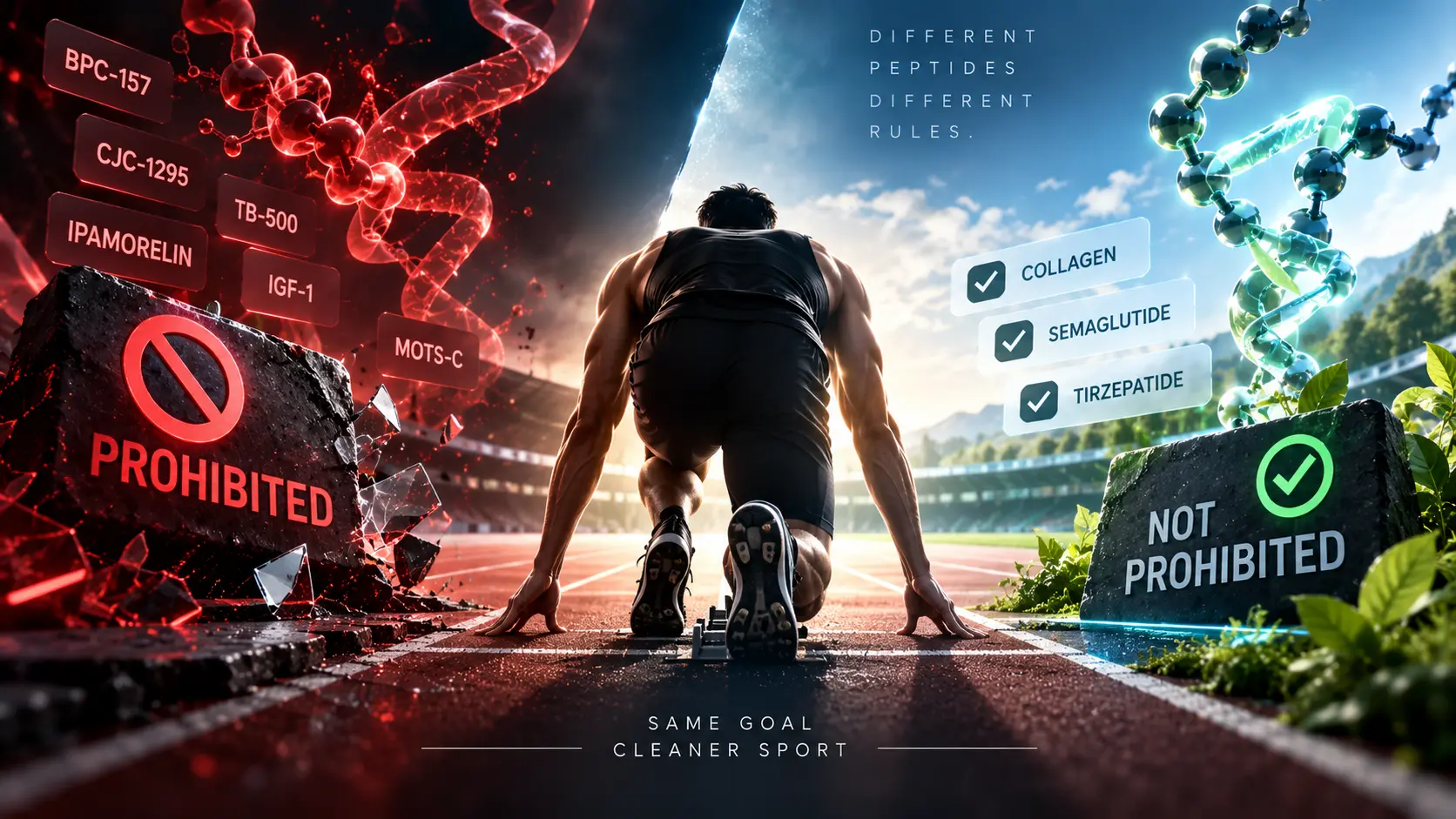
Last reviewed: September 2026. This page reflects the 2026 WADA Prohibited List, in force from 1 January 2026.
Quick Answer: Most WADA banned peptides sit in section S2 of the 2026 Prohibited List, which prohibits them at all times, in and out of competition. That includes growth hormone releasing factors such as CJC-1295, ipamorelin and sermorelin, growth hormone fragments such as AOD-9604, and growth factors such as IGF-1, MGF and TB-500. BPC-157 is named separately in S0 and MOTS-c in S4.4.1, and both are also banned year-round, while collagen peptides are not prohibited. For any individual decision, check Global DRO or your anti-doping organisation. [1]
Key Takeaways
- The 2026 WADA Prohibited List took effect on 1 January 2026, and WADA replaces it with a new edition every year [1].
- BPC-157 is printed by name in S0 (Non-Approved Substances), and USADA reports it was added there on the 2022 List [1][2].
- MOTS-c is printed by name in S4.4.1 as an AMPK activator, and S4.4 substances are non-Specified [1].
- Every substance in S2 is non-Specified, while every substance in S0, including BPC-157, is Specified [1].
- No peptide on the List is "in-competition only": S0, S2 and S4 are all prohibited at all times [1].
- hCG, LH, GnRH and kisspeptin are prohibited under S2.2.1, a subsection the List limits to male athletes [1].
- Markers of semaglutide and tirzepatide are monitored in and out of competition in 2026, but neither drug is prohibited [3][4].
- Collagen peptides are not prohibited, according to USADA [5].
Research Use Only. 99 Purity Peptides supplies compounds strictly for laboratory research. Nothing we sell is intended for human or veterinary use. This page is a regulatory reference, not medical advice, and nothing on it is advice to any athlete about what they can take. Athletes should confirm every substance with Global DRO and their anti-doping organisation.
Are Peptides Banned in Sport?
Most of the peptides athletes ask about are banned, but they are banned for different reasons. The 2026 List reaches them through three sections [1], and within S2 they are spread across five separate subsections. S0 covers unapproved substances, S2 covers peptide hormones and growth factors, and S4 covers metabolic modulators. Within S2, they are spread across four separate subsections.
"Peptide" is a chemistry word, not a regulatory category. In fact, the List never prohibits peptides as a class. Instead, it prohibits mechanisms, such as releasing growth hormone or activating AMPK, and then prints example compounds for each one. USADA makes the same point in its cosmetics guidance. Most peptides are not prohibited; only those that are, or could be, performance enhancing are [6].
So the useful question is never "is it a peptide?" Instead, ask "which section, if any, captures it?" The rest of this page answers that for 27 compounds. It then covers the ones the List leaves out.
Which WADA Banned Peptides Are on the 2026 List?
Every row was checked against the 2026 List text, section by section [1]. That includes the Specified designation printed at the head of each section.
Compound | 2026 List section | Prohibited when | Specified status | How the 2026 List names it | Status grade |
|---|---|---|---|---|---|
BPC-157 | S0 Non-approved substances | At all times | Specified | Named example: BPC-157 | A |
Thymosin beta-4 | S2.3 Growth factors | At all times | Non-Specified | Thymosin-β4 and its derivatives | A |
TB-500 | S2.3 Growth factors | At all times | Non-Specified | Named as a thymosin-β4 derivative | A |
IGF-1 | S2.3 Growth factors | At all times | Non-Specified | Insulin-like growth factor 1 (IGF-1, mecasermin) | A |
IGF-1 LR3 | S2.3 Growth factors | At all times | Non-Specified | Not printed; covered as an IGF-1 analogue | B |
MGF | S2.3 Growth factors | At all times | Non-Specified | Mechano growth factors (MGFs) | A |
Somatropin (growth hormone) | S2.2.3 | At all times | Non-Specified | Growth hormone (GH) is named as a class; somatropin is recombinant human GH | B |
AOD-9604 | S2.2.3 | At all times | Non-Specified | Growth hormone fragment, named | A |
HGH fragment 176-191 | S2.2.3 | At all times | Non-Specified | Growth hormone fragment: hGH 176-191 | A |
CJC-1295 | S2.2.4 | At all times | Non-Specified | GHRH analogue, named | A |
CJC-1293 | S2.2.4 | At all times | Non-Specified | GHRH analogue, named | A |
Sermorelin | S2.2.4 | At all times | Non-Specified | GHRH analogue, named | A |
Tesamorelin | S2.2.4 | At all times | Non-Specified | GHRH analogue, named | A |
Ipamorelin | S2.2.4 | At all times | Non-Specified | Growth hormone secretagogue, named | A |
GHRP-1 to GHRP-6 | S2.2.4 | At all times | Non-Specified | GH-releasing peptides; GHRP-2 also as pralmorelin | A |
Hexarelin | S2.2.4 | At all times | Non-Specified | Printed as examorelin (hexarelin) | A |
MK-677 | S2.2.4 | At all times | Non-Specified | Secretagogue mimetic: ibutamoren (MK-677) | A |
Anamorelin | S2.2.4 | At all times | Non-Specified | Growth hormone secretagogue, named | A |
Macimorelin | S2.2.4 | At all times | Non-Specified | Growth hormone secretagogue, named | A |
Ghrelin | S2.2.4 | At all times | Non-Specified | Printed as lenomorelin (ghrelin) | A |
MOTS-c | S4.4.1 Metabolic modulators | At all times | Non-Specified | AMPK activator, named in full | A |
Kisspeptin | S2.2.1 | At all times, male athletes | Non-Specified | Kisspeptin and its agonist analogues | A |
hCG | S2.2.1 | At all times, male athletes | Non-Specified | Chorionic gonadotrophin (CG) | A |
LH | S2.2.1 | At all times, male athletes | Non-Specified | Luteinizing hormone (LH) | A |
Gonadorelin (GnRH) | S2.2.1 | At all times, male athletes | Non-Specified | GnRH, gonadorelin and agonist analogues | A |
EPO | S2.1.1 | At all times | Non-Specified | Erythropoietins (EPO) | A |
Collagen peptides | Not on the List | Not prohibited | Not applicable | Not listed; USADA confirms status [5] | Not prohibited |
Three details in that table do more work than they appear to. First, several compounds are printed under names athletes rarely use: hexarelin appears as examorelin, ghrelin as lenomorelin and MK-677 as ibutamoren. A search for the street name alone can miss the entry. Second, IGF-1 LR3 is never printed; it is caught because S2.3 covers IGF-1 together with its analogues. Third, S2.2.1 is limited to male athletes in its own title [1]. So the four compounds in it carry a condition the others do not.
MK-677 is not a peptide at all. WADA files it with the peptide secretagogues anyway, because the List sorts by effect rather than chemistry [1].
How We Graded Status Certainty
Grade A means the compound, or an exact synonym, is printed in the 2026 List. Grade B means it is not printed but falls inside a class term, such as the analogues of a named hormone. Grade C means neither applies. In that case, status turns on a catch-all clause and needs a ruling. In practice, Grade B is still a prohibition. Grade C, however, is an open question rather than an answer.
How Does WADA Classify Peptides?
WADA classifies peptides by what they do, and seven subsections of the 2026 List carry almost all of the peptide entries [1].
Section | What it captures | Peptide examples printed there | Specified status | Catch-all reach |
|---|---|---|---|---|
S0 Non-approved substances | Pharmacological substances not covered elsewhere and with no current human-therapeutic approval from any government health authority | BPC-157 | Specified | Any unnamed substance meeting that test |
S2.1 Erythropoietins | Erythropoietin receptor agonists and other agents affecting erythropoiesis | EPO, darbepoetins, peginesatide | Non-Specified | "Including, but not limited to" |
S2.2.1 Testosterone-stimulating peptides in males | Peptides that drive testosterone production | CG, LH, gonadorelin, kisspeptin | Non-Specified | Agonist analogues included |
S2.2.3 Growth hormone | Growth hormone, its analogues and its fragments | Somapacitan, AOD-9604, hGH 176-191 | Non-Specified | Unnamed analogues and fragments |
S2.2.4 Growth hormone releasing factors | GHRH analogues, secretagogues and GHRPs | CJC-1295, sermorelin, ipamorelin, GHRP-6 | Non-Specified | Unnamed releasing factors |
S2.3 Growth factors and modulators | IGF-1, MGFs, FGFs, HGF, PDGF, VEGF, thymosin-β4 | IGF-1, TB-500 | Non-Specified | Other growth factors with listed tissue effects |
S4.4.1 Metabolic modulators | AMPK activators, PPARδ agonists, Rev-erbα agonists | MOTS-c, alongside AICAR and GW1516 | Non-Specified | Any activator of AMPK |
The sentence that matters most is not in any row. S2 opens by prohibiting the substances it lists and also any others with similar chemical structure or similar biological effect [1]. Consequently, a new growth hormone secretagogue does not need to be named to be banned.
S2.2.2 also belongs on the radar, since it covers corticotrophins such as corticorelin and tetracosactide [1]. S1, by contrast, holds anabolic steroids and SARMs rather than peptides. For that comparison, see how peptides differ from anabolic steroids.
Is BPC-157 Banned?
Yes. BPC-157 is named in S0 of the 2026 List, which says the class "covers many different substances including but not limited to BPC-157" [1]. As a result, it is prohibited at all times, and it is a Specified Substance [1].
Pages describing BPC-157 as an unnamed grey area are wrong, yet the claim still circulates. USADA reports that the peptide was added to S0 on the 2022 List [2]. Moreover, pages that infer a ban under S2.3 get a second fact wrong. S2 substances are non-Specified, whereas S0 substances are Specified [1].
The error also reaches the peer-reviewed literature. A 2025 review in Pharmaceuticals stated that BPC-157 "is not currently listed as banned by the WADA" [7]. The 2026 List text contradicts that directly.
It lands in S0 because it has no approval anywhere. USADA states that no health authority, including the FDA, has approved it for human clinical use [8]. For the same reason, USADA says there is no basis for granting a therapeutic use exemption for it [2]. Human evidence is also thin. A Phase I safety and pharmacokinetic trial in 42 healthy volunteers (NCT02637284) started in 2015, but its results submission was cancelled in 2016 [7]. Meanwhile, most published efficacy work comes from rodent models [7].
Sporting status and legal status are separate questions. Whether BPC-157 can be sold or compounded in the US is an FDA matter. We cover it in whether BPC-157 is legal and in the July 2026 FDA advisory committee peptide vote. S0 turns on approval for human therapeutic use. Whether any future compounding decision would count as approval for S0 purposes is a question for WADA, and nobody should assume the answer.
Is MOTS-c Banned?
Yes. MOTS-c is named in S4.4.1 of the 2026 List, under activators of AMP-activated protein kinase (AMPK) [1]. The List prints it in full as the mitochondrial open reading frame of the 12S rRNA-c. It shares that entry with AICAR and BAM15, and every S4.4 substance is non-Specified [1].
Two mistakes are worth ruling out. Some references leave MOTS-c out entirely. Others file it under S2 simply because it is a peptide. Here, the section matters for credibility more than outcome. S2 and S4.4 are both non-Specified and prohibited at all times, so the practical status is identical. Still, a reference that cites the wrong section for MOTS-c cannot be trusted on BPC-157, where the section changes the Specified status.
The wording is also broader than one compound. S4.4.1 defines the class as activators of AMPK and gives examples, so an unnamed AMPK activator falls inside the same class [1].
What Does "Specified Substance" Actually Mean?
A Specified Substance is not a permitted or minor substance. Under Article 4.2.2 of the World Anti-Doping Code, every prohibited substance is Specified unless the List says otherwise. The Code's comment adds that Specified substances are no less important or dangerous [1]. They are simply more likely to have been used for a non-performance purpose.
What the label changes is who must prove intent. Under Article 10.2.1 of the current Code, a non-Specified violation carries four years of ineligibility unless the athlete establishes it was not intentional. For a Specified substance, by contrast, four years applies when the anti-doping organisation establishes intent [10]. The revised 2027 Code also adds a three-year tier for certain non-Specified cases [11].
Question | Specified (S0, e.g. BPC-157) | Non-Specified (S2 and S4.4, e.g. TB-500, CJC-1295, MOTS-c) |
|---|---|---|
Prohibited in and out of competition? | Yes | Yes |
Strict liability applies? | Yes | Yes |
Can the violation carry four years? | Yes | Yes |
Who must address intent for the four-year period? | The anti-doping organisation must establish intent | The athlete must establish a lack of intent to avoid it |
Realistic TUE route? | USADA says none exists for BPC-157 | Only for an approved medicine meeting all TUE criteria |
Our reading is simple: "Specified" describes how a case is argued, not how serious the substance is. Treating BPC-157 as the safer choice because of its label inverts what the Code says.
Are Any of These Only Banned In Competition?
No. S0, S1, S2 and S4 all sit under the 2026 List's heading for substances prohibited at all times [1]. Each section also repeats that its contents are prohibited in and out of competition. The in-competition-only classes are S6 stimulants, S7 narcotics, S8 cannabinoids and S9 glucocorticoids [1].
None of the compounds in the status table falls into those four classes. The confusion probably spreads from stimulants and glucocorticoids, which athletes do meet as in-competition-only substances. It does not carry over. For an S0, S2 or S4 substance, the competition calendar has no bearing on status.
Are Collagen Peptides Banned?
No. USADA states that collagen is not prohibited by WADA. In its words, "the substance collagen is not prohibited by the World Anti-Doping Agency (WADA)" [5]. Because collagen is not prohibited, USADA also says a TUE is unnecessary [5].
The confusion is purely linguistic. Dietary collagen is a protein. USADA notes that once eaten, it is broken down in the gut rather than delivered intact [5]. Nothing in S2 targets it.
There is one real caveat. USADA does not evaluate or approve dietary supplements [5], and Global DRO does not cover supplements or foods [12]. Therefore "collagen is not prohibited" is a statement about the substance. It is not a guarantee about the contents of any particular product, which is a quality question the List cannot answer.
What Is the Monitoring Program, and Why Are GLP-1 Markers On It?
The Monitoring Program is a separate WADA list of substances tracked to detect patterns of misuse, and it imposes no sanctions [4]. For 2026, WADA adjusted its semaglutide monitoring and added tirzepatide, so markers of both are now monitored in and out of competition [3].
The 2026 program covers other items too, including ecdysterone, hypoxen, and GnRH analogues in females under 18 [4]. That last entry is worth a second look. GnRH analogues are already prohibited for males under S2.2.1 [1]. Meanwhile, the Monitoring Program gathers data on the other side of that line for younger athletes.
Feature | Prohibited List | Monitoring Program |
|---|---|---|
Consequence of a finding | Can be an anti-doping rule violation | No violation and no sanction |
Purpose | Defines what is banned | Detects patterns of misuse |
Peptide-relevant 2026 entries | BPC-157, TB-500, CJC-1295, MOTS-c and others | Semaglutide and tirzepatide markers; GnRH analogues in females under 18 |
TUE needed to use? | Yes, for a prohibited substance | No |
Revision cycle | Annual, effective 1 January | Annual, published alongside the List |
Monitoring is data collection, not a waiting room with a fixed exit. A monitored drug may later be listed, or it may not, and nobody outside WADA can say which. In short, GLP-1 drugs are not prohibited in 2026, and anyone relying on that should recheck when the next List is published.
What About Peptides That Are Not Named?
Not named does not mean permitted. GHK-Cu, epitalon, semax, selank, KPV, thymalin, thymosin alpha-1, PT-141 (bremelanotide) and melanotan II do not appear anywhere in the 2026 List text [1]. Even so, two clauses can still reach an unnamed compound. S0 covers any pharmacological substance with no current human-therapeutic approval [1]. Meanwhile, S2 extends to substances with a similar structure or biological effect [1].
Approval status therefore changes the analysis. For example, the FDA approved bremelanotide as Vyleesi in June 2019 [13], so S0 is not the obvious route for it. Similarly, thymosin alpha-1 is approved in several countries [14]. A compound with no approval anywhere has no such exit, and some of the compounds above are in exactly that position.
Not-named compound | Printed in 2026 List? | Clause that could still apply | Status grade | Who decides |
|---|---|---|---|---|
GHK-Cu | No | S0 approval test; S2.3 growth factor modulator wording is arguable | C | Anti-doping organisation |
Epitalon | No | S0 approval test | C | Anti-doping organisation |
Semax | No | S0 approval test, which depends on approval status | C | Anti-doping organisation |
Selank | No | S0 approval test, which depends on approval status | C | Anti-doping organisation |
KPV | No | S0 approval test | C | Anti-doping organisation |
Thymalin | No | S0 approval test, which depends on approval status | C | Anti-doping organisation |
Thymosin alpha-1 | No | Approved in several countries [14], so S0 is less likely; no obvious S2 class | C | Anti-doping organisation |
PT-141 (bremelanotide) | No | FDA-approved in 2019 [13], so S0 is less likely; S2 fit unclear | C | Anti-doping organisation |
Melanotan II | No | S0 approval test | C | Anti-doping organisation |
In our view, Grade C compounds are where athletes get caught out, because "not on the list" sounds like a clearance. It is not one. Nor does this page tell anyone that these compounds are safe to use in sport.
Where Can You Check a Specific Substance?
Start with Global DRO, and go to your anti-doping organisation whenever Global DRO cannot answer. Global DRO reports WADA-List status for pharmaceutical products sold in Australia, Canada, Japan, New Zealand, Switzerland, the UK and the US [15]. However, it does not cover supplements, cosmetics or foods [12]. Compounds sold outside the medicine system may not appear at all. A missing result is not a permitted result.
In the US, USADA answers substance questions through its Drug Reference Line at drugreference@usada.org [16]. Notably, USADA also warns athletes away from peptide hormones sold online as research chemicals or for research use only [16]. Other national anti-doping organisations run equivalent services.
A therapeutic use exemption (TUE) is the only route to using a prohibited substance legitimately. To qualify, all four criteria must be met [17]. A diagnosed condition must require it, and it must not enhance performance beyond a return to normal health. It must also be an indicated treatment with no reasonable permitted alternative. Finally, the need must not stem from earlier prohibited use. Unapproved compounds struggle with those criteria, which is why USADA says there is no basis for a BPC-157 TUE [2].
What Does the 2026 List Not Establish?
A listing is not proof of human performance benefit. Under Article 4.3 of the Code, WADA considers a substance when it meets any two of three criteria [18]. Those are performance-enhancing potential, health risk, and violation of the spirit of sport. Consequently, a peptide can be banned without controlled human trials showing it works. For BPC-157, the published efficacy evidence is mostly animal data [7].
Detection methods do not define status. Anti-doping laboratories do publish methods. For example, a 2017 study from a Salt Lake City anti-doping laboratory identified BPC-157 in confiscated vials [9]. The team studied its metabolism in plasma in vitro and validated a urine assay. That is a laboratory method paper, not a human dosing study. Either way, prohibition does not depend on whether a test exists.
Not named is not the same as permitted. Grade C compounds need an individual ruling, not an inference from silence.
A Global DRO miss is not a clearance. The database covers medications in seven countries, not research compounds or supplements [12][15].
This page covers WADA only. The NCAA publishes its own banned-drug classes and names BPC-157 and TB-500 under peptide hormones [19]. Professional leagues also run separate policies.
The status is dated. The Prohibited List is revised every year with effect from 1 January [12]. This page reflects the 2026 edition, and the 2027 List will replace it.
Where Should You Read Next?
If you are new to this area, start with our overview of what research peptides are and how they are used in the lab. For laboratory and regulatory abbreviations, see the research peptide glossary. The regulatory side of BPC-157, which is a different question from its sporting status, is covered in the BPC-157 legal guide linked above.
References
- World Anti-Doping Agency. World Anti-Doping Code International Standard: Prohibited List 2026. In force 1 January 2026. https://www.wada-ama.org/sites/default/files/2025-09/2026list_en_final_clean_september_2025.pdf. Official English text reproduced in Austria's Federal Law Gazette, BGBl. III Nr. 219/2025: https://www.ris.bka.gv.at/Dokumente/BgblAuth/BGBLA_2025_III_219/Anlagen_0002_F0BD5BBE_465B_4C18_BFE4_16E75843E435.pdf
- U.S. Anti-Doping Agency. Athlete Advisory: Explanation of Key Changes on 2022 WADA Prohibited List. https://www.usada.org/athlete-advisory/key-changes-2022-prohibited-list/
- Nationale Anti Doping Agentur Deutschland (NADA). WADA publishes Prohibited List 2026. https://www.nada.de/en/service/news/news-detail/wada-publishes-prohibited-list-2026
- Athletics Integrity Unit. Understand the Prohibited List. https://www.athleticsintegrity.org/know-the-rules/understand-the-prohibited-list
- U.S. Anti-Doping Agency. What Athletes Need to Know about Collagen. https://www.usada.org/dietary-supplements/athlete-need-know-collagen/
- U.S. Anti-Doping Agency. Peptides and Growth Factors in Cosmetics: Are They Banned? https://www.usada.org/spirit-of-sport/peptides-growth-hormones-cosmetics/
- Józwiak M, Bauer M, Kamysz W, et al. Multifunctionality and Possible Medical Application of the BPC 157 Peptide—Literature and Patent Review. Pharmaceuticals (Basel). 2025;18(2):185. PMID: 40005999. doi:10.3390/ph18020185. https://pmc.ncbi.nlm.nih.gov/articles/PMC11859134/
- U.S. Anti-Doping Agency. BPC-157: Experimental Peptide Creates Risk for Athletes. https://www.usada.org/spirit-of-sport/bpc-157-peptide-prohibited/
- Cox HD, Miller GD, Eichner D. Detection and in vitro metabolism of the confiscated peptides BPC 157 and MGF R23H. Drug Test Anal. 2017;9(10):1490-1498. PMID: 28035768. doi:10.1002/dta.2152. https://analyticalsciencejournals.onlinelibrary.wiley.com/doi/10.1002/dta.2152
- Elite Law. Tackling Doping in Sport: A Brief Overview of the Regulatory Tools (World Anti-Doping Code Article 10.2.1). https://www.elitelaw.ch/tackling-doping-in-sport/
- Bird & Bird. The 2027 World Anti-Doping Code: Navigating the New Legal Landscape. December 2025. https://www.twobirds.com/en/insights/2025/the-2027-world-anti-doping-code-navigating-the-new-legal-landscape
- Swiss Sport Integrity. Medication Inquiry Service Global DRO. https://www.sportintegrity.ch/en/anti-doping/medicine/medication-inquiry-service
- Healio. FDA approves Vyleesi for women with low sexual desire. 21 June 2019. https://cm.healio.com/news/endocrinology/20190621/fda-approves-vyleesi-for-women-with-low-sexual-desire
- Mandaliti W, Nepravishta R, Pica F, et al. Thymosin α1 Interacts with Hyaluronic Acid Electrostatically by Its Terminal Sequence LKEKK. Molecules. 2017;22(11):1843. PMID: 29077041. doi:10.3390/molecules22111843. https://www.mdpi.com/1420-3049/22/11/1843
- U.S. Anti-Doping Agency. Substances. https://www.usada.org/substances/
- U.S. Anti-Doping Agency. 6 Things to Know About Peptide Hormones and Releasing Factors. https://www.usada.org/spirit-of-sport/6-things-know-peptide-hormones/
- Oceania Regional Anti-Doping Organisation. Information on Therapeutic Use Exemptions. https://www.orado.org/information-on-therapeutic-use-exemptions
- vLex. A critical analysis of article 4.3 of the World Anti-Doping Code (text of Code Article 4.3.1). https://international.vlex.com/vid/critical-analysis-of-article-635445841
- National Collegiate Athletic Association. 2025-26 NCAA Banned Substances. https://ncaaorg.s3.amazonaws.com/ssi/substance/2025-26/2025-26NCAA_BannedSubstances.pdf
- National Collegiate Athletic Association. NCAA Drug-Testing Manual 2026-27. https://ncaaorg.s3.amazonaws.com/ssi/substance/SSI_DrugTestingManual.pdf
- U.S. Anti-Doping Agency. Therapeutic Use Exemptions. https://www.usada.org/testing/tue/
- U.S. Food and Drug Administration. FDA Approves Egrifta to Treat Lipodystrophy in HIV Patients. News release, 10 November 2010, as reproduced by Manufacturing.net. https://www.manufacturing.net/operations/news/13087088/fda-approves-egrifta-to-treat-lipodystrophy-in-hiv-patients
Frequently Asked Questions
Are all peptides banned in sports?
No. The WADA List prohibits mechanisms, not the word "peptide," and USADA states that most peptides are not prohibited. Collagen peptides, for instance, are explicitly not prohibited. However, the peptides most often marketed for growth hormone release, recovery or body composition are largely named in S0, S2 or S4 of the 2026 List. Check each substance individually with Global DRO or your anti-doping organisation.
Why is BPC-157 in S0 instead of the peptide hormone section?
S0 covers substances not addressed elsewhere on the List that have no current human-therapeutic approval from any health authority, and the 2026 List names BPC-157 there. USADA states that BPC-157 is not approved by the FDA or any other health authority. That placement makes it a Specified Substance, and it also explains why USADA says there is no basis for a BPC-157 TUE.
Is TB-500 banned in sports?
Yes. The 2026 List prohibits thymosin-β4 and its derivatives under S2.3, and it names TB-500 as an example. TB-500 is therefore prohibited at all times, in and out of competition, and it is a non-Specified Substance. The NCAA also names TB-500 in its 2025-26 peptide hormone class. Competitive athletes should confirm current status with their anti-doping organisation before any decision.
Is ipamorelin banned?
Yes. Ipamorelin is named in S2.2.4 of the 2026 List as a growth hormone secretagogue, alongside anamorelin, ibutamoren (MK-677) and macimorelin. It is prohibited at all times and is non-Specified. Because S2 also covers substances with similar biological effects, related secretagogues sold under other names fall under the same class even when they are not printed. Global DRO and national anti-doping organisations can confirm individual cases.
Are CJC-1295 and sermorelin banned?
Yes. Both are named in S2.2.4 of the 2026 List as analogues of growth hormone-releasing hormone, together with CJC-1293 and tesamorelin. The List does not distinguish DAC and non-DAC versions of CJC-1295. It prohibits GHRH analogues as a class, so either form falls inside S2.2.4. Both compounds are prohibited at all times and are non-Specified Substances.
Why is MOTS-c listed as a metabolic modulator rather than a peptide hormone?
WADA sorts substances by mechanism, and MOTS-c is classed as an activator of AMP-activated protein kinase (AMPK). The 2026 List names it in S4.4.1, beside AICAR and BAM15. S4.4 substances are non-Specified and prohibited at all times, so the practical status matches S2. Pages filing MOTS-c under S2 cite the wrong section, even though the ban itself is real.
Is thymosin alpha-1 banned?
Thymosin alpha-1 is not named anywhere in the 2026 List. It is approved as a medicine in several countries, which makes S0 an unlikely route, and it is not an obvious fit for any named S2 class. That is our reading of the text, not a ruling. Do not confuse it with thymosin-β4, which is prohibited under S2.3. Confirm thymosin alpha-1 status with your anti-doping organisation.
Do athletes need a TUE to take collagen peptides?
No. USADA states that collagen is not prohibited by WADA, so a therapeutic use exemption is unnecessary. That answer covers the substance, not any particular product. USADA does not evaluate or approve dietary supplements, and Global DRO does not cover supplements. As a result, contamination of a specific product is a separate question that the Prohibited List cannot resolve for anyone.
Does the off-season change whether a peptide is prohibited?
No. S0, S2 and S4 substances are prohibited at all times, in and out of competition, under the 2026 List. Only S6 stimulants, S7 narcotics, S8 cannabinoids and S9 glucocorticoids are limited to the in-competition period. None of the peptides named on this page belongs to those classes. For these compounds, a quiet training block carries exactly the same status as competition week.
Does "Specified Substance" mean a lighter ban?
No. The Code's own comment says Specified substances are no less important or dangerous; they are simply more likely to have a non-sporting explanation. Under current Code Article 10.2.1, both Specified and non-Specified violations can carry four years. The difference is who must address intent. BPC-157 is Specified, while TB-500 is non-Specified, and neither label signals leniency.
Are GLP-1 drugs like semaglutide banned in sport?
No, not in 2026. Semaglutide and tirzepatide are not on the Prohibited List, but markers of both are tracked through WADA's 2026 Monitoring Program, in and out of competition. Monitoring collects data and carries no sanction. It does not predict a future ban either way. Anyone relying on this answer should recheck the 2027 List when WADA publishes it.
Can NCAA athletes use peptides?
The NCAA runs its own banned-drug classes rather than the WADA List. Its 2025-26 list names BPC-157, TB-500, growth hormone, hCG, EPO, ibutamoren and IGF-1 under peptide hormones, and it bans chemically or pharmacologically related substances too. Medical use of that class needs NCAA preapproval through its medical exceptions process. College athletes should direct questions to their athletics department compliance staff.
Can an athlete get a therapeutic use exemption for a peptide?
Sometimes, for an approved medicine that meets all four TUE criteria, including a diagnosed condition and no reasonable permitted alternative. Unapproved research compounds rarely qualify, and USADA says there is no basis for a BPC-157 TUE. USADA also warns that competing while an application is pending carries a risk of a violation if it is denied. TUE applications are made through the athlete's anti-doping organisation.
Are peptides detectable in anti-doping tests?
Anti-doping laboratories develop methods for peptides, and some are published. For example, a 2017 laboratory study identified BPC-157 in confiscated vials and validated a urine detection method. That paper describes laboratory chemistry, not human dosing. More importantly, prohibition does not depend on detection: a substance on the List is prohibited whether or not a routine test exists for it.
Does FDA approval mean a substance is allowed in sport?
No. Approval only matters for S0, which covers unapproved substances. Approved medicines named in other sections remain prohibited. Tesamorelin, for example, was approved by the FDA as Egrifta in 2010, yet the 2026 List names it in S2.2.4. For an athlete, the only legitimate route to using a prohibited approved medicine is a granted therapeutic use exemption.