Last reviewed: September 2026
Quick Answer
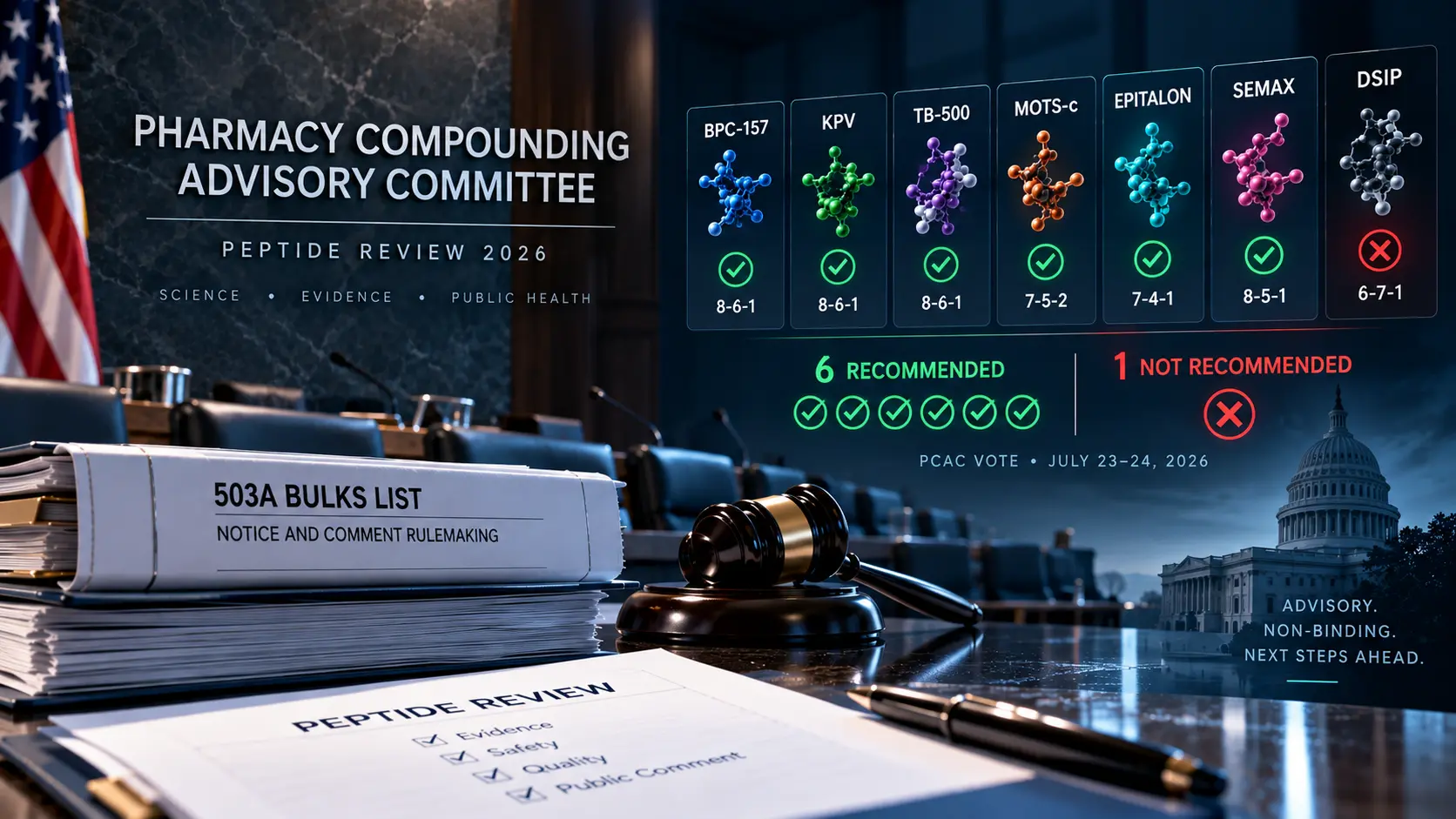
The FDA peptide vote 2026 took place on July 23-24, when the agency's Pharmacy Compounding Advisory Committee recommended six of seven peptides for possible inclusion on the Section 503A Bulks List and declined to recommend the seventh, emideltide (DSIP) [1,5]. The vote was advisory and non-binding, and it changed nothing about what any pharmacy may lawfully compound. As of September 2026, none of the seven appears in 21 CFR 216.23, the regulation that actually contains the 503A Bulks List [4], and none is an FDA-approved drug. Adding them requires notice-and-comment rulemaking that FDA has not yet started.
Key Takeaways
- The Pharmacy Compounding Advisory Committee (PCAC) met July 23-24, 2026 at FDA's White Oak Campus in Silver Spring, Maryland, under docket FDA-2025-N-6895 [1].
- FDA review staff recommended against all seven substances. The committee went the other way on six of them, an outcome AJMC described as atypical [6].
- Reported tallies: BPC-157, KPV and TB-500 each 8-6 with one abstention; MOTS-c 7-5 with two abstentions; Semax 8-5-1; Epitalon 7-4-1; emideltide 6-7-1 against [20,22].
- FDA evaluated each peptide against a narrowed subset of the uses its nominators proposed, not against how the compound is discussed in consumer coverage. Epitalon was reviewed for insomnia. Semax was reviewed for cerebral ischemia, migraine and trigeminal neuralgia [1,23,24,25].
- Section 216.23(a) currently lists six bulk drug substances in total, none of them a peptide, and the section has not been amended since it was created by a final rule published February 19, 2019 [4].
- Glutathione received a favorable PCAC recommendation on June 8, 2022 by a vote of 8-5 with one abstention. More than four years later it is still absent from the regulation [4,13,14].
- Separately, on August 24, 2026, FDA issued warning letters to five online peptide sellers stating that website evidence established their "research use only" products were intended as drugs for human use [10,11,12].
Research Use Only
99 Purity Peptides supplies compounds for laboratory research use only. Nothing we sell is for human or veterinary consumption. Nothing on this page is medical, legal, dosing or health advice, and nothing here describes any compound as treating, preventing or helping any condition. Where this article refers to an indication, it refers only to a use nominated for, or evaluated in, FDA's regulatory review.
How we graded the evidence
Throughout this article, claims about what happened at the meeting are sourced to FDA's own meeting materials where those exist, and attributed to named law firms or trade press where FDA has not published a record. Claims about study quality use this article's own grading, not a scale FDA published: randomized double-blind placebo-controlled trial, uncontrolled open-label human study, single-subject case report, animal model, and in-vitro work. We say which one applies every time. Where reported figures disagree, we show both and say which one we think is right and why.
What Did the FDA Advisory Committee Decide in July 2026?
The committee recommended six peptide-related bulk drug substances for possible inclusion on the 503A Bulks List and voted against one. Each compound was considered in two forms, free base and acetate, and the outcome was the same for both forms of every substance [1,20].
Compound | Day | Indication(s) FDA reviewed | Vote (yes-no-abstain) | FDA staff position | Result |
|---|---|---|---|---|---|
BPC-157 | July 23 | Ulcerative colitis | 8-6-1 | Against listing | Recommended |
KPV | July 23 | Wound healing and inflammatory conditions | 8-6-1 | Against listing | Recommended |
TB-500 | July 23 | Wound healing | 8-6-1 | Against listing | Recommended |
MOTS-c | July 23 | Obesity and osteoporosis | 7-5-2 | Against listing | Recommended |
Emideltide (DSIP) | July 24 | Opioid withdrawal, chronic insomnia, narcolepsy | 6-7-1 | Against listing | Not recommended |
Semax | July 24 | Cerebral ischemia, migraine, trigeminal neuralgia | 8-5-1 | Against listing | Recommended |
Epitalon | July 24 | Insomnia | 7-4-1 | Against listing | Recommended |
Indications are taken from FDA's published agenda [1]. Tallies are from trade and law-firm reporting [20,22], because FDA had not posted minutes or a transcript when this article was written.
That last point deserves emphasis. FDA's meeting page carries the briefing documents, the agenda, the roster and the voting questions, but no official vote record [1]. Every tally in circulation traces back to people watching the webcast.
We can, however, test those tallies against a primary source. The totals differ from compound to compound (fifteen ballots for BPC-157, fourteen for MOTS-c, twelve for Epitalon), and FDA's final meeting roster explains why: the committee had eleven standing voting members and eight temporary voting members, and many of them were seated for specific topics only [2]. Voting eligibility therefore changed from compound to compound, which is also why any description of a fixed-size panel producing every tally should be read with care.
Work it through and every reported tally lands exactly on its eligible pool.
Compound | Eligible voters per the FDA roster | Reported ballots cast | Reconciles? |
|---|---|---|---|
BPC-157 | 15 | 8+6+1 = 15 | Yes |
KPV | 15 | 8+6+1 = 15 | Yes |
TB-500 | 15 | 8+6+1 = 15 | Yes |
MOTS-c | 14 | 7+5+2 = 14 | Yes |
Emideltide | 14 | 6+7+1 = 14 | Yes |
Semax | 14 | 8+5+1 = 14 | Yes |
Epitalon | 12 | 7+4+1 = 12 | Yes |
This also settles a live disagreement. Some reports give Epitalon as 7-5-1 rather than 7-4-1. Only twelve members were eligible to vote on Epitalon, because two standing members and five of the eight temporary members were seated for other topics [2]. A 7-5-1 tally would require thirteen ballots. The 7-4-1 figure is the one consistent with FDA's own roster, it is the figure McDermott Will & Emery reports, and Restore Health Consulting says it checked its tallies against FDA's archived livestream [20,22]. We use 7-4-1 with reasonable confidence, but it is still not an official record until FDA publishes minutes.
Which Uses Was Each Peptide Actually Reviewed For?
FDA evaluated a narrowed subset of the uses its nominators proposed, and that subset differs from how the compounds are framed in headlines. For several substances, including BPC-157, Semax and Epitalon, the nominations proposed additional uses that FDA declined to evaluate [23,24,25]. This matters because a 503A listing, if it ever happens, follows from an evaluation tied to the uses FDA actually reviewed.
Compound | Use(s) FDA evaluated from the nominations |
|---|---|
Epitalon | Insomnia |
Semax | Cerebral ischemia, migraine, trigeminal neuralgia |
MOTS-c | Obesity and osteoporosis |
TB-500 | Wound healing |
KPV | Wound healing and inflammatory conditions |
BPC-157 | Ulcerative colitis |
Emideltide (DSIP) | Opioid withdrawal, chronic insomnia, narcolepsy |
These are regulatory review categories, not established effects, and nothing in the vote establishes any effect for any use.
The Epitalon case is the cleanest example of a claim that ranking pages keep getting wrong. FDA's agenda lists one evaluated use for Epitalon-related bulk drug substances: insomnia [1]. Pages asserting that the committee endorsed Epitalon for longevity are describing a vote that did not happen. Epitalon was nominated for longevity-related uses, but FDA declined to evaluate them and reviewed it for insomnia only [23].
One naming point worth fixing while we are here. FDA's substance name for what the market calls TB-500 is the fragment, not the full 43-amino-acid parent protein. Conflating the two is common and wrong, and our TB-500 research guide sets out the distinction.
Why Was DSIP (Emideltide) Rejected?
Emideltide failed because the evidence did not match the nomination, and FDA's briefing document says so with unusual bluntness. Its conclusion: no study evaluated effectiveness by the nominated route of administration at all [3].
The nominations proposed compounding emideltide for subcutaneous injection. Every human effectiveness study FDA could find used the intravenous route. FDA stated it identified no data supporting effectiveness for chronic insomnia, narcolepsy or opioid withdrawal via the nominated subcutaneous route [3].
The condition-by-condition record is thinner still:
Narcolepsy. The nominators submitted no clinical references at all. FDA located a single 1984 case report describing one 35-year-old man with a ten-year history of the condition [3]. One patient is not an evidence base.
Opioid withdrawal. Two studies, both uncontrolled and open-label. The 1984 study was unblinded with no comparison group and, in FDA's assessment, did not adequately describe how outcomes were confirmed. The 1998 study enrolled seven subjects, of whom only two completed the full injection schedule [3].
Chronic insomnia. Genuinely conflicting results, which is the most interesting part of the file. Studies from one research group reported improvements in sleep onset latency, total sleep time and sleep efficiency. Two independent double-blind placebo-controlled studies, one with sixteen subjects and one with six, found effects that the authors themselves called weak or of little clinical significance [3]. A 1986 review concluded the evidence was insufficient to show emideltide reliably induced or maintained sleep.
Then there is a chemistry problem that got almost no coverage. FDA noted that the free base's limited water solubility could cause solubility problems at the proposed 1,000 mcg/mL subcutaneous concentration, while the acetate form should not have that issue [3]. FDA also found that one nominator's certificate of analysis carried a molecular formula that does not correspond to any emideltide structure [3]. Both nominations were later withdrawn; FDA evaluated the substance at its own discretion [3].
Our judgment: emideltide was the correct rejection on this record, and it is not close. The insomnia literature is old, small, mostly from one group, and contradicted by the two best-controlled studies in the set. Readers interested in the underlying compound can see our DSIP research guide and the DSIP and Epitalon comparison, both of which describe the same literature limits.
What is harder to defend is the inconsistency. FDA raised characterization, impurity and immunogenicity concerns across all seven substances, and the committee accepted them for one and set them aside for six.
Does This Mean the FDA Approved These Peptides?
No. A PCAC recommendation is advice, and FDA is not required to follow it [1,9]. Four distinct regulatory statuses get collapsed together in coverage of this vote, and keeping them apart is the single most useful thing a reader can take away.
Status | What it legally permits | Where the seven sit today |
|---|---|---|
FDA-approved drug | A specific product, dose, indication, manufacturing process and label reviewed and approved by FDA | None of the seven |
On the 503A Bulks List (21 CFR 216.23(a)) | Eligible for use in patient-specific compounding when all other 503A conditions are met. Not an approval, and representing it as one misbrands the product | None of the seven [4] |
Interim Category 1 / 2 / 3 | An enforcement-discretion posture under FDA's interim policy while a substance is evaluated [15,16]. Category 1 substances may be compounded under stated conditions; Category 2 may not | None of the seven. FDA removed twelve peptides from Category 2 effective around April 22, 2026, after their nominators withdrew the nominations, without placing them in Category 1 [17,18,20] |
Research Use Only reagent | Sale as a laboratory material. Confers no authorization for human use, and FDA treats website context as evidence of intended use [10,11] | Where these compounds sit in the research-supply market |
Nothing moved between rows on July 24. The six favorable votes moved a substance one step along a path toward the second row, and the path has more steps left than most coverage suggests.
What Is the 503A Bulks List, and How Is It Different From 503B?
Section 503A of the Federal Food, Drug, and Cosmetic Act exempts certain patient-specific compounded preparations from parts of federal drug law, but only if the bulk drug substance used satisfies one of three conditions: it complies with an applicable USP or NF monograph, it is a component of an FDA-approved drug product, or it appears on the 503A Bulks List [3,21]. None of the seven peptides satisfies any of the three. FDA's emideltide briefing document states plainly that there is no applicable USP or NF monograph for either emideltide form and that neither is a component of an approved drug [3].
503B is a separate track. Outsourcing facilities registered under Section 503B compound larger batches that are not tied to an individual prescription, and they work from a different bulk substances list under a different statutory standard. A favorable 503A vote says nothing about 503B eligibility.
The practical consequence is that "recommended for the 503A Bulks List" and "compoundable" are not the same sentence. Until FDA completes rulemaking, a pharmacy compounding these substances on the strength of the July votes is doing so at its own enforcement risk [21]. If you operate a pharmacy or a clinic and need to know where you stand, consult a regulatory attorney rather than a summary article.
What Happens Next, and How Long Could It Take?
FDA must publish a proposed rule, take public comment, and issue a final rule amending 21 CFR 216.23 before any of these substances can be added [9,15]. As of mid-September 2026, no proposed rule has been published and we found no post-vote statement from FDA or HHS.
Published estimates for how long this takes vary, and each should be attributed rather than treated as fact. Holland & Knight wrote in August 2026 that the peptides still cannot be lawfully compounded [5]. The FDA Law Blog noted in April 2026 that notice-and-comment rulemaking can take more than a year under standard timelines, and observed that final rulemaking under Section 503A has been completed for only about ten substances in total [17]. AJMC described notice-and-comment rulemaking as a process that can take twelve to twenty-four months [26], while LumaLex founding partner Dustin Robinson told Pharmaceutical Executive the cycle realistically runs eight to twelve months [7].
Here is the precedent nobody puts next to those estimates. On June 8, 2022, PCAC voted 8-5 with one abstention to recommend glutathione for the 503A Bulks List, also against FDA staff's recommendation [13,14]. Glutathione is not in 21 CFR 216.23 today [4]. More striking: its source note shows the section was created by a final rule published February 19, 2019 (84 FR 4710), effective March 21, 2019 [4]. Seven and a half years have passed, PCAC has issued favorable recommendations in that window, and the regulation has not changed once.
That is the realistic base rate. A favorable PCAC vote has recently been a necessary step, not a predictive one. Anyone telling you these compounds will be compoundable by a particular date is guessing.
How Did We Get Here?
Date | Event |
|---|---|
June 8, 2022 | PCAC recommends glutathione 8-5-1; it is still not in the regulation as of 2026 [4,13] |
September 2023 | FDA moves more than a dozen peptide substances into interim Category 2. They had never been in Category 1 or on the Bulks List, so they were never eligible for 503A compounding [17] |
February 27, 2026 | HHS Secretary Kennedy indicates several of the Category 2 peptides will become more accessible [27] |
April 15, 2026 | FDA announces removal of twelve peptides from Category 2, effective about seven days later, and announces two PCAC meetings [17,18,20] |
April 16, 2026 | Federal Register notice published; docket FDA-2025-N-6895 opened [1,17] |
July 23-24, 2026 | PCAC reviews seven peptides; six recommended, emideltide rejected [1,5] |
August 24, 2026 | FDA issues warning letters to five online peptide sellers over research-use-only marketing [10,11,12] |
By end of February 2027 | Next PCAC meeting scheduled to consider GHK-Cu, Melanotan II, LL-37, dihexa acetate and PEG-MGF [17,18] |
Not yet scheduled | Proposed rule, comment period, final rule |
The April 2026 action is routinely misdescribed. Removal from Category 2 was procedural: it followed the nominators' withdrawal of their nominations [20,27]. It did not place anything in Category 1 and it did not authorize compounding [20]. Our BPC-157 legal status analysis covers that sequence in detail and stays consistent with the dates above.
What Does the Vote Not Change?
Approval status. None of the seven is an FDA-approved drug, and the 503A Bulks List is explicit that representing a compounded drug made from a listed substance as FDA-approved misbrands it [4].
Anti-doping status. The 2026 WADA Prohibited List, effective January 1, 2026, names BPC-157 as an example within class S0 (non-approved substances) and lists thymosin-β4 and its derivatives, giving TB-500 as the example, under S2.3 (growth factors) [19]. Both are prohibited at all times, in and out of competition. MOTS-c is named under S4.4.1 (metabolic modulators); KPV, Epitalon, Semax and emideltide are not named individually [19]. As a general rule, WADA's S0 covers any pharmacological substance not addressed by another section of the List and with no current approval by any governmental regulatory health authority for human therapeutic use [19]. A US compounding decision has no bearing on any of this.
Dietary supplement status. A favorable compounding vote does not make any of these compounds a lawful dietary ingredient.
Research-use-only supply. This is the part that matters most to anyone reading a research-supply site. On August 24, 2026, FDA's Center for Drug Evaluation and Research issued warning letters to five online peptide sellers [12]. The Peptide Partners letter states that despite labeling marketing the products "for research use only" and "not for human or veterinary use," evidence obtained from the website established that the products are intended to be drugs for human use [10]. The Royal Peptides letter goes further, stating that the firm markets bacteriostatic water alongside a "peptide guide" and "peptide calculator," resources that collectively provide the means to prepare an injectable drug for human administration [11].
Read that carefully. FDA did not object to the label. It objected to what surrounded the label. Product claims tying a compound to a condition or body function, bacteriostatic water sold alongside the peptides, and resources such as a "peptide guide" or "peptide calculator" are the evidence FDA cited.
Two clarifications the coverage has blurred. The compounds named in those letters were GLP-1 receptor agonists and other substances including SS-31, PT-141 and tesamorelin, not the seven reviewed in July. And there were five letters that day [12]. The doctrine, however, is general. It turns on website context, and it applies regardless of which molecule is in the vial.
What the Record Does Not Establish Yet
Several things in this story remain genuinely open, and we would rather say so than pretend otherwise.
FDA has posted no minutes and no transcript for the July meeting. Every tally in this article, including ours, rests on contemporaneous observation of the webcast, cross-checked against the roster. If FDA publishes an official record that contradicts these figures, the official record wins.
A 7-5-1 Epitalon figure still circulates. The 7-4-1 figure is supported by roster arithmetic and by reporting checked against FDA's archived livestream [20,22], but neither is an official vote record.
No proposed rule exists. No post-vote statement from FDA or HHS was found as of mid-September 2026. Whether the agency accepts six recommendations, some, or none is unknown, and FDA staff recommended against all seven.
Committee composition has drawn scrutiny. Reporting has noted increased representation from clinicians and businesses involved in prescribing or producing peptides, and conflict-of-interest questions have been raised [6]. We have not independently evaluated those claims.
Finally, and most importantly for anyone reading this as a research buyer: the vote established nothing about safety or effectiveness. FDA's reviewers raised incomplete chemical characterization, unquantified impurity profiles, potential aggregation and immunogenicity risk across these substances [3,8]. A committee disagreeing about regulatory eligibility did not resolve any of those technical questions.
Where to Read Further
The compound-level research literature is covered separately, and none of it changes as a result of this vote. See our BPC-157 regulatory history, TB-500 research guide, KPV research guide, MOTS-c research guide, Semax research guide, Epithalon research guide, DSIP research guide and the DSIP and Epitalon comparison.
For background on how research-grade material is classified and documented, see what research peptides are and how to read a certificate of analysis. Lot documentation for our catalog is published at certificates.
References
- U.S. Food and Drug Administration. July 23-24, 2026: Meeting of the Pharmacy Compounding Advisory Committee. Content current as of August 6, 2026. https://www.fda.gov/advisory-committees/advisory-committee-calendar/july-23-24-2026-meeting-pharmacy-compounding-advisory-committee-07232026
- U.S. Food and Drug Administration. July 23-24, 2026 Meeting of the Pharmacy Compounding Advisory Committee: Final Meeting Roster. https://www.fda.gov/media/193772/download
- U.S. Food and Drug Administration. FDA Briefing Document for Emideltide-Related Bulk Drug Substances, Pharmacy Compounding Advisory Committee, July 23-24, 2026. https://www.fda.gov/media/193344/download
- Electronic Code of Federal Regulations. 21 CFR 216.23, Bulk drug substances that can be used to compound drug products in accordance with section 503A of the Federal Food, Drug, and Cosmetic Act. Current as of September 10, 2026. https://www.ecfr.gov/current/title-21/chapter-I/subchapter-C/part-216/subpart-B/section-216.23
- Holland & Knight. FDA Advisory Committee Endorses Compounding of Certain Peptides. August 2026. https://www.hklaw.com/en/insights/publications/2026/08/fda-advisory-committee-endorses-compounding-of-certain-peptides
- American Journal of Managed Care. FDA Panel Backs 6 Peptides for Compounding. https://www.ajmc.com/view/fda-panel-backs-6-peptides-for-compounding
- Pharmaceutical Executive. FDA Panel Votes to Loosen Restrictions for Four Peptides. https://www.pharmexec.com/view/fda-votes-loosen-restrictions-four-peptides
- Health Affairs Forefront. FDA Advisory Committee's Vote May Open A Drug-Compounding Back Door For Unapproved Peptides. August 4, 2026. https://www.healthaffairs.org/content/forefront/fda-advisory-committee-s-vote-may-open-drug-compounding-back-door-unapproved-peptides
- Buchanan Ingersoll & Rooney PC. FDA Advisory Committee Voted Yes on Six Peptides. Now What? The Regulatory Road Ahead. https://www.bipc.com/fda-voted-yes-on-six-peptides-now-what-the-regulatory-road-ahead
- U.S. Food and Drug Administration. Warning Letter, Peptide Partners LLC, reference number 735063, August 24, 2026. https://www.fda.gov/inspections-compliance-enforcement-and-criminal-investigations/warning-letters/peptide-partners-llc-735063-08242026
- U.S. Food and Drug Administration. Warning Letter, Royal Peptides LLC, reference number 734884, August 24, 2026. https://www.fda.gov/inspections-compliance-enforcement-and-criminal-investigations/warning-letters/royal-peptides-llc-734884-08242026
- pharmaphorum. FDA issues warning letters to five unapproved GLP-1 websites. https://pharmaphorum.com/news/fda-issues-warning-letters-five-unapproved-glp-1-websites
- Alliance for Pharmacy Compounding. PCAC recommends glutathione for bulks list. June 10, 2022. https://a4pc.org/news/2022-06/pcac-recommends-glutathione-for-bulks-list
- U.S. Food and Drug Administration. Pharmacy Compounding Advisory Committee Meeting, June 8, 2022: Questions. https://www.fda.gov/media/159041/download
- U.S. Food and Drug Administration. Interim Policy on Compounding Using Bulk Drug Substances Under Section 503A of the Federal Food, Drug, and Cosmetic Act: Guidance for Industry. https://www.fda.gov/media/174456/download
- Federal Register. Interim Policy on Compounding Using Bulk Drug Substances Under Section 503A; Guidance for Industry; Availability. January 7, 2025. https://www.federalregister.gov/documents/2025/01/07/2024-31546/interim-policy-on-compounding-using-bulk-drug-substances-under-section-503a-of-the-federal-food-drug
- FDA Law Blog (Hyman, Phelps & McNamara). FDA's Pep(tide) Rally! What Compounders and Industry Need to Know. April 2026. https://www.thefdalawblog.com/2026/04/fdas-peptide-rally-what-compounders-and-industry-need-to-know-post-1-of-2/
- Sheppard Mullin. What to Watch: Status Update on Peptide Regulation. June 2026. https://www.sheppard.com/insights/blogs/what-to-watch-status-update-on-peptide-regulation
- World Anti-Doping Agency 2026 Prohibited List, as published by the Jamaica Anti-Doping Commission, effective January 1, 2026. https://jadco.gov.jm/wp-content/uploads/2026/01/JADCO-Prohibited-List-2026.pdf
- Restore Health Consulting. FDA's PCAC Votes in Favor of Six Peptides for 503A Bulks List: What Compounders Need to Know. https://www.restorehealthconsulting.com/news/fdas-pcac-votes-in-favor-of-six-peptides-for-potential-inclusion-on-the-503a-bulks-list-what-compounders-need-to-know
- Boesen & Snow Law. Peptides: The Quiet After the PCAC Vote. What Compounders Should Be Doing While the FDA Makes Up Its Mind. August 4, 2026. https://www.boesensnowlaw.com/blog/peptides-the-quiet-after-the-pcac-vote-what-compounders-should-be-doing-while-the-fda-makes-up-its-mind/
- McDermott Will & Emery. Bulk-list bound? PCAC backs majority of peptides in two-day public meeting. July 27, 2026. https://www.mcdermottlaw.com/insights/bulk-list-bound-pcac-backs-majority-of-peptides-in-two-day-public-meeting/
- U.S. Food and Drug Administration. FDA Briefing Document for Epitalon-Related Bulk Drug Substances, Pharmacy Compounding Advisory Committee, July 23-24, 2026. https://www.fda.gov/media/193345/download
- U.S. Food and Drug Administration. FDA Briefing Document for Semax-Related Bulk Drug Substances, Pharmacy Compounding Advisory Committee, July 23-24, 2026. https://www.fda.gov/media/193348/download
- U.S. Food and Drug Administration. FDA Briefing Document for BPC-157-Related Bulk Drug Substances, Pharmacy Compounding Advisory Committee, July 23-24, 2026. https://www.fda.gov/media/193343/download
- American Journal of Managed Care. 5 Things to Know About the FDA's Peptide Reversal. August 21, 2026. https://www.ajmc.com/view/5-things-to-know-about-the-fda-s-peptide-reversal
- Orrick. FDA Announces Removal of 12 Peptides from Category 2 and Schedules PCAC Meetings to Consider Adding Peptides to 503A Bulk Drug Substances List. April 2026. https://www.orrick.com/en/Insights/2026/04/FDA-Announces-Removal-of-12-Peptides-from-Category-2-and-Schedules-PCAC-Meetings
Frequently Asked Questions
Is BPC-157 legal now after the FDA vote?
No. The July 23, 2026 vote was an advisory recommendation, not a legal change. BPC-157 does not appear in 21 CFR 216.23, is not an FDA-approved drug, and is not in interim Category 1. Compounding pharmacies cannot lawfully use it under Section 503A on the strength of the vote alone. FDA would need to complete notice-and-comment rulemaking first, and it has not begun.
Did the FDA approve BPC-157 or TB-500?
No, and the distinction is not a technicality. Drug approval evaluates a specific finished product, its manufacturing process, its label and a defined indication. The committee voted on whether a bulk substance should be eligible for use in patient-specific compounding. Even full inclusion on the 503A Bulks List would not be an approval, and the regulation explicitly says representing it as one misbrands the product.
Can compounding pharmacies make these peptides yet?
Not lawfully under Section 503A. A bulk drug substance must meet a USP or NF monograph, be a component of an approved drug, or appear on the 503A Bulks List. None of the six recommended peptides meets any of those three conditions today. FDA has also not announced an interim enforcement policy covering them. Until a final rule is published, they remain ineligible for 503A compounding.
What is the 503A Bulks List?
It is the list at 21 CFR 216.23(a) of bulk drug substances that may be used in traditional patient-specific compounding even though they are not components of approved drugs and have no applicable monograph. It currently contains six substances in total, none of them peptides. Being on it establishes eligibility to compound, not safety, effectiveness or FDA approval.
What is FDA "Category 2"?
Category 2 is a grouping under FDA's interim compounding policy for nominated substances that the agency identified as raising significant safety risks. Substances placed there are not eligible for compounding under the enforcement-discretion conditions that apply to Category 1. FDA removed twelve peptides from Category 2 in April 2026 after their nominators withdrew the nominations. That removal did not move them into Category 1.
Why was DSIP (emideltide) rejected?
The evidence did not support the nomination. Emideltide was nominated for subcutaneous injection, but FDA found no effectiveness study using that route at all; the human data it located used intravenous administration. Narcolepsy support amounted to one 1984 case report. Opioid withdrawal rested on two uncontrolled open-label studies. The insomnia studies conflicted, with the better-controlled ones showing weak or clinically insignificant effects.
What were the exact votes for each peptide?
BPC-157, KPV and TB-500 each passed 8-6 with one abstention. MOTS-c passed 7-5 with two abstentions. Semax passed 8-5-1 and Epitalon 7-4-1. Emideltide was rejected 6-7-1. FDA has not published official minutes, so these come from observers and law-firm analyses. Some sources report Epitalon as 7-5-1, which does not fit the number of members eligible to vote on it.
Can the FDA ignore the advisory committee's recommendation?
Yes. Advisory committees give non-binding advice, and FDA is not legally required to adopt any of it. That is especially relevant here, because FDA's own review staff recommended against all seven substances before the committee reached the opposite conclusion on six. The agency retains sole responsibility for deciding what ultimately appears on the 503A Bulks List.
When will the FDA make a final decision?
There is no announced date, and no proposed rule had been published as of mid-September 2026. Published estimates range from about eight to twenty-four months, but the track record suggests caution: 21 CFR 216.23 has not been amended since it was created in February 2019, despite favorable committee recommendations in the years since. Treat any specific prediction as speculation.
Was Epitalon reviewed for longevity?
No. FDA's published agenda lists one evaluated use for Epitalon-related bulk drug substances: insomnia. Epitalon was nominated for longevity-related uses, but FDA declined to evaluate them and reviewed it for insomnia only. This matters because a 503A evaluation is tied to the nominated use, so the indication under review defines what the vote actually concerned.
Is TB-500 the same as thymosin beta-4?
No. Thymosin beta-4 is a 43-amino-acid protein. TB-500 refers to a short synthetic fragment of it. FDA named the reviewed substance as the fragment rather than the full-length protein. The two are chemically distinct and should not be treated as interchangeable, even though marketing and some news coverage use the names as synonyms.
What is the difference between 503A and 503B?
Section 503A covers traditional compounding by a pharmacist or physician against an individual patient prescription. Section 503B covers registered outsourcing facilities that produce larger batches not tied to a specific prescription, under stricter manufacturing requirements. They use separate bulk substance lists with different statutory standards, so a favorable 503A recommendation says nothing about 503B eligibility.
Which peptides is the FDA reviewing next?
FDA has said another Pharmacy Compounding Advisory Committee meeting will be held before the end of February 2027 to consider five additional substances: GHK-Cu, Melanotan II, LL-37 (cathelicidin), dihexa acetate and PEG-MGF. As with the July meeting, any recommendation from that session would be advisory and would still require rulemaking before it changed anything.
Are these peptides still banned by WADA?
Yes, and the FDA vote has no bearing on anti-doping rules. The 2026 Prohibited List names BPC-157 as an example under S0 and thymosin-β4 derivatives including TB-500 under S2.3, both prohibited at all times. MOTS-c is named under S4.4.1 (metabolic modulators); KPV, Epitalon, Semax and emideltide are not named individually. As a general rule, S0 covers any pharmacological substance not addressed elsewhere on the List and lacking approval by any governmental regulatory health authority for human therapeutic use.
Does the vote change anything for research-use-only suppliers?
No, and recent enforcement moved in the opposite direction. On August 24, 2026, FDA issued warning letters to five online peptide sellers stating that website evidence established their research-use-only products were intended as drugs for human use. One letter cited bacteriostatic water sold alongside a peptide guide and calculator. FDA weighs site context, not the disclaimer.