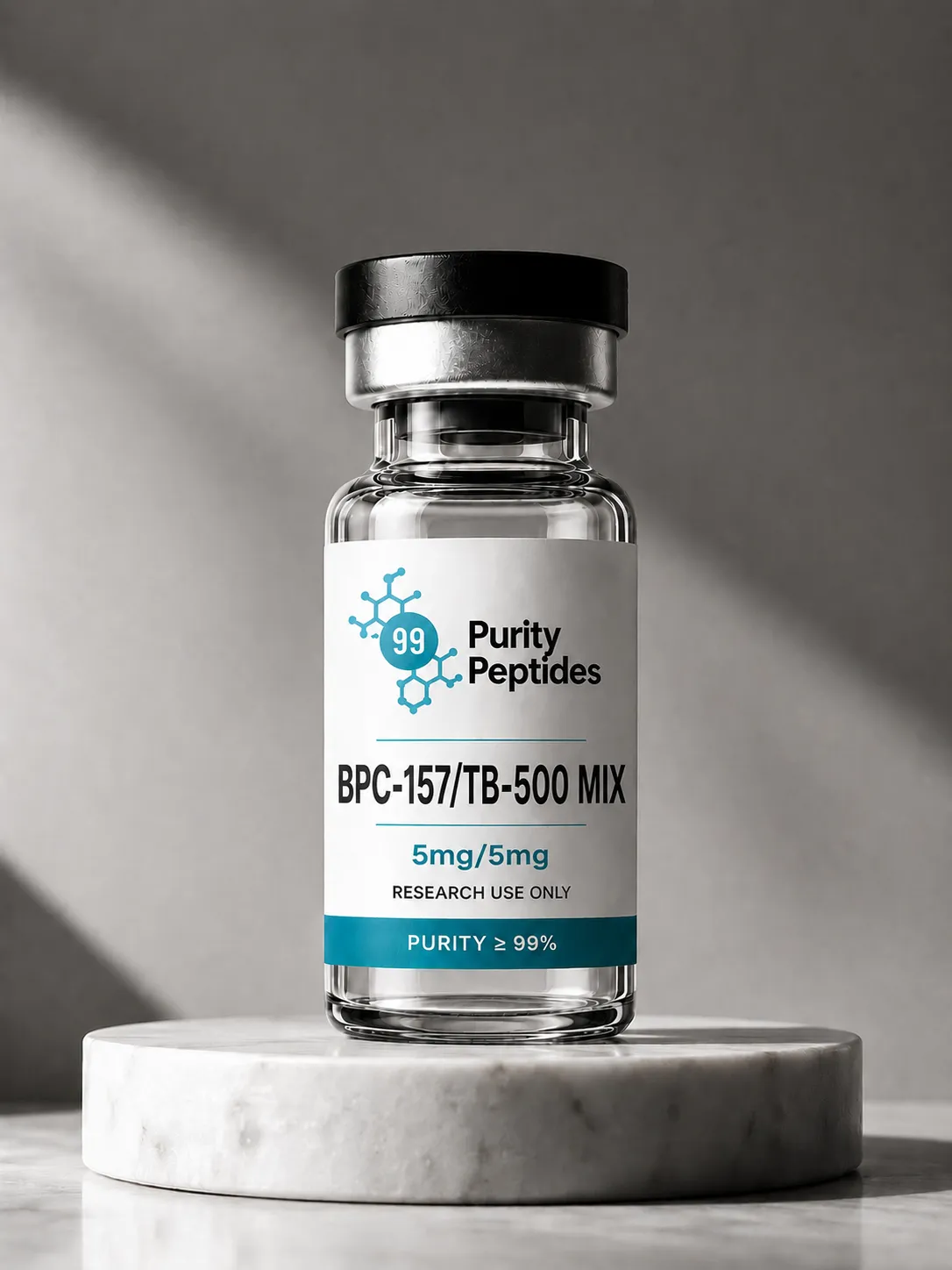
Research Use Only. 99 Purity Peptides supplies BPC-157 strictly as a laboratory research material. It is not approved by the FDA for human or veterinary use. It is not a drug, food, dietary supplement, or cosmetic, and it is not intended for ingestion, injection, or any form of administration to humans or animals. Nothing on this page is medical, legal, or dosing advice.

Quick Answer: What Is BPC-157's Legal Status Right Now?
Quick Answer
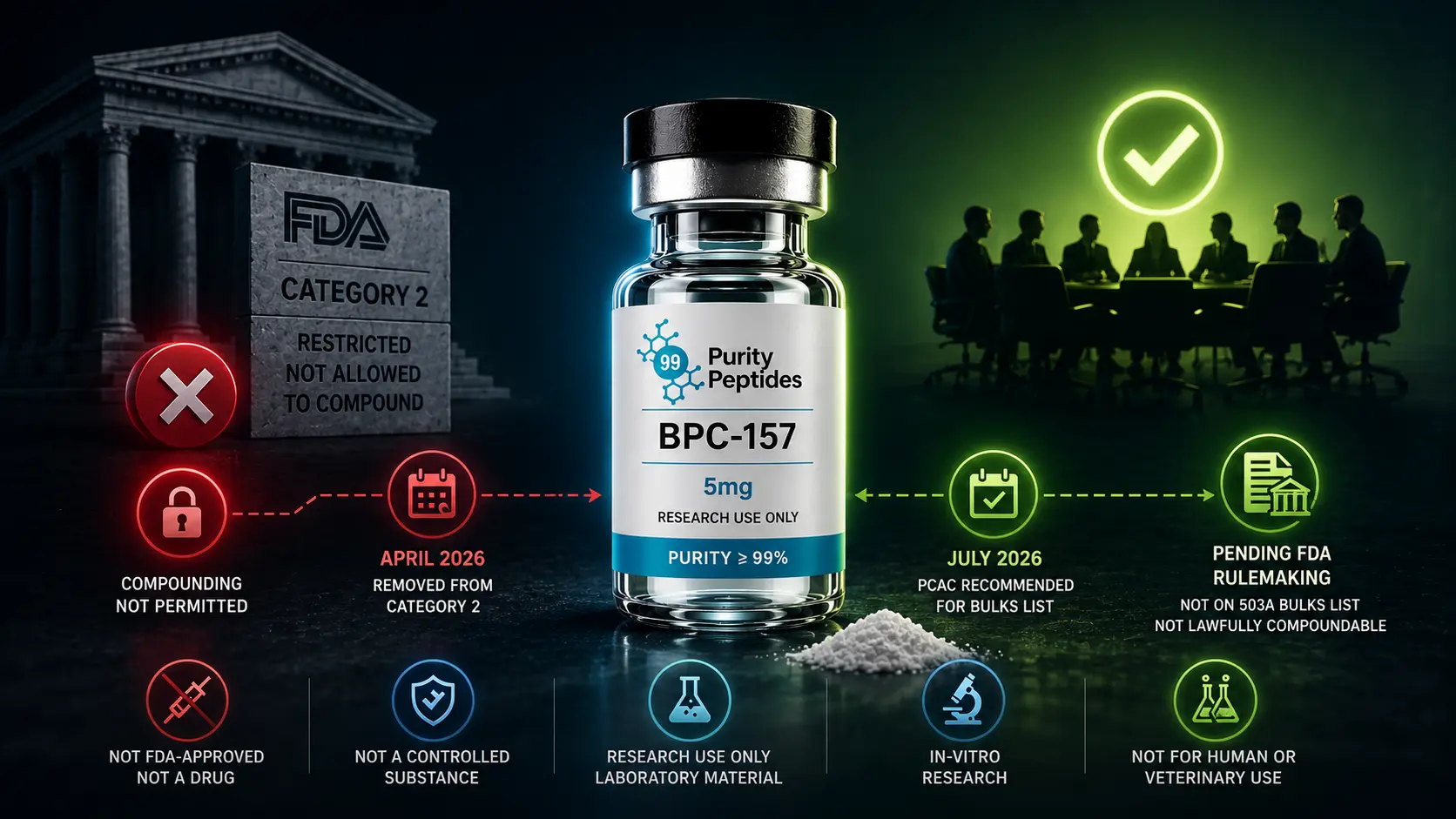
BPC-157 is not an FDA-approved drug for any human indication. In April 2026 the FDA removed it from Category 2, the restricted list that had blocked compounding pharmacies from using it. In July 2026 the FDA's Pharmacy Compounding Advisory Committee voted 8–6, with one abstention, to recommend adding it to the Section 503A Bulks List. That recommendation is non-binding. As of this writing, BPC-157 has not been added to the 503A Bulks List and cannot be lawfully compounded, because the FDA has not completed the required notice-and-comment rulemaking.
Two things changed in 2026. Neither one made BPC-157 an approved drug, and neither one made it lawful to compound today.
Key Takeaways
- BPC-157 has never been approved by the FDA as a drug for any human or veterinary indication, and that has not changed.
- On April 15, 2026, the FDA announced it was removing BPC-157 from Category 2 of its interim 503A policy, with removal effective seven calendar days later.
- Removal from a restricted list is not the same as addition to a permitted list. The FDA did not move BPC-157 to Category 1.
- On July 23, 2026, the Pharmacy Compounding Advisory Committee (PCAC) voted 8–6 with one abstention to recommend BPC-157 for the Section 503A Bulks List.
- PCAC recommendations are advisory. The FDA is not legally bound to follow them.
- BPC-157 is still absent from the codified 503A Bulks List at 21 CFR 216.23, so lawful 503A compounding remains unavailable pending rulemaking.
- BPC-157 is not a controlled substance under the federal Controlled Substances Act. It is not scheduled I through V.
- Research-use-only (RUO) laboratory material is a separate, legitimate regulatory category. It is not a route to obtaining BPC-157 for personal use.
Why "Is BPC-157 Legal?" Is the Wrong Question
The honest answer is that "legal" is not one question. It is at least five.
People searching for BPC-157's legal status usually want a yes or no. The regulatory system does not produce one. A substance can sit in completely different positions across separate legal tracks at the same time, and BPC-157 does exactly that. Conflating those tracks is the single largest source of confusion in this topic, and it is the reason so much published commentary contradicts itself.
Asking "what is BPC-157's current regulatory status?" produces a precise answer. Asking "is BPC-157 legal?" produces a misleading one.
What Are the Separate Legal Tracks for a Compound Like BPC-157?
Each track below is governed by different law, different agencies, and different criteria. A change in one track does not automatically move any other.
Regulatory track | Current status (as of this writing) | What it permits | What it does not permit |
|---|---|---|---|
FDA drug approval (NDA/BLA under the FD&C Act) | Not approved for any indication. No approved BPC-157 product exists. | Nothing. There is no approved product to prescribe or dispense. | Any marketing, prescribing, or sale of BPC-157 as a therapeutic drug. |
503A compounding pharmacy eligibility (Bulks List, 21 CFR 216.23) | Not on the list. Removed from Category 2 in April 2026. Recommended for inclusion by PCAC in July 2026 on a non-binding vote. | Nothing yet. Removal from Category 2 lifted an explicit restriction; it did not create authorization. | Lawful compounding by a 503A pharmacy pending completed rulemaking. |
503B outsourcing facility eligibility (separate bulks list) | Not included. This is a distinct list with its own process. | Nothing. | Lawful compounding by a registered outsourcing facility. |
RUO laboratory research material | A distinct and lawful supply category for qualified research professionals. | Purchase, possession, and in vitro laboratory use of material labeled and sold as research-use-only. | Human use, veterinary use, therapeutic claims, or any treatment of RUO material as equivalent to an approved drug. |
Controlled Substances Act (possession) | Not a controlled substance. Not scheduled I through V. | Possession is not a federal controlled-substance offense. | Human administration, which remains an unapproved-new-drug question under the FD&C Act, not a CSA question. Separate rules may still apply. |
Note: Track five is the one most often misread. "Not a controlled substance" is a narrow statement about drug-scheduling law. It says nothing at all about FDA approval status, compounding eligibility, or whether a product is lawful to market for human use.
What Actually Changed in 2026? A Verified Timeline
Two federal actions moved BPC-157 in 2026. Here is what happened, when, and what each event did.
Date | Event | Source | What it changed |
|---|---|---|---|
September 2023 | FDA placed BPC-157 into Category 2 of its interim policy on compounding with bulk drug substances, the designation for substances the agency identified as presenting significant safety risks. | Effectively removed BPC-157 from lawful compounding channels. | |
April 15, 2026 | FDA announced removal of BPC-157 (free base and acetate) from Category 2, alongside eleven other peptides, with removal effective seven calendar days later (widely reported as April 22, 2026). | Lifted the explicit Category 2 restriction. Did not add BPC-157 to Category 1 or to the 503A Bulks List. | |
April 16, 2026 | FDA published a Federal Register notice announcing a PCAC meeting for July 23–24, 2026, and establishing a public comment docket (FDA-2025-N-6895). | Scheduled formal advisory review of seven peptides. | |
July 23, 2026 | PCAC voted 8–6, with one abstention, to recommend BPC-157 (free base and acetate) for the Section 503A Bulks List. FDA staff had recommended against all seven peptides under review. | Produced a non-binding advisory recommendation. Changed no regulation. | |
July 23–24, 2026 | Across both days the committee recommended six of seven peptides. Emideltide (DSIP) was the only rejection. | Established the advisory record the FDA will now weigh. | |
By end of February 2027 | FDA has announced a further PCAC meeting to review five additional peptides, including GHK-Cu, Melanotan II, LL-37, Dihexa acetate, and PEG-MGF. | Scheduled, not yet held. |
One detail from the official record deserves attention, because most coverage omits it. The FDA did not evaluate BPC-157 for general use. According to the agency's own published meeting materials, the use reviewed for BPC-157 was ulcerative colitis. The other peptides were each tied to their own specified indications, such as wound healing for TB-500. Advisory review of a bulk substance is indication-specific, and any eventual listing would carry that context with it.
What Does Removal From Category 2 Actually Mean?
It means one restriction was lifted. It does not mean approval.
The FDA's interim policy sorts nominated bulk drug substances into three categories. Category 1 substances fall within an enforcement-discretion policy while the agency evaluates them. Category 2 substances are those for which the FDA identified significant safety risks, and the agency has stated it would consider action against compounders using them. Category 3 covers substances nominated without enough information to evaluate.
When the FDA removed BPC-157 from Category 2 in April 2026, it did not move the substance into Category 1. It removed a prohibition without granting a permission.
Why Doesn't Removal Equal Approval?
Because approval and listing are different legal acts with different requirements.
FDA drug approval requires a sponsor to submit a new drug application with adequate evidence of safety and effectiveness for a specified indication. No such approval exists for BPC-157. Separately, under Section 503A, a compounder may only use a bulk drug substance that has an applicable USP or NF monograph, or is a component of an FDA-approved drug, or appears on the 503A Bulks List. BPC-157 currently satisfies none of those three conditions.
That is the operative point. Removing a substance from a restricted list does nothing to satisfy the affirmative statutory requirements that make compounding lawful in the first place.
What Does the PCAC Vote Actually Mean?
It means a federal advisory committee gave a recommendation. Recommendations are not rules.
The FDA states plainly that its advisory committees make non-binding recommendations, which the agency generally follows but is not legally required to follow. The July 2026 vote was notable precisely because the committee departed from FDA staff, who had proposed that none of the peptide forms under consideration be added to the list.
The margins were narrow. BPC-157, KPV, and TB-500 each passed 8–6 with one abstention. Committee reconstitution and member conflicts of interest also drew scrutiny in contemporaneous reporting, which is worth knowing when weighing how predictive the vote is.
What Steps Remain Before Compounding Could Become Lawful?
The FDA develops the 503A Bulks List through notice-and-comment rulemaking, handled on a rolling basis. Several distinct steps remain:
- The FDA reviews the committee's recommendations alongside the full scientific and regulatory record, including public docket comments.
- The agency decides whether to accept, modify, or decline the recommendations.
- If it proceeds, the FDA publishes a proposed rule in the Federal Register identifying which substances it intends to add or not add.
- A public comment period follows, and the agency reviews the comments received.
- The FDA issues a final rule, which amends the codified list at 21 CFR 216.23.
None of those steps had been completed as of this writing. The agency has not announced a firm deadline, and historically this process has moved slowly. Separately, the FDA could in principle announce an interim enforcement position before rulemaking concludes, but no such policy has been announced for these substances.
Note: Until a final rule is published, the compounding status of BPC-157 is unchanged from where it stood before the vote. A favorable advisory vote and a completed rulemaking are years apart in legal effect, even when they are weeks apart in the news cycle.
Where Does RUO Research Material Fit Into This?
It sits on a separate track entirely, and the separation is the whole point.
Everything discussed above concerns a prescription pathway: whether a licensed 503A pharmacy could one day lawfully compound BPC-157 for a patient with a valid prescription. That pathway is not open today. It may open if and when the FDA completes rulemaking.
Research-use-only material is a different category with a different purpose. RUO compounds are laboratory reagents supplied to qualified research professionals for in vitro investigation. They are not approved drugs, they are not prescription products, and they are not dispensed against prescriptions. 99 Purity Peptides is not a compounding pharmacy and does not operate as a compounding facility as defined under Section 503A.
Is RUO Sourcing a Way to Obtain BPC-157 for Personal Use?
No. This is the specific error this article exists to correct.
The RUO designation defines what the material is for, not merely how it is labeled. Material sold for laboratory research is supplied on the express basis that it will not be administered to humans or animals. The absence of an open compounding pathway does not convert the research channel into a substitute for one. These are parallel tracks, not upstream and downstream stages of the same track.
Anyone weighing a prescription pathway should be talking to a licensed prescriber about lawful, approved options, not reading a research-material catalogue.
Common Misconceptions About BPC-157's Legal Status
Each of the following appears regularly in published commentary. Each is wrong.
"Category 2 removal means BPC-157 is now approved." False. Category 2 is a list within an interim compounding policy. It has no relationship to drug approval. BPC-157 was never approved before its Category 2 listing and is not approved now.
"The PCAC vote made BPC-157 legal to compound." False. The vote was an advisory recommendation. The substance is not on the 503A Bulks List, and the FDA has not completed rulemaking. Legal compounding status is unchanged.
"It's off Category 2, so pharmacies can compound it now." False. Section 503A requires a bulk substance to meet one of three affirmative conditions. Removal from a restricted list satisfies none of them.
"It's not a controlled substance, so it's legal." False as stated. Controlled-substance scheduling and FDA approval are separate legal questions. BPC-157 is unscheduled and simultaneously unapproved.
"RUO labeling is a legal loophole." False. RUO is a recognized, legitimate category for laboratory reagents, and it exists across the entire life-sciences supply chain. It is not a workaround for the drug-approval system, because it does not authorize the thing the drug-approval system governs, which is human use. Treating it as a loophole misunderstands both the label and the law.
"BPC-157 is legal because it's sold openly." False. Commercial availability is not a legal determination. Research reagents are lawfully sold for research; that says nothing about human-use legality.
"A favorable vote means it will definitely be listed." Not established. The FDA is not bound by the committee, staff reviewers recommended against inclusion, and rulemaking outcomes are not predictable from advisory votes.
"It's approved somewhere else, so it's fine." False. BPC-157 holds no approval from any national regulatory health authority for human therapeutic use. That absence is why the World Anti-Doping Agency classifies it under S0, the category for non-approved substances.
How Can You Verify BPC-157's Current Status Yourself?
Do not rely on any single article, including this one. Regulatory status changes, and secondary coverage goes stale quickly.
Check these primary sources directly:
- FDA, Bulk Drug Substances Used in Compounding Under Section 503A — the agency's own explanation of the three interim categories and the 503A Bulks List, with links to current category documents.
- 21 CFR 216.23 — the codified 503A Bulks List. If a substance is not in the regulation, it is not on the list. Read it at eCFR.
- FDA's July 23–24, 2026 PCAC meeting page — agenda, roster, voting questions, and the complete FDA briefing documents, including the BPC-157 briefing package.
- FederalRegister.gov — search for proposed and final rules amending the 503A Bulks List. A proposed rule is the signal that the FDA has acted on the committee's recommendation.
- Regulations.gov, docket FDA-2025-N-6895 — the public comment docket associated with the July 2026 meeting.
- FDA Drugs@FDA database — the authoritative record of approved drugs. BPC-157 does not appear there.
A practical test: if someone claims BPC-157 is now legally compoundable, ask which Federal Register final rule they are relying on. If there is no citation, there is no rule.
Note: This article is not legal advice. Regulatory status can change, and this page reflects the position at the time of writing. Verify against primary sources before relying on any summary.
Purity and COA Verification for Research Material
Regulatory status and material quality are separate questions, and researchers need answers to both.
Whatever the compounding picture looks like in a given month, laboratory work depends on knowing what is actually in the vial. Identity, purity, and net peptide content are documented on a lot-specific certificate of analysis, not inferred from a product label or a supplier claim.
Reversed-phase HPLC establishes purity as a percentage of chromatographic peak area. Mass spectrometry confirms identity by matching measured molecular weight against the theoretical weight for the sequence. Net peptide content, which is frequently omitted by suppliers, reports how much of the powder mass is actually peptide rather than counterions and residual moisture. All three matter for reproducibility.
For a field-by-field walkthrough of how to read these documents, see our guide on how to read a certificate of analysis. Lot-specific COAs for current inventory are published in the certificate library.
Closing: Precision Over a Yes or No
BPC-157's 2026 status resists a one-word answer, and any source giving you one is compressing away the part that matters.
The accurate summary is short. BPC-157 is not FDA-approved. It came off the Category 2 restricted list in April 2026. It received a narrow, non-binding advisory recommendation for the 503A Bulks List in July 2026. It is not on that list today, and lawful compounding awaits rulemaking that has not been completed. Separately and independently, it remains available as a research-use-only laboratory material, which is not a pathway to personal use and never has been.
For the mechanistic and preclinical research picture rather than the regulatory one, see our BPC-157 tissue repair guide. For a direct comparison against the other peptide reviewed at the same July 2026 meeting, see BPC-157 vs TB-500. Researchers sourcing laboratory material can review current BPC-157 research material specifications and lot documentation.
Frequently Asked Questions
Is BPC-157 a controlled substance in the United States?
No. BPC-157 is not scheduled under the federal Controlled Substances Act, meaning it does not appear in Schedules I through V. That is a narrow statement about drug-scheduling law only. It does not imply FDA approval, and it does not make BPC-157 lawful to market or use as a human therapeutic.
Can I legally order BPC-157 to an address in the US?
Research-use-only material is lawfully supplied to qualified research professionals for laboratory use, and BPC-157 is not federally scheduled. That legality attaches to the research-reagent transaction. It does not extend to human use, and RUO material is expressly not supplied for administration to people or animals.
What does "research use only" actually mean legally?
RUO designates a product as a laboratory reagent for non-clinical investigation. It is not an FDA approval, not a quality grade, and not a claim of safety. RUO products cannot be marketed for diagnostic or therapeutic purposes. The designation defines the intended use of the material, which is in vitro research by qualified professionals.
Did the FDA approve BPC-157 in 2026?
No. Nothing that happened in 2026 constituted an approval. The FDA removed BPC-157 from a restricted compounding list in April, and an advisory committee recommended it for a compounding-eligibility list in July. Drug approval requires a new drug application with evidence of safety and effectiveness. None exists.
Can a compounding pharmacy legally make BPC-157 right now?
Not lawfully under Section 503A. A compounder may use a bulk substance only if it meets a USP or NF monograph, is a component of an approved drug, or appears on the 503A Bulks List. BPC-157 meets none of these. Removal from Category 2 lifted a restriction without creating authorization.
When will the FDA make a final decision?
No deadline has been announced. The agency must review the advisory recommendations and docket comments, then publish a proposed rule, take public comment, and issue a final rule. That process has historically taken a long time for 503A bulk substances. Any specific timeline you see quoted is an estimate, not an agency commitment.
What exactly was the PCAC vote count for BPC-157?
The committee voted 8–6 with one abstention on July 23, 2026, recommending BPC-157 for the 503A Bulks List. The free base and acetate forms were voted on separately and produced the same outcome. Six of seven peptides reviewed across both days received favorable votes; emideltide was the only rejection.
Is BPC-157 legal in the UK, Canada, or Australia?
Regulatory status differs by jurisdiction and none of these approve BPC-157 for human therapeutic use. Australia's TGA and Canada's and the UK's regulators each apply their own frameworks, and import rules for research chemicals vary considerably. This article addresses US federal status only. Verify local law before sourcing anything internationally.
Is BPC-157 banned for athletes?
Yes. The World Anti-Doping Agency prohibits BPC-157 at all times under category S0, which covers substances not approved by any governmental health authority for human therapeutic use. No therapeutic use exemption is available for S0 substances. The US Department of Defense also lists it as prohibited for service members.
Does removal from Category 2 mean the FDA no longer has safety concerns?
Not necessarily, and the agency's own July 2026 briefing materials argued against listing all seven peptides on evidence grounds. FDA reviewers cited short, underpowered studies as insufficient to establish safety and effectiveness for the proposed uses. Category status and the agency's scientific assessment are related but distinct.
What indication was BPC-157 actually reviewed for?
Ulcerative colitis. The FDA's published meeting materials specify the use evaluated for each substance, and for BPC-157 that use was ulcerative colitis rather than tissue repair or general wellness. Bulks-list evaluation is indication-specific, so the framing most popular commentary uses does not match the official record.
Is BPC-157 legal to possess?
Possession of BPC-157 is not a federal controlled-substance offense, because the compound is unscheduled. Possession and lawful use are separate questions. State law, institutional rules, employer policies, and sport or military regulations may all impose their own restrictions independent of federal scheduling.
Can BPC-157 be sold as a dietary supplement?
No. BPC-157 does not qualify as a dietary ingredient, and the FDA has stated it cannot be lawfully marketed as a supplement ingredient. Products presenting it as a supplement are misbranded. This is a separate legal defect from the compounding and approval questions discussed elsewhere on this page.
How do I know if this article is still current?
Check the primary sources rather than trusting any publication date. The decisive question is whether the FDA has published a proposed or final rule amending 21 CFR 216.23 to include BPC-157. Search FederalRegister.gov and read the current 503A Bulks List directly. If no rule exists, the status described here still holds.