Anyone who spends ten minutes searching “research peptides” runs into the same wall: pages of chemistry jargon, vague legal disclaimers, and vendors who never explain what they're actually selling. If you're sourcing peptides for a laboratory, evaluating a supplier, or just trying to understand this category before spending money, that gap is frustrating and can be genuinely risky.
This guide closes it. You'll learn what research peptides are, how “research use only” (RUO) labeling works, why purity testing matters more than almost anything else in this category, and how to evaluate a supplier before you place an order. By the end, you'll be able to read a certificate of analysis, understand where the FDA and DEA currently stand on research-use compounds, and know what questions separate a serious vendor from a risky one.
What Are Research Peptides?
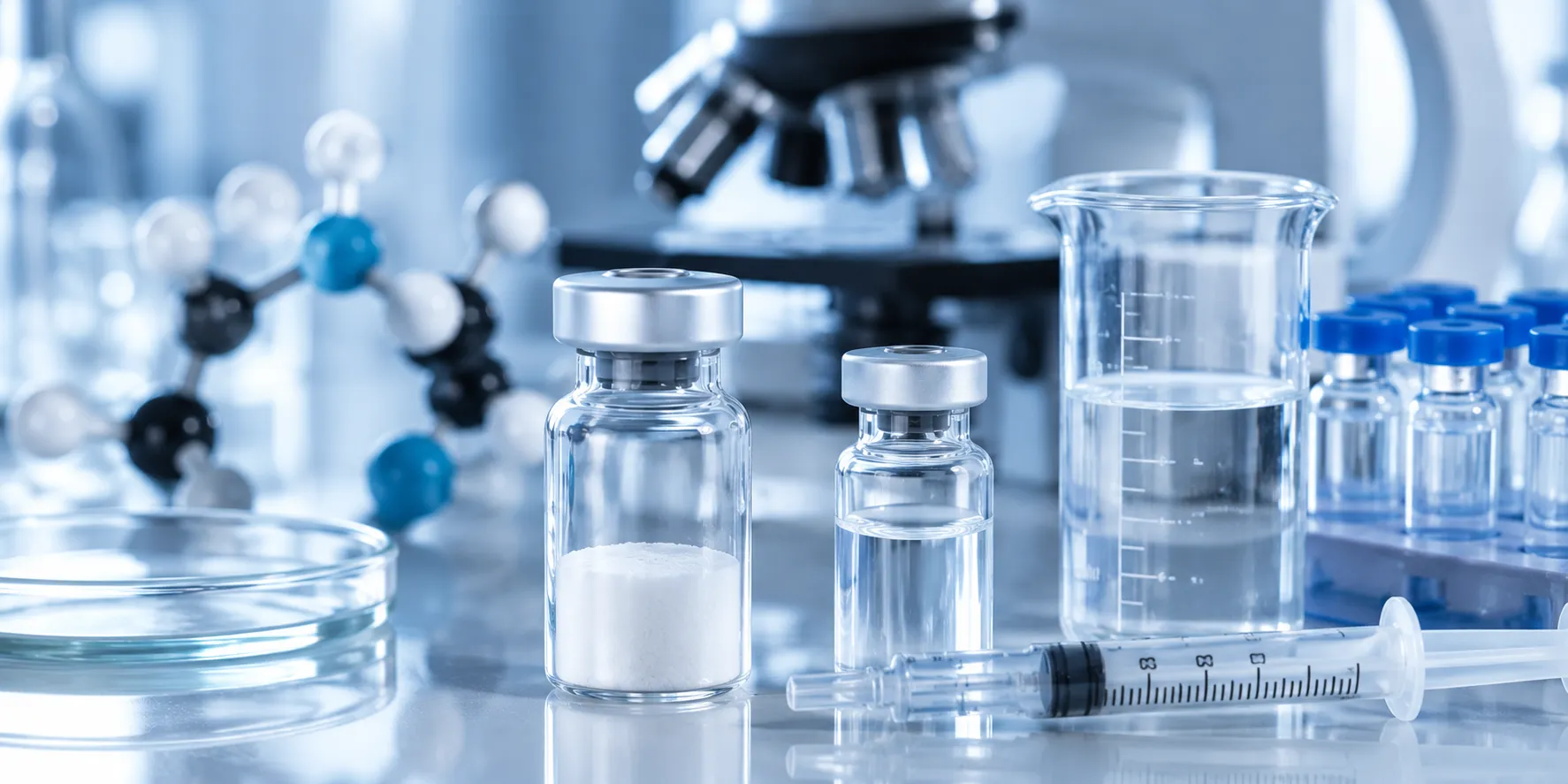
Research peptides are short chains of amino acids manufactured for laboratory and preclinical research, not for human or animal consumption. They're synthesized to a defined sequence and molecular weight, then verified for purity and identity before shipping. Reputable suppliers label every vial “for laboratory research use only” and back that label with third-party testing.
That one paragraph answers the query directly, but the details matter, so let's go section by section.
How Research Peptides Are Made
Peptides don't occur as a single uniform category — each one is built to a specific amino acid sequence for a specific research application. But the manufacturing process behind almost all commercially available research peptides follows the same core method.
Solid-Phase Peptide Synthesis (SPPS)
Most research peptides are built using solid-phase peptide synthesis, a technique where amino acids are added one at a time to a growing chain anchored to an insoluble resin. Each amino acid is attached, its protecting group is removed, and the next one is added — repeated until the full sequence is complete. The peptide is then cleaved from the resin and purified.
This approach lets manufacturers produce longer, more complex sequences with fewer errors than older solution-phase methods, which is part of why SPPS has become the standard in both pharmaceutical and research-grade peptide manufacturing.
Purification and the Final Product
Once synthesis is complete, the raw peptide still contains byproducts — truncated sequences, deletion sequences, and residual reagents. High-performance liquid chromatography (HPLC) separates the target peptide from these impurities. The purified peptide is then typically lyophilized (freeze-dried) into a stable powder for shipping and storage, since peptides in solution degrade far faster than lyophilized ones.
Key takeaway: A research peptide's quality is determined at two separate stages — synthesis accuracy and purification thoroughness. A supplier that skips or shortcuts either step ends up selling a peptide that doesn't match its label, even if the packaging looks identical to a properly tested product.
What Does RUO Mean? Research Use Only Explained
RUO stands for Research Use Only. It's a labeling designation that tells buyers, distributors, and regulators that a compound is intended exclusively for laboratory research — not for human use, veterinary use, food, or cosmetic application. It's the same category framework used across the broader life sciences industry for lab reagents, diagnostic components, and research chemicals generally, not something unique to peptides.
“Not for Human Consumption” — Why That Label Exists
RUO products haven't gone through the FDA's drug approval process (safety and efficacy trials, manufacturing standards for human-use products, or clinical review). That doesn't mean the compound is unsafe or illegitimate for its stated purpose — it means it hasn't been evaluated for that different, much higher regulatory bar. The “not for human consumption” language is a legal and safety boundary, not a marketing footnote, and any credible research peptide seller states it clearly rather than burying it in fine print.
Research Peptides vs. Pharmaceutical Peptides
These two categories are often confused, but they differ in almost every practical respect: intended use, regulatory pathway, manufacturing standard, and how they reach a buyer.
Factor | Research Peptides (RUO) | Pharmaceutical Peptides |
Intended use | Laboratory and preclinical research only | Human therapeutic use |
Regulatory pathway | Not FDA-approved for human use | FDA-approved drug or compounded under a licensed pharmacy |
Manufacturing standard | Varies by supplier; look for GMP-aligned facilities | cGMP-mandated, FDA-inspected |
Purchase pathway | Direct from RUO supplier, no prescription | Prescription required (or compounding pharmacy order) |
Labeling | "Research use only, not for human consumption" | Dosing instructions, drug facts, prescribing information |
Testing disclosure | Should include third-party COA | Batch records under regulatory oversight |
Featured-snippet answer: Research peptides are RUO-labeled compounds sold for laboratory study, with no FDA approval for human use and no prescription requirement. Pharmaceutical peptides are FDA-approved or pharmacy-compounded products intended for human treatment, dispensed only with a prescription and manufactured under cGMP oversight.
Is It Legal to Buy Research Peptides in the USA? (2026 Update)
Buying RUO-labeled research peptides for legitimate laboratory research is legal in the United States. What's regulated is not the peptide category broadly — it's specific compounds and specific uses.
The FDA's Role
The FDA doesn't pre-approve RUO products the way it approves drugs, but it does enforce against RUO-labeled products that are marketed or sold for human use. The distinction the agency draws is intent and marketing: a compound properly labeled, marketed, and sold strictly for laboratory research sits outside the drug-approval framework; the same compound marketed with dosing suggestions for human use does not.
DEA Scheduling
Most research peptides are not scheduled controlled substances, meaning the DEA doesn't regulate their purchase the way it regulates controlled drugs. A small number of specific compounds carry scheduling status, so this is always worth verifying compound-by-compound rather than assuming the entire category is unregulated.
The 2026 Compounding Rule Landscape
2026 has been an active year for peptide regulation, particularly around compounds that sit near the boundary between “research chemical” and “compounded drug ingredient.” In April 2026, the FDA removed BPC-157 and TB-500 from its Category 2 bulk drug substance list, and in late July 2026 the Pharmacy Compounding Advisory Committee voted (8-6, a nonbinding recommendation) to add both compounds to the 503A Bulks List — a step that, if finalized, would open a compounding-pharmacy pathway for those two specific peptides.
This matters for buyers because it illustrates something important about the category: regulatory status is compound-specific and it changes. A peptide that's RUO-only today can shift toward a compounding or prescription pathway tomorrow, and vice versa. If a specific compound's legal status matters to your work, verify it directly against current FDA and DEA guidance rather than relying on a static assumption.
Understanding Peptide Purity and Testing
Purity is the single most important quality signal in this category, because it directly determines whether a peptide behaves the way the published research on that sequence would predict.
HPLC and Mass Spectrometry
High-performance liquid chromatography (HPLC) measures purity — how much of the vial's contents is the target peptide versus synthesis byproducts. Mass spectrometry confirms identity — that the peptide's molecular weight actually matches the sequence on the label. A peptide can pass one test and fail the other, which is why a credible certificate of analysis includes both.
How to Read a Certificate of Analysis (COA)
A COA should be from an independent third-party lab, not the manufacturer's own in-house testing, and it should include:
- The peptide's exact sequence or name
- Purity percentage, backed by an HPLC chromatogram
- Molecular weight confirmation via mass spectrometry
- Batch or lot number matching the vial you received
- Testing lab name and test date
If a vendor can't produce a COA that meets those five points for the specific batch you're buying, treat that as a serious gap, not a minor omission.
98% vs. 99% Purity — Does It Matter?
For most research applications, the difference between 98% and 99% purity is smaller in practice than it looks on paper — both represent high-quality material suitable for laboratory use. What matters more is consistency: a supplier who reliably hits their stated purity batch after batch, with documentation to prove it, is more valuable than a marginally higher number with no verification behind it.
How to Store and Reconstitute Research Peptides
Storage Guidelines
- Lyophilized (freeze-dried) peptides: store in a freezer, protected from light, until ready to reconstitute
- Reconstituted peptides: refrigerate, use within the timeframe indicated by the supplier's documentation, and avoid repeated freeze-thaw cycles
- Keep vials in their original, sealed packaging until use to limit moisture exposure
Reconstitution Basics
Reconstitution is the process of dissolving a lyophilized peptide into a liquid solution, typically using bacteriostatic water, so it can be measured and used in a research protocol. The general steps:
- Bring the lyophilized vial and diluent to room temperature
- Slowly inject the bacteriostatic water down the interior wall of the vial rather than directly onto the powder
- Gently swirl — never shake — until the powder is fully dissolved
- Label the reconstituted vial with the date and concentration
- Store per the supplier's guidance and use within the recommended window
A peptide reconstitution calculator removes the guesswork from step 3 by converting vial size, diluent volume, and desired concentration into an exact figure — useful for maintaining consistency across a research protocol.
Common Categories of Research Peptides
Research peptides span several application areas within the broader research literature:
- Growth factor peptides — studied in tissue-repair and regenerative research
- Metabolic peptides — studied in relation to metabolic and weight-related research models
- Cosmetic and dermatological peptides — studied for skin-related research applications
- Longevity peptides — studied within aging and cellular research
- Peptide blends — combinations formulated for multi-pathway research designs
Each category has its own dedicated compound guides, linked at the end of this article, that go deeper into specific sequences, published research, and handling considerations.
How to Choose a Reliable Research Peptide Supplier
Red Flags to Avoid
- No COA available, or a COA that isn't matched to your specific batch/lot
- Marketing language that suggests dosing for human use
- No verifiable US-based manufacturing or shipping information
- Pricing dramatically below the rest of the market with no explanation
- No customer support channel or unclear return/quality-issue policy
Questions to Ask Before You Buy
- Can you provide a third-party COA for this specific batch?
- Where is this peptide manufactured, and under what quality standards?
- What's your policy if a batch fails to match its stated purity?
- How is the product shipped and stored in transit?
- Do you disclose HPLC and mass spectrometry results, or just a purity percentage?
A supplier willing to answer all five clearly, with documentation, is signaling exactly the kind of transparency this category needs more of.
Key Takeaways
- Research peptides are RUO-labeled compounds manufactured for laboratory research only, not human or animal use
- SPPS synthesis followed by HPLC purification and lyophilization is the standard manufacturing path
- RUO status is legal for legitimate research use, but it is not the same as FDA drug approval
- Regulatory status is compound-specific and can change — the BPC-157/TB-500 rule activity in 2026 is a live example
- A trustworthy COA needs independent lab testing, both HPLC and mass spec results, and batch-matched documentation
- Consistency and transparency matter more than a marginal purity percentage difference
- Proper storage, careful reconstitution, and buying from a supplier who documents everything reduce risk and protect research integrity
Frequently Asked Questions
What are research peptides used for?
Research peptides are used in laboratory studies to investigate biological mechanisms, test hypotheses, and support preclinical research. They are not intended for human or animal use.
What does RUO mean?
RUO stands for Research Use Only — a labeling designation indicating a compound is intended exclusively for laboratory research, not human consumption.
Are research peptides legal in the USA?
Yes, purchasing RUO-labeled research peptides for legitimate laboratory research is legal. Regulation applies to specific compounds and to marketing or selling them for human use, not to the category as a whole.
Do research peptides require a prescription?
No. Research peptides are sold directly by RUO suppliers without a prescription, since they are not intended for human therapeutic use. Pharmaceutical peptides, by contrast, do require a prescription.
What is the difference between research peptides and pharmaceutical peptides?
Research peptides are RUO-labeled, unapproved for human use, and sold without a prescription. Pharmaceutical peptides are FDA-approved or pharmacy-compounded, manufactured under cGMP oversight, and require a prescription.
How should research peptides be stored?
Lyophilized peptides should be kept frozen and protected from light until reconstitution. Reconstituted peptides should be refrigerated and used within the supplier's recommended timeframe.
How do I reconstitute a research peptide?
Bring the vial and bacteriostatic water to room temperature, slowly inject the diluent down the vial wall, gently swirl until dissolved, then label and store the reconstituted vial per the supplier's guidance.
How can I verify a peptide's purity?
Request a third-party certificate of analysis that includes both HPLC purity results and mass spectrometry identity confirmation, matched to the specific batch or lot number of your vial.
Why do research peptides need third-party testing?
Independent testing confirms that a peptide matches its labeled sequence and purity claim, since in-house manufacturer testing alone doesn't provide an unbiased verification.
What is the difference between 98% and 99% peptide purity?
Both represent high-quality research material, and the practical difference is often smaller than the numbers suggest. Consistency and documented verification across batches matter more than a marginal purity gap.
How do I choose a reliable research peptide supplier?
Look for a supplier who provides batch-matched third-party COAs, discloses manufacturing and testing practices, avoids human-use marketing language, and has clear support and quality-issue policies.
What regulations apply to research use only products?
RUO products fall outside FDA drug approval but are subject to FDA enforcement if marketed for human use. Some individual compounds also carry DEA scheduling or evolving compounding-pathway status, so regulatory status should be checked compound by compound.