Anyone digging into semax peptide benefits for the first time runs into the same wall: scattered forum posts, thin product pages, and old Russian clinical papers that never quite translate into a clear research picture. That gap makes it hard to evaluate the compound on its actual merits.

Semax is a synthetic heptapeptide built from a fragment of adrenocorticotropic hormone (ACTH), and it has drawn sustained research interest for its role in BDNF signaling, neuroprotection, and cognitive-function studies. This guide lays out what the peptide is, how it appears to work in laboratory and clinical-research settings, what the current 2026 U.S. regulatory picture looks like, and what to check before sourcing a research-grade batch.
Every claim below is framed for laboratory and research use only. Nothing here is a dosing recommendation, a treatment protocol, or a substitute for a licensed researcher's own review of the primary literature.
Research Use Only (RUO) Notice Semax is not approved by the FDA for human use. It is sold and discussed here strictly for laboratory research. No content in this guide should be interpreted as medical advice, a dosing protocol, or an endorsement of human consumption. |
What Is Semax Peptide?
Semax is a synthetic heptapeptide derived from the ACTH(4-10) fragment of adrenocorticotropic hormone, stabilized with a Pro-Gly-Pro tripeptide sequence that resists rapid enzymatic breakdown. Its full sequence is Met-Glu-His-Phe-Pro-Gly-Pro.
Researchers at the Institute of Molecular Genetics of the Russian Academy of Sciences developed Semax in the 1980s. It has been an approved pharmaceutical in Russia since 2011, where clinicians have studied it for cognitive and neurological applications. In the United States, Semax is classified strictly as a research chemical, and 99 Purity Peptides sells it exclusively for laboratory research under that RUO framing.
Semax Peptide: Key Identifiers
Property | Detail |
|---|---|
Classification | Synthetic heptapeptide, ACTH(4-10) analog |
Amino acid sequence | Met-Glu-His-Phe-Pro-Gly-Pro |
Stabilizing motif | Pro-Gly-Pro tripeptide (resists rapid enzymatic degradation) |
Approximate molecular weight | ~813 Da |
Origin | Institute of Molecular Genetics, Russian Academy of Sciences (1980s) |
Regulatory status (U.S.) | Research Use Only — not FDA-approved for human use |
How Does Semax Peptide Work in Research Models?
Semax's research profile centers on three overlapping mechanisms: neurotrophic signaling, melanocortin receptor activity, and monoaminergic modulation. Understanding each helps explain why researchers keep returning to this peptide across cognitive, neuroprotective, and stress-response study designs.
BDNF and Neurotrophic Signaling
Semax is associated with increased expression of brain-derived neurotrophic factor (BDNF) and its receptor pathway, TrkB, in preclinical models. BDNF supports synaptic plasticity, the process by which neural connections strengthen through use — a mechanism central to memory formation and learning. Some research also links Semax to nerve growth factor (NGF) expression, reinforcing its neurotrophic profile.
Melanocortin Receptor Interaction
As an ACTH(4-10) fragment, Semax retains affinity for melanocortin receptors in the central nervous system without triggering the hormonal, corticosteroid-releasing activity of full-length ACTH. This selective receptor interaction is one reason researchers describe Semax as an ACTH analog with cognitive rather than endocrine research relevance.
Monoaminergic and HPA-Axis Modulation
Preclinical literature also points to Semax's influence on dopamine and serotonin signaling, alongside modulation of hypothalamic-pituitary-adrenal (HPA) axis activity. Together, these pathways form the basis for research into attention, mood-adjacent behavior, and stress-response modeling in animal studies.
Quick Answer Semax's research effects are attributed to three linked mechanisms: BDNF/TrkB upregulation supporting synaptic plasticity, selective melanocortin receptor binding without ACTH's hormonal cascade, and modulation of dopamine, serotonin, and HPA-axis activity. |
Semax Peptide Benefits in Research
The term "semax peptide benefits" in a research context refers to documented and hypothesized effects observed in preclinical (largely rodent) studies and in Russian clinical research, not to guaranteed outcomes in any individual. The table below summarizes the primary research areas.
Research Area | Reported Mechanism | Research Context |
|---|---|---|
Cognitive function & memory | BDNF/TrkB upregulation, synaptic plasticity support | Rodent learning and memory models |
Neuroprotection | Antioxidant activity, neurotrophic signaling | Encephalopathy and traumatic brain injury models |
Stroke / ischemic research | Reduced oxidative stress, neurotrophic support | Russian clinical research on ischemic stroke |
Optic nerve research | Neuroprotective and regenerative signaling | Optic nerve atrophy studies |
Anti-inflammatory activity | Modulation of inflammatory mediators | Preclinical inflammation models |
Gastroprotective research | Mucosal protective signaling | Peptic ulcer research models |
Two caveats matter for anyone reviewing this literature. First, most of the foundational efficacy data comes from Russian clinical research and rodent studies, with limited large-scale Western randomized controlled trials to date. Second, none of these findings translate into a human dosing recommendation — they describe research observations, not a use protocol.
Semax vs. N-Acetyl Semax
N-Acetyl Semax is a modified variant that adds an acetyl group to the peptide's N-terminus. Researchers primarily use this modification to explore differences in stability and receptor-binding behavior relative to standard Semax.
Attribute | Semax | N-Acetyl Semax |
|---|---|---|
Structure | Standard heptapeptide sequence | N-terminal acetylated variant |
Research focus | Cognitive & neuroprotective signaling | Comparative stability & receptor studies |
Availability | Nasal spray and injectable research formats | Primarily injectable research format |
Semax vs. Selank and Semax vs. Noopept
Semax, Selank, and Noopept sit in the same broad nootropic-peptide research category, but each targets a distinct mechanism. Selank is a tuftsin analog studied primarily for GABA-B and stress-response pathways, while Noopept is a smaller synthetic dipeptide-derived compound studied for cognitive research through a different pharmacological route.
Compound | Structural Class | Primary Research Focus |
|---|---|---|
Semax | ACTH(4-10) analog heptapeptide | BDNF signaling, neuroprotection, cognitive function |
Selank | Tuftsin analog heptapeptide | GABA-B modulation, anxiolytic/stress-response research |
Noopept | Synthetic dipeptide-derived compound | Cognitive research via a distinct pharmacological pathway |
For a deeper structural and mechanism-by-mechanism comparison, see 99 Purity Peptides' dedicated Semax vs. Selank research guide, which covers shared Pro-Gly-Pro stabilization and diverging receptor targets in full.
Semax Peptide Regulatory Status in the United States (2026 Update)
Semax's U.S. regulatory position shifted twice in 2026, and researchers sourcing the compound should understand both moves.
On April 15, 2026, the FDA removed Semax — along with eleven other peptides, including BPC-157 and TB-500 — from its Category 2 restricted-substances list, following withdrawal of the original nominations. Removal from Category 2 means the FDA no longer classifies Semax as presenting significant safety risks that would bar it from further compounding review, but it does not, on its own, authorize compounding or human use.
On July 24, 2026, the FDA's Pharmacy Compounding Advisory Committee (PCAC) reviewed Semax as one of seven peptides considered for addition to the 503A Bulks List, the register of substances compounding pharmacies may legally use. The committee voted 8-5 in favor of recommending Semax for inclusion. That vote is advisory only — the FDA has not yet issued a final decision, and PCAC recommendations are not binding.
What This Means for Research Buyers Semax remains Research Use Only in the United States. Neither the April 2026 Category 2 removal nor the July 2026 PCAC recommendation makes Semax an FDA-approved drug or a legal over-the-counter product. 99 Purity Peptides sells Semax exclusively for laboratory research, not for human consumption. |
Purity, Third-Party Testing, and the Certificate of Analysis
Research validity depends on knowing exactly what is in the vial. A Certificate of Analysis (COA) documents third-party verification of a peptide's identity and purity, typically through High-Performance Liquid Chromatography (HPLC), and should accompany every research-grade Semax order.
What to check on a Semax COA:
- Independent, named third-party testing laboratory (not an in-house-only result)
- HPLC purity percentage specific to the lot you are purchasing
- Batch or lot number that matches the physical vial label
- Test date recent enough to reflect the current inventory batch
- Mass spectrometry (LC-MS) confirmation of peptide identity, where available
For a full walkthrough of how to read a COA and evaluate purity claims, see 99 Purity Peptides' Understanding Peptide Purity guide and the companion How to Choose High-Purity Research Peptides buyer's guide.
Reconstitution and Storage Guidelines for Semax Research
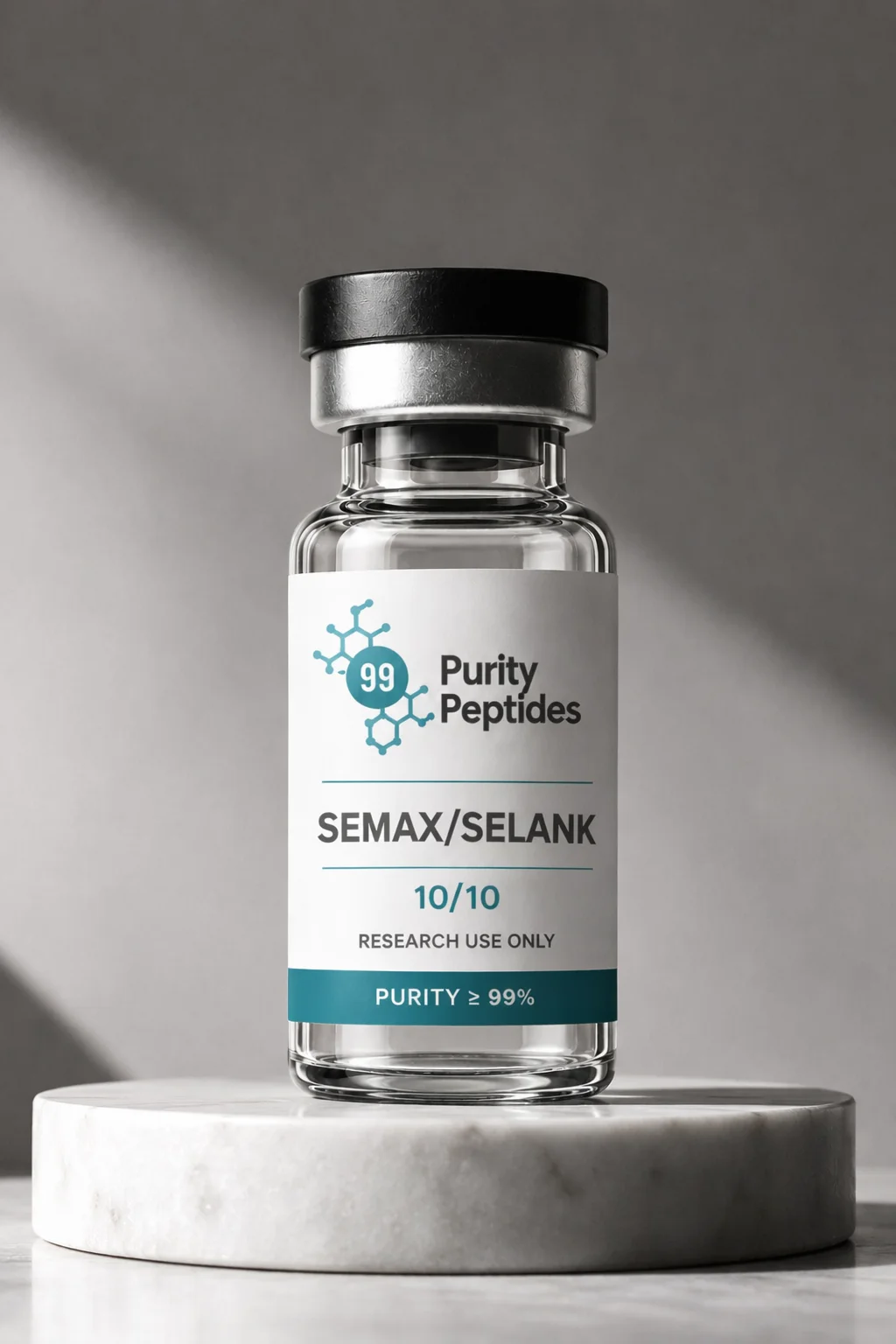
Semax ships as a lyophilized (freeze-dried) powder and requires reconstitution with bacteriostatic water before use in a research protocol. Store the lyophilized powder in a freezer, ideally between -20°C and -80°C, away from light and moisture, until you are ready to reconstitute it.
Once reconstituted, keep Semax refrigerated and use it within the stability window documented for that batch. Repeated freeze-thaw cycles and exposure to warm ambient temperatures accelerate peptide degradation. 99 Purity Peptides' Research Peptide Storage & Handling guide covers cold-chain shipping, degradation causes, and lyophilized-versus-reconstituted stability differences in detail.
How to Choose a High-Purity Semax Peptide Supplier
- Confirm a current, lot-specific Certificate of Analysis is available before you order
- Look for stated HPLC purity of 99% or higher, not a vague "high purity" claim
- Verify the supplier ships with proper cold-chain packaging
- Check that the product is explicitly labeled Research Use Only, with no human-dosing claims
- Review the supplier's own published research content for accuracy and citation quality
These same criteria apply across the research-peptide category, not just Semax. 99 Purity Peptides' buyer's guide expands each point into a full sourcing checklist.
Key Takeaways
- Semax is a synthetic ACTH(4-10) analog heptapeptide studied for BDNF signaling, neuroprotection, and cognitive-function research.
- Its research profile spans memory and learning, stroke and ischemic models, optic nerve studies, and anti-inflammatory research — primarily from rodent studies and Russian clinical research.
- N-Acetyl Semax is a stability-modified variant studied for comparative receptor behavior.
- Semax, Selank, and Noopept share a nootropic-peptide research category but target different mechanisms.
- Semax left the FDA's Category 2 list on April 15, 2026, and received an 8-5 favorable PCAC recommendation for the 503A Bulks List on July 24, 2026 — neither action makes it FDA-approved or legal for human use.
- A lot-specific COA with HPLC verification is non-negotiable for research-grade sourcing.
Frequently Asked Questions
What is Semax peptide?
Semax is a synthetic heptapeptide derived from the ACTH(4-10) fragment, studied in laboratory research for its effects on BDNF signaling, neuroprotection, and cognitive function. It is sold in the U.S. strictly for research use.
What are the main benefits of Semax peptide in research?
Research on Semax spans cognitive function and memory, neuroprotection, stroke and ischemic models, optic nerve studies, anti-inflammatory activity, and gastroprotective research, largely from rodent studies and Russian clinical research.
How does Semax peptide work in the brain?
Semax is associated with increased BDNF and TrkB signaling, selective melanocortin receptor binding, and modulation of dopamine, serotonin, and HPA-axis activity in preclinical models.
Is Semax peptide FDA-approved?
No. Semax is not an FDA-approved drug. It came off the FDA's Category 2 restricted list on April 15, 2026, and received a favorable PCAC recommendation for the 503A Bulks List on July 24, 2026, but neither action constitutes approval for human use.
What is the difference between Semax and N-Acetyl Semax?
N-Acetyl Semax adds an acetyl group to the N-terminus of the standard Semax sequence. Researchers use this variant primarily to study differences in stability and receptor-binding behavior.
What is the difference between Semax and Selank?
Semax is an ACTH(4-10) analog studied for BDNF signaling and cognitive research, while Selank is a tuftsin analog studied for GABA-B modulation and stress-response research. Both share a stabilizing Pro-Gly-Pro sequence.
Does Semax peptide have anti-inflammatory properties?
Preclinical research has explored anti-inflammatory and gastroprotective activity for Semax, alongside its more established neuroprotective and cognitive research profile.
How should Semax peptide be stored?
Store lyophilized Semax frozen, ideally between -20°C and -80°C, away from light and moisture. After reconstitution with bacteriostatic water, keep it refrigerated and use it within the stability window documented for that batch.
How is Semax peptide reconstituted for research use?
Semax ships as a lyophilized powder that researchers reconstitute with bacteriostatic water before use. Refer to the product's storage guide for lot-specific volume and concentration guidance.
Does Semax peptide come with a Certificate of Analysis?
Research-grade Semax from 99 Purity Peptides ships with a lot-specific Certificate of Analysis documenting third-party HPLC purity testing.
What was the FDA's 503A Category 2 status of Semax before 2026?
Semax was previously listed on the FDA's Category 2 list, which flags substances the agency considers to present significant safety risks for compounding. The FDA removed Semax from that list on April 15, 2026.
Why was Semax reviewed by the FDA's Pharmacy Compounding Advisory Committee in July 2026?
After its Category 2 removal, Semax was one of seven peptides the PCAC reviewed on July 23-24, 2026, to recommend for or against addition to the 503A Bulks List, which governs which substances compounding pharmacies may legally use.