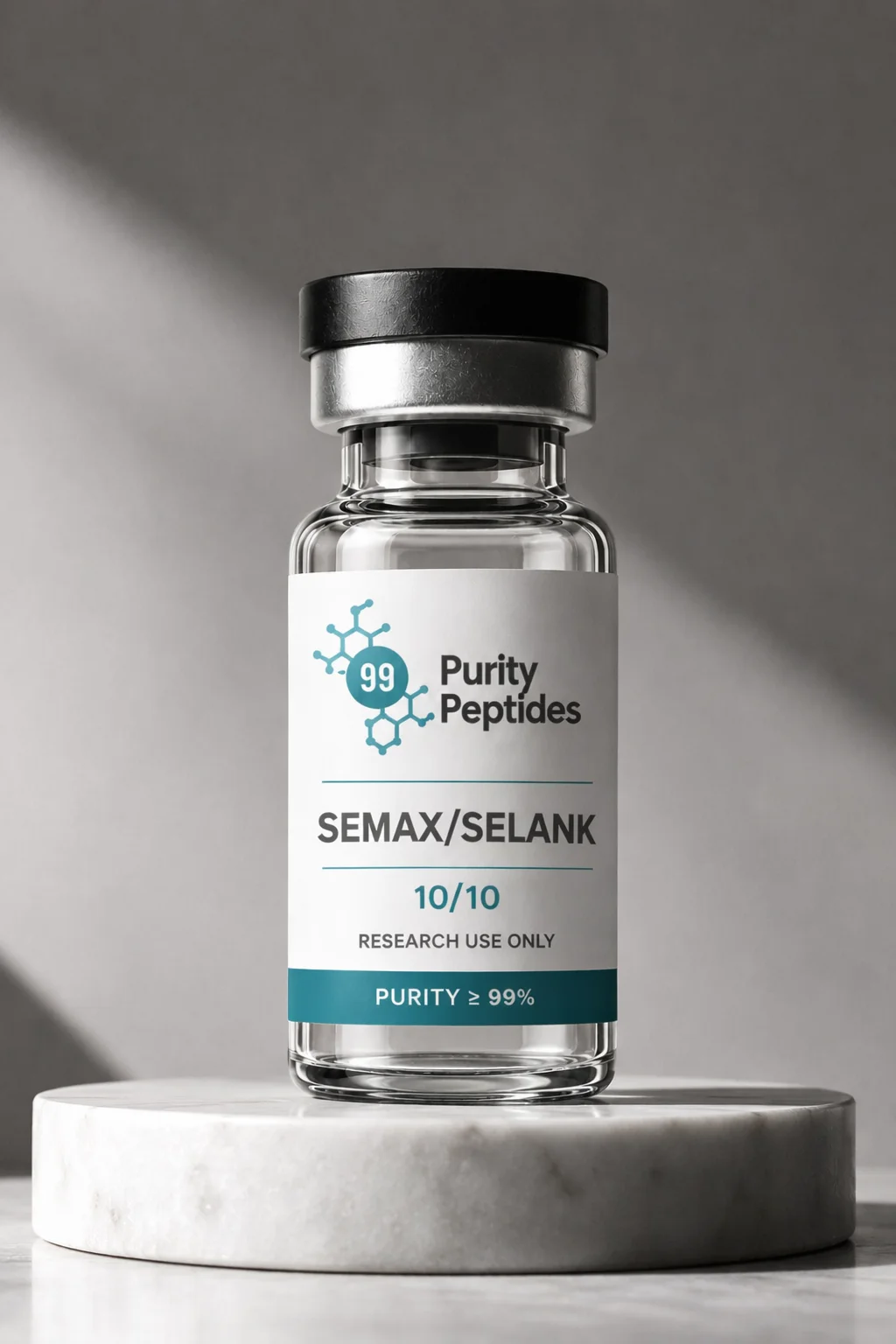
Semax and Selank show up together constantly in nootropic peptide research discussions, and it's easy to see why: both are Russian-developed synthetic peptides, both are derived from natural regulatory peptides in the body, and both get studied for effects on the central nervous system. That overlap is exactly what makes them confusing to compare — researchers often assume they're interchangeable tools for the same job when they're actually built from different peptide families with different biological targets.

Semax is an ACTH(4-10) analogue most closely associated in the literature with cognitive and neurotrophic research, particularly around BDNF expression. Selank is a synthetic tuftsin analogue studied primarily in the context of stress-response modeling and GABAergic activity. Same general category — synthetic regulatory-peptide research tools — but different structural class, different proposed mechanisms, and different research applications.
This guide lays out exactly how Semax and Selank differ: their molecular classification, structure, proposed mechanisms of action, and how each is typically handled in a laboratory setting, from reconstitution through storage. You'll also find a side-by-side comparison table and answers to the questions researchers ask most often before choosing between the two.
Research Use Only Semax and Selank, as sold by 99 Purity Peptides, are research chemicals intended strictly for laboratory and in-vitro/in-vivo research use. They are not drugs, dietary supplements, or products for human consumption, and nothing in this article should be read as a recommendation for personal use. |
What Is Semax?
Semax is a synthetic heptapeptide (7 amino acids) developed as an analogue of ACTH(4-10), a fragment of adrenocorticotropic hormone. Unlike native ACTH(4-10), Semax is structurally modified with a Pro-Gly-Pro tripeptide addition at the C-terminus, which extends its stability without carrying the hormonal activity associated with full ACTH. That modification is what turns a fast-degrading natural fragment into a peptide stable enough to study.
In the research literature, Semax is most frequently discussed in relation to brain-derived neurotrophic factor (BDNF) expression and central nervous system signaling pathways tied to learning, memory, and neuroprotection. It's typically formulated and studied via intranasal delivery models in published research, reflecting how the compound is designed to cross into central nervous system research contexts efficiently.
- Molecular classification: ACTH(4-10) analogue (heptapeptide)
- Approximate molecular weight: 813 Da
- Key structural feature: C-terminal Pro-Gly-Pro extension for stability
- Primary research relevance: BDNF expression, cognitive and neuroprotective research models
What Is Selank?
Selank is a synthetic nonapeptide (9 amino acids) derived from tuftsin, a naturally occurring immunomodulatory tetrapeptide. Like Semax, Selank is built with a Pro-Gly-Pro C-terminal extension added to the native tuftsin sequence, which increases its enzymatic stability compared to unmodified tuftsin. The structural strategy is nearly identical to Semax's — stabilize a short, fast-degrading natural peptide fragment — but the starting fragment and its associated research targets are different.
Selank is studied predominantly in the context of stress-response modeling and anxiolytic-like activity in research models, with proposed mechanisms involving GABA-B receptor activity and modulation of the hypothalamic-pituitary-adrenal (HPA) axis. Because it originates from tuftsin rather than ACTH, its research literature centers on stress and behavioral models rather than the cognitive/neurotrophic focus more associated with Semax.
- Molecular classification: Tuftsin analogue (nonapeptide)
- Approximate molecular weight: 751 Da
- Key structural feature: C-terminal Pro-Gly-Pro extension on the native tuftsin sequence
- Primary research relevance: GABA-B receptor activity, HPA axis / stress-response research models
Semax vs Selank: Key Differences at a Glance
Featured Snippet Answer: Semax and Selank are both stabilized synthetic peptides built with a Pro-Gly-Pro extension, but they come from different parent molecules — Semax from ACTH(4-10), Selank from tuftsin — which is why Semax is studied mainly for cognitive/BDNF research and Selank for stress-response and GABAergic research.
Attribute | Semax | Selank |
|---|---|---|
Parent molecule | ACTH(4-10) fragment | Tuftsin (immunomodulatory tetrapeptide) |
Peptide class | Heptapeptide (7 amino acids) | Nonapeptide (9 amino acids) |
Approx. molecular weight | 813 Da | 751 Da |
Stabilizing modification | C-terminal Pro-Gly-Pro extension | C-terminal Pro-Gly-Pro extension |
Proposed primary mechanism | BDNF expression / neurotrophic signaling | GABA-B receptor activity / HPA axis modulation |
Dominant research focus | Cognitive function, memory, neuroprotection models | Stress response, anxiolytic-like behavior models |
Typical research delivery model | Intranasal delivery model | Intranasal delivery model |
Reported solution stability | Stable under proper cold storage | Stable under proper cold storage |
Molecular Structure & Mechanism of Action
10.1 A Shared Stabilization Strategy, Different Starting Points
Both Semax and Selank exist because their parent fragments — ACTH(4-10) and tuftsin, respectively — are naturally short-lived, broken down quickly by peptidases in biological systems. Researchers in the original Russian peptide programs addressed this the same way for both: attaching a Pro-Gly-Pro tripeptide to the C-terminus, which resists enzymatic degradation without fundamentally altering the parent fragment's proposed activity. That shared engineering trick is why the two compounds are so often mentioned in the same breath, even though what they're derived from is unrelated.
10.2 Semax and the ACTH(4-10) Pathway
ACTH(4-10) is the mid-region fragment of adrenocorticotropic hormone that retains central nervous system activity without the hormonal (adrenal-stimulating) effects of full-length ACTH. Semax's research profile centers on this fragment's proposed role in upregulating BDNF expression, a protein central to neuroplasticity, learning, and neuronal survival — which is why Semax shows up predominantly in cognitive and neuroprotective research designs.
10.3 Selank and the Tuftsin Pathway
Tuftsin is best known in the literature for immunomodulatory activity, but Selank's research applications diverge from that immune focus toward central nervous system effects — specifically stress-response and anxiolytic-like activity in research models, with proposed involvement of GABA-B receptor signaling and HPA axis regulation. The tuftsin lineage is structural, not functional; Selank's studied effects are almost entirely CNS-focused rather than immune-focused.
Research Applications Comparison
Because Semax and Selank come from different peptide families, their research literature clusters around different questions, even though both are broadly categorized as "nootropic peptides" in research-supplier terminology.
- Semax research models frequently examine learning and memory consolidation, neuroprotective signaling, and BDNF expression changes following administration in preclinical models.
- Selank research models more often examine stress-response behavior, anxiolytic-like activity, and modulation of GABAergic signaling in preclinical behavioral paradigms.
- Some research protocols study Semax and Selank together, treating them as complementary rather than redundant tools — one targeting neurotrophic/cognitive pathways, the other targeting stress-response pathways.
Quick Answer Semax and Selank are not the same class of peptide and are not interchangeable research tools. Semax is an ACTH(4-10) analogue studied mainly for cognitive/BDNF-related research; Selank is a tuftsin analogue studied mainly for stress-response and GABAergic research. |
Choosing Between Semax and Selank for Your Study
The right compound depends entirely on which biological pathway your protocol is designed to investigate.
12.1 Semax may fit your protocol when:
- The research question involves BDNF expression, neuroplasticity, or neuroprotective signaling
- The study design centers on learning, memory, or cognitive-function models
- You're building on existing literature that used ACTH(4-10)-derived analogues
12.2 Selank may fit your protocol when:
- The research question involves stress-response behavior or the HPA axis
- The study design centers on anxiolytic-like activity or GABAergic signaling models
- You're building on existing literature that used tuftsin-derived analogues
Researcher Checklist Before ordering either peptide, confirm: (1) which biological pathway your protocol targets — neurotrophic/cognitive or stress-response/GABAergic, (2) whether your study design requires them individually or as a combined-protocol comparison, (3) your lab's cold-chain and reconstitution capability, and (4) that your supplier provides a batch-specific Certificate of Analysis. |
Purity, Testing & Certificates of Analysis
Because Semax and Selank research findings often hinge on precise dosing and consistent compound identity, purity verification isn't optional context — it's foundational to reproducible results. This is a core E-E-A-T signal for any research peptide supplier, and researchers should treat it as a baseline requirement rather than a bonus feature.
At minimum, look for the following from any Semax or Selank supplier:
- A batch-specific Certificate of Analysis (COA), not a generic or outdated one
- Purity verification via HPLC (high-performance liquid chromatography)
- Identity confirmation via mass spectrometry
- Third-party lab testing rather than in-house-only results
- Clear Research Use Only (RUO) labeling and documentation
99 Purity Peptides batch-tests its Semax and Selank inventory and provides Certificates of Analysis for verification — a baseline researchers should expect from any domestic USA peptide supplier before basing a study on a given lot.
Storage, Reconstitution & Handling Best Practices
Both Semax and Selank are typically supplied as lyophilized (freeze-dried) peptide powder and require the same careful handling common to short synthetic peptides.
Before reconstitution
- Store lyophilized peptide powder frozen, away from light and moisture, until ready for use
- Allow vials to reach room temperature before opening to avoid condensation inside the vial
Reconstitution
- Use sterile or bacteriostatic water (per your protocol) as the reconstitution liquid
- Add the diluent slowly, directing the stream against the vial wall rather than directly onto the lyophilized powder
- Gently swirl to dissolve — do not shake, which can degrade peptide structure
- Label the vial with reconstitution date and concentration for traceability
After reconstitution
- Refrigerate reconstituted peptide and avoid repeated freeze-thaw cycles
- Use reconstituted solution within the timeframe validated by your lab's stability protocol
- Discard any solution showing discoloration, precipitation, or cloudiness
Research Use Only Compliance & Safety
Semax and Selank are sold and distributed strictly for laboratory research applications. They are not approved by the FDA for human use, are not dietary supplements, and are not intended for diagnostic or therapeutic administration outside of a qualified research setting.
- Products should only be handled by qualified personnel in an appropriate laboratory environment
- Every order should be accompanied by RUO documentation and, where applicable, a Safety Data Sheet (SDS)
- Researchers should follow their institution's protocols for handling and disposing of research peptides
Common Mistakes Researchers Make When Comparing Semax and Selank
- Assuming both peptides target the same pathway because they're marketed together as "nootropic peptides"
- Overlooking that the Pro-Gly-Pro stabilization is a shared engineering feature, not evidence of a shared mechanism
- Sourcing from a supplier without batch-specific COAs, making purity assumptions instead of verifying them
- Reconstituting more peptide than a single research session requires
- Skipping documentation of reconstitution date and storage conditions, which undermines reproducibility
Key Takeaways
- Semax is an ACTH(4-10) analogue (heptapeptide); Selank is a tuftsin analogue (nonapeptide) — different parent molecules despite a shared stabilization strategy
- Both use a C-terminal Pro-Gly-Pro extension to resist enzymatic degradation compared to their unmodified parent fragments
- Semax's research literature centers on BDNF expression, cognition, and neuroprotection; Selank's centers on stress response, GABA-B activity, and HPA axis modulation
- The two are not interchangeable — the right choice depends on which biological pathway your protocol investigates
- Purity verification (HPLC, mass spectrometry, third-party COA) matters as much as which peptide you choose
- Both peptides are Research Use Only and are not intended for human consumption
Frequently Asked Questions
What is the main difference between Semax and Selank?
Semax is an ACTH(4-10) analogue studied mainly for cognitive and BDNF-related research, while Selank is a tuftsin analogue studied mainly for stress-response and GABAergic research. They come from different parent molecules despite sharing a similar stabilization strategy.
What is Semax peptide?
Semax is a synthetic heptapeptide derived from ACTH(4-10), stabilized with a C-terminal Pro-Gly-Pro extension, studied in research contexts related to BDNF expression, learning, and neuroprotection.
What is Selank peptide?
Selank is a synthetic nonapeptide derived from tuftsin, stabilized with the same Pro-Gly-Pro extension strategy, studied primarily for stress-response and anxiolytic-like activity in research models.
Are Semax and Selank the same class of peptide?
No. Semax is an ACTH(4-10) analogue and Selank is a tuftsin analogue — different parent molecules and different research focuses, even though both are marketed under the broader "nootropic peptide" category.
How does Semax work at the molecular level?
Semax's proposed mechanism centers on upregulating BDNF (brain-derived neurotrophic factor) expression, a protein linked to neuroplasticity, learning, and neuronal survival in research models.
How does Selank work at the molecular level?
Selank's proposed mechanism involves GABA-B receptor activity and modulation of the HPA (hypothalamic-pituitary-adrenal) axis, which is why its research literature centers on stress-response modeling.
Can Semax and Selank be researched together?
Some research protocols study the two together as complementary tools targeting different pathways — Semax for neurotrophic/cognitive signaling and Selank for stress-response signaling — rather than as interchangeable substitutes.
How should I store Semax and Selank peptides?
Store lyophilized powder frozen and protected from light and moisture. Once reconstituted, refrigerate and avoid repeated freeze-thaw cycles, using the solution within the timeframe your lab's stability protocol specifies.
What purity does 99 Purity Peptides guarantee?
99 Purity Peptides batch-tests its Semax and Selank inventory and provides a Certificate of Analysis (COA) with HPLC and mass spectrometry verification for each batch.
Do you provide a certificate of analysis (CoA)?
Yes. A batch-specific Certificate of Analysis is available for every Semax and Selank order to verify purity and identity before use.
Are Semax and Selank sold for research use only?
Yes. Both peptides are sold strictly for laboratory research purposes and are not intended for human consumption, diagnostic use, or therapeutic administration.
How do I reconstitute lyophilized Semax or Selank?
Add sterile or bacteriostatic water slowly against the vial wall, then gently swirl (never shake) until fully dissolved, and label the vial with the reconstitution date and concentration.
Which peptide has more published research, Semax or Selank?
Both have an established research literature base, though they cluster around different topics — Semax around cognitive/BDNF research and Selank around stress-response research — making direct volume comparisons context-dependent.
What is the shelf life of lyophilized Semax and Selank?
Properly stored lyophilized peptide (frozen, protected from light and moisture) maintains stability considerably longer than reconstituted solution; always follow your lab's validated stability data for exact timelines.
How do I choose between Semax and Selank for my study?
Match the peptide to your research question: choose Semax for protocols investigating BDNF expression, learning, or neuroprotection, and Selank for protocols investigating stress response or GABAergic activity.