Last reviewed: October 2026

Quick Answer N-acetyl selank amidate is not another name for Selank. It is a separate, related molecule: Selank's seven-residue sequence with an acetyl cap added at the N-terminus and an amide replacing the C-terminal acid. That shifts its mass from 751.89 Da to about 792.94 Da, and no published study has tested the modified version.
Key Takeaways
- Selank is the heptapeptide Thr-Lys-Pro-Arg-Pro-Gly-Pro (TKPRPGP), formula C33H57N11O9, average mass 751.89 Da [4][5].
- N-Acetyl Selank Amidate, sold as "NA-Selank" or "NASA Selank," is reported as Ac-Thr-Lys-Pro-Arg-Pro-Gly-Pro-NH2. By our calculation that is C35H60N12O9, about 792.94 Da.
- The two changes net out to +41.05 Da: the acetyl cap adds 42.04 Da and amidation removes 0.98 Da.
- A PubMed search on 3 October 2026 found 136 records for Selank and 0 for the modified compound under any name or sequence notation we tried.
- The only CAS-style registry entry we found, on ChemicalBook (CAS 2920938-92-5), lists formula C17H20FN3O2 and 317.36 Da. That cannot describe any form of this heptapeptide.
- Selank's research record is mostly animal work from Russian institutions, plus small Russian-language clinical reports such as a 62-patient comparison published in 2008 [9]. None of it transfers automatically to the modified molecule.
- The "more stable" claim for NA-Selank is a reasonable inference from general peptide chemistry [7], not a measured result for this compound.
Research Use Only. Every compound discussed here is sold strictly for laboratory research. It is not for human consumption or veterinary use, and nothing on this page is medical, dosing or health advice.
Is N-Acetyl Selank Amidate the Same as Selank?
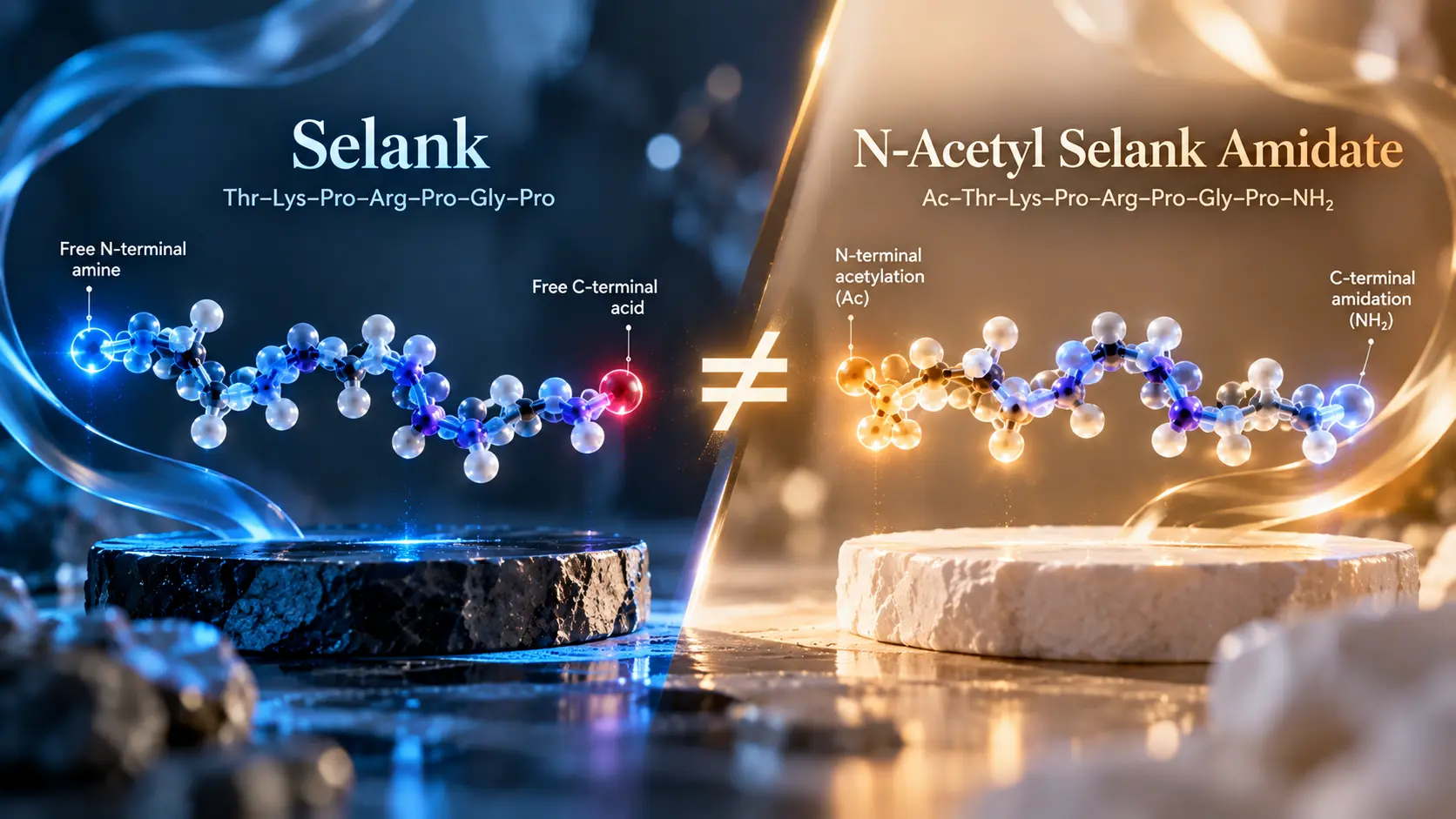
No: N-Acetyl Selank Amidate and Selank share an amino acid sequence but have different ends, different formulas and different masses, so they are two molecules.
Start with the parent. Selank is a synthetic analogue of tuftsin, the tetrapeptide Thr-Lys-Pro-Arg first isolated by Najjar and Nishioka in 1970 [1][2]. Russian researchers extended that four-residue core with a Pro-Gly-Pro tail, giving the seven-residue chain Thr-Lys-Pro-Arg-Pro-Gly-Pro [3][4]. Groups at the Institute of Molecular Genetics of the Russian Academy of Sciences have published most of the later work on it [4][5][6]. For Selank's own background and research history, the site's Selank research overview covers it in depth, and this page will not repeat it.
In its standard form, Selank has a free amine (NH2) on threonine at one end. It has a free carboxylic acid (COOH) on proline at the other.
The modified compound keeps all seven residues in the same order. What changes is the two ends. Vendor listings and product titles report the structure as Ac-Thr-Lys-Pro-Arg-Pro-Gly-Pro-NH2: an acetyl group on the N-terminal threonine and a carboxamide in place of the C-terminal acid.
We could not confirm that structure from any primary or database source. No peer-reviewed paper describes it, and the one registry entry we found is visibly wrong (more on that below). The sequence on this page is therefore the vendor-reported structure, checked for internal consistency by our own arithmetic. It has not been independently verified.
That distinction matters more than it sounds. A molecule with a different formula is a different chemical entity, even when the backbone is identical. Calling the two "the same thing" is like calling a methyl ester the same compound as its parent acid.
What Exactly Was Modified?
Two small chemical groups were changed, one at each end of the chain, and nothing in the interior sequence was touched.
N-terminal acetylation. An acetyl group (CH3CO-) is attached to the free amine of threonine. That adds C2H2O, or 42.04 Da on average mass. The terminal amine loses the positive charge it would normally carry at neutral pH.
C-terminal amidation. The carboxylic acid on the final proline (-COOH) becomes a primary amide (-CONH2). One oxygen leaves and one nitrogen plus one hydrogen arrive. The net average-mass change is -0.98 Da. Its terminal negative charge disappears along with the acid.
Change | Where on the chain | Atoms added / removed | Average mass change | Charge effect at neutral pH |
|---|---|---|---|---|
N-terminal acetylation | Amine of Thr1 | +C2H2O | +42.04 Da | Removes the terminal positive charge |
C-terminal amidation | Carboxyl of Pro7 | -O, +N, +H | -0.98 Da | Removes the terminal negative charge |
Both together | Both ends | +C2H3N (net) | +41.05 Da | Removes both terminal charges |
The interior residues still carry their own charges. Lysine and arginine side chains stay positive, so the molecule as a whole remains basic.
We rebuilt Selank's formula from its seven residues and got C33H57N11O9, 751.89 Da, matching the published figure. Applying both changes gives C35H60N12O9 and 792.94 Da for the vendor-reported NA-Selank structure. The difference is 41.05 Da.
One number deserves special attention. Amidation alone moves the mass by less than one dalton. A low-resolution mass spectrum, read loosely, can blur that gap. We return to this in the verification section, because it is the most practical point on the page.
Why Would a Modified Version Be Made?
Capping both ends usually slows breakdown by enzymes that work from the chain ends, but nobody has published that rationale for this molecule.
The general principle is well documented. Exopeptidases need a free terminal group to grip. Aminopeptidases work from a free N-terminal amine, and carboxypeptidases work from a free C-terminal acid. Removing those handles can extend a peptide's life in biological fluids. A clear example comes from cancer-vaccine research in 1999. Brinckerhoff and colleagues found that the unmodified MART-1(27-35) peptide had a calculated half-life of 22 seconds in fresh human plasma, measured in vitro. N-terminal acetylation, C-terminal amidation, or both, markedly prolonged its stability [7]. Reviews of peptide design make the same general point: native peptides are cut quickly by proteases, which shortens their activity [8].
Selank's own breakdown pattern makes the idea plausible. A 2006 tracer study using tritium-labeled Selank in blood plasma identified TKPRP, TKP, RP and GP as the main fragments [5]. Several of those cuts happen near or at the ends of the chain.
Here is the editorial judgment, stated plainly. Capping the ends is a sensible design choice, but "more stable" is still a prediction for NA-Selank. Nobody has measured its half-life in plasma, tissue or any other matrix.
There is also a subtler problem the vendor pages skip. Selank's fragments may not be inert waste. A 2003 animal study comparing Selank with ten related tuftsin-family peptides attributed some effects to "degradation fragments" [3]. In a 2014 mouse study, the dipeptide Gly-Pro, a Selank breakdown product, shifted several inflammation-related genes in the spleen. Its patterns often matched Selank itself [6].
If part of Selank's activity in those models comes from its fragments, slowing fragment release could change the profile, not just stretch it. That is a hypothesis, not a finding. It is a strong reason to stop treating NA-Selank as "Selank, but longer-lasting."
Is There an Independent Record of This Compound's Identity?
Not a reliable one: the only CAS-numbered entry we found lists an impossible formula, and no primary database confirms the reported structure.
We searched PubChem, ChemSpider, ChemicalBook and CAS Common Chemistry for the compound name, its abbreviations and its sequence notation. Results, as of 3 October 2026:
Source | What it lists for the modified molecule | Consistent with Ac-TKPRPGP-NH2? | Our grade |
|---|---|---|---|
ChemicalBook entry "n-acetyl selank amidate" [10] | CAS 2920938-92-5; formula C17H20FN3O2; 317.36 Da | No. A heptapeptide cannot contain fluorine or weigh 317 Da | Unreliable |
CAS Common Chemistry | No match found for that CAS number or name | Cannot assess | Not confirmable |
PubChem [11] | A compound page titled "N-Acetyl selank" exists. The title names only acetylation | Unclear. Structure fields could not be retrieved for this review | Unconfirmed |
PubMed (literature) | No paper describes the synthesis or characterization | Cannot assess | Absent |
The ChemicalBook entry is the instructive one. Its formula, C17H20FN3O2, describes a small fluorinated organic molecule. Selank contains 33 carbons before any modification. Any form of this heptapeptide must contain at least 33 carbons and 11 nitrogens. The entry appears to attach the product name to the wrong structure.
That also means the CAS number 2920938-92-5 should not be repeated as this compound's identifier. We could not confirm it in CAS's own public registry. If you see it quoted on a listing or a certificate, treat it as unverified.
Compare the parent. Selank has CAS 129954-34-3 and PubChem CID 11765600, and its formula is consistent across sources [4][5]. Salt forms add their own records. One reference supplier lists Selank monoacetate at 811.9 Da, and Selank diacetate appears elsewhere at 871.98 Da. Those differences come from acetic acid counter-ions, not from a changed peptide, and they explain many "conflicting" Selank weights online.
What Research Exists Specifically on N-Acetyl Selank Amidate?
None that we could find: PubMed returns zero records for this analogue under any name or notation, against 136 records for Selank itself.
We searched PubMed on 3 October 2026 using "N-acetyl selank amidate," "N-acetyl selank," "acetyl-selank," "NA-Selank," "NASA selank," "Ac-TKPRPGP," "TKPRPGP-NH2" and "Thr-Lys-Pro-Arg-Pro-Gly-Pro-NH2." Every one returned nothing. A broader search for Selank combined with acetylation, amidation or "analogue" returned 31 papers. We screened them, and none studies this molecule. No CAS number could be searched, because none could be verified.
The Selank record is not small, but its shape matters. Most of it is animal and cell work, much of it from a single network of Moscow institutions, and a good share is published in Russian. Clinical reports exist but are few and small. One 2008 Russian-language randomized study compared Selank with medazepam in 62 patients, 30 of whom received Selank [9]. Nothing in that record was done with an acetylated or amidated form.
How we graded the evidence
We used four grades for every identity and rationale claim on this page:
- Verified: confirmed in peer-reviewed literature or a curated database, and consistent with our own formula arithmetic.
- Calculated: derived by us from a verified starting point using standard atomic masses; reproducible by any chemist.
- Plausible, untested: supported by general peptide chemistry but never measured for this compound.
- Unsupported or contradicted: appears only on vendor pages, or conflicts with a primary source.
Claim | Evidence type | Grade |
|---|---|---|
Selank sequence is TKPRPGP | Peer-reviewed papers from the developing institute [4][5] | Verified |
Selank mass is 751.89 Da | Formula from sequence, matches published value | Verified |
NA-Selank is Ac-TKPRPGP-NH2 | Vendor listings only | Unsupported (vendor-reported) |
NA-Selank mass is about 792.94 Da | Our arithmetic from the reported structure | Calculated |
NA-Selank resists enzymes better | General capping data in other peptides [7] | Plausible, untested |
NA-Selank works like Selank | No mechanistic study exists | Unsupported |
NA-Selank has CAS 2920938-92-5 | Aggregator entry with an impossible formula [10] | Contradicted |
How Do the Two Compare Side by Side?
The two share a backbone but differ at both ends, in formula and mass, and in how much can be independently checked.
Property | Selank | N-Acetyl Selank Amidate (NA-Selank) | Independent verification possible? |
|---|---|---|---|
Sequence | Thr-Lys-Pro-Arg-Pro-Gly-Pro | Ac-Thr-Lys-Pro-Arg-Pro-Gly-Pro-NH2 (reported) | Selank yes [4][5]; NA-Selank no |
N-terminus | Free amine on Thr | Acetylated amine | Selank yes; NA-Selank vendor-reported |
C-terminus | Free acid on Pro | Primary amide | Selank yes; NA-Selank vendor-reported |
Formula | C33H57N11O9 | C35H60N12O9 | Selank yes; NA-Selank calculated by us |
Average mass | 751.89 Da | 792.94 Da | Selank yes; NA-Selank calculated by us |
Monoisotopic mass | 751.434 Da | 792.461 Da | Both calculated by us |
CAS number | 129954-34-3 | None verified | Selank yes; NA-Selank no |
Peer-reviewed studies | 136 PubMed records | 0 | Searched 3 October 2026 |
The table hides one asymmetry worth naming. Every Selank cell rests on a published source. Each NA-Selank cell rests on a vendor claim, our arithmetic, or an absence. That is not a criticism of the molecule. It is a description of how little is on record about it.
Why Do Vendor Listings Blur the Two Together?
Listings blur them because the names overlap, the sequences overlap, and the borrowed research record makes the modified compound look better studied than it is.
Three patterns show up repeatedly across listings. Some titles say "Selank" while the description names the acetylated, amidated form. Others list "N-Acetyl Selank Amidate" but describe it entirely with Selank studies. A few treat "N-acetyl Selank" and "N-acetyl Selank amidate" as interchangeable, although the first name implies only one modification.
That last point is easy to miss. "N-acetyl Selank" and "N-acetyl Selank amidate" are themselves different molecules, separated by 0.98 Da. The PubChem page title we found uses the shorter name [11].
The fix is the same one this site applies to other identity gaps, such as TB-500 versus full-length thymosin beta-4. Read the certificate of analysis, not the product title. Our guide on how to read a certificate of analysis covers the fields; the numbers below are the ones to check for this pair.
Compound | Average mass | Monoisotopic mass | Expected [M+H]+ | Expected [M+2H]2+ |
|---|---|---|---|---|
Selank (free acid) | 751.89 Da | 751.434 Da | 752.441 | 376.724 |
Selank amide only | 750.90 Da | 750.450 Da | 751.457 | 376.232 |
N-acetyl Selank (acid) | 793.92 Da | 793.445 Da | 794.452 | 397.730 |
N-Acetyl Selank Amidate | 792.94 Da | 792.461 Da | 793.468 | 397.238 |
All values in that table are our calculations from standard atomic masses. Two practical rules follow from them. An observed mass near 752 points to plain Selank, and one near 793 points to an acetylated form. Telling acetyl-only from acetyl-plus-amide needs the reported mass to at least one decimal place, because the two sit less than one dalton apart.
Salt forms do not change these peptide ions. A COA that lists 811.9 or 871.98 as "molecular weight" is likely quoting an acetate salt of plain Selank, not a modified peptide.
What Does This Evidence Not Tell Us?
It does not tell us that NA-Selank behaves like Selank, lasts longer than Selank, or has been characterized by anyone outside the vendor market.
Specifically, the current record does not establish:
- that the vendor-reported structure is what any given vial contains;
- any half-life, stability or degradation figure for NA-Selank in any matrix;
- receptor binding, gene-expression or behavioral data for NA-Selank in any model;
- that Selank's animal or clinical findings apply to the modified molecule;
- a verified CAS number or curated database structure for NA-Selank.
This page also covers no dosing, administration or outcome claims for either compound. Readers looking for the site's existing material on Selank research design can use the Selank research guide and the Selank spray research overview. Anyone comparing the two Russian neuropeptides can see Semax vs. Selank. For the naming side, our guide to peptide drug names explains WHO naming stems. It does not cover chemical prefixes such as "N-acetyl" or suffixes such as "amidate," which describe modifications rather than drug families.
Where Does This Leave a Lab Comparing Listings?
Treat N-acetyl selank amidate as a distinct, thinly documented compound, and confirm its identity by mass on a lot-specific certificate.
For transparency, 99 Purity Peptides does not sell a separately labeled N-Acetyl Selank Amidate or NA-Selank product. Our catalog carries unmodified Selank only. A lab comparing suppliers can apply exactly the check described above. If a listing titled "N-Acetyl Selank Amidate" comes with a certificate reporting a mass near 752, it is plain Selank under another name. A mass near 793 raises a second question: do the decimals separate the amide from the free acid?
Our Selank research materials are Selank (10 mg) and Selank Spray. Each is supplied with lot documentation, and batch-level certificates are posted on our certificates of analysis page.
References
- Najjar VA, Nishioka K. "Tuftsin": a natural phagocytosis stimulating peptide. Nature. 1970;228(5272):672-673. PMID: 4097539. DOI: 10.1038/228672a0. https://pubmed.ncbi.nlm.nih.gov/4097539/
- Wardowska A, Dzierzbicka K, Myśliwski A. [Tuftsin: new analogues and properties]. Postepy Biochem. 2007;53(1):60-65. PMID: 17718389. https://pubmed.ncbi.nlm.nih.gov/17718389/
- Kozlovskaya MM, Kozlovskii II, Val'dman EA, et al. Selank and short peptides of the tuftsin family in the regulation of adaptive behavior in stress. Neurosci Behav Physiol. 2003;33(9):853-860. PMID: 14969422. DOI: 10.1023/a:1025988519919. https://pubmed.ncbi.nlm.nih.gov/14969422/
- Kolomin TA, Agapova TIu, Agniullin IaV, et al. [Transcriptome alteration in hippocampus under the treatment of tuftsin analog Selank]. Zh Vyssh Nerv Deiat Im I P Pavlova. 2013;63(3):365-374. PMID: 24450168. DOI: 10.7868/s0044467713030052. https://pubmed.ncbi.nlm.nih.gov/24450168/
- Zolotarev IuA, Dadaian AK, Dolotov OV, et al. [Evenly tritium-labeled peptides and their in vivo and in vitro biodegradation]. Bioorg Khim. 2006;32(2):183-191. PMID: 16637290. https://pubmed.ncbi.nlm.nih.gov/16637290/
- Kolomin T, Morozova M, Volkova A, et al. The temporary dynamics of inflammation-related genes expression under tuftsin analog Selank action. Mol Immunol. 2014;58(1):50-55. PMID: 24291245. DOI: 10.1016/j.molimm.2013.11.002. https://pubmed.ncbi.nlm.nih.gov/24291245/
- Brinckerhoff LH, Kalashnikov VV, Thompson LW, et al. Terminal modifications inhibit proteolytic degradation of an immunogenic MART-1(27-35) peptide: implications for peptide vaccines. Int J Cancer. 1999;83(3):326-334. PMID: 10495424. https://pubmed.ncbi.nlm.nih.gov/10495424/
- Gentilucci L, De Marco R, Cerisoli L. Chemical modifications designed to improve peptide stability: incorporation of non-natural amino acids, pseudo-peptide bonds, and cyclization. Curr Pharm Des. 2010;16(28):3185-3203. PMID: 20687878. DOI: 10.2174/138161210793292555. https://pubmed.ncbi.nlm.nih.gov/20687878/
- Zozulia AA, Neznamov GG, Siuniakov TS, et al. [Efficacy and possible mechanisms of action of a new peptide anxiolytic selank in the therapy of generalized anxiety disorders and neurasthenia]. Zh Nevrol Psikhiatr Im S S Korsakova. 2008;108(4):38-48. PMID: 18454096. https://pubmed.ncbi.nlm.nih.gov/18454096/
- ChemicalBook. n-acetyl selank amidate (CB83379916). Database entry, accessed 3 October 2026. https://www.chemicalbook.com/ChemicalProductProperty_EN_CB83379916.htm
- PubChem. N-Acetyl selank. National Center for Biotechnology Information compound page, accessed 3 October 2026. https://pubchem.ncbi.nlm.nih.gov/compound/N-Acetyl-selank
Frequently Asked Questions
Is N-Acetyl Selank Amidate the same as Selank?
No. N-Acetyl Selank Amidate is a separate molecule built on Selank's seven-residue sequence, with an acetyl cap on the first residue and an amide on the last. Those changes give it a different formula and a mass of about 792.94 Da versus Selank's 751.89 Da. The two are related, but a certificate of analysis should show which one is actually in a vial.
What does the name "N-Acetyl Selank Amidate" mean?
The name describes two edits to Selank. "N-acetyl" means an acetyl group sits on the free amine at the N-terminus, the threonine end. "Amidate" means the C-terminal carboxylic acid on the final proline has been converted to an amide. The middle of the chain is unchanged. It is a description of a modified molecule, not Selank's full chemical name.
What is the sequence of N-Acetyl Selank Amidate?
Vendors report it as Ac-Thr-Lys-Pro-Arg-Pro-Gly-Pro-NH2, which is Selank's TKPRPGP backbone with both ends capped. No peer-reviewed paper or curated database confirms that structure as of October 2026. It is internally consistent and chemically sensible, but it remains a vendor-reported sequence. A lot-specific mass spectrum is the practical way to check it.
Why is it called "NASA Selank" or "NA-Selank"?
Both are trade shorthand. "NA" stands for N-acetyl, and "NASA" strings together N-Acetyl Selank Amidate. Neither abbreviation appears in the scientific literature, and neither is a registered name. They are useful for searching listings, but they carry no information about purity or structure. Only a certificate with a measured mass shows what a product labeled this way contains.
What is the molecular weight difference between Selank and N-Acetyl Selank Amidate?
By standard atomic masses, the difference is +41.05 Da on average mass. Selank is C33H57N11O9 at 751.89 Da. Adding an acetyl group contributes +42.04 Da, and converting the terminal acid to an amide subtracts 0.98 Da, giving C35H60N12O9 at about 792.94 Da. Monoisotopic values are 751.434 and 792.461 Da.
Why would acetylation and amidation be added to a peptide?
The usual aim is to slow enzymatic breakdown from the chain ends. Aminopeptidases need a free N-terminal amine, and carboxypeptidases need a free C-terminal acid. In one 1999 in vitro study, capping a short peptide markedly extended its stability in fresh plasma. Whether that holds for Selank's sequence has never been measured.
Is there published research specifically on N-Acetyl Selank Amidate?
We found none. A PubMed search on 3 October 2026 using the full name, "NA-Selank," "NASA selank" and several sequence notations returned zero results. Selank itself has 136 PubMed records, mostly animal and cell studies from Russian institutions. That body of work used unmodified Selank and should not be read as evidence about the modified compound.
Is N-Acetyl Selank Amidate more stable than Selank?
Probably, but that has not been shown. Terminal capping slows breakdown in other peptides, and Selank's known plasma fragments include cuts near its ends. No study has measured NA-Selank's half-life in any matrix. "More stable" is a reasonable chemical prediction, not a demonstrated property, and stability alone would not show that its activity matches Selank's.
Does N-Acetyl Selank Amidate work the same way as Selank?
Nobody knows. No receptor, gene-expression or behavioral study has been run on the modified molecule. Removing both terminal charges could change how it binds or how it is processed. Selank's fragments, such as the dipeptide Gly-Pro, may contribute to its effects in animal models. Slower fragment release could therefore alter the profile, not simply extend it.
How can I verify which compound is in my vial?
Check the mass on the lot-specific certificate of analysis. An observed [M+H]+ near 752.4 indicates plain Selank. A value near 793.5 indicates the acetylated, amidated form, while 794.5 suggests acetylation without amidation. Because those last two differ by about one dalton, the certificate should report mass to at least one decimal place.
Why do some vendors use the two names interchangeably?
Mostly convenience and borrowed credibility. The sequences overlap, so listings often describe the modified compound with Selank's research record. Some titles also mix "N-acetyl Selank" and "N-acetyl Selank amidate," which are different molecules. The pattern is worth checking on any certificate, not proof of bad intent. Mass data settles the question either way.
Is N-Acetyl Selank Amidate listed in a chemical database?
Not reliably. ChemicalBook has an entry under that name with CAS 2920938-92-5, but it lists formula C17H20FN3O2 and 317.36 Da, which cannot describe this heptapeptide. PubChem has a page titled "N-Acetyl selank," naming only the acetyl change. We could not confirm the CAS number in CAS's own public registry.
What is tuftsin, and how does it relate to Selank?
Tuftsin is the natural tetrapeptide Thr-Lys-Pro-Arg, first described by Najjar and Nishioka in 1970 as a phagocytosis-stimulating peptide. Selank is a synthetic analogue: tuftsin's four residues followed by a Pro-Gly-Pro extension, making seven in total. N-Acetyl Selank Amidate is one step further removed, adding modified ends to that seven-residue chain.
Is the CAS number listed for N-Acetyl Selank Amidate reliable?
No, not as currently listed. The number 2920938-92-5 appears on a database entry whose formula and mass belong to a small fluorinated compound, not a peptide. We found no matching record in CAS Common Chemistry. Until a registry confirms it against the correct structure, treat any CAS number quoted for this compound as unverified.
Is N-Acetyl Selank Amidate the same as N-Acetyl Semax Amidate?
No. Both use the same naming pattern, acetylated at one end and amidated at the other, but they are built on different peptides. Selank derives from tuftsin, while Semax derives from a fragment of ACTH. The shared "N-acetyl ... amidate" wording describes the end modifications only and says nothing about the sequence in between.