Last reviewed: September 2026
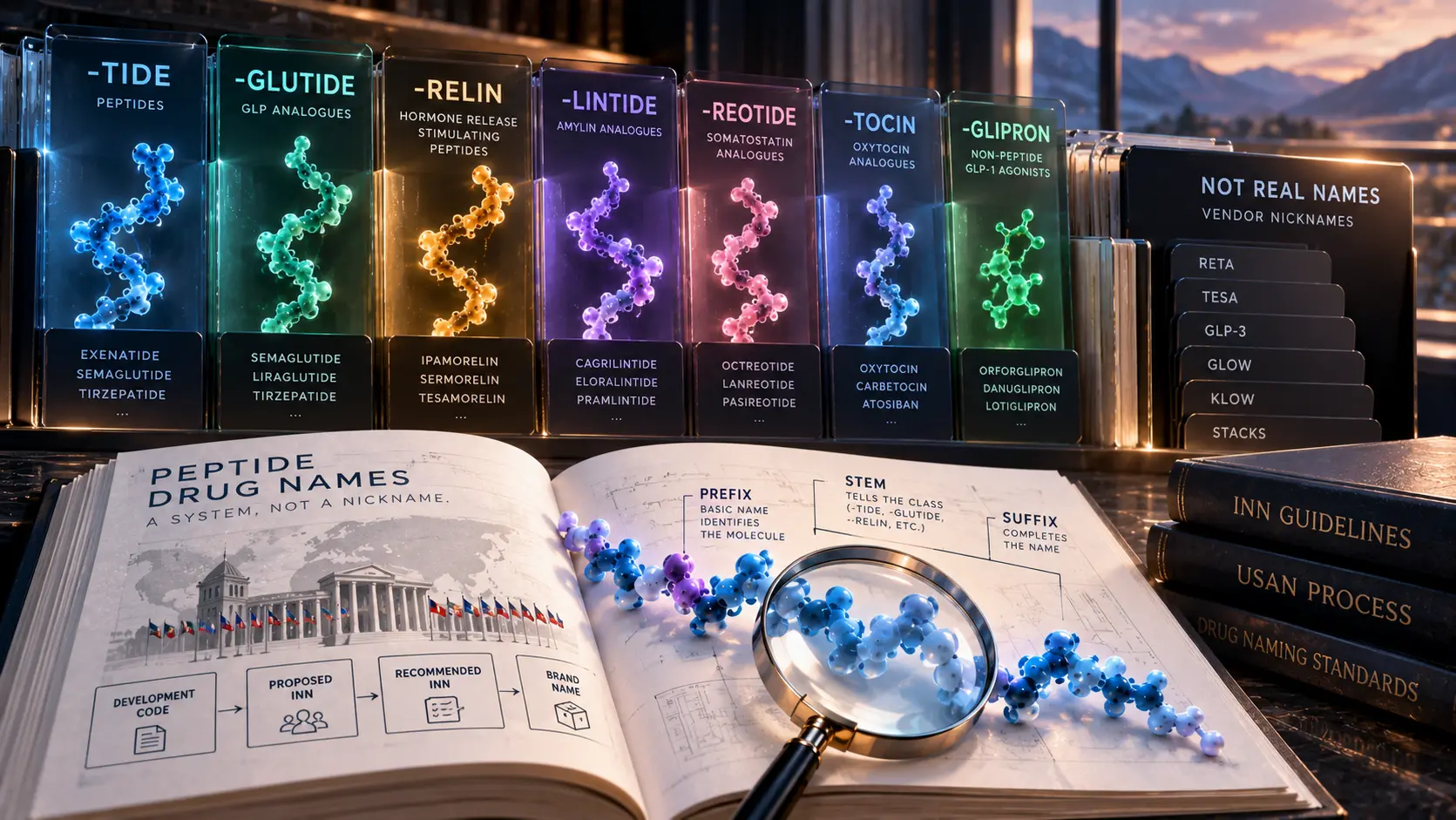
Quick Answer: Peptide drug names are built from a system of stems assigned by the World Health Organization. The ending -tide marks a peptide. Longer stems such as -glutide, -relin, -lintide and -glipron place it in a narrower family, for example GLP analogues or amylin receptor agonists. A drug's name travels from an internal company code to a proposed and then recommended International Nonproprietary Name (INN). The company separately trademarks a brand name. Vendor nicknames like reta, tesa or GLP-3 are not INNs and carry no regulatory meaning.
Key Takeaways
- WHO's stem book (2024 edition, plus the 6 February 2026 addendum) defines -tide as peptides; -glutide as glucagon-like peptide (GLP) analogues and agonists; and -lintide as amylin receptor agonists including dual amylin/calcitonin receptor agonists.
- The USAN Council's rule is strict. A name's prefix means nothing and only differentiates it from others in its class, while the stem carries the meaning.
- Tirzepatide does not carry -glutide. WHO created the -patide substem for GIP receptor agonists with or without GLP-1 receptor agonist activity, and tirzepatide (proposed INN list 120) sits under it.
- The endings -trutide and -dutide are not WHO substems. The October 2024 WHO prestem list cross-references -dutide to -tide with no definition of its own.
- An INN moves from proposed to recommended after a four-month objection period, with lists published twice a year in WHO Drug Information.
- LY3841136 became eloralintide. Semaglutide is sold as Ozempic and Wegovy, tirzepatide as Zepbound and Mounjaro, and orforglipron as Foundayo after its FDA approval on 1 April 2026.
- Trademarks cannot be built from an INN or include its stem, which is why brand names look nothing like generic names.
Research Use Only. The compounds discussed in this article are sold as research materials, not for human or veterinary consumption. Nothing here is medical, dosing or health advice. A name tells you a compound's family. It never tells you its safety, purity or quality. For background on the category, see our guide on what research peptides are.
How we graded the evidence. Naming claims in this article rest on WHO and USAN documents first, because those bodies define the names. Brand and approval facts come from named news outlets reporting the events. Chemical identity facts come from PubChem and FDA substance records. No vendor or forum page is cited as evidence, and nicknames are described only as nicknames.
Who Decides What a Drug Is Called?
The World Health Organization assigns a drug's international nonproprietary name, and the USAN Council handles the same job for the United States. Neither a company nor a blogger gets to coin the official name on its own.
It starts with the manufacturer or inventor. WHO says the applicant submits a request for a new INN, and an expert group reviews it before selecting a proposed INN [1]. Proposed names are published in WHO Drug Information for a four-month comment and objection period [1]. When no unresolved objection stands, the name becomes a recommended INN [1]. WHO publishes these lists twice a year, and recommended INNs are public-domain names for active pharmaceutical substances [1]. Trademark offices are asked to block any proprietary claim on them [1].
In the United States, the same job runs in parallel. The USAN Council has assigned nonproprietary names since January 1964, naming over 200 substances each year [7][16]. A company normally files for a USAN once it has an investigational new drug application [7]. The council then negotiates the name with the sponsor [7][8]. FDA recognizes USAN names as the established name for drug products [7]. National names such as the British, French, Japanese and US names now usually match the INN, so one scientific name works worldwide [1].
Definitions of INN, USAN and stem are collected in our research peptide glossary for readers who want the terms in one place.
What Does "-tide" Mean in a Drug Name?
-tide means the substance is a peptide. That is the entire meaning, and it is the broadest peptide stem in the WHO system.
The current WHO wording, confirmed in the February 2026 addendum, is simply "peptides" [2]. An earlier edition, from 2018, said "peptides and glycopeptides," so the scope narrowed over time [3]. Semaglutide, tirzepatide and cagrilintide all end in -tide, and each is a peptide. Exenatide, an older drug name, carries -tide with no narrower substem at all [3].
-tide tells you the molecule's class, not its target. It says nothing about which receptor the drug acts on, whether it is approved, or how potent it is. One more detail completes the picture: names ending in -relin or -tocin are peptides too, but their endings already place them in a special group.
What Do the Common Peptide Stems Mean?
A stem is a syllable inside a name that signals the drug's family. The table uses the exact definitions from the 2024 WHO stem book, its February 2026 addendum and the 2018 edition. Each example comes from a WHO INN list.
Stem | WHO definition | Real INN examples |
|---|---|---|
-tide | Peptides | semaglutide (list 101), tirzepatide (list 120), cagrilintide (list 123) |
-glutide | Glucagon-like peptide (GLP) analogues and agonists | semaglutide (list 101), liraglutide (list 87), dulaglutide (list 103) |
-patide | GIP receptor agonists, with or without GLP-1 receptor agonist activity | tirzepatide (list 120), brenipatide (list 134) |
-relin | Pituitary hormone-release stimulating peptides | goserelin (list 55), leuprorelin (list 47), gonadorelin (list 32) |
-morelin | Growth hormone release-stimulating substances | ipamorelin (list 78), sermorelin (list 56), tesamorelin (list 96) |
-lintide | Amylin receptor agonists, including dual amylin/calcitonin receptor agonists | cagrilintide (list 123), eloralintide (list 131), pramlintide (list 74) |
-reotide | Somatostatin receptor agonists/antagonists | octreotide (list 52), lanreotide (list 64), pasireotide (list 90) |
-tocin | Oxytocin derivatives | carbetocin, demoxytocin |
-glipron | Glucagon-like peptide 1 receptor (GLP1R) agonists | orforglipron (list 128), danuglipron (list 124), lotiglipron (list 129) |
Two patterns in the naming system deserve attention. Stems nest inside broader stems, so -glutide sits under the peptide family -tide and -morelin sits under -relin [2]. That layering gives a name like tesamorelin two levels of meaning. Definitions also shift over time: WHO widened -glutide from "analogues" to "analogues and agonists" in February 2024 [2]. In February 2026, WHO widened -morelin from "peptides" to "substances" [2]. A stem is a living convention, not a permanent law.
Definitions and example INNs come from the 2024 stem book and its February 2026 addendum [2]. The 2018 edition [3] and WHO's biological nomenclature review [5] cover the rest.
How Do You Read a Real Name, Piece by Piece?
You read a name from the right. Find the stem first, then treat everything before it as a meaningless prefix. WHO says the prefix should be random, chosen only to make a distinctive and pronounceable name [4]. USAN says the same thing: a prefix carries no meaning and exists to separate one member of a class from another [7].
Name | How it breaks down | What the stem tells you | What it does not tell you |
|---|---|---|---|
semaglutide | sema- (prefix) + -glutide | GLP analogue/agonist, a peptide | Which brand, dose or indication |
liraglutide | lira- (prefix) + -glutide | GLP analogue/agonist, a peptide | How it differs from semaglutide |
cagrilintide | cagri- (prefix) + -lintide | Amylin receptor agonist | Whether it is approved or investigational |
eloralintide | elora- (prefix) + -lintide | Amylin receptor agonist | Its exact receptor selectivity |
ipamorelin | ipa- (prefix) + -morelin | Growth hormone release-stimulating substance | Its sequence or potency |
sermorelin | sermo- (prefix) + -morelin | Growth hormone release-stimulating substance | Its product identity or purity |
tesamorelin | tesa- (prefix) + -morelin | Growth hormone release-stimulating substance | Its safety profile |
oxytocin | the archetype of -tocin | Gave its pattern to oxytocin derivatives | It is not decoded like a new USAN name |
orforglipron | orfor- (prefix) + -glipron | GLP-1 receptor agonist | Whether it is a peptide or not |
Three notes complete the decoding picture. Semaglutide and liraglutide share -glutide but are different molecules, which is why their prefixes exist [2]. "Tesa" is simply the first syllable of tesamorelin, a prefix that means nothing on its own [4][7]. The orforglipron example teaches the key lesson. Its stem, -glipron, denotes GLP-1 receptor agonists [2]. WHO defines no peptide requirement for it, so a name ending this way can belong to a small molecule. For a deeper look at one -lintide member, see our eloralintide amylin agonist guide. The wider field of GLP-1 candidates is tracked in our 2026 GLP-1 peptide pipeline.
What Is the Difference Between a Code, a Generic Name and a Brand?
A code, a generic name and a brand are three different stages of one compound's life, owned by three different authorities.
Stage | Example | Who controls it |
|---|---|---|
Development code | LY3841136 | The company, internally |
Nonproprietary (generic) name | eloralintide, proposed INN list 131 | WHO, as a recommended INN |
Brand name | Foundayo for orforglipron; Ozempic and Wegovy for semaglutide; Zepbound and Mounjaro for tirzepatide | The company, as a trademark |
The code comes first in the timeline. LY3841136 was Eli Lilly's internal designation for the molecule later named eloralintide, and the discovery paper lists both names together [12]. Once development advanced, WHO assigned the INN [2]. The brand comes last and follows different rules. WHO and USAN both forbid building a trademark from an INN [1]. They also forbid including an INN stem in a trademark, which is why Foundayo gives no hint of orforglipron [7].
A brand is also a product label, not a synonym for the compound. USAN explains that a brand applies to a specific product, can differ from country to country, and can even cover two different active ingredients [7]. One compound can carry several brands: semaglutide appears as Ozempic and Wegovy, while tirzepatide appears as Zepbound and Mounjaro [11]. Our FDA-approved peptides list keeps the approved names in one place.
Are "Reta" and "GLP-3" Real Peptide Drug Names?
None of them are. These are vendor or forum nicknames, and they carry no regulatory or pharmacological meaning.
Nickname | What it points to | Is it an INN? | What it means |
|---|---|---|---|
reta | Retatrutide | No | Forum shorthand, no regulatory meaning |
tesa | Tesamorelin | No | A shortening of the INN's meaningless first syllable |
GLP-3 | Nothing | No | No such receptor or drug class exists |
Glow, Klow | Various vendor listings | No | Vendor shorthand, not a substance name |
Wolverine stack | A bundle of two or more products | No | A bundle label, not a substance name at all |
The confusion around nicknames is understandable. Search results mix vendor pages with INN information, and nicknames travel faster than official names. Still, a nickname never appears in a WHO INN list, never carries a CAS number or UNII, and never defines a molecule [2][6]. Our article on what the GLP-3 peptide claim really is explains why that particular name has no scientific basis.
How Can You Check What a Name Refers To?
You check a name the same way a regulator would: against an official listing, not against a vendor page.
Start with the INN lists. WHO publishes proposed and recommended INN lists twice a year in WHO Drug Information [1]. If a name is absent from those lists, it is not an INN. This single check settles reta, tesa and GLP-3 immediately.
Use a substance registry. The FDA's Global Substance Registration System generates a Unique Ingredient Identifier (UNII) for each substance in regulated products [14]. It bases the UNII on molecular structure or descriptive information. A UNII is non-proprietary, unique and unambiguous. Searching the public GSRS or the FDA's substance data turns a name into a structure-anchored record.
Match a chemical identifier. PubChem, run by the US National Library of Medicine, lists CAS registry numbers and UNIIs for known substances [15]. A CAS number points to a specific chemical; it says nothing about quality or approval, but it pins down identity. Two different names that share a CAS number are the same substance.
Read the certificate of analysis. A certificate of analysis should identify the molecule through analytical identity data, not a marketing nickname. Mass spectrometry plus an orthogonal structural or purity method ties the material in the vial to the stated INN. Our guides explain how to read a certificate of analysis and where to find our certificates. Glossary terms used in this section appear in the research peptide glossary.
What Can a Stem Not Tell You About a Drug?
A stem places a drug in a family. It says nothing about safety, potency, purity, approval status, dose or legality. That boundary is the most important lesson in this article.
The examples make the point clear. Semaglutide and liraglutide share -glutide, yet they are distinct molecules with distinct labels and histories [2]. Eloralintide carries -lintide while remaining an investigational compound that moved from discovery to clinical proof of concept [12]. The same stem covers approved drugs and research compounds alike, so -tide never means approved.
Stems also drift in meaning over time. WHO widened -glutide in February 2024 and -morelin in February 2026 [2]. A stem's meaning is a convention maintained by people, not a law of chemistry. Tirzepatide's -patide shows the coarseness directly: "with or without GLP-1 receptor agonist activity" is a wide net [2]. Two compounds under one stem can differ in almost every property that matters to a researcher. The stem tells you where to start looking. It never tells you what you will find.
What Should You Read Next?
If a nickname confused you, start with the source of the confusion. Our GLP-3 explainer shows why that name has no basis in the receptor system. The research peptide glossary defines every term used here, and our certificate of analysis guide shows how identity is actually verified.
Researchers who need INN-identified reference materials with lot documentation can find semaglutide, cagrilintide and ipamorelin in the catalog: semaglutide, cagrilintide and ipamorelin. Each is listed under its nonproprietary name, the same system this article describes.
References
- World Health Organization. International Nonproprietary Names (INN): guidance on INN. https://www.who.int/teams/health-product-and-policy-standards/inn/guidance-on-inn (accessed September 2026).
- World Health Organization. The use of stems in the selection of International Nonproprietary Names (INN) for pharmaceutical substances. 2024 edition (ISBN 978-92-4-009938-8), with cumulative addendum INN Working Document 26.638, 6 February 2026. https://cdn.who.int/media/docs/default-source/international-nonproprietary-names-%28inn%29/addendum-stembook2025-202602.pdf?download=true&sfvrsn=c6fc181b_5
- World Health Organization. The use of stems in the selection of International Nonproprietary Names (INN) for pharmaceutical substances. 2018 edition (WHO/EMP/RHT/TSN/2018.1). https://cdn.who.int/media/docs/default-source/international-nonproprietary-names-%28inn%29/stembook-2018.pdf?download=true&
- World Health Organization. The use of stems in the selection of International Nonproprietary Names (INN) for pharmaceutical substances. 2011 edition. https://cdn.who.int/media/docs/default-source/international-nonproprietary-names-(inn)/stembook-2011-final.pdf
- World Health Organization. INN Working Document 05: review of the nomenclature of biological substances, 2019. https://cdn.who.int/media/docs/default-source/international-nonproprietary-names-%28inn%29/bioreview2019.pdf
- World Health Organization. INN Working Document 24.584: prestem and suffix lists, October 2024. https://cdn.who.int/media/docs/default-source/international-nonproprietary-names-(inn)/prestem-suffixes-202410.pdf?sfvrsn=8764b778_3
- American Medical Association. United States Adopted Names naming guidelines. https://www.ama-assn.org/about/united-states-adopted-names-usan/united-states-adopted-names-naming-guidelines (accessed September 2026).
- Karet GB. How do drugs get named? AMA J Ethics. 2019;21(8):E686-E696. https://journalofethics.ama-assn.org/sites/joedb/files/2019-07/mhst1-1908_4.pdf
- Reuters. Lilly's weight-loss pill wins US approval. 1 April 2026. https://www.reuters.com/business/healthcare-pharmaceuticals/lillys-weight-loss-pill-wins-us-approval-2026-04-01/
- STAT News. Eli Lilly's obesity pill orforglipron approved by FDA as Foundayo. 1 April 2026. https://www.statnews.com/2026/04/01/eli-lilly-obesity-pill-approved-orforglipron-foundayo/
- Reuters. US FDA sends 25 letters to telehealth companies over claims on compounded weight-loss drugs. 16 June 2026. https://www.reuters.com/legal/litigation/us-fda-sends-25-letters-telehealth-companies-over-claims-compounded-weight-loss-2026-06-16/
- Eloralintide (LY3841136), a novel amylin receptor agonist for the treatment of obesity: from discovery to clinical proof of concept. Mol Metab. 2025. doi:10.1016/j.molmet.2025.102271. PMID: 41109426. PMCID: PMC12640043. https://pubmed.ncbi.nlm.nih.gov/41109426/
- Shirley M. Mazdutide: first approval. Drugs. 2025;85(12):1621-1627. doi:10.1007/s40265-025-02249-y. PMID: 41028652. https://pubmed.ncbi.nlm.nih.gov/41028652/
- US Food and Drug Administration. FDA's Global Substance Registration System (GSRS). https://www.fda.gov/forindustry/datastandards/substanceregistrationsystem-uniqueingredientidentifierunii/ (accessed September 2026).
- US National Library of Medicine. PubChem. https://pubchem.ncbi.nlm.nih.gov/ (accessed September 2026).
- US Food and Drug Administration. 21 CFR 299.4: Established names for drugs. https://www.govinfo.gov/content/pkg/CFR-2012-title21-vol4/pdf/CFR-2012-title21-vol4-sec299-4.pdf (accessed September 2026).
Frequently Asked Questions
What does the suffix "-tide" mean in a drug name?
The suffix -tide means the substance is a peptide. It is the broadest peptide stem in the WHO naming system, confirmed as "peptides" in the February 2026 addendum to the 2024 stem book. Names like semaglutide, tirzepatide and cagrilintide all end in -tide. The ending says nothing about the drug's target, safety, potency or approval status. Some peptide families, such as -relin and -tocin, use their own stems instead of -tide.
What do drug name suffixes mean in general?
A stem, called a suffix in plain language, signals the drug's pharmacological family. WHO and the USAN Council assign stems so that names in the same class share a recognizable ending. One example is -glutide for GLP analogues and agonists. The stem carries the meaning, while the prefix before it is meaningless and only distinguishes one member from another. A stem never guarantees safety, approval, potency or product quality.
What does "-glutide" mean?
The stem -glutide means the compound is a glucagon-like peptide (GLP) analogue or agonist, and it sits under the broader peptide family -tide. Semaglutide and liraglutide are the best-known examples. WHO widened the definition from "analogues" to "analogues and agonists" in February 2024. Sharing -glutide does not make two drugs interchangeable. Each remains a distinct molecule with its own properties and history.
What does "-relin" mean?
Under WHO nomenclature, -relin denotes pituitary hormone-release stimulating peptides. Familiar examples include goserelin, leuprorelin and gonadorelin. The narrower -morelin substem sits underneath it for growth hormone release-stimulating substances such as ipamorelin, sermorelin and tesamorelin. A -relin ending tells you the peptide family. It does not tell you which hormone pathway is involved without more letters.
What does "-lintide" mean?
The February 2026 WHO addendum defines -lintide as amylin receptor agonists, including dual amylin and calcitonin receptor agonists. Cagrilintide, eloralintide and pramlintide are the listed examples. The ending places a compound in the amylin family. It says nothing about selectivity between the receptors, development stage, approval status or safety. Like every stem, it is a family label rather than a complete description.
What does "-glipron" mean?
In the WHO system, -glipron denotes glucagon-like peptide 1 receptor (GLP-1R) agonists. Orforglipron, danuglipron and lotiglipron are the listed examples. WHO defines no peptide requirement for this stem, so a -glipron name can belong to a small molecule rather than a peptide. Orforglipron, approved as Foundayo in April 2026, is the proof. The stem signals the receptor target, never the molecular structure.
Who decides what a drug is called?
International nonproprietary names come from the World Health Organization through its INN programme, and US names come from the USAN Council. A manufacturer or inventor applies to WHO, an expert group selects a proposed name, and it becomes recommended after a four-month objection period. Names are published twice a year in WHO Drug Information. Companies separately choose and trademark brand names, which must not derive from the INN or contain its stem.
What is an INN, and how is it different from a brand name?
An INN, or international nonproprietary name, is the public, non-commercial name WHO assigns to an active pharmaceutical substance, such as semaglutide. It belongs to no company and cannot be trademarked. A brand name, such as Ozempic or Wegovy, is a company's trademark for its specific product. One INN can sit behind several brands, brands can differ between countries, and brands are chosen to look nothing like the INN.
What is the difference between a generic name and a brand name?
The generic name is the nonproprietary scientific name, the USAN or INN, and it identifies the active ingredient itself. A brand name is a trademark that identifies one company's finished product. In the US, semaglutide is the generic name behind the brands Ozempic and Wegovy, while tirzepatide sits behind Zepbound and Mounjaro. Two brands can share one generic name, and a brand can even differ from country to country.
What is a drug development code?
A development code is the internal designation a company gives a compound before it has an official name. Codes usually combine company letters with numbers, such as LY3841136 for the molecule later named eloralintide. The code has no regulatory meaning and appears in early papers and trial registries. Once WHO assigns an INN, the code is retired from official use, though researchers still use it to trace the compound's early history.
Is "GLP-3" a real drug name?
GLP-3 is not a real drug name. It is not an INN, not a USAN, and not a recognized receptor or drug class. No WHO stem list contains it, and no substance registry assigns it a UNII or CAS number. It appears only in vendor marketing and forum posts. Names built on it carry no regulatory or pharmacological meaning. Verify any compound marketed under the term through an INN list or substance registry instead of trusting the label.
What do "reta" and "tesa" stand for?
"Reta" is forum shorthand for retatrutide, an investigational compound whose only official stem is the generic -tide. "Tesa" is a shortening of tesamorelin, where "tesa" is the meaningless prefix of the INN tesamorelin. Neither is an INN, neither appears in WHO nomenclature lists, and neither carries a UNII or CAS number, so they have no regulatory meaning. A certificate of analysis written against a nickname identifies nothing verifiable.
Does a drug's suffix tell you whether it is a peptide?
The answer is sometimes yes and sometimes no. A -tide ending reliably marks a peptide, and -glutide, -lintide, -relin, -morelin and -reotide sit inside the peptide family. But -glipron denotes GLP-1 receptor agonists with no peptide requirement, so a -glipron drug can be a small molecule. Stems describe pharmacological families, not chemistry, and only the specific stem's definition decides. Check the WHO stem definition rather than guessing from the ending.
How can I look up what a drug name refers to?
Start with the twice-yearly INN lists in WHO Drug Information, which form the authoritative record. If the name is absent, it is not an INN. Then use a substance registry: the FDA's Global Substance Registration System assigns each substance a Unique Ingredient Identifier (UNII) based on structure. PubChem also lists CAS numbers and UNIIs. A certificate of analysis should tie the material to the stated INN through analytical identity data, never through a marketing nickname.
Why do vendors use nicknames instead of drug names?
Vendors use nicknames because they are short, memorable and search-friendly, while official names like tesamorelin are long and unfamiliar. Nicknames also dodge the regulatory weight of an INN, since a nickname never appears in an official list. Some may not know the correct name. The result is confusion: buyers cannot verify a nickname against a substance registry, and a certificate of analysis written against one identifies nothing. Always translate a nickname to its INN before checking anything.