Last reviewed: September 2026

Quick Answer
Eloralintide (development code LY3841136) is an investigational, once-weekly amylin receptor agonist from Eli Lilly that preferentially activates the human amylin 1 receptor. In a 48-week Phase 2 trial of 263 adults, mean body weight changed by −9% to −20% across dose arms, against −0.4% on placebo [3]. It entered Phase 3 in 2026 through the ENLIGHTEN program and has no FDA approval for any use [5][9].
Key Takeaways
- Lilly's eloralintide is a 37-residue amylin analog, with a 20-carbon fatty diacid attached at lysine 26 to bind albumin [1].
- In human cell assays it was about 12-fold more potent at AMY1R than at the calcitonin receptor (EC50 23.9 pM vs 291.0 pM) [1].
- Its terminal half-life in healthy volunteers was 310 to 366 hours, or 12.9 to 15.3 days [1].
- The Phase 2 trial (NCT06230523), published in The Lancet on November 6, 2025, reported −9% to −20% mean weight change at 48 weeks [3][4].
- Nausea ranged from 11% to 64% across Phase 2 arms versus 14% on placebo, and fatigue reached 46% in one arm [3].
- ENLIGHTEN-1 (NCT07321886) was listed as recruiting in August 2026, with about 1,980 participants planned [5][9].
- No trial has compared eloralintide head-to-head with cagrilintide or CagriSema, so every comparison today is cross-trial.
Research Use Only
Research Use Only. 99 Purity Peptides sells compounds for laboratory research only, never for human or veterinary use. This article summarizes published research and is not medical, dosing or health advice. No compound discussed here is recommended for any outcome. Eloralintide is an investigational Eli Lilly drug candidate, and 99 Purity Peptides does not sell it.
What Is Eloralintide?
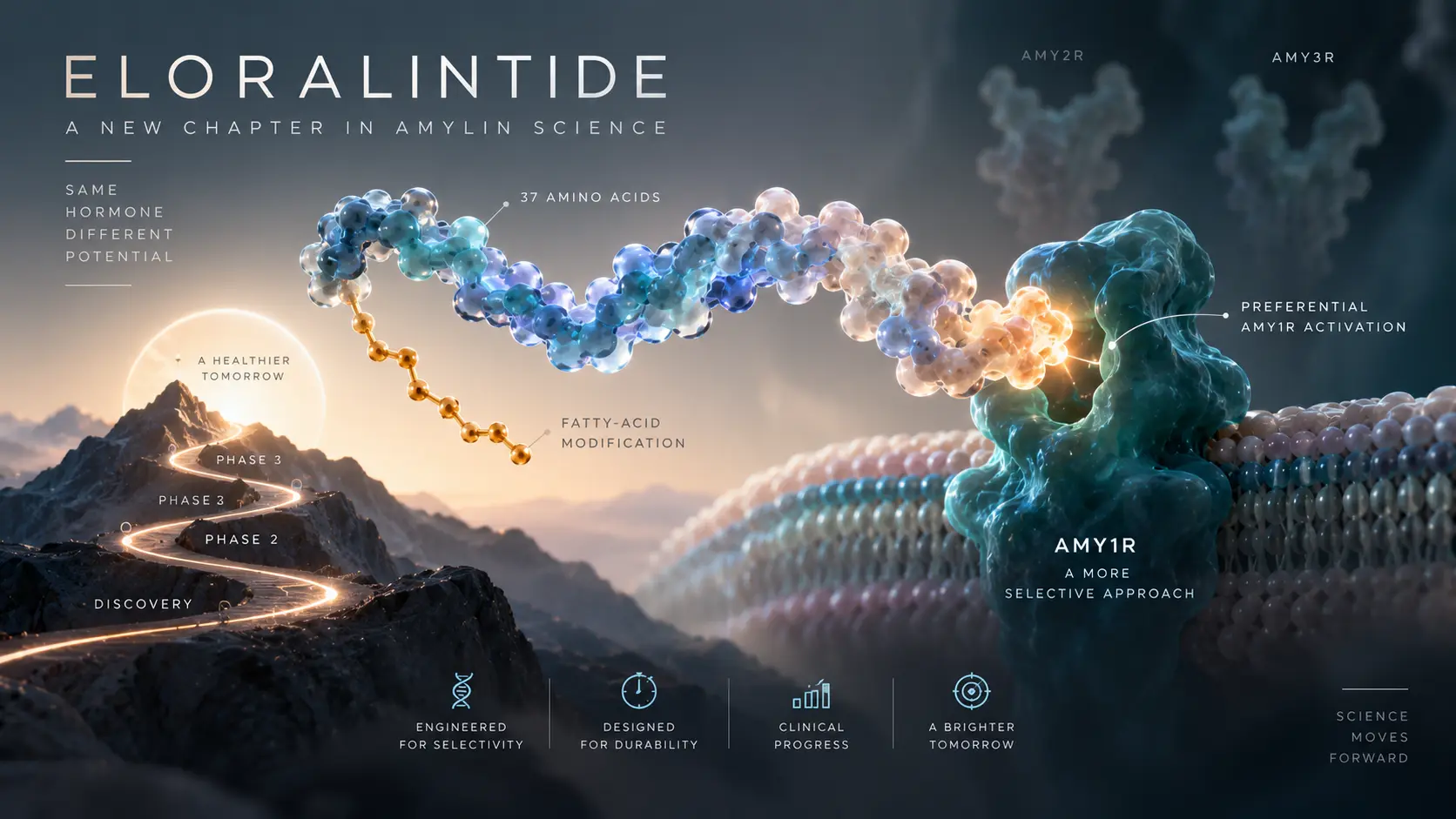
Eloralintide is a synthetic, lipidated analog of human amylin that Eli Lilly built to favor one amylin receptor subtype over the calcitonin receptor [1]. Lilly's 2025 discovery paper in Molecular Metabolism is the primary pharmacology source, and every structural claim on this page traces to it [1].
Some background on the target makes the design choice clearer. Amylin is a 37-amino-acid hormone released alongside insulin from pancreatic beta cells [1]. Its receptors are hybrids: the calcitonin receptor (CTR) paired with one of three receptor activity-modifying proteins, RAMP1, RAMP2 or RAMP3 [1]. Those pairings create the AMY1R, AMY2R and AMY3R subtypes.
Bare CTR, with no RAMP attached, prefers calcitonin over amylin. Because every amylin receptor shares that CTR core, most amylin mimics also activate CTR to some degree. Lilly's stated aim was an agonist that leans toward AMY1R and away from CTR [1].
How Selective Is Eloralintide, in Actual Numbers?
The verified figure is about 12-fold, measured in cells that each expressed a single human receptor [1]. Potency was read from cAMP signaling, and a separate radioligand assay measured binding. Binding showed a smaller gap of roughly 8-fold [1].
Human receptor tested | cAMP potency (EC50) | Binding affinity (Ki) | Potency gap vs AMY1R |
|---|---|---|---|
AMY1R (CTR + RAMP1) | 23.9 pM | 478.1 pM | Reference |
AMY3R (CTR + RAMP3) | 253.8 pM | 3,608.9 pM | About 11-fold weaker |
CTR alone | 291.0 pM | 3,896.1 pM | About 12-fold weaker |
Two details rarely make it into secondary coverage. Eloralintide still reached full agonism at all three human receptors, with maximum efficacy above 80% [1]. "Selective" therefore means a potency gap, not a switched-off calcitonin receptor. Any page claiming eloralintide "does not touch" CTR has the pharmacology wrong.
Rat receptors also behaved differently from human ones. In rat assays, eloralintide activated both AMY1R and AMY3R strongly, with a 45-fold potency gap between rat AMY1R and rat CTR [1]. That matters later, because the animal tolerability data come from rats.
The authors add a caveat worth repeating: no minimum selectivity threshold has been established to define biological relevance [1]. Our read is that the 12-fold number is well measured in vitro. What it buys in people is still an open question.
What Makes Eloralintide Long-Acting?
A fatty-acid side chain that binds albumin is the main reason eloralintide lasts long enough for weekly administration in trials [1]. Lilly attached a saturated 20-carbon diacid to the lysine at position 26, using a linker of two gamma-glutamate residues [1]. Albumin binding keeps the peptide circulating and slows its clearance.
Three further changes sit in the backbone itself. The native disulfide bridge between cysteines 2 and 7 was replaced with a methylene thioacetal bridge, which the authors say improves chemical stability [1]. Non-coded amino acids occupy positions 11, 15 and 22 [1]. The C-terminus is amidated, as it is in native amylin.
How much longer does it last? In the single-dose Phase 1 study, plasma levels peaked 72 to 132 hours after injection [1]. Terminal half-life ran 310 to 366 hours across the 0.4 mg to 12 mg cohorts [1]. For comparison, the same paper cites a cagrilintide half-life of 159 to 195 hours [1].
The repeated-dose trials used once-weekly subcutaneous administration as their protocol design, and the single-dose study was built to check that the kinetics supported it [1][2][3]. That describes how the studies were built. It is not guidance of any kind.
One set of claims needs correcting. Eloralintide is sometimes described as proven to carry low immunogenicity and low fibril-forming risk. The discovery paper is more careful, saying only that its sequence changes "may" reduce immunogenicity risk and improve developability [1]. That statement rests on Lilly's patent filing, not on a reported antibody or aggregation dataset [1]. Until such data appear in a peer-reviewed paper, treat both as design intentions rather than demonstrated properties.
What Do the Human Trials Show So Far?
Three human studies are published, and each answers a different question [1][2][3]. Two are small Lilly Phase 1 studies, and the third is the 48-week Phase 2 trial in The Lancet.
Study | Design | Who was enrolled | Size and length | Headline result | Source |
|---|---|---|---|---|---|
Phase 1, single ascending dose (NCT05295940, Part A) | Randomized, placebo-controlled, participant- and investigator-blinded | Healthy adults, mean BMI 27.5 | 48 people (36 drug, 12 placebo); one dose, followed 29 days | Weight change of −2.5% and −4.4% in the two highest-dose cohorts vs +0.6% on placebo | Molecular Metabolism, 2025 [1] |
Phase 1, multiple ascending dose | Randomized, placebo-controlled, blinded, no dose escalation | Adults with obesity or overweight, mean BMI 32.6 | 100 people; 12 weeks | Least-squares mean weight reduction of 2.6% to 11.3% across dose groups | Diabetes, Obesity and Metabolism, 2026 [2] |
Phase 2 (NCT06230523) | Randomized, double-blind, placebo-controlled, multicentre, US only | Adults with obesity, or overweight plus a comorbidity, without type 2 diabetes | 263 people; 48 weeks | Mean weight change of −9% to −20% by arm vs −0.4% on placebo | The Lancet, 2025 [3] |
A citation mix-up circulates around these two Phase 1 studies. The 2026 Diabetes, Obesity and Metabolism paper and the ADA 2025 abstract 882-P describe the same 12-week multiple-dose study [2][8]. Lilly's first-in-human single-dose trial is a separate study, reported inside the 2025 Molecular Metabolism discovery paper [1].
What Exactly Did the Phase 2 Trial Find?
The Phase 2 trial met its primary endpoint in every eloralintide arm [3][4]. Participants averaged 49.0 years of age, 109.1 kg and a BMI of 39.1, and 78% were female [3].
Trial arm | People randomized | Mean weight change at 48 weeks (95% CI) | Nausea | Fatigue |
|---|---|---|---|---|
Placebo | 53 | −0.4% (−2.2 to 1.4) | 14% | 12% |
1 mg | 28 | −9% (−12.6 to −6.3) | 11% | 0% |
3 mg | 24 | −12% (−14.9 to −9.8) | 13% | 13% |
6 mg | 28 | −18% (−20.7 to −14.5) | 64% | 29% |
9 mg | 54 | −20% (−22.7 to −17.5) | 33% | 43% |
6 mg to 9 mg escalation | 24 | −20% (−22.7 to −17.0) | 54% | 46% |
3 mg to 9 mg escalation | 52 | −16% (−18.6 to −14.1) | 25% | 21% |
Those weight figures use the efficacy estimand. It estimates the result if every participant had stayed on the study drug for 48 weeks [4]. Lilly's release also notes that the arm-level endpoints were not adjusted for multiplicity [4]. Estimands that count people who stopped treatment usually give smaller numbers in obesity trials.
Some vendor pages call the 9.5% to 20.1% range "placebo-adjusted." That label is simply not correct. Lilly's release reports these as mean changes from baseline, with placebo listed separately at −0.4% [4].
How Big Were the Tolerability Differences Between Arms?
Tolerability depended heavily on the arm, and the pattern was not a clean dose curve [3]. Nausea hit 64% in the fixed 6 mg arm but 33% in the larger 9 mg arm. Arms of 24 to 28 people produce noisy percentages, so single-arm figures deserve caution.
Across everyone given eloralintide, the paper reports nausea in 33% (68 of 208). The slower 3 mg to 9 mg escalation group came in at 25% [3]. Lilly's release says gastrointestinal events were lower with slower escalation and similar to placebo in the 1 mg and 3 mg arms [4].
Fatigue is the signal we would watch most closely. It reached 43% to 46% in the two highest-exposure arms, against 12% on placebo [3]. Phase 3 should show whether that rate persists or fades with slower escalation.
Our position: Lilly's "favorable tolerability" headline is fair for the low doses and the slow-escalation arm. It is not a fair summary of the fixed 6 mg arm. A second correction also belongs in this section. The phrase "minimal gastrointestinal adverse events" comes from the conclusion of the 12-week Phase 1 paper [2], not from Lilly's Phase 2 announcement [4].
How Do These Numbers Compare With Cagrilintide and CagriSema?
Every comparison available today is cross-trial, and the designs differ enough to mislead. Cagrilintide's 26-week Phase 2 trial in 706 people reported −10.8% at its top dose versus −3.0% on placebo [6]. In the Phase 3 REDEFINE 1 trial of 3,417 people, cagrilintide alone produced −11.5% at 68 weeks [7]. CagriSema produced −20.4% under the treatment-policy estimand and 22.7% under the trial-product estimand [7].
Tolerability figures follow the same caution. Lilly's authors summarize cagrilintide 2.4 mg nausea at 24% to 31% as monotherapy and up to 55% alongside semaglutide [1]. The eloralintide Lancet paper cites nausea of 20% to 47% in cagrilintide's Phase 2 program [3].
So does eloralintide's 20% match CagriSema's 20.4%? The numbers match on paper, but the evidence behind them does not. Eloralintide's figure comes from 54 people over 48 weeks under an efficacy estimand. CagriSema's comes from 2,108 people over 68 weeks under a stricter treatment-policy estimand [7]. A reverse trap exists too, because eloralintide's single-agent arms beat cagrilintide's 11.5% only across different estimands, durations and populations.
How We Graded the Evidence
We applied one scale to every compound on this page. Grade A requires at least one completed, peer-reviewed Phase 3 randomized trial. B covers peer-reviewed randomized Phase 2 data. Small Phase 1 or other early human studies earn a C. We give a D to claims supported only by animal or cell data, with no human test.
Claim being tested | Eloralintide | Cagrilintide alone | CagriSema |
|---|---|---|---|
Reduces body weight in humans vs placebo | B: one Phase 2 trial, 263 people, 48 weeks [3] | A: REDEFINE 1 monotherapy arm, 302 people, 68 weeks [7] | A: REDEFINE 1, 2,108 people on CagriSema, 68 weeks [7] |
Human gastrointestinal tolerability profile | B [3] | A [7] | A [7] |
Receptor selectivity profile | D: human cell assays [1] | D: human cell assays [1] | Not applicable |
Better tolerated than cagrilintide | D: rat taste-avoidance data only [1] | Not applicable | Not applicable |
Less lean-mass loss than cagrilintide | D: diet-induced obese rats only [1] | Not applicable | Not applicable |
Regulatory status (September 2026) | Phase 3, no application filed [5] | Investigational [10] | NDA submitted December 2025, not approved as of our review [10] |
The most important row is the fourth one. Eloralintide's tolerability advantage over cagrilintide is currently a rat finding. No human trial has tested it.
How Is Eloralintide Different From Cagrilintide?
Eloralintide is one molecule acting on one receptor family, tilted toward AMY1R, while CagriSema is two molecules acting on two families [1][10]. Cagrilintide on its own is a non-selective amylin receptor agonist. It activates AMY1R, AMY3R and CTR with comparable relative potency in both human and rat assays [1].
Feature | Eloralintide | Cagrilintide | CagriSema |
|---|---|---|---|
Developer | Eli Lilly | Novo Nordisk | Novo Nordisk |
Molecules in the product | One | One | Two, at fixed doses (cagrilintide plus semaglutide) |
Receptor profile | Amylin receptors, AMY1R-leaning, weaker CTR | AMY1R, AMY3R and CTR at comparable potency | Amylin and calcitonin receptors plus the GLP-1 receptor |
Reported human half-life | 310 to 366 hours | 159 to 195 hours | Not assessed here |
Most advanced stage | Phase 3 (ENLIGHTEN) | Investigational, not approved [10] | FDA review after December 2025 submission [10] |
Mechanistically, the contrast should play out in a few predictable ways. A single amylin-pathway agonist works through satiation and appetite signaling, without a GLP-1 receptor component [1][4]. CagriSema engages two separate pathways at once, which is the whole premise of pairing them. Lilly's researchers describe eloralintide as designed to have minimal calcitonin activity in the clinic, unlike cagrilintide [8]. In cell assays, though, it still fully activates CTR at higher concentrations [1].
Here is what the design difference does not settle. A single molecule is not automatically better or worse tolerated than a two-molecule combination. Narrower action does not guarantee fewer side effects, and the Phase 2 fatigue rates are a reminder of that [3].
The rat evidence also has a built-in weakness. Eloralintide caused less conditioned taste avoidance than cagrilintide in rats [1]. The authors note this gap may reflect lower CTR engagement rather than any AMY1R versus AMY3R effect [1]. Because rats respond to eloralintide at AMY3R more than humans do, the rat model is an imperfect stand-in [1].
Lilly is not treating eloralintide as a strictly solo product either. It is testing the molecule with tirzepatide in NCT06603571 and with macupatide in NCT07215559 [4][15]. ENLIGHTEN-6 adds it to an existing weekly incretin [14]. "Amylin-only" describes the molecule, not the development strategy. For the component-level detail on cagrilintide and CagriSema, see our cagrilintide vs semaglutide comparison.
What Happens Next, and Is Eloralintide Approved?
Eloralintide is not approved by the FDA for any indication, and Lilly has not announced a marketing application. The drug is in Phase 3, and the registry records we checked in September 2026 show several ENLIGHTEN trials [5][11][12][13][14].
ENLIGHTEN-1 (NCT07321886) tests eloralintide in adults with obesity, or overweight, without type 2 diabetes [5]. Lilly's trial site lists about 1,980 planned participants and dates from January 2026 to July 2030 [9]. The main phase lasts about 75 weeks, with a two-year extension for participants with prediabetes [9].
ENLIGHTEN-2 (NCT07282600) covers adults with type 2 diabetes and was listed as recruiting [11]. ENLIGHTEN-3 (NCT07369011) is a master protocol in moderate to severe obstructive sleep apnea [12]. ENLIGHTEN-4 (NCT07353931) targets knee osteoarthritis pain and was listed as not yet recruiting in the record we reviewed [13]. Phase 1 studies on hepatic impairment and gastric emptying are registered alongside them [16][17].
When might an FDA decision come? Nobody knows yet. Lilly has not published a filing timeline, and ENLIGHTEN-1's listed end date includes a long extension. Any date you see quoted is a guess.
For the regulatory framework that governs all of these pipeline compounds, our GLP-1 peptide pipeline overview for 2026 covers it in full. Our list of FDA-approved peptides shows what has already cleared review. For the separate question of research compounds, see whether peptides are legal to buy for research.
What the Evidence Does Not Establish
The published record answers early questions well and later questions barely at all. These are the gaps we consider most important.
Durability beyond one year remains unknown. The longest human exposure reported is 48 weeks [3]. Nothing published shows what happens to body weight after treatment stops.
Long-term safety data are still thin. About 208 people received eloralintide in Phase 2, far too few to detect uncommon adverse events [3]. Phase 3 exists precisely to answer that.
The Phase 2 population was narrow. It was entirely US-based, 78% female and 78% White, and excluded type 2 diabetes [3][4]. Results may differ in other groups.
Selectivity has not been linked to outcomes in people. The 12-fold figure comes from engineered cell lines, and the authors say no threshold defines meaningful selectivity [1]. No human study has tested whether it changes tolerability.
Claims of better tolerability than cagrilintide rest on rats. Lean-mass preservation rests on rats too. In one head-to-head rat study, fat made up 80% of weight lost on eloralintide versus 63% on cagrilintide [1]. Lean mass in that assay includes water and bone as well as muscle [1].
Headline efficacy is an idealized estimate. The efficacy estimand assumes full adherence, and the arm-level results were not multiplicity-adjusted [4].
Finally, a vendor listing proves nothing about identity. Any "eloralintide" sold outside Lilly's trials is not Lilly's investigational product, and its contents can only be judged from lot-level analytical data.
Where Should You Read Next on Amylin Research?
Eloralintide is worth tracking because it tests a clean idea: how far a single, receptor-selective amylin agonist can go on its own. The Phase 3 readouts will settle more than any preclinical argument can. Until then, the 2026 GLP-1 peptide pipeline overview places it among retatrutide, survodutide, amycretin, CagriSema and MariTide.
For laboratories working on amylin-pathway pharmacology, cagrilintide is the related research material in our catalogue. Lot documentation for every batch sits in our certificate library. Our guide on how to read a certificate of analysis explains which fields to check before a vial enters a study.
References
- Briere DA, Qu H, Lansu K, et al. Eloralintide (LY3841136), a novel amylin receptor agonist for the treatment of obesity: from discovery to clinical proof of concept. Mol Metab. 2025;102:102271. doi:10.1016/j.molmet.2025.102271. PMID: 41109426. https://www.sciencedirect.com/science/article/pii/S2212877825001784
- Bhattachar S, Tham LS, Tidemann-Miller B, et al. Eloralintide, a selective, long-acting amylin receptor agonist for treatment of obesity: Phase 1 proof of concept. Diabetes Obes Metab. 2026;28(4):2651-2660. doi:10.1111/dom.70439. PMID: 41559929. https://pubmed.ncbi.nlm.nih.gov/41559929/
- Billings LK, Hsia S, Bays H, et al. Eloralintide, a selective amylin receptor agonist for the treatment of obesity: a 48-week phase 2, multicentre, double-blind, randomised, placebo-controlled trial. Lancet. 2025;406:2631-2643. doi:10.1016/S0140-6736(25)02155-5. https://www.thelancet.com/journals/lancet/article/PIIS0140-6736(25)02155-5/fulltext
- Eli Lilly and Company. Lilly's selective amylin agonist, eloralintide, demonstrated meaningful weight loss and favorable tolerability in a Phase 2 study of adults with obesity or overweight. Press release. November 6, 2025. https://lilly.gcs-web.com/news-releases/news-release-details/lillys-selective-amylin-agonist-eloralintide-demonstrated
- Eli Lilly and Company. A Phase 3 randomized, double-blind, placebo-controlled study to investigate the efficacy and safety of once weekly eloralintide in adult participants with obesity or overweight, without type 2 diabetes (ENLIGHTEN-1). ClinicalTrials.gov identifier NCT07321886. Status verified August 2026. https://clinicaltrials.gov/study/NCT07321886
- Lau DCW, Erichsen L, Francisco AM, et al. Once-weekly cagrilintide for weight management in people with overweight and obesity: a multicentre, randomised, double-blind, placebo-controlled and active-controlled, dose-finding phase 2 trial. Lancet. 2021;398(10317):2160-2172. doi:10.1016/S0140-6736(21)01751-7. https://doi.org/10.1016/S0140-6736(21)01751-7
- Garvey WT, Blüher M, Osorto Contreras CK, et al. Coadministered cagrilintide and semaglutide in adults with overweight or obesity. N Engl J Med. 2025;393(7):635-647. doi:10.1056/NEJMoa2502081. https://doi.org/10.1056/NEJMoa2502081
- Bhattachar SN, Tham LS, Tidemann-Miller B, et al. 882-P: Eloralintide, a selective, long-acting amylin receptor agonist for obesity: Phase 1 proof of concept. Diabetes. 2025;74(Suppl 1):882-P. doi:10.2337/db25-882-P. https://diabetesjournals.org/diabetes/article/74/Supplement_1/882-P/159628/882-P-Eloralintide-a-Selective-Long-Acting-Amylin
- Eli Lilly and Company. A study of eloralintide (LY3841136) in participants with obesity, or overweight without type 2 diabetes (ENLIGHTEN-1). Lilly Trials study page, J3R-MC-YDAG. Accessed September 2026. https://trials.lilly.com/en-US/trial/664295
- Novo Nordisk. Novo Nordisk files for FDA approval of CagriSema, the first once-weekly combination of GLP-1 and amylin analogues for weight management. Press release. December 18, 2025. https://www.prnewswire.com/news-releases/novo-nordisk-files-for-fda-approval-of-cagrisema-the-first-once-weekly-combination-of-glp1-and-amylin-analogues-for-weight-management-302645862.html
- Eli Lilly and Company. A Phase 3 study of once weekly eloralintide in adult participants with obesity or overweight, and type 2 diabetes (ENLIGHTEN-2). ClinicalTrials.gov identifier NCT07282600. Status verified August 2026. https://clinicaltrials.gov/study/NCT07282600
- Eli Lilly and Company. A master protocol for Phase 3 studies of once weekly eloralintide in adult participants with moderate to severe obstructive sleep apnea, and obesity or overweight (ENLIGHTEN-3). ClinicalTrials.gov identifier NCT07369011. https://clinicaltrials.gov/study/NCT07369011
- Eli Lilly and Company. A master protocol for Phase 3 studies of once weekly eloralintide in adult participants with osteoarthritis knee pain, and obesity or overweight (ENLIGHTEN-4). ClinicalTrials.gov identifier NCT07353931. https://clinicaltrials.gov/study/NCT07353931
- NYU Langone Health. A Phase 3 study of once weekly eloralintide in adult participants with persistent obesity or overweight treated with a weekly incretin, with and without type 2 diabetes (ENLIGHTEN-6). ClinicalTrials.gov identifier NCT07392190. Trial listing accessed September 2026. https://clinicaltrials.med.nyu.edu/clinicaltrial/2988/phase-3-randomized-double-blind/
- Eli Lilly and Company. A Phase 2 study to investigate weight reduction with macupatide and eloralintide, alone or in combination, in adult participants with obesity or overweight and with type 2 diabetes. ClinicalTrials.gov identifier NCT07215559. https://clinicaltrials.gov/study/NCT07215559
- Eli Lilly and Company. A Phase 1 study to assess the pharmacokinetics and tolerability of a single subcutaneous dose of eloralintide (LY3841136) in participants with hepatic impairment and normal hepatic function. ClinicalTrials.gov identifier NCT07401862. https://clinicaltrials.gov/study/NCT07401862
- Eli Lilly and Company. A Phase 1 study to evaluate the gastric emptying delay, pharmacokinetics, safety, and tolerability of eloralintide in participants with obesity or overweight. ClinicalTrials.gov identifier NCT07738614. https://clinicaltrials.gov/study/NCT07738614
Frequently Asked Questions
What is eloralintide?
Eloralintide is an investigational drug candidate from Eli Lilly, also known by its development code LY3841136. It is a lipidated analog of amylin, a hormone released with insulin after meals. Lilly designed it to activate the amylin 1 receptor more strongly than the calcitonin receptor. It has completed Phase 2 testing and entered Phase 3 in 2026, but it is not an approved medicine anywhere.
Is eloralintide FDA-approved?
No, eloralintide has no FDA approval for any indication as of September 2026. Lilly has not announced a marketing application, and the drug is still in Phase 3 trials under the ENLIGHTEN program. Approval would require completed pivotal trials, a submitted application and an FDA review. Any website implying the compound is approved, or close to approval, is ahead of the public record.
What phase of clinical trials is eloralintide in?
Eloralintide is in Phase 3 clinical trials. Its lead study, ENLIGHTEN-1 (NCT07321886), enrolls adults with obesity or overweight but without type 2 diabetes. The registry listed it as recruiting in August 2026. Companion Phase 3 studies cover type 2 diabetes, obstructive sleep apnea, knee osteoarthritis pain and use alongside an existing weekly incretin. Several Phase 1 pharmacology studies are also running.
What is eloralintide's mechanism of action?
Amylin is a satiety hormone, and eloralintide mimics it by activating amylin receptors. These receptors pair the calcitonin receptor with a RAMP protein. In human cell assays, eloralintide was about 12-fold more potent at the amylin 1 receptor than at the calcitonin receptor alone. Lilly describes its likely effect as reducing calorie intake through satiety. The molecule is not designed to act on the GLP-1 receptor.
How is eloralintide different from cagrilintide?
Both are long-acting, lipidated amylin analogs, but their receptor profiles differ. Cagrilintide, from Novo Nordisk, activates amylin receptors and the calcitonin receptor at comparable potency. Eloralintide, from Eli Lilly, leans toward the amylin 1 receptor. Eloralintide's reported half-life is also longer, at 310 to 366 hours versus 159 to 195 hours. No human trial has compared the two directly.
Is eloralintide the same as CagriSema?
No, they are different products from different companies. CagriSema is Novo Nordisk's fixed-dose combination of two molecules, cagrilintide and the GLP-1 receptor agonist semaglutide. Eloralintide is a single Eli Lilly molecule that acts on amylin receptors only. CagriSema was submitted to the FDA in December 2025, while eloralintide is still in Phase 3 testing.
Who is developing eloralintide?
Eli Lilly and Company is developing eloralintide and sponsors all of its registered trials. Lilly scientists authored the discovery paper in Molecular Metabolism and both Phase 1 reports. The Phase 2 publication in The Lancet was led by an outside investigator, Dr Liana Billings of Endeavor Health, with Lilly co-authors. Lilly is the listed sponsor of every eloralintide trial registration we found.
What did the Phase 2 eloralintide trial find?
The 48-week trial randomized 263 adults without type 2 diabetes to placebo or one of six eloralintide regimens. Mean weight change ranged from −9% to −20% across arms, against −0.4% on placebo, using an estimand that assumes everyone stayed on treatment. Nausea ranged from 11% to 64% by arm, and fatigue reached 46%. Slower dose escalation was associated with fewer gastrointestinal events.
How often was eloralintide given in clinical trials?
Lilly's published repeated-dose studies used once-weekly subcutaneous administration as part of their protocols. That schedule follows from the molecule's long half-life, which ran about 13 to 15 days in the first human study. This is a description of trial design only. It is not guidance, and no dosing information for human use exists outside Lilly's controlled trials.
Why does eloralintide last so long in the body?
A 20-carbon fatty diacid chain is attached to the lysine at position 26 through a short linker. That chain binds albumin, the most abundant blood protein, which slows the peptide's clearance. Lilly also replaced amylin's disulfide bridge with a more stable methylene thioacetal bridge. In healthy volunteers, the terminal half-life measured 310 to 366 hours.
Is eloralintide being studied alongside GLP-1 drugs?
Yes, although its main Phase 3 trials test it alone. Lilly is running a Phase 2 study of eloralintide with tirzepatide (NCT06603571) and another with macupatide (NCT07215559). The Phase 3 ENLIGHTEN-6 study adds eloralintide for people already treated with a weekly incretin. Lilly has described eloralintide as a possible complement to incretin therapy as well as a standalone option.
What does "selective amylin receptor agonist" mean?
It means the compound activates amylin receptors noticeably more strongly than the closely related calcitonin receptor. For eloralintide, the gap was about 12-fold in human cell potency assays and about 8-fold in binding assays. Selective does not mean exclusive, though. Eloralintide still fully activated the calcitonin receptor at higher concentrations, so the term describes a ratio, not an on-off switch.
When did eloralintide enter Phase 3 trials?
Lilly said in November 2025 that it would begin Phase 3 enrollment by the end of that year. Lilly's trial site lists ENLIGHTEN-1 as starting in January 2026, and the registry showed it recruiting by August 2026. The study's listed dates run to July 2030, including an extension phase, so results are unlikely to appear quickly.
Is eloralintide available as a research compound?
Eloralintide is an investigational Eli Lilly drug, and 99 Purity Peptides does not sell it. Some vendors list material under that name, but none of it is Lilly's clinical product. Its identity and purity could only be judged from lot-specific HPLC and mass spectrometry data. The closest amylin-pathway material in our catalogue is cagrilintide, sold strictly for laboratory research.
Where can I find the published eloralintide trial data?
The Phase 2 results are in The Lancet (2025; doi 10.1016/S0140-6736(25)02155-5). Lilly's single-dose Phase 1 study and preclinical pharmacology appear in Molecular Metabolism (2025; doi 10.1016/j.molmet.2025.102271), which is open access. The 12-week Phase 1 study is in Diabetes, Obesity and Metabolism (2026; doi 10.1111/dom.70439). Registry records sit on ClinicalTrials.gov under NCT06230523 and NCT07321886.