Last reviewed: September 2026
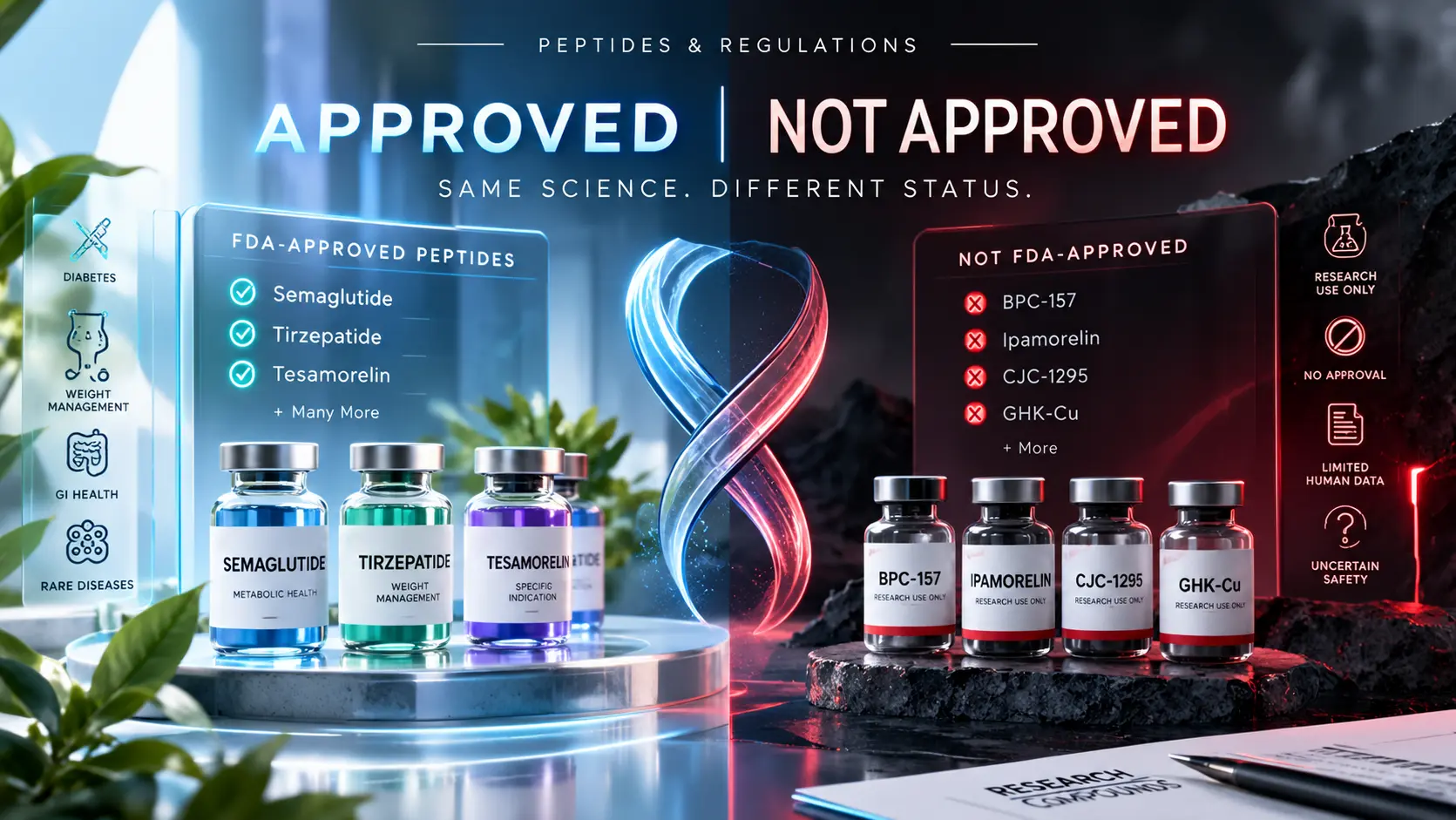
Quick Answer: Yes, FDA approved peptides exist, and there are many of them: a 2024 peer-reviewed review counted more than 90 FDA approvals for peptide drugs [1]. They include semaglutide (Ozempic, Wegovy), tirzepatide (Mounjaro, Zepbound) and tesamorelin (Egrifta WR). The compounds usually sold as research peptides, including BPC-157, TB-500, ipamorelin, CJC-1295 and GHK-Cu, hold no FDA approval for any use, and sermorelin's approvals were withdrawn in 2009 [2].
Key Takeaways
- A 2024 review in the European Journal of Medicinal Chemistry counted more than 90 FDA approvals for peptide drugs [1]; a 2022 review put worldwide approvals above 80 [3].
- Semaglutide was first approved as Ozempic on December 5, 2017, and tirzepatide as Mounjaro on May 13, 2022 [4].
- Sermorelin is not FDA-approved today. Both GEREF applications (NDA 19-863 and NDA 20-443) were withdrawn effective June 18, 2009 [2].
- BPC-157, TB-500, KPV, MOTS-c, epitalon, semax, ipamorelin, CJC-1295 and GHK-Cu have no FDA approval for any indication [4][5].
- The July 23-24, 2026 advisory committee votes concerned pharmacy compounding, not approval, and they are non-binding [6][23].
- Under a 2020 FDA rule, any amino acid chain longer than 40 residues is legally a protein, so tesamorelin (44 residues) and insulin are regulated as biologics [8][21].
- Among the "not approved" compounds, the one randomized human trial reviewed for this page, a 117-patient ipamorelin study, missed its key efficacy endpoint (p = 0.15) [10].
Research Use Only: 99 Purity Peptides supplies compounds strictly for laboratory research. Nothing on this site is intended for human or veterinary use. This page is a regulatory reference, not medical, dosing or health advice, and it does not describe how to obtain any approved medicine.
Are Peptides FDA-Approved?
Dozens of peptide drugs are FDA-approved, and almost none of the compounds sold as research peptides are. Both halves of that sentence matter. Most confusion comes from hearing only one of them.
The first half is larger than many readers expect. A 2024 review in the European Journal of Medicinal Chemistry reported more than 90 FDA approvals for peptide drugs [1]. A 2022 review in Signal Transduction and Targeted Therapy put the worldwide total above 80 [3]. The figures differ partly because reviews use different inclusion rules and cutoff dates, and one molecule can sit behind several brands.
The second half is just as firm. The Department of Defense's Operation Supplement Safety program notes that BPC-157 does not appear in FDA's approved drugs database and calls it an unapproved drug [5]. Likewise, the seven peptides reviewed by FDA's compounding advisers in July 2026 were all described as unapproved going into that meeting [11].
So "are peptides FDA approved?" has no yes-or-no answer. The useful question is narrower: which peptide, in which product, for which use?
Which Peptide Drugs Are on the FDA Approved Peptides List?
The FDA has approved peptide drugs for diabetes, obesity, gastrointestinal disease, prostate cancer, sexual desire disorder and at least one ultra-rare mitochondrial disease. Dates and application numbers come from Drugs@FDA records and FDA announcements [4].
Compound | Brand | FDA application | First US approval | Approved to treat (original indication) |
|---|---|---|---|---|
Leuprolide | Lupron | NDA 019010 | April 9, 1985 | Palliative treatment of advanced prostate cancer |
Liraglutide | Victoza | NDA 022341 | 2010-01-25 | Type 2 diabetes |
Tesamorelin | Egrifta (now Egrifta WR) | 022505 (now a BLA) | 2010-11-10 | Excess abdominal fat in adults with HIV and lipodystrophy |
Linaclotide | Linzess | See Drugs@FDA | 2012-08-30 | Chronic idiopathic constipation; IBS with constipation |
Teduglutide | Gattex | NDA 203441 | 2012-12-21 | Short bowel syndrome |
Liraglutide | Saxenda | NDA 206321 | 2014-12-23 | Chronic weight management |
Plecanatide | Trulance | See Drugs@FDA | 2017-01-19 | Chronic idiopathic constipation |
Semaglutide | Ozempic | NDA 209637 | 2017-12-05 | Type 2 diabetes |
Bremelanotide | Vyleesi | See Drugs@FDA | 2019-06-21 | Hypoactive sexual desire disorder in premenopausal women |
Semaglutide | Rybelsus | NDA 213051 | 2019-09-20 | Type 2 diabetes (oral tablet) |
Setmelanotide | Imcivree | NDA 213793 | 2020-11-25 | Obesity due to POMC, PCSK1 or LEPR deficiency |
Semaglutide | Wegovy | NDA 215256 | 2021-06-04 | Chronic weight management |
Tirzepatide | Mounjaro | NDA 215866 | 2022-05-13 | Type 2 diabetes |
Tirzepatide | Zepbound | NDA 217806 | 2023-11-08 | Chronic weight management |
Elamipretide | Forzinity | NDA 215244 | 2025-09-19 | Barth syndrome (accelerated approval) |
In running text, for anyone who needs one line: leuprolide was first approved as Lupron on April 9, 1985 under NDA 019010 [4], and trade coverage at the time reported it as the first Abbott-Takeda product to reach the US market [12]. Liraglutide followed as Victoza in 2010 and Saxenda in 2014. Tesamorelin was approved as Egrifta in 2010, and its current formulation, Egrifta WR, was approved in March 2025 [13].
Linaclotide (Linzess) and teduglutide (Gattex) arrived in 2012, plecanatide (Trulance) in 2017, and bremelanotide (Vyleesi) in 2019. Semaglutide was approved as Ozempic in 2017, Rybelsus in 2019 and Wegovy in 2021. Setmelanotide (Imcivree) was approved in 2020 [14]. Tirzepatide was approved as Mounjaro in 2022 and Zepbound in 2023. Elamipretide (Forzinity) received accelerated approval in September 2025 [15].
One correction to the record sits inside that table. A January 16, 2020 approval also appears in FDA's Rybelsus records, under NDA 213182, and it is easy to mistake for the first approval. That application added cardiovascular outcomes data, after which FDA administratively closed it and directed future submissions to the original NDA 213051 [16]. The original Rybelsus approval was September 20, 2019 [17].
The table is a sample, not the full list. A 2024 review in the Journal of Peptide Science points to two recent firsts on that longer list: trofinetide (Daybue), the first approved treatment for Rett syndrome, and motixafortide (Aphexda), the first peptide-based chemokine antagonist [18].
Why Do Tesamorelin and Insulin Count as Proteins Under FDA Rules?
Because FDA draws a legal line at 40 amino acids. A final rule effective March 23, 2020, defines a protein as any alpha amino acid polymer with a specific, defined sequence that is greater than 40 amino acids in size [8]. On that date, roughly 100 products approved as drugs moved to biologics licenses [9].
This matters for any "peptide" list. Insulin is often described as the first therapeutic peptide [3], yet FDA now regulates it as a biologic [8]. Tesamorelin comprises the 44-amino-acid sequence of human growth hormone-releasing factor plus a hexenoyl group [21], so its 2025 Egrifta WR approval came as a supplemental Biologics License Application [13]. Semaglutide and tirzepatide sit under the line and remain NDAs. To a chemist, all of these are peptides. To the agency, the category depends on residue count.
Which Popular Research Peptides Are Not Approved?
None of the nine compounds most often searched alongside "FDA approved" holds an FDA approval for any indication. This is the half of the question most readers came for, so the table adds two things competitors skip: where each compound stood after the July 2026 compounding votes, and what human evidence is actually on record.
Compound | FDA approval | July 2026 compounding advisory vote | Human evidence on record | Our grade |
|---|---|---|---|---|
BPC-157 | None | Recommended, 8-6 with 1 abstention (non-binding) | Research is predominantly cell and animal work [24] | C |
TB-500 | None | Recommended, 8-6 with 1 abstention | FDA identified no human safety studies [11] | D |
KPV | None | Recommended, 8-6 with 1 abstention | FDA identified no human safety studies [11] | D |
MOTS-c | None | Recommended, 7-5 with 2 abstentions | FDA identified no human safety studies [11] | D |
Epitalon | None | Recommended, 7-5 with 1 abstention | FDA identified no human safety studies [11] | D |
Semax | None | Recommended, 8-5 | Not reviewed for this page | Not graded |
Ipamorelin | None | Not on the July 2026 agenda | One Phase 2 randomized trial, 117 enrolled, key efficacy endpoint not met [10] | B |
CJC-1295 | None | Not on the July 2026 agenda | Not reviewed for this page | Not graded |
GHK-Cu | None | Not on the July 2026 agenda | Not reviewed for this page | Not graded |
Vote tallies come from trade coverage of the meeting [7][20].
How we graded the evidence. Grade A would mean at least one adequately powered human randomized trial met its primary endpoint; no graded compound here earns it. Grade B means human randomized data exist but are small or missed the primary endpoint. Grade C means the record is predominantly animal or cell-culture work. Grade D means FDA's 2026 compounding review identified no human safety studies. "Not graded" means we did not complete a primary-literature review for this page, and we would rather say so than guess.
Ipamorelin's B deserves a sentence of context. It is the only compound in the table where a sponsor, Helsinn, ran a placebo-controlled human trial for a defined condition. In 114 analyzable patients recovering from bowel surgery, median time to a tolerated solid meal was 25.3 hours on ipamorelin versus 32.6 hours on placebo, a difference that was not statistically significant [10]. That negative result is more informative than any amount of preclinical enthusiasm, because it shows what happened when the compound met a real endpoint.
For a worked example of how an unapproved compound's status breaks down, see our guide to whether BPC-157 is legal.
Approved, Compoundable, or Neither?
These are three different legal positions, and a compound can move between the last two without ever reaching the first. Several ranking pages blur them, usually by implying that a compounding pathway amounts to approval. It does not.
Status | What it means | Who decides | Where the finished product stands |
|---|---|---|---|
FDA-approved | A specific product was reviewed for safety and effectiveness for specific uses | FDA, through an NDA or BLA | Approved, labeled, manufactured under an application |
Eligible for 503A compounding | A licensed pharmacy may prepare the substance for an individual prescription | FDA, after advisory review and rulemaking | Not FDA-approved, even when lawfully compounded |
Neither | Not approved and not currently eligible for compounding | No affirmative decision exists | Not a lawful drug product |
BPC-157 shows how the middle category works in practice. FDA removed it and eleven other peptides from its Category 2 safety-concern list in April 2026, but removal alone did not make it eligible for pharmacy compounding [19]. On July 23-24, 2026, FDA's Pharmacy Compounding Advisory Committee then voted to recommend six peptides for the 503A Bulks List, against the position of FDA staff, and pharmacies may not compound them until final rulemaking is in place [6][20][23]. Our breakdown of the July 2026 FDA peptide vote covers the pathway in detail.
A second correction belongs here. Some ranking pages cite a February 2026 announcement as though it restored approval for named peptides. We could not verify a primary source for that framing. The formal actions we could verify were an April 2026 change to a compounding safety list and a July 2026 non-binding advisory vote. Neither is an approval.
Is Sermorelin FDA-Approved?
No. Sermorelin was approved in the past as GEREF, but FDA withdrew approval of both GEREF applications effective June 18, 2009, and no approved sermorelin product is marketed today [2]. At least one page ranking for this query still describes sermorelin as "FDA-approved for diagnostic use." That was true in 1990. It has not been true since 2009.
The Federal Register record is unusually complete, so here it is in order.
Date | What happened | Application |
|---|---|---|
1990-12-28 | GEREF approved for evaluating the pituitary's ability to secrete growth hormone | NDA 19-863 |
1997-09-26 | GEREF approved for idiopathic growth hormone deficiency in children with growth failure | NDA 20-443 |
2008-07-11 | EMD Serono notifies FDA the diagnostic product is being discontinued | NDA 19-863 |
2008-12-02 | EMD Serono notifies FDA the treatment product is being discontinued and requests withdrawal | NDA 20-443 |
2009-05-19 | FDA announces withdrawal of both applications, effective June 18, 2009 | Both |
2013-03-04 | FDA determines neither product was withdrawn for reasons of safety or effectiveness | Both |
Every row comes from FDA's 2013 Federal Register notice [2].
The fair reading cuts both ways. Sermorelin did not leave the market over a safety finding, and the 2013 determination means FDA could approve a generic that references GEREF. Even so, FDA's Orange Book lists only the discontinued GEREF presentations under sermorelin [25]. "Formerly approved" is accurate. "FDA-approved" is not.
Are GLP-1 Drugs Peptides?
Yes. Semaglutide, tirzepatide and liraglutide are peptide drugs with FDA approvals, which is the main reason "are peptides FDA approved for weight loss" is such a common query. The honest answer to that query is shorter than people expect, because only some of these brands carry a weight-management indication.
Brand | Compound | Original approved use | Weight-management indication at approval? |
|---|---|---|---|
Saxenda | Liraglutide | Chronic weight management | Yes |
Imcivree | Setmelanotide | Obesity due to three rare genetic deficiencies | Yes, restricted to those conditions |
Wegovy | Semaglutide | Chronic weight management | Yes |
Zepbound | Tirzepatide | Chronic weight management | Yes |
Ozempic, Rybelsus | Semaglutide | Type 2 diabetes | No |
Mounjaro | Tirzepatide | Type 2 diabetes | No |
Egrifta WR | Tesamorelin | Excess abdominal fat in HIV-associated lipodystrophy | No; the label states it is not indicated for weight loss management [21] |
The tesamorelin row surprises people. Its label targets one fat depot in one patient population and explicitly excludes weight loss [21].
Here is the inference error the GLP-1 approvals create. Semaglutide is a peptide, and semaglutide is approved, so "peptides" start to sound approved as a class. Approval does not work at the class level. It attaches to one sponsor's product, backed by that sponsor's trial data, for the uses on its label. Being a peptide confers no regulatory standing on BPC-157 or any other compound.
Why Are So Few Research Peptides Approved?
Because approval must be requested and paid for: a sponsor has to fund clinical trials and file an application, and for most research peptides nobody has. FDA does not approve molecules on its own initiative. Every application in the approved table has a company name behind it.
That also explains why the approved list skews metabolic and hormonal. Therapeutic peptide research grew out of natural human hormones such as insulin, oxytocin, vasopressin and gonadotropin-releasing hormone [3]. Those molecules came with known receptors and measurable clinical endpoints, such as blood glucose and body weight. A sponsor could design a trial, predict what success looked like, and see a market at the end of it.
Most research peptides lack at least one of those ingredients. Consider what FDA scientists told the July 2026 committee: without universally accepted chemical definitions, even the identity and comparability of some nominated substances were unclear [20]. That is a problem that precedes any efficacy trial.
When a sponsor does step in, the process works as designed, in both directions. Helsinn took ipamorelin into a Phase 2 trial and it did not separate from placebo [10]. Stealth BioTherapeutics took elamipretide, long discussed in research circles as SS-31, through a trial in Barth syndrome and won accelerated approval in 2025 [15]. In our view, the gap between those two stories is the whole answer. The difference is not whether a compound is popular. It is whether anyone has put it through the test.
What Approval Actually Means, and What It Does Not
An FDA approval covers a specific product for specific uses, and it does not transfer to the same molecule in another form, formulation or use. Two examples from the approved table make that concrete.
First, even a change to the label is reviewed on its own. When Novo Nordisk sought to add the PIONEER 6 cardiovascular outcomes data to the Rybelsus prescribing information, FDA handled it through a separate application, NDA 213182, approved January 16, 2020 [16]. The molecule was already approved; the new safety and efficacy information still needed its own review.
Second, formulations are reviewed one at a time. Egrifta WR contains the same active molecule as Egrifta SV, yet it required its own supplemental approval in 2025, and the two products are not substitutable [13].
It follows that a compound bearing an approved drug's chemical name, but made outside that approved application, is not covered by the approval. The label, the manufacturing controls and the clinical data belong to the application, not to the name.
Approval can also be conditional. Forzinity's accelerated approval rests on improved knee extensor strength, a measure FDA considered reasonably likely to predict benefit, and it requires a confirmatory randomized trial [15].
What This List Does Not Tell You
This page is a snapshot, and approvals keep changing after any snapshot is taken. In March 2026, for example, Imcivree gained a new indication for acquired hypothalamic obesity [22]. Brands also get replaced, as Egrifta WR is replacing Egrifta SV [13], and approvals can be withdrawn outright, as GEREF's were [2].
The list is also incomplete by design. It holds 15 rows drawn from a field of more than 90 approvals [1]. Leaving a drug out says nothing about its status.
Several things the evidence does not establish, stated plainly:
- An approval does not establish that a compound is safe or useful outside its labeled population and use.
- A favorable compounding vote does not establish safety or effectiveness; FDA staff scientists argued against the nominations [7][20].
- Our evidence grades describe what research exists. They are not verdicts on whether any compound works.
- A missing human trial is not evidence of harm, and it is not evidence of benefit either.
For current status, check Drugs@FDA for drug applications [4]. Biologics such as tesamorelin and insulin are also listed in FDA's Purple Book.
Where Should You Go Next?
If your question is about one unapproved compound, start with our explainer on whether BPC-157 is legal, which walks through each regulatory layer. For the compounding pathway and the committee votes, read our analysis of the July 2026 FDA peptide vote. For background on the category itself, see what research peptides are, and use the research peptide glossary for terms such as NDA, BLA and 503A.
References
- Sharma A, Singh LR. An insight into the pharmacology of cysteine/methionine containing peptide drugs. Eur J Med Chem. 2024;271:116456. doi:10.1016/j.ejmech.2024.116456. PMID 38691890. https://pubmed.ncbi.nlm.nih.gov/38691890/
- Food and Drug Administration. Determination that GEREF (sermorelin acetate) injection, 0.5 milligrams base/vial and 1.0 milligrams base/vial, and GEREF (sermorelin acetate) injection, 0.05 milligrams base/amp, were not withdrawn from sale for reasons of safety or effectiveness. Federal Register. March 4, 2013. FR Doc. 2013-04827. https://public-inspection.federalregister.gov/2013-04827.pdf
- Wang L, Wang N, Zhang W, et al. Therapeutic peptides: current applications and future directions. Signal Transduct Target Ther. 2022;7(1):48. doi:10.1038/s41392-022-00904-4. PMID 35165272. https://pmc.ncbi.nlm.nih.gov/articles/PMC8844085/
- U.S. Food and Drug Administration. Drugs@FDA: FDA-Approved Drugs. https://www.accessdata.fda.gov/scripts/cder/daf/
- Operation Supplement Safety (U.S. Department of Defense). BPC-157: A prohibited peptide and an unapproved drug found in health and wellness products. https://www.opss.org/article/bpc-157-prohibited-peptide-and-unapproved-drug-found-health-and-wellness-products
- U.S. Food and Drug Administration. July 23-24, 2026: Meeting of the Pharmacy Compounding Advisory Committee. https://www.fda.gov/advisory-committees/advisory-committee-calendar/july-23-24-2026-meeting-pharmacy-compounding-advisory-committee-07232026
- Regulatory Affairs Professionals Society (Regulatory Focus). FDA advisory committee backs two more peptides, rejects one for compounding list. July 2026. https://www.raps.org/resource/fda-advisory-committee-backs-two-more-peptides-rejects-one-for-compounding-list.html
- Food and Drug Administration. Definition of the term "biological product." Final rule. Federal Register. 2020;85(35):10057. February 21, 2020. https://www.govinfo.gov/content/pkg/FR-2020-02-21/pdf/2020-03505.pdf
- Regulatory Affairs Professionals Society (Regulatory Focus). FDA finalizes biological product definition ahead of transition. February 2020. https://www.raps.org/resource/fda-finalizes-biological-product-definition-ahea.html
- Beck DE, Sweeney WB, McCarter MD; Ipamorelin 201 Study Group. Prospective, randomized, controlled, proof-of-concept study of the ghrelin mimetic ipamorelin for the management of postoperative ileus in bowel resection patients. Int J Colorectal Dis. 2014;29(12):1527-1534. doi:10.1007/s00384-014-2030-8. PMID 25331030. https://doi.org/10.1007/s00384-014-2030-8
- Health Affairs Forefront. FDA advisory committee's vote may open a drug-compounding back door for unapproved peptides. August 4, 2026. https://www.healthaffairs.org/content/forefront/fda-advisory-committee-s-vote-may-open-drug-compounding-back-door-unapproved-peptides
- The Pink Sheet. Lupron is first Abbott-Takeda product to reach U.S. market; FDA approves synthetic LHRH analog. April 15, 1985. https://pink.pharmaintelligence.informa.com/articles/1985/04/15/lupron-is-first-abbotttakeda-product-to-reach-us-market-fda-approves-synthetic-lhrh-analog-was-treat
- Theratechnologies Inc. Theratechnologies receives FDA approval for EGRIFTA WR (tesamorelin F8). Press release, March 25, 2025 (reproduced by EATG). https://www.eatg.org/hiv-news/theratechnologies-receives-fda-approval-for-egrifta-wr-tesamorelin-f8-to-treat-excess-visceral-abdominal-fat-in-adults-with-hiv-and-lipodystrophy/
- U.S. Food and Drug Administration. FDA approves first treatment for weight management for people with certain rare genetic conditions. November 27, 2020. https://www.fda.gov/drugs/drug-safety-and-availability/fda-approves-first-treatment-weight-management-people-certain-rare-genetic-conditions
- U.S. Food and Drug Administration. FDA grants accelerated approval to first treatment for Barth syndrome. September 19, 2025. https://www.fda.gov/news-events/press-announcements/fda-grants-accelerated-approval-first-treatment-barth-syndrome
- U.S. Food and Drug Administration. Approval letter, NDA 213182 and NDA 213051/S-001, Rybelsus (semaglutide) tablets. January 16, 2020. https://www.accessdata.fda.gov/drugsatfda_docs/appletter/2020/213182Orig1s000,%20213051Orig1s001ltr.pdf
- U.S. Food and Drug Administration. FDA approves first oral GLP-1 treatment for type 2 diabetes. September 20, 2019. https://www.fda.gov/news-events/press-announcements/fda-approves-first-oral-glp-1-treatment-type-2-diabetes
- Al Musaimi O. FDA's stamp of approval: unveiling peptide breakthroughs in cardiovascular diseases, ACE, HIV, CNS, and beyond. J Pept Sci. 2024;30(11):e3627. doi:10.1002/psc.3627. PMID 38885943. https://pubmed.ncbi.nlm.nih.gov/38885943/
- Holt Law. BPC-157 in 2026: why regulatory limbo is not the same as a green light. 2026. https://djholtlaw.com/regulatory-alert-the-legal-status-of-bpc-157-in-compounding-and-clinical-practice/
- Pharmaceutical Executive. FDA panel votes to loosen restrictions for four peptides. July 2026. https://www.pharmexec.com/view/fda-votes-loosen-restrictions-four-peptides
- EGRIFTA WR (tesamorelin) for injection. Prescribing information. U.S. Food and Drug Administration; revised March 2025. https://www.accessdata.fda.gov/drugsatfda_docs/label/2025/022505s020lbl.pdf
- Epocrates. Imcivree now FDA-approved for acquired hypothalamic obesity. March 2026. https://epocrates.com/online/article/imcivree-now-fda-approved-for-acquired-hypothalamic-obesity
- National Community Pharmacists Association. FDA advisory committee nominates six peptides for pharmacies to compound. July 31, 2026. https://ncpa.org/newsroom/qam/2026/07/31/fda-advisory-committee-nominates-six-peptides-pharmacies-compound
- Holt Law. Understanding the legal risks of BPC-157 and other unapproved peptides. 2026. https://djholtlaw.com/understanding-the-legal-risks-of-bpc-157-and-other-unapproved-peptides/
- U.S. Food and Drug Administration. Orange Book: Approved Drug Products with Therapeutic Equivalence Evaluations. https://www.accessdata.fda.gov/scripts/cder/ob/
Frequently Asked Questions
Are any peptides actually FDA-approved?
Yes, many are. Peer-reviewed counts put FDA approvals for peptide drugs above 90, including semaglutide (Ozempic, Wegovy), tirzepatide (Mounjaro, Zepbound), liraglutide (Victoza, Saxenda), linaclotide (Linzess) and tesamorelin (Egrifta WR). What those approvals cover is narrow: each belongs to one company's product, for the uses printed on its label. None of that approval extends to research compounds such as BPC-157 or TB-500.
How many peptide drugs has the FDA approved?
More than 90, according to a 2024 review in the European Journal of Medicinal Chemistry. Exact totals vary by source because counting rules vary. Some reviews include large hormones such as insulin, which FDA has regulated as a biologic since 2020, while others stop at a size cutoff. A single molecule can also appear under several brand names, which inflates brand counts without adding new peptides.
Which peptides are FDA-approved for weight loss?
Three peptide brands carry a general chronic weight-management indication: Saxenda (liraglutide, 2014), Wegovy (semaglutide, 2021) and Zepbound (tirzepatide, 2023). Imcivree (setmelanotide) is approved only for obesity caused by specific rare genetic conditions, with a further indication added in 2026. Ozempic and Mounjaro were approved for type 2 diabetes, not weight management, even though they contain the same active peptides as Wegovy and Zepbound.
Is BPC-157 FDA-approved?
No. BPC-157 has no FDA approval for any use, and the Department of Defense's Operation Supplement Safety program describes it as an unapproved drug. In July 2026, an FDA advisory committee voted 8-6 to recommend it for the pharmacy compounding list, but that vote was non-binding and concerned compounding eligibility, not approval. Its research record is predominantly cell and animal work.
Is ipamorelin FDA-approved?
No. Ipamorelin has no FDA approval for any indication. It is one of the few research peptides that a pharmaceutical sponsor actually tested in humans: a Phase 2 randomized trial enrolled 117 patients recovering from bowel surgery and did not show a statistically significant benefit on its main endpoint. No approval application followed, and ipamorelin was not on the July 2026 compounding committee agenda.
Is CJC-1295 FDA-approved?
No. CJC-1295 has no FDA approval for any use. FDA has placed it in Category 2 of its compounding bulk-substance review, the category for substances with significant safety concerns, and it was not among the seven peptides voted on by the July 2026 advisory committee. It is sometimes confused with sermorelin or tesamorelin, which act on the same receptor but have separate regulatory histories.
Is sermorelin FDA-approved?
Not today. Sermorelin was approved as GEREF in 1990 and 1997, but FDA withdrew approval of both applications effective June 18, 2009, after the manufacturer discontinued them. A 2013 Federal Register notice confirmed the withdrawal was not for safety or effectiveness reasons. Pages calling sermorelin "FDA-approved for diagnostic use" are describing a status that ended over fifteen years ago.
Is tesamorelin FDA-approved?
Yes, for one specific use. Tesamorelin was first approved as Egrifta in 2010, and its current formulation, Egrifta WR, was approved in 2025 to reduce excess abdominal fat in adults with HIV and lipodystrophy. Its label states it is not indicated for weight loss management. Because it has 44 amino acids, FDA regulates it as a biologic rather than as a conventional drug.
Is GHK-Cu FDA-approved?
No. GHK-Cu, the copper-binding tripeptide, has no FDA approval as a drug for any indication. It was not among the peptides reviewed at the July 2026 compounding advisory meeting, so that vote did not change its position. Any claim that GHK-Cu is approved should come with a Drugs@FDA application number you can check yourself.
Are GLP-1 drugs like Ozempic peptides?
Yes. Semaglutide, the active ingredient in Ozempic, Rybelsus and Wegovy, is a peptide, as are tirzepatide and liraglutide. All three stay below FDA's 40-amino-acid protein threshold, so they are regulated through new drug applications. Their approvals explain why "peptides" sounds approved as a category, but approval never applies to a whole class of molecules.
What is the difference between FDA-approved and compounded?
An FDA-approved drug is a specific product reviewed by FDA for safety and effectiveness for labeled uses. A compounded drug is prepared by a licensed pharmacy for an individual prescription and is not FDA-approved, even when compounding is lawful. A substance can become eligible for compounding, as some peptides may after the July 2026 votes, without ever becoming an approved drug.
Does "research use only" mean the FDA rejected a compound?
No. "Research use only" is a seller's statement about intended use, not an FDA decision. FDA reviews a drug only when a sponsor submits an application, and most research peptides have never been submitted. So the absence of approval usually means nobody asked, not that FDA said no. It also means no one has shown the compound is safe or effective in people.
Why do so few research peptides get FDA approval?
Approval requires a sponsor willing to fund human trials and file an application, and most research peptides have never had one. Approved peptide drugs mostly grew from well-understood hormones with measurable endpoints. Research peptides often lack a defined target condition or even agreed chemical specifications. When a sponsor did test one, ipamorelin, the trial missed its key efficacy endpoint.
Does FDA approval of a molecule cover every form of it?
No. Approval covers a specific product, made under a specific application, for specific uses. FDA reviewed Rybelsus's cardiovascular indication through a separate application, and Egrifta WR needed its own approval despite sharing its molecule with Egrifta SV. A compound carrying an approved drug's chemical name, made outside that application, is not covered by the approval.
Where can I check a drug's current FDA approval status?
Use Drugs@FDA, the agency's free database at accessdata.fda.gov, to search by brand or active ingredient and see application numbers, approval dates and marketing status, including "Discontinued." For products FDA regulates as biologics, such as insulin and tesamorelin, also check the FDA Purple Book. Status can change after any article is published, so the database is the final word.