Last reviewed: September 2026
Quick Answer
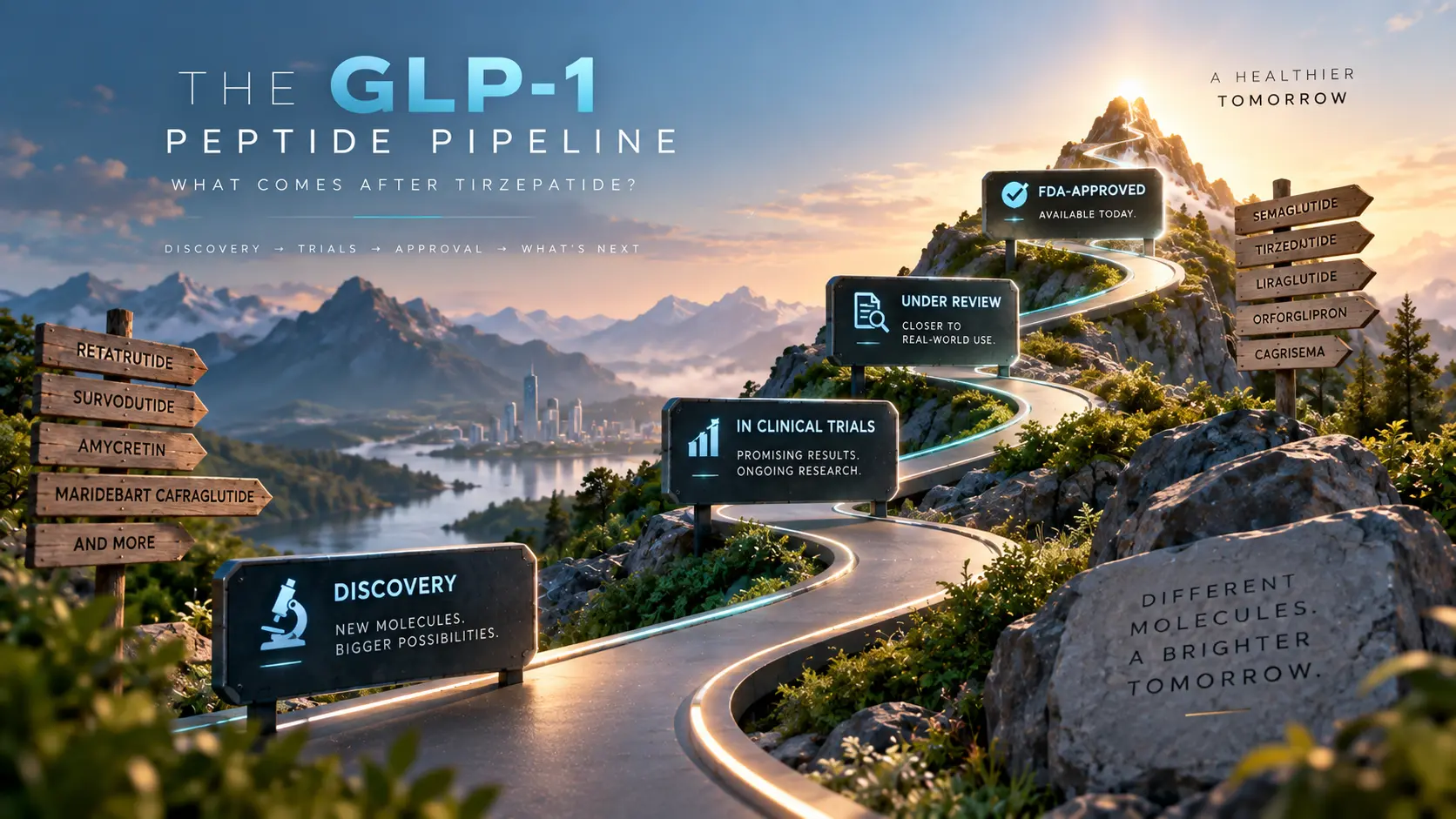
The GLP-1 peptide pipeline in 2026 splits into three groups that are often blurred together. Five compounds with GLP-1 receptor activity now hold FDA approval for weight management: semaglutide by injection, semaglutide as a tablet, tirzepatide, liraglutide, and orforglipron. One combination, CagriSema, sits under active FDA review with a decision anticipated before the end of 2026. Four more remain investigational with no US application yet filed: retatrutide, survodutide, amycretin, and maridebart cafraglutide. None of the four can be lawfully compounded, and none has been evaluated for human use outside a trial protocol.
Key Takeaways
- Retatrutide is no longer a Phase 2 compound. Five Phase 3 TRIUMPH readouts landed between December 2025 and July 2026, and Eli Lilly has said it plans to file a Biologics License Application in the first quarter of 2027. [1][2][3]
- CagriSema produced 23.0% mean weight loss in the head-to-head REDEFINE 4 trial and still failed its primary endpoint. It did not show non-inferiority to tirzepatide 15 mg, which reached 25.5% on the same measure. [4]
- Amycretin's Phase 3 obesity trial, AMAZE 1, began on 24 February 2026 and lists an estimated primary completion date of 26 June 2029. Pipeline pages predicting 2027 results are reading the wrong document. [5]
- Maridebart cafraglutide pairs a GLP-1 receptor agonist with a GIP receptor antagonist. Tirzepatide pairs a GLP-1 receptor agonist with a GIP receptor agonist. Both reduce food intake in trials, and the reason is still contested. [6][7]
- Survodutide's glucagon arm shows up in the liver. A pre-specified MRI sub-study reported relative reductions of up to 34.0% in visceral fat and 63.1% in liver fat. [8]
- Orforglipron, approved 1 April 2026, is a small molecule rather than a peptide. The label "GLP-1" describes a receptor, not a chemical class. [9]
- The FDA issued five warning letters on 24 August 2026 stating that website content, not vial labels, established that products marketed for research use were intended as drugs for human use. [10][11]
- Headline percentages from different sponsors are frequently not comparable. Most come from efficacy estimands, which model what would happen if everyone stayed on treatment.
Research Use Only
99 Purity Peptides supplies compounds for laboratory research only. Nothing sold here is for human or veterinary consumption. Nothing on this page is medical, dosing, or health advice, and no compound discussed is recommended for any outcome. Trial doses appear below only where they identify which study arm produced a result.
How We Graded the Evidence
Four criteria decide how much weight a figure carries on this page. First, trial phase, since a Phase 1b signal and a Phase 3 primary endpoint are not the same kind of claim. Second, peer review status, because a press release is a summary written by the sponsor. Third, estimand transparency, meaning whether the source says which population and which analysis produced the number. Fourth, whether an active comparator was used, since almost every cross-company comparison in this field is indirect.
What Counts as a GLP-1 Peptide in 2026?
A GLP-1 peptide is a chain of amino acids engineered to bind the GLP-1 receptor, and several compounds now called GLP-1 drugs are not peptides at all. Semaglutide, tirzepatide, liraglutide, retatrutide, survodutide, and amycretin are peptide analogs. Orforglipron is a small molecule, built by medicinal chemistry rather than peptide synthesis, and the FDA approved it on 1 April 2026 as the first oral non-peptide GLP-1 receptor agonist for weight management. [9]
Maridebart cafraglutide sits in a third category. It is a peptide-antibody conjugate, with two GLP-1 peptide analogs attached to a monoclonal antibody that blocks the GIP receptor. [6] Calling it a peptide is roughly half right.
The distinction matters for a practical reason. Synthesis route, stability, storage behavior, and analytical characterization all differ between a 30-residue peptide and a small molecule. A supplier's certificate of analysis reports on one of those things and says nothing about the other.
Compound | Molecular class | GLP-1 receptor | GIP receptor | Glucagon receptor | Amylin receptor | Single molecule |
|---|---|---|---|---|---|---|
Semaglutide | Peptide analog | Agonist | No | No | No | Yes |
Liraglutide | Peptide analog | Agonist | No | No | No | Yes |
Tirzepatide | Peptide analog | Agonist | Agonist | No | No | Yes |
Retatrutide | Peptide analog | Agonist | Agonist | Agonist | No | Yes |
Survodutide | Peptide analog | Agonist | No | Agonist | No | Yes |
Amycretin | Peptide analog | Agonist | No | No | Agonist | Yes |
CagriSema | Two peptides, fixed dose | Agonist | No | No | Agonist | No |
Maridebart cafraglutide | Peptide-antibody conjugate | Agonist | Antagonist | No | No | Yes |
Orforglipron | Small molecule | Agonist | No | No | No | Yes |
Two rows in that table deserve a second look. CagriSema is not a new molecule. It is semaglutide and the amylin analog cagrilintide combined at fixed doses in one injection, which our cagrilintide and semaglutide comparison covers in detail. The maridebart cafraglutide row is the only one where a receptor is blocked rather than activated.
Which GLP-1-Class Compounds Are Already FDA-Approved?
Five are approved in the United States for weight management as of September 2026, and a sixth combination is under review. Semaglutide injection has carried a weight management approval since June 2021. Tirzepatide followed on 8 November 2023. Liraglutide has been approved for adults since 2014. Oral semaglutide at 25 mg was approved on 22 December 2025, based on the OASIS 4 trial, making it the first GLP-1 receptor agonist in tablet form cleared for weight management. [12] Orforglipron arrived on 1 April 2026 with a boxed warning for thyroid C-cell tumors. [9]
Approval status is the one fact on this page that changes fastest, and the one most often copied forward from stale sources. Our guide to FDA-approved peptides tracks the full list.
Compound | US status, September 2026 | Regulatory basis | Next milestone |
|---|---|---|---|
Semaglutide, injection | Approved | STEP and SELECT programs | None pending |
Semaglutide, oral 25 mg | Approved 22 Dec 2025 | OASIS programme, SELECT | None pending |
Tirzepatide | Approved 8 Nov 2023 | SURMOUNT-1, SURMOUNT-2 | None pending |
Liraglutide | Approved 2014 | SCALE programme | None pending |
Orforglipron | Approved 1 Apr 2026 | ATTAIN-1, ATTAIN-2 | None pending |
CagriSema | Under FDA review | REDEFINE 1, REDEFINE 2 | Decision anticipated late 2026 |
Retatrutide | Investigational | TRIUMPH programme | BLA planned Q1 2027 |
Survodutide | Investigational | SYNCHRONIZE programme | No US filing announced |
Amycretin | Investigational | AMAZE programme | Primary completion est. Jun 2029 |
Maridebart cafraglutide | Investigational | MARITIME programme | Readouts expected early 2027 |
What Is Retatrutide, and How Far Along Is It?
Retatrutide is a single peptide that activates the GLP-1, GIP, and glucagon receptors, and it moved out of Phase 2 more than a year ago. Most pipeline trackers still quote the 2023 Phase 2 result, in which 338 adults received weekly injections for 48 weeks and the 12 mg group lost 24.2% of body weight against 2.1% on placebo. [13] That number is real, peer-reviewed, and now superseded.
Phase 3 changed the picture. In TRIUMPH-1, a 2,339-participant trial, the 12 mg arm lost an average of 28.3% at 80 weeks, and 45.3% of that group reached at least 30% weight reduction. [1] A blinded extension of 532 participants with a starting body mass index of 35 or higher reported 30.3% at 104 weeks. That extension enrolled only people who completed the main trial and tolerated the drug, so it describes a selected group rather than everyone who started. TRIUMPH-2 in type 2 diabetes reached 20.8% at 80 weeks at the top dose, and TRIUMPH-3 in established cardiovascular disease reached 22.6%. [2]
Tolerability data arrived alongside. Nausea affected 42.4% of the 12 mg group against 14.8% on placebo, and dysesthesia reached 12.5% against 0.9%. [1] Discontinuation for adverse events in TRIUMPH-3 hit 13.5% at the top dose. [2]
Lilly says the Chemistry, Manufacturing, and Controls package is still being completed, with a BLA planned for the first quarter of 2027. [2] Our retatrutide and tirzepatide comparison and the companion piece on how retatrutide differs mechanistically from tirzepatide and semaglutide handle the head-to-head detail.
What Is Survodutide, and Why Does It Target the Liver?
Survodutide is a glucagon and GLP-1 receptor dual agonist, and the glucagon half is what sends it toward the liver. Glucagon receptor activation increases hepatic energy expenditure and shifts lipid handling, which is a different lever from appetite suppression. Boehringer Ingelheim has run two development tracks in parallel because of it.
The obesity track reported first. SYNCHRONIZE-1 randomized 725 adults across 116 sites in 14 countries and ran 76 weeks, with full results published in the New England Journal of Medicine on 7 June 2026. [14] Weight loss reached 16.6% on the efficacy estimand against 3.2% on placebo. On the treatment-policy estimand, which counts everyone regardless of whether they stayed on treatment, the figure was roughly 12% to 13% against a placebo arm that lost 5.4%. [8][15] Gastrointestinal events led to discontinuation in up to 20.2% of participants receiving survodutide. [15]
That gap between 16.6% and 12% is not a rounding difference. It is the whole distance between an idealized model and what a randomized population actually did.
The liver track is where survodutide separates from the pack. SYNCHRONIZE-MASLD enrolled 218 adults and met both primary endpoints at 48 weeks, with results published in Nature Medicine. [8] A pre-specified MRI sub-study recorded relative reductions of up to 34.0% in visceral fat and 63.1% in liver fat. [8] Two dedicated Phase 3 trials are running in metabolic dysfunction-associated steatohepatitis, LIVERAGE in fibrosis stages 2 and 3 with roughly 1,800 adults, and LIVERAGE-Cirrhosis in compensated cirrhosis with roughly 1,590. [16] The FDA granted Breakthrough Therapy designation for that indication in September 2024. [17]
No US marketing application for survodutide has been announced in either indication.
What Is Amycretin, and How Does Adding Amylin Change the Picture?
Amycretin is a single molecule that activates both the GLP-1 receptor and the amylin receptor, which makes it structurally different from CagriSema even though the two target the same pair of pathways. Amylin signals satiety through the brainstem, a route independent of the incretin axis. Combining both activities in one molecule avoids the dose-matching problem that comes with pairing two separate drugs.
Early results drew attention for good reason. A Phase 1b/2a trial of 125 adults tested three maintenance doses of weekly subcutaneous amycretin over 36 weeks, and the 60 mg group reached 24.3% weight loss against 1.1% on placebo. [18] An oral formulation reached roughly 13% over 12 weeks in a first-in-human study. [18] A Phase 2 trial in 448 adults with type 2 diabetes reported up to 14.5% with the injection and 10.1% with the tablet. [19]
Here is where the reporting goes wrong. A 36-week Phase 1b/2a result in 125 people is a dose-finding signal, not an efficacy estimate, and the trial was never powered to produce one. Novo Nordisk moved both formulations straight into Phase 3 after end-of-Phase 2 regulatory discussions, skipping a conventional Phase 2b in obesity. [20]
Registry records set the real timeline. AMAZE 1 started on 24 February 2026, enrolls 1,150 participants across five arms, and lists an estimated primary completion date of 26 June 2029 with study completion in August 2029. [5] Pages forecasting amycretin data in 2027 are not reading the trial record.
What Is CagriSema, and What Is Its Current Regulatory Status?
CagriSema is a fixed-dose combination of cagrilintide and semaglutide, and it is under FDA review rather than approved. Novo Nordisk submitted the New Drug Application on 18 December 2025 on the strength of REDEFINE 1 and REDEFINE 2, and has said it anticipates a decision by late 2026. [21] REDEFINE 1 reported 22.7% weight loss at 68 weeks in adults without type 2 diabetes, and REDEFINE 2 reported 15.7% in adults with it. [22]
Then came the head-to-head. REDEFINE 4 randomized 809 adults with obesity and at least one related condition to CagriSema or tirzepatide 15 mg, ran 84 weeks, and was open-label. On 23 February 2026, Novo Nordisk announced 23.0% weight loss for CagriSema against 25.5% for tirzepatide on the efficacy estimand, and 20.2% against 23.6% on the treatment-policy estimand. [4] The trial did not meet its primary endpoint of non-inferiority.
Most pipeline pages report the 23% and stop. The miss is the more informative result, because it is the only direct Phase 3 comparison in this entire group of compounds. Our page on semaglutide versus tirzepatide for weight loss covers the approved side of that comparison.
Two design limits apply. Open-label allocation means participants and investigators knew which drug was being given, which can influence behavior and reporting. A single comparison at one dose pair says nothing about other dose pairs, and Novo Nordisk began a separate higher-dose Phase 3b study in the second quarter of 2026.
What Is MariTide, and Why Does a GIP Antagonist Do What a GIP Agonist Does?
Maridebart cafraglutide blocks the GIP receptor while activating the GLP-1 receptor, which is the opposite of what tirzepatide does at GIP, and both approaches reduce body weight in trials. This is the most interesting open question in the field, and it is genuinely unresolved.
The Phase 2 data are published. A 592-participant trial ran 52 weeks with monthly or less frequent dosing, and the obesity cohort lost 12.3% to 16.2% on the treatment-policy estimand against 2.5% on placebo. [6] The efficacy estimand reached 19.9%, which is the source of the "up to 20%" figure that circulates widely. Reporting the 20% next to a competitor's treatment-policy number produces a comparison that means nothing.
Three hypotheses compete to explain the paradox. One holds that chronic GIP receptor agonism causes ligand-mediated internalization and functional desensitization, so a long-acting agonist eventually behaves like an antagonist. [7] A second holds that GIP receptor blockade enhances GLP-1 receptor signaling through compensatory cross-talk, rather than acting on its own. [7] A third holds that the two work through separate circuits, and mouse work supports it. In animals lacking a functional GLP-1 receptor, the effects of GIP receptor antagonism disappeared, while the effects of agonism did not. [23]
None of this is settled. A 2026 review noted that agonism appears to recruit anorectic neural circuits and blunt the aversive effects of GLP-1 signaling, while antagonism appears to work by a different route. [24] One awkward fact cuts against the desensitization story: the agonist achieves comparable weight loss at far lower doses than the optimized antagonist, which is hard to reconcile if the two converge on the same endpoint state. [7]
Phase 3 MARITIME-1 and MARITIME-2 have primary readouts expected in early 2027. [25] Amgen announced Part 2 maintenance results at an investor conference in January 2026, saying a "large majority" of participants maintained weight loss on reduced dosing. No data accompanied the statement. [26]
Which of These Can Legally Be Compounded or Sold as Research Material?
None of the investigational compounds can be lawfully compounded, and the approved ones mostly cannot either. Compounding under section 503A or 503B of the Federal Food, Drug, and Cosmetic Act requires either an approved drug in shortage or a substance on the applicable bulk drug substances list. Retatrutide, survodutide, amycretin, and maridebart cafraglutide satisfy neither condition, because no approved product containing them exists.
For the approved compounds, the pathway closed in stages. The FDA declared the tirzepatide shortage resolved in December 2024 and the semaglutide shortage resolved in February 2025, ending the shortage-based exemption that had permitted "essentially a copy" compounding. [27] A federal court denied the Outsourcing Facilities Association's preliminary injunction motion on 24 April 2025. [27] On 30 April 2026, the FDA proposed excluding semaglutide, tirzepatide, and liraglutide from the 503B bulks list, finding no clinical need, with a comment period that closed on 29 June 2026. [28]
Research-use labeling is a separate question with its own answer. On 24 August 2026, the FDA's Center for Drug Evaluation and Research issued warning letters to five online peptide vendors. The letters state that despite labeling products for research use only and not for human consumption, evidence obtained from the vendors' websites established that the products were intended to be drugs for human use. [10][11] Several letters also cited the sale of bacteriostatic water alongside the peptides as evidence of intended injection. [11]
The mechanism there is worth understanding precisely. The FDA did not test a single vial. It read the websites. Our page on whether peptides are legal covers the statutory framework in full.
What the Evidence Does Not Establish
Most of the numbers on this page come from sponsor announcements rather than published papers, and that distinction is doing real work. The TRIUMPH-1, TRIUMPH-2, and TRIUMPH-3 results exist as press releases and conference presentations, with peer-reviewed publication still pending at the time of writing. [1][2] Amgen's maintenance claim has no data behind it in the public record. [26] Treating a press release as equivalent to a published trial is the single most common error on competing pipeline pages.
Estimands are the second problem. Almost every headline figure in this field is an efficacy estimand, modeling what would happen if all participants stayed on treatment and used nothing else. Treatment-policy estimands, which count everyone as randomized, run several percentage points lower. Survodutide moved from 16.6% to roughly 12%, CagriSema from 23.0% to 20.2%, and maridebart cafraglutide from 19.9% to 16.2%. Comparing one compound's efficacy estimand against another's treatment-policy estimand produces a ranking that reflects arithmetic, not biology.
Three further gaps deserve naming. There is no long-term safety data beyond roughly two years for any of the four investigational compounds. There is exactly one direct Phase 3 head-to-head comparison in this entire group, REDEFINE 4, and it was open-label. And there is nothing at all establishing that a compound synthesized by a third party matches the molecule used in any published trial.
That last point is the one the pipeline-tracker sites never raise. A trial result describes a specific molecule, manufactured under specific controls, administered under supervision. It does not transfer to a vial from a different source. A certificate of analysis speaks to the identity and purity of one batch, which is useful and limited, and our guides on reading a certificate of analysis and our published certificates explain what those documents do and do not cover.
Compound | Best available evidence | Peer-reviewed | Direct comparator | Our grade |
|---|---|---|---|---|
Retatrutide | Five Phase 3 readouts | Phase 2 only | No | Strong, publication pending |
Survodutide | Two published Phase 3 trials | Yes | No | Strong |
CagriSema | Three Phase 3 trials incl. head-to-head | Partly | Yes, failed non-inferiority | Strong but qualified |
Maridebart cafraglutide | Published Phase 2, Phase 3 ongoing | Yes, Phase 2 | No | Moderate |
Amycretin | Phase 1b/2a and Phase 2 in diabetes | Yes, early phase | No | Early |
Where to Read Next
The regulatory backbone for this topic lives in two places on this site. Start with FDA-approved peptides for the current approval list, then are peptides legal for how federal law treats compounds without an approved application. For the compound-level comparisons this page deliberately does not rebuild, see retatrutide versus tirzepatide, the mechanistic comparison across retatrutide, tirzepatide and semaglutide, cagrilintide versus semaglutide, and semaglutide versus tirzepatide.
Documentation matters more than marketing copy when sourcing any laboratory material. Our guide to reading a certificate of analysis walks through what each analytical section actually proves, and our certificates library holds the lot records.
Four research materials in our catalog correspond to receptor targets discussed above, each supplied with lot documentation for laboratory use only: a GLP-1 receptor agonist research material, an amylin receptor agonist research material, a GLP-1, GIP and glucagon triple-receptor research material, and a GLP-1 and GIP dual-receptor research material. Two of these are catalogued under research code names rather than international nonproprietary names.
References
- Eli Lilly and Company. Lilly's triple agonist, retatrutide, delivered powerful weight loss in pivotal Phase 3 obesity trial. 21 May 2026. https://investor.lilly.com/news-releases/news-release-details/lillys-triple-agonist-retatrutide-delivered-powerful-weight-loss
- Eli Lilly and Company. Lilly's triple agonist, retatrutide, successful in two additional Phase 3 obesity trials, delivering significant improvements in weight and A1C. 23 July 2026. https://investor.lilly.com/news-releases/news-release-details/lillys-triple-agonist-retatrutide-successful-two-additional
- Eli Lilly and Company. Form 8-K, first quarter 2026 results. 30 April 2026. https://www.sec.gov/Archives/edgar/data/0000059478/000005947826000043/q126lillysalesandearningsp.htm
- Novo Nordisk A/S. CagriSema demonstrated 23% weight loss in an open-label head-to-head REDEFINE 4 trial in people with obesity; the primary endpoint was not achieved. 23 February 2026. https://www.novonordisk.com/content/nncorp/global/en/news-and-media/news-and-ir-materials/news-details.html?id=916501
- ClinicalTrials.gov. AMAZE 1: Efficacy and Safety of NNC0487-0111 s.c. Once-weekly in Participants With Obesity. NCT07339423. https://clinicaltrials.gov/study/NCT07339423
- Jastreboff AM, Ryan DH, Bays HE, et al. Once-Monthly Maridebart Cafraglutide for the Treatment of Obesity: A Phase 2 Trial. N Engl J Med. 2025;393(9):843-857. doi:10.1056/NEJMoa2504214. PMID 40549887. https://pubmed.ncbi.nlm.nih.gov/40549887/
- Cortez A, et al. The Premise of the Paradox: Examining the Evidence That Motivated GIPR Agonist and Antagonist Drug Development Programs. J Clin Med. 2025;14(11):3812. doi:10.3390/jcm14113812. https://pmc.ncbi.nlm.nih.gov/articles/PMC12155807/
- Zealand Pharma. Boehringer Ingelheim's survodutide Phase III trial showed targeted 34% visceral and 63% liver fat reduction while minimizing lean mass loss in pre-specified analysis. 7 June 2026. https://www.globenewswire.com/news-release/2026/06/07/3307740/0/en/zealand-pharma-announces-boehringer-ingelheim-s-survodutide-phase-iii-trial-in-people-living-with-obesity-showed-targeted-34-visceral-and-63-liver-fat-reduction-while-minimizing-le.html
- Eli Lilly and Company. FDA approves Lilly's Foundayo (orforglipron), the only GLP-1 pill for weight loss that can be taken any time of day without food or water restrictions. 1 April 2026. https://investor.lilly.com/news-releases/news-release-details/fda-approves-lillys-foundayotm-orforglipron-only-glp-1-pill
- US Food and Drug Administration. Warning Letter, Royal Peptides LLC, reference number 734884. 24 August 2026. https://www.fda.gov/inspections-compliance-enforcement-and-criminal-investigations/warning-letters/royal-peptides-llc-734884-08242026
- US Food and Drug Administration. Warning Letter, Peak Performance Peptides, reference number 735127. 24 August 2026. https://www.fda.gov/inspections-compliance-enforcement-and-criminal-investigations/warning-letters/peak-performance-peptides-735127-08242026
- Novo Nordisk A/S. Wegovy pill approved in the US as first oral GLP-1 for weight management. 22 December 2025. https://www.novonordisk.com/news-and-media/news-and-ir-materials/news-details.html?id=916472
- Jastreboff AM, Kaplan LM, Frías JP, et al. Triple-Hormone-Receptor Agonist Retatrutide for Obesity: A Phase 2 Trial. N Engl J Med. 2023;389(6):514-526. doi:10.1056/NEJMoa2301972. PMID 37366315. https://pubmed.ncbi.nlm.nih.gov/37366315/
- le Roux CW, Wharton S, Startseva E, et al. Survodutide Once Weekly for the Treatment of Adults With Obesity. N Engl J Med. 2026. doi:10.1056/NEJMoa2600751. PMID 42253238. https://eprints.gla.ac.uk/388916/
- Lonardo A, Weiskirchen R. Synchronizing obesity management with survodutide. Explor Drug Sci. 2026;4:1008175. doi:10.37349/eds.2026.1008175. https://www.explorationpub.com/Journals/eds/Article/1008175
- Boehringer Ingelheim. Results from Phase III SYNCHRONIZE-1 obesity trial. 28 April 2026. https://www.boehringer-ingelheim.com/us/human-health/metabolic-diseases/results-phase-iii-synchronize-1-obesity-trial
- Boehringer Ingelheim. Survodutide receives US FDA Breakthrough Therapy designation and enters Phase III trials in MASH. https://www.boehringer-ingelheim.com/human-health/metabolic-diseases/survodutide-us-fda-breakthrough-therapy-phase-3-trials-mash
- Novo Nordisk. Novo Nordisk advances early-stage obesity medication, amycretin, to phase 3 clinical development based on early-phase clinical trial results published in The Lancet. 20 June 2025. https://www.prnewswire.com/news-releases/novo-nordisk-advances-early-stage-obesity-medication-amycretin-to-phase-3-clinical-development-based-on-early-phase-clinical-trial-results-in-people-with-obesity-or-excess-weight-published-in-the-lancet-302487500.html
- Pharmaphorum. Data sets up phase 3 trials for Novo's amycretin in diabetes. November 2025. https://pharmaphorum.com/news/data-sets-phase-3-trials-novos-amycretin-diabetes
- Novo Nordisk A/S. Novo Nordisk to advance subcutaneous and oral amycretin for weight management into phase 3 clinical development. 12 June 2025. https://www.novonordisk.com/content/nncorp/global/en/news-and-media/news-and-ir-materials/news-details.html?id=916348
- Novo Nordisk. Novo Nordisk files for FDA approval of CagriSema, the first once-weekly combination of GLP-1 and amylin analogues for weight management. 18 December 2025. https://www.prnewswire.com/news-releases/novo-nordisk-files-for-fda-approval-of-cagrisema-the-first-once-weekly-combination-of-glp1-and-amylin-analogues-for-weight-management-302645862.html
- Drug Topics. CagriSema Did Not Meet Primary End Point of Noninferiority to Tirzepatide. February 2026. https://www.drugtopics.com/view/cagrisema-did-not-meet-primary-end-point-of-noninferiority-to-tirzepatide
- Liskiewicz A, et al. GIPR agonism and antagonism decrease body weight and food intake via different mechanisms in male mice. https://www.ncbi.nlm.nih.gov/pmc/articles/PMC12198009/
- One receptor, two opposite approaches: efficacy and tolerability of GIPR agonism and antagonism in obesity pharmacotherapy. PMID 42492687. https://pubmed.ncbi.nlm.nih.gov/42492687/
- Fierce Biotech. Amgen enters Maritime, launching 2 late-stage obesity trials for MariTide. 4 March 2025. https://www.fiercebiotech.com/biotech/amgen-enters-maritime-launching-2-late-stage-obesity-trials-maritide
- Bloomberg. Amgen's MariTide Patients Maintain Weight Loss for Two Years. 13 January 2026. https://www.bloomberg.com/news/articles/2026-01-13/amgen-s-maritide-patients-maintain-weight-loss-for-two-years
- US Food and Drug Administration. FDA clarifies policies for compounders as national GLP-1 supply begins to stabilize. https://www.fda.gov/drugs/drug-alerts-and-statements/fda-clarifies-policies-compounders-national-glp-1-supply-begins-stabilize
- US Food and Drug Administration. FDA Proposes to Exclude Semaglutide, Tirzepatide, and Liraglutide on 503B Bulks List. 30 April 2026. https://www.fda.gov/news-events/press-announcements/fda-proposes-exclude-semaglutide-tirzepatide-and-liraglutide-503b-bulks-list
Frequently Asked Questions
What is the GLP-1 peptide pipeline?
The GLP-1 peptide pipeline is the set of compounds in development that act on the GLP-1 receptor, usually alongside one or more other metabolic receptors. As of September 2026 it spans approved products, one combination under FDA review, and several compounds in Phase 3. The term is loose, and pipeline trackers often mix approved drugs with early-stage candidates in the same list without marking the difference.
What comes after tirzepatide?
Several candidates are positioned as successors, though none has replaced it. Retatrutide has completed five Phase 3 trials with a US filing planned for early 2027. CagriSema is under FDA review. Survodutide, amycretin, and maridebart cafraglutide remain in trials. In the only direct Phase 3 comparison so far, tirzepatide outperformed CagriSema.
Is retatrutide FDA-approved?
No. Retatrutide has no FDA approval for any indication as of September 2026. Eli Lilly has reported positive results from five Phase 3 trials and said it plans to submit a Biologics License Application in the first quarter of 2027. Regulatory review typically takes many months after submission, so no approval decision is imminent.
What is survodutide, and how is it different from tirzepatide?
Survodutide activates the glucagon receptor and the GLP-1 receptor. Tirzepatide activates the GIP receptor and the GLP-1 receptor. The glucagon component gives survodutide a hepatic profile that tirzepatide does not share, which is why it has a separate Phase 3 programme in liver disease. Survodutide is investigational; tirzepatide has been approved since November 2023.
What is amycretin?
Amycretin is an investigational Novo Nordisk compound, development code NNC0487-0111, that combines GLP-1 and amylin receptor agonism in a single molecule. Both a once-weekly injection and a once-daily tablet are in development. Early-phase trials reported substantial weight reduction, but those studies were small and designed primarily to assess safety and dose response rather than efficacy.
Is CagriSema FDA-approved?
Not as of September 2026. Novo Nordisk submitted a New Drug Application on 18 December 2025 and has said it anticipates an FDA decision by late 2026. CagriSema remains investigational in both the United States and the European Union. Any source describing it as available is either wrong or describing an unapproved product.
What is MariTide?
MariTide is the development name for maridebart cafraglutide, an Amgen compound formerly called AMG 133. It is a peptide-antibody conjugate given monthly or less often, combining GLP-1 receptor agonism with GIP receptor blockade. Phase 2 results were published in the New England Journal of Medicine in 2025. Phase 3 trials are running, with readouts expected in early 2027.
Why do a GIP antagonist and a GIP agonist both reduce food intake in trials?
Nobody has resolved this. One hypothesis is that sustained agonism desensitizes the receptor until it behaves as though blocked. Another is that blockade enhances GLP-1 receptor signaling rather than acting independently. Mouse work suggests the two act through different circuits, since antagonism lost its effect in animals lacking a working GLP-1 receptor while agonism did not.
Which of these compounds are already available as research material?
Several appear in laboratory supply catalogs, sometimes under research code names rather than their international nonproprietary names. Availability as a research material carries no regulatory meaning. It does not indicate approval, does not permit compounding, and says nothing about whether a given batch matches the molecule used in published trials.
How much weight loss has amycretin shown in trials so far?
In a Phase 1b/2a trial of 125 adults, the highest maintenance dose group reached 24.3% at week 36 against 1.1% on placebo. An oral first-in-human study reached roughly 13% at 12 weeks. A Phase 2 trial in 448 adults with type 2 diabetes reported up to 14.5% with the injection. All of these are early-phase results in small populations.
Is survodutide FDA-approved, and when might it launch?
Survodutide is not approved anywhere. Boehringer Ingelheim has published Phase 3 results in obesity and in metabolic dysfunction-associated steatotic liver disease, and holds FDA Breakthrough Therapy designation for a liver indication. No US marketing application has been announced. Launch timing cannot be estimated responsibly without a filing date, and the company has not given one.
When are amycretin's obesity trial results expected?
The Phase 3 AMAZE 1 trial record lists an estimated primary completion date of 26 June 2029, with study completion estimated for August 2029. That trial started on 24 February 2026 and enrolls 1,150 participants over a treatment period of roughly two years. Estimated dates in trial registries shift, but the registry is the best available source.
Are any of these compounds approved for pharmacy compounding?
No. Compounding under sections 503A or 503B generally requires either a drug shortage or inclusion on a bulk drug substances list. Retatrutide, survodutide, amycretin, and maridebart cafraglutide meet neither condition. For semaglutide, tirzepatide, and liraglutide, the shortage-based pathway closed in 2024 and 2025, and the FDA proposed a permanent 503B exclusion in April 2026.
How does amycretin compare with tirzepatide and retatrutide?
Any comparison is indirect, since no head-to-head trial exists. Amycretin's strongest data come from a 125-person early-phase study, while tirzepatide and retatrutide have Phase 3 datasets in thousands of participants. Comparing a Phase 1b/2a number against a Phase 3 number is not a like-for-like exercise, regardless of which percentage is larger.
Where can I find the primary trial data for these compounds?
ClinicalTrials.gov holds trial registrations, design details, and estimated completion dates, searchable by compound name or NCT number. PubMed and PubMed Central hold peer-reviewed publications. Sponsor investor-relations pages carry topline announcements before publication. Regulatory status is best checked at fda.gov rather than through secondary coverage, which goes stale quickly in this field.