Anyone comparing GHRH analog peptides for a research protocol eventually runs into the same question: tesamorelin vs sermorelin — which one actually fits the study design? Both are growth hormone-releasing hormone analogs, both stimulate the pituitary through the same receptor family, and both show up constantly in literature on growth hormone secretion and metabolic research. But they are not interchangeable. They differ in amino acid sequence, structural stability, receptor binding behavior, and how long they remain active once reconstituted.
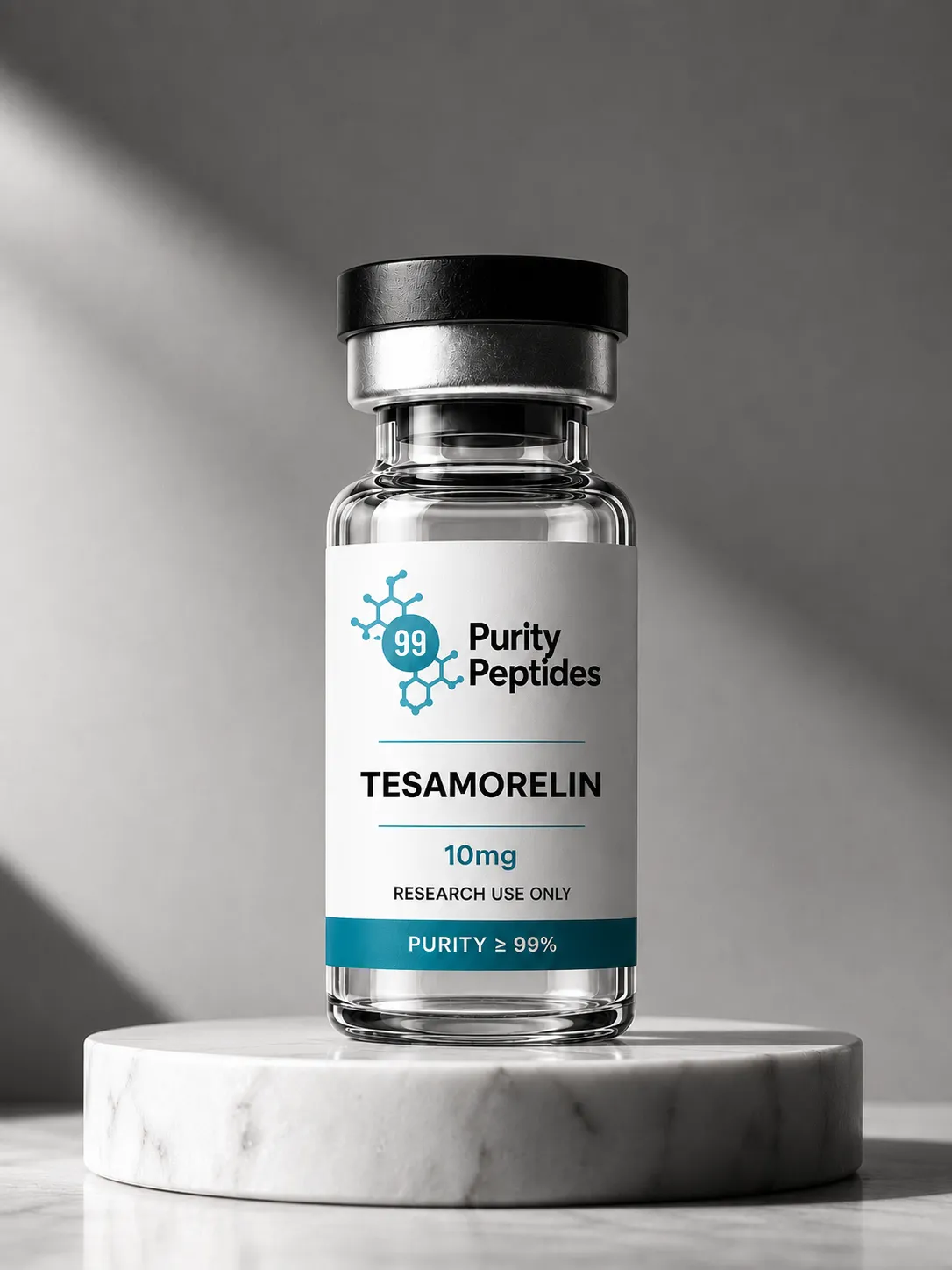
This guide breaks down tesamorelin and sermorelin side by side — molecular structure, mechanism of action, half-life, research applications, and what to look for when sourcing either peptide from a research-chemical supplier. Everything here is written for laboratory and research purposes only. Neither compound discussed in this article is intended for human consumption, and nothing below should be read as medical, dosing, or clinical guidance.
By the end, you'll have a clear, side-by-side reference for how tesamorelin and sermorelin compare — and a practical framework for choosing which GHRH analog fits your research question.
Research Use Only Tesamorelin and sermorelin, as sold by 99 Purity Peptides and similar suppliers, are intended strictly for laboratory and research use — not for human or animal consumption. This article is educational and does not constitute medical advice. |
What Is Tesamorelin?
Tesamorelin is a synthetic 44-amino acid peptide modeled on human growth hormone-releasing hormone (GHRH), with an additional trans-3-hexenoic acid group attached to the N-terminus. That modification is what distinguishes it structurally from native GHRH(1-44) and contributes to its improved resistance to enzymatic breakdown in circulation.
In published research, tesamorelin acts as a GHRH receptor agonist on pituitary somatotroph cells, prompting pulsatile release of growth hormone, which in turn raises circulating insulin-like growth factor 1 (IGF-1). Tesamorelin acetate is the salt form most commonly supplied for laboratory work, typically as a lyophilized (freeze-dried) powder.
Key Tesamorelin Facts for Researchers
- Sequence: 44 amino acids, structurally based on GHRH(1-44) with an N-terminal modification
- Classification: GHRH analog / growth hormone secretagogue research compound
- Known clinical reference point: the active ingredient in Egrifta, an FDA-approved therapy studied for HIV-associated lipodystrophy — referenced here only as scientific background, not as a use case for research-grade material
- Form supplied: lyophilized powder, typically requiring reconstitution before laboratory use
- Primary research interest areas: GHRH receptor pharmacology, IGF-1 signaling, body composition research models
What Is Sermorelin?
Sermorelin corresponds to the first 29 amino acids of native human GHRH — sometimes labeled GRF(1-29) in older literature — and represents the shortest fragment of the GHRH sequence still capable of binding and activating the GHRH receptor. It lacks tesamorelin's N-terminal modification, which is part of why the two peptides behave differently once introduced into a biological system.
Because sermorelin is a shorter, unmodified fragment, it's generally considered less resistant to enzymatic degradation than tesamorelin, which shows up directly in half-life comparisons between the two. Sermorelin has a long research history dating back decades and remains a reference compound in growth hormone pulsatility studies.
Key Sermorelin Facts for Researchers
- Sequence: 29 amino acids — the shortest active fragment of the native GHRH molecule
- Classification: GHRH analog / growth hormone secretagogue research compound
- Historical use: extensively referenced in growth hormone axis and pulsatility research going back to the 1980s
- Form supplied: lyophilized powder, typically requiring reconstitution before laboratory use
- Primary research interest areas: growth hormone pulsatility, somatotropic axis research, GHRH receptor pharmacology
Tesamorelin vs Sermorelin: Mechanism of Action
Quick Answer Both tesamorelin and sermorelin work the same basic way: they bind the GHRH receptor on pituitary somatotroph cells and trigger pulsatile growth hormone release, which downstream raises IGF-1. The difference is in degree and duration, not in the underlying pathway. |
Structurally, tesamorelin's N-terminal modification changes how the peptide interacts with peptidases in the bloodstream, which research suggests contributes to a somewhat longer active window compared to unmodified GHRH fragments. Sermorelin, being a shorter and unmodified sequence, is metabolized faster — a property that has made it useful in research designed around natural pulsatile secretion patterns rather than sustained receptor activation.
Neither peptide directly triggers growth hormone release on its own the way a growth hormone molecule would; both work upstream, at the level of the pituitary's own regulatory signaling, which is precisely why they're studied as GHRH analogs rather than growth hormone substitutes.
Tesamorelin vs Sermorelin Comparison Chart
For a fast side-by-side reference, here's how the two GHRH analogs compare across the attributes researchers ask about most often.
Attribute | Tesamorelin | Sermorelin |
|---|---|---|
Amino acid count | 44 | 29 |
GHRH fragment basis | GHRH(1-44) + N-terminal modification | GHRH(1-29), unmodified fragment |
Relative research half-life | Longer — modification slows enzymatic breakdown | Shorter — more rapidly degraded |
Receptor target | GHRH receptor (pituitary somatotroph) | GHRH receptor (pituitary somatotroph) |
Typical supplied form | Lyophilized powder | Lyophilized powder |
Established clinical reference | Egrifta (tesamorelin) — background context only | No current FDA-approved product |
Common research focus | IGF-1 signaling, body composition models | GH pulsatility, somatotropic axis studies |
Tesamorelin vs Sermorelin Half-Life
Quick Answer Tesamorelin's structural modification gives it a longer research half-life than sermorelin, which is broken down more quickly once introduced into a biological system. This is one of the most consistently cited differences between the two peptides in the literature. |
Half-life matters enormously in study design. A peptide that clears quickly, like sermorelin, is often chosen when researchers want to observe discrete, pulsatile signaling events. A peptide with a longer active window, like tesamorelin, tends to be selected when the research question involves sustained receptor engagement over a longer observation period.
Once reconstituted, both peptides are considered less stable than in lyophilized form and are generally handled under refrigerated or frozen conditions to preserve integrity for the duration of a study — a storage consideration independent of, but related to, their biological half-life.
Handling, Reconstitution, and Storage Best Practices
Proper handling has a direct effect on peptide stability and, by extension, on data quality. The following reflects general best practices for lyophilized GHRH-analog peptides in a laboratory setting.
Storage of Lyophilized Peptide
- Store unreconstituted, lyophilized vials in a freezer (well below refrigeration temperature) away from light
- Avoid repeated freeze-thaw cycles on the sealed vial
- Keep vials in their original packaging with desiccant until ready for use
General Reconstitution Considerations
- Reconstitution is typically performed with bacteriostatic or sterile water under aseptic laboratory conditions
- Peptide should be added to the liquid gently, without vigorous shaking, to protect the peptide chain
- Reconstituted peptide is generally less stable than lyophilized powder and should be refrigerated and used within a limited window
- Each lab should follow its own institutional protocol and the supplier's certificate of analysis (COA) for reconstitution specifics
Note This section describes general laboratory handling practices reported in the literature and standard peptide-handling guidance. It is not a dosing or administration protocol, and 99 Purity Peptides products are not intended for human or animal use. |
Purity, Certificates of Analysis, and Choosing a Research Peptide Vendor
Peptide purity affects every downstream result in a study, which makes third-party verification non-negotiable when sourcing tesamorelin or sermorelin for research. A credible research-chemical vendor should be able to answer a few basic questions before you order.
What to Check Before Ordering
- Does the vendor publish a certificate of analysis (COA) for each batch, ideally from an independent, third-party lab?
- Is purity verified with HPLC (high-performance liquid chromatography) and confirmed with mass spectrometry?
- Is the peptide clearly labeled 'for research use only, not for human consumption'?
- Does the supplier ship with proper cold-chain handling to protect peptide integrity in transit?
- Are vial sizes and concentrations clearly documented, with batch numbers traceable to a specific COA?
99 Purity Peptides publishes third-party COAs for its tesamorelin and sermorelin batches and ships within the USA using cold-chain packaging designed to preserve peptide integrity from dispatch to delivery.
Tesamorelin or Sermorelin: How to Choose for Your Research
There's no universal answer to which GHRH analog is 'better' — it depends entirely on the research question.
Tesamorelin may be the better fit when:
- The study design calls for a longer window of GHRH receptor engagement
- Research interest centers on IGF-1 response or body composition-related endpoints
- Structural stability during the observation period is a priority
Sermorelin may be the better fit when:
- The research question focuses on natural pulsatile GH secretion patterns
- A shorter-acting reference compound is needed to isolate discrete signaling events
- The study is designed around comparisons with historical GHRH(1-29) literature
Some research protocols reference both peptides side by side specifically because their differing half-lives make them useful comparison points against the same GHRH receptor pathway.
Key Takeaways
- Tesamorelin is a 44-amino acid, structurally modified GHRH analog; sermorelin is a shorter, unmodified 29-amino acid GHRH fragment.
- Both act on the same GHRH receptor pathway but differ meaningfully in research half-life, with tesamorelin generally lasting longer once introduced into a biological system.
- Tesamorelin research often centers on IGF-1 and body composition endpoints; sermorelin research often centers on GH pulsatility.
- Purity verification — HPLC testing, mass spectrometry, and a published COA — should be non-negotiable when sourcing either peptide.
- Both compounds are supplied strictly for laboratory research use, not for human or animal consumption.
Frequently Asked Questions
What is the main difference between tesamorelin and sermorelin?
Tesamorelin is a 44-amino acid GHRH analog with a structural modification that extends its research half-life. Sermorelin is a shorter, 29-amino acid, unmodified fragment of native GHRH that is metabolized more quickly.
Are tesamorelin and sermorelin the same type of peptide?
Yes, both belong to the GHRH analog / growth hormone secretagogue class and act on the same GHRH receptor, but they differ in sequence length, structure, and half-life.
Which peptide has a longer half-life in research settings?
Tesamorelin generally shows a longer research half-life than sermorelin, largely due to its N-terminal structural modification, which slows enzymatic breakdown.
How should tesamorelin and sermorelin vials be stored?
Lyophilized vials should be kept frozen and protected from light until use. Once reconstituted, the peptide solution is less stable and should be refrigerated and used within a limited window, consistent with the supplier's COA.
How do I reconstitute lyophilized peptides for research?
Reconstitution is typically performed with bacteriostatic or sterile water under aseptic conditions, adding liquid gently to preserve the peptide chain. Labs should follow their own institutional protocols alongside the supplier's documentation.
What does "research use only" mean on a peptide label?
It means the product is intended exclusively for laboratory and scientific research, not for human or animal consumption, and has not been evaluated or approved by the FDA for such use.
How can I confirm the purity of a peptide before use?
Request the batch-specific certificate of analysis (COA) from the supplier, confirming purity through independent HPLC and mass spectrometry testing.
What is a certificate of analysis (COA) and why does it matter?
A COA is a lab document verifying a specific peptide batch's purity, identity, and quality. It matters because it's the primary way researchers can confirm what they're actually receiving.
Does 99 Purity Peptides provide third-party lab testing?
Yes — 99 Purity Peptides publishes third-party COAs for its tesamorelin and sermorelin batches so researchers can verify purity independently.
How long does reconstituted peptide remain stable?
Stability windows vary by peptide and storage conditions, but reconstituted GHRH analogs are generally considered stable for a limited number of weeks under refrigeration. Always defer to the batch-specific COA and supplier guidance.
What is the amino acid sequence length of tesamorelin vs sermorelin?
Tesamorelin is a 44-amino acid peptide. Sermorelin is a 29-amino acid peptide corresponding to the shortest active fragment of native GHRH.
How does tesamorelin interact with the GHRH receptor compared to sermorelin?
Both bind and activate the same GHRH receptor on pituitary somatotroph cells. Tesamorelin's structural modification is associated with a longer duration of receptor engagement compared to sermorelin's shorter, unmodified sequence.
Can tesamorelin and sermorelin be compared side by side in the same study?
Yes — because they act on the same receptor pathway but differ in half-life, researchers sometimes use them as comparison points to study duration-dependent effects on the GHRH signaling pathway.
Is there a cost difference between tesamorelin and sermorelin?
Pricing varies by supplier, vial size, and purity grade rather than being fixed by the peptide itself. Compare current listings and COA documentation directly on each product page.
What quality standards should a research peptide vendor follow?
Look for third-party HPLC and mass spectrometry verification, published batch-specific COAs, proper cold-chain shipping, and clear 'research use only' labeling.