Last reviewed: October 2026. Regulatory status can change; every claim below was checked against the primary source on that date.
Featured Products
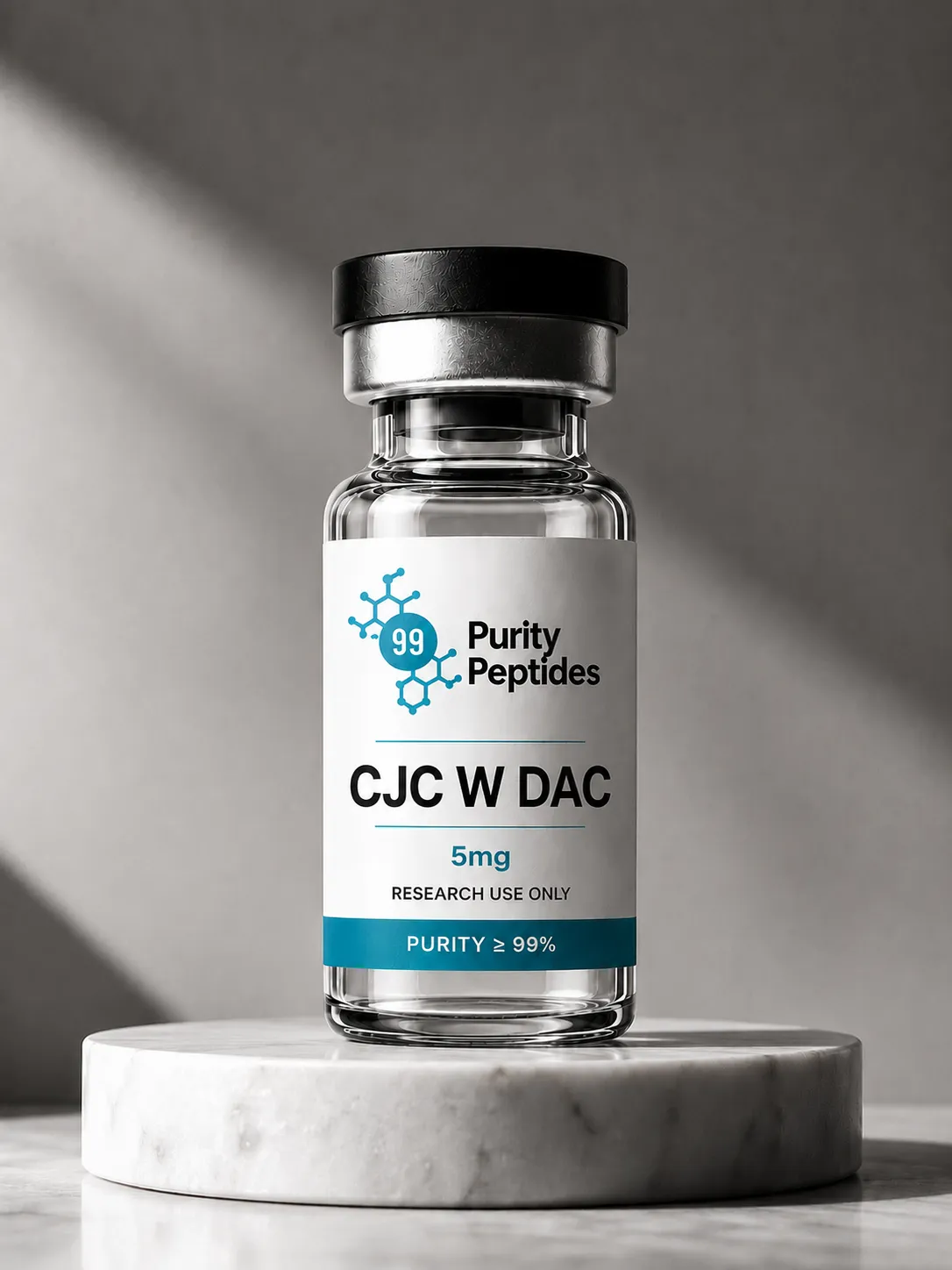
Quick Answer: Is CJC-1295 legal? It is not a controlled substance, but it has never been FDA-approved and cannot currently be compounded under section 503A. Its Category 2 nomination was withdrawn in September 2024, not April 2026. An FDA advisory committee then voted against adding it to the 503A bulks list in December 2024.
Key Takeaways
- CJC-1295 has no FDA marketing approval for any indication; the closest GHRH analogue that does is tesamorelin, approved on November 10, 2010 [20].
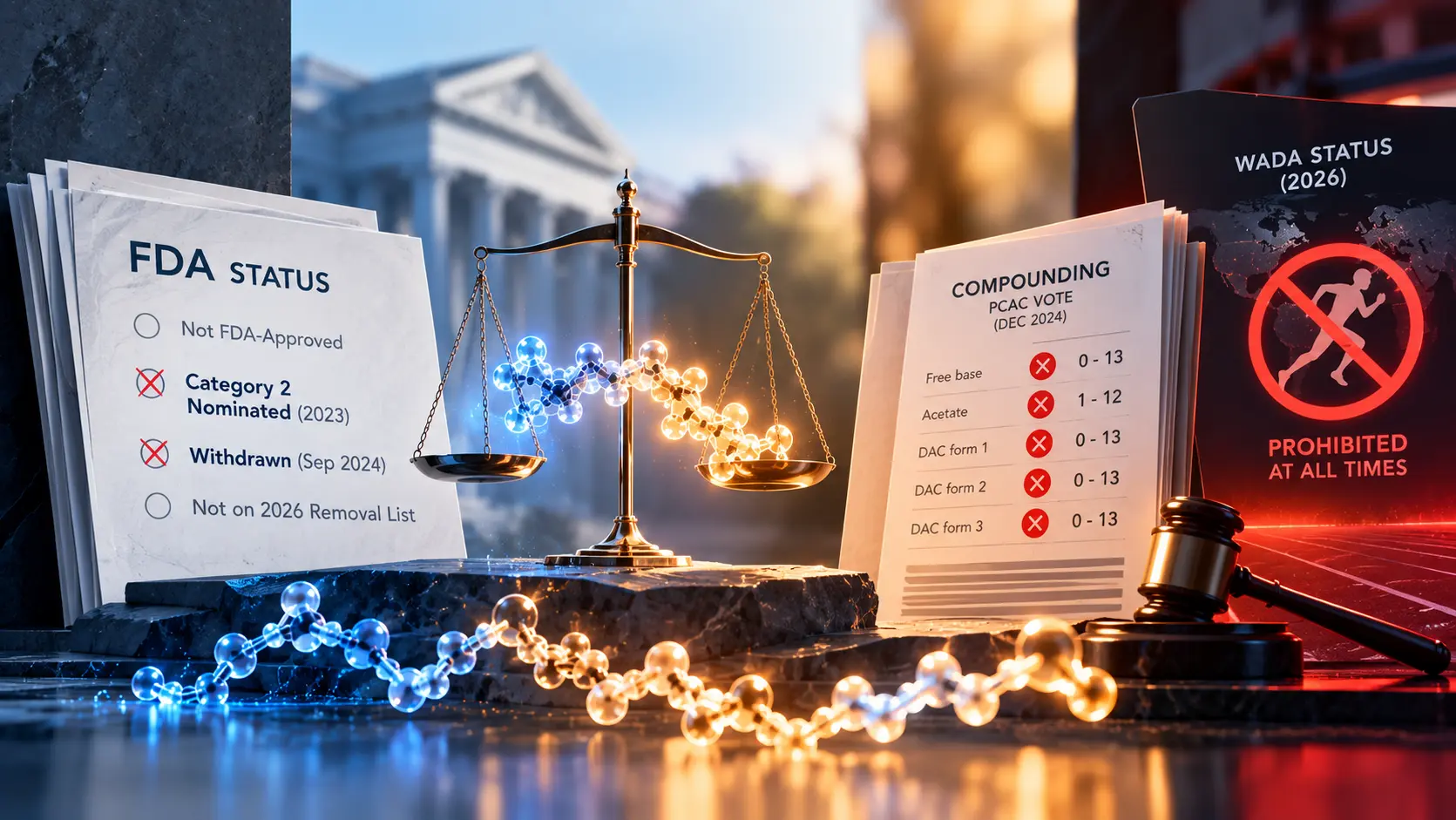
- FDA placed CJC-1295 in 503A Category 2 in September 2023 and removed it as of September 27, 2024, after both nominators withdrew [7][5].
- FDA presented five CJC-1295 forms to its Pharmacy Compounding Advisory Committee (PCAC) on December 4, 2024, and proposed that none be added to the 503A bulks list [5].
- The committee agreed: 0 yes and 13 no for the free base, 1 yes and 12 no for the acetate, and 0 yes and 13 no for each of the three DAC forms [6].
- CJC-1295 was not one of the 12 peptides FDA announced on April 15, 2026 for removal from Category 2 [8].
- It does not appear in the Drug Enforcement Administration's controlled substance list dated August 27, 2026 [15].
- The WADA 2026 Prohibited List names CJC-1295 under S2.2.4, prohibited at all times, in and out of competition [13][14].
Research Use Only. CJC-1295 sold by 99 Purity Peptides is supplied strictly for in vitro laboratory research. It is not for human consumption or veterinary use, and nothing on this page is medical, dosing or legal advice to any individual.
Is CJC-1295 FDA-Approved?
No. CJC-1295 has never been approved by the FDA as a drug for any use, in any form.
The compound was developed in the mid-2000s by the Canadian company ConjuChem as a long-acting growth hormone-releasing hormone (GHRH) analogue. Its development record is short. Two randomized, placebo-controlled, double-blind ascending-dose trials in healthy adults aged 21 to 61 were published in 2006 [17]. A smaller study in healthy men aged 20 to 40 followed the same year [18]. Both measured hormone levels, not clinical outcomes.
A Phase II trial in 192 participants with HIV-associated visceral fat was halted in July 2006 after a participant died [19]. The outlet reporting it said the cause and any link to the drug were still under investigation. We found no later published determination either way, so we treat causality as unknown.
No sponsor carried CJC-1295 to a marketing application. That gap matters for the legal question: an approved drug label is the only thing that would make CJC-1295 a "prescription drug" in the ordinary sense.
A useful contrast sits in the same drug class. Tesamorelin, also a synthetic GHRH analogue, went through full clinical development and was approved by the FDA on November 10, 2010 [20]. The two compounds share a mechanism family, not a legal status. For how CJC-1295 differs mechanically from unmodified GHRH, see the site's CJC-1295 with DAC mechanism and half-life guide.
What Happened to CJC-1295's Category 2 Status?
CJC-1295 left Category 2 in September 2024 because its nominations were withdrawn, and that removal did not make it compoundable.
This is where much of the published material, including summaries circulating in 2026, gets the date wrong. The April 2026 Category 2 removals were a separate action covering a different set of peptides. Here is the sequence as the primary documents record it.
Date | Event | What it changed | Source |
|---|---|---|---|
September 2023 | FDA places CJC-1295 in 503A Category 2 | Excluded from FDA's interim compounding policy on safety grounds | [7] |
September 27, 2024 | Removed from Category 2 after nominators withdraw | Left the category list; gained no compounding pathway | [7] |
December 4, 2024 | PCAC reviews five CJC-1295 forms anyway | FDA proposed that none be added to the 503A bulks list | [4][5] |
December 4, 2024 | Committee votes against all five forms | Non-binding recommendation against listing | [6] |
April 15, 2026 | FDA announces 12 other peptides will leave Category 2 | No change for CJC-1295, which was not named | [8] |
April 22, 2026 | FDA's Category 2 page lists CJC-1295 under "nominated but withdrawn" | Safety summary still displayed | [1] |
Two nominators had filed for CJC-1295: Wells Pharmacy Network and LDT Health Solutions on behalf of the International Peptide Society. The FDA briefing document records both withdrawals and states that the agency chose to present the substances to the committee regardless [5].
FDA's safety summary has not gone away. Its Category 2 page still carries the CJC-1295 entry, noting reported serious adverse events including increased heart rate and a systemic vasodilatory reaction, and that available clinical data are limited [1].
Why "removed from Category 2" does not mean "allowed"
Category 2 is an interim enforcement list, not the law itself. Leaving it puts a substance back where every unlisted bulk substance starts: outside the statute's permitted sources.
Section 503A allows a compounder to use a bulk substance only if it meets one of three conditions [9]. It must comply with a USP or National Formulary monograph, or be a component of an FDA-approved drug, or appear on the 503A bulks list FDA creates by regulation. CJC-1295 meets none of them.
FDA's interim policy then offers enforcement discretion only for Category 1, the substances "under evaluation" [3]. For substances outside the permitted sources and outside Category 1, FDA says it would consider action under its general enforcement policies [3].
That is the honest reading. The "regulatory gap" description that several ranking pages use, a compound neither permitted nor banned, overstates the ambiguity. A withdrawn nomination plus a negative committee vote is about as clear a "no" as the interim system produces short of a final rule.
We searched FDA's bulk-substance pages and the Federal Register and found no final rule yet formally excluding CJC-1295 from the bulks list. That is the one open procedural step. It does not change the current position.
How Did the December 2024 Advisory Committee Vote?
The committee rejected every CJC-1295 form it was asked about, by margins of 12 or 13 to 1 or 0.
FDA framed the review around one nominated use, growth hormone deficiency [4]. The votes below come from the committee's final summary minutes [6].
Bulk substance reviewed | Yes | No | Abstain | FDA's proposal going in |
|---|---|---|---|---|
CJC-1295 (free base) | 0 | 13 | 0 | Do not list |
CJC-1295 acetate | 1 | 12 | 0 | Do not list |
CJC-1295 with DAC (free base) | 0 | 13 | 0 | Do not list |
CJC-1295 DAC acetate | 0 | 13 | 0 | Do not list |
CJC-1295 DAC trifluoroacetate | 0 | 13 | 0 | Do not list |
One committee member's recorded reason was the lack of evidence for effectiveness [6]. That fits the literature: the published human data measure growth hormone and IGF-1 concentrations, which are surrogate markers, not patient outcomes.
Compare this with July 2026. That meeting reviewed seven different peptides and voted in favour of six, a record covered in the site's July 2026 FDA peptide vote breakdown and its full 2026 compounding vote record. CJC-1295 was not on either 2026 agenda.
What Is the Difference Between 503A and 503B for a Compound Like This?
Neither pathway currently gives CJC-1295 a lawful route into compounded drugs, but they fail for different reasons.
Section 503A covers traditional compounding by a licensed pharmacist or physician for an identified patient, based on a valid prescription [9]. Registered outsourcing facilities fall under section 503B instead. They compound sterile drugs at scale and need not work from individual prescriptions [10].
Question | 503A (traditional pharmacy) | 503B (outsourcing facility) |
|---|---|---|
Statutory sources for a bulk substance | USP/NF monograph, approved-drug component, or 503A bulks list | Bulks list for clinical need, or a drug on FDA's shortage list |
Does CJC-1295 meet one? | No | No entry found on either list |
Interim enforcement discretion | Category 1 only | Category 1 only |
CJC-1295's category position | Withdrawn nomination, 2024; voted down for listing | Not mentioned on FDA's 503B page |
Patient prescription required? | Yes | No |
Net position | Outside the exemptions | Outside the exemptions |
The 503B route runs through a separate list of bulk substances with a demonstrated clinical need, or through a drug on the national shortage list [10]. A drug that has never been approved and marketed cannot be in shortage. FDA's 503B bulk-substances page does not mention CJC-1295 at all [21].
So the Category 2 history matters more for 503A. That is where CJC-1295 was nominated, categorized, withdrawn and voted on. For 503B, the problem is simpler: nobody has put it on either list.
Do You Need a Prescription for CJC-1295?
A prescription does not make CJC-1295 lawful to compound, because the barrier sits on the ingredient, not the paperwork.
Most people assume a prescription works the way it does for an approved drug. A prescriber writes it, a pharmacy dispenses a labelled, FDA-approved product, and the label defines the approved use. CJC-1295 has no approved product and no label, so that model does not apply [1].
Under 503A, a valid prescription for an identified patient is necessary, but it is only one of several conditions [9]. The bulk-substance condition must also be met. CJC-1295 fails that condition no matter who writes the order.
The cjc-1295 prescription question therefore has a two-part answer. Yes, 503A compounding always requires a prescription. No, a prescription cannot cure an ingredient that falls outside the statute. This page describes that structure only; it does not describe any way to obtain the compound.
Is CJC-1295 a controlled substance?
No. CJC-1295 does not appear on the DEA's alphabetical list of controlled substances, dated August 27, 2026 [15]. Neither does sermorelin, tesamorelin or any GHRH analogue we checked.
A related statute is worth naming because readers confuse the two. Federal law restricts distribution of "human growth hormone," which it defines as somatrem, somatropin, or an analogue of either [16]. CJC-1295 is an analogue of GHRH, the releasing hormone, not of growth hormone itself. We found no enforcement action applying that subsection to a GHRH analogue, and this page does not resolve that interpretive question.
What Does "Research Use Only" Actually Mean Legally?
An RUO (Research Use Only) label states the seller's intended use; it is not a legal shield for any other use.
The phrase itself comes from a federal labeling rule for in vitro diagnostic products, 21 CFR 809.10(c) [12]. No federal regulation we found creates a separate RUO status for peptides. The site's guide to whether research peptides are legal covers that history in full.
What regulators actually apply is the intended-use doctrine in 21 CFR 201.128. It defines intended use as the "objective intent" of the persons legally responsible for labeling [11]. That intent can be shown by labeling, advertising, written or oral statements, and the circumstances of distribution [11].
In practice, a disclaimer on a vial is one piece of evidence among many. If product pages, blog posts or social captions present a research chemical as something to take, the label stops carrying weight. FDA's August 2026 warning letters to peptide sellers quoted website copy as evidence of intended use, a point the site's general legal-status guide analyzes letter by letter.
This is why this page links CJC-1295 products only in the closing section, away from any legal or compounding discussion. The RUO position is credible only if every page, not just the label, treats the compound as a laboratory reagent.
Is CJC-1295 Banned in Competitive Sport?
Yes. The World Anti-Doping Agency's 2026 Prohibited List names CJC-1295 under S2.2.4, growth hormone-releasing factors, and prohibits it at all times [13][14].
The entry lists GHRH and its analogues, giving CJC-1293, CJC-1295, sermorelin and tesamorelin as examples [14]. Every substance in class S2 is banned both in and out of competition [14]. The 2026 list took effect on January 1, 2026 [14].
This status is independent of anything the FDA does. A future bulks-list listing would not change it, and an FDA-approved analogue like tesamorelin is on the same line of the list. For the rest of the S2 class, compound by compound, see the site's WADA banned peptides guide.
Is CJC-1295 Legal Today? Where Things Stand
CJC-1295's legal status in October 2026 is settled on four of five questions and procedurally open on one.
The grading table below is a snapshot. Check it against FDA's own Category 2 page and bulk-substance list before relying on it, because both are updated without notice [1][2].
Regulatory question | Verified answer | Confidence | Primary source to check |
|---|---|---|---|
Is it FDA-approved for any use? | No | High | FDA Category 2 entry; no marketing application on record [1] |
Is it in a 503A category today? | No; nomination withdrawn September 2024 | High | FDA Category 2 page, "nominated but withdrawn" table [1] |
Did it move to Category 1 in 2026? | No; not named in the April 15, 2026 action | High | FDA April 2026 categories update [2][8] |
Has FDA finalized exclusion from the 503A bulks list? | Not that we found; committee voted against in 2024 | Medium | PCAC minutes [6]; Federal Register |
Is it a federally controlled substance? | No | High | DEA controlled substance list, August 27, 2026 [15] |
Is it prohibited in sport? | Yes, S2.2.4, at all times | High | WADA 2026 Prohibited List [13] |
Does a prescription create a compounding pathway? | No | High | 21 U.S.C. 353a(b)(1)(A)(i) [9] |
How we graded the evidence
"High" means a current primary source, an FDA page, statute, DEA list or WADA list, states the answer directly. "Medium" means the primary record establishes the direction, but a formal step remains outstanding. We did not use any vendor or competitor page as a source, and we did not grade any claim we could not trace to a document we opened.
Common claims that do not survive the primary record
Claim seen online | What the primary source shows |
|---|---|
CJC-1295 left Category 2 in April 2026 | It left in September 2024; the April 2026 action named 12 other peptides [7][8] |
Leaving Category 2 created a legal gray zone | Outside Category 1 and the statutory sources, FDA reserves general enforcement [3][9] |
A prescription makes compounded CJC-1295 lawful | The bulk-substance condition applies regardless of prescription [9] |
CJC-1295 is a controlled substance | Not on the DEA list dated August 27, 2026 [15] |
CJC-1295 is pending PCAC review | It was reviewed and voted down on December 4, 2024 [6] |
The first row matters most. It is the error most likely to mislead someone who reads "removed from Category 2" as good news.
What This Page Does Not Establish
This page states regulatory facts. It does not give legal advice about any individual's situation, and it should not be read as one.
It does not say whether any particular sale, purchase or use is lawful in a specific state. State pharmacy boards and state law are outside its scope. It does not explain how to obtain CJC-1295 through any channel, and it gives no dosing, preparation or administration information.
Nor does it establish whether CJC-1295 works. The published human studies are three in number, all from 2006, all from one development program, and all measuring hormone levels rather than health outcomes [17][18][19]. That is the record behind the advisory committee's effectiveness concern [6].
Finally, the open rulemaking step could still change the written picture, even if the practical one is unlikely to move. Verification date: October 3, 2026.
Closing
For the mechanism, half-life and DAC versus no-DAC differences, start with the site's CJC-1295 with DAC research guide. The legal-status series continues with the general guide to research peptide legality and the compound-specific BPC-157 legal status page, which follows the April 2026 changes this page distinguishes CJC-1295 from.
Research teams sourcing reference material can review lot-documented listings for CJC-1295 with DAC 5mg, CJC-1295 No DAC 10mg and the CJC-1295 W/DAC 5mg spray, with certificates of analysis published on the site's certificates page.
So, is CJC-1295 legal? It is not a controlled substance, but it is unapproved as a drug, outside the compounding exemptions and banned in sport. Its current position rests on records from 2023 and 2024, not on the April 2026 changes.
References
- U.S. Food and Drug Administration. Certain Bulk Drug Substances for Use in Compounding that May Present Significant Safety Risks. Content current as of April 22, 2026. https://www.fda.gov/drugs/human-drug-compounding/certain-bulk-drug-substances-use-compounding-may-present-significant-safety-risks
- U.S. Food and Drug Administration. Bulk Drug Substances Nominated for Use in Compounding Under Section 503A of the Federal Food, Drug, and Cosmetic Act (categories list). Version dated May 14, 2026. https://www.fda.gov/media/94155/download
- U.S. Food and Drug Administration. Bulk Drug Substances Used in Compounding Under Section 503A of the FD&C Act. Updated May 14, 2026. https://www.fda.gov/drugs/human-drug-compounding/bulk-drug-substances-used-compounding-under-section-503a-fdc-act
- U.S. Food and Drug Administration. December 4, 2024: Meeting of the Pharmacy Compounding Advisory Committee. https://www.fda.gov/advisory-committees/advisory-committee-calendar/december-4-2024-meeting-pharmacy-compounding-advisory-committee-12042024
- U.S. Food and Drug Administration, Center for Drug Evaluation and Research. FDA Briefing Document: Pharmacy Compounding Advisory Committee Meeting, December 4, 2024 (CJC-1295-related bulk drug substances). https://www.fda.gov/media/183583/download
- U.S. Food and Drug Administration. Final Summary Minutes of the Pharmacy Compounding Advisory Committee Meeting, December 4, 2024. https://www.fda.gov/media/185642/download
- Reed Smith LLP. FDA removes certain peptide bulk drug substances from Category 2 and schedules PCAC review. October 2024. https://www.reedsmith.com/de/perspectives/2024/10/fda-certain-peptide-bulk-drug-substances-category-2-503a-bulks-pcac
- Frier Levitt. FDA to Remove 12 Popular Peptides from the Category 2 "Do Not Compound" List. April 2026. https://www.frierlevitt.com/articles/fda-peptides-do-not-compound-list-update-2026/
- 21 U.S.C. § 353a. Pharmacy compounding (FD&C Act section 503A). https://www.law.cornell.edu/uscode/text/21/353a
- 21 U.S.C. § 353b. Outsourcing facilities (FD&C Act section 503B). https://www.law.cornell.edu/uscode/text/21/353b
- 21 C.F.R. § 201.128. Meaning of "intended uses." https://www.ecfr.gov/current/title-21/chapter-I/subchapter-C/part-201/subpart-G/section-201.128
- 21 C.F.R. § 809.10. Labeling for in vitro diagnostic products. https://www.ecfr.gov/current/title-21/chapter-I/subchapter-H/part-809/subpart-B/section-809.10
- World Anti-Doping Agency. The 2026 Prohibited List. Effective January 1, 2026. https://www.wada-ama.org/en/prohibited-list
- Tractatenblad van het Koninkrijk der Nederlanden 2026, nr. 25. Official publication of the 2026 Prohibited List annex to the International Convention against Doping in Sport (S2.2.4). https://zoek.officielebekendmakingen.nl/trb-2026-25.html
- U.S. Drug Enforcement Administration, Diversion Control Division. Controlled Substances: Alphabetical Order. Dated August 27, 2026. https://www.deadiversion.usdoj.gov/schedules/orangebook/c_cs_alpha.pdf
- 21 U.S.C. § 333(e). Prohibited distribution of human growth hormone. https://www.law.cornell.edu/uscode/text/21/333
- Teichman SL, Neale A, Lawrence B, et al. Prolonged stimulation of growth hormone (GH) and insulin-like growth factor I secretion by CJC-1295, a long-acting analog of GH-releasing hormone, in healthy adults. J Clin Endocrinol Metab. 2006;91(3):799-805. PMID 16352683. doi:10.1210/jc.2005-1536. https://pubmed.ncbi.nlm.nih.gov/16352683/
- Ionescu M, Frohman LA. Pulsatile secretion of growth hormone (GH) persists during continuous stimulation by CJC-1295, a long-acting GH-releasing hormone analog. J Clin Endocrinol Metab. 2006;91(12):4792-4797. PMID 17018654. doi:10.1210/jc.2006-1702. https://pubmed.ncbi.nlm.nih.gov/17018654/
- aidsmap (NAM Publications). Lipodystrophy study halted after patient death. July 17, 2006. https://www.aidsmap.com/news/jul-2006/lipodystrophy-study-halted-after-patient-death
- HIV i-Base. FDA approves tesamorelin for reduction of central fat accumulation. HIV Treatment Bulletin, 2010. https://i-base.info/htb/?p=14188
- U.S. Food and Drug Administration. Bulk Drug Substances Used in Compounding Under Section 503B of the FD&C Act. Updated January 7, 2025. https://www.fda.gov/drugs/human-drug-compounding/bulk-drug-substances-used-compounding-under-section-503b-fdc-act
Frequently Asked Questions
Is CJC-1295 legal in the United States?
CJC-1295 is not a federally controlled substance, so possessing it as a laboratory reagent is not a drug-scheduling offense. It is also not an FDA-approved drug, and it cannot currently be compounded under section 503A. Whether any specific sale or use is lawful depends on intended use and state law, which no general article can settle for an individual reader.
Is CJC-1295 FDA-approved?
No. CJC-1295 has never received FDA marketing approval for any indication. Its developer, ConjuChem, published early hormone-level studies in 2006 but never brought it to a marketing application. FDA's own compounding pages describe limited clinical data and reported serious adverse events. Tesamorelin, a different GHRH analogue, is the only drug in that family with FDA approval, granted in November 2010.
Do you need a prescription for CJC-1295?
A prescription does not create a lawful route for CJC-1295. Section 503A compounding requires a prescription for an identified patient, but it also requires the bulk ingredient to meet one of three statutory conditions. CJC-1295 meets none of them. Because no approved CJC-1295 product exists, there is also no conventional prescription drug for a pharmacy to dispense.
Does CJC-1295 really work?
This page covers regulatory status, not efficacy, and makes no outcome claims. The published human data consist of three studies from 2006, which measured growth hormone and IGF-1 levels rather than health outcomes. The FDA advisory committee cited a lack of effectiveness evidence in 2024. For what the mechanism research shows, read the site's CJC-1295 with DAC guide.
What is a 503A bulk drug substance?
A bulk drug substance is the active ingredient a compounding pharmacy starts from. Under section 503A, it may be used only if it has a USP or National Formulary monograph, is a component of an FDA-approved drug, or appears on FDA's 503A bulks list. Substances nominated for that list are sorted into interim categories while FDA evaluates them.
What is FDA Category 2, and what changed for CJC-1295?
Category 2 is FDA's interim list of nominated bulk substances that raise significant safety concerns. CJC-1295 was placed there in September 2023 and removed on September 27, 2024, after its nominators withdrew. FDA still presented it to its advisory committee in December 2024, which voted against listing it. Nothing changed for CJC-1295 in 2026.
Was CJC-1295 moved to Category 1?
No. CJC-1295 was never placed in Category 1, the only category covered by FDA's interim enforcement discretion for 503A compounding. The April 15, 2026 action moved 12 named peptides out of Category 2, and CJC-1295 was not among them. Its FDA entry now sits in a separate table of withdrawn nominations, with its safety summary still displayed.
What is the difference between 503A and 503B compounding?
Section 503A covers licensed pharmacists and physicians compounding for an identified patient with a valid prescription. Section 503B covers registered outsourcing facilities that compound sterile drugs without patient-specific prescriptions. Each has its own bulk-substance rules: 503A uses its bulks list, while 503B uses a clinical-need list or the drug shortage list. CJC-1295 fits neither.
Can a compounding pharmacy legally prepare CJC-1295 today?
Not within the federal compounding exemptions as they stand in October 2026. CJC-1295 has no monograph, is not part of an approved drug, is not on the 503A bulks list and is not in Category 1. FDA says it may act under general enforcement policies in that situation. The PCAC voted 13 to 0 against listing the free base in 2024.
Is CJC-1295 banned by WADA?
Yes. The WADA 2026 Prohibited List names CJC-1295 under section S2.2.4, growth hormone-releasing factors, alongside sermorelin and tesamorelin. Every substance in class S2 is prohibited at all times, both in and out of competition. That status is independent of FDA decisions, so no compounding or approval change in the US would lift it.
What does "Research Use Only" mean legally?
Research Use Only describes the seller's stated intended use. The phrase comes from an FDA labeling rule for in vitro diagnostic products, not from any peptide-specific regulation. Under 21 CFR 201.128, regulators judge intended use from all labeling, advertising and statements, not the vial label alone. Website content can override an RUO disclaimer.
Is CJC-1295 a controlled substance?
No. CJC-1295 does not appear on the Drug Enforcement Administration's alphabetical controlled substance list dated August 27, 2026. Its restrictions come instead from FDA drug law: it is unapproved and outside the compounding exemptions. A separate federal statute restricts human growth hormone distribution, but it defines that hormone as somatropin, somatrem or their analogues.
Has CJC-1295 ever been approved for any use?
No. CJC-1295 has not been approved by the FDA for any human or veterinary indication. Its development stopped after a 2006 Phase II trial was halted following a participant death, with causality reported as under investigation. No regulator we checked lists an approved CJC-1295 product, and it remains a research compound.
How can I check CJC-1295's current regulatory status myself?
Start with FDA's page on bulk substances that may present significant safety risks, which lists CJC-1295 in its withdrawn-nominations table. Then check FDA's 503A categories document and the Federal Register for any bulks-list rule. For sport, read the current WADA Prohibited List, section S2.2.4. Note the date you checked.
Why do some websites say CJC-1295 left Category 2 in April 2026?
They appear to have merged two separate FDA actions. CJC-1295's nominations were withdrawn and it left Category 2 in September 2024. The April 15, 2026 announcement covered 12 other peptides, including BPC-157 and TB-500. FDA's April 2026 page redesign also moved CJC-1295 into a new withdrawn-nominations table, which may have added to the confusion.