Last reviewed: September 2026
Featured Products

Quick Answer
FDA peptide compounding 2026 changed far less than the headlines claimed. On July 23 and 24, 2026, the FDA's Pharmacy Compounding Advisory Committee recommended six peptides for the Section 503A Bulks List by narrow margins, and voted down a seventh, emideltide, by 6 to 7 with one abstention [1][2][3]. Every one of those votes is non-binding advice to the FDA, not a change in federal law. As of mid-September 2026, the regulation that holds the 503A Bulks List still names six substances, none of which is a peptide [4].
Key Takeaways
- The committee met on July 23 and 24, 2026 at FDA's White Oak campus and considered seven peptide families, each in free base and acetate form, which FDA split into 14 separate voting questions [1].
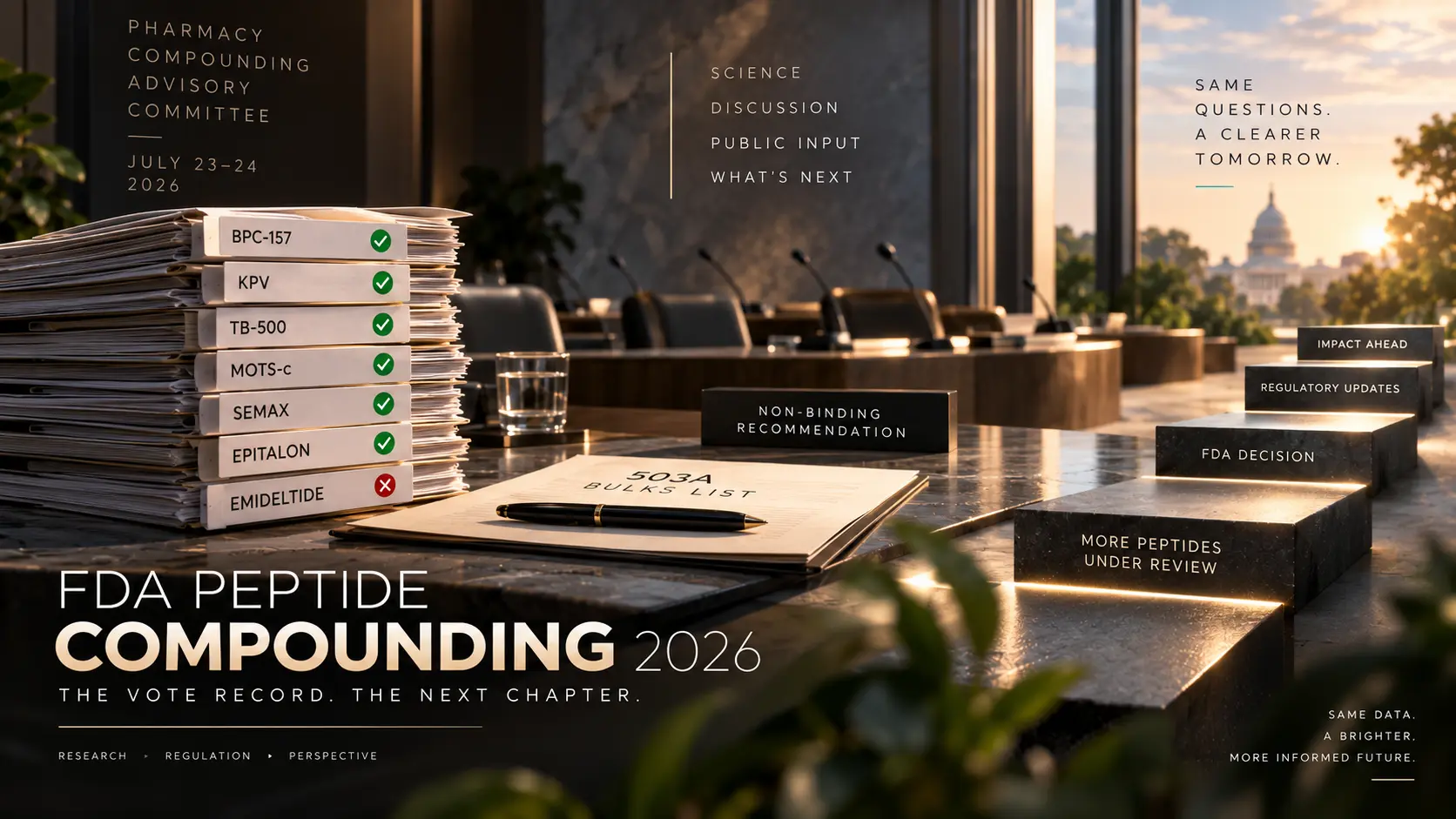
- Day one cleared four substances. BPC-157, KPV and TB-500 each passed 8 to 6 with one abstention, and MOTS-c passed 7 to 5 with two abstentions [8][9][10].
- Day two cleared two and rejected one. Semax passed 8 to 5, epitalon passed 7 to 5 with one abstention, and emideltide failed 6 to 7 with one abstention [3].
- FDA's own review staff had recommended against adding all seven, for every one of the 14 forms under consideration [7].
- Brian Serumaga of the United States Pharmacopeia voted to reject epitalon over the lack of data characterizing the substance [3].
- A separate April 15, 2026 action removed 12 peptide substances from Category 2 of FDA's interim list. That was a categorical change, not an authorization [6][14].
- Five more peptides go before the committee before the end of February 2027: cathelicidin LL-37, GHK-Cu, dihexa acetate, melanotan II and PEG-MGF [6][7].
Research Use Only
99 Purity Peptides supplies research compounds for laboratory use only. Nothing sold here is for human or veterinary consumption, and nothing on this page is medical advice, dosing guidance, or a statement that any compound treats any condition. This article describes a federal regulatory proceeding. It does not describe how to obtain a compounded drug, and it does not suggest that any research material is a medicine.
What Did the FDA's Pharmacy Compounding Advisory Committee Vote On?
The committee voted on whether 14 specific bulk drug substances should be eligible for use by pharmacies compounding under Section 503A of the Federal Food, Drug, and Cosmetic Act. Seven peptide families were on the agenda, and FDA treated the free base and the acetate salt of each as separate questions [1]. Vote outcomes turned out identical for both forms of every substance, so the practical result reads as seven decisions rather than fourteen.
Three things make this meeting unusual. FDA's review staff, in briefing documents published before the meeting, proposed the same answer for all seven peptides: do not add them [7]. The committee then went the other way on six of them. Reporters in the room noted that a PCAC panel had rarely voted against FDA staff's written recommendation.
Public interest was heavy. Docket FDA-2025-N-6895 drew roughly 1,860 comments before it closed on July 22, 2026 [7]. Comments filed by July 9 went to committee members ahead of the meeting; the rest went to FDA [1].
Here is the record, substance by substance.
Date | Substance | Use FDA evaluated | Yes | No | Abstain | Result |
|---|---|---|---|---|---|---|
July 23, 2026 | BPC-157 | Ulcerative colitis | 8 | 6 | 1 | Favorable |
July 23, 2026 | KPV | Wound healing and inflammatory conditions | 8 | 6 | 1 | Favorable |
July 23, 2026 | TB-500 | Wound healing | 8 | 6 | 1 | Favorable |
July 23, 2026 | MOTS-c | Obesity and osteoporosis | 7 | 5 | 2 | Favorable |
July 24, 2026 | Epitalon | Insomnia | 7 | 5 | 1 | Favorable |
July 24, 2026 | Semax | Cerebral ischemia, migraine, trigeminal neuralgia | 8 | 5 | 0 reported | Favorable |
July 24, 2026 | Emideltide (DSIP) | Opioid withdrawal, chronic insomnia, narcolepsy | 6 | 7 | 1 | Rejected |
Two details in that table are worth pausing on. No vote was decided by more than three ballots. And the number of ballots cast shifted between sessions, which is what happens when a committee runs with temporary voting members added shortly before a meeting [2].
Which Peptides Got a Favorable Recommendation, and For What?
Six peptides received a favorable recommendation, each tied to a specific use that FDA selected for review, not to the uses these compounds are known for online. The distinction matters more than almost anything else on this page.
A proposed use is the indication a nominator put forward and FDA agreed to evaluate. It is not a demonstrated benefit, an approved indication, or a claim FDA has endorsed. FDA's own agenda calls this column "uses evaluated" for exactly that reason [1].
This is also where published coverage went wrong. Several outlets described emideltide's proposed uses as insomnia, narcotic dependence and opioid withdrawal. FDA's meeting page lists opioid withdrawal, chronic insomnia and narcolepsy [1]. Narcolepsy and narcotic dependence are not the same condition, and the difference changes what the committee was actually weighing.
Notice what is absent from that list. Tendon repair, muscle growth, longevity, cognitive enhancement and fat loss are the reasons most people have heard of these compounds. None of them was evaluated. A favorable vote on BPC-157 for one gastrointestinal indication says nothing about any other use, and the record contains no finding that would support one.
How We Graded the Evidence
Where this article characterizes evidence strength, three criteria were applied. First, whether the substance is chemically characterized well enough for quality standards to exist, since FDA reviewers raised this for several of these peptides. Second, whether human data exists for the specific use FDA evaluated, as opposed to a different indication or an animal model. Third, whether the human data that does exist is controlled, recent and independent. A compound can fail all three and still receive a favorable advisory vote, which is what happened here.
On the first criterion, the record is unflattering. FDA's Russell Wesdyk asked the room, during the BPC-157 session, what BPC-157 actually is, noting that people hold different views about the sequence, and said quality standards cannot be established until more is known [2]. FDA's Mai Tu agreed the peptide is not well characterized [2]. Committee member Josh Mailman, president of the board of the Neuroendocrine Tumor Research Foundation, voted no on KPV and described it plainly as a black box to him [9].
On the second criterion, FDA staff said there is a lack of evidence supporting the effectiveness of BPC-157 free base and acetate as a treatment for ulcerative colitis [2]. For MOTS-c, FDA found no clinical studies assessing safety and effectiveness in humans, against animal work suggesting effects on obesity and insulin sensitivity [12]. For epitalon, FDA stated there are no publications discussing efficacy in patients with insomnia [3]. Animal data is not human data, and a favorable vote did not convert one into the other.
Why Was Emideltide Rejected?
Emideltide failed because a majority of the committee found the evidence too thin even by the standards of this meeting, and because approved alternatives already exist for the conditions it was nominated to address. The vote was 6 in favor and 7 against, with one abstention [3].
Emideltide is the international nonproprietary name for delta sleep-inducing peptide, which is why coverage refers to it as DSIP [1]. FDA's briefing package said the substance is not adequately characterized and carries potential for peptide-related impurities from incomplete coupling reactions, truncations and side reactions [3]. FDA's Katie Park told the committee there is a lack of safety and efficacy data supporting emideltide for insomnia, narcolepsy and opioid use disorder [3]. The package also noted that approved therapies already exist for those conditions [3].
Committee members explained themselves on the record. Kevin Zacharoff, an anesthesiologist and clinical assistant professor at the Renaissance School of Medicine at Stony Brook University, said that as a clinician it was impossible for him not to take FDA's safety and efficacy recommendations to heart [3]. Tod Durham, senior vice president of the Foundation for Fighting Blindness, said he voted no primarily because of low-quality evidence around efficacy, and pointed to the existence of approved drugs for those uses [3]. Robert Harshbarger, a Tennessee state senator on the committee, took the other side, arguing the substance should be available with a valid prescription [3].
The Dissent That Deserves More Attention
The sharpest objection of the two days was filed against a peptide that passed, not the one that failed. Epitalon cleared 7 to 5, and the members who voted no said why.
Brian Serumaga, director of personalized medicines at the United States Pharmacopeia, voted to reject epitalon over concerns about the lack of data characterizing the substance [3]. That is a pointed position given where he works, because USP is the body whose monographs would ordinarily settle what a substance is. Durham said he voted no because of poor characterization of the compound and potential risk with carcinogenicity [3]. William Zamboni, a pharmacologist at the University of North Carolina, said he voted no because he felt there was a significant lack of data on the safety of the product [3].
Reasoning also appeared on the yes side. David Pope, a pharmacist with XiFin Pharmacy Solutions, said he voted for epitalon because a physician and pharmacist are key to judging the risk of whether the peptide is right for a patient [3]. Several yes votes across both days rested on a similar argument, which is about who should decide rather than about what the data shows.
Does a Favorable Vote Make FDA Peptide Compounding Legal in 2026?
No. A favorable PCAC vote is a non-binding recommendation, it did not change federal law, and none of these six peptides could be lawfully compounded under Section 503A on the day of the vote or in the weeks after it [5][13].
This is the single most important point on the page, so here is the mechanism in full. FDA's advisory committees provide independent expert advice and make non-binding recommendations, which the agency generally follows but is not legally bound to follow [1]. Congress did not give PCAC final regulatory authority, and FDA retains responsibility for deciding which substances appear on the 503A Bulks List [13].
A widespread misreading is worth correcting directly. Coverage sometimes frames the vote as advice that now sits with the Secretary of Health and Human Services for signature. The recommendation went to FDA. Only two mechanisms can put a substance on the 503A Bulks List: formal notice-and-comment rulemaking, or an act of Congress amending the statute [5]. Rulemaking means amending 21 CFR 216.23, publishing a proposed rule, taking public comment, and issuing a final rule.
The regulation itself is the cleanest way to check the current status. Section 216.23(a) lists the bulk drug substances that can be used in compounding under section 503A(b)(1)(A)(i)(III). Six substances appear there: Brilliant Blue G, cantharidin, diphenylcyclopropenone, N-acetyl-D-glucosamine, squaric acid dibutyl ester and thymol iodide, with the last five limited to topical use [4]. Not one peptide is among them, on a version of Title 21 current to September 15, 2026 [4].
One more line from that regulation is worth quoting, because it forecloses a claim some sellers will eventually make. Paragraph (d) states that any person who represents that a compounded drug made with a bulk drug substance on the list is FDA approved, or otherwise endorsed by FDA generally or for a particular indication, will cause the drug to be misbranded under section 502(a) or 502(bb) of the Act [4]. Being on the list is not approval, and saying otherwise is itself a violation.
FDA can still pursue enforcement action against compounding pharmacies making these peptides [5].
How Does This Relate to the April 2026 Category 2 Removals?
The April action and the July vote are separate steps in the same review, and conflating them produces most of the confusion in circulation. On April 15, 2026, FDA republished its interim 503A bulks list indicating intent to remove 12 peptide substances from Category 2, the bucket for substances FDA had flagged as raising significant safety concerns. The removal took effect after a seven calendar-day notice period [6].
Those 12 are the same 12 now moving through advisory review: the seven heard in July and the five scheduled before the end of February 2027 [6]. The removals followed withdrawal of the substances' nominations, and FDA then elected to evaluate several of them on its own initiative.
Removal from Category 2 did not create eligibility for compounding [6]. With the exception of GHK-Cu, none of the 12 was moved into Category 1, and they did not appear on FDA's 503A nomination lists afterwards [14]. That is a stranger position than either "banned" or "allowed," and compounders reading removal as implicit permission carry real enforcement risk [14].
Context helps here. The peptides went into Category 2 on September 29, 2023, when FDA updated the nomination lists and cited significant safety risks. Everything since has been an unwinding of that single action.
Event | Date | What it changed | What it did not change |
|---|---|---|---|
Category 2 designation | September 29, 2023 | Flagged peptides as raising significant safety concerns under the interim policy | Did not amend 21 CFR 216.23 |
Category 2 removal | April 15, 2026, effective after seven days | Removed the safety-concern flag for 12 substances | Did not grant Category 1 status or compounding eligibility |
PCAC vote | July 23-24, 2026 | Produced six favorable and one unfavorable non-binding recommendations | Did not add anything to the 503A Bulks List |
Notice-and-comment rulemaking | Not initiated as of this writing | Would amend 21 CFR 216.23 | Would still not make any peptide an FDA-approved drug |
What Happens Next?
FDA decides whether to accept any of the six recommendations, and if it does, it must run a rulemaking before anything is compoundable. No statutory deadline governs that decision, and FDA has not announced one.
The second advisory meeting is the nearer event. FDA said in April that the committee would convene again before the end of February 2027 to consider five more peptide and peptide-derived substances [6][7]. A firm date had not been posted as of this writing.
Substance | Noted scope | Status before the April 2026 action |
|---|---|---|
Cathelicidin LL-37 | Peptide-derived bulk substance | Category 2 |
GHK-Cu | Injectable routes specifically | Category 1 for non-injectable routes; Category 2 for injection |
Dihexa acetate | Peptide-derived bulk substance | Category 2 |
Melanotan II | Peptide-derived bulk substance | Category 2 |
PEG-MGF (pegylated mechano growth factor) | Peptide-derived bulk substance | Category 2 |
Our read on timing, stated plainly so you can hold us to it: a completed rulemaking inside 2026 is very unlikely. FDA has finalized listing decisions for only a small number of substances since the statutory framework took effect, and the agency has operated under an interim policy since 2017 precisely because the rulemaking has been slow. Anyone quoting a specific month for legal compounding is guessing.
Does This Affect Buying These Compounds as Research Material?
It does not. The 503A Bulks List governs what a licensed pharmacy may use as a starting ingredient when preparing a drug for an individual patient with a valid prescription. That is a different legal pathway from buying a compound labelled as research material, and the two do not intersect.
Research-use-only material was never marketed as compoundable, cannot be compounded by a buyer, and is not made eligible for anything by an advisory vote. A favorable recommendation for BPC-157 is a statement about a pharmacy's ingredient list. It is not a statement about a vial on a bench.
The reverse inference is the dangerous one, and it is already circulating. Several outlets reported that within days of the vote, sellers were announcing that FDA had cleared these compounds. Nothing was cleared, nothing was approved, and the legal status of research material did not move. If a vendor tells you the July vote changed what you may do with a research compound, that vendor is describing a proceeding they have not read.
Claim in circulation | What the record shows |
|---|---|
"The FDA approved six peptides" | No approval occurred. The committee made non-binding recommendations about compounding eligibility [5][13] |
"The vote goes to the HHS Secretary to sign" | The recommendation went to FDA. Listing requires notice-and-comment rulemaking or an act of Congress [5] |
"BPC-157 is legal to compound now" | 21 CFR 216.23 lists six substances as of September 15, 2026, none a peptide [4] |
"February 2027 will cover TB-500, MOTS-c, semax and epitalon" | Those four were decided in July. February covers LL-37, GHK-Cu, dihexa acetate, melanotan II and PEG-MGF [6][7] |
"Emideltide was nominated for narcotic dependence" | FDA's agenda lists opioid withdrawal, chronic insomnia and narcolepsy [1] |
"Removal from Category 2 means these are allowed" | Removal did not confer Category 1 status or compounding eligibility [6][14] |
What This Process Does Not Establish
The committee was answering a narrow eligibility question, and the answer carries none of the meaning a drug approval would. Under 21 CFR 216.23(c), FDA weighs four criteria when considering a substance for the list: physical and chemical characterization, safety issues raised by use in compounded drug products, available evidence of effectiveness or lack of effectiveness, and historical use in compounded drug products including references in peer-reviewed medical literature [4].
Read that list again and notice what it is not. It is not a finding that a compound works. It is not a controlled trial, a dose-finding study, or a safety database. The statute's own criteria include historical use and literature reports, which is a materially lower bar than the evidence required for a new drug application [15].
So the honest summary of what six favorable votes establish is narrow. A majority of a 2026 advisory committee, working over FDA staff objections, concluded that the balance of those four criteria favored eligibility for one nominated indication each. That is all. It establishes nothing about safety in humans, nothing about efficacy for any use, and nothing about the uses these compounds are actually sought for.
Paragraph (d) of the same regulation makes the point in FDA's own words, stating that available evidence provides inadequate data to demonstrate the safety or efficacy of any drug product compounded using any listed substance [4]. That sentence applies to the six substances already on the list. It would apply equally to any peptide added later.
Our position, stated for the record: the characterization objections raised by Serumaga, Durham and Zamboni are the most substantive thing on this record, and they remain unanswered. A committee vote does not resolve a chemistry question. Until there is a monograph or a consensus specification, "BPC-157" names an intention rather than a defined substance, and that is a problem no regulatory vote can fix.
Where to Read Next
Our earlier article on the initial announcement of the July 2026 FDA peptide vote covers the run-up, the docket and the agenda as they stood before the meeting. This page is the deeper follow-up to it, not a replacement, and the two are meant to be read together.
The claim we previously had to hedge as unverifiable on our FDA-approved peptides page is now resolved by the record above, so that page's distinction between approval and compounding eligibility should be read alongside this vote history. For broader regulatory background, see are peptides legal and our reference on WADA-banned peptides. Readers tracking one compound in particular will find the narrower treatment at is BPC-157 legal.
Researchers sourcing material for laboratory work can review lot documentation and certificates of analysis on the relevant product pages: BPC-157, KPV, TB-500, MOTS-c, epitalon spray and semax. All are supplied strictly as research materials for laboratory use, and none is offered for human or veterinary use.
References
- U.S. Food and Drug Administration. July 23-24, 2026: Meeting of the Pharmacy Compounding Advisory Committee. FDA Advisory Committee Calendar. Content current as of August 6, 2026. https://www.fda.gov/advisory-committees/advisory-committee-calendar/july-23-24-2026-meeting-pharmacy-compounding-advisory-committee-07232026
- Eglovitch JS. FDA advisory committee backs two controversial peptides. Regulatory Focus, Regulatory Affairs Professionals Society. July 23, 2026. https://www.raps.org/resource/fda-advisory-committee-backs-two-controversial-peptides.html
- Eglovitch JS. FDA advisory committee backs two more peptides, rejects one for compounding list. Regulatory Focus, Regulatory Affairs Professionals Society. July 24, 2026. https://www.raps.org/resource/fda-advisory-committee-backs-two-more-peptides-rejects-one-for-compounding-list.html
- 21 CFR 216.23. Bulk drug substances that can be used to compound drug products in accordance with section 503A of the Federal Food, Drug, and Cosmetic Act. Electronic Code of Federal Regulations, Title 21 current as of September 15, 2026. [84 FR 4710, Feb. 19, 2019]. https://www.ecfr.gov/current/title-21/chapter-I/subchapter-C/part-216/subpart-B/section-216.23
- Werner MJ, Klock SM. FDA Advisory Committee Endorses Compounding of Certain Peptides. Holland & Knight Alert. August 4, 2026. https://www.hklaw.com/en/insights/publications/2026/08/fda-advisory-committee-endorses-compounding-of-certain-peptides
- González-Rivera JO, Lee S. FDA Signals Potentially Evolving Stance Toward Compounding of Certain Peptides. Goodwin Procter, Life Sciences Perspectives. May 11, 2026. https://www.goodwinlaw.com/en/insights/blogs/2026/05/fda-signals-potentially-evolving-stance-toward-compounding-of-certain-peptides
- Orrick, Herrington & Sutcliffe LLP. FDA Peptide Compounding Vote: What to Watch at the July PCAC Meeting. July 21, 2026. https://www.orrick.com/en/Insights/2026/07/FDA-Peptide-Compounding-Vote-What-to-Watch-at-the-July-PCAC-Meeting
- Pharmacy Times. What the Peptide Vote Actually Changes at My Counter (Hint: Not Much, Yet). July 29, 2026. https://www.pharmacytimes.com/view/what-the-peptide-vote-actually-changes-at-my-counter-hint-not-much-yet-
- Pharmaceutical Executive. FDA Panel Votes to Loosen Restrictions for Four Peptides. July 24, 2026. https://www.pharmexec.com/view/fda-votes-loosen-restrictions-four-peptides
- ABC News. FDA advisory committee votes to add popular peptide BPC-157 to drug compounding list. July 23, 2026. https://abcnews.com/Health/fda-advisory-committee-votes-add-popular-peptide-bpc/story?id=134913891
- TIME. An FDA Committee Just Voted in Favor of Peptides, Despite the Agency's Opposition. July 23, 2026. https://time.com/article/2026/07/23/fda-committee-peptides/
- CNN. FDA advisers support easing restrictions on six peptides. Here's what those drugs are and what happens next. July 31, 2026. https://www.cnn.com/2026/07/31/health/what-are-peptides-fda-next-steps-wellness
- Buchanan Ingersoll & Rooney PC. FDA Advisory Committee Voted Yes on Six Peptides. Now What? The Regulatory Road Ahead. August 18, 2026. https://www.bipc.com/fda-voted-yes-on-six-peptides-now-what-the-regulatory-road-ahead
- Sheppard Mullin. What to Watch: Status Update on Peptide Regulation. June 2026. https://www.sheppard.com/insights/blogs/what-to-watch-status-update-on-peptide-regulation
- U.S. Food and Drug Administration. Amendments to the List of Bulk Drug Substances That Can Be Used to Compound Drug Products in Accordance With Section 503A of the Federal Food, Drug, and Cosmetic Act. Federal Register. September 5, 2019;84:46690. https://www.federalregister.gov/documents/2019/09/05/2019-18951/amendments-to-the-list-of-bulk-drug-substances-that-can-be-used-to-compound-drug-products-in
- STAT News. FDA panel backs compounded BPC-157, KPV peptides in win for RFK Jr. July 23, 2026. https://www.statnews.com/2026/07/23/fda-panel-okays-peptides-compound-pharmacies-bpc-157-kpv/
- U.S. Food and Drug Administration. Bulk Drug Substances Used in Compounding Under Section 503A of the FD&C Act. https://www.fda.gov/drugs/human-drug-compounding/bulk-drug-substances-used-compounding-under-section-503a-fdc-act
Frequently Asked Questions
What did the FDA's Pharmacy Compounding Advisory Committee vote on in July 2026?
The committee voted on whether seven peptide families should be eligible for use by pharmacies compounding under Section 503A. FDA split each family into free base and acetate forms, creating 14 voting questions. The meeting ran across July 23 and 24, 2026 at FDA's White Oak campus in Silver Spring, Maryland. Six families received favorable recommendations and one did not.
Which peptides did the FDA advisory committee recommend for compounding?
Six received favorable votes: BPC-157, KPV, TB-500, MOTS-c, epitalon and semax. Each was tied to a specific nominated use that FDA agreed to evaluate, not to the uses these compounds are marketed for online. The votes were narrow, with margins of two or three ballots. Abstentions were recorded on five of the seven substances.
Did the FDA reject any peptides in the July 2026 vote?
Yes, one. Emideltide, also called delta sleep-inducing peptide or DSIP, failed on a 6 to 7 vote with one abstention. It was the only rejection of the two-day meeting. FDA's briefing package had said the substance is not adequately characterized and noted that approved therapies already exist for the conditions it was nominated to address.
Is BPC-157 now legal to compound?
No. The committee's favorable 8 to 6 vote was a non-binding recommendation to FDA, not a legal change. As of mid-September 2026, BPC-157 does not appear in 21 CFR 216.23, the regulation holding the 503A Bulks List. FDA would need to complete notice-and-comment rulemaking before any pharmacy has clear authority to compound it.
Does a PCAC vote make a peptide FDA-approved?
No, and the two are not related. Drug approval evaluates a specific finished product, its manufacturing, its labelling and a defined indication. A 503A listing decision asks only whether a bulk ingredient is eligible for use in patient-specific compounding. FDA's own regulation states there are inadequate data to demonstrate safety or efficacy of products compounded with listed substances.
What happens after an advisory committee recommends a substance?
FDA reviews the recommendation, the meeting record and the public docket, then decides whether to act. If it agrees, it must publish a proposed rule amending 21 CFR 216.23, accept public comment, and issue a final rule. FDA is not obliged to follow the recommendation. Congress amending the statute is the only other route.
What is the 503A Bulks List?
It is the list of bulk drug substances a pharmacy may use when compounding a drug for an individual patient under Section 503A, where the ingredient has no applicable USP or National Formulary monograph and is not part of an approved drug. It lives in 21 CFR 216.23 and currently names six substances, five of them limited to topical use.
Is the April 2026 Category 2 removal the same as the July vote?
No. Category 2 is an interim FDA designation for nominated substances the agency flagged as raising significant safety concerns. On April 15, 2026, FDA indicated it would remove 12 peptide substances from that category, effective after a seven-day notice period. Removal stripped a warning label from those substances. It did not authorize compounding or place anything on the statutory list.
What is emideltide, and why was it rejected?
Emideltide is the international nonproprietary name for delta sleep-inducing peptide. FDA evaluated it for opioid withdrawal, chronic insomnia and narcolepsy. The committee rejected it 6 to 7 after FDA reviewers described inadequate characterization, potential peptide-related impurities from incomplete coupling and truncation, and a lack of safety and efficacy data. Approved therapies already exist for those conditions.
Did the committee evaluate whether these peptides actually work?
Not in the way an approval would. The four criteria in 21 CFR 216.23(c) are chemical characterization, safety issues raised in compounded products, available evidence of effectiveness or lack of it, and historical use in compounding including literature references. FDA staff told the committee that evidence of effectiveness was lacking for several of these substances, and the committee voted favorably regardless.
Which peptides will the FDA review next?
Five more go before the committee before the end of February 2027: cathelicidin LL-37, GHK-Cu for injectable routes, dihexa acetate, melanotan II, and pegylated mechano growth factor known as PEG-MGF. FDA announced the second meeting in April 2026 alongside the July agenda. A firm date had not been published as of September 2026.
Does this vote affect buying these peptides as research material?
No. The 503A framework governs pharmacies preparing drugs against an individual prescription, which is an entirely separate legal pathway from research material supplied for laboratory use. Research compounds were never eligible for compounding and were never marketed as compoundable. An advisory vote about a pharmacy ingredient list does not change the status of anything sold as research material.
What is the FDA status of BPC-157 for compounding?
It sits between categories. BPC-157 was removed from Category 2 in April 2026, received a favorable advisory recommendation in July 2026, and has not been placed in Category 1 or added to 21 CFR 216.23. It has no USP monograph and is not a component of an approved drug, so its eligibility depends entirely on a listing decision FDA has not made.
Can the FDA still take enforcement action against compounders of these peptides?
Yes. Because the recommendations are non-binding and changed no law, these peptides still cannot be lawfully compounded, and FDA retains authority to act against pharmacies that make them. Legal commentators have warned that reading removal from Category 2 as implicit permission carries considerable enforcement risk. Nothing about the July vote alters that exposure.
When will the FDA make a final decision on the 503A Bulks List?
No date has been announced and no statutory deadline applies. FDA has finalized listing decisions for only a small number of substances since the framework took effect, and has relied on an interim enforcement policy since 2017 because the rulemaking has moved slowly. Estimates circulating in trade coverage range from several months to well beyond a year.