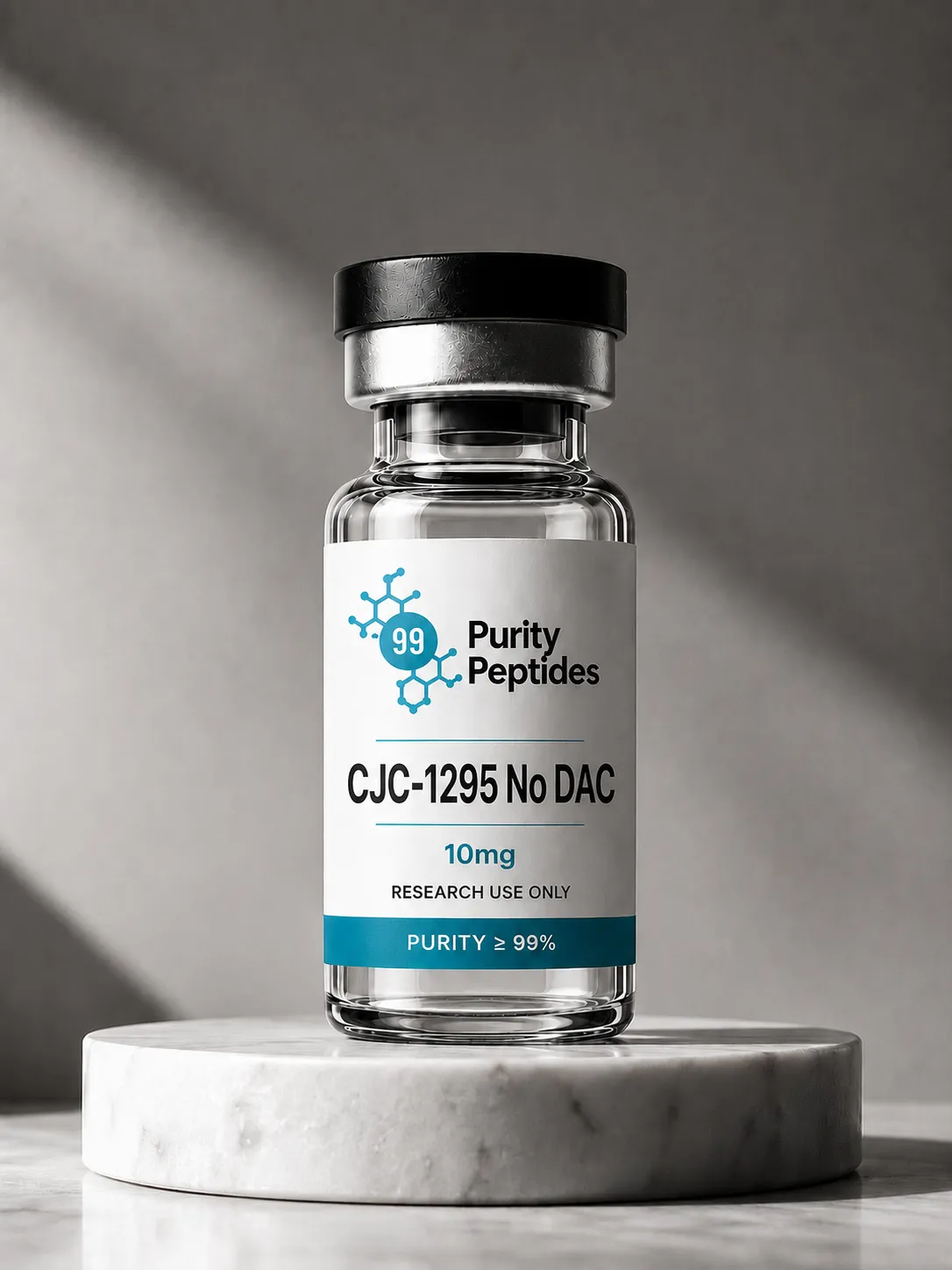
CJC-1295 with DAC is a synthetic analog of growth hormone-releasing hormone (GHRH). Its backbone is the first 29 amino acids of GHRH, known as GRF(1-29), which is the shortest fragment that keeps full activity at the GHRH receptor. Four amino acids in that sequence have been substituted (D-Ala at position 2, Gln at 8, Ala at 15, and Leu at 27) to make the peptide more resistant to enzymatic breakdown and to oxidation. On its own, that modified backbone is the peptide sold on this site as CJC-1295 No DAC. The version on this page goes one step further.
The addition is the Drug Affinity Complex, usually shortened to DAC. It is a maleimidopropionic acid (MPA) group attached through a lysine at the C-terminal end of the peptide. Maleimides react quickly and selectively with free thiols, and in blood or serum the most abundant free thiol belongs to cysteine 34 of albumin. Once the DAC reacts there, the peptide is covalently tied to a very large, long-lived carrier protein. Published pharmacokinetic work describes the result as a persistence measured in days, where unmodified GRF(1-29) is cleared within minutes. The reported molecular weight of the finished peptide is a little over 3.6 kDa.
The target of the peptide is the GHRH receptor (GHRHR), a class B G protein-coupled receptor found on pituitary somatotrophs. Activation of the receptor stimulates adenylyl cyclase through Gs, raises intracellular cAMP, and activates protein kinase A, which in turn drives transcription and secretion events in the cell. In animal and cell-based models, researchers follow those steps along with downstream markers such as insulin-like growth factor 1 (IGF-1). The comparison that makes CJC-1295 with DAC scientifically interesting is not what the receptor does, but for how long it is engaged.
Natural GHRH release is pulsatile, and many questions in endocrine research depend on whether receptor stimulation is brief and rhythmic or sustained. A peptide that persists through albumin binding lets laboratories ask those questions directly. Groups compare short and long exposure windows, examine receptor desensitization and recovery, and study how downstream signaling changes when the stimulus does not switch off. Paired with the No DAC version, which has a short activity profile, the two peptides make a useful matched set.
The DAC also has value as a piece of chemistry. Maleimide-thiol conjugation is widely used for attaching peptides to carriers, labels, and surfaces, and an albumin-reactive peptide is a practical model for studying how that reaction behaves in complex biological fluids. Researchers evaluate conjugation rate, linker stability, and the fraction of peptide that ends up bound, usually with HPLC and LC-MS. Plasma and serum stability studies are another common use.
Within the wider family of GHRH analogs, CJC-1295 with DAC sits alongside sermorelin (the unmodified GRF(1-29)), tesamorelin (a stabilized GHRH analog), and the No DAC form. Laboratories often run these side by side to compare receptor potency, signal duration, and degradation behavior. Researchers working on growth hormone secretagogue receptor biology also study these peptides together with ipamorelin.
The 5mg and 10mg vials are listed together on this page because they are the same material. The peptide, the process, and the testing standards are identical, and the only difference is the quantity of lyophilized powder per vial. The smaller size suits assay development and short experiments, while the larger size supports longer or shared protocols. Single vials and multi-vial kits are offered for both.
Each vial is supplied as a lyophilized powder to protect the peptide and the maleimide-derived linker during storage and shipping. Researchers generally keep the material dry, cool, and protected from light, and follow their own institution's procedures for handling after reconstitution. CJC-1295 with DAC is sold for Research Use Only and is not intended for human or veterinary use.