CJC-1295 No DAC (Mod GRF 1-29): Mechanism, DAC Comparison, and What the Research Shows
If you’ve spent any time reading supplier pages or forum threads about GHRH-analog research peptides, you’ve probably run into the same confusion over and over: is CJC-1295 the same thing as CJC-1295 No DAC? Is Mod GRF 1-29 a different compound entirely? And why do half the product listings use these names interchangeably?
Featured Product
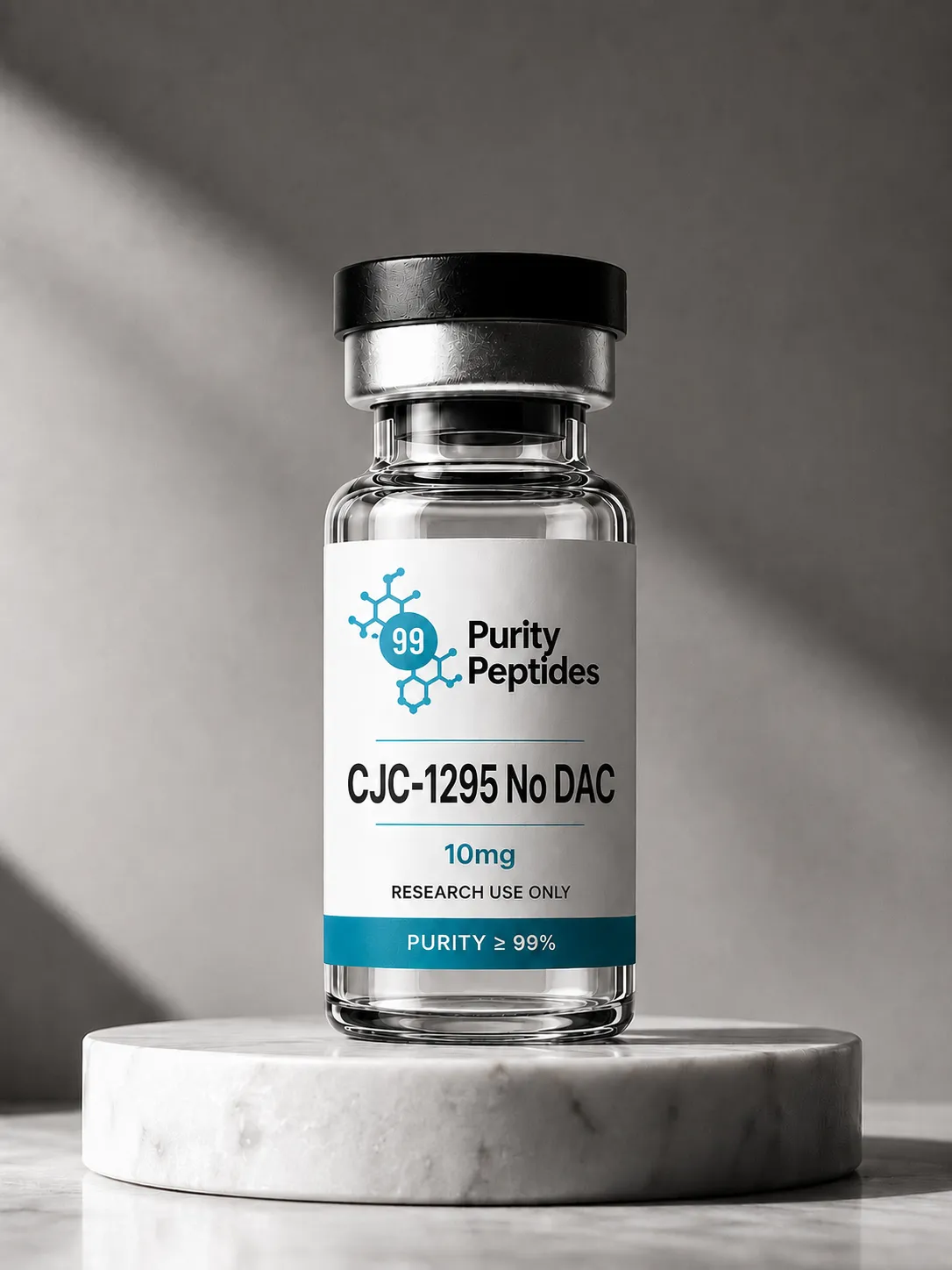
They shouldn’t be used interchangeably. CJC-1295 No DAC and Mod GRF 1-29 are the same molecule — a truncated, modified fragment of human growth-hormone-releasing hormone. CJC-1295 with DAC is a related but structurally distinct compound with very different pharmacokinetics. Getting this distinction right matters for anyone reading primary literature, comparing supplier listings, or trying to understand what a given study actually tested.
This guide walks through the structure, mechanism, regulatory status, and evidence base for CJC-1295 No DAC, and clears up where the DAC/No-DAC naming confusion comes from. Everything here is intended for laboratory research reference — CJC-1295 No DAC is not approved by the FDA for human or animal use, and nothing in this article should be read as usage instructions.
What Is CJC-1295 No DAC (Mod GRF 1-29)?
CJC-1295 No DAC is a 29-amino-acid peptide built from the first 29 residues of native human GHRH — the sequence responsible for GHRH’s biological activity. Four substitutions (at positions 2, 8, 15, and 27) protect the molecule from rapid breakdown by DPP-IV, an enzyme that normally degrades native GHRH within minutes.
“Mod GRF 1-29” is simply the more precise, mechanism-first name for this same compound: Modified Growth-hormone-Releasing Factor, residues 1 through 29. Suppliers and researchers use “CJC-1295 No DAC” and “Mod GRF 1-29” as synonyms, and a well-optimized product page should say so explicitly rather than let readers guess.
The “No DAC” qualifier exists because a second, related compound — CJC-1295 with DAC — attaches a Drug Affinity Complex (a maleimidopropionic acid linker) that covalently binds circulating albumin. That single structural difference is what separates the two compounds pharmacologically, and it’s the most common point of confusion across the entire research-peptide space.
CJC-1295 With DAC vs. Without DAC: The Complete Comparison
This is the single highest-value comparison in the category, and it deserves a scannable table rather than another paragraph of prose.
Attribute | CJC-1295 No DAC (Mod GRF 1-29) | CJC-1295 With DAC |
|---|---|---|
Albumin binding | None | Covalent, via DAC/MPA linker |
Approximate half-life | ~30 minutes | Several days (commonly cited 6–8 day range in literature) |
GH release pattern | Single pulsatile spike | Sustained, near-continuous elevation (“GH bleed”) |
Typical research pairing | Ipamorelin, GHRP-6 (dual-receptor pulsatility studies) | Standalone, longer-interval protocols |
Molecular basis | Truncated GHRH(1-29) with DPP-IV-resistant substitutions | Same core sequence plus DAC conjugation |
Common naming | “No DAC,” “Mod GRF 1-29” | “With DAC,” “DAC:GRF” |
The practical takeaway: No DAC mimics the body’s natural pulsatile GH release pattern, while the DAC version behaves more like a slow-release depot. Researchers studying pulsatility — the frequency and amplitude of GH pulses — favor the No DAC form specifically because a continuous elevation would defeat the purpose of a pulsatility study.
Mechanism of Action: How CJC-1295 No DAC Triggers a GH Pulse
CJC-1295 No DAC works through the same receptor pathway as native GHRH. It binds the GHRH receptor (GHRH-R) on somatotroph cells in the anterior pituitary gland. Receptor activation triggers a cAMP/PKA signaling cascade inside the somatotroph, which in turn stimulates release of growth hormone into circulation.
Three things distinguish this from simply injecting native GHRH:
- DPP-IV resistance. The four amino acid substitutions block the primary enzymatic degradation pathway that limits native GHRH’s activity to just a few minutes.
- No albumin conjugation. Because there’s no DAC group, the peptide isn’t held in circulation the way the DAC version is — it clears on a timescale closer to native GHRH, just without the immediate degradation.
- Pulsatile, not sustained, GH output. In laboratory models, this produces one discrete GH pulse per administration rather than a plateau — the pattern most closely resembling the body’s own GH pulsatility.
This mechanism is also why CJC-1295 No DAC is frequently paired with ghrelin-receptor agonists in dual-receptor research designs, which the next section covers.
The CJC-1295 No DAC + Ipamorelin Stack
Ipamorelin is a selective ghrelin-receptor (GHSR-1a) agonist. It stimulates GH release through a different receptor and signaling pathway than GHRH analogs do. Because CJC-1295 No DAC works through the GHRH receptor and Ipamorelin works through the ghrelin receptor, laboratory models combining the two are studying dual-receptor GH stimulation — the idea that activating both pathways simultaneously produces a larger GH pulse than either compound activates alone.
This is why so much of the competitor content in this space treats the combination as a default research design rather than a footnote. It’s worth noting as its own topic rather than folding it entirely into either individual product page, since readers searching for “CJC-1295 No DAC” and readers searching for “CJC-1295 No DAC Ipamorelin stack” are often at different stages of the same research question — one trying to understand the base compound, the other trying to understand a specific experimental design.
Selectivity matters here too: Ipamorelin is frequently cited in the literature as more selective for GH release than earlier ghrelin-mimetic peptides like GHRP-6, with less impact on cortisol and prolactin — a detail worth citing precisely rather than glossing over, since it’s a common point of comparison in forum discussion.
CJC-1295 No DAC vs. Sermorelin vs. Tesamorelin
All three of these are GHRH-pathway compounds, but they aren’t interchangeable, and ambiguous use of “CJC-1295” without specifying DAC status is one of the more common accuracy problems on competitor pages.
Compound | GHRH Fragment Length | Half-Life Profile | Primary Research Distinction |
|---|---|---|---|
CJC-1295 No DAC (Mod GRF 1-29) | 29 amino acids, DPP-IV resistant | Short (~30 min) | Pulsatile release; no albumin binding |
Sermorelin | 29 amino acids, unmodified fragment | Very short (minutes) | Closest to native GHRH(1-29); no DPP-IV resistance modifications |
Tesamorelin | 44 amino acids | Short, with distinct pharmacokinetics | The only GHRH analog with an FDA-approved indication (for HIV-associated lipodystrophy); structurally longer than the 1-29 fragment compounds |
The distinction worth emphasizing: Tesamorelin is the outlier here in that it has an actual FDA-approved clinical indication, which neither CJC-1295 No DAC nor Sermorelin has. That single fact belongs in any comparison content, because it’s often the detail readers are actually trying to confirm when they land on a comparison page.
Regulatory and Compounding Status in 2026
This is the differentiator almost no competitor page explains clearly, and it’s worth being precise rather than vague about it.
CJC-1295 (the broader compound family, not specifically disambiguated by DAC status in most regulatory correspondence) was at one point nominated for inclusion on the FDA’s 503A Category 2 bulk substances list — the list that governs which bulk substances licensed compounding pharmacies may use. As of April 2026, that nomination was reported as withdrawn, and CJC-1295 did not appear on the agenda for the July 2026 Pharmacy Compounding Advisory Committee meeting.
What this means in plain terms: CJC-1295 (in any form) is not an FDA-approved drug, is not currently authorized for compounding under 503A Category 2, and remains classified strictly for research use. Regulatory status for compounds like this can and does change, so any page discussing it should be dated, sourced to the FDA’s own public docket where possible, and revisited periodically rather than treated as a permanent statement of fact.
Editorial note: confirm the current FDA docket status directly before publishing this section, since regulatory determinations can shift between the time this report was compiled and the time the article goes live.
Purity, COA Verification, and Supplier Trust
Community discussion around this compound — on forums like Reddit’s peptide-research communities — centers heavily on one recurring concern: whether a supplier’s purity claims are actually verified. This is the single highest-trust-value section a supplier page can offer, and it’s underdeveloped across almost every competitor in this space.
A meaningful certificate of analysis (COA) for a research peptide should show, at minimum:
- HPLC purity result, typically expressed as a percentage (commonly referenced in the 98–99%+ range for research-grade material)
- LC-MS identity confirmation, verifying the molecule is actually the peptide it claims to be rather than a structurally similar fragment
- Batch or lot number that matches the specific vial received, not a generic reference document
- Testing laboratory name, ideally an independent third party rather than an internal-only test
- Test date, since peptide stability can degrade over time even under proper storage
If a supplier can’t produce a batch-matched COA from a named third-party lab, that’s a legitimate reason for a researcher to look elsewhere. This is also one of the clearest opportunities for a supplier to build genuine E-E-A-T signal: publishing real, verifiable COAs — not stock imagery of a lab — does more for trust than any amount of descriptive copy.
Handling and Storage Principles
At a general level, lyophilized (freeze-dried) research peptides are typically stored frozen and protected from light and repeated temperature cycling prior to use, and manufacturer/supplier-specific storage guidance should always take precedence over generic advice. This article intentionally does not provide step-by-step reconstitution ratios, volumes, or dosing protocols — those specifics vary by intended laboratory application and should be determined by qualified researchers following their own institution’s protocols and the compound’s certificate of analysis, not by a blog post. Suppliers should direct researchers to peer-reviewed methodology and their own COA documentation rather than publishing generic self-administration instructions.
What the Research Literature Actually Shows
Two papers come up repeatedly in serious discussion of GHRH-analog pharmacokinetics and are worth citing by name rather than gesturing at “studies show”:
Ionescu and Frohman’s 2006 work, published in the Journal of Clinical Endocrinology & Metabolism, examined pulsatile growth hormone secretion, and is frequently referenced as foundational context for understanding how GHRH-pathway compounds interact with the body’s natural GH pulse architecture. Raun and colleagues’ 1998 work is similarly cited as part of the original characterization work behind the modified GRF(1-29) analog family.
Neither of these papers, nor any other legitimate literature on this compound, supports specific human dosing protocols — they describe laboratory and preclinical pharmacokinetics, not consumer usage guidance. Any content that cites “research dosage ranges” as if they were consumer instructions is misrepresenting what the underlying literature actually says, and a well-built page should be explicit about that distinction rather than blur it.
Common Myths About CJC-1295 No DAC
Myth: “CJC-1295” and “CJC-1295 No DAC” always mean the same thing. Not necessarily — plenty of pages use “CJC-1295” ambiguously to refer to either variant, which is exactly the confusion this article exists to clear up. Always check whether a source specifies DAC status.
Myth: No DAC and with-DAC versions are interchangeable in research design. They produce fundamentally different GH release patterns — pulsatile versus sustained — so substituting one for the other changes what a study is actually measuring.
Myth: A higher purity percentage on a label is automatically trustworthy. A number on a label means nothing without a batch-matched, third-party-verified COA behind it. Purity claims should always be checked against actual testing documentation.
Myth: This compound is FDA-approved because it’s sold by legitimate-looking suppliers. CJC-1295 in any form is not FDA-approved for human or animal use and is not currently authorized for 503A Category 2 compounding. Supplier professionalism doesn’t change its regulatory status.
Myth: Mod GRF 1-29 is a completely different, newer compound than CJC-1295 No DAC. It’s a naming variant of the same molecule, not a distinct product.
Conclusion
The core thing to take away from all of this: CJC-1295 No DAC and Mod GRF 1-29 are one and the same compound — a DPP-IV-resistant, truncated GHRH(1-29) analog that produces a short-lived, pulsatile GH release, distinct from the sustained-release profile of CJC-1295 with DAC. It’s frequently studied alongside Ipamorelin in dual-receptor GH research designs, and its regulatory status — not FDA-approved, not currently on the 503A Category 2 bulk substances list — is worth stating plainly rather than glossing over. For anyone evaluating a supplier, the single best trust signal is a real, batch-matched, third-party certificate of analysis, not marketing copy.
Researchers evaluating CJC-1295 No DAC for laboratory use should review the current certificate of analysis, confirm third-party testing, and compare it directly against the CJC-1295 with DAC and Ipamorelin listings to determine which compound fits their specific research design. [Browse the CJC-1295 No DAC research peptide listing] and review the published COA before purchasing.
Frequently Asked Questions
What is CJC-1295 No DAC?
CJC-1295 No DAC is a synthetic 29-amino-acid analog of human GHRH, modified for DPP-IV resistance, that produces a short, pulsatile growth hormone release in laboratory models. It’s also known as Mod GRF 1-29.
Is CJC-1295 No DAC the same thing as Mod GRF 1-29?
Yes. “Mod GRF 1-29” and “CJC-1295 No DAC” refer to the same molecule; the two names are used interchangeably across suppliers and literature.
What is the difference between CJC-1295 with DAC and without DAC?
The DAC version has a Drug Affinity Complex that binds serum albumin, extending its half-life to several days and producing sustained GH elevation. The No DAC version has no such conjugation, clears in roughly 30 minutes, and produces a single pulsatile GH spike.
How does CJC-1295 No DAC activate the GHRH receptor?
It binds GHRH-R on pituitary somatotroph cells, triggering a cAMP/PKA signaling cascade that stimulates GH release — the same pathway native GHRH uses, but protected from rapid DPP-IV degradation.
Why does CJC-1295 No DAC have a shorter half-life than the DAC version?
Because it lacks the albumin-binding DAC conjugate. Without that binding, the peptide clears from circulation much faster than the DAC-linked version.
Why is CJC-1295 No DAC often stacked with Ipamorelin in research designs?
Ipamorelin activates the ghrelin receptor (GHSR-1a), a separate pathway from the GHRH receptor. Combining both is studied as a dual-receptor approach to GH pulse amplification in laboratory models.
Is CJC-1295 FDA approved?
No. CJC-1295, in either DAC or No DAC form, is not FDA-approved for human or animal use. It’s classified strictly as a research-use-only compound.
What is CJC-1295’s current FDA compounding status in 2026?
CJC-1295’s nomination to the FDA’s 503A Category 2 bulk substances list was reported withdrawn as of April 2026, and it did not appear on the July 2026 Pharmacy Compounding Advisory Committee agenda. Confirm current status directly with the FDA’s public docket, since this can change.
How is CJC-1295 no DAC different from Sermorelin?
Both are GHRH(1-29)-based fragments, but Sermorelin lacks the DPP-IV-resistance substitutions that give CJC-1295 No DAC its longer functional activity relative to native GHRH.
How is CJC-1295 No DAC different from Tesamorelin?
Tesamorelin is a 44-amino-acid GHRH analog and is the only compound in this comparison group with an actual FDA-approved clinical indication. CJC-1295 No DAC is a shorter, 29-amino-acid fragment with no approved indication.
Is CJC-1295 no DAC safe for laboratory research use?
As a research-use-only compound, it should be handled according to standard laboratory safety practices and institutional protocols. It is not evaluated or labeled for human or animal safety.
How do I know if a CJC-1295 No DAC supplier is legitimate?
Look for a batch-matched certificate of analysis from a named third-party testing laboratory, showing both HPLC purity and LC-MS identity confirmation — not just a purity percentage on a product label.
What does 99% HPLC-verified purity mean for a peptide?
It indicates that high-performance liquid chromatography testing found the sample to be approximately 99% the target compound by that testing method, with the remainder being residual synthesis byproducts or related impurities. It should always be backed by an actual, verifiable lab report.
What is a certificate of analysis (COA) and why does it matter?
A COA is a lab document verifying a specific batch’s purity and identity. It matters because it’s the only real evidence that what’s in the vial matches what’s on the label.
How many amino acids are in CJC-1295 No DAC?
Twenty-nine — it’s built from the first 29 residues of the human GHRH sequence, with four modified positions for DPP-IV resistance.