What Is GHRP-2?
GHRP-2 (growth hormone releasing peptide-2, also referenced in the literature as pralmorelin) is a synthetic hexapeptide belonging to the growth hormone secretagogue family. It functions as a ghrelin mimetic, binding to the growth hormone secretagogue receptor (GHS-R1a) to stimulate pulsatile growth hormone release in experimental models. GHRP-2 is frequently used in endocrinology research to study growth hormone secretion patterns, the somatotropic axis, and receptor-binding behavior.
Featured Products
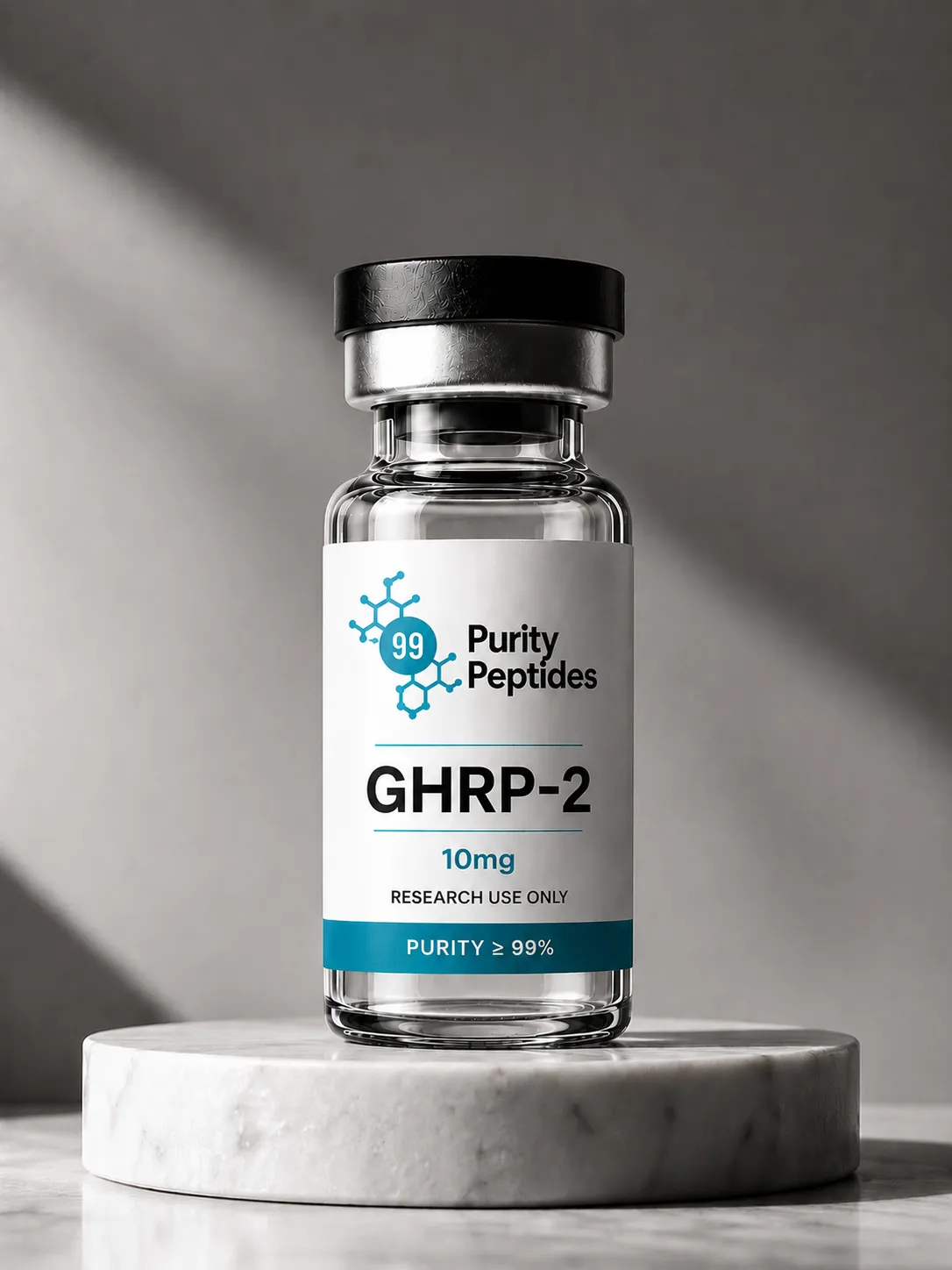
- Chemical class: synthetic hexapeptide, ghrelin receptor agonist
- Primary research interest: pulsatile growth hormone secretion
- Typical form supplied: lyophilized (freeze-dried) powder for laboratory reconstitution
What Is GHRP-6?
GHRP-6 (growth hormone releasing peptide-6) is the original compound in this peptide class, first characterized in the 1980s. Like GHRP-2, it is a ghrelin receptor agonist that triggers growth hormone release through the same GHS-R1a pathway. What distinguishes GHRP-6 in the research literature is its comparatively pronounced association with appetite stimulation in animal studies, which has made it a common tool for researchers studying the hunger-hormone (ghrelin) signaling pathway specifically, in addition to GH secretion.
- Chemical class: synthetic hexapeptide, ghrelin receptor agonist
- Primary research interest: GH secretion and appetite/hunger signaling studies
- Typical form supplied: lyophilized powder for laboratory reconstitution
Mechanism of Action: How GHRP-2 and GHRP-6 Compare
Both peptides act on the same receptor system, which is precisely why they are so often studied side by side. GHRP-2 and GHRP-6 bind to the growth hormone secretagogue receptor (GHS-R1a) — the same receptor that endogenous ghrelin activates — triggering a signaling cascade that increases growth hormone release from the pituitary gland. In research models, this occurs alongside secondary effects on cortisol, prolactin, and — notably for GHRP-6 — appetite regulation.
Where the Research Diverges
Comparative studies generally report that GHRP-2 produces a stronger, more selective growth-hormone-release signal relative to its effect on cortisol and prolactin, while GHRP-6 tends to show a comparatively larger orexigenic (appetite-driving) response. Researchers designing GH-secretion studies where appetite is a confounding variable often note this distinction when selecting which peptide to use in a given protocol.
GHRP-2 vs GHRP-6: Full Comparison Table
Attribute | GHRP-2 | GHRP-6 |
|---|---|---|
Peptide class | Synthetic hexapeptide, GHS-R1a agonist | Synthetic hexapeptide, GHS-R1a agonist |
Primary research focus | Growth hormone secretion, receptor selectivity | Growth hormone secretion, appetite/ghrelin signaling |
Reported potency (GH release) | Generally reported as more potent per unit dose in comparative studies | Reported as somewhat less potent for GH release specifically |
Appetite (orexigenic) effect | Reported as milder in animal studies | Reported as more pronounced in animal studies |
Cortisol/prolactin co-release | Present, generally reported as comparatively lower | Present, often reported as comparatively higher |
Research history | Developed after GHRP-6; widely cited | Original compound in the GHRP class; longest research history |
Common comparators in literature | Ipamorelin, Hexarelin | Ipamorelin, Hexarelin, Sermorelin |
Supplied form | Lyophilized powder, research use only | Lyophilized powder, research use only |
Reported values vary across studies and animal models; researchers should consult primary source literature for study-specific data rather than relying on general comparisons.
GHRP-2 vs GHRP-6 for Appetite Research
If your research protocol involves the ghrelin-appetite axis specifically, this is usually the deciding factor between the two peptides. GHRP-6's stronger orexigenic signal in animal models has made it the more commonly selected compound in studies isolating hunger-hormone pathways, cachexia models, and feeding-behavior research. GHRP-2, by contrast, is more frequently chosen when researchers want to isolate the growth-hormone-release pathway with less interference from appetite-related variables.
Key Takeaway Choose based on your research question: GHRP-6 for appetite/ghrelin-signaling studies, GHRP-2 for GH-secretion studies where a cleaner, more selective signal is preferred. |
Molecular Structure and Physical Properties
Both compounds are hexapeptides built from a similar synthetic backbone, which explains their shared receptor activity, but they differ in specific amino acid composition, molecular weight, and resulting binding characteristics. Researchers requiring exact structural data, CAS numbers, or molecular weight figures for citation purposes should reference peer-reviewed structural studies or PubChem entity records rather than vendor marketing pages, since these values should always be independently verified against primary chemical databases.
Purity, Testing, and Documentation in Research Settings
Purity verification matters more in peptide research than almost any other variable, because impurities can confound receptor-binding results and dose-response data. Reputable suppliers provide independent, third-party HPLC and mass spectrometry verification alongside a certificate of analysis (CoA) for each batch. When evaluating a supplier for institutional purchasing, ask for:
- A batch-specific certificate of analysis (CoA)
- Independent third-party lab verification, not just in-house testing
- Clear research-use-only (RUO) labeling and compliance documentation
- Documented cold-chain shipping and handling practices
How GHRP-2 and GHRP-6 Compare to Other Growth Hormone Secretagogues
GHRP-2 and GHRP-6 sit within a broader family of growth-hormone-related research peptides, and comparative literature frequently references three other compounds:
GHRP-2/GHRP-6 vs Ipamorelin
Ipamorelin is a newer-generation ghrelin receptor agonist studied for a more selective GH-release profile with reportedly minimal effect on cortisol and prolactin — a contrast researchers often cite when comparing selectivity across the GHRP class.
GHRP-2/GHRP-6 vs Hexarelin
Hexarelin is generally reported in the literature as the most potent GH secretagogue of this peptide family, though also associated with more pronounced cortisol and prolactin co-release than GHRP-2.
GHRP-2/GHRP-6 vs Sermorelin
Unlike GHRP-2 and GHRP-6, Sermorelin acts through the GHRH receptor pathway rather than the ghrelin (GHS-R1a) receptor, making it mechanistically distinct — a useful comparator for studies examining receptor-specific effects on GH secretion.
Best Practices and Common Mistakes in GHRP Research Protocols
Best Practices
- Confirm peptide identity and purity via CoA before beginning any protocol
- Store lyophilized peptides as directed by the supplier's documentation, away from light and moisture, until laboratory use
- Follow your institution's standard handling and disposal protocols for research peptides
- Cite primary, peer-reviewed literature rather than vendor blogs when reporting comparative data
Common Mistakes
- Treating GHRP-2 and GHRP-6 as interchangeable — their appetite and cortisol/prolactin profiles differ meaningfully
- Sourcing from suppliers that don't provide independent purity verification
- Overlooking that both peptides act on the same receptor as endogenous ghrelin, which matters for experimental design and controls
Key Takeaways
- GHRP-2 and GHRP-6 are both synthetic hexapeptide ghrelin receptor (GHS-R1a) agonists studied for growth hormone secretion.
- GHRP-6 is more strongly associated with appetite stimulation in animal research; GHRP-2 is generally reported as more selective for GH release.
- Both are supplied and sold strictly for laboratory research use, not for human consumption.
- Purity documentation (CoA, third-party testing) is essential when selecting a research peptide supplier.
- GHRP-2 and GHRP-6 are frequently compared against Ipamorelin, Hexarelin, and Sermorelin in the broader secretagogue literature.
Frequently Asked Questions
What is GHRP-2?
GHRP-2 is a synthetic hexapeptide and ghrelin receptor (GHS-R1a) agonist studied in laboratory research for its role in stimulating pulsatile growth hormone release.
What is GHRP-6?
GHRP-6 is a synthetic hexapeptide, the original compound in the GHRP class, studied for growth hormone release and — more prominently in the literature — appetite (orexigenic) signaling.
What is the main difference between GHRP-2 and GHRP-6?
GHRP-2 is generally reported as the more selective, potent GH secretagogue with a milder appetite effect, while GHRP-6 is more strongly linked to appetite stimulation in animal studies.
Is GHRP-2 stronger than GHRP-6 in research settings?
For growth-hormone-release specifically, comparative studies often report GHRP-2 as more potent per unit dose, though results vary by model and protocol.
Does GHRP-6 cause more appetite stimulation than GHRP-2?
Yes — animal studies consistently associate GHRP-6 with a stronger orexigenic (appetite-driving) response than GHRP-2.
Are GHRP-2 and GHRP-6 sold for human consumption?
No. Both are sold strictly for laboratory and in vitro research use and are not approved for human or animal consumption.
What receptor do GHRP-2 and GHRP-6 both target?
Both act on the growth hormone secretagogue receptor (GHS-R1a), the same receptor activated by endogenous ghrelin.
How does GHRP-2 compare to Hexarelin?
Hexarelin is generally reported as more potent for GH release than GHRP-2 but is also associated with greater cortisol and prolactin co-release.
How does GHRP-6 compare to Ipamorelin?
Ipamorelin is a newer secretagogue studied for a more selective GH-release profile with less cortisol/prolactin co-release than GHRP-6.
Is GHRP-2 or GHRP-6 more researched in peer-reviewed literature?
GHRP-6 has the longer research history since it was the first compound characterized in this peptide class, though both are well represented in the literature.
Can GHRP-2 and GHRP-6 be used in the same study?
Some comparative research designs do include both compounds as parallel arms, but protocol design should follow institutional review and the specific research question.
What documentation should accompany a GHRP-2 or GHRP-6 purchase for research?
A batch-specific certificate of analysis and, ideally, independent third-party HPLC/mass spectrometry verification of purity.
Are GHRP-2 and GHRP-6 the same molecule?
No. While both are hexapeptides acting on the same receptor, they have distinct amino acid sequences, molecular weights, and research profiles.
Why do researchers compare GHRP-2 and GHRP-6 so often?
Because they share a receptor and general mechanism but diverge meaningfully in reported potency and appetite effects, making the comparison directly relevant to protocol design.