Last reviewed: September 2026
Featured Products

Quick Answer
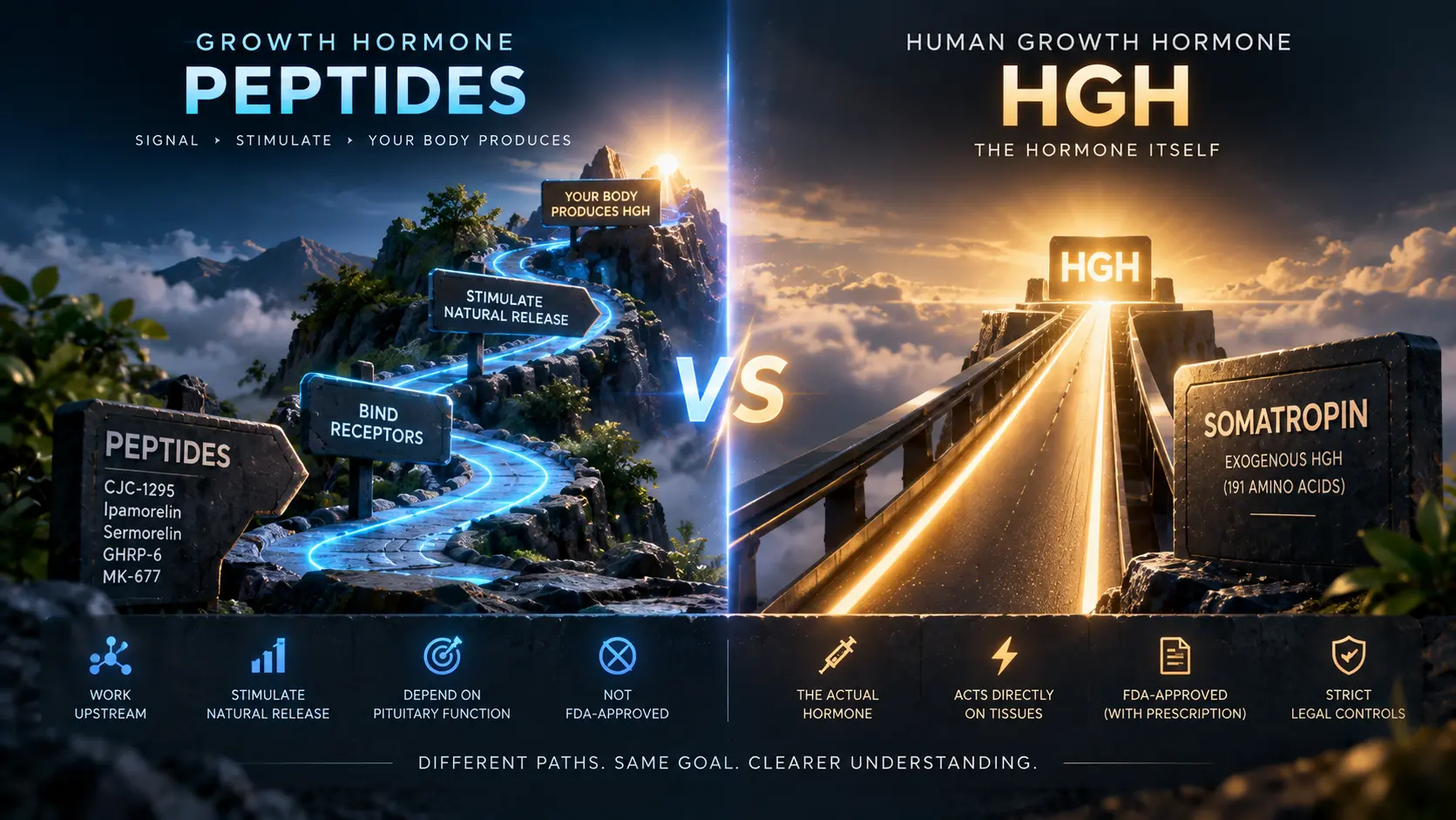
The peptides vs HGH question comes down to where the molecule acts: HGH means somatropin, the 191-amino-acid human growth hormone itself, supplied from outside the body, while growth hormone peptides are secretagogues that bind receptors on the pituitary and prompt it to release its own hormone. That is a real pharmacological difference, and it is routinely presented as a safety difference, which it is not. Somatropin is an approved prescription medicine whose non-medical distribution carries its own federal criminal penalty; no growth hormone secretagogue is approved for any indication in any jurisdiction, and the longest human trial of one recorded a rise in fasting glucose and a fall in insulin sensitivity alongside the gain in lean mass.
Key Takeaways
- Somatropin is the 191-residue hormone administered directly. Secretagogues act one step upstream, at either the ghrelin receptor (GHSR-1a) or the growth hormone-releasing hormone (GHRH) receptor.
- Federal law treats human growth hormone as a category of its own: 21 U.S.C. § 333(e)(1) makes knowing distribution for unapproved human use punishable by up to 5 years, rising to 10 where a person under 18 is involved [5].
- The statute defines human growth hormone as "somatrem, somatropin, or an analogue of either of them" at § 333(e)(4). Whether a ghrelin-receptor secretagogue such as ipamorelin is an "analogue" has not been settled by a court.
- Tesamorelin (Egrifta) is the only approved GHRH analogue in the United States, approved 10 November 2010 and only for HIV-associated lipodystrophy [6].
- Sermorelin's brand products (Geref, NDA 019863 approved 1990 and NDA 020443 approved 1997) are discontinued, and FDA determined in a 2013 Federal Register notice that they were not withdrawn for safety or effectiveness reasons [7].
- Two years of MK-677 in 65 adults aged 60 to 81 raised fat-free mass by 1.1 kg versus a 0.5 kg loss on placebo, produced no change in strength or function, raised fasting glucose by about 5 mg/dL and lowered insulin sensitivity [1].
- Ipamorelin's only substantial human randomized trial, in postoperative ileus, enrolled 117 patients and missed its efficacy endpoint (25.3 versus 32.6 hours to first tolerated meal, p = 0.15) [2].
- Somatropin sits in section S2.2.3 of the 2026 WADA Prohibited List and secretagogues in S2.2.4. Both are non-Specified Substances, prohibited at all times [8].
Research Use Only. Every compound named on this page is supplied for laboratory research use only. Nothing here is medical, dosing, training, or health advice, and nothing sold by 99 Purity Peptides is for human or veterinary consumption. This article describes chemistry, regulatory status, statute, and published data. It does not recommend either category of compound for any person or purpose.
What Is the Difference Between HGH and Growth Hormone Peptides?
One is the hormone; the other is a request for the hormone. Somatropin is recombinant human growth hormone, a 191-amino-acid protein identical in sequence to the pituitary product, and injecting it puts that protein into circulation directly. The compounds sold as "growth hormone peptides" never enter the growth hormone receptor at all. They bind one of two upstream receptors and depend on a functioning pituitary to do anything.
Which receptor matters more than most comparisons admit, because the two upstream classes are not interchangeable with each other, let alone with somatropin.
Compound | Class | Receptor engaged | What reaches the bloodstream |
|---|---|---|---|
Somatropin | Recombinant human growth hormone | GH receptor, on peripheral tissues | The 191-residue hormone, as injected |
Somatrem | Methionyl analogue of GH | GH receptor | The analogue, as injected |
Ipamorelin | Pentapeptide secretagogue | GHSR-1a (ghrelin receptor) | Endogenous GH, released by the pituitary |
GHRP-2 (pralmorelin), GHRP-6, hexarelin | GH-releasing peptides | GHSR-1a | Endogenous GH |
MK-677 (ibutamoren) | Non-peptide oral ghrelin mimetic | GHSR-1a | Endogenous GH |
CJC-1295, sermorelin, tesamorelin | GHRH analogues | GHRH receptor, on somatotrophs | Endogenous GH |
Two consequences follow from the right-hand column. First, everything below the top two rows is bounded by how much hormone the somatotroph population can actually make and release, and by the two brakes on that release: hypothalamic somatostatin, and negative feedback from circulating insulin-like growth factor 1 (IGF-1). Somatropin bypasses all of it. Second, the secretagogue classes differ from each other in ways that matter to anyone designing an experiment, which is why the compound comparisons belong on their own pages rather than compressed into a line here. The GHRP-6 and ipamorelin comparison covers selectivity within the GHSR-1a group, and the GHRP-2 and GHRP-6 comparison covers the differences inside the GHRP series itself.
Why Does the Pituitary Ceiling Matter?
A bounded output is a fact about pharmacology, and it is the single most abused fact in this category. Clinic pages take the ceiling and convert it into a safety claim: because a secretagogue cannot force the pituitary past its reserve, the argument runs, overdose is impossible and the compound is therefore gentler than exogenous hormone. The first half is roughly true. The second half does not follow from it, and nobody has produced the trial that would test it.
Consider what "within the feedback loop" actually looked like when someone measured it. Ionescu and Frohman gave healthy men a single injection of CJC-1295 with drug affinity complex and sampled growth hormone overnight before and after. Pulsatility survived, which is the finding the marketing quotes. What the same study also reported is that trough and mean growth hormone secretion both rose, along with IGF-1 production [4]. The secretory pattern was not simply preserved; the baseline it oscillated around moved up, and it stayed up for days, because the albumin-bound analogue has a half-life measured in days rather than minutes. Teichman's dose-ranging work put that half-life at 5.8 to 8.1 days and found IGF-1 still elevated for 9 to 11 days after one injection, with levels remaining above baseline for as long as 28 days after repeated dosing [3].
A ceiling on peak height is not a ceiling on exposure duration. Those are different quantities, and the second one is what chronic elevation of the growth hormone axis is measured in. Acromegaly, the clinical syndrome of sustained growth hormone excess, is not characterised by a single enormous spike; it is characterised by years of elevation. Saying so is not a claim that any secretagogue causes it. It is a statement about which axis of the problem the ceiling argument fails to address.
So the honest version of the mechanism story is narrower than either side wants. Secretagogue output is bounded by somatotroph reserve and by somatostatin and IGF-1 feedback. That boundedness is not evidence of safety, it has never been tested as a safety hypothesis, and the one long human trial in the class did not come back clean.
Is HGH Legal? Are Growth Hormone Peptides?
Human growth hormone occupies a category in federal law that almost nothing else in this field occupies. Under 21 U.S.C. § 333(e)(1), knowingly distributing or possessing with intent to distribute human growth hormone for any use in humans other than treatment of a disease or recognised medical condition authorised by the Secretary of Health and Human Services and ordered by a physician is an offence punishable by up to 5 years in prison plus fines. Paragraph (e)(2) raises that to 10 years where the offence involves an individual under 18. Paragraph (e)(3) then does something unusual: it directs that a conviction be treated as a felony violation of the Controlled Substances Act for forfeiture purposes, even though growth hormone is not scheduled. Paragraph (e)(5) assigns investigative authority to the Drug Enforcement Administration [5].
The definition sits at paragraph (e)(4), and it is short: human growth hormone means somatrem, somatropin, or an analogue of either of them [5].
That single word, "analogue," is where the comparison stops being tidy. Somatrem and somatropin are named. A structural analogue of the 191-residue protein, such as somapacitan or somatrogon, is plainly covered. A five-amino-acid ghrelin-receptor agonist that shares no sequence with growth hormone and binds a completely different receptor is a harder question, and the enforcement record does not answer it: § 333(e) prosecutions have concerned somatropin itself, typically imported unapproved product, rather than GHSR-1a secretagogues. No reported decision has held that ipamorelin is an analogue of somatropin, and none has held that it is not.
This site is not going to resolve that for you, because it is not resolved. What can be said precisely is that the analysis differs by compound, that the compounding question is separate again from the distribution question, and that both sit alongside the older and better-settled controlled-substance framework that governs anabolic steroids. That framework is covered in the peptides and steroids comparison, and the broader regulatory picture, including how FDA has treated peptide bulk substances, is covered in the BPC-157 legal status guide and the July 2026 FDA peptide vote explainer.
Which of These Are FDA-Approved?
One growth hormone-releasing compound is approved in the United States, and it is not the one people ask about. The table below separates approval from availability, which the ranking pages tend to blur.
Compound (brand) | US status | Approved for | Notes |
|---|---|---|---|
Somatrem (Protropin) | Approved 1985, no longer marketed | Growth hormone deficiency in children | First recombinant growth hormone product cleared in the US |
Somatropin (Genotropin) | Approved; label states initial US approval 1987 | Paediatric growth failure across several defined causes; adult growth hormone deficiency | Multiple brands share the same active substance |
Somatropin (Serostim) | Accelerated approval 1996; full approval 29 August 2003 | HIV-associated wasting and cachexia | Approval converted after a confirmatory trial |
Tesamorelin (Egrifta) | Approved 10 November 2010 | Reduction of excess visceral abdominal fat in HIV-infected patients with lipodystrophy | The only approved GHRH analogue [6] |
Sermorelin (Geref) | Approved 1990 and 1997; discontinued | Paediatric growth hormone deficiency and pituitary function testing | FDA determined in 2013 that the products were not withdrawn for safety or effectiveness reasons [7] |
Ipamorelin, CJC-1295, GHRP-2, GHRP-6, hexarelin, MK-677 | Not approved | Nothing, anywhere | No marketing authorisation in any jurisdiction |
Three things in that table are worth more than the approval column itself.
Tesamorelin's indication is narrow on purpose. It was approved on two placebo-controlled trials in 816 HIV-infected adults, and the FDA announcement said in terms that whether the drug reduces cardiovascular risk had not been studied [6]. An approval for visceral fat in lipodystrophy is not a general endorsement of GHRH analogues, and it is certainly not transferable to CJC-1295, which shares the receptor and nothing else regulatory.
Serostim's history shows what a real evidence trajectory costs. Accelerated approval in 1996 came over a split advisory committee; full approval arrived seven years later, after a confirmatory placebo-controlled study. That is the standard against which "no approved indication anywhere" should be read.
Sermorelin's position is genuinely distinct from ipamorelin's and is almost always described wrongly. The brand products were discontinued for commercial reasons, and the 2013 Federal Register determination that they were not withdrawn for safety or effectiveness reasons is the specific regulatory fact that separates sermorelin from a compound that was never approved at all [7]. Treating "sermorelin used to be a drug" and "ipamorelin is not a drug" as the same status is a category error, whichever direction you make it in.
What Do the Human Trials on Secretagogues Actually Show?
The human record for this class is thin, old, and mostly negative on the outcomes people care about. Three studies carry nearly all the weight.
Study | Design and size | Compound | Primary finding |
|---|---|---|---|
Nass 2008 [1] | 2-year double-blind, randomized, placebo-controlled, modified crossover; 65 healthy adults aged 60 to 81; primary endpoints at 12 months | MK-677 (oral) | Fat-free mass rose 1.1 kg versus a 0.5 kg fall on placebo (p < 0.001); no change in strength or function; fasting glucose rose ~0.3 mmol/L (5 mg/dL, p = 0.015) and insulin sensitivity fell |
Beck 2014 [2] | Phase 2 multicentre, double-blind, placebo-controlled; 117 enrolled, 114 analysed; bowel resection patients | Ipamorelin (intravenous) | Median time to first tolerated meal 25.3 h versus 32.6 h on placebo, p = 0.15; endpoint not met |
Teichman 2006 [3] | Two randomized, double-blind, placebo-controlled ascending-dose trials of 28 and 49 days; healthy adults aged 21 to 61 | CJC-1295 with DAC | Pharmacokinetics and pharmacodynamics only: GH rose 2- to 10-fold, IGF-1 1.5- to 3-fold for 9 to 11 days; no clinical outcome measured |
Read those three rows together and the "safer and just as effective" pitch loses its second half before it loses its first.
The Nass trial is the one that should end the argument about efficacy, because it is the only one that ran long enough to look. Growth hormone and IGF-1 went up into the young-adult range. Fat-free mass went up. Strength did not. Function did not. The authors state plainly that the increase in fat-free mass did not translate into changes in strength or function, and they flag that the study was not powered for functional endpoints in healthy elderly people [1]. That last caveat cuts both ways: it means the null result on function is not definitive, and it also means nobody has since produced the adequately powered trial that would settle it. Eighteen years on, that is telling.
The metabolic signal in the same trial is the part the clinic pages omit. Fasting glucose rose and insulin sensitivity fell. Cortisol rose. Body weight rose by 2.7 kg against 0.8 kg on placebo, and the extra limb fat gain was larger in the treated group [1]. None of that is catastrophic, and none of it is reassuring either, which is the point.
Beck's ipamorelin trial is the closest thing the compound has to a real efficacy study in humans, and it was in postoperative ileus, not body composition. It missed. A 7-hour median difference with p = 0.15 in 114 analysed patients is a negative trial, and it should be described that way rather than as "promising early data."
Teichman is frequently cited as though it were an efficacy study for CJC-1295. It is not. Its stated outcome measures were peak concentrations and area under the curve for growth hormone and IGF-1, plus standard pharmacokinetic parameters [3]. It tells you the molecule does what it was designed to do to a blood level. It tells you nothing about what happens to a person over a year. The distinction between with-DAC and no-DAC formulations, which determines whether you are looking at days of exposure or minutes, is covered separately in the CJC-1295 DAC comparison, and the combined-compound literature in the CJC-1295 and ipamorelin research overview and the ipamorelin and CJC-1295 comparison.
Are Peptides Safer Than HGH?
Nobody has run the study, so the honest answer is that the comparison is not answerable from the evidence. There is no head-to-head randomized trial of any growth hormone secretagogue against somatropin with safety as an endpoint. There is no registry comparing adverse events between the two classes in matched populations. The question that every clinic page answers confidently has no data behind it in either direction.
What exists instead is an argument from mechanism on one side and a decades-long approved-product safety database on the other. The mechanism argument is the ceiling: bounded release, feedback intact, therefore safer. Somatropin's side of the ledger is a set of labelled adverse reactions accumulated across approved indications since the 1980s, which is an unattractive-looking list precisely because it was compiled under regulatory obligation. An unapproved compound with no safety database is not thereby safer. It is unmeasured, and the two are easy to confuse when only one of them has a package insert.
Where a long-term human measurement does exist for a secretagogue, it went the wrong way for the safety story: two years of MK-677 worsened fasting glucose and insulin sensitivity [1]. One trial, one compound, one population. But it is the best evidence in the class, and it does not support the claim being made.
What Do Clinic Pages Get Wrong?
Four claims recur across the pages ranking for this query, and all four are either unsupported or false. We are quoting the claim types rather than naming individual clinics.
Claim as stated | Status | What the primary source shows |
|---|---|---|
"Peptides are safer than HGH because they work within the body's feedback loop, reducing overdose risk" | Unsupported | No head-to-head safety trial exists. The longest secretagogue trial found rising fasting glucose and falling insulin sensitivity [1] |
"Peptide therapy gently stimulates your body's own production" | Marketing language | "Gently" is not a pharmacological term. Measured continuous GHRH-receptor stimulation raised trough and mean GH and IGF-1 for days per dose [3][4] |
"Legal when prescribed by a physician and compounded by a 503A pharmacy" | Overstated | Compounding eligibility turns on a substance's status under section 503A, which is decided by FDA rulemaking. Advisory committee votes are recommendations, not approvals, and eligibility to compound is not the same thing as approval |
"Secretagogues can't be detected" | False | Validated mass-spectrometry methods for GHRP-2 and its urinary metabolite were published in 2010 [9], and receptor-binding and excretion work covering GHRP-1, GHRP-2, GHRP-6, hexarelin and ipamorelin followed [10] |
The detection claim deserves a sentence of its own because it is the only one of the four that is flatly, checkably wrong. Accredited anti-doping laboratories have run validated methods for these compounds for over a decade, positive findings have been reported in competition, and retrospective testing has produced sanctions years after the fact. Anyone repeating the undetectable claim in 2026 is either not reading the analytical literature or is counting on the reader not to.
Where Do They Stand in Sport?
Both classes are prohibited at all times, in and out of competition, with no in-competition-only carve-out and no threshold. The 2026 WADA Prohibited List places growth hormone, its analogues and fragments in section S2.2.3, and growth hormone releasing factors in S2.2.4, the latter explicitly naming GHRH analogues (CJC-1293, CJC-1295, sermorelin, tesamorelin), growth hormone secretagogues and their mimetics (anamorelin, capromorelin, ibutamoren, ipamorelin, lenomorelin, macimorelin, tabimorelin) and GH-releasing peptides (alexamorelin, hexarelin, GHRP-1 through GHRP-6) [8].
Every substance in class S2 is a non-Specified Substance. That classification is not cosmetic; it changes how sanctions are calculated under the Code, and it is why an inadvertent-use argument is harder to run for this class than for many stimulants.
The list also closes the obvious gap with a catch-all: substances with similar chemical structure or similar biological effect are prohibited whether or not they are named [8]. A novel GHSR-1a agonist that appears next year is covered on the day it appears.
Why This Page Will Not Compare Prices
A cost comparison between these two categories is not a comparison of like with like, so we are not publishing one. On one side is an approved prescription medicine with a marketing authorisation, a manufacturer liable for its content, lot release testing under current good manufacturing practice, and a labelled indication. On the other is an unapproved substance with no authorised human use. Putting per-milligram figures next to each other implies the two are substitutable purchases differing mainly in price, which is exactly the framing that the price tables on ranking pages exist to create. The relevant question for a research buyer is not what a milligram costs but what documentation comes with it, which is what the certificate of analysis guide and our certificates library are for.
What the Evidence Does Not Establish
Stating the limits plainly is more useful than another table, so here they are.
It does not establish that secretagogues are safer than somatropin. No comparison has been run.
It does not establish that secretagogues are less effective than somatropin for any human outcome, either. Absence of an approved indication is not the same as a demonstrated failure, and Beck's single negative trial was in postoperative ileus, a setting with no bearing on body composition.
It does not establish any body composition, recovery, sleep, or ageing-related benefit in humans for ipamorelin, CJC-1295, GHRP-2, GHRP-6 or hexarelin. For CJC-1295 the human literature is pharmacodynamics only [3][4]. For ipamorelin the one substantial human trial was negative on its endpoint [2]. The lean-mass finding for MK-677 is real but came without strength or function change and with a metabolic cost [1].
It does not establish the legal status of a GHSR-1a secretagogue under the definition at 21 U.S.C. § 333(e)(4). That question is open.
And it does not establish that the pituitary ceiling protects anyone from anything. It establishes that a ceiling exists.
How We Graded the Evidence
Study types are named every time they appear in this article, and they are not treated as interchangeable. A multi-year randomized placebo-controlled trial with a prespecified primary endpoint sits at the top. A phase 2 trial that missed its endpoint is reported as a negative result rather than as preliminary support. Ascending-dose pharmacokinetic and pharmacodynamic studies are described as measurements of blood levels, never as evidence of clinical effect. Animal and cell-culture work is excluded from the claims above entirely. Where the primary literature is old, small, or from a single research group, that is stated in the same sentence as the finding. Regulatory and legal statements cite the statute, the approval record, or the Federal Register rather than a secondary summary.
For Researchers Working in This Area
The compound-level comparisons live on their own pages, and they are the better starting point for anyone designing work in this space: ipamorelin against CJC-1295 for the two most commonly paired secretagogues, the CJC-1295 and ipamorelin research overview for the combined literature, and IGF-1 LR3 against IGF-1 DES for the downstream growth factor analogues.
Research materials with batch documentation are listed on the product pages for ipamorelin, CJC-1295 with ipamorelin, GHRP-2 10mg, GHRP-6 10mg and IGF-1 LR3. Each ships with lot-specific analytical documentation; how to read it is covered in our certificate of analysis guide.
References
- Nass R, Pezzoli SS, Oliveri MC, et al. Effects of an oral ghrelin mimetic on body composition and clinical outcomes in healthy older adults: a randomized trial. Ann Intern Med. 2008;149(9):601-611. PMID 18981485. doi:10.7326/0003-4819-149-9-200811040-00003. https://pubmed.ncbi.nlm.nih.gov/18981485/
- Beck DE, Sweeney WB, McCarter MD. Prospective, randomized, controlled, proof-of-concept study of the ghrelin mimetic ipamorelin for the management of postoperative ileus in bowel resection patients. Int J Colorectal Dis. 2014;29(12):1527-1534. PMID 25331030. doi:10.1007/s00384-014-2030-8. ClinicalTrials.gov NCT00672074.
- Teichman SL, Neale A, Lawrence B, et al. Prolonged stimulation of growth hormone (GH) and insulin-like growth factor I secretion by CJC-1295, a long-acting analog of GH-releasing hormone, in healthy adults. J Clin Endocrinol Metab. 2006;91(3):799-805. PMID 16352683. doi:10.1210/jc.2005-1536.
- Ionescu M, Frohman LA. Pulsatile secretion of growth hormone (GH) persists during continuous stimulation by CJC-1295, a long-acting GH-releasing hormone analog. J Clin Endocrinol Metab. 2006;91(12):4792-4797. PMID 17018654. doi:10.1210/jc.2006-1702. https://pubmed.ncbi.nlm.nih.gov/17018654/
- 21 U.S.C. § 333(e), Prohibited distribution of human growth hormone. https://www.law.cornell.edu/uscode/text/21/333
- US Food and Drug Administration. FDA approves Egrifta to treat lipodystrophy in HIV patients. News release, 10 November 2010.
- US Food and Drug Administration. Determination that GEREF (sermorelin acetate) injection products were not withdrawn from sale for reasons of safety or effectiveness. Federal Register, 4 March 2013. Docket No. FDA-2012-P-1071.
- World Anti-Doping Agency. The 2026 Prohibited List, International Standard, effective 1 January 2026, sections S2.2.3 and S2.2.4. https://www.wada-ama.org/en/resources/world-anti-doping-code-and-international-standards/prohibited-list
- Okano M, Sato M, Ikekita A, Kageyama S. Determination of growth hormone secretagogue pralmorelin (GHRP-2) and its metabolite in human urine by liquid chromatography/electrospray ionization tandem mass spectrometry. Rapid Commun Mass Spectrom. 2010;24(14):2046-2056. PMID 20552695. doi:10.1002/rcm.4619.
- Ferro P, Krotov G, Zvereva I, Rodchenkov G, Segura J. Structure-activity relationship for peptidic growth hormone secretagogues. Drug Test Anal. 2017;9(1):87-95. PMID 26811125. https://pubmed.ncbi.nlm.nih.gov/26811125/
Frequently Asked Questions
What is the difference between HGH and growth hormone peptides?
HGH is somatropin, the 191-amino-acid growth hormone itself, supplied from outside the body and acting on growth hormone receptors in peripheral tissues. Growth hormone peptides are secretagogues that bind either the ghrelin receptor (GHSR-1a) or the GHRH receptor on the pituitary, prompting release of the body's own hormone. One delivers the hormone; the other requests it.
Are growth hormone peptides the same thing as HGH?
No. They differ in molecular size, receptor target, and regulatory status. Ipamorelin is five amino acids and binds a ghrelin receptor; somatropin is 191 amino acids and binds the growth hormone receptor. They also differ legally: somatropin is an approved prescription medicine covered by a specific federal distribution offence, while ipamorelin has no approved indication in any country.
Is HGH legal in the United States?
Somatropin is legal as a prescription medicine for approved indications ordered by a physician. Outside that, 21 U.S.C. § 333(e)(1) makes knowing distribution, or possession with intent to distribute, human growth hormone for other human uses an offence carrying up to 5 years in prison, rising to 10 years where a person under 18 is involved. Convictions also trigger Controlled Substances Act forfeiture provisions.
Are growth hormone peptides legal?
Their status is unsettled and compound-specific. None has an approved human indication, so none can lawfully be marketed for human use. Whether a ghrelin-receptor secretagogue falls inside the statutory definition of human growth hormone as "an analogue" of somatrem or somatropin has not been decided by a court, and enforcement under that provision has concerned somatropin itself.
Is HGH FDA-approved?
Yes, for defined indications. Somatropin products are approved for conditions including paediatric growth failure from several causes, adult growth hormone deficiency, and HIV-associated wasting. Serostim received accelerated approval in 1996 and full approval on 29 August 2003. Approval never extended to anti-ageing, bodybuilding, or athletic performance, and those uses fall outside the statutory exemption.
Are ipamorelin and CJC-1295 FDA-approved?
Neither is approved for any indication in any jurisdiction. Both are research compounds. Human data for CJC-1295 consists of ascending-dose pharmacokinetic and pharmacodynamic studies measuring hormone concentrations rather than clinical outcomes. Ipamorelin's one substantial human randomized trial, in postoperative ileus, did not meet its efficacy endpoint.
Is sermorelin the same as HGH?
No. Sermorelin is a GHRH analogue acting on the pituitary, not growth hormone itself. Its regulatory history is distinct from other secretagogues: the Geref brand products were approved in 1990 and 1997, then discontinued, and FDA determined in 2013 that they were not withdrawn for safety or effectiveness reasons. That determination is why sermorelin's position differs from a never-approved compound.
Are peptides safer than HGH?
There is no evidence either way, because no head-to-head safety comparison has been conducted. The common argument is mechanistic: secretagogue output is limited by pituitary reserve and feedback, so it cannot be pushed as high. That is true and does not establish safety. The longest human secretagogue trial found worsening fasting glucose and insulin sensitivity over two years.
Do growth hormone secretagogues actually raise growth hormone?
Yes, measurably, in healthy adults. Daily MK-677 raised growth hormone and IGF-1 into the young-adult range in people aged 60 to 81. A single CJC-1295 injection produced dose-dependent increases in growth hormone of 2- to 10-fold. Raising a hormone level is a pharmacodynamic result, not a clinical benefit, and the two should not be reported as the same finding.
What did the longest human trial of a secretagogue find?
A two-year randomized placebo-controlled trial of oral MK-677 in 65 adults aged 60 to 81 found fat-free mass rose 1.1 kg against a 0.5 kg loss on placebo, with no accompanying change in strength or function. Fasting glucose rose by around 5 mg/dL and insulin sensitivity fell. Cortisol rose. Two-year analyses confirmed the one-year results.
Do secretagogues raise IGF-1 the way HGH does?
They raise it, though by a different route and on a different time course. Secretagogues raise IGF-1 indirectly, through pituitary growth hormone release, and the magnitude depends on somatotroph reserve. A single dose of CJC-1295 with DAC raised IGF-1 by 1.5- to 3-fold for 9 to 11 days. Exogenous somatropin drives hepatic IGF-1 production without depending on the pituitary at all.
Is there a ceiling on how much growth hormone a secretagogue can release?
Yes. Output is bounded by the number and capacity of pituitary somatotrophs and by two brakes: hypothalamic somatostatin and negative feedback from circulating IGF-1. That ceiling limits peak concentration. It does not limit how long exposure lasts, and long-acting analogues raise trough as well as peak levels for days per dose.
Are growth hormone peptides banned in sport?
Yes, all of them, at all times. The 2026 WADA Prohibited List covers growth hormone releasing factors in section S2.2.4, naming GHRH analogues, growth hormone secretagogues and GH-releasing peptides. Every substance in class S2 is a non-Specified Substance. A catch-all provision extends the ban to substances of similar structure or biological effect that are not individually listed.
Can secretagogues be detected in anti-doping tests?
Yes. Validated liquid chromatography-mass spectrometry methods for GHRP-2 and its urinary metabolite were published in 2010, and subsequent work characterised excretion and receptor binding for GHRP-1, GHRP-2, GHRP-6, hexarelin and ipamorelin. Accredited laboratories run these methods routinely, and retrospective analysis of stored samples has produced positive findings years after collection.
Why is tesamorelin approved when other GHRH analogues are not?
Because a sponsor ran the trials and filed for a specific indication. Tesamorelin was approved on 10 November 2010 on the strength of two placebo-controlled studies in 816 HIV-infected adults with lipodystrophy, for reduction of excess visceral abdominal fat. The approval is narrow, and the FDA noted that cardiovascular effects were not studied. No sponsor has done equivalent work for CJC-1295.