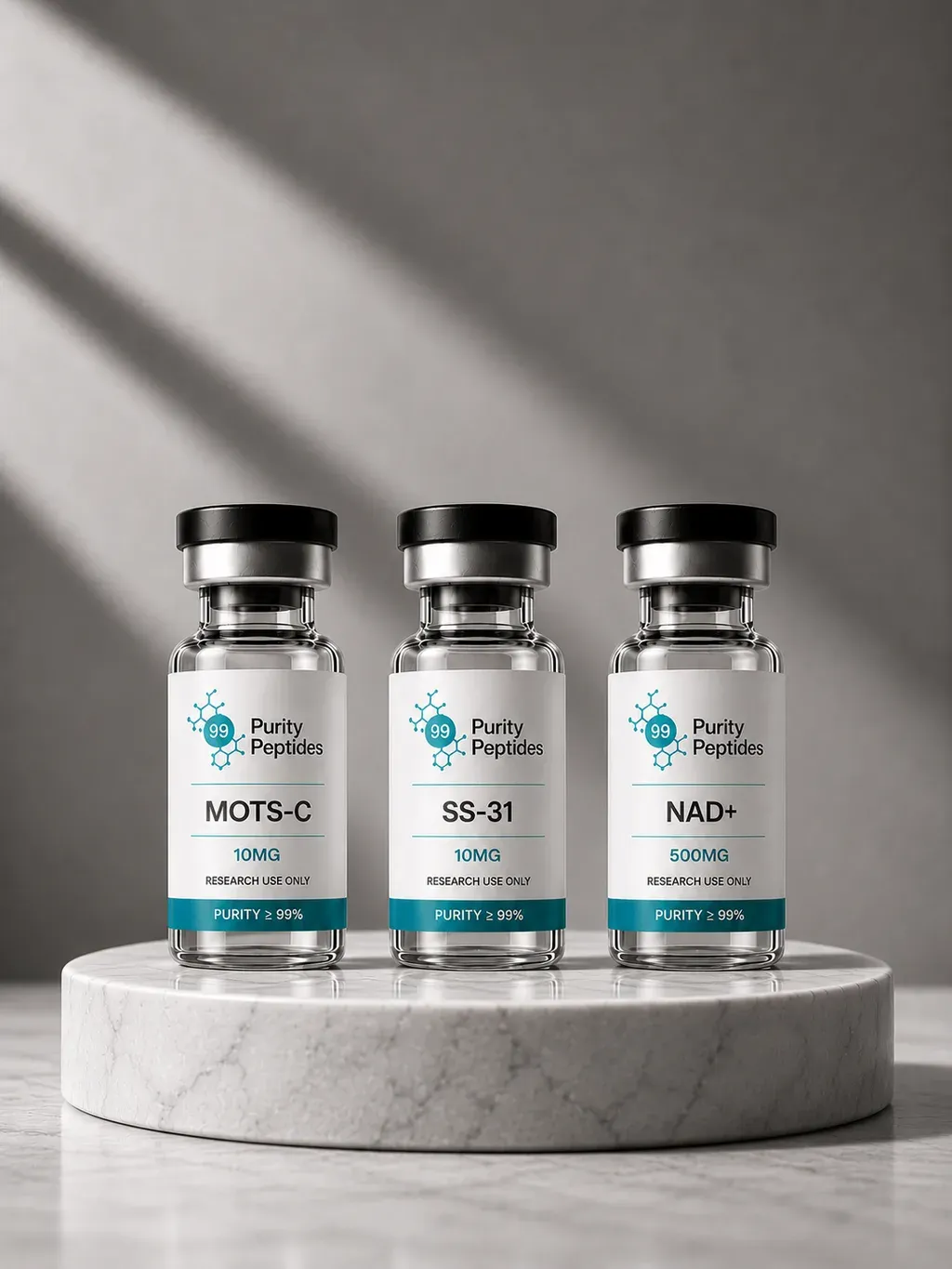
The Mitochondrial Research Panel supplies three compounds examined at different levels of mitochondrial function: MOTS-c at 10 mg, a peptide encoded in mitochondrial DNA; SS-31 at 10 mg, a synthetic peptide associating with the inner mitochondrial membrane; and NAD+ at 500 mg, a dinucleotide coenzyme central to electron transport. NAD+ is not a peptide, and the panel spans signal, membrane and substrate rather than one mechanism. For research use only.
HPLC certified
Independent analysis
Highest standard
Full traceability
The Mitochondrial Research Panel brings together three compounds relevant to mitochondrial research at three different levels of description.
MOTS-c is a sixteen-residue peptide encoded within mitochondrial DNA, studied as a retrograde signal from mitochondrion to nucleus. SS-31, also known as elamipretide, is a synthetic tetrapeptide studied for its association with cardiolipin at the inner mitochondrial membrane. NAD+ is neither — it is a dinucleotide coenzyme, containing no amino acids and no peptide bonds, and functions as the redox carrier feeding the electron transport chain.
That structure is the panel’s rationale: a regulatory signal, a membrane environment, and a substrate. Three levels at which the same organelle can be examined, rather than three components of one mechanism. No synergy between them has been established, and no published study has examined the three together.
Two points matter for study design. First, the masses are not matched and cannot meaningfully be — compared on a molar basis, the three compounds differ by more than two orders of magnitude, because a stoichiometric cofactor and a signalling peptide are not comparable by mass. Second, supplying NAD+ to a system is not the same as raising mitochondrial NAD+, since NAD+ pools are compartmentalised and extracellular NAD+ does not readily cross membranes intact.
For Research Use Only. Not intended for human consumption, therapeutic use, veterinary use, or diagnostic applications.
The Mitochondrial Research Panel is a three-vial set containing MOTS-c (10 mg), SS-31 (10 mg) and NAD+ (500 mg). MOTS-c is a peptide encoded in mitochondrial DNA; SS-31 is a synthetic peptide associating with the inner mitochondrial membrane; NAD+ is a dinucleotide coenzyme, not a peptide. The panel spans signal, membrane and substrate rather than representing a single mechanism.
| Compound | Mass | Molecular class | Level examined | Why it is included |
|---|---|---|---|---|
| MOTS-c | 10 mg | Peptide, 16 residues, mtDNA-encoded | Signalling | Mitochondrial-derived peptide studied as an outbound regulatory signal |
| SS-31 | 10 mg | Peptide, 4 residues, synthetic | Membrane | Studied for association with cardiolipin at the inner mitochondrial membrane |
| NAD+ | 500 mg | Dinucleotide coenzyme — not a peptide | Substrate | Redox carrier central to electron transport chain function |
All three are supplied as lyophilized material with batch documentation.
NAD+ — nicotinamide adenine dinucleotide — is a dinucleotide coenzyme. It consists of two nucleotides joined through a pyrophosphate bridge. It contains no amino acids, no peptide bonds, and belongs to a different molecular class than MOTS-c and SS-31 entirely.
This is stated first because NAD+ is routinely listed alongside research peptides, and search queries such as “NAD+ research peptide” reflect a misclassification that vendors reproduce rather than correct.
The distinction has practical consequences rather than being a terminological point:
A researcher who treats NAD+ as a peptide will apply the wrong specification checks to it. See also the glutathione and NAD+ comparison.
The three compounds relate to mitochondrial function at three different levels rather than through a shared mechanism.
| Level | Compound | What it represents |
|---|---|---|
| Signal | MOTS-c | A regulatory output of the organelle, encoded in mitochondrial DNA and acting outward on nuclear gene expression |
| Structure | SS-31 | The membrane environment, through association with cardiolipin at the inner mitochondrial membrane |
| Substrate | NAD+ | The redox currency the electron transport chain operates on |
These are three levels of description, not three parts of one mechanism. A signalling peptide, a membrane-associating peptide and a redox cofactor are studied with different methods and measured against different endpoints.
No synergy between the three has been established, and none is claimed here. The panel supplies materials relevant to a common research area, not a validated combination.
One connection is genuine and worth stating precisely.
NAD+ and its reduced form NADH are the electron donors feeding Complex I of the electron transport chain. That complex is embedded in the inner mitochondrial membrane — the same membrane whose organisation involves cardiolipin, the lipid SS-31 is studied for associating with.
So the two compounds relate to one system from different angles: SS-31 concerns the membrane environment in which the chain sits, NAD+ concerns the substrate supply feeding it. That describes a shared subject, not a demonstrated interaction.
Be the first to share your experience with this product and help other researchers!
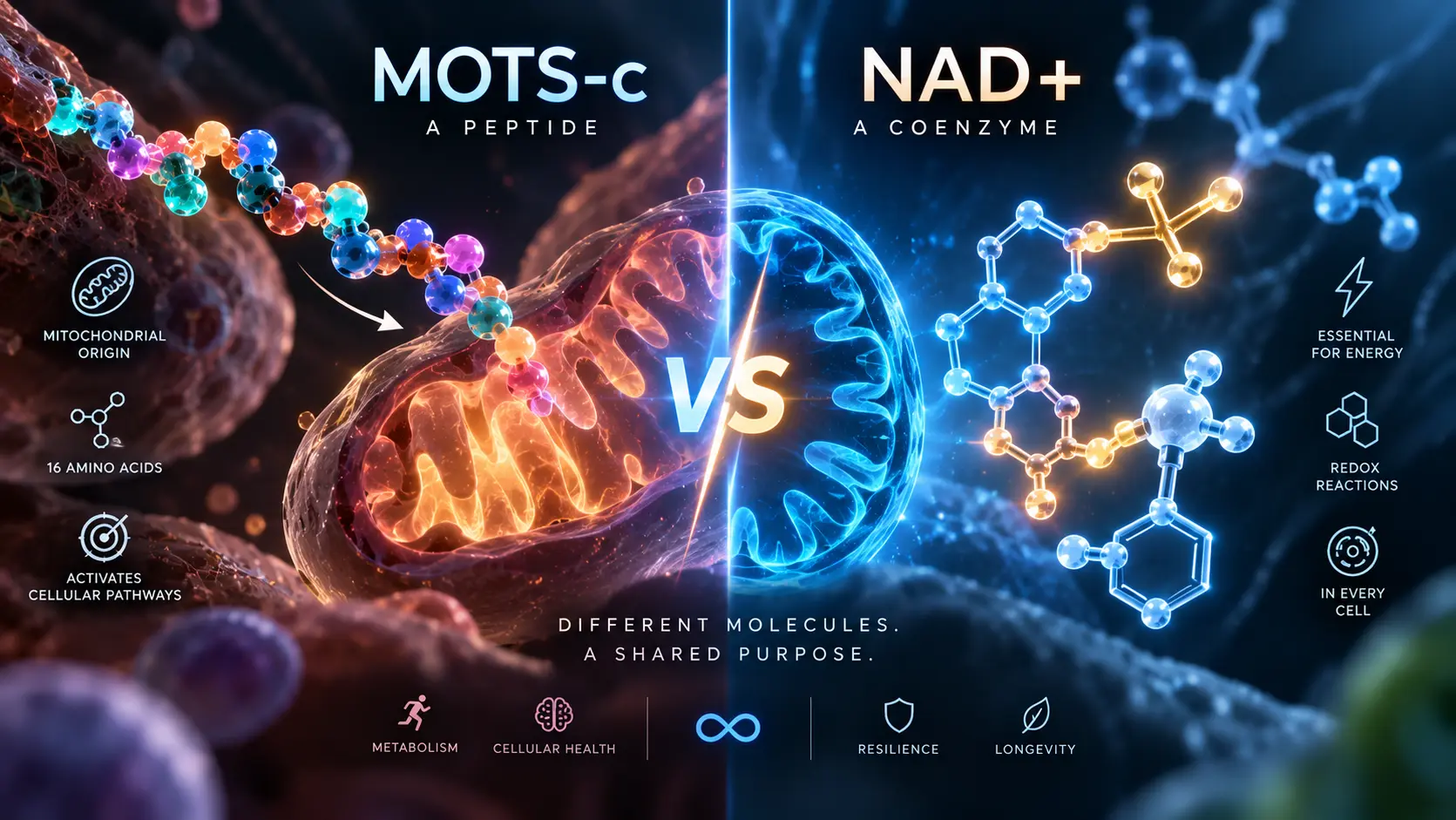
MOTS-c vs NAD+ compared honestly: one is a peptide, one a coenzyme. What the human evidence shows, and why the 2026 MOTS-c trial record needs checking.

MOTS-c and Humanin research: how these mitochondrial-derived peptides link metabolism, aging, and cell survival. See what the science actually shows.

GHK-Cu nasal spray research reviewed: three mouse studies from one lab, no human data, and what is still unknown about absorption and tolerability.
(faqs)