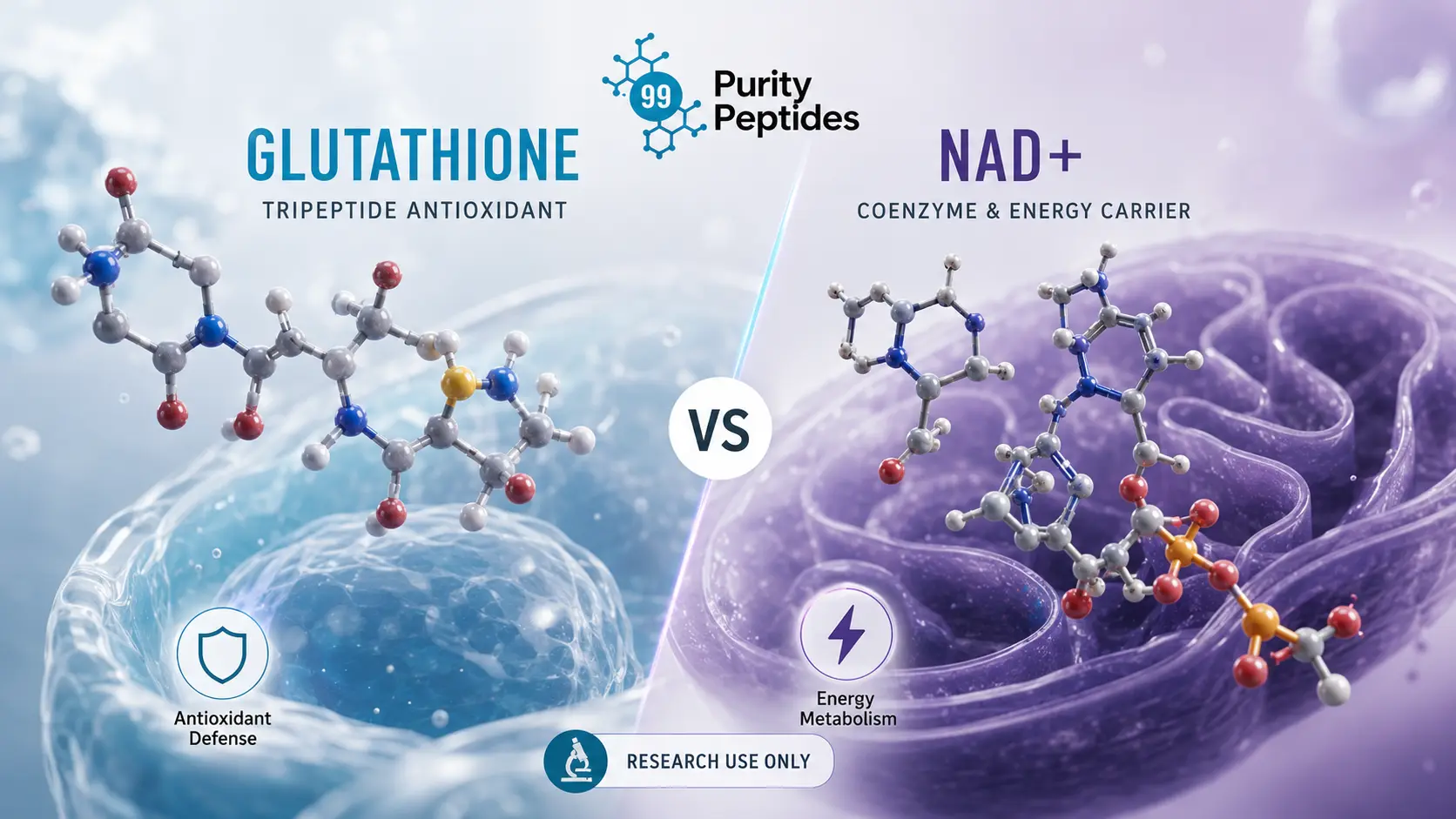
Glutathione vs NAD+: What’s the Difference?
Research Use Only The compounds discussed on this page are supplied strictly for laboratory research. They are not drugs, foods, cosmetics, or supplements, and they are not intended for human or veterinary consumption, diagnosis, or treatment. Nothing here is dosing guidance or medical advice. |
Two compound names show up together constantly in cellular research catalogs, and they get confused just as constantly. Glutathione and NAD+ both sit near the center of how a cell handles energy and damage. Both decline in aging tissue. Both appear in longevity literature. Both arrive in your lab as a white lyophilized powder in a sealed vial, which does nothing to help you tell them apart.

Beyond that, they have almost nothing in common. They are different classes of molecule. They participate in different reactions. One is consumed and regenerated as a substrate; the other is a cofactor that reactions borrow and return. Buying one when your protocol called for the other is not a small substitution — it changes what the experiment measures.
This guide separates them properly: molecular structure, biosynthesis, cellular function, the mechanism-level distinction between an antioxidant and a coenzyme, the one place where the two pathways genuinely intersect, and the practical handling differences that matter once the vials are on your bench. Written for researchers sourcing high-purity compounds in the United States.
The Short Answer
Glutathione vs NAD+ in 55 words Glutathione is a tripeptide antioxidant built from glutamate, cysteine and glycine that directly neutralizes reactive oxygen species using its thiol group. NAD+ is a dinucleotide coenzyme that carries electrons between metabolic reactions and acts as a consumed substrate for sirtuin and PARP enzymes. Glutathione defends against oxidative damage; NAD+ enables energy metabolism and cell signaling. |
Glutathione vs NAD+: Side-by-Side Comparison
This table answers the bulk of the comparison at a glance. Each row is expanded in the sections that follow.
Attribute | Glutathione (GSH) | NAD+ |
|---|---|---|
Molecule class | Tripeptide (a true peptide) | Dinucleotide coenzyme — not a peptide |
Full name | γ-L-glutamyl-L-cysteinylglycine | Nicotinamide adenine dinucleotide |
Molecular formula | C₁₀H₁₇N₃O₆S | C₂₁H₂₇N₇O₁₄P₂ |
Molecular weight | ~307.32 g/mol | ~663.43 g/mol |
CAS number | 70-18-8 | 53-84-9 |
Building blocks | Glutamate, cysteine, glycine | Nicotinamide mononucleotide + AMP |
Reactive site | Thiol (–SH) group on cysteine | C4 position of the nicotinamide ring |
Primary role | Direct antioxidant and conjugation substrate | Electron carrier and enzyme cosubstrate |
Redox partner | GSSG (oxidized glutathione disulfide) | NADH (reduced form) |
Reaction behavior | Consumed as a substrate, then recycled | Cycles as a cofactor; also consumed by sirtuins/PARPs |
Key enzymes | Glutathione peroxidase, reductase, S-transferase | Sirtuins (SIRT1–7), PARPs, CD38, NAMPT |
Cellular location | Cytosol, mitochondria, nucleus (1–10 mM) | Cytosol, mitochondria, nucleus (low µM–mM) |
Signaling role | Redox signaling via GSH:GSSG ratio | Direct substrate for deacetylation and DNA repair |
Main research context | Oxidative stress, detoxification pathways | Mitochondrial function, energy metabolism, aging |
Common precursors | NAC, cysteine, glycine | NMN, NR, nicotinamide, tryptophan |
Physical form supplied | Lyophilized powder, RUO vial | Lyophilized powder, RUO vial |
What Is Glutathione?
Glutathione is a tripeptide antioxidant produced inside virtually every human cell, assembled from three amino acids: glutamate, cysteine and glycine. It is among the most abundant small molecules in the cytosol, present at roughly 1 to 10 millimolar. Its job is to absorb oxidative damage before that damage reaches DNA, membrane lipids, or protein structure.
It earned the nickname “master antioxidant” for two defensible reasons. It operates at concentrations orders of magnitude higher than most other cellular antioxidants, and it sits upstream of several others — vitamin C and vitamin E both depend on glutathione-linked recycling to return to their active forms. It is less a single defender than the system that keeps the other defenders in play.
Glutathione’s Molecule Structure: The Unusual Bond
Here is the structural detail most summaries skip, and it explains a great deal about how glutathione behaves.
In an ordinary peptide, amino acids link through the alpha-carboxyl group. In glutathione, the bond between glutamate and cysteine forms at the glutamate side chain instead — a gamma peptide bond. That single deviation makes glutathione resistant to standard intracellular peptidases, which recognize alpha linkages. The molecule persists in the cytosol rather than being cleaved apart, and only one specialized enzyme, gamma-glutamyl transpeptidase, breaks it down.
The cysteine residue carries the thiol group, written –SH. That sulfur atom is where essentially all of glutathione’s chemistry happens. It donates an electron to neutralize a free radical, and in doing so becomes a thiyl radical that pairs with a second oxidized glutathione molecule to form a disulfide bridge.
Reduced vs Oxidized Glutathione: GSH and GSSG
Two forms circulate, and confusing them is one of the more common errors in early-stage assay design.
Feature | GSH (reduced) | GSSG (oxidized) |
|---|---|---|
Structure | Single tripeptide, free thiol | Two tripeptides joined by a disulfide bond |
Molecular weight | ~307.32 g/mol | ~612.63 g/mol |
State | Active, electron-donating form | Spent form awaiting regeneration |
Typical ratio | Dominant — often above 100:1 vs GSSG | Minor fraction in unstressed cells |
What it indicates | Intact redox capacity | Rising ratio signals oxidative stress |
The GSH:GSSG ratio is the readout researchers actually care about. Total glutathione tells you how much material is present; the ratio tells you how much of it is still capable of doing anything. A shift toward GSSG is one of the most widely used markers of oxidative stress in cell and tissue models.
How Glutathione Is Synthesized in the Body
Glutathione synthesis is a two-step, ATP-dependent process. Both steps happen in the cytosol.
- Glutamate-cysteine ligase joins glutamate to cysteine through the gamma bond, producing gamma-glutamylcysteine. This step is rate-limiting and is feedback-inhibited by the finished glutathione molecule.
- Glutathione synthetase attaches glycine to complete the tripeptide.
Cysteine availability is the practical bottleneck, since it is the least abundant of the three amino acids in most cells. This is precisely why N-acetylcysteine appears constantly alongside glutathione in the research literature — NAC functions as a cysteine donor that feeds the first step rather than as an antioxidant in its own right.
Glutathione’s Function in Cells
Three distinct enzymatic systems put glutathione to work, and they answer three different research questions.
- Glutathione peroxidase. A selenium-dependent enzyme that reduces hydrogen peroxide and lipid hydroperoxides to water and alcohols, consuming two GSH molecules and producing one GSSG. This is the free radical scavenger role the compound is best known for.
- Glutathione reductase. Runs the reaction backward, converting GSSG back to two GSH. Critically, it requires NADPH to do so — the point where the two subjects of this article intersect, covered in detail below.
- Glutathione-S-transferase. Conjugates glutathione onto electrophilic compounds, tagging them for export. This is the core of phase II liver detoxification and the reason glutathione dominates the detoxification pathway literature.
What Is NAD+?
NAD+ is nicotinamide adenine dinucleotide, a coenzyme present in every living cell. It is not an antioxidant and not a peptide. Its function is to carry electrons between reactions — it accepts a hydride from one molecule and hands it to another, becoming NADH in between. That single shuttling action underwrites glycolysis, the Krebs cycle, fatty acid oxidation and the electron transport chain.
The compound has a long history in biochemistry. It was first identified in 1906 by Arthur Harden and William Young as a heat-stable yeast fermentation factor they called cozymase; its structure was later resolved by Hans von Euler-Chelpin, and Otto Warburg established its role in hydride transfer.
NAD+ Molecule Structure
The name describes the architecture. “Dinucleotide” means two nucleotides bonded together: nicotinamide mononucleotide on one end, adenosine monophosphate on the other, joined by a pyrophosphate bridge. Molecular weight is roughly 663 g/mol — more than double glutathione.
The chemistry occurs at one specific spot: carbon 4 of the nicotinamide ring. That carbon accepts a hydride ion, meaning one proton and two electrons together. The adenine half of the molecule contributes nothing to the redox reaction; it functions as a recognition handle that enzymes bind to.
This is the structural reason NAD+ is often supplied and discussed alongside peptide research compounds without being one. It is a nucleotide-derived cofactor. The classification matters for anyone selecting analytical methods, since peptide-specific assays will not characterize it correctly.
NAD+ vs NADH: Understanding the Redox Pair
NAD+ and NADH are the same molecule in two oxidation states. NAD+ carries a positive charge on the nicotinamide nitrogen and is electron-hungry. NADH is the reduced form, carrying the hydride it collected.
Property | NAD+ | NADH |
|---|---|---|
Oxidation state | Oxidized — electron acceptor | Reduced — electron donor |
Role in metabolism | Fuels catabolic breakdown reactions | Delivers electrons to the electron transport chain |
Charge | Positive on the nicotinamide nitrogen | Neutral nicotinamide ring |
UV absorbance | Absorbs at 260 nm only | Additional peak near 340 nm — basis of many assays |
Ratio significance | High NAD+/NADH signals catabolic demand | High NADH signals reductive, energy-replete state |
One further distinction is worth flagging because it causes real confusion. NADP+ and NADPH are separate molecules, differing from NAD+ and NADH by a single phosphate group on the adenosine ribose. The division of labor is clean: NAD+/NADH runs catabolism — breaking things down for energy — while NADPH powers biosynthesis and antioxidant defense.
How NAD+ Is Synthesized in the Body
Cells build NAD+ through three routes, and knowing which one your model organism or cell line favors changes precursor selection.
- The salvage pathway. Dominant in most mammalian tissue. Nicotinamide released by NAD+-consuming enzymes is recaptured by NAMPT to form NMN, then converted to NAD+ by NMNAT enzymes. NAMPT is the rate-limiting step and the reason it appears in so much NAD+ metabolism research.
- The de novo pathway. Builds NAD+ from tryptophan through the kynurenine pathway. Metabolically expensive and comparatively minor.
- The Preiss-Handler pathway. Starts from nicotinic acid and converges on the same NMNAT step.
Nicotinamide riboside enters this network one step earlier than NMN, converted by NRK enzymes. That relationship is why NAD+, NMN and NR are so often studied as a set rather than in isolation.
NAD+ Function in Cells: Two Separate Jobs
This is where most comparisons oversimplify. NAD+ does two categorically different things, and only the first is a coenzyme function.
Job one: recycled electron carrier
In glycolysis, the Krebs cycle and beta-oxidation, NAD+ picks up electrons and delivers them to complex I of the electron transport chain, driving ATP production. In this role it is regenerated, not consumed — the same molecules cycle through repeatedly.
Job two: consumed signaling substrate
A second class of enzymes destroys NAD+ rather than borrowing it. They cleave the molecule at the nicotinamide-ribose bond and use the ADP-ribose fragment.
- Sirtuins (SIRT1 through SIRT7) remove acetyl groups from histones and other proteins, consuming one NAD+ per reaction. This links cellular NAD+ availability directly to gene expression and is the mechanistic core of sirtuin activation research.
- PARP enzymes build poly-ADP-ribose chains at sites of DNA damage as part of the repair response, consuming large quantities of NAD+ when damage is extensive.
- CD38 and SARM1 degrade NAD+ in immune signaling and axonal degradation contexts respectively.
This consumption is the widely cited explanation for age-related NAD+ decline: as accumulated DNA damage and inflammatory signaling rise, demand from PARPs and CD38 climbs while salvage capacity does not keep pace.
Antioxidant vs Coenzyme: The Core Distinction
If you take one concept from this article, take this one. It resolves most of the confusion between the two compounds.
An antioxidant is a reactant. It is spent in the reaction it performs. Glutathione hands over an electron and is chemically altered — it becomes GSSG and must be actively regenerated before it can work again. Each molecule of glutathione neutralizes and is neutralized.
A coenzyme is a facilitator. It enables an enzyme to catalyze a reaction and emerges in a form that can be restored and reused. NAD+ shuttles electrons through metabolism thousands of times over without net loss. Only the sirtuin and PARP reactions consume it outright, and those are signaling functions rather than metabolic ones.
Is NAD+ an Antioxidant Like Glutathione?
No, and this is worth stating plainly because a large amount of published marketing copy blurs it.
NAD+ does not scavenge free radicals. It has no thiol group and no direct radical-quenching capability. When you see NAD+ described as antioxidant-supporting, the mechanism being referenced is indirect and runs through its phosphorylated relative, NADPH — described in the next section.
Common mistake Treating NAD+ as an antioxidant control in an oxidative stress assay. It will not behave like one. If your study design calls for a direct radical scavenger, glutathione, NAC, or alpha lipoic acid are the appropriate comparators; NAD+ belongs in the energy metabolism arm of the same experiment. |
Where Glutathione and NAD+ Actually Connect
The two systems are not independent, and the link is specific rather than vague. Here it is, step by step.
- Glutathione neutralizes a peroxide via glutathione peroxidase and is oxidized to GSSG.
- GSSG is useless until reduced back to two GSH molecules. Glutathione reductase performs that regeneration.
- Glutathione reductase requires NADPH as its electron source. Without NADPH, the recycling stops and the glutathione pool stays oxidized regardless of how much total glutathione is present.
- NADPH is generated primarily through the pentose phosphate pathway and by NAD kinase acting on NAD+ — which places the cellular NAD+ pool upstream of NADPH availability.
So the honest formulation is this: NAD+ does not neutralize free radicals, but the cell’s capacity to keep glutathione in working order depends on a nucleotide pool that NAD+ feeds. That is a real mechanistic relationship, not a marketing one, and it is the strongest available answer to whether the two can be meaningfully studied together.
It also explains a result that surprises researchers new to the area: adding more glutathione to a system with depleted reducing capacity produces less effect than expected, because the limiting factor was regeneration rather than supply.
Is Glutathione a Peptide? Is NAD+?
Short answers first, because both are frequently asked and frequently answered incorrectly.
Glutathione is a peptide. Specifically a tripeptide — three amino acids joined by peptide bonds, one of which is the unusual gamma linkage described earlier. It sits squarely inside the peptide chemical class.
NAD+ is not a peptide. It contains no amino acids and no peptide bonds. It is a dinucleotide, built from nucleotide components, and belongs to the coenzyme class. It appears in research peptide catalogs because it shares a research audience and a supply chain with peptides, not because it shares a chemistry.
The practical consequence: analytical verification differs. Peptide purity work leans on reversed-phase HPLC with peptide-appropriate gradients and mass confirmation against the expected peptide mass. NAD+ characterization uses methods suited to nucleotides, including UV absorbance profiling that distinguishes NAD+ from NADH at 340 nm. A supplier issuing a certificate of analysis for both should be able to show method-appropriate documentation for each.
NAD+ vs NADH vs NMN vs NR: Clearing Up the Family
These four names appear interchangeably in vendor listings and are not interchangeable at all.
Compound | What it is | Approx. MW | Relationship to NAD+ |
|---|---|---|---|
NAD+ | Oxidized coenzyme | ~663 g/mol | The active cofactor itself |
NADH | Reduced coenzyme | ~665 g/mol | Same molecule carrying a hydride |
NMN | Nicotinamide mononucleotide | ~334 g/mol | Direct precursor — one enzymatic step away |
NR | Nicotinamide riboside | ~255 g/mol | Precursor to NMN — two steps away |
NADP+ | Phosphorylated coenzyme | ~743 g/mol | NAD+ plus a phosphate; anabolic pathways |
NADPH | Reduced NADP+ | ~745 g/mol | Powers glutathione reductase |
Glutathione and NAD+ in Aging and Longevity Research
Both compounds appear across geroscience literature, and both decline measurably in aged tissue. The reasons differ, which is why they are frequently examined as parallel rather than competing variables.
NAD+ decline is attributed largely to rising consumption. Accumulated DNA damage recruits PARP activity, inflammatory signaling elevates CD38 expression, and salvage-pathway throughput does not scale to match. Because sirtuins depend on NAD+ availability, falling NAD+ is proposed as a mechanism linking metabolic state to gene expression and cellular senescence.
Glutathione depletion follows a different logic, driven by cumulative oxidative load, reduced synthetic capacity, and constrained cysteine availability. The observable shift is often in the GSH:GSSG ratio rather than total pool size — the material is present but oxidized.
Design note for comparative studies Because the two decline through different mechanisms, measuring only one gives an incomplete picture of redox and metabolic status. Studies examining cellular aging increasingly track NAD+/NADH ratio and GSH:GSSG ratio together, treating them as complementary readouts of energy state and oxidative state respectively. |
Can Glutathione and NAD+ Be Studied Together?
Yes, and the NADPH relationship gives a defensible mechanistic rationale for doing so. A few honest caveats belong alongside that.
- The interaction is indirect. Any protocol claiming a direct synergy between the two molecules is overstating what the biochemistry supports.
- Include separate controls. A combined arm without single-compound arms cannot attribute an effect to either variable.
- Handle the compounds separately. Their stability profiles diverge sharply, as covered below, and co-storage in a shared solution invites confounding degradation.
- Published head-to-head comparisons of the two under matched conditions remain limited. Most literature examines each within its own pathway, so cross-study comparison carries the usual methodological caveats.
Purity, Storage and Reconstitution: Practical Differences
Once the vials arrive, the two compounds stop behaving similarly. Both are hygroscopic lyophilized powders, and both degrade faster in solution than as dry solids — but they degrade by different routes.
Handling factor | Glutathione | NAD+ |
|---|---|---|
Primary degradation route | Thiol oxidation to GSSG | Hydrolysis of the pyrophosphate bridge |
Main accelerant | Air exposure and trace metal ions | Alkaline pH and elevated temperature |
Lyophilized storage | Cold, dark, sealed, desiccated | Cold, dark, sealed, desiccated |
Reconstituted stability | Short — oxidizes readily once dissolved | Short — hydrolyzes readily once dissolved |
Common reconstitution fluid | Bacteriostatic or sterile water | Bacteriostatic or sterile water |
Freeze-thaw tolerance | Poor — aliquot before freezing | Poor — aliquot before freezing |
Verification note | Confirm GSH vs GSSG content, not just total | Confirm NAD+ vs NADH; check 340 nm profile |
Reconstitution: The Sequence That Applies to Both
- Bring the sealed vial to room temperature before opening. Introducing solvent into a cold vial condenses atmospheric moisture into the powder.
- Sanitize the stopper and let it dry fully.
- Add solvent slowly against the vial wall rather than directly onto the powder cake.
- Swirl gently until dissolved. Do not shake — mechanical agitation and the resulting air interface accelerate degradation in both compounds.
- Aliquot into single-use volumes immediately and return to cold storage. Repeated freeze-thaw cycling is the single largest avoidable source of potency loss.
- Label with compound, concentration, solvent and date. Undated reconstituted vials are the most common cause of irreproducible results in small labs.
Follow the storage temperature and shelf life stated on your specific lot documentation. Values vary by formulation, and lot-specific data supersedes any general guidance including this page.
Reading the Certificate of Analysis
A COA is only useful if you know which numbers to interrogate. Four things to check on either compound:
- Method disclosure. The COA should name the analytical method and show the chromatogram, not just assert a percentage.
- Lot specificity. A COA that does not tie to the lot number on your vial documents someone else’s material.
- Identity confirmation. Purity states how much of the sample is one substance. Identity confirms that substance is what the label claims. Both are needed.
- Testing source. Third-party lab testing carries more weight than in-house-only reporting, particularly for compounds where in-house method development varies widely.
Sourcing Research-Grade Glutathione and NAD+ in the United States
Buying decisions for research compounds in the US market come down to documentation and logistics more than price. A short checklist:
- Domestic fulfillment. Shorter transit reduces temperature exposure for compounds that degrade with heat.
- Lot-linked COAs available before purchase, not on request after the fact.
- Explicit research use only labeling on the product page, the vial and the invoice.
- Clear statement of purity method — HPLC percentage without a stated method is an incomplete claim.
- Cold-chain handling described rather than assumed.
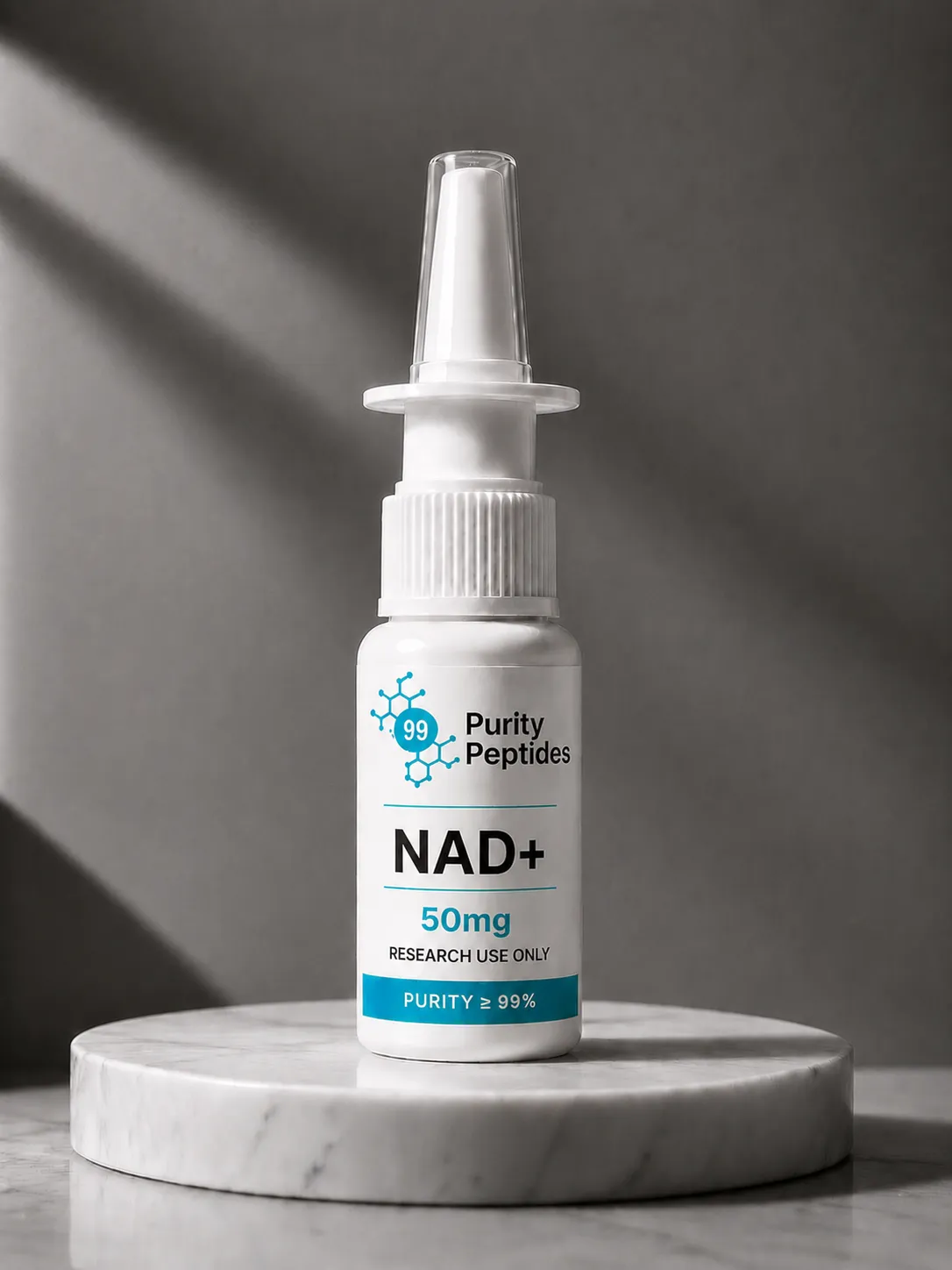
99 Purity Peptides supplies both glutathione and NAD+ as lyophilized research compounds to United States researchers, with lot documentation available for review.
Key Takeaways
- Glutathione is a tripeptide antioxidant; NAD+ is a dinucleotide coenzyme. Different molecular classes entirely.
- Glutathione neutralizes reactive oxygen species directly through its cysteine thiol group. NAD+ has no radical-scavenging capability.
- Glutathione is consumed and regenerated as a substrate. NAD+ mostly cycles as a cofactor, though sirtuins and PARPs consume it outright.
- The genuine connection is NADPH: glutathione reductase needs it to recycle GSSG back to GSH, and NADPH availability traces back to the NAD+ pool.
- NAD+ is not a peptide despite frequently appearing in research peptide catalogs. Glutathione is.
- NAD+, NADH, NMN and NR are distinct compounds with different molecular weights and different positions in the biosynthetic pathway.
- Both decline with age, but through different mechanisms — rising consumption for NAD+, cumulative oxidative load for glutathione.
- Both degrade quickly once reconstituted, by different chemical routes. Aliquot immediately and avoid freeze-thaw cycling.
- Verify lot-specific COAs with disclosed methods for either compound before use.
- Both are supplied strictly for laboratory research and are not for human consumption.
Frequently Asked Questions
What exactly is the difference between glutathione and NAD+?
Glutathione is a tripeptide antioxidant made from glutamate, cysteine and glycine that neutralizes reactive oxygen species directly. NAD+ is a dinucleotide coenzyme that carries electrons between metabolic reactions and serves as a substrate for sirtuin and PARP enzymes. Different molecular classes, different functions.
Are glutathione and NAD+ the same type of molecule?
No. Glutathione is a peptide, built from three amino acids joined by peptide bonds. NAD+ is a dinucleotide, built from nicotinamide mononucleotide and adenosine monophosphate. They share no structural class.
Is glutathione an antioxidant and NAD+ a coenzyme?
Yes, that is the cleanest one-line summary. Glutathione acts as a consumed antioxidant substrate; NAD+ acts as a recycled coenzyme and, in sirtuin and PARP reactions, as a consumed signaling substrate.
Is NAD+ a peptide?
No. NAD+ contains no amino acids and no peptide bonds. It is a nucleotide-derived coenzyme. It appears in research peptide catalogs because it shares a research audience with peptides, not a chemistry.
Is glutathione a peptide?
Yes. Glutathione is a tripeptide. One of its two peptide bonds is an unusual gamma linkage at the glutamate side chain, which makes it resistant to standard intracellular peptidases.
Does NAD+ have antioxidant properties like glutathione?
Not directly. NAD+ cannot scavenge free radicals. Its indirect connection to antioxidant defense runs through NADPH, the phosphorylated form that glutathione reductase requires to regenerate oxidized glutathione.
Can glutathione and NAD+ be studied together?
Yes, and there is a genuine mechanistic rationale via the NADPH-dependent regeneration of glutathione. Combined study designs should include single-compound control arms, since the interaction is indirect rather than a direct synergy.
Which compound is more relevant to mitochondrial research?
NAD+. It delivers electrons to complex I of the electron transport chain and is central to ATP production. Glutathione is more relevant to oxidative stress and detoxification pathway research, including mitochondrial oxidative damage.
What is the difference between NAD+ and NADH?
They are the same molecule in two oxidation states. NAD+ is the oxidized, electron-accepting form; NADH is the reduced form carrying a hydride. NADH absorbs at 340 nm, which is the basis of many enzymatic assays.
What is the difference between NAD+ and NMN?
NMN, nicotinamide mononucleotide, is a direct biosynthetic precursor one enzymatic step away from NAD+. NAD+ is roughly 663 g/mol; NMN is roughly 334 g/mol. Nicotinamide riboside sits one step further upstream.
What is the molecular weight difference between glutathione and NAD+?
Glutathione is approximately 307.32 g/mol. NAD+ is approximately 663.43 g/mol — more than double. Oxidized glutathione, GSSG, is approximately 612.63 g/mol because it is two glutathione molecules joined by a disulfide bond.
Why is glutathione called the master antioxidant?
Because it is present at unusually high intracellular concentrations, roughly 1 to 10 millimolar, and because other antioxidants including vitamins C and E depend on glutathione-linked recycling to return to their active forms.
Why does NAD+ decline with age?
The prevailing explanation is rising consumption rather than falling production. Accumulated DNA damage recruits PARP activity and inflammatory signaling elevates CD38, while salvage-pathway throughput does not increase to match.
How should glutathione and NAD+ research vials be stored?
Both are lyophilized hygroscopic powders and should be kept cold, dark, sealed and dry. Once reconstituted, both degrade quickly — glutathione by thiol oxidation, NAD+ by hydrolysis. Aliquot into single-use volumes and avoid freeze-thaw cycling. Follow your lot documentation, which supersedes general guidance.
Are glutathione and NAD+ from 99 Purity Peptides intended for human consumption?
No. All compounds supplied by 99 Purity Peptides are for laboratory research use only. They are not drugs, foods or supplements, and they are not intended for human or veterinary consumption, diagnosis or treatment.