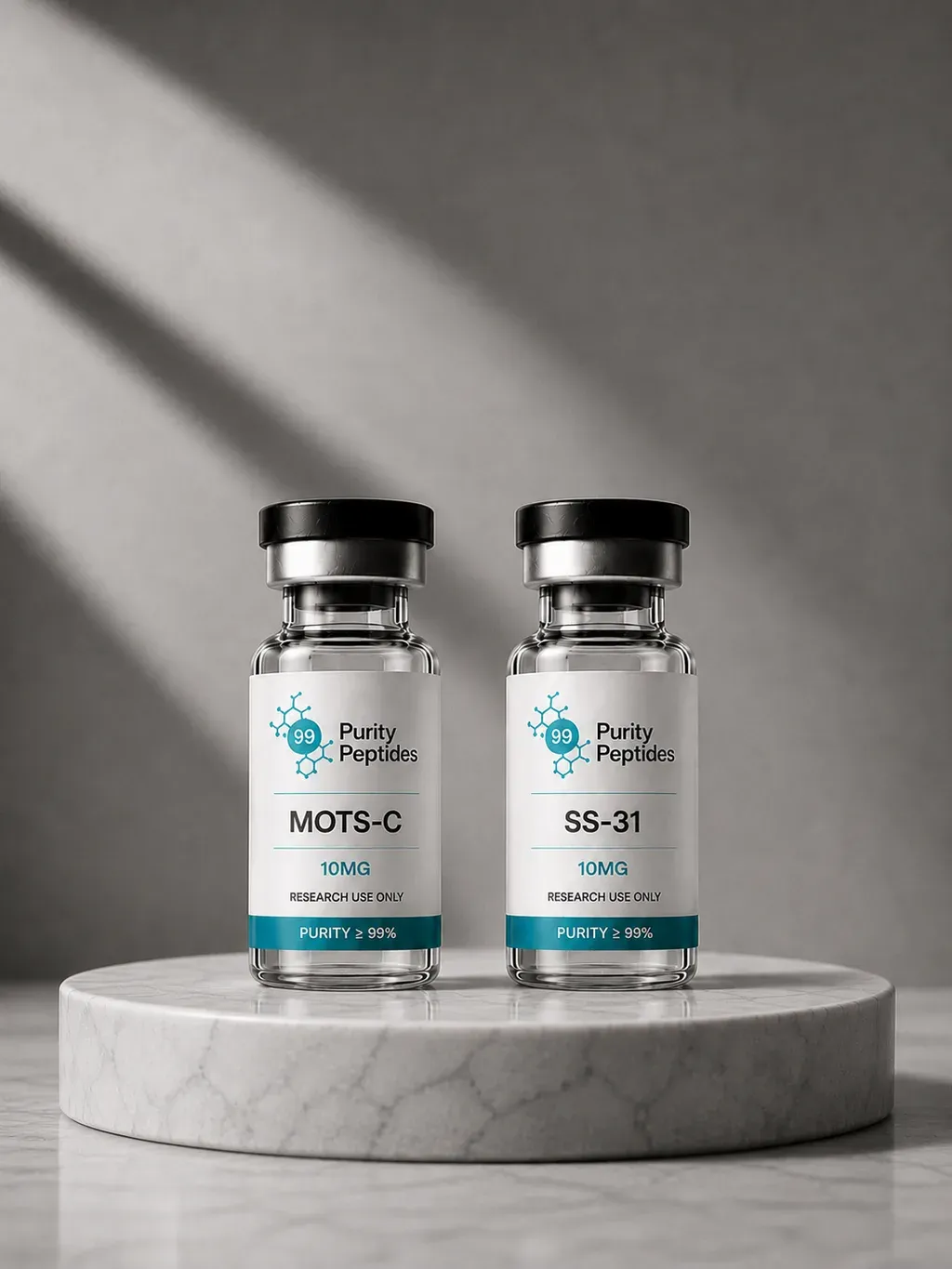
The Mitochondrial Peptide Pair supplies MOTS-c and SS-31 as matched 10 mg research vials. The two peptides share an organelle rather than a mechanism: MOTS-c is a sixteen-residue peptide encoded within mitochondrial DNA that signals outward to the nucleus, while SS-31 is a synthetic tetrapeptide designed to concentrate at the inner mitochondrial membrane. Supplied lyophilized. For research use only.
HPLC certified
Independent analysis
Highest standard
Full traceability
The Mitochondrial Peptide Pair brings together two compounds routinely grouped as mitochondrial peptides, at matched 10 mg mass. The grouping describes a location rather than a mechanism, and the two peptides differ in almost every other respect.
MOTS-c is a mitochondrial-derived peptide — a sixteen-residue sequence encoded within the 12S rRNA region of mitochondrial DNA. It is produced inside the mitochondrion and studied as a retrograde signal, influencing nuclear gene expression through the folate-methionine cycle and AMPK activation.
SS-31, also known as elamipretide, is a synthetic aromatic-cationic tetrapeptide. It originates outside the cell entirely and is studied for its association with cardiolipin at the inner mitochondrial membrane. Where MOTS-c signals outward, SS-31 is designed to move inward toward the organelle.
The two also differ in scale. A sixteen-residue peptide and a four-residue peptide behave differently in solubility, stability and handling, and SS-31’s compact alternating structure is itself the basis of its mitochondrial targeting.
Researchers should note that SS-31 and elamipretide are the same compound, and that elamipretide received FDA accelerated approval in September 2025. Material supplied here is research-grade and is not that approved product. No published study has examined the two peptides together.
For Research Use Only. Not intended for human consumption, therapeutic use, veterinary use, or diagnostic applications.
The Mitochondrial Peptide Pair is a two-vial research set containing MOTS-c and SS-31, both at 10 mg. MOTS-c is a sixteen-residue peptide encoded in mitochondrial DNA that signals outward to the nucleus. SS-31, also called elamipretide, is a synthetic tetrapeptide that associates with cardiolipin at the inner mitochondrial membrane. The two share an organelle rather than a mechanism.
| Compound | Mass | Also known as | Origin | Why it is included |
|---|---|---|---|---|
| MOTS-c | 10 mg | Mitochondrial ORF of the 12S rRNA type-c | Encoded in mitochondrial DNA | Mitochondrial-derived peptide studied as an outbound metabolic signal |
| SS-31 | 10 mg | Elamipretide, MTP-131 | Synthetic | Tetrapeptide studied for association with the inner mitochondrial membrane |
Both vials are supplied as lyophilized powder with batch documentation.
MOTS-c and SS-31 are frequently grouped together as mitochondrial peptides. That grouping names a location rather than a mechanism, and the two compounds are less alike than the label suggests.
MOTS-c originates inside the mitochondrion. Its sixteen-residue sequence is encoded within the 12S rRNA region of mitochondrial DNA — not in the nuclear genome. MOTS-c is therefore an endogenous product of the organelle itself, studied as a signal that travels outward and influences nuclear gene expression.
SS-31 originates outside biology entirely. It is a synthetic tetrapeptide designed to accumulate at the inner mitochondrial membrane, where it associates with cardiolipin. Nothing produces SS-31 naturally; it is a targeting agent constructed to reach a compartment.
The two therefore move in opposite directions relative to the same organelle. One is an outbound signal. The other is an inbound targeting molecule. A researcher expecting complementary action from compounds sharing a category label should note that the label describes where they are relevant, not how they work.
The mechanistic classes differ as much as the origins do.
MOTS-c is studied as a metabolic signalling peptide, with research attention on the folate-methionine cycle and downstream AMPK activation — a transcriptional and metabolic route with effects distributed across the cell.
SS-31 is studied for a biophysical association with a specific membrane lipid. Research interest concerns what that association does to inner-membrane organisation and electron transport chain behaviour, rather than a signalling cascade.
Signalling and membrane association are not competing explanations of one effect. They are different kinds of process, examined with different methods and different endpoints.
Be the first to share your experience with this product and help other researchers!

MOTS-c vs SS-31 compared on identity, mechanism, animal data and human trial evidence — including why no direct comparison exists.
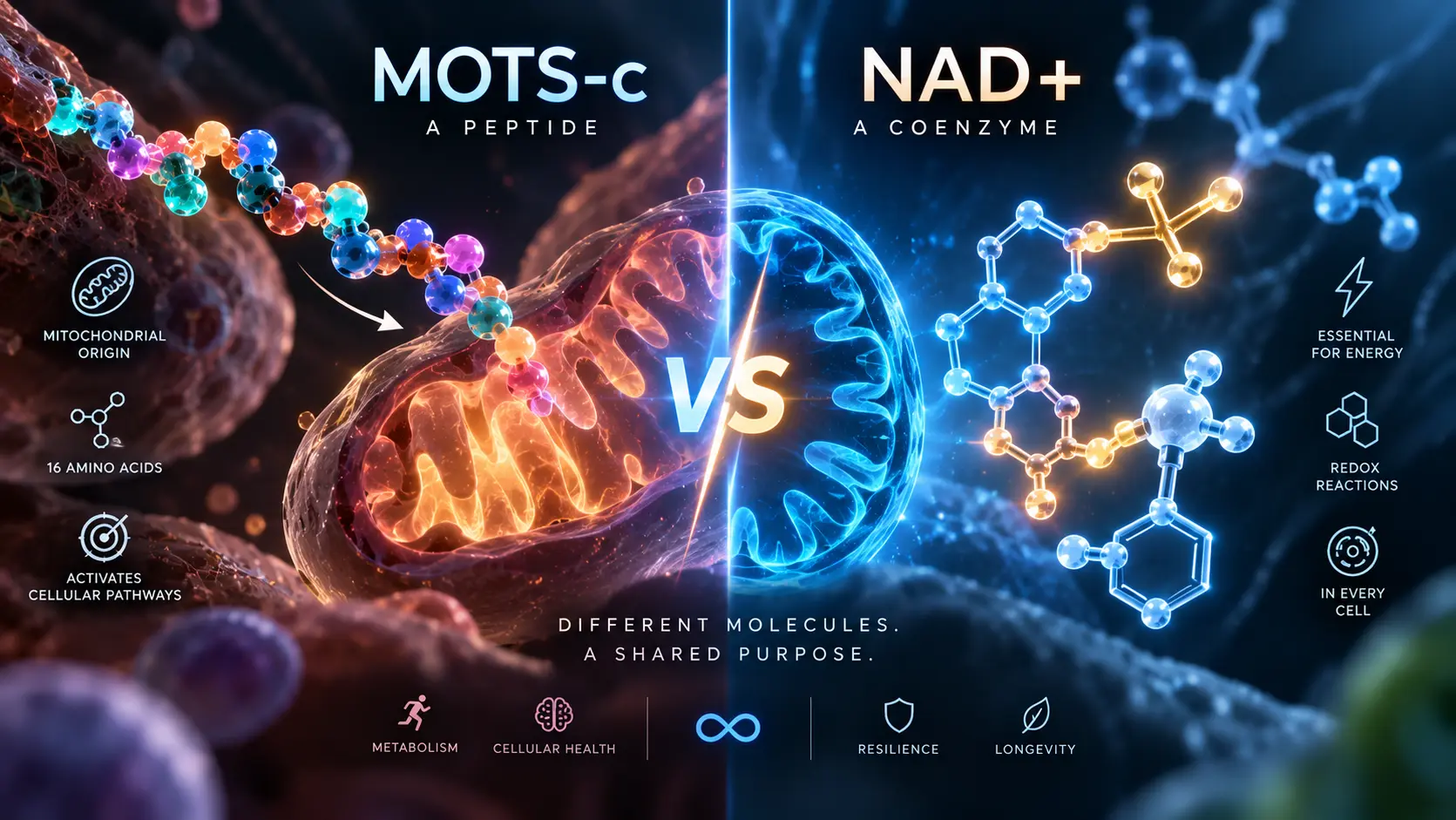
MOTS-c vs NAD+ compared honestly: one is a peptide, one a coenzyme. What the human evidence shows, and why the 2026 MOTS-c trial record needs checking.

MOTS-c and Humanin research: how these mitochondrial-derived peptides link metabolism, aging, and cell survival. See what the science actually shows.
(faqs)