Last reviewed: September 2026
Featured Products
Quick Answer
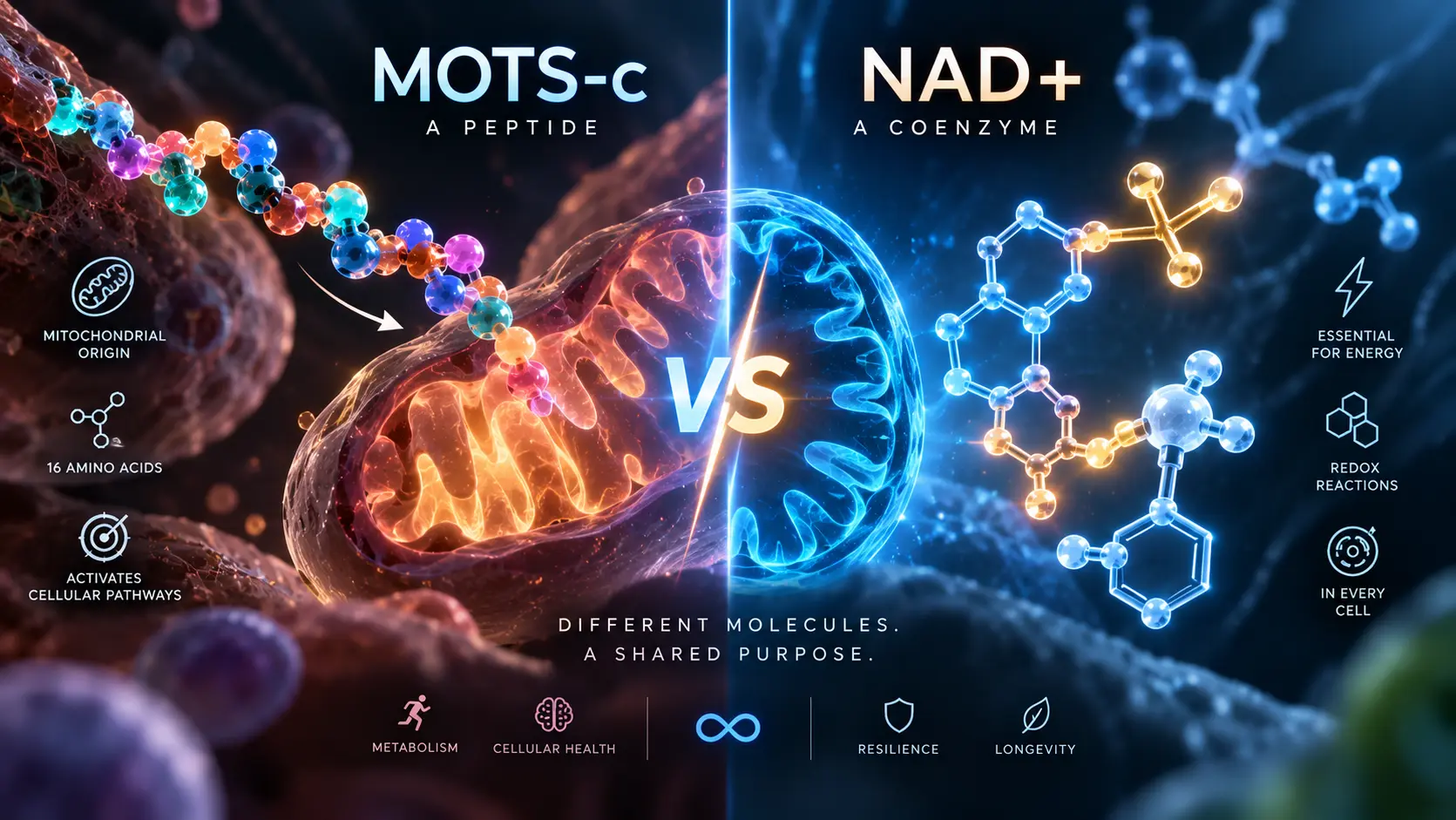
The mots-c vs nad+ comparison is built on a category error. MOTS-c is a 16-amino-acid peptide encoded inside mitochondrial DNA; NAD+ is a coenzyme, a small molecule every cell already makes and uses to shuttle electrons in redox reactions. They are not two members of one class, no study has ever compared them against each other in humans or animals, and the evidence behind each is very different: NAD+ precursors have randomized human trials with surrogate endpoints, while exogenous MOTS-c has no completed human administration study at all.
Key Takeaways
- MOTS-c is a 16-amino-acid peptide translated from a short open reading frame inside the mitochondrial 12S rRNA gene. NAD+ is a dinucleotide coenzyme, C21H27N7O14P2, molecular weight about 663 g/mol. One is a peptide; the other is not.
- No published study has compared MOTS-c and NAD+ head to head, in humans or in animals. Every page ranking a winner is answering a question no laboratory has asked.
- A ClinicalTrials.gov record often cited as the first human MOTS-c trial, NCT07505745, belongs to a batch of eight registrations from one sponsor that includes entries describing themselves as fictional and mock. Treat it as unverified.
- The closest thing to human data is CB4211, an engineered MOTS-c analogue: 65 healthy adults in the Phase 1a stage, then 20 adults with fatty liver in Phase 1b. Its developer announced liquidation in November 2023.
- The FDA states it has identified no human exposure data for MOTS-c by any route of administration.
- Oral NR and NMN both roughly doubled whole-blood NAD+ over 14 days in a 65-participant randomized comparison published in January 2026. Nicotinamide did not.
- Intravenous NAD+ has a single 2019 pilot: 11 men, 8 infused and 3 given saline, measuring metabolites rather than outcomes.
- MOTS-c is named on the WADA 2026 Prohibited List under S4.4.1 as an AMPK activator. Separately, IV infusions over 100 mL in 12 hours are prohibited for athletes regardless of what is in the bag.
Research Use Only
Both compounds discussed here are supplied by 99 Purity Peptides for laboratory research only. Nothing on this page is medical, dosing or health advice, and nothing sold is for human or veterinary consumption. Study details describe what researchers tested, never what anyone should do.
Is MOTS-c a Peptide? Is NAD+?
MOTS-c is a peptide and NAD+ is not, which is where most comparisons of the two go wrong before they begin.
MOTS-c stands for mitochondrial open reading frame of the 12S rRNA type-c. Lee and colleagues identified it in 2015 after examining short open reading frames within the human 12S rRNA region and finding one that translates into a 16-residue peptide [1]. That mitochondrial origin is the interesting part: almost every peptide in human biology is encoded by nuclear DNA, and this one is not.
NAD+ is a coenzyme. It is a dinucleotide, two nucleotides joined through their phosphate groups, with the formula C21H27N7O14P2 and a molecular weight near 663 g/mol. Its job in redox chemistry is to accept a hydride and become NADH, then hand it back. When it works as a redox couple it is not consumed at all. It is also a substrate for sirtuins, PARPs and CD38, which do consume it [10].
The error is not subtle, and it is in print. One of the pages currently ranking for this exact query carries a title asking which of the two "peptides" is better. NAD+ has never been a peptide. It has no amino acids and no peptide bonds.
That matters for more than pedantry. Comparing a signalling peptide to a redox coenzyme is comparing a message to a currency. Asking which is stronger produces an answer-shaped sentence with nothing behind it. The useful question is narrower: what is each one, and what has actually been measured in people?
NAD+ vs MOTS-c: What Each One Actually Is
The two molecules differ in genome of origin, chemical class, size and what happens to them inside a cell.
Property | MOTS-c | NAD+ |
|---|---|---|
Chemical class | Peptide, 16 amino acids | Dinucleotide coenzyme |
Encoded by | Mitochondrial DNA, 12S rRNA region | Not encoded; synthesised enzymatically |
Approximate size | Peptide of 16 residues | 663 g/mol |
Role in the cell | Signalling, including translocation to the nucleus under metabolic stress | Electron carrier in redox reactions; substrate for sirtuins, PARPs, CD38 |
Consumed in its main function? | Acts as a signal | Not consumed as a redox couple; consumed by sirtuins, PARPs, CD38 |
Proposed mechanism | Inhibits the folate cycle and tethered de novo purine synthesis, raising AICAR, which activates AMPK [1] | Substrate, not a receptor ligand |
Completed human administration study | None for the native peptide | One IV pilot, 11 participants [8] |
The mechanism line deserves unpacking, because MOTS-c does not activate AMPK the way a textbook energy sensor is activated. The 2015 paper reported that MOTS-c targets the methionine-folate cycle and the de novo purine biosynthesis pathway tethered to it, causing AICAR to accumulate, and AICAR is itself an AMPK activator [1]. The authors noted AMPK activation occurring under low AMP levels, which is to say through a route other than the classical AMP-to-ATP ratio.
NAD+ has no equivalent story because it is not a signal. It is the substrate a large family of enzymes needs in order to function.
What Human Evidence Exists for Each?
Human evidence exists for the NAD+ precursors, thinly for NAD+ itself, and not at all for native MOTS-c.
Molecule | Best human study | What it measured | What it did not measure |
|---|---|---|---|
MOTS-c (administered) | None published | Nothing | Everything |
MOTS-c (endogenous) | Reynolds 2021, 10 sedentary healthy young men on a bicycle protocol [2] | Muscle and plasma MOTS-c before and after exercise | Any effect of giving MOTS-c to a person |
Nicotinamide riboside (NR) | Martens 2018, 2 x 6-week randomized crossover, 30 randomized [6]; Christen 2026, 65 participants, 14 days [12] | NAD+ metabolites in blood cells; whole-blood NAD+ | Any clinical outcome |
Nicotinamide mononucleotide (NMN) | Yoshino 2021, 10-week randomized placebo-controlled trial, 25 postmenopausal prediabetic women [7] | Insulin-stimulated glucose disposal by clamp; muscle insulin signalling | Clinical events; durability |
NAD+ intravenous | Grant 2019 pilot, 11 men, 8 infused and 3 saline [8] | Plasma and urine metabolite concentrations | Any clinical or cognitive outcome |
NAD+ intranasal | None published | Nothing | Everything |
How we graded the evidence
Four criteria, applied identically. Was the compound administered to humans at all? Was there a control group? Was the endpoint a clinical outcome or a surrogate marker? And does evidence for a related molecule get counted? The last answer is no, which is why an analogue reaching Phase 1 does not lift the parent peptide, and why NR's trials do not transfer to NAD+ itself.
Two specific corrections belong here. The Martens crossover randomized 30 participants and 24 completed it; NR raised NAD+ in peripheral blood mononuclear cells by roughly 60% versus placebo, while blood pressure and arterial stiffness moved only as non-significant trends after correction for multiple testing [6]. And the Grant IV pilot was not uncontrolled, as several vendor pages claim: participants were randomized to eight infused and three saline controls, though it remains a pharmacokinetic study funded in part by an organisation that promotes the therapy [8].
Reynolds and colleagues reported that endogenous MOTS-c in skeletal muscle rose roughly 11.9-fold after an intense cycling session in ten young men, with a smaller rise in circulation [2]. That is a measurement of the body's own peptide responding to exercise. In the same paper, MOTS-c was given to mice, not to the volunteers.
Has MOTS-c Ever Been Given to People?
Not in any published, verifiable trial, and the registry entry most often cited to say otherwise needs checking before anyone repeats it.
A ClinicalTrials.gov record, NCT07505745, describes a Phase 2a study of subcutaneous MOTS-c in adults with prediabetes and overweight or obesity, listing 120 estimated participants, a 12-week double-blind treatment period and a four-week safety follow-up, sponsored by an entity called Hudson Biotech. Several peptide sites now cite it as the first human MOTS-c trial.
In July 2026, a pharmaceutical scientist writing at Dr. Noc examined that record's neighbours [11]. It is one of eight trials registered by the same sponsor, all listing the same study site, all submitted within weeks of each other, all marked recruiting. Three describe themselves: a TB-500 entry whose summary opens by calling itself a fictional example record, a Melanotan II entry opening with similar wording, and a tesamorelin entry carrying "(Mock Study)" in its title. Two more reproduce Eli Lilly trial names and internal compound codes; Lilly told the author it has no relationship with the sponsor and did not authorise use of its protocol identifiers [11]. We verified the TB-500 self-description and the tesamorelin title independently.
The MOTS-c record is one of the three in that batch that read like ordinary trial listings. Nothing inside it says fictional. Its only tell is the company it keeps.
So the honest statement is layered. A registered trial is not a result, and this particular registration is not reliably a trial. Anyone citing it should say so, and anyone relying on it should check the record's current status directly before publishing.
The nearest thing to genuine human data concerns CB4211, an engineered MOTS-c analogue developed by CohBar. The Phase 1a stage assessed safety and pharmacokinetics in 65 healthy adults; the Phase 1b stage gave the selected dose to 20 adults with fatty liver over four weeks. Topline results were announced by press release in August 2021 and reported no serious adverse events alongside changes in liver enzymes and glucose [13]. We found no peer-reviewed publication of them. In November 2023 CohBar announced it intended to commence liquidating and dissolving the company [4].
The regulatory record says the rest. In its published compounding assessment, the FDA states that it has not identified any human exposure data on drug products containing MOTS-c administered via any route of administration, and lacks important information about whether it would cause harm if administered to humans [3].
Has Anyone Compared Them Directly?
No. We found no published study, in humans or in animals, that administered MOTS-c and NAD+ to comparable groups and measured the same endpoint in both.
This is the finding that ends the comparison on its own terms. Every "which is better" page on this topic is extrapolating from separate literatures with different species, different endpoints and different eras. Even the adjacent question of NAD+ precursors against each other went unanswered until 2026, when a randomized study finally put NR, NMN and nicotinamide side by side [12]. If that head-to-head was considered a gap worth filling for three closely related small molecules, the absence of one between a mitochondrial peptide and a coenzyme is not a detail.
Do They Work on the Same Pathway?
They touch related metabolic territory, and the overlap is a hypothesis from cell work rather than a demonstrated relationship in people.
Here is the actual chain of evidence. In the 2015 discovery paper, cells stably expressing MOTS-c showed high NAD+ levels. Because SIRT1 depends on NAD+, and because SIRT1 is required for resveratrol-driven AMPK activation, the authors tested whether SIRT1 was needed for the glycolytic effects of MOTS-c. Knocking down SIRT1 reduced glucose-stimulated glycolytic rate by 40%, and inhibiting it pharmacologically by 45%, which the authors read as SIRT1 being partially necessary for some MOTS-c actions [1].
That is cell culture, in a manipulated cell line, describing a partial dependency. It is not a demonstration that giving MOTS-c to an organism raises NAD+, and it is certainly not a demonstration in a person. A clinic page currently ranking for this query states that MOTS-c increases cellular NAD+ as part of activating AMPK through SIRT1, and offers it as a reason to combine the two. The underlying observation is real; the conclusion drawn from it is several inferential steps past what was measured.
For the biology underneath this, our guide to MOTS-c, mitochondrial energy and metabolic health covers the AMPK arm, and what NAD+ metabolism actually involves covers the coenzyme side.
NAD+, NMN or NR: Which One Do the Human Studies Actually Use?
Almost always a precursor, because NAD+ itself is poorly absorbed and rapidly dismantled.
NAD+ is a charged dinucleotide that does not undergo direct intestinal absorption or cellular uptake intact. Outside the cell it is hydrolysed to NMN, which CD73 cleaves to NR, which cells can actually take up and rebuild [8][9]. That single fact explains the shape of the entire field: trials use NR and NMN because they get in.
The 2026 comparison sharpened this further. Sixty-five healthy adults received NR, NMN, nicotinamide or placebo daily for 14 days. NR and NMN each roughly doubled baseline whole-blood NAD+, by 49.4 and 43.1 micromolar respectively against placebo, while nicotinamide did not. The authors' ex vivo work pointed to gut microbial conversion to nicotinic acid as a major route, since NR and NMN added directly to whole blood did not raise NAD+ at all [12].
IV NAD+ exists as a clinic product on much thinner ground. The 2019 pilot found that infused NAD+ vanished from plasma entirely for the first two hours, appearing only later alongside its breakdown products, a pattern consistent with rapid extracellular cleavage [8]. A 2026 retrospective comparison of commercial NAD+ and NR infusions found that all six NAD+ recipients reported moderate to severe symptoms during infusion, with average infusion times of 97 minutes against 37 for NR, in a study of 14 people run by the company providing the service [14].
Our comparison of glutathione and NAD+ keeps the same precursor distinction intact, and the NAD+ research guide covers the salvage and Preiss-Handler routes in more detail.
Can They Be Studied Together?
Nobody knows, because no combination study of any kind has been published.
The stacking question generates real search volume and has no evidence behind it. There is no trial, no animal study and no cell paper that administered both and measured a combined effect. What exists is the SIRT1 observation above, which describes a possible mechanistic adjacency and nothing about what happens when both are supplied together.
For laboratory purposes, that absence is itself the finding: a combination study would be novel work, not a replication.
Where Do They Stand With Regulators and in Sport?
Neither is an FDA-approved drug, and MOTS-c is explicitly prohibited in sport at all times.
Question | MOTS-c | NAD+ |
|---|---|---|
FDA-approved drug? | No | No; no approved product contains NAD+ as an active ingredient |
Named on the WADA 2026 Prohibited List? | Yes, S4.4.1, as an AMPK activator [5] | Not named by substance |
Route restriction for athletes | Prohibited at all times | IV infusions over 100 mL per 12 hours are a prohibited method [15] |
FDA compounding status | Nomination withdrawn from Category 2; advisory committee recommended for the 503A list, 7-5 with 2 abstentions, July 2026 [3][16] | Not on the 503A list |
Two details are worth stating precisely. The WADA list names MOTS-c by its full expansion, mitochondrial open reading frame of the 12S rRNA-c, alongside AICAR as an example of an AMPK activator [5]. And the July 2026 advisory committee vote recommending MOTS-c for the 503A bulks list is advisory only; the FDA must still complete rulemaking, and the agency's own staff had recommended against inclusion [16]. Our coverage of what the July 2026 peptide vote changed sets out the procedure, and peptides versus steroids covers the wider WADA picture.
The IV rule catches more people than the substance list does. An infusion exceeding 100 mL in a 12-hour window is prohibited even when everything in the bag is permitted, including saline and vitamins [15].
What the Evidence Does Not Establish
Stated plainly, so nothing here is over-read.
Nothing on this page establishes that either compound improves energy, metabolism, cognition or any other outcome in a human being. MOTS-c has no completed human administration study. NAD+ precursors have raised a biomarker in blood and, in one narrow population, improved a clamp measurement; neither is a clinical outcome, and raising a metabolite is not the same as changing how a person ages.
Nothing here establishes that MOTS-c raises NAD+ in an organism. The observation is from cells and is partial.
Nothing here establishes a ranking. The absence of a head-to-head comparison is not a tie; it is an absence.
And one registry record cited across this topic cannot currently be treated as evidence of anything. Our wider evidence ranking of longevity compounds places MOTS-c and the NAD+ precursors in the same tiers this article describes, for the same reasons.
Working With These Compounds in the Laboratory
Researchers sourcing materials for mitochondrial or redox work can find lot-documented MOTS-c and NAD+ on our product pages, both supplied for research use only, with current lot documentation in the certificates library. Since the two belong to different chemical classes, their analytical paperwork differs, and knowing how to read a certificate of analysis is worth more than any purity badge.
For background on the peptide family MOTS-c belongs to, see our explainer on MOTS-c and humanin as mitochondrial peptides.
References
- Lee C, Zeng J, Drew BG, et al. The mitochondrial-derived peptide MOTS-c promotes metabolic homeostasis and reduces obesity and insulin resistance. Cell Metab. 2015;21(3):443-454. PMID 25738459. https://pubmed.ncbi.nlm.nih.gov/25738459/
- Reynolds JC, Lai RW, Woodhead JST, et al. MOTS-c is an exercise-induced mitochondrial-encoded regulator of age-dependent physical decline and muscle homeostasis. Nat Commun. 2021;12(1):470. PMID 33473109. https://pubmed.ncbi.nlm.nih.gov/33473109/
- U.S. Food and Drug Administration. Certain Bulk Drug Substances for Use in Compounding that May Present Significant Safety Risks. Content current as of April 22, 2026. https://www.fda.gov/drugs/human-drug-compounding/certain-bulk-drug-substances-use-compounding-may-present-significant-safety-risks
- CohBar, Inc. Current Report on Form 8-K. U.S. Securities and Exchange Commission; November 1, 2023. https://www.sec.gov/Archives/edgar/data/1522602/000121390023081954/ea187569-8k_cohbar.htm
- World Anti-Doping Agency. The Prohibited List, section S4.4 Metabolic Modulators. https://www.wada-ama.org/en/prohibited-list
- Martens CR, Denman BA, Mazzo MR, et al. Chronic nicotinamide riboside supplementation is well-tolerated and elevates NAD+ in healthy middle-aged and older adults. Nat Commun. 2018;9(1):1286. PMID 29599478. https://pubmed.ncbi.nlm.nih.gov/29599478/
- Yoshino M, Yoshino J, Kayser BD, et al. Nicotinamide mononucleotide increases muscle insulin sensitivity in prediabetic women. Science. 2021;372(6547):1224-1229. PMID 33888596. https://pubmed.ncbi.nlm.nih.gov/33888596/
- Grant R, Berg J, Mestayer R, et al. A pilot study investigating changes in the human plasma and urine NAD+ metabolome during a 6 hour intravenous infusion of NAD+. Front Aging Neurosci. 2019;11:257. PMID 31572171. https://pubmed.ncbi.nlm.nih.gov/31572171/
- Yaku K, Palikhe S, Iqbal T, et al. Nicotinamide riboside and nicotinamide mononucleotide facilitate NAD+ synthesis via enterohepatic circulation. Sci Adv. 2025;11:eadr1538. PMID 40117359. https://pubmed.ncbi.nlm.nih.gov/40117359/
- Migaud ME, Ziegler M, Baur JA. Regulation of and challenges in targeting NAD+ metabolism. Nat Rev Mol Cell Biol. 2024;25:822-840. PMID 39026037. https://pubmed.ncbi.nlm.nih.gov/39026037/
- McSweeney M. A fake peptide clinical trial is hiding on the government's registry. Dr. Noc, PhD; July 31, 2026. https://drnoc.substack.com/p/a-fake-clinical-trial-is-hiding-on
- Christen S, Redeuil K, Goulet L, et al. The differential impact of three different NAD+ boosters on circulatory NAD and microbial metabolism in humans. Nat Metab. 2026;8(1):62-73. https://www.nature.com/articles/s42255-025-01421-8
- CohBar, Inc. CohBar announces positive topline results from the Phase 1a/1b study of CB4211. Press release; August 10, 2021. https://www.globenewswire.com/news-release/2021/08/10/2278324/0/en/CohBar-Announces-Positive-Topline-Results-from-the-Phase-1a-1b-Study-of-CB4211-Under-Development-for-NASH-and-Obesity.html
- Reyna K, Heinzen G, Patel N, et al. Intravenous infusion of nicotinamide adenine dinucleotide (NAD+) versus nicotinamide riboside (NR): a retrospective tolerability pilot study in a real-world setting. Front Aging. 2026;7:1652582. https://www.frontiersin.org/journals/aging/articles/10.3389/fragi.2026.1652582/full
- U.S. Anti-Doping Agency. IV Infusion: Explanatory Note. https://www.usada.org/athlete-advisory/iv-infusions-explanatory-note/
- McDermott Will & Emery. Bulk-list bound? PCAC backs majority of peptides in two-day public meeting. July 28, 2026. https://www.mcdermottlaw.com/insights/bulk-list-bound-pcac-backs-majority-of-peptides-in-two-day-public-meeting/
Frequently Asked Questions
Is MOTS-c a peptide?
Yes. MOTS-c is a peptide of 16 amino acids, translated from a short open reading frame inside the 12S ribosomal RNA region of mitochondrial DNA. That origin makes it unusual, since almost all human peptides are encoded by nuclear DNA. It belongs to a small family called mitochondrial-derived peptides, of which humanin was the first described.
Is NAD+ a peptide?
No. NAD+ is a coenzyme, specifically a dinucleotide with the formula C21H27N7O14P2 and a molecular weight of about 663 g/mol. It contains no amino acids and no peptide bonds. Vendor pages and clinic articles that describe NAD+ as a peptide are simply wrong, and that error is common enough to appear in page titles ranking for this topic.
Which is better, MOTS-c or NAD+?
The question cannot be answered from published evidence, because no study has compared them. They are also different kinds of molecule doing different jobs, one a signal and one a substrate. What can be said is that NAD+ precursors have randomized human trials measuring biomarkers, while administered MOTS-c has no completed human study at all.
Has MOTS-c been tested in humans?
Not as an administered compound in any published trial. Human MOTS-c measurements in the literature describe the peptide people produce themselves, usually sampled before and after exercise. The FDA's compounding assessment states it has identified no human exposure data for MOTS-c by any route. An engineered analogue, CB4211, did reach Phase 1 before its developer wound down.
What is the MOTS-c clinical trial registered in 2026?
A ClinicalTrials.gov record, NCT07505745, describes a Phase 2a MOTS-c study in prediabetes. Its sponsor registered eight trials in one batch, three of which openly describe themselves as fictional, example or mock records, and two of which copy another company's trial identifiers. The MOTS-c entry looks ordinary but sits in that batch, so it should not be cited as evidence without checking the record directly.
Has anyone compared MOTS-c and NAD+ directly?
No published study has administered both and measured the same endpoint. Comparisons circulating online are assembled from separate literatures involving different species, different outcomes and different decades. Even the narrower question of how NAD+ precursors compare with each other went untested in a randomized head-to-head until 2026.
Does MOTS-c raise NAD+ levels?
Not demonstrably in any organism. In the 2015 discovery work, cultured cells engineered to express MOTS-c showed high NAD+, and blocking SIRT1 reduced their glucose-driven glycolysis by 40 to 45 percent, which the authors read as partial dependency. That is a cell-line observation. No study has shown that administering MOTS-c raises NAD+ in an animal or a person.
Can MOTS-c and NAD+ be studied together?
Nobody knows what happens, because no combination study has been published in any model. There is no human trial, no animal study and no cell paper administering both and measuring a joint effect. Anyone describing a combination as synergistic is reasoning from mechanism rather than reporting a result.
What is the difference between NAD+, NMN and NR?
NAD+ is the working coenzyme. NMN and NR are precursors cells convert into it. The practical difference is absorption: NAD+ itself is not taken up intact and is cleaved outside the cell into NMN and then NR, which cells can import. That is why human trials overwhelmingly test the precursors rather than the coenzyme.
Do NAD+ IV drips have evidence behind them?
Very little. The main published study is a 2019 pharmacokinetic pilot in 11 men, 8 infused and 3 given saline, which tracked metabolites rather than any clinical outcome. A 2026 retrospective of 14 people at a commercial clinic reported that everyone receiving NAD+ had moderate to severe symptoms during infusion. Neither measured whether anything improved.
Why do human studies use precursors instead of NAD+ itself?
Because NAD+ does not get in. As a charged dinucleotide it undergoes no direct intestinal absorption or intact cellular uptake, and in the extracellular space it is hydrolysed to NMN and then NR before anything enters a cell. Supplying the precursor skips several demolition steps, which is why oral trials of NR and NMN exist while oral NAD+ trials essentially do not.
Is MOTS-c banned in sport?
Yes. The WADA Prohibited List names MOTS-c under section S4.4.1 as an example of an AMP-activated protein kinase activator, within hormone and metabolic modulators, prohibited at all times. Athletes should also note that the list works by mechanism as well as by name, so related unapproved compounds can be caught even when not listed individually.
Is either compound FDA-approved?
Neither is an approved drug. No FDA-approved product contains NAD+ as an active ingredient, and compounded NAD+ preparations are not FDA-approved finished products. MOTS-c is not approved either; a July 2026 advisory committee recommended it for the compounding bulks list by 7 votes to 5 with 2 abstentions, but that recommendation is not binding and rulemaking has not concluded.
How is MOTS-c different from other research peptides?
Two ways. Its gene sits in mitochondrial DNA rather than the nucleus, which is rare. And its proposed mechanism is indirect: rather than binding a receptor, it is reported to inhibit the folate cycle and the purine synthesis pathway attached to it, causing AICAR to build up, with AICAR then activating AMPK. Most research peptides act through receptors instead.
What does the exercise research on MOTS-c actually show?
That exercise raises the peptide people already make. In ten sedentary young men completing a cycling protocol, muscle MOTS-c rose roughly 11.9-fold after exercise, with a smaller rise in circulation. That makes MOTS-c an exercise-responsive marker. The mice in the same paper received injected MOTS-c; the human volunteers did not, so the popular phrase "exercise mimetic in humans" inverts what was measured.