Last reviewed: September 2026
Quick Answer
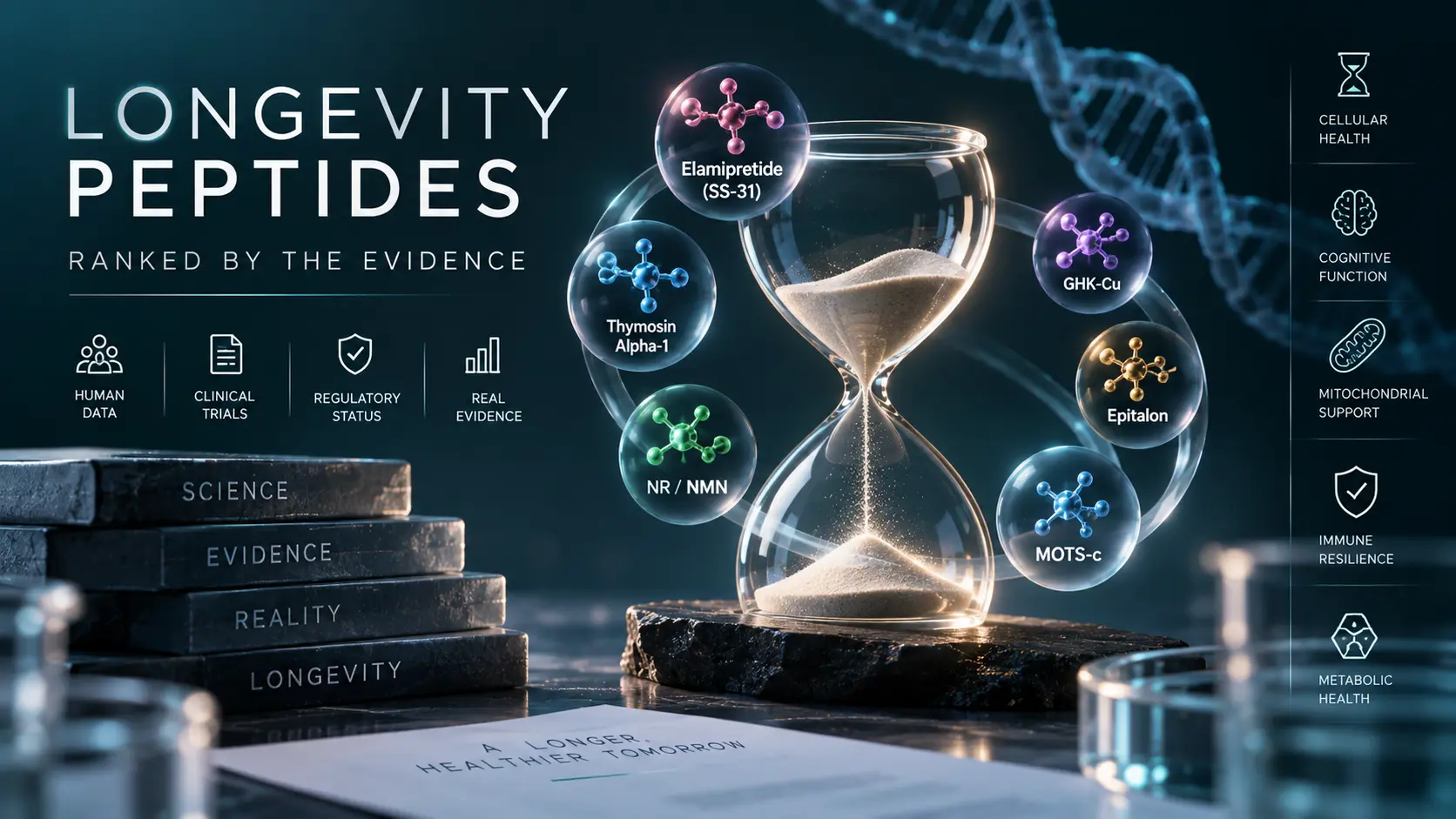
Ranked strictly by the quality of published human data, the best peptides for longevity are elamipretide (SS-31) first, thymosin alpha-1 second, and then GHK-Cu, Epitalon and MOTS-c. Among non-peptide comparators, the NAD+ precursors nicotinamide riboside (NR) and nicotinamide mononucleotide (NMN) sit in the third tier alongside GHK-Cu. That ordering describes evidence, not expected results. Elamipretide is the only compound on the list holding a US approval, and that approval covers Barth syndrome, not ageing. Not one peptide here has been shown to extend human lifespan or healthspan, and three of them have produced their largest and most rigorous results as failures.
Key Takeaways
- Elamipretide (Forzinity) received FDA accelerated approval on 19 September 2025 for Barth syndrome in patients weighing at least 30 kg, based on knee-extensor strength as an intermediate endpoint. The same compound missed both primary endpoints in a 218-patient Phase 3 trial in primary mitochondrial myopathy.
- Thymosin alpha-1 failed its largest trial. TESTS, a 1,106-patient Phase 3 in sepsis published in 2025, found 28-day mortality of 23.4% versus 24.1% for placebo, a hazard ratio of 0.97 (95% CI 0.76 to 1.24).
- Khavinson's widely cited human mortality data came from participants given thymalin (a thymus extract) and/or epithalamin (a bovine pineal extract), not synthetic Epitalon, and the abstract reports no blinding or randomisation. It did not measure telomeres.
- The only randomized trial of a cosmetic GHK-Cu skincare product indexed on PubMed, which 13 patients completed, found no objective difference in redness, wrinkles or skin quality. Only patient-reported satisfaction differed.
- Exogenous MOTS-c has never been given to humans in a published trial. The FDA's own compounding risk assessment states it has identified no human exposure data for MOTS-c by any route.
- Human randomized trials exist for the precursors NR and NMN, all with surrogate endpoints. NAD+ itself has a single 11-participant pharmacokinetic pilot and no published intranasal human trial.
- The TAME trial, the study designed to test whether ageing itself can be treated, has still not launched. AFAR's own page describes it as raising funds to launch.
- Across every compound in this ranking, the column for human lifespan or healthspan evidence reads: none.
Research Use Only
Every compound discussed on this page is supplied by 99 Purity Peptides for laboratory research use only. Nothing here is sold for human or veterinary consumption, and nothing on this page is medical advice, dosing guidance or a treatment protocol. Trial details are described to characterise what the published literature tested, never as a recommendation.
Which Longevity Peptide Has the Strongest Evidence?
Elamipretide has the strongest human evidence of any peptide associated with ageing research, and it earns that position on a regulatory record built entirely outside the ageing field. Everything below it drops off a cliff in evidence quality.
Compound | Tier | Best human evidence | Most important negative or null result | Regulatory status (US) | Human lifespan/healthspan evidence |
|---|---|---|---|---|---|
Elamipretide (SS-31) | 1 | TAZPOWER crossover trial plus open-label extension, n=12, supporting accelerated approval [1][2][25] | MMPOWER-3, n=218, no significant difference from placebo on 6-minute walk distance or fatigue [3] | Approved 19 Sep 2025 (Forzinity), Barth syndrome, confirmatory trial required [1] | None |
Thymosin alpha-1 | 2 | Hepatitis B trial, n=98: complete virological response at 18 months 40.6% in the 26-week arm vs 9.4% in untreated controls; 52-week arm 26.5%, not significant [4] | TESTS sepsis trial, n=1,106, 28-day mortality 23.4% vs 24.1%, HR 0.97 (95% CI 0.76 to 1.24) [5][19] | Not approved; marketed abroad as Zadaxin (thymalfasin) | None |
Nicotinamide riboside (NR) | 3 | Randomized crossover in healthy middle-aged and older adults, surrogate endpoints only [6] | No significant effect on most prespecified physiological outcomes [6] | Sold as a dietary supplement, not an approved drug | None |
Nicotinamide mononucleotide (NMN) | 3 | Randomized placebo-controlled trial reporting improved muscle insulin sensitivity [7] | Single mechanistic endpoint; no clinical outcome measured [7] | Not an approved drug | None |
GHK-Cu (topical) | 3 | Randomized evaluator-blinded trial after CO2 laser resurfacing, n=13 [8] | No objective difference in erythema, wrinkles or skin quality; only satisfaction differed [8] | Not approved; injectable route flagged by FDA for limited human data [9] | None |
NAD+ (intravenous) | 3 | 11-participant pharmacokinetic and metabolomic pilot, 8 infused and 3 saline controls [10] | No clinical or cognitive outcomes assessed [10] | Not an approved drug | None |
Epitalon (synthetic AEDG) | 4 | None. Human survival data used the extract epithalamin, not synthetic Epitalon [11] | Telomere findings are cell-line only; the 2025 paper carries a figure correction [12][13] | Not approved; FDA identified no safety-related information for the proposed route [9] | None |
MOTS-c | 4 | None. Human studies measured the body's own MOTS-c after exercise [14] | A MOTS-c analogue reached Phase 1; its developer then announced liquidation [15] | Not approved; FDA identified no human exposure data by any route [9] | None |
How we graded the evidence
Four tiers, applied the same way to every compound.
Tier 1 means an approved drug supported by regulatory-grade trials, for an indication that has nothing to do with ageing. Tier 2 means approval outside the United States and/or several human randomized controlled trials producing mixed results. Tier 3 means limited or low-quality human data: small samples, surrogate endpoints, single research groups, or trials that measured a biomarker rather than an outcome. Tier 4 means no human administration data at all, whatever the volume of cell and animal work behind it.
Two rules kept the grading honest. Evidence for a related molecule does not count as evidence for the molecule being sold, which is why synthetic Epitalon and MOTS-c both sit in Tier 4 despite substantial literatures. And a trial's result counts whether or not it flattered the compound, which is why the largest study on thymosin alpha-1 does more to set its tier than the positive ones do.
The last column is the one to read twice. It reads "none" for every compound, at every tier, including the approved one. No peptide has been shown to extend lifespan or healthspan in a human being.
Is Any Peptide FDA-Approved for Anti-Aging?
No peptide is FDA-approved for anti-aging, longevity, healthspan or any related indication, because no such indication exists. The FDA approves drugs for diseases, and ageing is not one of them. Three peptides commonly cited in longevity discussions do hold or once held approvals, all for narrow clinical conditions.
Compound | Brand | Approved for | Key date | Current status |
|---|---|---|---|---|
Elamipretide | Forzinity | Barth syndrome, patients ≥30 kg | Accelerated approval 19 Sep 2025 [1] | Approved; confirmatory randomized trial required as a condition [1] |
Tesamorelin | Egrifta | Excess visceral abdominal fat in HIV-associated lipodystrophy | 10 Nov 2010 [16] | Approved, with newer formulations since |
Sermorelin | Geref | Pituitary function testing; growth hormone deficiency in children | Discontinued 2008; approvals withdrawn 18 Jun 2009 [17] | No current approval |
The sermorelin entry is where a durable myth lives. A common claim is that sermorelin was "pulled for safety reasons." The FDA determined otherwise, in writing. A Federal Register notice dated 4 March 2013 formally concluded that the Geref products were not withdrawn from sale for reasons of safety or effectiveness [17]. The determination exists so that generic applications could be approved if anyone filed one. The record is duller than the myth: the manufacturer stopped making the product, and not for reasons of safety or effectiveness.
Elamipretide's approval carries its own asterisk. It came through the accelerated pathway on an intermediate endpoint, and the FDA required a post-approval randomized, double-blind, placebo-controlled trial to confirm the strength changes translate into benefit patients can feel [1]. An approval that is explicitly contingent is not the same as a settled question.
Elamipretide (SS-31): Why Is an Approved Drug Still Unproven for Ageing?
Elamipretide is approved for one ultra-rare genetic disease and has failed its largest trial in a broader mitochondrial population, which is precisely why an approval tells you nothing about ageing.
The compound is a cell-permeable peptide that binds reversibly to cardiolipin in the inner mitochondrial membrane. In Barth syndrome, a tafazzin mutation depletes cardiolipin, so the target is concrete and the disease mechanism is understood. TAZPOWER, the crossover trial behind the approval, enrolled twelve patients [2]. Twelve. The randomized phase did not show a statistically significant improvement on its primary endpoints of six-minute walk distance or fatigue score; the knee-extensor strength gains that supported approval emerged during the open-label extension [25].
Then there is MMPOWER-3. It enrolled 218 patients with primary mitochondrial myopathy, ran to Phase 3, and found no significant difference from placebo on six-minute walk distance or on the fatigue scale [3]. A drug granted accelerated, conditional approval in one genetic cardiolipin defect, on a strength endpoint whose clinical benefit is still to be confirmed, did not show benefit in a broader population with mitochondrial disease.
That is the whole lesson in miniature. "Mitochondrial dysfunction is a hallmark of ageing" is true and useless as an inference. Improving muscle strength, under a conditional approval, in a defined mitochondrial disease that affects about 150 people in the United States according to the manufacturer [26] is not the same problem as slowing mitochondrial decline in healthy older adults, and the one trial that tested something closer to the broader case came back null.
What elamipretide has not been shown to do: improve any outcome in healthy ageing, extend healthspan, or benefit anyone outside a diagnosed mitochondrial disease. Tier 1, on strength of regulatory evidence, for indications unrelated to ageing.
Thymosin Alpha-1: What Do the Hepatitis B and Sepsis Trials Show?
Thymosin alpha-1 has the largest randomized human trial of any compound in this ranking, and that trial was negative.
Start with the positive record. A 1998 trial in chronic hepatitis B, n=98, reported a complete virological response at 18 months of 40.6% in the 26-week treatment arm versus 9.4% in untreated controls; the 52-week arm reached 26.5%, which was not statistically significant against controls [4]. The compound is marketed outside the United States as Zadaxin (thymalfasin). You will see "approved in 35+ countries" circulating online; we could find no primary source for it. SciClone's filings state that ZADAXIN "is approved in over 30 countries", for uses that include hepatitis B treatment and as an immune system enhancer [27], which is a different and vaguer claim. Treat the precise number as unverified.
The US regulatory record is less flattering. A Phase III trial published in 1999 found a response rate of 14% versus 4% and did not reach statistical significance [18]. Thymosin alpha-1 has never been approved in the United States.
Then TESTS. Published in The BMJ in January 2025, it randomized 1,106 adults with sepsis across 22 centres in China to thymosin alpha-1 or placebo. Twenty-eight-day all-cause mortality was 23.4% in the treatment arm and 24.1% on placebo, hazard ratio 0.97, with a 95% confidence interval of 0.76 to 1.24 [5][19]. No secondary or safety outcome differed significantly. Subgroup signals appeared for age and diabetes, which is what subgroup analyses in null trials tend to produce.
One further detail worth knowing, since it is the kind of thing that distinguishes a source you can trust from one you cannot: TESTS itself was subsequently corrected. Data verification at some centres was disrupted during the covid-19 pandemic; survival data for nine participants who had been recorded as lost to follow-up were recovered afterwards, lymphocyte-count data for 35 participants were corrected, and the hazard ratio for the primary outcome moved from 0.99 to 0.97 [19]. The conclusion did not change. A trial that publishes its own correction is behaving well.
Anyone writing about thymosin alpha-1 (see our thymosin alpha-1 research guide) should be citing the 2025 result rather than the 2016 meta-analyses it superseded.
What thymosin alpha-1 has not been shown to do: reduce mortality in sepsis, slow any ageing process, or improve any outcome in healthy adults. Tier 2.
NAD+, NMN or NR: Which One Actually Has Human Data?
The precursors have human randomized trials; NAD+ itself effectively does not. That distinction is the entire story.
Molecule | Route | Human evidence | What was measured |
|---|---|---|---|
Nicotinamide riboside (NR) | Oral | Randomized crossover in healthy middle-aged and older adults [6] | Blood NAD+ levels and physiological surrogates |
Nicotinamide mononucleotide (NMN) | Oral | Randomized placebo-controlled trial in prediabetic postmenopausal women [7] | Muscle insulin sensitivity, a surrogate endpoint |
NAD+ | Intravenous | One pilot study, 11 participants, 8 infused and 3 saline controls [10] | Plasma and urine metabolite concentrations |
NAD+ | Intranasal | No published human trial | Nothing |
In one crossover trial, Martens and colleagues found that oral NR raised NAD+ metabolites in blood cells [6]. That is a genuine pharmacological finding, and it is also the ceiling of what was demonstrated: raising a metabolite is not the same as changing how a person ages. Yoshino and colleagues reported improved skeletal muscle insulin sensitivity with NMN in a randomized placebo-controlled trial [7], a result that remains a surrogate endpoint in a narrow population.
Intravenous NAD+ is where the gap opens. The 2019 pilot by Grant and colleagues followed eleven healthy men, eight receiving a six-hour infusion and three receiving saline, and tracked what happened to the molecule in plasma and urine [10]. It was designed as pharmacokinetics and metabolomics. It measured no clinical outcome, no cognitive outcome, and no marker of ageing. Clinics running NAD+ drips are operating well ahead of that evidence base, and intranasal NAD+ has no published human trial at all.
For a longer treatment of how the molecule is made and consumed, see our explainer on what NAD+ metabolism actually involves and the comparison of glutathione and NAD+, both of which keep the precursor distinction intact.
What NAD+ has not been shown to do in humans: improve cognition, reverse any ageing biomarker, or produce a clinical benefit by any route. Tier 3 for the oral precursors and intravenous NAD+, Tier 4 for intranasal.
GHK-Cu: How Strong Is the Skin Evidence Really?
The famous GHK-Cu percentages do not come from where readers assume. Trace each headline claim to its primary source and the citation chain gets thin fast.
Commonly quoted claim | Actual source type |
|---|---|
Collagen and wrinkle improvement percentages from facial cream studies | Conference abstracts presented at a 2002 dermatology meeting, a non-indexed journal, and a book chapter, catalogued in a 2018 review [20] |
"Resets more than 4,000 genes" | Connectivity Map analysis, in-silico work on cell-line expression data [21] |
Post-laser wound healing benefit | A randomized trial of a cosmetic GHK-Cu skincare product, completed by 13 patients, that found no objective difference [8] |
The 2018 review by Pickart and Margolina is useful precisely because it lists the cosmetic studies and their formats [20]. Read the reference list rather than the summary and the picture changes: the widely quoted numbers were never published as peer-reviewed randomized trials.
The only randomized trial of a cosmetic GHK-Cu skincare product indexed on PubMed is Miller and colleagues, 2006, which 13 patients completed. Patients underwent circumoral CO2 laser resurfacing and were randomized to post-treatment regimens with or without GHK-Cu. Blinded evaluation with computer analysis found no significant reduction in erythema, and objective assessment found no significant improvement in wrinkles or overall skin quality. Patient-reported satisfaction was significantly higher [8]. That is the whole finding. Separately, wound-healing trials of a tripeptide-copper complex exist with mixed results: in venous stasis ulcers it performed no better than placebo [28], while a trial in diabetic neuropathic ulcers reported improved closure [29].
The gene-expression claim deserves the same scrutiny. The Connectivity Map work is genuine bioinformatics on cell-line data [21]. It is not human evidence, and presenting it as though it describes what happens in a person's skin is a category error rather than an exaggeration.
None of this means GHK-Cu is uninteresting. Its copper-binding chemistry and effects on fibroblasts in culture are well characterised, which is why it remains a heavily studied research compound, and why our GHK-Cu research guide and the broader copper peptide research guide both stay inside what the cell and topical literature actually support.
What GHK-Cu has not been shown to do: produce objectively measurable anti-wrinkle or collagen outcomes in a controlled human trial, or do anything systemically by injection. The FDA's own assessment of injectable GHK-Cu notes limited human data to inform safety considerations [9]. Tier 3 topical, Tier 4 injectable.
Epitalon: Does It Lengthen Telomeres in Humans?
No. The human data attributed to Epitalon were not generated with Epitalon, and the telomere data were not generated in humans. Those two facts, held together, dismantle most of what gets written about this compound.
Khavinson and Morozov's 2003 paper is the origin of the survival claim. It followed 266 elderly participants and reported reduced mortality [11]. The participants received thymalin, a thymus extract, and/or epithalamin, a peptide preparation derived from bovine pineal tissue, alone or combined; none received the synthetic tetrapeptide AEDG sold today as Epitalon or Epithalon. The abstract reports no blinding or randomisation. And it measured mortality, not telomere length.
The telomere work runs on a separate track entirely. Khavinson's 2003 telomerase finding came from human fibroblast culture [22]. A 2025 paper in Biogerontology by a group at Brunel University London exposed breast cancer lines and normal human fibroblast and mammary epithelial cells to Epitalon and reported telomere lengthening through hTERT and telomerase upregulation in normal cells and through alternative lengthening of telomeres in the cancer lines [12]. It is cell culture. It is also the paper that carries a correction, published on 15 November 2025 [13].
The correction states that incorrect versions of Figures 1, 2 and 3 appeared in the original article and supplies the corrected figures [13]. Our Epitalon nasal spray research page covers this study and its correction in detail, and our Epithalon research guide handles the circadian literature separately. The broader Khavinson peptide bioregulator programme is worth understanding on its own terms, and so is the underlying biology of the telomerase enzyme, which is more interesting than the marketing around it suggests.
The regulatory record adds one more line. In its review of substances nominated for pharmacy compounding, the FDA stated it had not identified safety-related information regarding Epitalon for the proposed route of administration, and therefore lacked sufficient information to know whether it would cause harm if administered to humans [9].
What Epitalon has not been shown to do: lengthen telomeres in a human being, extend human lifespan, or produce any measured outcome in a blinded human trial. Tier 4 for the synthetic tetrapeptide.
MOTS-c: Has It Ever Been Tested in People?
Exogenous MOTS-c has never been administered to humans in any published trial. Every human MOTS-c measurement in the literature describes the peptide a person's own mitochondria produced.
The distinction collapses constantly in longevity writing, so it is worth stating plainly. Lee and colleagues discovered MOTS-c in 2015 in work conducted in mice and cell lines [23]. Reynolds and colleagues showed in 2021 that exercise raises endogenous MOTS-c in human skeletal muscle and plasma, and in the same paper administered MOTS-c to mice [14]. Human observation, mouse administration, one publication. From this, the phrase "exercise mimetic in humans" entered circulation, and it is unsupported in both halves: nobody has given MOTS-c to a person and measured anything, and nothing has been shown to mimic exercise in people.
The closest anything came to a human test was CB4211, a modified MOTS-c analogue developed by CohBar. It completed a Phase 1a/1b study; topline results were first released in a company press release on 10 August 2021 and later presented at the AASLD 2021 Liver Meeting, and we could find no peer-reviewed publication of them. CohBar later stated that it did not believe the formulation of CB4211 used in the Phase 1b stage of the trial was suitable for further development [30], and on 1 November 2023 it announced its intention to commence liquidating and dissolving the company [15]. Its shares were delisted from Nasdaq in the weeks that followed. An analogue that reached the clinic and was abandoned is not evidence for the parent peptide, which never reached the clinic at all.
The FDA is unusually direct on this point. In its published assessment of compounding substances, the agency states that it has not identified any human exposure data on drug products containing MOTS-c administered via any route of administration, and lacks important information about whether it would cause harm if administered to humans [9].
Our page on MOTS-c, mitochondrial energy and metabolic health and the explainer covering MOTS-c and humanin as mitochondrial peptides both hold this line, and it is the line worth holding: mitochondrial-derived peptides are a fascinating class of signalling molecules, and that is a separate proposition from any of them working in a person.
Tier 4, without qualification.
Why Has No Peptide Been Proven to Extend Human Lifespan?
Three structural obstacles, none of which any peptide has cleared, and none of which is about peptides specifically.
The first is the endpoint problem. Lifespan is the endpoint nobody can afford to measure. A trial that waits for participants to die needs decades and enormous cohorts, so the field substitutes surrogates: telomere length, NAD+ concentration, insulin sensitivity, a walking distance. Every result in this article's ranking is a surrogate result. Surrogates have a poor historical record of predicting mortality benefit.
The second is trial duration. Even a healthspan trial measuring disease onset rather than death takes years, and healthy-volunteer studies of research peptides typically run for weeks. The two timescales are not close.
The third is regulatory, and it is the binding constraint. There is no FDA indication for ageing. A company cannot design a registrational trial against an endpoint the agency does not recognise, which means the ageing field has no commercial pathway and therefore no sponsor with a reason to spend the money. This is not a hypothetical bottleneck. The TAME trial (Targeting Aging with Metformin) was designed specifically to break it. The American Federation for Aging Research describes TAME as a planned series of six-year trials at 14 research institutions that would engage more than 3,000 adults aged 65 to 79 and test whether metformin delays the development or progression of age-related chronic diseases such as heart disease, cancer and dementia. As of this review, AFAR's own TAME page still lists "Raising Funds to Launch" and gives the six-year duration as "once launched" [24]. Metformin is generic, so no manufacturer stands to profit from proving it works.
That is the state of the field. The trial designed to show ageing can be treated has not yet launched, and it concerns a cheap generic drug with far more human data behind it than any peptide in this ranking.
What the Evidence Does Not Establish
Stated plainly, so there is no ambiguity about what this page is and is not claiming.
No compound discussed here has been shown to extend human lifespan or healthspan. No compound here has been shown to reverse any ageing process in a human being. The ranking above grades published evidence, and a Tier 1 placement means regulatory-grade data exists for something other than ageing, not that the compound works for ageing.
Cell-line results do not transfer to humans, and this article has flagged three places where they are routinely presented as though they do: Epitalon's telomere data, GHK-Cu's gene-expression claim, and MOTS-c's mechanistic literature. Animal results do not transfer either, which is why MOTS-c's substantial mouse record earns it Tier 4 rather than Tier 3.
Adjacent compounds sit in the same position. Senolytics including FOXO4-DRI and the cellular ageing literature attract similar longevity framing on a similar evidence base, and they deserve the same reading: interesting mechanism, no human outcome data.
One last caution about evidence hygiene. Two papers cited in this article carry published corrections, and a third body of evidence rests on conference abstracts. Correction notices are a feature of functioning science, not a scandal, but they are invisible to anyone who read a secondary summary and stopped there. Purity and identity documentation deserve the same scepticism as citations: knowing how to read a certificate of analysis is the research equivalent of checking whether a study was blinded.
Working With These Compounds in the Laboratory
Researchers sourcing materials for work in this area can find third-party tested compounds with lot-specific documentation on our product pages for Epithalon, GHK-Cu, Thymosin Alpha-1, MOTS-c and NAD+. All are supplied for research use only. Current lot documentation is available in our certificates library.
For deeper background on any single compound in this ranking, start with the Epitalon nasal spray research page, the copper peptide research guide, or the NAD+ research guide.
References
- U.S. Food and Drug Administration. FDA Grants Accelerated Approval to First Treatment for Barth Syndrome. FDA News Release; September 19, 2025. https://www.fda.gov/news-events/press-announcements/fda-grants-accelerated-approval-first-treatment-barth-syndrome
- Reid Thompson W, Hornby B, Manuel R, et al. A phase 2/3 randomized clinical trial followed by an open-label extension to evaluate the effectiveness of elamipretide in Barth syndrome, a genetic disorder of mitochondrial cardiolipin metabolism. Genet Med. 2021;23(3):471-478. PMID 33077895. https://pubmed.ncbi.nlm.nih.gov/33077895/
- Karaa A, Bertini E, Carelli V, et al. Efficacy and Safety of Elamipretide in Individuals With Primary Mitochondrial Myopathy: The MMPOWER-3 Randomized Clinical Trial. Neurology. 2023;101(3):e238-e252. PMID 37268435. https://pubmed.ncbi.nlm.nih.gov/37268435/
- Chien RN, Liaw YF, Chen TC, et al. Efficacy of thymosin alpha1 in patients with chronic hepatitis B: a randomized, controlled trial. Hepatology. 1998;27(5):1383-1387. PMID 9581695. https://pubmed.ncbi.nlm.nih.gov/9581695/
- Wu J, Pei F, Zhou L, et al. The efficacy and safety of thymosin α1 for sepsis (TESTS): multicentre, double blinded, randomised, placebo controlled, phase 3 trial. BMJ. 2025;388:e082583. PMID 39814420. https://pubmed.ncbi.nlm.nih.gov/39814420/
- Martens CR, Denman BA, Mazzo MR, et al. Chronic nicotinamide riboside supplementation is well-tolerated and elevates NAD+ in healthy middle-aged and older adults. Nat Commun. 2018;9(1):1286. PMID 29599478. https://pubmed.ncbi.nlm.nih.gov/29599478/
- Yoshino M, Yoshino J, Kayser BD, et al. Nicotinamide mononucleotide increases muscle insulin sensitivity in prediabetic women. Science. 2021;372(6547):1224-1229. PMID 33888596. https://pubmed.ncbi.nlm.nih.gov/33888596/
- Miller TR, Wagner JD, Baack BR, Eisbach KJ. Effects of topical copper tripeptide complex on CO2 laser-resurfaced skin. Arch Facial Plast Surg. 2006;8(4):252-259. PMID 16847171. https://pubmed.ncbi.nlm.nih.gov/16847171/
- U.S. Food and Drug Administration. Certain Bulk Drug Substances for Use in Compounding that May Present Significant Safety Risks. Content current as of April 22, 2026. https://www.fda.gov/drugs/human-drug-compounding/certain-bulk-drug-substances-use-compounding-may-present-significant-safety-risks
- Grant R, Berg J, Mestayer R, et al. A Pilot Study Investigating Changes in the Human Plasma and Urine NAD+ Metabolome During a 6 Hour Intravenous Infusion of NAD+. Front Aging Neurosci. 2019;11:257. PMID 31572171. https://pubmed.ncbi.nlm.nih.gov/31572171/
- Khavinson VKh, Morozov VG. Peptides of pineal gland and thymus prolong human life. Neuro Endocrinol Lett. 2003;24(3-4):233-240. PMID 14523363. https://pubmed.ncbi.nlm.nih.gov/14523363/
- Al-Dulaimi S, Thomas R, Matta S, Roberts T. Epitalon increases telomere length in human cell lines through telomerase upregulation or ALT activity. Biogerontology. 2025;26(5):178. PMID 40908429. https://pubmed.ncbi.nlm.nih.gov/40908429/
- Al-Dulaimi S, Thomas R, Matta S, Roberts T. Correction: Epitalon increases telomere length in human cell lines through telomerase upregulation or ALT activity. Biogerontology. 2026;27(1):1. Published online November 15, 2025. PMID 41240216. https://pubmed.ncbi.nlm.nih.gov/41240216/
- Reynolds JC, Lai RW, Woodhead JST, et al. MOTS-c is an exercise-induced mitochondrial-encoded regulator of age-dependent physical decline and muscle homeostasis. Nat Commun. 2021;12(1):470. PMID 33473109. https://pubmed.ncbi.nlm.nih.gov/33473109/
- CohBar, Inc. Current Report on Form 8-K (termination of merger agreement; intention to liquidate and dissolve). U.S. Securities and Exchange Commission; November 1, 2023. https://www.sec.gov/Archives/edgar/data/1522602/000121390023081954/ea187569-8k_cohbar.htm
- U.S. Food and Drug Administration. NDA 022505 approval letter: Egrifta (tesamorelin for injection). November 10, 2010. https://www.accessdata.fda.gov/drugsatfda_docs/appletter/2010/022505s000ltr.pdf
- Food and Drug Administration. Determination That GEREF (Sermorelin Acetate) Injection... Were Not Withdrawn From Sale for Reasons of Safety or Effectiveness. 78 Fed. Reg. 14095; March 4, 2013. https://www.federalregister.gov/documents/2013/03/04/2013-04827/determination-that-geref-sermorelin-acetate-injection-05-milligrams-basevial-and-10-milligrams
- Mutchnick MG, Lindsay KL, Schiff ER, et al. Thymosin alpha1 treatment of chronic hepatitis B: results of a phase III multicentre, randomized, double-blind and placebo-controlled study. J Viral Hepat. 1999;6(5):397-403. PMID 10607256. https://pubmed.ncbi.nlm.nih.gov/10607256/
- Correction: The efficacy and safety of thymosin α1 for sepsis (TESTS): multicentre, double blinded, randomised, placebo controlled, phase 3 trial. BMJ. 2025;389:r1098. PMID 40447307. https://pubmed.ncbi.nlm.nih.gov/40447307/
- Pickart L, Margolina A. Regenerative and Protective Actions of the GHK-Cu Peptide in the Light of the New Gene Data. Int J Mol Sci. 2018;19(7):1987. PMID 29986520. https://pubmed.ncbi.nlm.nih.gov/29986520/
- Pickart L, Vasquez-Soltero JM, Margolina A. GHK and DNA: resetting the human genome to health. Biomed Res Int. 2014;2014:151479. PMID 25302294. https://pubmed.ncbi.nlm.nih.gov/25302294/
- Khavinson VKh, Bondarev IE, Butyugov AA. Epithalon peptide induces telomerase activity and telomere elongation in human somatic cells. Bull Exp Biol Med. 2003;135(6):590-592. PMID 12937682. https://pubmed.ncbi.nlm.nih.gov/12937682/
- Lee C, Zeng J, Drew BG, et al. The mitochondrial-derived peptide MOTS-c promotes metabolic homeostasis and reduces obesity and insulin resistance. Cell Metab. 2015;21(3):443-454. PMID 25738459. https://pubmed.ncbi.nlm.nih.gov/25738459/
- American Federation for Aging Research. TAME — Targeting Aging with Metformin. Accessed September 2026. https://www.afar.org/tame-trial
- Thompson WR, Manuel R, Abbruscato A, et al. Long-term efficacy and safety of elamipretide in patients with Barth syndrome: 168-week open-label extension results of TAZPOWER. Genet Med. 2024;26(7):101138. PMID 38602181. https://pubmed.ncbi.nlm.nih.gov/38602181/
- Stealth BioTherapeutics. Stealth BioTherapeutics Announces FDA Accelerated Approval of FORZINITY (elamipretide HCl), the First Therapy for Progressive and Life-limiting Ultra-rare Genetic Disease Barth Syndrome. Press release; September 19, 2025. https://www.prnewswire.com/news-releases/stealth-biotherapeutics-announces-fda-accelerated-approval-of-forzinity-elamipretide-hcl-the-first-therapy-for-progressive-and-life-limiting-ultra-rare-genetic-disease-barth-syndrome-302562058.html
- SciClone Pharmaceuticals, Inc. Annual Report on Form 10-K for the fiscal year ended December 31, 2015. U.S. Securities and Exchange Commission; 2016. https://www.sec.gov/Archives/edgar/data/880771/000088077116000135/scln-20151231x10k.htm
- Bishop JB, Phillips LG, Mustoe TA, et al. A prospective randomized evaluator-blinded trial of two potential wound healing agents for the treatment of venous stasis ulcers. J Vasc Surg. 1992;16(2):251-257. PMID 1495150. https://pubmed.ncbi.nlm.nih.gov/1495150/
- Mulder GD, Patt LM, Sanders L, et al. Enhanced healing of ulcers in patients with diabetes by topical treatment with glycyl-l-histidyl-l-lysine copper. Wound Repair Regen. 1994;2(4):259-269. PMID 17147644. https://pubmed.ncbi.nlm.nih.gov/17147644/
- CohBar, Inc. Annual Report on Form 10-K for the fiscal year ended December 31, 2022. U.S. Securities and Exchange Commission; 2023. https://www.sec.gov/Archives/edgar/data/1522602/000121390023018882/f10k2022_cohbarinc.htm
Frequently Asked Questions
Which longevity peptide has the most human evidence?
Elamipretide (SS-31) ranks first on the quality of human evidence, including a US approval and a Phase 3 trial in 218 patients. Thymosin alpha-1 is second, with the largest randomized trial of any compound here, a 1,106-patient sepsis study. Neither has human evidence relating to ageing. Everything else in this category sits on small trials, surrogate endpoints, or cell and animal work only.
Are any peptides FDA-approved for anti-aging?
No. The FDA has no indication for ageing, longevity or healthspan, so nothing can be approved for it. Elamipretide is approved for Barth syndrome and tesamorelin for HIV-associated visceral fat. Both are narrow clinical indications unrelated to ageing. Any page describing a peptide as "FDA-approved for anti-aging" is describing something that cannot legally exist.
Do any peptides extend lifespan in humans?
No peptide has been shown to extend human lifespan. No trial has ever measured it, because a lifespan trial would take decades and enormous cohorts. Existing studies use surrogate endpoints such as telomere length, NAD+ concentration or insulin sensitivity, and surrogates have a weak record of predicting mortality benefit. Animal lifespan results do not establish a human effect.
Does Epitalon lengthen telomeres in humans?
No human study has measured telomere length after Epitalon administration. The telomere findings come from cell culture, including a 2025 Brunel University London study in breast cancer lines and normal human cells. That paper carries a November 2025 correction replacing three figures. The frequently cited human survival data measured mortality, not telomeres, and used thymus and pineal extracts rather than synthetic Epitalon.
Is Epitalon the same as epithalamin?
No. Epithalamin is a peptide preparation extracted from bovine pineal tissue. Epitalon, also written Epithalon, is a synthetic tetrapeptide (AEDG) designed as a simplified analogue of it. Khavinson's human survival study in elderly participants used extracts, epithalamin and the thymus extract thymalin, alone or combined, not the synthetic peptide. Evidence generated with one does not transfer to the other.
What do studies actually show GHK-Cu does for skin?
The only randomized trial of a cosmetic GHK-Cu skincare product indexed on PubMed, which 13 patients completed after CO2 laser resurfacing, found no objective difference in redness, wrinkles or skin quality versus control skincare. Only patient-reported satisfaction was significantly higher. The widely quoted collagen and wrinkle percentages come from conference abstracts, a non-indexed journal and a book chapter rather than peer-reviewed trials.
Is thymosin alpha-1 approved anywhere?
Thymosin alpha-1 is marketed outside the United States as Zadaxin (thymalfasin), principally for chronic hepatitis B. It has never been approved in the United States; its US Phase III hepatitis B trial did not reach statistical significance. We could find no primary source for the "approved in 35+ countries" figure circulating online, so it should be treated as unverified; SciClone's filings state that ZADAXIN "is approved in over 30 countries".
Did thymosin alpha-1 work for sepsis?
No. The TESTS trial, published in The BMJ in 2025, randomized 1,106 adults with sepsis across 22 centres. Twenty-eight-day all-cause mortality was 23.4% with thymosin alpha-1 and 24.1% with placebo, a hazard ratio of 0.97 (95% CI 0.76 to 1.24). No secondary or safety outcome differed significantly. It is the largest and best-designed trial of the compound, and it was negative.
Has MOTS-c been tested in humans?
Not as an administered compound. Every human MOTS-c measurement in the published literature describes the peptide people produce themselves, typically measured before and after exercise. The FDA's own compounding assessment states it has identified no human exposure data for MOTS-c by any route of administration. A modified analogue, CB4211, reached Phase 1 before its developer announced liquidation in 2023.
Is MOTS-c an exercise mimetic?
Not in humans, and the phrase inverts what was actually found. Exercise raises the body's own MOTS-c in human muscle and plasma, which makes it an exercise marker, not a substitute for exercise. The studies giving MOTS-c to an organism and observing effects were done in mice. No published trial has administered MOTS-c to a person.
What is the difference between NAD+, NMN and NR?
NAD+ is the working coenzyme cells use in energy metabolism. NMN (nicotinamide mononucleotide) and NR (nicotinamide riboside) are precursors the body converts into it. The practical difference is evidentiary: NR and NMN have oral randomized human trials with surrogate endpoints, while NAD+ itself has almost no human interventional data. Pages that treat all three as interchangeable obscure that gap.
Is there evidence for NAD+ IV infusions or nasal spray?
For intravenous NAD+, one 2019 pilot followed eleven healthy men, eight infused and three given saline, and tracked plasma and urine metabolites. It measured no clinical or cognitive outcome. For intranasal NAD+, no human trial has been published at all. Clinical use of both routes runs substantially ahead of the published evidence.
What is elamipretide approved for?
Elamipretide is approved in the United States as Forzinity for Barth syndrome, a rare genetic mitochondrial disease, in patients weighing at least 30 kg. Approval came through the accelerated pathway on 19 September 2025, based on knee-extensor strength as an intermediate endpoint, and the FDA required a confirmatory randomized placebo-controlled trial as a condition of that approval.
Why was sermorelin discontinued?
Not for reasons of safety or effectiveness, according to the FDA. The manufacturer discontinued Geref in 2008, and the FDA withdrew the approvals in 2009. A Federal Register notice dated 4 March 2013 formally determined the products were not withdrawn from sale for reasons of safety or effectiveness. Claims that sermorelin was "pulled for safety" are contradicted by that determination.
What is the difference between research-use-only and prescription peptides?
Research-use-only (RUO) compounds are supplied for laboratory work and are not manufactured, labelled or approved for administration to people or animals. Prescription peptides are FDA-approved drugs with an approved indication, a label, and a regulated manufacturing chain. The difference is regulatory status, not chemistry, and RUO status carries no implication that a compound is safe or effective in humans.