Research Use Only. Every peptide bioregulator discussed on this page is intended strictly for laboratory research. Nothing here is a therapeutic claim, a medical recommendation, or a suggestion for human or veterinary consumption. |
Quick answer. Peptide bioregulators are synthetic di-, tri-, and tetrapeptides developed by Vladimir Khavinson's group in St Petersburg, each assigned to a specific tissue and proposed to influence gene expression through direct DNA interaction. The family includes Epitalon, Bronchogen, Cartalax, Chonluten, and roughly a dozen others. All are supplied for laboratory research use only.
Key takeaways
- Bioregulators are defined by length and origin, not by a shared target. Every compound in the family is two to four residues long and traces back to a single Soviet-era research programme.
- The published sequences and the marketed sequences frequently do not match. Cartalax is AED, a tripeptide. A large share of vendor listings describe it as AEDL — which is Bronchogen, a different molecule with a different PubChem record.
- The proposed mechanism is direct peptide–DNA binding, not receptor activation. That distinction separates bioregulators from signalling peptides like BPC-157 and explains why the class is studied differently.
- The evidence base is large and narrow at the same time. Hundreds of publications exist; the overwhelming majority originate from one research lineage, and independent replication outside that lineage remains limited.
- For this class specifically, identity confirmation matters more than purity percentage. A vial can be 99% pure and still contain the wrong peptide.
What peptide bioregulators are
A peptide bioregulator is a synthetic short peptide — typically two to four amino acids — assigned to a specific tissue and studied for its proposed effect on gene expression in that tissue.
That definition does two useful things. It sets a hard structural boundary, since nothing in the family exceeds four residues. And it identifies what the compounds have in common, which is a shared research origin rather than a shared molecular target.
The category is narrower than it first appears. GHK-Cu is a tripeptide, but it is not a bioregulator — it came out of separate work on plasma-derived growth factors and acts through copper coordination and receptor-mediated pathways. Bioregulators are the specific set of compounds that emerged from Vladimir Khavinson's programme at the St Petersburg Institute of Bioregulation and Gerontology, carry Russian trade names, and are proposed to work through a common mechanism.
For definitions of the analytical and regulatory terms used throughout this reference, see our short peptide terminology guide.
Cytomedins and cytogens — from tissue extract to defined sequence
Two terms recur in the older literature and cause persistent confusion.
Cytomedins are the original preparations: peptide fractions extracted from animal organs. Thymalin, from thymus tissue, and Epithalamin, from pineal tissue, are the archetypes. These were mixtures, not defined molecules, and their composition varied between batches.
Cytogens are the synthetic successors. Khavinson's group analysed the amino-acid composition of active extract fractions and synthesised defined short peptides intended to reproduce the effect in a single characterised molecule. Epithalamin gave rise to Epitalon. Thymalin gave rise to Thymogen.
Everything sold today as a bioregulator is a cytogen — a chemically synthesised peptide with a known sequence. The distinction matters when reading older studies, because a paper on Epithalamin is not a paper on Epitalon. They are different substances, and results from one do not transfer to the other.
Why bioregulators are so short
The proposed mechanism requires it.
Khavinson's group argues that these peptides act inside the nucleus by associating directly with DNA. Reaching the nucleus means crossing the cytoplasmic membrane and passing through a nuclear pore. Nuclear pores permit free diffusion of low-molecular-weight substances up to roughly 3,500 daltons, and every bioregulator in the family sits far below that ceiling — Vilon is a dipeptide at around 275 Da, Bronchogen a tetrapeptide at around 446 Da.
Length is therefore not incidental. It is a constraint the hypothesis imposes. Whether the mechanism holds is a separate question, addressed further below, but the size profile of the family follows directly from it.
How bioregulators differ from signalling peptides
Most research peptides act on receptors. Bioregulators are proposed to act on DNA.
Signalling peptides (BPC-157, TB-500, GHK-Cu) | Peptide bioregulators (Epitalon, Bronchogen, Cartalax) | |
|---|---|---|
Typical length | 7–43 residues | 2–4 residues |
Proposed target | Cell-surface or intracellular receptors | Double-stranded DNA, directly |
Mechanism class | Receptor binding → signalling cascade | Proposed transcriptional modulation |
Tissue selectivity | Receptor distribution | Proposed sequence-to-tissue specificity |
Origin | Varied — endogenous fragments, analogues | Single research programme, St Petersburg |
Evidence base | Multiple independent groups | Predominantly one research lineage |
The practical consequence is that the two classes need different experimental designs. Receptor-binding assays are informative for a signalling peptide and largely uninformative for a compound proposed to act transcriptionally. Researchers moving between the two categories should expect different endpoints, different controls, and different timescales.
For broader context on how research peptides are categorised, see our guide to research peptides.
Origin: the Khavinson research programme
The bioregulator family is the output of one laboratory over five decades, and understanding that shapes how the evidence should be read.
The St Petersburg Institute of Bioregulation and Gerontology
Vladimir Khavinson began the work in the 1970s, initially in a Soviet military medical context. The programme extracted peptide fractions from animal organs and reported that each fraction preferentially affected the organ it was derived from. That observation — tissue-derived fractions showing tissue-preferential effects — became the organising hypothesis for everything that followed.
The Institute was established to continue this work, and Khavinson directed it for decades. The compounds, the trade names, the sequences, and the great majority of the supporting literature all originate there.
From organ extracts to synthetic sequences
The transition from cytomedin to cytogen is the programme's central technical achievement, whatever one concludes about the biology.
Extracts are unreproducible. Composition varies with source tissue, animal, and preparation method, so a result obtained with one batch cannot be reliably repeated with another. Identifying candidate active sequences and synthesising them as defined molecules solved that problem: a synthetic tripeptide is the same molecule every time.
That step also made the compounds commercially viable as research materials, which is why they exist in catalogues today.
The scale of the literature — and where it comes from
The Khavinson programme has produced hundreds of publications across more than forty years, spanning gene expression, cell culture, animal ageing models, and observational clinical work.
Both halves of that sentence carry weight. The volume is genuinely substantial. The concentration is equally real: the overwhelming majority of this literature is authored by Khavinson, his direct collaborators, or the Institute. Independent replication by unaffiliated groups outside Russia remains limited.
That is not a reason to dismiss the work. It is a reason to read it with the same caution any single-lineage evidence base warrants — a point developed in detail further down this page.
Verified sequence reference
The sequences below are as published by Khavinson, Lin'kova and Tarnovskaya in Bulletin of Experimental Biology and Medicine, 2016 — a paper from the originating group that maps trade names directly to amino-acid sequences.
This is the authoritative mapping. Where vendor listings disagree with this table, the vendor listing is wrong.
Compound | Sequence | Residues | Associated tissue | Catalogue |
|---|---|---|---|---|
Vilon | Lys-Glu (KE) | 2 | Thymus, immune | |
Thymogen | Glu-Trp (EW) | 2 | Thymus, immune | — |
Vesilute | Glu-Asp (ED) | 2 | Bladder | |
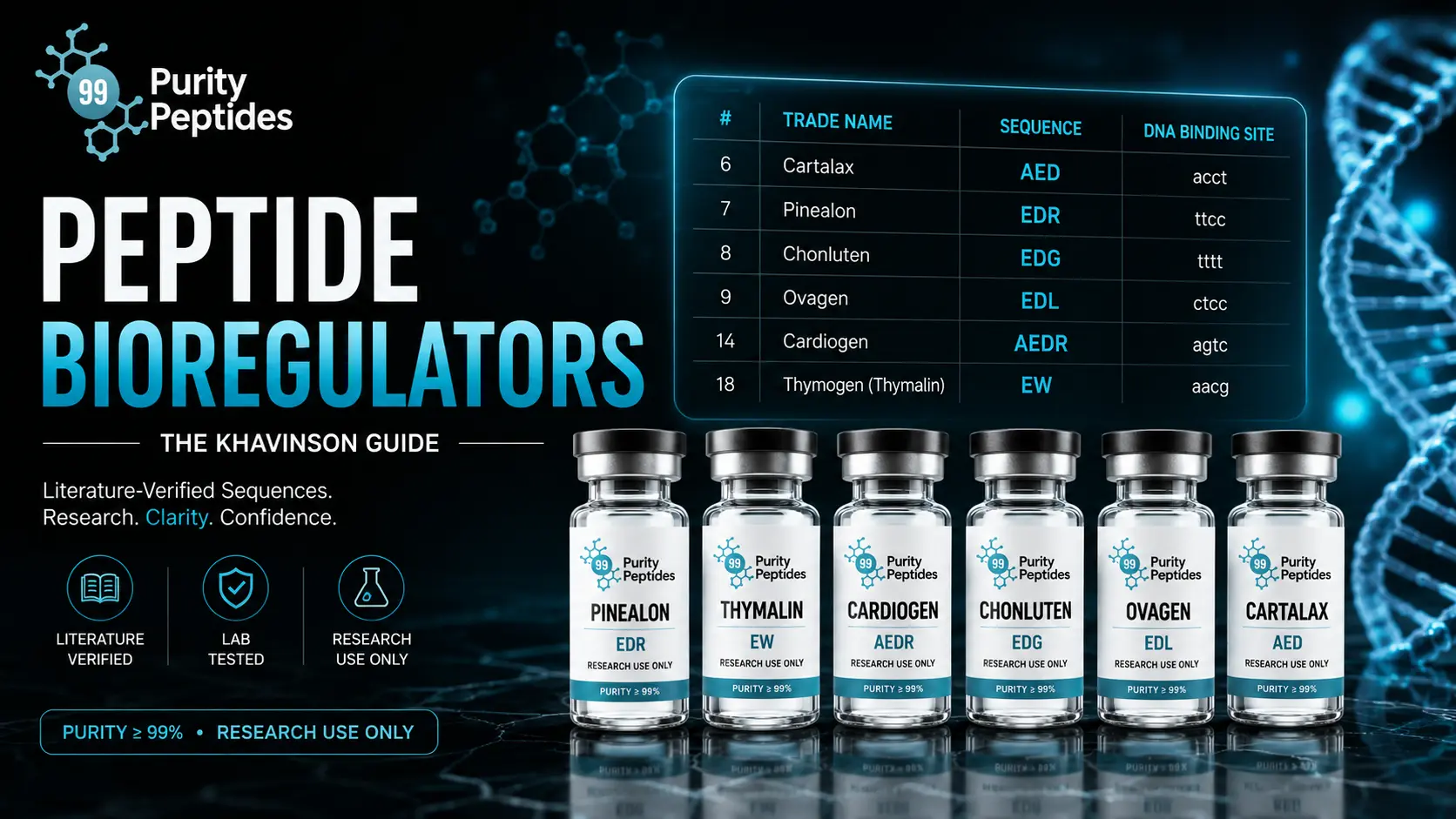
Cartalax | Ala-Glu-Asp (AED) | 3 | Cartilage, connective tissue | |
Pinealon | Glu-Asp-Arg (EDR) | 3 | Brain, nervous system | |
Chonluten | Glu-Asp-Gly (EDG) | 3 | Lung, bronchial mucosa | |
Ovagen | Glu-Asp-Leu (EDL) | 3 | See note below | |
Cristagen | Glu-Asp-Pro (EDP) | 3 | Immune | |
Vesugen | Lys-Glu-Asp (KED) | 3 | Vascular | |
Epitalon | Ala-Glu-Asp-Gly (AEDG) | 4 | Pineal gland | |
Bronchogen | Ala-Glu-Asp-Leu (AEDL) | 4 | Bronchi, respiratory tract | |
Cortagen | Ala-Glu-Asp-Pro (AEDP) | 4 | Cerebral cortex | |
Cardiogen | Ala-Glu-Asp-Arg (AEDR) | 4 | Cardiac | |
Prostamax | Lys-Glu-Asp-Pro (KEDP) | 4 | Prostate | |
Pancragen | Lys-Glu-Asp-Trp (KEDW) | 4 | Pancreas | |
Livagen | Lys-Glu-Asp-Ala (KEDA) | 4 | Liver | |
Testagen | Lys-Glu-Asp-Gly (KEDG) | 4 | Testes |
Note on Ovagen: the 2016 source establishes the sequence as EDL but does not settle the tissue assignment. The name suggests ovarian tissue; several secondary sources assign it to liver and digestive tissue instead. We have not found a primary source that resolves this, and we are not going to assign a tissue we cannot cite.
Lining the sequences up reveals the family's structural signature: a Glu-Asp core recurs across nearly every compound, with one or two flanking residues distinguishing them. Cartalax (AED), Chonluten (EDG), and Ovagen (EDL) differ by a single terminal residue, yet each is assigned to a different tissue. Whether one-residue differences can produce genuine tissue selectivity is the central open question about this family — and a testable one.
Where market sources disagree — and how the errors spread
Cartalax is AED, a tripeptide. A substantial share of vendor listings describe it as AEDL or Ala-Glu-Asp-Lys. Both are wrong, and the origin of the error is identifiable: AEDL is Bronchogen.
The two compounds are separately registered. Cartalax as AED carries PubChem CID 87815447 with a molecular weight near 333 Da. Bronchogen as AEDL carries PubChem CID 11690869 at roughly 446 Da. Different formulas, different masses, different molecules.
Independent support comes from the Khavinson group's own 2021 systematic review in Molecules, which describes AEDL as a bronchoprotective peptide. Bronchoprotective is respiratory. It is not cartilage.
The likely mechanism of the error is mundane. Cartalax is a tripeptide surrounded in the family by tetrapeptides, and AED sits one residue away from AEDL. One listing transposed them, other vendors copied it, and the error propagated across the market faster than anyone checked it against the source.
A second, similar error affects Pinealon. Many listings give Pinealon as KED. The 2016 table gives Pinealon as EDR (Glu-Asp-Arg), and KED is Vesugen — again, two different compounds swapped.
The practical takeaway for anyone sourcing these compounds: verify the sequence on the certificate of analysis against the published sequence, not against the vendor's product description. Product copy is downstream of whatever the vendor copied. The COA is downstream of the actual material.
The proposed mechanism
Bioregulators are proposed to enter the cell nucleus and associate directly with double-stranded DNA, influencing transcription without binding a cell-surface receptor.
The word proposed is load-bearing throughout this section. What follows is a hypothesis with supporting modelling and cell-level data, not an established pathway.
Direct peptide–DNA interaction
The argument runs in three steps.
First, short peptides are small enough to reach the nucleus. Nuclear pores permit passive diffusion up to roughly 3,500 Da; bioregulators sit an order of magnitude below that. Fluorescence-labelled short peptides have been observed entering the nucleus in HeLa cells.
Second, molecular docking models place specific peptides at specific DNA sequences. The 2016 paper constructed models for 19 peptides and reported binding sites — Vilon and Cristagen at agat, Pancragen and Cartalax at acct, Bronchogen and Ovagen at ctcc.
Third, gene expression changes have been reported following peptide exposure in cell and animal models, including microarray work on Vilon and Epitalon in mouse heart tissue.
Each step is supported by published work. The chain as a whole is a hypothesis, and the strength of the docking evidence — computational modelling rather than direct structural determination — should be weighed accordingly.
The Glu-Asp core motif
Nearly every compound in the family contains adjacent glutamic acid and aspartic acid residues. Both carry negative charge at physiological pH, which is chemically counterintuitive for a molecule proposed to bind the negatively charged phosphate backbone of DNA.
The proposed resolution is that binding occurs in the minor groove and is driven by hydrogen bonding to exposed base edges rather than backbone electrostatics. Flanking residues — the lysine in Vilon, the arginine in Pinealon, the tryptophan in Pancragen — are proposed to supply the specificity.
This is a coherent structural story. It is also, at present, largely a modelled one.
What the mechanism does not establish
Several limits are worth stating explicitly.
A modelled binding interaction is not a demonstrated one. Docking predicts plausible geometry; it does not confirm that binding occurs in a living cell at achievable concentrations.
A reported change in gene expression is not a demonstrated physiological outcome. Transcript-level changes in culture may or may not translate into tissue-level effects.
Tissue assignment is nomenclature, not evidence. Calling AED "the cartilage peptide" reflects the fraction it was derived from, not the tissue it has been tested in.
None of this constitutes evidence of therapeutic effect in humans. These compounds are not approved for any medical use in the United States, and nothing on this page should be read as suggesting otherwise.
The compounds, by tissue system
Respiratory — Bronchogen and Chonluten
Two compounds are assigned to the respiratory system, and they are structurally distinct rather than variants of one another.
Bronchogen (AEDL) is a tetrapeptide associated with the bronchi and airway epithelium. It is the compound the Khavinson group's 2021 review characterises as bronchoprotective, and it has been studied in rat models of chronic obstructive lung pathology and in respiratory-tissue differentiation work in vitro.
Chonluten (EDG) is a tripeptide associated with lung and bronchial mucosa specifically. Searches for "lung and bronchial mucosa bioregulator" typically resolve to Chonluten — that phrasing reflects how the compound is described in Russian-language product documentation.
The division is anatomical: Bronchogen tracks the conducting airways, Chonluten the mucosal surface. Whether that distinction is biologically real or a naming artefact is unresolved.
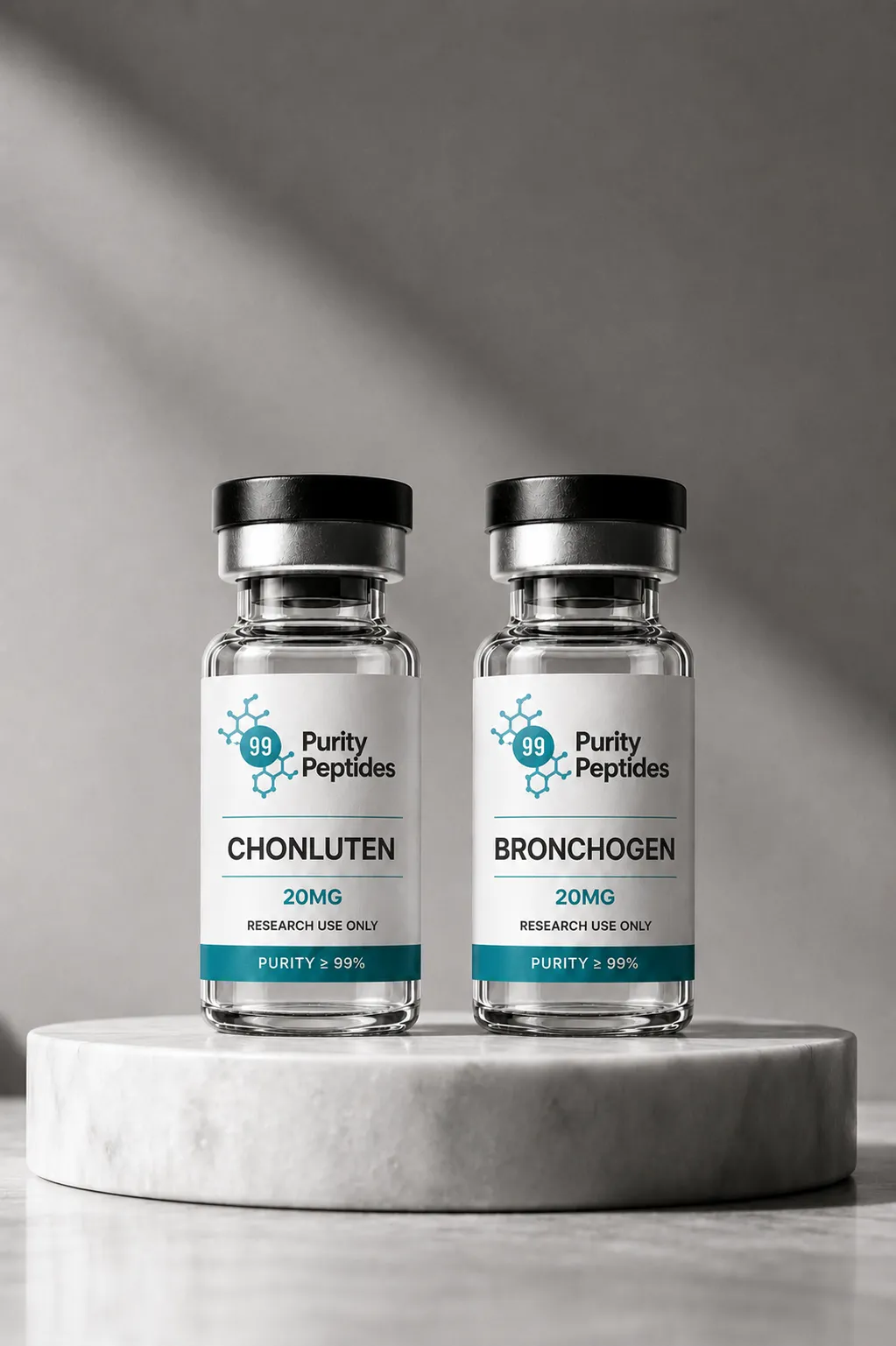
Both compounds are supplied together as the Respiratory panel for laboratory use.
Connective tissue — Cartalax
Cartalax (AED) is a tripeptide assigned to cartilage and connective tissue, and it is the compound most affected by the sequence-mislabelling problem described above.
Its evidence base is in vitro. Published work using the AED sequence has examined bone marrow stromal cells, periodontal ligament cells, fibroblasts, and thymocytes. Cartilage-specific endpoints — collagen II, aggrecan, SOX9 expression — are not well represented in the PubMed-indexed literature, which is worth knowing before designing a study around the cartilage assignment.
Cartalax does not currently have a dedicated single-compound listing in our catalogue; it ships as part of the Bioregulator Core Panel or the Full Master Set.
Immune and thymic — Vilon, Thymogen, Cristagen
The thymic compounds are the family's oldest lineage, descending directly from the Thymalin extract.
Vilon (KE) is a dipeptide — the shortest compound in the family — and appears in more of the mechanistic literature than most, including early DNA-microarray work in mouse cardiac tissue. Thymogen (EW) is the direct synthetic successor to Thymalin. Cristagen (EDP) is assigned to immune function; note that vendor listings frequently give the wrong sequence for this one as well.
Vilon and Cristagen are supplied within the Immune/Thymic panel, alongside Thymalin, the extract-form precursor.
Neuroendocrine — Epitalon, Pinealon, Cortagen
Epitalon (AEDG) is the most studied compound in the family by a wide margin, largely because of work reporting telomerase induction in human fibroblast culture. The telomerase literature is worth reading carefully rather than in summary — we cover the enzyme, the measurement methods, and the replication picture in our guide to telomerase and the Epitalon research.
Pinealon (EDR) is assigned to brain tissue and appears in Khavinson-group work on gene expression relevant to neurodegeneration. It is EDR, not KED.
Cortagen (AEDP) is the synthetic counterpart to the cortex extract Cortexin. An important caveat: the clinical track record commonly cited for Cortagen belongs to the Cortexin extract, not the synthetic tetrapeptide. Extract results do not transfer to the cytogen.
Epitalon is available individually; Pinealon and Cortagen ship together as the Neuro/Pineal panel.
Reproductive, hepatic and metabolic — Ovagen, Prostamax, Pancragen
Ovagen (EDL) carries the tissue-assignment ambiguity noted in the sequence table above.
Prostamax (KEDP) is a tetrapeptide assigned to prostate tissue, positioned as the defined-sequence successor to older bovine prostate extracts.
Pancragen (KEDW) is assigned to pancreatic tissue and shares a modelled DNA binding site with Cartalax.
Ovagen and Pancragen ship together as the Hepatic/Digestive panel; Prostamax ships within the Urogenital panel.
Explore the full range. All bioregulators in our catalogue ship with lot-specific certificates of analysis.
View the bioregulator catalogue →
Evidence quality: an honest assessment
The bioregulator literature is simultaneously extensive and narrow, and both properties matter when evaluating any claim made about these compounds.
What the replication picture looks like
Hundreds of publications exist. The great majority are authored by Khavinson, by researchers at the St Petersburg Institute, or by direct collaborators. Independent replication by unaffiliated groups outside that network is limited, and where it exists it tends to address mechanism rather than outcome.
A meaningful portion of the older literature is published in Russian-language journals with limited international indexing, which constrains how readily it can be independently assessed.
Clinical claims associated with the family — lifespan effects, reductions in disease incidence, improvements in elderly cohorts over multi-year follow-up — derive substantially from observational and uncontrolled studies conducted within the same programme. Randomised controlled trials of the synthetic bioregulators are essentially absent from the international literature.
Why single-lineage evidence is a limitation, not a dismissal
Concentration of evidence within one research group is a recognised limitation in any field. It does not mean the findings are wrong. It means the usual error-correcting mechanism — independent groups attempting the same experiment and reporting what they get — has not operated at normal strength.
Two things follow.
Confidence should scale with replication, so a mechanistic finding reproduced in independent cell systems warrants more weight than an outcome reported once within the originating programme.
And the gap is an opportunity. The core claims are testable. Sequence-to-tissue specificity, in particular, is a well-posed question: if one-residue differences genuinely determine tissue selectivity, that is measurable with contemporary transcriptomic methods. Very little independent work has attempted it.
Reading bioregulator claims critically
Three questions separate supportable statements from marketing.
Was this measured, or is it inferred from the name? "The cartilage peptide" describes a naming convention. It does not describe a tested endpoint.
Was this the extract or the synthetic peptide? Thymalin and Thymogen are different substances. So are Epithalamin and Epitalon, and Cortexin and Cortagen. Results from the extract are routinely attributed to the peptide, and they should not be.
What was the model system? In vitro gene expression, animal ageing models, and human clinical outcomes are three separate tiers of evidence. Most bioregulator claims sit in the first tier. Very few reach the third.
Sourcing and verification
For peptide bioregulators specifically, confirming which peptide is in the vial matters more than confirming how pure it is.
That is not the usual priority order, and the reason is the mislabelling problem documented above. A vial can test at 99% purity and still contain the wrong compound, because purity measures how much of the material is a single peptide — not whether that peptide is the one on the label.
Why sequence verification matters more for this class
Three factors compound.
Sequences are short and similar. AED and AEDL differ by one residue. EDG, EDL, and EDP differ by one. Transcription errors are easy to make and hard to notice.
Trade names are marketing nomenclature, not chemical names. "Cartalax" carries no chemical information. Only the sequence does.
And the market has already propagated errors at scale. When a large share of listings for a compound give the wrong sequence, the label alone is not evidence of what you have.
What a bioregulator COA should show
Field | What to check |
|---|---|
Sequence | Stated in three-letter or one-letter code. Compare against the published sequence, not the product page. |
Identity method | Mass spectrometry confirming molecular weight. This is the field that catches a mislabelled compound. |
HPLC purity | Percentage with the chromatogram, not a bare number |
Molecular weight | Observed mass against theoretical. AED ≈ 333 Da; AEDL ≈ 446 Da — a mislabelled vial fails here. |
Lot number | Must match the vial |
Test date | Recent, and tied to the lot rather than a generic reference document |
Testing laboratory | Named, with accreditation scope where applicable |
A COA that reports purity but omits identity confirmation cannot tell you the vial contains the right peptide. For a compound class with a documented mislabelling problem, that gap is the one that matters.
Our certificates of analysis are published per lot, and our approach to ≥99% purity verification covers the methods used. For a fuller account of what happens between synthesis and release, see how peptide labs establish purity and identity.
HPLC purity versus identity confirmation
The two answer different questions, and conflating them is the most common analytical error in this space.
HPLC purity separates a sample by hydrophobicity and reports the target peak as a percentage of total peak area. It answers: how much of this material is one substance?
Mass spectrometry measures molecular weight and answers: which substance?
For most research peptides, purity is the binding constraint. For short bioregulators with near-identical sequences and a market-wide labelling problem, identity is. Ask for both. See our guide on why peptide purity matters for the broader context.
Verify before you source. Every bioregulator we supply ships with a lot-specific certificate of analysis including sequence and identity confirmation.
View certificates of analysis →
Storage and handling
Bioregulators are supplied lyophilized and share the stability profile of other short synthetic peptides — with one advantage: fewer residues means fewer degradation-prone sites.
Lyophilized material stored at -20°C, protected from light and moisture, is stable over extended periods. Once reconstituted, stability drops substantially, and short peptides in solution remain vulnerable to hydrolysis at the peptide bond regardless of length.
Compounds containing tryptophan — Pancragen (KEDW) and Thymogen (EW) — warrant additional care, since tryptophan is among the residues most susceptible to oxidation and photodegradation. Amber vials and minimal light exposure are sensible defaults for those two.
Repeated freeze-thaw cycling degrades peptides in solution. Aliquot after reconstitution rather than returning a single vial to the freezer repeatedly.
Full protocols are in our peptide storage and handling guide, and our reconstitution calculator handles the concentration arithmetic.
Where this leaves the class
Peptide bioregulators occupy an unusual position. The chemistry is simple and well defined. The proposed mechanism is unconventional but coherent. The evidence is voluminous and concentrated in a way that makes independent assessment harder than it should be.
None of that makes the compounds uninteresting. It makes them under-tested — which, for a laboratory, is a different proposition entirely. The sequence-to-tissue-specificity hypothesis is well posed and measurable with methods that were unavailable when most of the original work was done.
What the class demands from anyone working with it is precision about what is known. Distinguish the extract from the synthetic peptide. Distinguish the tissue in the name from the tissue in the assay. And confirm the sequence in the vial against the sequence in the literature, because on that last point the market has demonstrably not been careful.
Start with verified material. Sequence-confirmed bioregulators with lot-specific certificates of analysis.
Browse the bioregulator catalogue →
References
- Khavinson VKh, Lin'kova NS, Tarnovskaya SI. Short Peptides Regulate Gene Expression. Bull Exp Biol Med. 2016;162(2):288–292. link.springer.com
- Khavinson V, Popovich IG, Linkova NS, Mironova ES, Ilina AR. Peptide Regulation of Gene Expression: A Systematic Review. Molecules. 2021.
- Khavinson V, Linkova N, Kozhevnikova E, Trofimova S. EDR Peptide: Possible Mechanism of Gene Expression and Protein Synthesis Regulation. Molecules. 2021;26(1):159. PMC7795577
- Cartalax (AED) compound record. PubChem CID 87815447. pubchem.ncbi.nlm.nih.gov
- Bronchogen (AEDL) compound record. PubChem CID 11690869. pubchem.ncbi.nlm.nih.gov
- Fedoreyeva LI, Kireev II, Khavinson VKh, Vanyushin BF. Biochemistry (Mosc). 2011;76(11):1210–1219. pubmed.ncbi.nlm.nih.gov
- Anisimov SV, Bokheler KR, Khavinson VKh, Anisimov VN. Bull Exp Biol Med. 2002;133(3):293–299. pubmed.ncbi.nlm.nih.gov
- Anisimov VN, Khavinson VKh. Peptide bioregulation of aging: results and prospects. Biogerontology. 2010;11(2):139–149. pubmed.ncbi.nlm.nih.gov
A note on this page. This is an educational overview of published research. We source the sequence table above directly to the originating laboratory's own published paper, and we encourage you to verify any claim — ours included — against the primary literature cited above rather than taking a vendor description on trust.
Research Use Only. All products and information referenced on this page are intended strictly for laboratory research use. These compounds are not drugs, foods, cosmetics, or dietary supplements. They have not been evaluated by the FDA and are not approved for the diagnosis, treatment, cure, or prevention of any disease. They are not for human or veterinary administration, and any such use is prohibited. Content on this page summarises published preclinical and laboratory research and does not constitute medical advice.
Frequently Asked Questions
What are peptide bioregulators?
Peptide bioregulators are synthetic short peptides of two to four amino acids, developed by Vladimir Khavinson's group in St Petersburg, each associated with a specific tissue and proposed to influence gene expression through direct DNA interaction. The family includes Epitalon, Bronchogen, Cartalax, Chonluten, Vilon, and roughly a dozen others.
What is the difference between a bioregulator and a regular research peptide?
Bioregulators are two to four residues long and are proposed to act inside the nucleus by associating with DNA. Most research peptides are longer and act on cell-surface or intracellular receptors, triggering signalling cascades. BPC-157 and TB-500 are signalling peptides; Epitalon and Bronchogen are bioregulators. The two classes require different experimental designs and different endpoints.
Is Cartalax AED or AEDL?
Cartalax is AED — Ala-Glu-Asp, a tripeptide. Listings describing Cartalax as AEDL are incorrect. AEDL is Bronchogen, a separate tetrapeptide assigned to the respiratory tract. The two compounds hold distinct PubChem records with different molecular weights: approximately 333 Da for AED and 446 Da for AEDL.
What is the amino acid sequence of Cartalax?
Cartalax is Ala-Glu-Asp, abbreviated AED — alanine, glutamic acid, aspartic acid. It is a tripeptide with a molecular weight of approximately 333 Da. The sequence appears in Khavinson, Lin'kova and Tarnovskaya's 2016 paper in Bulletin of Experimental Biology and Medicine.
Is Pinealon KED or EDR?
Pinealon is EDR — Glu-Asp-Arg. Listings giving Pinealon as KED are incorrect; KED is Vesugen, a different compound assigned to vascular tissue. The EDR sequence appears in the Khavinson group's own published work, including a 2021 paper in Molecules examining EDR and gene expression relevant to neurodegeneration.
Who is Vladimir Khavinson?
Vladimir Khavinson is the Russian researcher who developed the peptide bioregulator class, beginning in the 1970s and continuing at the St Petersburg Institute of Bioregulation and Gerontology. His group produced the original tissue extracts, the synthetic short peptides that succeeded them, and the majority of the supporting literature across more than four decades.
What is Bronchogen used for in research?
Bronchogen is the tetrapeptide AEDL, associated with bronchial and respiratory tract tissue. It has been examined in rat models of chronic obstructive lung pathology and in respiratory-tissue differentiation studies in vitro. The Khavinson group's 2021 systematic review describes AEDL as a bronchoprotective peptide. It is supplied for laboratory research only.
What is Chonluten?
Chonluten is the tripeptide EDG — Glu-Asp-Gly — assigned within the Khavinson family to lung and bronchial mucosa. It is distinct from Bronchogen, which is the tetrapeptide AEDL assigned to the conducting airways. Chonluten's published evidence base consists of preclinical work and uncontrolled clinical observation, without randomised trials.
Why are peptide bioregulators so short?
Length follows from the proposed mechanism. Bioregulators are hypothesised to act inside the nucleus, which requires crossing the cytoplasmic membrane and passing through a nuclear pore. Nuclear pores allow passive diffusion of substances up to roughly 3,500 daltons, and every bioregulator sits well below that — from around 275 Da for the dipeptide Vilon to around 446 Da for tetrapeptides.
What is a cytomedin?
A cytomedin is a peptide fraction extracted from animal tissue — the original form of the Khavinson preparations. Thymalin, from thymus, and Epithalamin, from pineal tissue, are examples. Cytomedins are mixtures with batch-to-batch variation. The synthetic short peptides that replaced them are termed cytogens, and the two are not interchangeable in the literature.
Do peptide bioregulators actually bind DNA?
Direct DNA binding is the proposed mechanism, supported by molecular docking models, observations of fluorescence-labelled short peptides entering cell nuclei, and reported gene-expression changes in cell and animal models. It has not been demonstrated by direct structural determination in living cells. The evidence supports the hypothesis as plausible; it does not establish it as confirmed.
Are Khavinson peptides supported by independent research?
Only partially. The literature is extensive — hundreds of publications across four decades — but the overwhelming majority originates from Khavinson's group, the St Petersburg Institute, or direct collaborators. Independent replication by unaffiliated groups outside that network is limited, and randomised controlled trials of the synthetic bioregulators are largely absent from the international literature. Confidence in any specific claim should scale with how much replication it has received.
Are peptide bioregulators FDA approved?
No. No peptide bioregulator is approved by the FDA for any medical indication in the United States. These compounds are supplied strictly as research materials for laboratory use, are not drugs or dietary supplements, and are not intended for human or veterinary administration.
What should a bioregulator certificate of analysis show?
A bioregulator COA should state the amino-acid sequence, confirm identity by mass spectrometry with observed against theoretical molecular weight, report HPLC purity with the chromatogram, and carry a lot number matching the vial, a recent test date, and a named testing laboratory. For this compound class, identity confirmation matters more than the purity percentage, because a mislabelled vial can still test as highly pure.
How should peptide bioregulators be stored?
Store lyophilized material at -20°C, protected from light and moisture. Reconstituted peptide is considerably less stable and should be aliquoted to avoid repeated freeze-thaw cycles. Compounds containing tryptophan — Pancragen and Thymogen — warrant extra protection from light, since tryptophan is particularly susceptible to oxidation and photodegradation.