Quick Answer
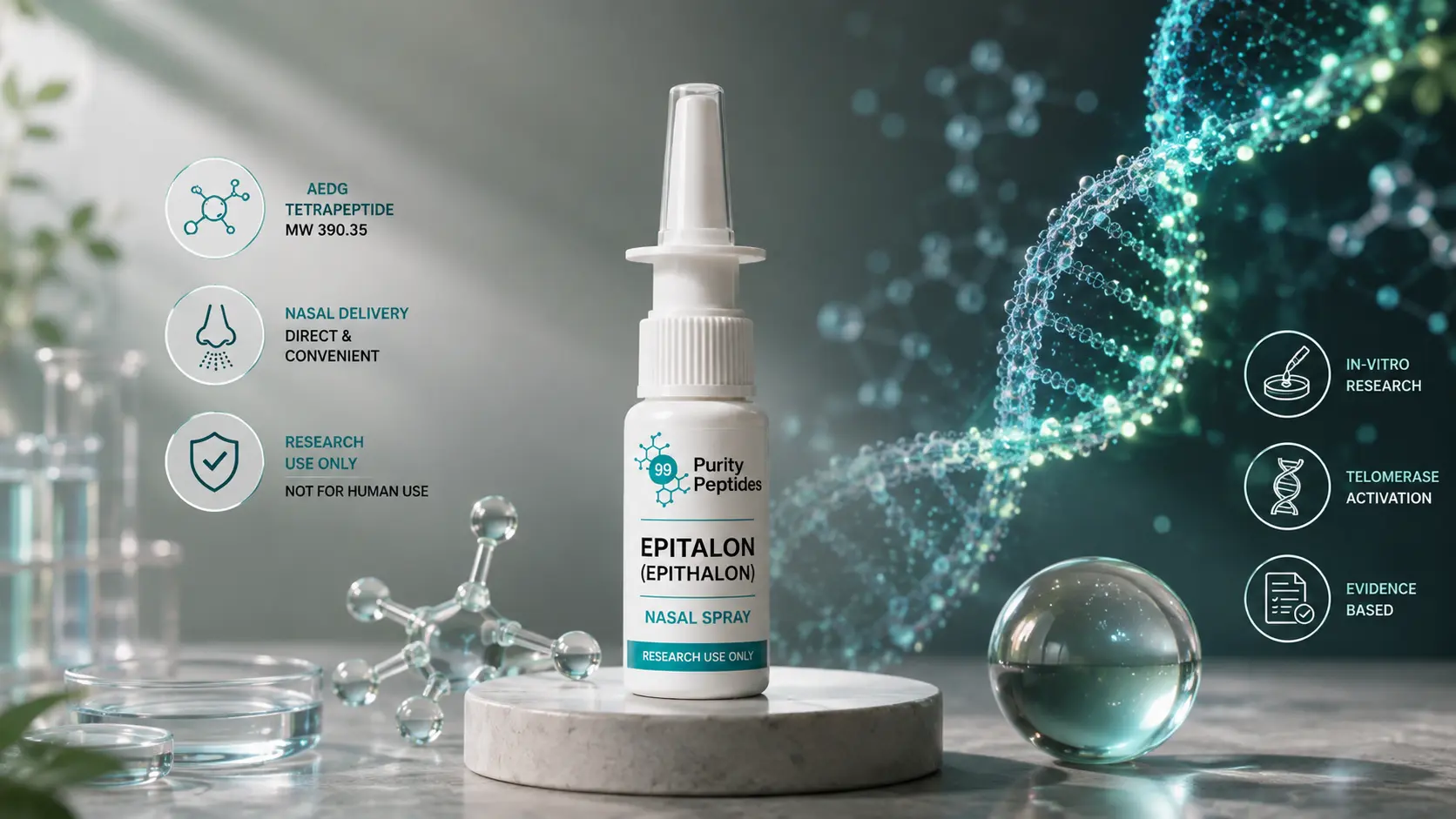
Epitalon, also spelled epithalon, is a synthetic tetrapeptide with the sequence Ala-Glu-Asp-Gly (AEDG). An epitalon nasal spray supplies that same tetrapeptide already in solution in a metered spray bottle, rather than as a lyophilized powder a lab reconstitutes itself. The published research is concentrated on telomerase and telomere endpoints in cultured cells, supported by small rodent studies drawn largely from one Russian research lineage. No published study has measured how much epitalon a nasal spray delivers, so the format is a handling choice rather than an evidence-backed delivery route.
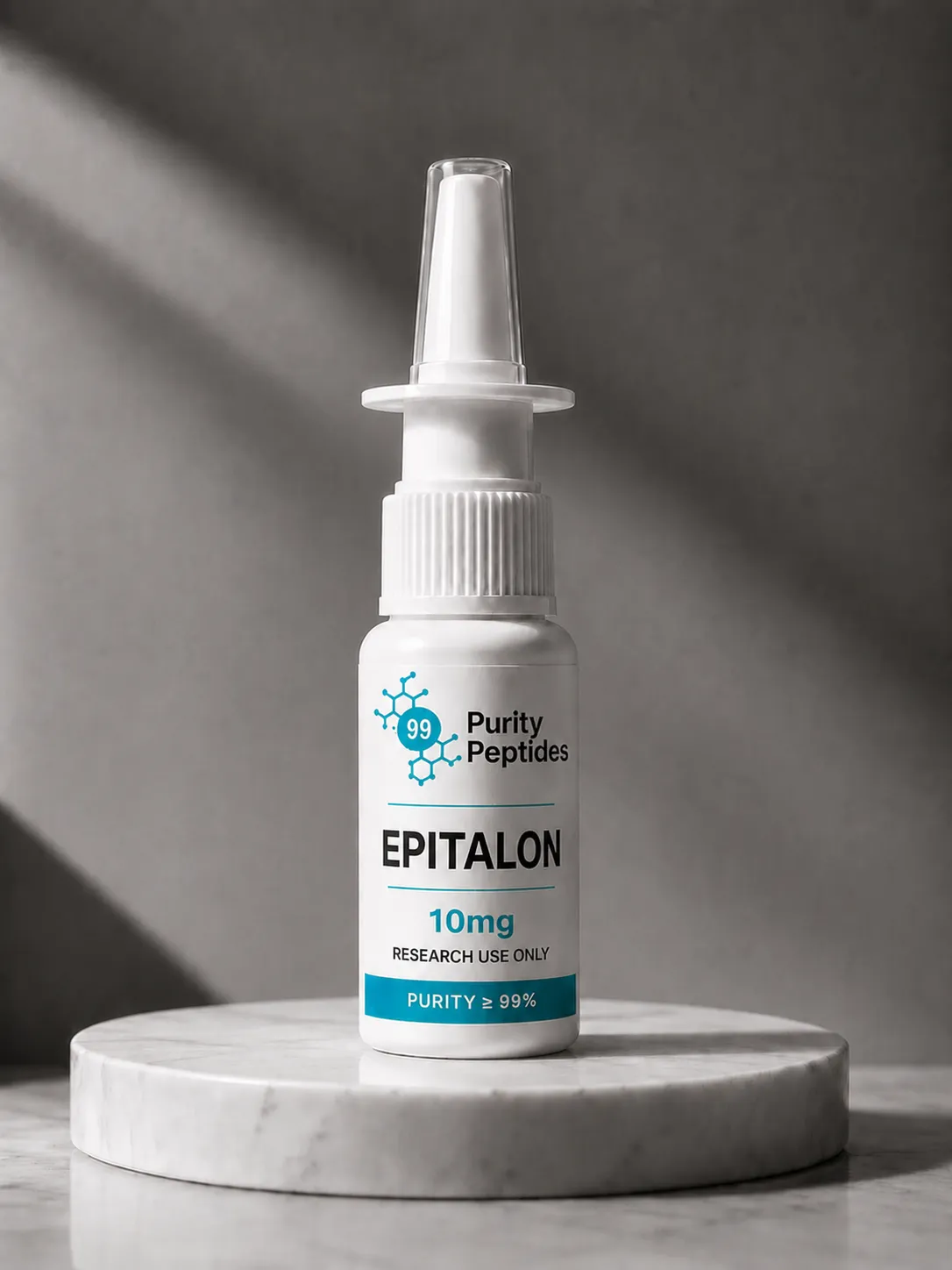
Research Use Only. Epitalon and every product referenced on this page are supplied strictly for laboratory research and analytical applications. They are not approved for human consumption, therapeutic use, veterinary use, cosmetic use, or diagnostic purposes, and they are not intended for ingestion, injection, or any form of administration. Nothing here is medical, dosing, or health advice.
Key Takeaways
- Epitalon and epithalon are two transliterations of the same compound: the AEDG tetrapeptide, CAS 307297-39-8, molecular weight 390.35 g/mol.
- The foundational telomerase finding comes from a 2003 cell-culture study in telomerase-negative human fetal fibroblasts, not from human trials.
- A 2025 study from Brunel University London independently reproduced telomerase and telomere effects in cultured cells. It carries a published correction to three figures.
- That 2025 work found telomerase activity rose in normal cells but not in the cancer lines tested, which extended telomeres through a separate ALT pathway instead.
- At roughly 390 Da, epitalon sits in the molecular weight band where nasal absorption is generally most favorable. That is a structural inference, not a measurement of this compound.
- No published pharmacokinetic study reports epitalon's nasal bioavailability, plasma concentration, or nose-to-brain fraction.
- A bottle figure such as 10mg or 50mg describes total peptide in the container, not the amount in one actuation.
- Epitalon has no FDA approval for any indication. A July 2026 advisory committee recommended it for the 503A compounding list over FDA staff objections, and that recommendation is non-binding.
What Is Epitalon?
Epitalon is a four-residue synthetic peptide: alanine, glutamic acid, aspartic acid, glycine. Chemists write it Ala-Glu-Asp-Gly, or AEDG in single-letter code. Its molecular formula is C14H22N4O9, its molecular weight 390.35 g/mol, and its CAS number 307297-39-8 (PubChem CID 219042).
The compound came out of Vladimir Khavinson's short peptide bioregulator program at the St. Petersburg Institute of Bioregulation and Gerontology. That program began with epithalamin, a polypeptide extract from bovine pineal gland. Researchers there synthesized epitalon based on the amino acid composition of that extract, and the AEDG sequence was later identified in pineal gland extract directly.
The distinction between the two matters when reading the literature. Epithalamin is a multi-component tissue extract. Epitalon is a single defined tetrapeptide. Findings reported for epithalamin may reflect contributions from other components, so they do not transfer automatically to the purified peptide. Several widely circulated human observations, including a long-running elderly mortality cohort, used epithalamin rather than epitalon.
Epitalon belongs to a wider family of Khavinson short peptides that includes Vilon (KE), Pinealon (EDR), and Cartalax (AED). For the full family and the verified sequence table, see our peptide bioregulators guide. For compound-level mechanism depth beyond the format question, see the existing epithalon research guide.
Is Epitalon the Same as Epithalon?
Yes. Both spellings refer to the same AEDG tetrapeptide, and both appear in the primary literature.
The variation traces back to transliteration from Russian. The originating research was published in Russian, and the Cyrillic source term has been rendered into the Latin alphabet inconsistently ever since. Some translators carried the "th" cluster across, producing epithalon and epithalone. Others dropped it, producing epitalon and epitalone. No chemical difference sits behind the difference in spelling.
The 2003 paper that established the telomerase finding is titled with "Epithalon." PubChem indexes the compound under "Epitalon." A 2025 review in the International Journal of Molecular Sciences opens by noting all three variants as names for the same molecule. Vendors split the same way, which is why the two spellings both generate real search volume.
This carries straight through to product listings. One supplier's epitalon spray is another's epithalon spray. A search for epithalon nasal spray and one for epitalon nasal spray describe the same format of the same compound. Neither spelling signals a different grade, source, or formulation.
For anyone comparing supplier listings, the practical check is the identifier rather than the spelling. Confirm the sequence is Ala-Glu-Asp-Gly and that the CAS number reads 307297-39-8. Those two fields settle the question regardless of how the product name is spelled on the label.
What Does the Telomerase Research Actually Show?
The research shows telomerase activation and telomere elongation in cultured human cells. It does not show either outcome in a living human being.
Telomerase is the enzyme that adds repeat sequences back onto chromosome ends, offsetting the shortening that happens with each division. Most human somatic cells switch it off. For the enzyme itself, its TERT and TERC subunits, and how activity is measured, see our telomerase enzyme guide.
The 2003 Foundational Study
Khavinson, Bondarev and Butyugov added epithalon to cultures of telomerase-negative human fetal fibroblasts. They reported induced expression of the telomerase catalytic subunit, increased enzymatic activity, and telomere elongation, and concluded this indicated reactivation of the telomerase gene in somatic cells.[1]
Three constraints belong alongside that result. The work was published in Bulletin of Experimental Biology and Medicine, a Russian journal, as a three-page report. It was conducted in a single cell type. And it came from the same institute that developed the compound, so it was not an independent test of the claim.
A companion paper from the same group in 2004 reported that treated fibroblast cultures divided beyond the conventional Hayflick limit.[2] Secondary sources quote conflicting figures for how far past that limit the cultures went. Read the specific number from the paper rather than from vendor summaries.
The 2025 Independent Replication
In September 2025, a group at Brunel University London and Royal Brompton Hospital published the quantitative replication the field had lacked.[3] They treated two breast cancer lines (21NT, BT474), a fibroblast line (IBR.3), and normal human mammary epithelial cells with epitalon at 0.1 to 1 µg/ml.
Telomere length increased across all four lines. hTERT expression rose roughly 12-fold in 21NT at 1 µg/ml. The split in mechanism was the more interesting result. Telomerase activity rose in the normal cells but not in the cancer lines. Those extended telomeres through alternative lengthening of telomeres (ALT) instead. Normal cells also needed a three-week incubation where the cancer lines responded in four days.
Two caveats apply. This is still cell culture, not an organism. And the paper carries a published correction, issued in November 2025.[4] The authors reported that the wrong versions of Figures 1, 2 and 3 appeared in the original article. Corrected figures are available with the notice. Anyone citing the numbers should work from the corrected version.
What the Animal Work Reports
The most cited rodent study used female Swiss-derived SHR mice, 54 per group.[5] Animals received subcutaneous epitalon at 1.0 µg per mouse. Dosing ran five consecutive days each month, from three months of age until natural death.
The headline result is more qualified than its reputation suggests. Epitalon did not change mean lifespan. It did increase maximum lifespan by 12.3%, and the lifespan of the last 10% of survivors by 13.3%. Chromosome aberrations in bone marrow cells fell by 17.1%. Total spontaneous tumor incidence was unchanged, though leukemia development was inhibited.
A null result on mean lifespan sits at the center of the study most often cited as lifespan evidence. That distinction is routinely lost in secondary summaries, and it is worth carrying forward when reading any claim built on this literature.
Why a Nasal Spray Format?
The argument for supplying an epitalon peptide spray rather than a powder is structural. It is worth stating precisely, because the structural case is all that exists here.
Nasal absorption of peptides varies with molecular weight in a fairly consistent pattern. Below roughly 1,000 Da, reported systemic bioavailability can reach the tens of percent. Between about 1,000 and 3,500 Da it typically falls to low single digits, which is where desmopressin and salmon calcitonin sit. Above that, absorption drops below one to two percent without permeation enhancers.
At 390.35 g/mol, epitalon sits comfortably in the most favorable band. It is one of the smaller compounds in any nasal spray catalogue. Our intranasal peptide delivery guide covers the olfactory and trigeminal pathways, mucosal anatomy, and the bioavailability bands in full.
The Caveat That Most Pages Skip
Favorable molecular weight is an inference from a general relationship. It is not a measurement of this compound.
We could not locate a published pharmacokinetic study of intranasal epitalon. No indexed paper appears to report its nasal bioavailability, plasma concentration curve, or absorbed fraction in any species. The 2025 review makes a related point about the corpus as a whole. Physico-chemical and structural investigation is limited relative to the volume of biological work.[6]
One intranasal study does exist, and it is worth describing accurately because it is often cited as if it settled the delivery question. Sibarov and colleagues administered epitalon intranasally to anesthetized Wistar rats at 30 ng per animal and recorded spontaneous neuron activity in the neocortex.[7] Discharge frequency rose by a factor of two to two and a half, with peaks at 5 to 7, 11 to 12, and 17 to 18 minutes.
That is a pharmacodynamic result. The researchers measured what neurons did, not how much peptide arrived or where it went. A change in cortical firing is consistent with the peptide reaching the CNS. But the study reports no concentration, no absorbed fraction, and no bioavailability figure.
Systemic Absorption Is Not Nose-to-Brain Delivery
These two things get conflated constantly, including in marketing copy for nasal peptides generally.
Systemic nasal bioavailability describes how much compound crosses the nasal mucosa into general circulation. Nose-to-brain delivery describes the much smaller fraction that travels directly along olfactory and trigeminal pathways into the CNS, bypassing the blood-brain barrier. Nearly every published bioavailability percentage measures the first. The direct CNS fraction is a separate and considerably smaller number.
For epitalon specifically, neither figure has been published. Treat the format as a handling and formulation choice rather than a delivery route with established performance characteristics.
What Does 10mg or 50mg on the Bottle Actually Mean?
It means total peptide content in the container. It does not describe the amount in a single actuation.
Converting between the two requires three numbers: total peptide mass, total fill volume, and metered actuation volume. Total mass gives concentration only when paired with fill volume. Concentration gives per-actuation content only when paired with the volume the pump delivers per press, which is set by the pump hardware.
99 Purity Peptides lists Epitalon Spray in 10mg and 50mg sizes, matching the epithalon 10mg and epithalon 50mg strengths offered in the lyophilized vial. Neither the fill volume nor the metered actuation volume is published on the spray product page at the time of writing. A per-actuation figure therefore cannot be derived from the listing alone. We are not going to estimate one. A per-actuation number resting on an assumed fill volume is a guess presented as a specification. It would be wrong in exactly the way that matters.
The same caution applies when comparing suppliers. Two bottles both labeled 50mg can differ in concentration if their fill volumes differ. They can differ again in per-press content if their pumps are calibrated differently. The label figure alone does not make two products comparable.
Spray Format Versus Lyophilized Vial
Both formats supply the same tetrapeptide. They differ in what the receiving lab controls and what it has to do before use. 99 Purity Peptides lists both: the spray and the lyophilized vial.
Consideration | Nasal spray (in solution) | Lyophilized vial (powder) |
|---|---|---|
Preparation | None. Supplied ready in solution. | Requires reconstitution with a suitable diluent before use. |
Concentration control | Fixed by the manufacturer at fill. | Set by the lab, by choosing diluent volume. |
Per-unit metering | Determined by pump hardware; depends on published fill and actuation volumes. | Determined by the lab's own measurement. |
Stability profile | In solution from manufacture, so the peptide is exposed to hydrolysis for the whole shelf life. | Dry state is substantially more stable; the clock starts at reconstitution. |
Storage demand | Fixed by the supplied formulation. | Dry powder tolerates a wider range; solution does not. |
Documentation | COA covers the peptide lot; formulation details depend on what the supplier publishes. | COA covers the peptide lot directly, with no formulation layer in between. |
Analytical transparency | Fill volume and actuation volume needed to characterise fully. | Mass and diluent volume are both known to the lab. |
The trade-off is convenience against control. A spray removes a preparation step and the variability that comes with it. A vial gives the lab authority over concentration and a much longer stable window before the peptide enters solution. Which one fits depends on whether the study design needs a defined concentration the lab set itself.
How Should Epitalon Be Stored?
Storage requirements diverge sharply between the two formats, because the dominant degradation pathway differs.
A lyophilized short peptide is comparatively stable. Removing water removes the medium for hydrolysis, which is the main route by which peptide bonds break down. Once a peptide enters solution, that protection is gone and the shelf clock runs faster.
Epitalon carries two acidic side chains, glutamic acid and aspartic acid. Aspartic acid residues in particular are associated with pH-sensitive backbone cleavage in aqueous conditions. Solution-phase storage of Asp-containing peptides therefore warrants attention to buffer conditions. The 2025 review notes plainly that short peptides of this class are typically unstable and degrade rapidly in vivo.[6]
Factor | Lyophilized powder | In solution |
|---|---|---|
Primary degradation route | Slow, mainly moisture ingress and oxidation | Hydrolysis, accelerated by unfavorable pH |
Temperature | Cold storage for long-term holding; short excursions tolerated | Refrigerated storage; far less tolerant of excursions |
Light | Protect from light | Protect from light |
Moisture | The critical variable. Warm to room temperature before opening to avoid condensation. | Already aqueous; the concern shifts to buffer and pH |
Freeze-thaw | Not applicable while dry | Repeated cycles are a known stressor; aliquoting limits exposure |
Practical shelf position | Longer stable window | Shorter stable window from date of manufacture |
Because a spray arrives already in solution, its stable window began at manufacture rather than at the point the lab opened it. That makes lot date and supplier storage conditions more consequential for a spray than for a vial. Our peptide storage guidelines cover temperature bands, aliquoting, and degradation chemistry in more depth.
What Should a Complete COA Show for a Tetrapeptide?
Three things, and they answer three different questions.
Identity answers whether the vial contains the right molecule. For epitalon, mass spectrometry should return an observed mass matching the theoretical mass for C14H22N4O9, around 390.35 g/mol on an average-mass basis. A four-residue peptide leaves little room for ambiguity. That makes an absent or vague identity section harder to excuse than on a long sequence.
Purity answers what proportion of the peptide-related material is the target sequence. HPLC gives this as a percentage of the chromatogram area. It is a relative measure, so a high figure describes the peptide fraction and says nothing about how much peptide is in the container.
Net peptide content answers how much of the vial's mass is actually peptide. The remainder is counter-ion, residual water, and salts. This field is the one most often missing from research-market COAs. It determines whether a stated milligram figure reflects peptide or total powder mass. Epitalon is commonly supplied as a free base or as an acetate or trifluoroacetate salt, and the salt form affects this number directly.
A short peptide with three carboxyl groups is also a candidate for counter-ion variability between lots. That is another argument for reading the specific lot document rather than a generic one. 99 Purity Peptides publishes lot COAs in its certificates library, and the lyophilized Epithalon vial links a lot-specific certificate directly from the product page. For a field-by-field walkthrough, see our guide on how to read a certificate of analysis.
What the Evidence Does Not Establish
This section matters more than any other on the page, because the gap between what epitalon is marketed for and what has been demonstrated is unusually wide.
No large-scale human trials. There is no published randomised controlled trial of epitalon for any endpoint. The human-facing observations most often cited, including the elderly mortality cohort work, largely used epithalamin, the pineal extract, rather than the purified tetrapeptide.
The literature is old, small, and concentrated. Much of the primary work appeared between the late 1990s and mid-2000s, in Russian-language journals. The researchers were connected to the institute that developed the compound. Sample sizes are small. Independent Western replication arrived only in 2025, and only in cell culture.
Mechanism is not settled. The 2025 review states directly that the precise mechanism of action remains unverified, and that structural and physico-chemical characterization lags well behind the biological work.[6]
Telomerase activation is not self-evidently desirable. Cancer cells depend on telomere maintenance, and the 2025 replication observed telomere extension in breast cancer lines through the ALT pathway. This is a live scientific question, not a settled benefit.
No FDA approval, and a contested regulatory record. Epitalon is not approved for any indication. On 24 July 2026, the FDA's Pharmacy Compounding Advisory Committee voted 7-5 with one abstention to recommend epitalon for the 503A Bulks List, for insomnia. The committee overrode FDA staff in doing so.[8]
FDA's own briefing package stated there were no publications addressing the efficacy of epitalon in patients with insomnia. It also flagged immunogenicity risk, potentially amplified by aggregation, alongside potential peptide-related impurities. Committee members voting against cited poor characterization and insufficient safety data.
The vote is a recommendation only. It is not binding, it is not approval, and it does not change Research Use Only status.
No delivery data for the nasal format. As covered above, no published pharmacokinetic study establishes what an intranasal dose of epitalon achieves in any species.
Taken together: a real, reproducible cell-culture finding sits at the center of this compound. A large gap separates that finding from the claims commonly attached to it.
Where to Go From Here
Epitalon is a well-defined molecule with a narrow but genuine evidence base. The telomerase result has now been reproduced by an independent laboratory, which is more than can be said for many compounds in this category. What has not been established is anything about outcomes in humans, or anything about what the nasal format delivers.
For laboratories choosing between formats, the question is control. A spray removes preparation steps; a lyophilized vial lets the lab set concentration and keeps the peptide dry until it is needed. Both are listed: Epitalon Spray in 10mg and 50mg, and the lyophilized Epithalon vial with a lot-specific COA.
For compound-level mechanism and the pineal signalling literature, see the epithalon research guide. For how epitalon compares with another peptide often studied alongside it, see DSIP vs Epitalon. For the delivery science behind every spray in the catalogue, see the intranasal peptide delivery guide.
Frequently Asked Questions
Is epitalon the same as epithalon?
Yes. Both spellings describe the same synthetic tetrapeptide, Ala-Glu-Asp-Gly, CAS 307297-39-8. The difference comes from inconsistent transliteration of the original Russian term into the Latin alphabet. Epithalone and epitalone appear as further variants. An epithalon spray and an epitalon spray are the same product. When comparing listings, check the sequence and CAS number rather than the spelling.
What is epitalon nasal spray?
It is the AEDG tetrapeptide supplied already dissolved in solution inside a metered spray bottle, rather than as a lyophilized powder requiring reconstitution. The compound is identical to what a vial contains. The difference is formulation and handling: a spray removes the preparation step but fixes concentration at manufacture rather than leaving it to the lab.
Has epitalon nasal absorption been measured?
Not in any study we could locate. No indexed publication reports epitalon's nasal bioavailability, plasma concentration curve, or absorbed fraction. The case for nasal delivery rests on molecular weight, since compounds under about 1,000 Da generally cross nasal mucosa more readily. That is a structural inference from a general relationship, not a measurement of this compound.
Is there any intranasal epitalon study at all?
Yes, one. Sibarov and colleagues gave anesthetized Wistar rats 30 ng of epitalon intranasally and recorded cortical neuron firing, which rose two to two-and-a-half fold in a multiphasic pattern. That is a pharmacodynamic result. It measured what neurons did, not how much peptide was absorbed, so it establishes no bioavailability figure.
What did the 2003 telomerase study actually find?
Khavinson, Bondarev and Butyugov added epithalon to telomerase-negative human fetal fibroblast cultures and reported induced expression of the telomerase catalytic subunit, increased enzymatic activity, and telomere elongation. It was a short report, in one cell type, from the institute that developed the compound. Findings were in cell culture only.
Has the telomerase finding been independently replicated?
Yes, in 2025. A group at Brunel University London reported telomere lengthening across breast cancer lines, fibroblasts, and normal mammary epithelial cells. Telomerase activity rose in normal cells but not in the cancer lines, which used the ALT pathway instead. The paper carries a published correction to three figures, issued in November 2025.
Does epitalon extend lifespan?
That is not established, and the most cited rodent study is more qualified than its reputation. In female SHR mice, epitalon did not change mean lifespan. It increased maximum lifespan by 12.3% and the lifespan of the last 10% of survivors by 13.3%. No human lifespan data exists. No claim about human outcomes is supported.
What does 50mg mean on an epitalon spray bottle?
Total peptide content in the container, not the amount delivered per actuation. Deriving a per-press figure requires the fill volume and the metered actuation volume, and those figures are not published for this product. Two bottles labeled 50mg can differ in concentration and per-press content if fill or pump specifications differ.
Spray or lyophilized vial: which suits a research application better?
It depends on whether the study needs lab-defined concentration. A spray is ready to use and removes reconstitution variability, but concentration is fixed at manufacture and the peptide has been in solution since then. A vial keeps the peptide dry, giving a longer stable window, and lets the lab set concentration by choosing diluent volume.
How should epitalon be stored?
Storage depends on format. Lyophilized powder is comparatively stable and benefits from cold, dry, dark storage, with warming to room temperature before opening to avoid condensation. Material already in solution is more vulnerable to hydrolysis, tolerates temperature excursions poorly, and has a stable window that started at manufacture rather than at delivery.
What should a COA for epitalon show?
Three distinct fields. Identity by mass spectrometry, with observed mass matching the theoretical value for C14H22N4O9 near 390.35 g/mol. Purity by HPLC, reported as a percentage of chromatogram area. And net peptide content, which states how much of the vial mass is peptide rather than counter-ion, salts, and residual water.
Is epitalon FDA approved?
No. Epitalon has no FDA approval for any indication. In July 2026 an FDA advisory committee voted 7-5 with one abstention to recommend it for the 503A compounding bulks list for insomnia, overriding FDA staff objections. That vote is a non-binding recommendation, not approval, and it does not alter Research Use Only status.
What is the difference between epitalon and epithalamin?
Epithalamin is a multi-component polypeptide extract from bovine pineal gland. Epitalon is a single synthetic tetrapeptide developed from the amino acid composition of that extract. Findings for epithalamin may reflect other components, so they do not transfer automatically. Several widely cited human observations used epithalamin rather than the purified peptide.
Why is so much of the epitalon literature in Russian?
The compound originated in Vladimir Khavinson's short peptide bioregulator program at the St. Petersburg Institute of Bioregulation and Gerontology. Most primary work was published in Russian-language journals between the late 1990s and mid-2000s by researchers connected to that institute. Independent Western replication arrived only in 2025, and only in cell culture.