Research Use Only. All products and information referenced on this page are intended strictly for laboratory research use. These compounds are not drugs, foods, cosmetics, or dietary supplements. They have not been evaluated by the FDA and are not approved for the diagnosis, treatment, cure, or prevention of any disease. |
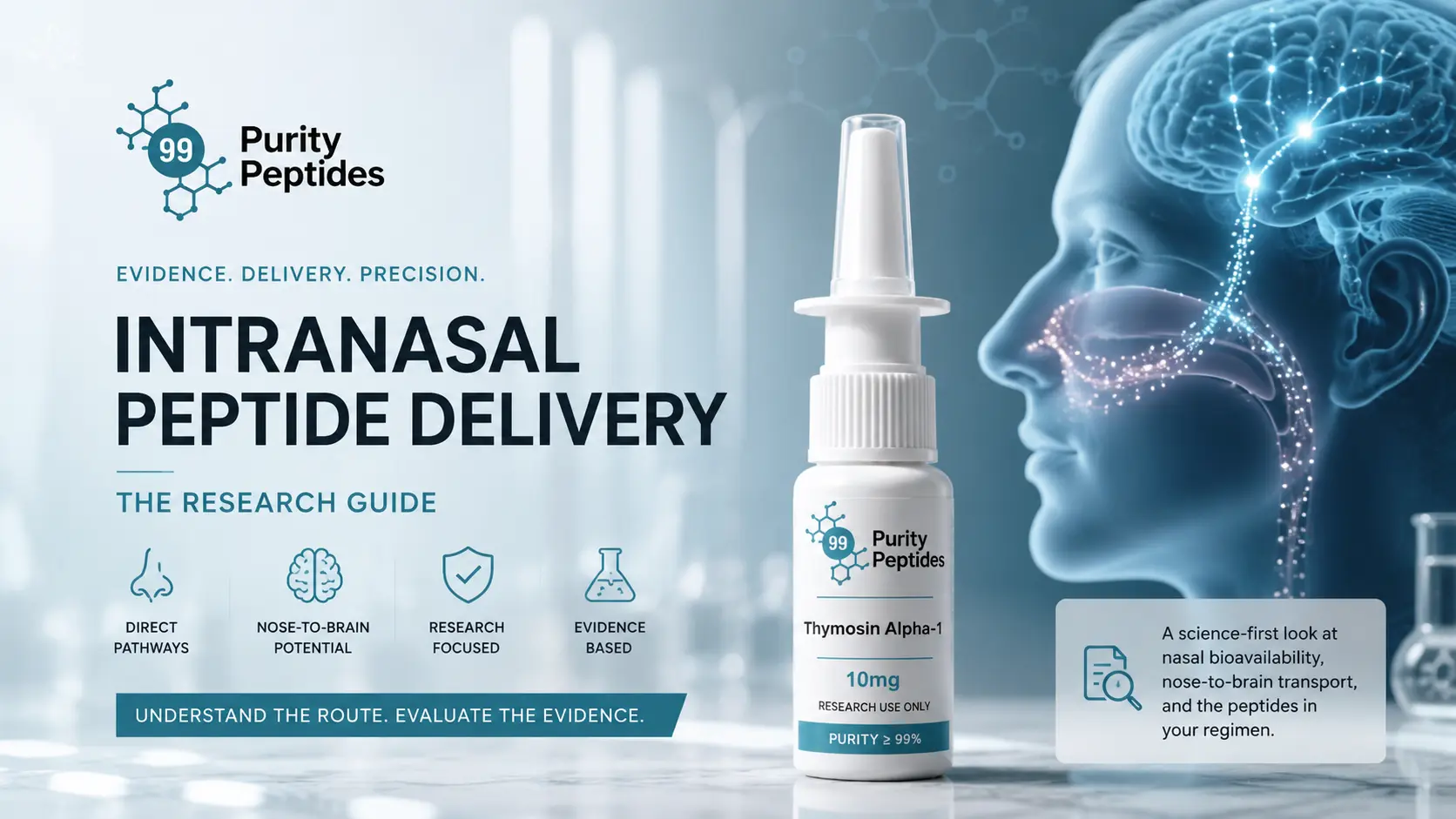
Quick answer. Intranasal peptide delivery uses the nasal mucosa to move a compound into systemic circulation and, via the olfactory and trigeminal nerves, directly into the central nervous system. Absorption depends heavily on molecular weight: peptides under roughly 1,000 daltons can reach 50–70% systemic bioavailability, while larger peptides fall to a few percent or less. The fraction reaching the brain directly is a separate and considerably smaller number.
Key takeaways
- Two destinations, two numbers. Systemic absorption and direct nose-to-brain transport are distinct processes with very different efficiencies. Most published bioavailability figures describe the systemic route.
- Molecular weight dominates. An 800 Da peptide behaves nothing like a 3,400 Da one. Reported nasal bioavailability spans roughly 70% down to under 1% across that range.
- Approved nasal peptide drugs establish the ceiling. Desmopressin and salmon calcitonin are marketed as nasal sprays with bioavailability in the 3–4% range — clinically useful because those molecules are potent, not because absorption is efficient.
- Deposition is a limiting factor independent of the molecule. The olfactory epithelium occupies a small, high-set region of the nasal cavity, and conventional spray devices deposit mostly anteriorly.
- For research use, the route is a variable requiring controls — device, droplet size, head position, and volume per actuation all affect what is delivered.
Why intranasal delivery is studied
The nasal route exists in peptide research because the two obvious alternatives each fail for a structural reason.
Oral administration destroys most peptides before absorption. Gastric acid and intestinal proteases cleave peptide bonds efficiently, and what survives faces poor epithelial permeability followed by hepatic first-pass metabolism. For most peptides the oral fraction reaching circulation is negligible.
Injection works but is invasive, requires sterile technique, and delivers to systemic circulation — from which the central nervous system remains largely inaccessible.
Intranasal delivery is studied because it addresses both problems at once. The nasal mucosa presents roughly 150 cm² of well-vascularised surface, absorption there bypasses first-pass hepatic metabolism, and the olfactory region offers a direct anatomical connection to the brain that no other non-invasive route provides.
The blood-brain barrier problem
The blood-brain barrier is a selective interface formed by tight junctions between the endothelial cells lining cerebral capillaries, and it is the reason systemic delivery rarely produces meaningful CNS exposure.
The barrier's selectivity is severe. Published estimates hold that it excludes roughly 98% of small-molecule drugs and effectively all macromolecules. Peptides — hydrophilic, charged, and larger than the passive-diffusion threshold — sit firmly in the excluded category.
That constraint drives the entire nose-to-brain research field. If a compound cannot cross the barrier from the blood, the only non-invasive alternative is a route that never enters the blood first.
Why peptides are rarely formulated orally
Peptide bonds are chemically vulnerable, and the gastrointestinal tract is optimised to break them.
Three barriers compound. Proteolytic enzymes in the stomach and small intestine cleave peptide backbones. The intestinal epithelium permits limited paracellular transport of hydrophilic molecules of peptide size. And whatever is absorbed passes through hepatic circulation before reaching the systemic compartment.
Nasal formulation avoids all three. That advantage is real regardless of whether CNS delivery is the objective, and it explains why several peptide drugs reached market as nasal sprays despite modest absorption efficiency.
The two pathways to the brain
Material deposited in the nasal cavity can reach the central nervous system by two neural routes, and it can enter systemic circulation by a third, entirely separate mechanism. Distinguishing them is the single most useful thing a researcher can do when reading claims about nasal delivery.
The olfactory pathway
The olfactory pathway carries material from the olfactory epithelium in the upper nasal cavity, across the cribriform plate, to the olfactory bulb and onward into the CNS.
This route is anatomically unusual. Olfactory sensory neurons extend directly into the nasal cavity, making the olfactory epithelium the only site where the nervous system is exposed to the external environment without an intervening barrier. Transport proceeds along and around these neurons and into perivascular spaces, with subsequent distribution assisted by cerebrospinal fluid movement.
The constraint is geometric. The olfactory epithelium occupies a small fraction of total nasal surface area and sits high in the cavity, behind and above the region where a conventional spray deposits. Reaching it is a formulation and device problem before it is a molecular one.
The trigeminal pathway
The trigeminal pathway provides a second neural route, using branches of the trigeminal nerve that innervate the respiratory epithelium across a much larger area of the nasal cavity.
Trigeminal fibres enter the CNS at the brainstem rather than the olfactory bulb, producing a different distribution pattern within the brain. The larger accessible surface area is an advantage over the olfactory route; the longer transport distance is a disadvantage.
Both pathways typically operate together after nasal administration, and separating their relative contributions experimentally remains difficult.
Systemic absorption through the respiratory epithelium
Most material deposited in the nasal cavity is not taking either neural pathway. It is being absorbed into the bloodstream through the respiratory epithelium — the highly vascularised tissue covering the majority of the nasal cavity.
This is ordinary systemic absorption. It bypasses hepatic first-pass metabolism, which is a genuine pharmacokinetic advantage, but it delivers to circulation rather than to the brain. A compound absorbed this way then faces the blood-brain barrier exactly as an injected compound would.
The distinction is not academic. When a source reports that a nasal peptide has 4% bioavailability, that figure almost always describes systemic absorption measured in plasma. It says nothing about how much reached the CNS directly.
Why "bypasses the blood-brain barrier" is accurate but incomplete
The statement is true of the neural pathways and false of everything else that happens in the nasal cavity.
Material travelling the olfactory or trigeminal routes does reach the CNS without crossing the blood-brain barrier. That is the mechanism the nose-to-brain field is built on, and it is well supported.
But those pathways handle a minority of an administered dose. The majority is either absorbed systemically, cleared by mucociliary transport, or swallowed. Presenting the bypass mechanism without the proportion is where most commercial descriptions of nasal peptide delivery become misleading.
The accurate framing: nasal administration provides a direct CNS route that no other non-invasive method offers, and the fraction of dose using that route is small.
Bioavailability — what the numbers actually say
Nasal peptide bioavailability is not a single number. It varies across roughly two orders of magnitude, and molecular weight explains most of that variation.
Molecular weight is the dominant variable
The nasal epithelium behaves as a size-selective barrier. Small molecules cross it readily; absorption falls sharply as molecular weight rises.
Molecular weight | Reported nasal bioavailability | Reference point |
|---|---|---|
Under ~1,000 Da | Approximately 50–70% | An ~800 Da octapeptide reached 73% in rat studies |
~1,000–3,500 Da | Approximately 3–5% | Desmopressin (~1,070 Da): 3.3–4.1% |
~3,000–3,500 Da | Approximately 3% | Salmon calcitonin (~3,432 Da), 32 residues |
Above ~3,500 Da | Under 1–2% without enhancement | Biologics and larger proteins |
This gradient explains a pattern that otherwise looks arbitrary — why some peptides are marketed as nasal sprays and others are not.
Short peptides sit in the favourable band. A tripeptide near 400 Da, a tetrapeptide near 390 Da, and a heptapeptide near 750–815 Da all fall below the 1,000 Da threshold where nasal absorption is reasonably efficient. Peptides in the low kilodalton range fall into the few-percent band. Anything substantially above that requires formulation enhancement to achieve meaningful absorption at all.
The practical consequence for research design: check the molecular weight before assuming a route is viable. It is the first-order variable, and it is available on any certificate of analysis.
What approved nasal peptide drugs demonstrate
Several peptide drugs have reached market as nasal sprays, and their pharmacokinetics establish what the route can realistically achieve.
Desmopressin, a nine-residue vasopressin analogue near 1,070 Da, is marketed as a nasal spray with reported bioavailability of 3.3–4.1%. It has been used clinically for decades.
Salmon calcitonin, a 32-residue peptide near 3,432 Da, is marketed as Miacalcin nasal spray for postmenopausal osteoporosis with nasal bioavailability around 3%.
Nafarelin, a GnRH agonist, is FDA-approved for intranasal administration.
Two conclusions follow. Nasal delivery of peptides is an established pharmaceutical route, not a speculative one. And it works clinically at single-digit bioavailability because the molecules involved are potent enough that a small absorbed fraction is sufficient — not because absorption is efficient.
Device design matters measurably. A comparative study of desmopressin found spray administration produced a two- to three-fold increase in relative bioavailability compared with drops, attributable to deposition pattern and residence time rather than any change to the molecule.
Mucociliary clearance and residence time
Mucociliary clearance is the coordinated ciliary transport of the nasal mucus layer toward the nasopharynx, and it is the principal reason nasal formulations have limited time to be absorbed.
The nasal cavity continuously moves its mucus layer backward, where it is swallowed. Anything deposited on that layer is carried along with it. A formulation with low mucosal affinity may be cleared before a substantial fraction has crossed the epithelium.
This is why mucoadhesive excipients and viscosity modifiers appear throughout the nasal formulation literature. Extending residence time is one of the few levers available that does not require altering the peptide.
Deposition — where the spray actually lands
Absorption cannot occur where the formulation never arrives, and deposition is a substantial and under-discussed constraint.
Spray devices deposit predominantly in the anterior nasal cavity. The olfactory epithelium — the tissue offering the direct CNS route — sits high and posterior. Published deposition studies report that only a modest percentage of an administered volume reaches the total nasal cavity surface, with olfactory-region coverage lower still.
Several variables affect the outcome: droplet size, spray angle, actuation force, administered volume, and head position during administration. Formulation studies have suggested particle sizes in the low micron range are appropriate for olfactory deposition, and that inspiratory flow rate during administration matters.
For research purposes, the implication is direct. Device and technique are experimental variables, not incidental details. Two researchers using different devices and head positions with identical solution are running different experiments.
Formulation approaches in the literature
Enhancement strategies for nasal peptide delivery cluster into four approaches, at differing stages of evidence.
Approach | Mechanism | Evidence stage |
|---|---|---|
Mucoadhesive excipients | Extend nasal residence time by resisting mucociliary clearance | Established; used in marketed products |
Permeation enhancers (surfactants, bile salts) | Transiently increase epithelial permeability | Established in preclinical work; some clinical use; tolerability constrains selection |
Cell-penetrating peptides | Facilitate transepithelial translocation of the cargo molecule | Active research; largely preclinical |
Lipid nanocarriers and nanoemulsions | Protect cargo, modify deposition, improve mucosal interaction | Active research; systematic reviews published, clinical translation limited |
Two observations are worth carrying forward.
Enhancement strategies are aimed principally at molecules that need them — larger peptides and biologics in the low-bioavailability band. A short peptide already absorbing at 50–70% has considerably less to gain.
And several approaches that performed well in animal models have not translated to clinical success, which is a general caution about extrapolating from preclinical nasal delivery data.
Intranasal versus subcutaneous
Intranasal | Subcutaneous | |
|---|---|---|
Systemic bioavailability | Highly MW-dependent: ~70% under 1 kDa, ~3–5% at 1–3.5 kDa, under 1–2% above | Generally high across the peptide range |
Direct CNS access | Yes, via olfactory and trigeminal pathways — small fraction of dose | No; must cross the blood-brain barrier from circulation |
First-pass metabolism | Avoided | Avoided |
Onset | Rapid; nasal mucosa is well vascularised | Slower; depends on depot absorption |
Inter-subject variability | Higher — affected by mucosal condition, technique, device | Lower |
Technique dependence | High — device, angle, volume, head position | Moderate — depth and site |
Sterility requirement | Non-sterile route, though formulation stability still matters | Sterile technique required |
Formulation stability | Aqueous solution; shorter usable life | Reconstituted from lyophilized; also limited |
The comparison rarely resolves to one route being better. It resolves to which limitation matters for a given research question.
If the endpoint is systemic exposure of a large peptide, subcutaneous delivery is more efficient and far more reproducible. If the endpoint involves CNS exposure, the nasal route offers something injection cannot, at the cost of higher variability and a small delivered fraction. If the compound is a short peptide under 1,000 Da, nasal absorption may be efficient enough that the route choice turns on convenience and variability tolerance rather than bioavailability.
Peptides studied intranasally
Neuropeptides — Selank, Semax, DSIP, VIP
The neuropeptides are the compounds for which intranasal administration has the clearest rationale, since CNS exposure is the point.
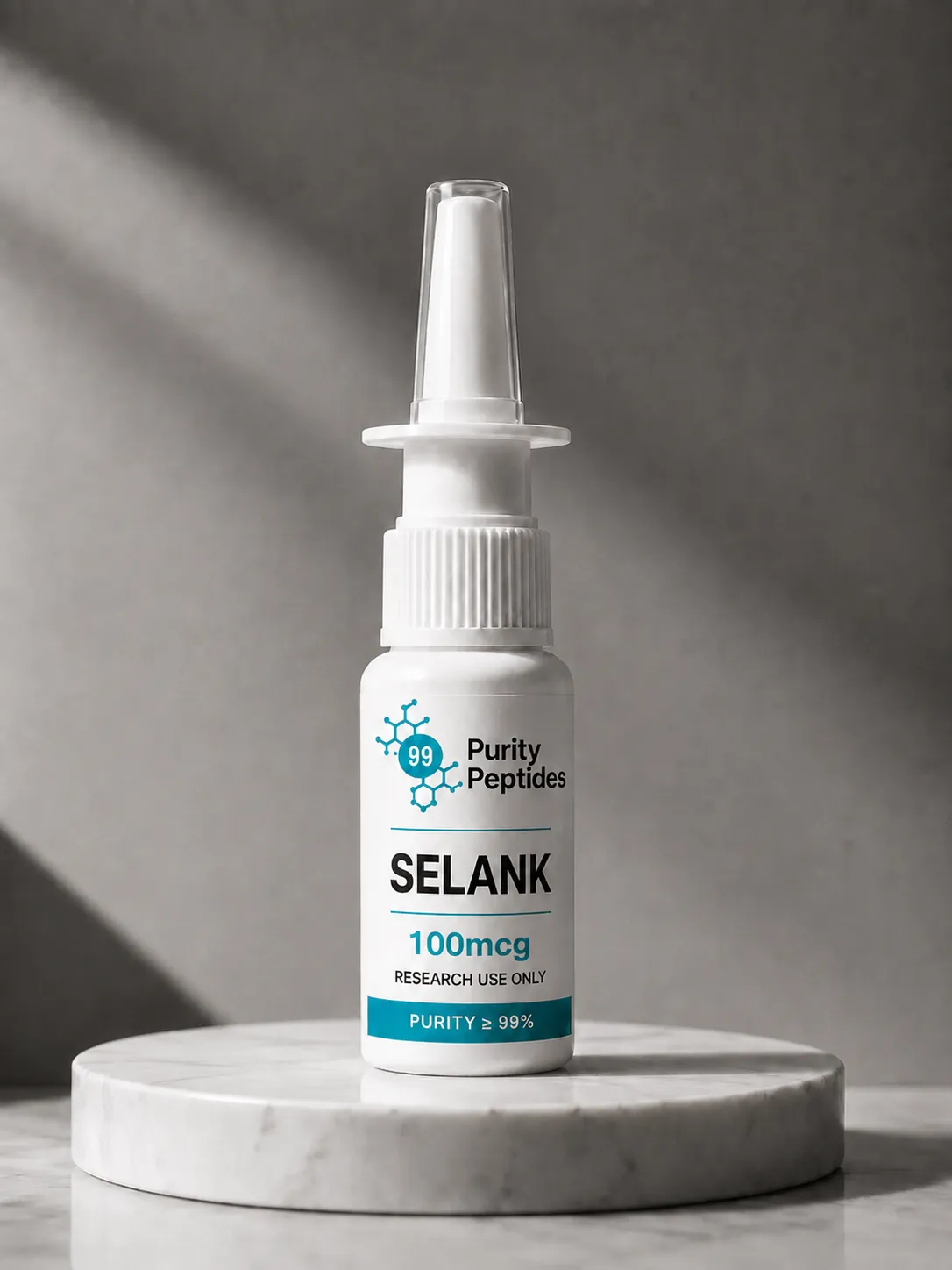
Selank (seven residues, approximately 751 Da) and Semax (seven residues, approximately 813 Da) both sit below the 1,000 Da threshold. Both originated in Russian research programmes where intranasal administration was the standard route from the outset.
DSIP — delta sleep-inducing peptide, nine residues, approximately 849 Da — also falls in the favourable weight band.
VIP — vasoactive intestinal peptide, 28 residues, approximately 3,326 Da — does not. At that molecular weight, nasal absorption falls into the low single-digit percentages seen with salmon calcitonin, and VIP appears in the formulation-enhancement literature for precisely that reason.
Available as Selank nasal spray, DSIP nasal spray, VIP nasal spray, and as a Semax and Selank combination spray. For a compound-level comparison of the two Russian neuropeptides, see our Semax and Selank comparison.
Locally acting — KPV and GHK-Cu
Two compounds in the nasal spray category are studied for effects at the mucosal surface itself, which changes the analysis entirely.
KPV is a tripeptide near 411 Da, examined in research on mucosal inflammatory signalling. GHK-Cu is a copper-binding tripeptide near 340 Da.
Where the research interest is local tissue rather than systemic or CNS exposure, systemic bioavailability becomes a secondary consideration — the relevant question is concentration at the mucosal surface. Both compounds are also small enough that systemic absorption would be efficient if it were the objective.
Available as KPV nasal spray and GHK-Cu nasal spray.
Systemically targeted — AOD-9604, MT-2 and PT-141
Three compounds in this category are studied for systemic rather than CNS or local effects, placing them in the intermediate weight band.
AOD-9604 (16 residues, approximately 1,815 Da), MT-2 (approximately 1,024 Da) and PT-141 (bremelanotide, approximately 1,025 Da) all sit above the 1,000 Da threshold. Expected nasal bioavailability for this range is in the low single-digit percentages — the desmopressin band rather than the octapeptide band.
That is not a disqualifying figure, since desmopressin functions clinically at 3–4%, but it does mean nasal and subcutaneous administration of these compounds are not equivalent exposures and should not be treated as interchangeable in a research protocol.
Available as AOD-9604 nasal spray, MT-2 nasal spray and PT-141 nasal spray.
Bioregulators — Epitalon
Epitalon is a tetrapeptide near 390 Da, well inside the favourable absorption band, and is supplied in nasal spray format alongside lyophilized powder.
Epitalon belongs to the Khavinson bioregulator family — a distinct compound class with its own proposed mechanism, covered in our guide to peptide bioregulators.
Available as Epitalon nasal spray.
Review the research materials. All nasal spray formulations ship with lot-specific certificates of analysis confirming sequence and purity.
View certificates of analysis →
Handling nasal formulations
Nasal sprays are supplied as aqueous solutions rather than lyophilized powder, and that single difference drives most of the handling considerations.
Solution versus lyophilized stability
Lyophilized peptide is considerably more stable than peptide in solution. Removing water removes the substrate for hydrolysis, and correctly stored lyophilized material remains stable for extended periods at -20°C.
A nasal spray is already reconstituted. Hydrolysis at the peptide bond proceeds from the moment the solution is prepared, and oxidation-prone residues — methionine, cysteine, tryptophan — remain vulnerable throughout.
The practical consequence is that nasal formulations have a defined usable window rather than an indefinite shelf life, and that window is materially shorter than lyophilized equivalents. Refrigerated storage, protection from light, and avoiding temperature cycling all extend it.
General storage protocols are covered in our peptide storage and stability guide.
Concentration and delivered volume
Nasal spray dosing is constrained by anatomy in a way injection is not.
The nasal cavity accommodates a limited volume per administration — typically around 100–200 µL per nostril, beyond which excess simply runs out or is swallowed. Every actuation therefore delivers a fixed volume, and the only variable available is concentration.
For research documentation, the figures that matter are concentration in mg/mL, volume per actuation, and the resulting mass per actuation. Our reconstitution calculator handles the concentration arithmetic where a formulation is being prepared rather than supplied ready-made.
Sterility and preservatives
The nasal route is not sterile, which relaxes one requirement and introduces another.
Because the nasal cavity is not a sterile compartment, nasal formulations do not carry the sterility requirement that injectable preparations do. But an aqueous solution stored and used over multiple actuations does need protection against microbial growth, which is why bacteriostatic agents and preservatives appear in nasal formulations.
Preservative selection interacts with the peptide. Some preservatives and surfactants affect peptide stability, and some affect mucosal tolerability. Where a formulation is being prepared rather than supplied, both interactions warrant checking against the specific compound.
Where this leaves the route
Intranasal delivery is a legitimate, pharmaceutically established route for peptides, with a genuine and unique property: it is the only non-invasive method that provides direct anatomical access to the central nervous system.
It is also a route with characterised limits. Absorption is strongly molecular-weight dependent. Mucociliary clearance constrains residence time. Deposition patterns mean much of an administered dose never reaches the region offering CNS access. And the direct nose-to-brain fraction is a separate, smaller number than the systemic bioavailability figures most sources quote.
For research purposes, that combination makes the route interesting rather than problematic — provided the variables are controlled and documented. Device, droplet size, volume per actuation, head position, and formulation composition all belong in a methods section, because they all affect what is actually delivered.
The claim worth being sceptical of is not that nasal peptides reach the brain. They do. It is any source that reports a bioavailability figure without specifying which compartment it measured.
Explore nasal spray research materials. Sequence-verified peptides in nasal spray format, with lot-specific certificates of analysis.
Browse the catalogue →
References
- De Martini LB, Sulmona C, Brambilla L, Rossi D. Cell-Penetrating Peptides as Valuable Tools for Nose-to-Brain Delivery of Biological Drugs. Cells. 2023;12(12):1643. PMC10296828
- Intranasal Nanoemulsions for Direct Nose-to-Brain Delivery of Actives for CNS Disorders. PMC7767046
- Nose-to-Brain Delivery of Therapeutic Peptides as Nasal Aerosols. PMC9502087
- Intranasal administration of peptides: nasal deposition, biological response, and absorption of desmopressin. PMID 3102719
- Systemic and brain delivery of antidiabetic peptides through nasal administration using cell-penetrating peptides. PMC9703138
- Navigating the Nose-to-Brain Route: A Systematic Review on Lipid-Based Nanocarriers for CNS Disorders. PMC10975610
- An overview of in vitro and in vivo techniques for characterization of intranasal protein and peptide formulations for brain targeting. Int J Pharm. 2024;654. PMID 38401871
A note on this page. This is an educational overview of published research. The pharmacokinetic data discussed on this page derives from published research on specific compounds and formulations, including approved pharmaceutical products. Those figures describe the compounds studied and do not automatically transfer to other peptides or formulations. We encourage you to verify any claim — ours included — against the primary literature cited above.
Research Use Only. All products and information referenced on this page are intended strictly for laboratory research use. These compounds are not drugs, foods, cosmetics, or dietary supplements. They have not been evaluated by the FDA and are not approved for the diagnosis, treatment, cure, or prevention of any disease. They are not for human or veterinary administration, and any such use is prohibited. Nothing on this page constitutes medical advice, administration guidance, or evidence of therapeutic effect.
Frequently Asked Questions
How does intranasal peptide delivery work?
Intranasal peptide delivery moves a compound across the nasal mucosa by two distinct mechanisms. Most of an administered dose is absorbed into systemic circulation through the well-vascularised respiratory epithelium, bypassing hepatic first-pass metabolism. A smaller fraction travels along the olfactory and trigeminal nerve pathways directly into the central nervous system, without crossing the blood-brain barrier.
Do peptide nasal sprays reach the brain?
Some fraction does. The olfactory and trigeminal nerve pathways provide direct anatomical routes from the nasal cavity into the central nervous system, bypassing the blood-brain barrier entirely. However, that fraction is small relative to the administered dose. Most material is absorbed systemically, cleared by mucociliary transport, or swallowed. Published bioavailability figures for nasal peptides almost always measure systemic absorption, not CNS delivery.
What is the bioavailability of intranasal peptides?
Nasal peptide bioavailability depends primarily on molecular weight. Peptides under roughly 1,000 daltons can reach 50–70% systemic bioavailability. Peptides between about 1,000 and 3,500 daltons typically achieve 3–5% — desmopressin is reported at 3.3–4.1% and salmon calcitonin around 3%. Larger peptides and biologics fall below 1–2% without formulation enhancement.
Does molecular weight affect nasal absorption?
Molecular weight is the dominant variable in nasal peptide absorption. The nasal epithelium acts as a size-selective barrier, and absorption falls sharply as molecular weight increases. The practical threshold sits near 1,000 daltons: below it, absorption is reasonably efficient; above it, bioavailability drops into the single-digit percentages and continues falling with increasing size.
What is the nose-to-brain pathway?
The nose-to-brain pathway describes direct transport from the nasal cavity to the central nervous system along cranial nerves, bypassing the blood-brain barrier. Two routes are involved: the olfactory pathway, running from the olfactory epithelium across the cribriform plate to the olfactory bulb, and the trigeminal pathway, using trigeminal nerve branches that enter the CNS at the brainstem.
What is the olfactory pathway?
The olfactory pathway is the neural route from the olfactory epithelium in the upper nasal cavity, across the cribriform plate, to the olfactory bulb. Olfactory sensory neurons extend directly into the nasal cavity, making this the only site where the nervous system is exposed to the external environment without an intervening barrier. The olfactory epithelium occupies a small, high-set fraction of nasal surface area.
What is mucociliary clearance?
Mucociliary clearance is the coordinated ciliary transport of the nasal mucus layer toward the nasopharynx, where it is swallowed. Anything deposited on that mucus layer is carried along with it. Mucociliary clearance limits how long a nasal formulation remains available for absorption, which is why mucoadhesive excipients and viscosity modifiers feature throughout the nasal formulation literature.
Why are some peptides formulated as nasal sprays and others not?
Molecular weight largely determines whether nasal formulation is practical. Short peptides under about 1,000 daltons absorb efficiently through the nasal mucosa, making the route viable. Larger peptides absorb poorly without formulation enhancement. Compounds studied for central nervous system effects also favour the nasal route, since the olfactory and trigeminal pathways offer direct CNS access unavailable by injection.
Are any peptide nasal sprays FDA approved?
Several peptide drugs are approved for intranasal administration. Desmopressin, a nine-residue vasopressin analogue, has been marketed as a nasal spray for decades. Salmon calcitonin is approved as Miacalcin nasal spray for postmenopausal osteoporosis. Nafarelin, a GnRH agonist, is also FDA-approved intranasally. Research peptides supplied for laboratory use hold no such approval.
What is the difference between intranasal and subcutaneous delivery?
Subcutaneous injection delivers high, reproducible systemic bioavailability across the peptide size range but provides no direct central nervous system access. Intranasal delivery offers direct CNS routes via the olfactory and trigeminal nerves, avoids injection entirely, and is highly molecular-weight dependent. Intranasal administration also shows greater variability, since device, technique, volume, and mucosal condition all affect delivery.
What is the blood-brain barrier?
The blood-brain barrier is a selective interface formed by tight junctions between endothelial cells lining cerebral capillaries. It restricts passage of substances from blood into brain tissue and is estimated to exclude roughly 98% of small-molecule drugs and effectively all macromolecules. Peptides are hydrophilic, charged, and larger than the passive-diffusion threshold, placing them firmly in the excluded category.
Does the spray device affect how much peptide is absorbed?
Device design measurably affects nasal absorption. A comparative study of desmopressin found spray administration produced a two- to three-fold increase in relative bioavailability compared with drops, driven by deposition pattern and residence time rather than any change to the molecule. Droplet size, spray angle, actuation force, administered volume, and head position all influence where material lands.
How should peptide nasal sprays be stored?
Nasal sprays are supplied as aqueous solutions, which are considerably less stable than lyophilized powder. Hydrolysis at the peptide bond proceeds continuously in solution, and oxidation-prone residues remain vulnerable throughout. Refrigerated storage, protection from light, and avoiding repeated temperature cycling all extend usable life. Nasal formulations have a defined usable window rather than an indefinite shelf life.
How much volume can the nasal cavity accommodate per dose?
The nasal cavity accommodates roughly 100–200 microlitres per nostril per administration. Beyond that volume, excess formulation runs out of the nostril or drains posteriorly and is swallowed. Because delivered volume per actuation is fixed by the device, concentration is the only variable available for adjusting delivered mass — which makes concentration in mg/mL the figure that matters for research documentation.