Introduction
For most of modern biology, mitochondria were taught as one thing: the cell's power plant, quietly converting nutrients into ATP and nothing more. That picture changed in 2001, when researchers screening surviving neurons from an Alzheimer's disease brain found a short, unexpected protein — one encoded not in the cell's nuclear DNA, but inside the mitochondria themselves.
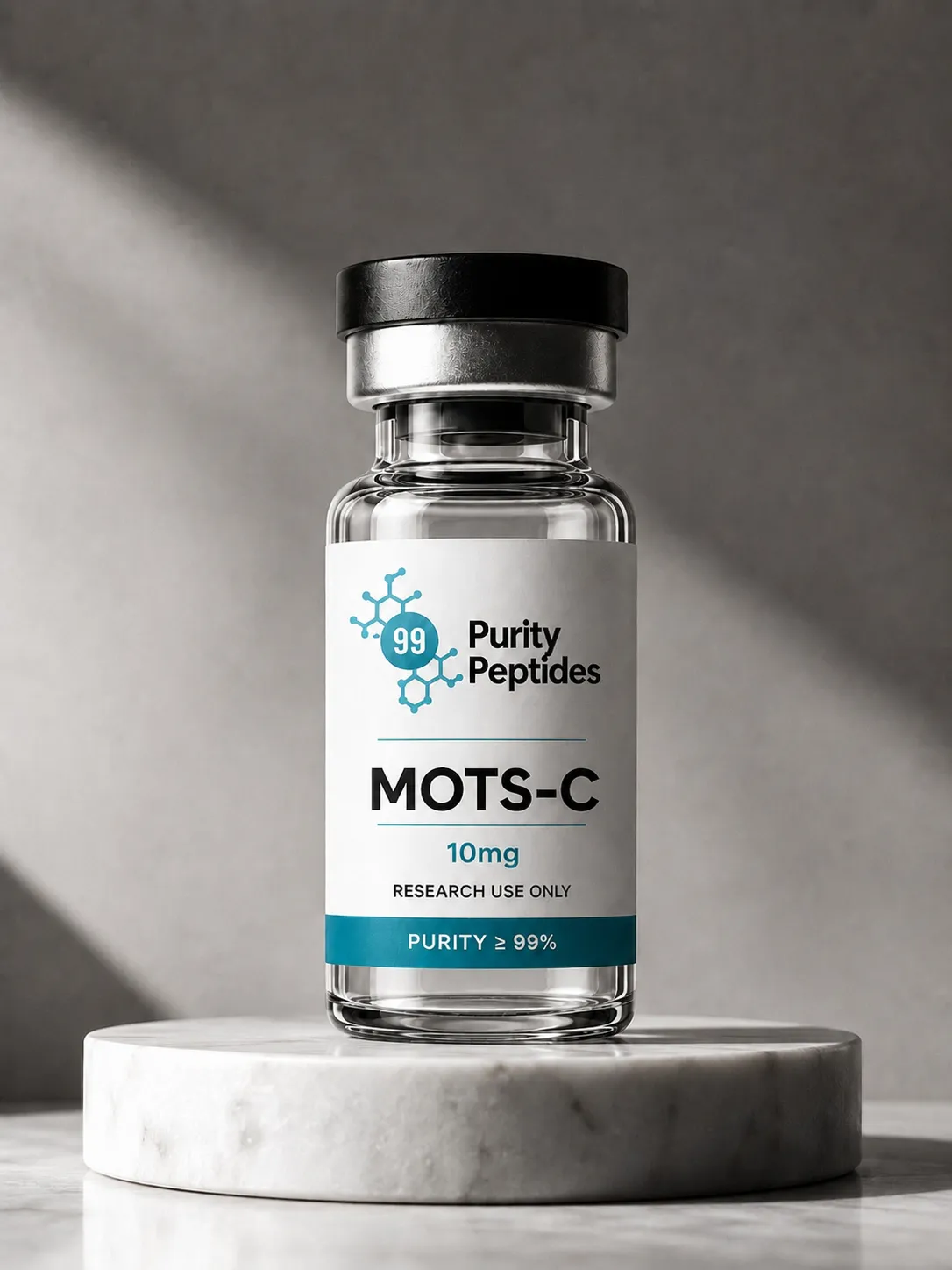
That protein was named Humanin, and it turned out not to be alone. Fourteen years later, a second mitochondrial-encoded peptide, MOTS-c, was identified in a different region of the mitochondrial genome. Together with a handful of related molecules called SHLPs (small humanin-like peptides), they form a class now known as mitochondrial-derived peptides, or MDPs.
This article explains what MOTS-c and Humanin actually are, how each one works at the molecular level, what the published research says about their roles in metabolism and cellular aging, and where the current evidence is strong versus still preliminary.
Quick Answer: What Are Mitochondrial-Derived Peptides?
Mitochondrial-derived peptides (MDPs) are small proteins encoded by short open reading frames within mitochondrial DNA, rather than the cell's nuclear genome. MOTS-c and Humanin are the two best-characterized MDPs. MOTS-c, encoded in the 12S rRNA gene, regulates energy sensing and glucose metabolism through AMPK activation. Humanin, encoded in the 16S rRNA gene, protects cells from stress-induced death and interacts with insulin-signaling pathways. Both circulate in blood, acting as hormone-like signals — sometimes called "mitokines" — that let mitochondria communicate with the nucleus and distant tissues. |
Where MOTS-c and Humanin Come From
Mitochondria carry their own small, circular genome — separate from the DNA in the cell nucleus. For decades, most of that mitochondrial DNA was assumed to code only for a small set of proteins involved directly in energy production. MDPs overturned that assumption by showing that regions long labeled "non-coding," including ribosomal RNA genes, actually contain short open reading frames (sORFs) capable of producing functional peptides.
Humanin: the first mitochondrial-derived peptide discovered
Humanin is a 24-amino-acid peptide encoded within the MT-RNR2 gene, inside the mitochondrial 16S rRNA region. It was identified in 2001 by researchers searching for factors that protected surviving neurons in Alzheimer's disease brain tissue from cell death. Since then, five to six related small humanin-like peptides (SHLP1-6) have been identified in the same genomic region.
MOTS-c: identified more than a decade later
MOTS-c (Mitochondrial Open reading frame of the Twelve S rRNA type-C) is a 16-amino-acid peptide encoded in the 12S rRNA gene of the mitochondrial genome. It was first characterized by USC researchers in 2015 for its striking effects on metabolic regulation and aging in mouse models.
Featured-snippet answer: Where do MOTS-c and Humanin come from? MOTS-c and Humanin are both encoded directly by mitochondrial DNA rather than nuclear DNA. Humanin comes from the 16S rRNA gene and was discovered in 2001; MOTS-c comes from the 12S rRNA gene and was discovered in 2015. Both are released into the bloodstream and act on distant tissues, functioning more like hormones than typical cellular proteins. |
How MOTS-c Works: Metabolism and Energy Sensing
MOTS-c functions as a stress-responsive messenger. Under conditions such as low glucose availability, oxidative stress, or metabolic strain, mitochondria increase MOTS-c production. The peptide then translocates into the nucleus, where it helps regulate the expression of genes involved in stress response and metabolic adaptation.
Mechanistically, MOTS-c is best characterized as an activator of AMP-activated protein kinase (AMPK) — the same cellular energy-sensing pathway targeted by several metabolic health strategies, including exercise itself. Preclinical research links MOTS-c to:
- Improved glucose uptake and insulin sensitivity in skeletal muscle in animal models
- Reduced diet-induced obesity and improved metabolic homeostasis in mice
- Age-related decline in circulating MOTS-c levels, observed in some human cohort studies
- Antioxidant defense support during metabolic stress
Human clinical research status for MOTS-c
As of 2026, MOTS-c has moved further into human clinical research than most other MDPs: a Phase 2a human trial is reportedly underway evaluating MOTS-c in prediabetes and insulin resistance, with endpoints including insulin sensitivity, glucose disposal, and exercise capacity. Results from this trial have not yet been published in peer-reviewed literature, so its clinical significance in humans remains unconfirmed pending publication.
How Humanin Works: Cell Survival and Neuroprotection
Humanin's defining research story is cytoprotection — helping cells survive stress rather than directly regulating energy metabolism. Several distinct molecular mechanisms have been characterized:
- IGFBP-3 binding: Humanin binds insulin-like growth factor-binding protein 3 (IGFBP-3), interfering with IGFBP-3's pro-apoptotic signaling and blocking a pathway that otherwise promotes cell death.
- BAX inhibition: Humanin binds the pro-apoptotic protein BAX, helping prevent mitochondrial membrane permeabilization — a key step in the classic apoptosis (programmed cell death) pathway.
- STAT3 and PI3K/Akt activation: Humanin activates the JAK2/STAT3 pathway linked to neuronal survival, and PI3K/Akt signaling that connects it to insulin-pathway biology.
- Receptor-mediated signaling: A trimeric cell-surface receptor complex involving CNTFR, WSX-1, and gp130 has been proposed as a high-affinity receptor for extracellular Humanin.
These mechanisms explain why Humanin research spans neurodegeneration (particularly Alzheimer's disease models), cardiovascular protection, age-related macular degeneration, and insulin-sensitizing effects, in addition to its original discovery context.
Human clinical research status for Humanin
Humanin's evidence base is currently the inverse of MOTS-c's: extensive and well-characterized mechanistic and animal-model research, but no completed, published human trials of exogenous Humanin administration for any indication. Circulating Humanin levels are being studied as a biomarker of mitochondrial health and biological age, which is a distinct research question from testing Humanin itself as an intervention.
Featured-snippet answer: Is Humanin proven to work in humans? Humanin has strong mechanistic and animal-model evidence — including IGFBP-3 binding, BAX inhibition, and STAT3 activation — but no completed, peer-reviewed human clinical trials of exogenous Humanin administration have been published as of 2026. Current human data is limited to observational studies correlating circulating Humanin levels with age and metabolic markers. |
MOTS-c vs. Humanin: Side-by-Side Comparison
Factor | MOTS-c | Humanin |
|---|---|---|
Length | 16 amino acids | 24 amino acids |
Mitochondrial gene of origin | 12S rRNA gene | 16S rRNA gene (MT-RNR2) |
Year discovered | 2015 | 2001 |
Primary research focus | Metabolic homeostasis, glucose regulation, exercise mimicry | Cytoprotection, neuroprotection, apoptosis resistance |
Key mechanism | AMPK activation; nuclear gene regulation under metabolic stress | IGFBP-3 binding; BAX inhibition; STAT3/PI3K-Akt activation |
Human trial status (2026) | Phase 2a trial in prediabetes underway; results not yet published | No completed human trials of exogenous administration published |
Associated research areas | Obesity, insulin resistance, exercise physiology, aging | Alzheimer's disease, cardiovascular protection, macular degeneration, diabetes |
Why Mitochondrial-Derived Peptides Matter for Aging Research
A 2026 review in the International Journal of Peptide Research and Therapeutics described MDPs as regulators of cellular stress resistance, metabolism, inflammation, and survival that interact with major aging pathways — including AMPK, mTOR, and the sirtuins. This positions MOTS-c, Humanin, and the SHLP family as a candidate class of "geroprotectors": molecules studied for their potential to help protect cells against age-related decline.
It's worth being precise about what this means in practice. Circulating levels of both MOTS-c and Humanin have been observed to decline with age in several human studies — an association, not proof that restoring these peptides reverses aging. The stronger, better-replicated evidence lies in the mechanistic pathways each peptide engages (AMPK for MOTS-c; IGFBP-3/BAX/STAT3 for Humanin), which are independently recognized as relevant to metabolic health and cell survival.
Common Mistakes When Interpreting MDP Research
- Treating MOTS-c and Humanin as interchangeable "anti-aging peptides" — they originate from different genes, engage different pathways, and are studied for different primary endpoints.
- Citing MOTS-c's Phase 2a trial as if results are already published — as of this writing, the trial is underway and outcomes have not appeared in peer-reviewed literature.
- Assuming Humanin's strong mechanistic data means it is clinically proven — no completed human trials of exogenous Humanin have been published, despite extensive cell and animal research.
- Confusing observational age-decline data (falling MOTS-c/Humanin levels with age) with interventional proof that raising these peptides slows aging.
- Overlooking that SHLPs 1-6 are part of the same MDP family but have a much smaller, less mature evidence base than MOTS-c or Humanin.
Key Takeaways
- Mitochondrial-derived peptides (MDPs) are small proteins encoded directly by mitochondrial DNA — a discovery that overturned the view of mitochondria as purely energy-producing organelles.
- MOTS-c (16 amino acids, discovered 2015) is primarily studied for metabolic regulation through AMPK activation, and has entered an early-phase human trial for prediabetes.
- Humanin (24 amino acids, discovered 2001) is primarily studied for cytoprotection and neuroprotection through IGFBP-3 binding, BAX inhibition, and STAT3 activation.
- Both peptides show robust preclinical and mechanistic evidence, but human clinical data remains limited: MOTS-c trial results are pending publication, and no completed human trials of exogenous Humanin exist as of 2026.
- Neither MOTS-c nor Humanin is FDA-approved for any indication; circulating-level research and biomarker studies should not be confused with proof that administering these peptides produces the same effects in humans.
Frequently Asked Questions
What are mitochondrial-derived peptides (MDPs)?
MDPs are small proteins encoded by short open reading frames within mitochondrial DNA rather than the cell's nuclear genome. MOTS-c and Humanin are the two best-characterized examples, alongside a related family called SHLPs.
What is MOTS-c?
MOTS-c is a 16-amino-acid peptide encoded in the mitochondrial 12S rRNA gene. It was identified in 2015 and is primarily studied for its role in activating AMPK and regulating glucose metabolism and energy homeostasis.
What is Humanin?
Humanin is a 24-amino-acid peptide encoded in the mitochondrial 16S rRNA gene (MT-RNR2). Discovered in 2001, it is studied mainly for its cytoprotective and neuroprotective effects, particularly in Alzheimer's disease research.
How is MOTS-c different from Humanin?
MOTS-c and Humanin come from different mitochondrial genes, differ in length (16 vs. 24 amino acids), and are studied for different primary purposes: MOTS-c for metabolic regulation via AMPK, and Humanin for cell survival via IGFBP-3 and BAX interactions.
Has MOTS-c been tested in human clinical trials?
Yes, at least in part. A Phase 2a human trial evaluating MOTS-c in prediabetes and insulin resistance is reportedly underway as of 2026, but results have not yet been published in peer-reviewed literature.
Has Humanin been tested in human clinical trials?
No completed, published human trials of exogenous Humanin administration exist as of 2026. Current human data on Humanin is limited to observational studies correlating circulating levels with age and disease markers.
Do MOTS-c and Humanin levels decline with age?
Observational studies report that circulating levels of both MOTS-c and Humanin tend to decline with age, which has led researchers to study them as potential biomarkers of mitochondrial and biological aging.
What is the connection between MOTS-c and AMPK?
MOTS-c activates AMP-activated protein kinase (AMPK), a central cellular energy-sensing pathway also engaged by exercise and calorie restriction, linking MOTS-c to metabolic homeostasis research.
How does Humanin protect cells from death?
Humanin binds IGFBP-3 to block its pro-apoptotic signaling, binds the protein BAX to help prevent mitochondrial membrane permeabilization, and activates STAT3 signaling associated with cell survival.
What are SHLPs?
SHLPs (small humanin-like peptides 1 through 6) are a family of mitochondrial-derived peptides encoded in the same 16S rRNA region as Humanin. Their individual effects vary, but they have a smaller and less mature research base than MOTS-c or Humanin.
Are MOTS-c and Humanin FDA-approved?
No. Neither MOTS-c nor Humanin is FDA-approved for any human indication as of 2026.
Why are MDPs considered important for longevity research?
MDPs interact with major cellular pathways implicated in aging, including AMPK, mTOR, and sirtuins, leading some researchers to describe them as a candidate class of geroprotectors — though this remains an active research area rather than an established therapeutic category.
What organ or tissue produces the most MOTS-c and Humanin?
Both peptides are produced across multiple tissues wherever mitochondria are present, with skeletal muscle being a major source of circulating MOTS-c and neural tissue being a key research focus for Humanin.