Research Use Only. 99 Purity Peptides supplies research-grade compounds for in-vitro and pre-clinical laboratory work. Nothing sold on this site is for human or veterinary use, ingestion, injection, or any form of administration. This page discusses published clinical literature about FDA-approved pharmaceutical products used in humans under medical supervision, and separately discusses laboratory research on a compound we supply for research use only. Nothing here claims, or should be read to suggest, that GHK-Cu or any product sold by 99 Purity Peptides treats, prevents, reverses, or otherwise addresses facial volume loss or any other human outcome. This page is not medical, dosing, or health advice.

Quick Answer: What Is "Ozempic Face"?
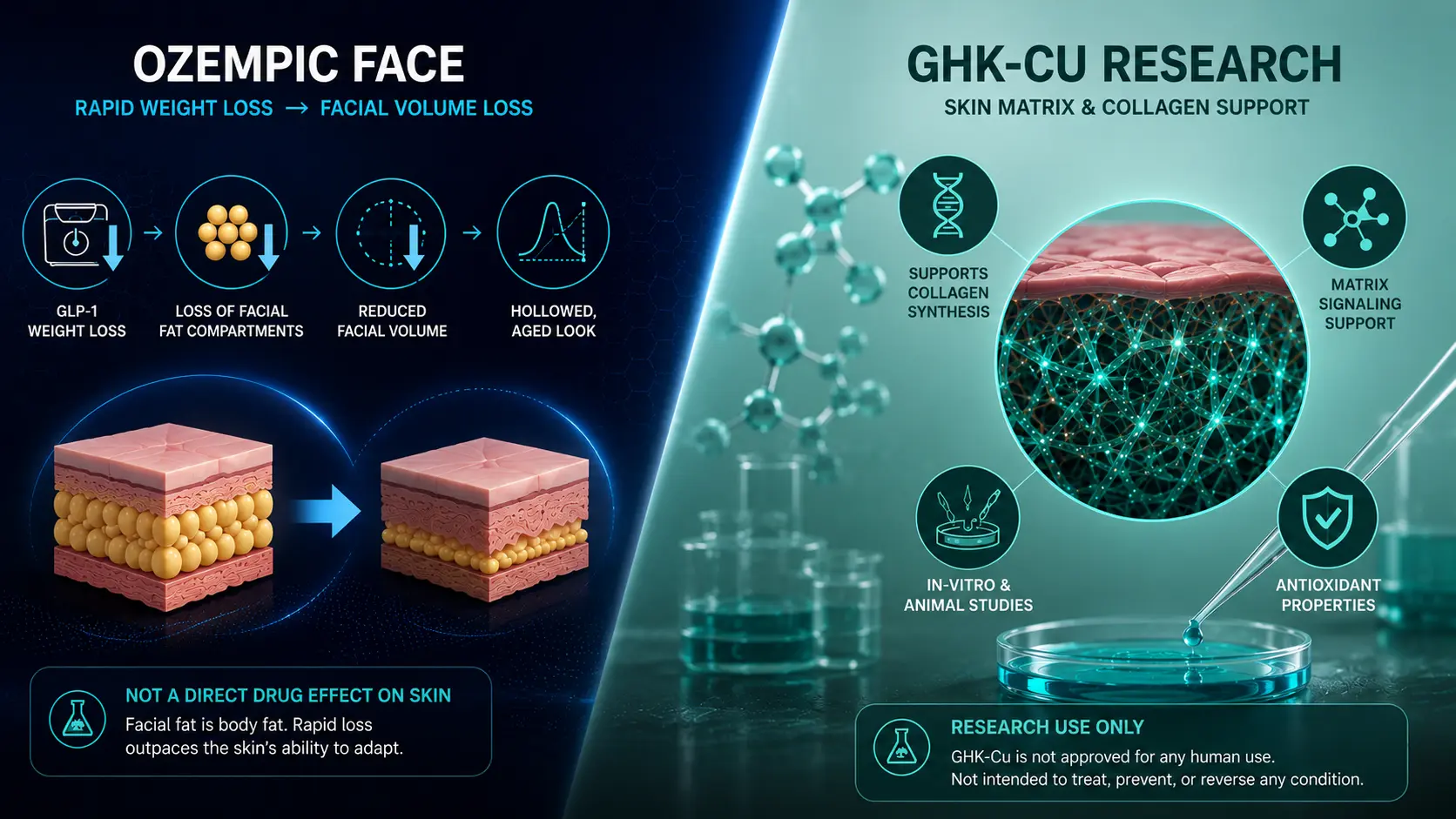
Quick Answer: "Ozempic face" is a lay term for the hollowed, deflated, prematurely aged facial appearance that can follow rapid weight loss on GLP-1 receptor agonist therapy. It is not a distinct disease and not a direct drug effect on the skin. Facial fat is body fat, so when total adiposity falls quickly, the fat compartments that give the cheeks, temples, and periorbital region their fullness lose volume along with everything else. A 2025 radiographic study at Vanderbilt University Medical Center measured the effect and found roughly 7% of midfacial volume lost for every 10 kg of body weight lost.
Key Takeaways
- "Ozempic face" describes facial volume loss associated with rapid weight reduction on GLP-1 receptor agonists such as semaglutide (Ozempic, Wegovy) and tirzepatide (Mounjaro, Zepbound). The drugs are FDA-approved pharmaceuticals used in humans under medical supervision.
- The effect is not unique to these medications. Any sufficiently rapid weight loss can produce it. The medications simply make rapid loss far more achievable.
- Objective measurement is recent and limited. The Vanderbilt cohort included 20 patients and reported a median 9.0% reduction in total midfacial volume, concentrated in the superficial fat compartments.
- Facial fat is compartmentalized rather than distributed as one continuous layer, which is why volume loss reads as structural aging rather than as simple thinning.
- Histology after massive weight loss shows collagen reorganization and elastic fiber fragmentation, though studies disagree on whether total collagen content actually falls.
- Some researchers propose mechanisms beyond fat loss alone, including effects on dermal adipose stem cells and advanced glycation end product signaling. These remain hypotheses under investigation.
- GHK-Cu has a substantial published literature on collagen synthesis and matrix signaling in cell culture and animal wound models. That literature is topical, in-vitro, and pre-clinical.
- No published study has tested GHK-Cu against GLP-1-associated facial volume loss. The compound is supplied for research use only and is not an approved treatment for any human condition.
What "Ozempic Face" Actually Is
The direct answer: it is subcutaneous fat loss in the face, occurring as part of generalized fat loss, at a speed that outpaces the skin's capacity to retract.
The term entered common use around early 2023 and has no formal diagnostic definition. Dermatology and plastic surgery literature has since adopted it as shorthand. A 2025 review of the dermatological profile of GLP-1 agonists describes the presentation as reduced facial volume from subcutaneous fat loss, producing hollowed features, deeper wrinkles, and skin laxity, with the distinguishing characteristic that these changes appear suddenly in people who are still relatively young. [1]
Mechanistically, the leading explanation is unglamorous. GLP-1 receptor agonists reduce systemic adiposity. They do not appear to target facial adipocytes specifically. The face simply participates in a body-wide process, and because the face is the part of the body people look at, the change is disproportionately visible. [1]
Until recently, the entire discussion rested on clinician impressions and patient photographs. That changed with a retrospective imaging study from Vanderbilt University Medical Center, published in Otolaryngology–Head and Neck Surgery in 2025. Investigators queried hospital records for patients who had both a GLP-1 prescription and head or neck CT or MRI imaging before and after that prescription between 2017 and 2024. [2]
Twenty patients met criteria. Median age was 54 years, mean treatment duration 321 days, mean weight loss 11.0 kg. The median decrease in total midfacial volume was 9.0%. Superficial compartments lost a median 11.0%. Deep compartments lost a median 7.0%, which did not reach statistical significance. Weight loss correlated with superficial volume loss but not with deep loss. Regression gave the headline figure: roughly 7% of midfacial volume per 10 kg lost. [2]
Note: Twenty patients is a small retrospective sample drawn from people who happened to have clinical imaging for unrelated reasons. It is the best objective measurement currently available, not a definitive one. Treat the 7% figure as an early estimate rather than a settled constant.
Does "Ozempic Face" Happen With Wegovy and Other GLP-1 Drugs?
The phenomenon is tied to the rate and magnitude of weight loss, not to a specific brand. Semaglutide face, Wegovy face, and the equivalent effect described with tirzepatide all reflect the same underlying process. Ozempic simply supplied the name because it reached public awareness first.
Why Facial Fat Loss Reads as "Aging"
Direct answer: because facial fat is organized into discrete compartments that deflate unevenly, and uneven deflation reproduces the exact contour changes the eye interprets as an older face.
For most of the twentieth century, facial aging was understood primarily as skin descending under gravity. Work published by Rohrich and Pessa in 2007 reframed it. Using methylene blue dye injected into cadaveric specimens, they demonstrated that facial fat is not a single confluent mass. It is partitioned into anatomically distinct compartments separated by septa. [3]
The distinction matters because the compartments behave differently. Deep compartments provide structural support to the midface and to the superficial fat layer above them. Superficial compartments sit subcutaneously and shape the visible surface. [3][4] When deep fat atrophies, the superficial layer above it loses its scaffold and descends. Rohrich and colleagues termed this "pseudoptosis": apparent sagging that is actually the consequence of deflation underneath. [4][5]
This explains a common observation. Two people can lose identical amounts of weight and look different afterward, because compartment-specific volume, baseline facial fat distribution, skin elasticity, and bone structure all vary. It also explains why the change registers as aging rather than as thinness. Age-related facial change involves the same compartments losing volume, only across decades instead of months. Rapid weight loss compresses a familiar timeline.
The Vanderbilt data add a wrinkle to that analogy. In their cohort, loss concentrated in superficial compartments while deep compartments showed no statistically significant change. Ordinary chronological aging shows meaningful loss in both. [2] The pattern of GLP-1-associated volume loss may therefore not be identical to the pattern of aging it superficially resembles.
What Causes Ozempic Face at the Tissue Level?
Three structural variables interact:
Factor | What changes | Why it shows on the face |
|---|---|---|
Compartment volume | Adipocytes shrink as systemic fat stores are mobilized | Cheeks, temples, and periorbital hollows lose projection |
Structural support | Deep compartments deflate, reducing the scaffold beneath superficial fat | Superficial fat descends, producing folds and jowling |
Skin envelope | Dermis must retract to a smaller underlying volume | Rapid loss outpaces retraction, leaving laxity |
How Widespread Is This, and Why Is It Suddenly a Major Search Topic?
Direct answer: prescription volume rose sharply, and public search interest in the cosmetic consequence rose faster.
The documented search surge is substantial. An infodemiologic analysis published in the Journal of Cosmetic Dermatology examined Google Trends data for "Ozempic" and its co-searched queries from November 2021 through December 2024. Among related queries, "Ozempic face" showed the largest relative increase in search volume at approximately 4,600%. The primary peak arrived in early 2023, tracking the first major surge in searches for the drug itself, with a second and larger peak during 2024. [6]
A separate systematic review in Aesthetic Surgery Journal Open Forum identified 23 plastic surgery publications discussing GLP-1 receptor agonists and paired that literature review with its own Google Trends analysis running October 2019 to October 2024. The authors reported that rising searches for "Ozempic face" were accompanied by rising searches for facial fillers and for plastic surgeons. [7]
Being precise about what those numbers represent matters. Google Trends reports relative search volume on a 0 to 100 scale, not absolute query counts. A 4,600% increase from a near-zero baseline is a real signal of attention, and it is not the same as a measured incidence rate in a treated population. No published study currently reports what proportion of people on GLP-1 therapy develop clinically meaningful facial volume loss.
Two drivers are commonly proposed for the attention: broad expansion of GLP-1 prescribing, and sustained celebrity and media coverage. The prescribing expansion is well documented. The relative contribution of media amplification is plausible but not quantified.
Note: Searches for "ozempic face before and after" reflect how the topic is discussed publicly, not how it has been measured. Paired photographs are uncontrolled for lighting, angle, age, expression, and time interval. The imaging literature exists precisely because photographic comparison could not answer the quantitative question.
What the Research Says About Skin, Collagen, and Elastin During Rapid Weight Change
Direct answer: the dermis changes measurably after large weight loss, but published histology disagrees on whether total collagen falls or simply reorganizes.
This section describes general dermatology research on skin structure during weight change. It does not concern any compound sold by this site.
Skin biopsy studies in post-bariatric and non-surgical massive weight loss populations give a consistent qualitative picture with inconsistent quantitative detail. A prospective longitudinal cohort published in Obesity Surgery reported that obesity and subsequent massive weight loss produced disorganization of collagen fibers and fragmentation of elastic fibers in the extracellular matrix. [8] A separate study in Aesthetic Plastic Surgery comparing post-bariatric patients against patients with morbid obesity found no significant difference in the total quantity of collagen fibers. What differed was architecture: thick, organized, directionally aligned fibers were replaced by thin, misaligned, loosely arranged ones. [9]
A 2024 comparison of surgical against non-surgical massive weight loss found reduced elastic fiber content in abdominal skin in the surgical group, while collagen content fell comparably in both groups. [10] Another 2024 histological series reported decreased collagen fibers, decreased dermal elastic fibers, reduced adipocyte population, reduced vascular proliferation, and increased fibrosis. [11]
Reading these together, matrix reorganization is better supported than simple matrix depletion. Sample sizes are small, biopsy sites are abdominal or breast rather than facial, and the weight loss is surgical rather than pharmacological. Extrapolating any of it directly to the face requires caution.
Is There a Mechanism Beyond Fat Loss?
Possibly, and it remains unresolved. A 2025 review in Endocrine argued that GLP-1 facial aging may not be attributable to reduced facial fat alone. The authors proposed several additional pathways: GLP-1 receptor stimulation on adipose-derived stem cells reducing their proliferation and metabolic activity; reduced local estrogen production from dermal white adipose tissue, which would in turn reduce fibroblast stimulation of collagen synthesis; and interaction with advanced glycation end products and RAGE signaling. [12]
The authors were careful about status. They concluded that further mechanisms have yet to be elucidated and that it remains unclear whether all patients receiving these medications are affected. [12] These are hypotheses generating research, not established findings.
GHK-Cu: What the Copper Peptide Research Actually Shows
Direct answer: GHK-Cu skin research spans decades of published data on collagen synthesis and matrix signaling in fibroblast culture and animal wound models. That evidence base is topical, in-vitro, and pre-clinical.
Compliance statement, restated in context: GHK-Cu appears in this article because both topics touch dermal matrix biology, not because the research connects them. No published study has evaluated GHK-Cu in relation to GLP-1-associated facial volume loss, and 99 Purity Peptides makes no claim that GHK-Cu addresses that or any other human cosmetic or medical outcome. GHK-Cu is supplied strictly for laboratory research. The material below summarizes what investigators have reported in research models, and what they have not.
GHK-Cu is the copper(II) complex of the tripeptide glycyl-L-histidyl-L-lysine, isolated from human plasma by Pickart in 1973. Its collagen-related findings begin with a 1988 report in FEBS Letters, in which GHK-Cu stimulated collagen synthesis in cultured fibroblasts at concentrations as low as 10⁻¹² M, peaking near 10⁻⁹ M, with the effect independent of changes in cell number. [13]
The most cited in-vivo work is a 1993 study in the Journal of Clinical Investigation using a rat wound chamber model. Investigators implanted stainless steel mesh cylinders subcutaneously, injected GHK-Cu or saline, and analyzed chamber contents for dry weight, total protein, collagen, DNA, elastin, glycosaminoglycans, and collagen and TGF-β messenger RNA. [14]
GHK-Cu produced concentration-dependent increases in dry weight, DNA, total protein, collagen, and glycosaminoglycan content. Collagen synthesis was stimulated at roughly twice the rate of non-collagen proteins. Type I and type III collagen mRNA increased; TGF-β mRNA did not. Relative dermatan sulfate rose. A control tripeptide produced no significant effect. [14]
One detail in that study deserves attention, because it is routinely misreported. Elastin was among the analytes measured. It was not among the components reported as increased. [14] Marketing copy across this industry frequently describes GHK-Cu as stimulating elastin; the most-cited in-vivo matrix study that measured elastin directly did not report that result.
Related work examined proteoglycan expression, reporting increased decorin in wound tissue, with an inhibitory effect on biglycan in vivo that did not reproduce in cell culture. [15] A 2018 review consolidating the gene-expression literature described Broad Institute Connectivity Map data in which GHK exposure altered expression of 4,192 of 13,424 human genes assayed at a 50% change threshold, spanning DNA repair, antioxidant defense, and tissue remodeling pathways. [16]
What GHK-Cu Research Covers and Does Not Cover
Research area | Status in the published literature |
|---|---|
Collagen synthesis in fibroblast culture | Reported repeatedly since 1988, at picomolar to nanomolar concentrations [13] |
Collagen accumulation in animal wound models | Reported, concentration-dependent, in rat wound chambers [14] |
Glycosaminoglycan and decorin expression | Reported in wound models and cell culture [14][15] |
Broad gene-expression modulation | Reported from Connectivity Map analysis [16] |
Elastin synthesis | Measured in the 1993 wound-chamber study; not reported among the components increased [14] |
Subcutaneous adipose volume restoration | Not an endpoint in the GHK-Cu literature reviewed here |
GLP-1-associated facial volume loss | No published study |
Human therapeutic or cosmetic outcomes | Not established; not FDA-approved for any indication |
For the full mechanistic and analytical picture, including copper transport, handling, and stability, see our GHK-Cu research guide. This page does not duplicate that depth.
What This Research Does Not Establish
Direct answer: no evidence links GHK-Cu to the phenomenon this article describes, and the mechanistic gap is larger than the surface similarity suggests.
Four limitations are worth stating plainly.
No direct study exists. No published trial, case series, or animal model has tested GHK-Cu against GLP-1-associated facial volume loss. Any inference connecting the two is extrapolation, not evidence.
The tissue compartments differ. This is the substantive problem, and it is easy to miss. GHK-Cu's matrix findings concern the dermis: fibroblasts, collagen, glycosaminoglycans. The volume loss measured in the Vanderbilt cohort was subcutaneous adipose tissue in the facial fat compartments. [2] These are different tissues doing different jobs. Dermal collagen contributes to skin quality and firmness; it does not constitute the fat pads whose deflation produces facial hollowing. Even accepting the GHK-Cu literature at full value, collagen synthesis in the dermis is not volume restoration in an adipose compartment.
The models are distant from the question. The GHK-Cu evidence rests on cultured fibroblasts, rat wound chambers, and topical application to injured skin. Uninjured human facial tissue undergoing gradual adipose depletion is a materially different context. Concentrations that produce clear effects in culture have no established translation to any in-vivo human setting.
The elastin claim is weaker than commonly stated. As noted above, the frequently repeated assertion that GHK-Cu stimulates elastin is not supported by the primary in-vivo study most often cited for it. [14]
Note: Honest evidence limits are not a marketing weakness. A supplier that describes what research has not shown is easier to verify than one that does not.
Purity and COA Verification
Direct answer: for any research compound, the certificate of analysis is the only document tying the material in the vial to independent measurement.
Whatever a compound is being studied for, reproducibility depends on knowing what is actually present. A complete COA reports product identity and CAS number, batch and lot number, HPLC purity with the accompanying chromatogram, mass spectrometry identity confirmation against theoretical molecular weight, appearance, storage conditions, and an impurity profile.
For GHK-Cu specifically, identity confirmation should match the expected mass for the complex, and the impurity profile should account for truncated sequences, free uncomplexed GHK, and residual copper salts. Batch-level documentation matters more than a headline purity figure, since purity can vary between lots. Our published certificates are available at certificates.
Where This Leaves the Topic
"Ozempic face" is a real, documented phenomenon with a straightforward primary explanation and a growing body of measurement behind it. Rapid systemic fat loss depletes the facial fat compartments, the skin envelope does not retract fast enough, and the resulting contour change resembles accelerated aging. Whether additional dermal mechanisms contribute is an open research question that several groups are actively pursuing.
GHK-Cu occupies a separate conversation. It is a well-studied compound in dermal matrix research, with a literature that is genuinely interesting and genuinely limited to laboratory and pre-clinical settings. The two subjects share a biological vocabulary and nothing more. Researchers studying dermal matrix signaling can review our GHK-Cu research guide for the mechanistic detail, and the compound itself is catalogued at GHK-Cu for laboratory use.
Nothing on this page constitutes a claim that any product sold by 99 Purity Peptides treats, prevents, or reverses facial volume loss, skin aging, or any other human outcome. All products are supplied for research use only and are not for human or veterinary use, diagnosis, or treatment.
Frequently Asked Questions
Is Ozempic face permanent?
Published literature does not establish permanence either way. Clinically, facial appearance is generally assessed after weight has stabilized, since ongoing loss keeps changing the baseline. No controlled study has followed GLP-1-associated facial volume changes long-term after weight stabilization, so any claim about permanence currently rests on clinical impression rather than measurement.
Does Ozempic face happen with all GLP-1 drugs?
The effect tracks the speed and size of weight loss rather than any single molecule. Semaglutide face, Wegovy face, and comparable observations with tirzepatide reflect the same process. Ozempic supplied the popular name because it entered public awareness first. No head-to-head study has compared facial volume outcomes between individual GLP-1 medications.
What causes Ozempic face?
Systemic fat loss depletes the subcutaneous fat compartments of the face along with fat everywhere else. Deep compartments lose the volume that supports the superficial layer above them, which then descends. The skin envelope cannot retract quickly enough to match the reduced underlying volume, producing hollowing, folds, and laxity.
How much facial volume is actually lost?
The Vanderbilt retrospective imaging study of 20 patients reported a median 9.0% reduction in total midfacial volume, with superficial compartments losing a median 11.0%. Linear regression estimated roughly 7% of midfacial volume lost per 10 kg of body weight lost. This is one small study, and the figure should be treated as an early estimate.
Is Ozempic face caused by the drug damaging skin directly?
Current evidence points primarily to fat loss rather than direct dermal injury. A 2025 review proposed additional mechanisms involving adipose-derived stem cells, dermal white adipose tissue estrogen production, and advanced glycation end product signaling, but presented them as hypotheses requiring further work rather than established findings.
Why do before-and-after photos look so dramatic?
Paired photographs are uncontrolled. Lighting, camera angle, lens focal length, facial expression, weight-loss interval, and normal aging over that interval all affect apparent facial volume, and none of these are standardized in images shared online. Radiographic imaging studies exist precisely because photographic comparison cannot answer the quantitative question reliably.
Does slower weight loss reduce the effect?
The relationship between loss rate and facial change is widely described clinically and is the basis for the "rapid" framing throughout the literature. It has not been isolated in a controlled comparison of loss rates with facial volume as the measured endpoint. The mechanism is plausible: slower loss gives the skin envelope more time to retract.
What happens to skin collagen and elastin during major weight loss?
Histology studies report collagen reorganization, with thick aligned fibers replaced by thinner misaligned ones, and fragmentation of elastic fibers. Studies disagree on whether total collagen content falls or stays comparable. Most of this work sampled abdominal or breast skin in post-bariatric patients rather than facial skin.
What is GHK-Cu studied for?
GHK-Cu is a copper-binding tripeptide studied in laboratory settings for collagen synthesis, glycosaminoglycan and proteoglycan expression, copper transport, antioxidant signaling, and broad gene-expression modulation. The published work is concentrated in fibroblast culture, animal wound models, and topical dermatology research. It is supplied for research use only.
Does GHK-Cu treat or reverse Ozempic face?
No. No published study has tested GHK-Cu against GLP-1-associated facial volume loss, and 99 Purity Peptides makes no such claim. GHK-Cu is a research compound, not an approved treatment for any human condition. It is not for human or veterinary use in any form.
Does GHK-Cu stimulate elastin?
The claim is weaker than its frequency suggests. The most-cited in-vivo study, a 1993 rat wound-chamber experiment, measured elastin among its analytes and reported concentration-dependent increases in dry weight, DNA, total protein, collagen, and glycosaminoglycans. Elastin was not among the components reported as increased.
Why can't collagen research be applied to facial volume loss?
Because they concern different tissues. Collagen is a dermal structural protein. The volume measured in the facial imaging studies is subcutaneous adipose tissue in the fat compartments. Increasing dermal collagen in a research model would not constitute restoring fat-pad volume, which is what produces facial hollowing.
What does a complete GHK-Cu certificate of analysis include?
Product identity and CAS number, batch and lot number, manufacture date, HPLC purity percentage with the chromatogram, mass spectrometry identity confirmation against theoretical molecular weight, appearance, recommended storage conditions, and an impurity profile covering truncated sequences, free uncomplexed GHK, and residual copper salts.
Is GHK-Cu the same as the copper peptide in cosmetic serums?
Chemically the molecule is the same compound; copper tripeptide-1 is the cosmetic ingredient nomenclature for it. The regulatory categories differ entirely. Cosmetic formulations are regulated as cosmetics for topical personal care. Research-grade GHK-Cu is a laboratory reagent supplied under research-use-only terms, with analytical documentation and no formulation excipients.