Quick Answer
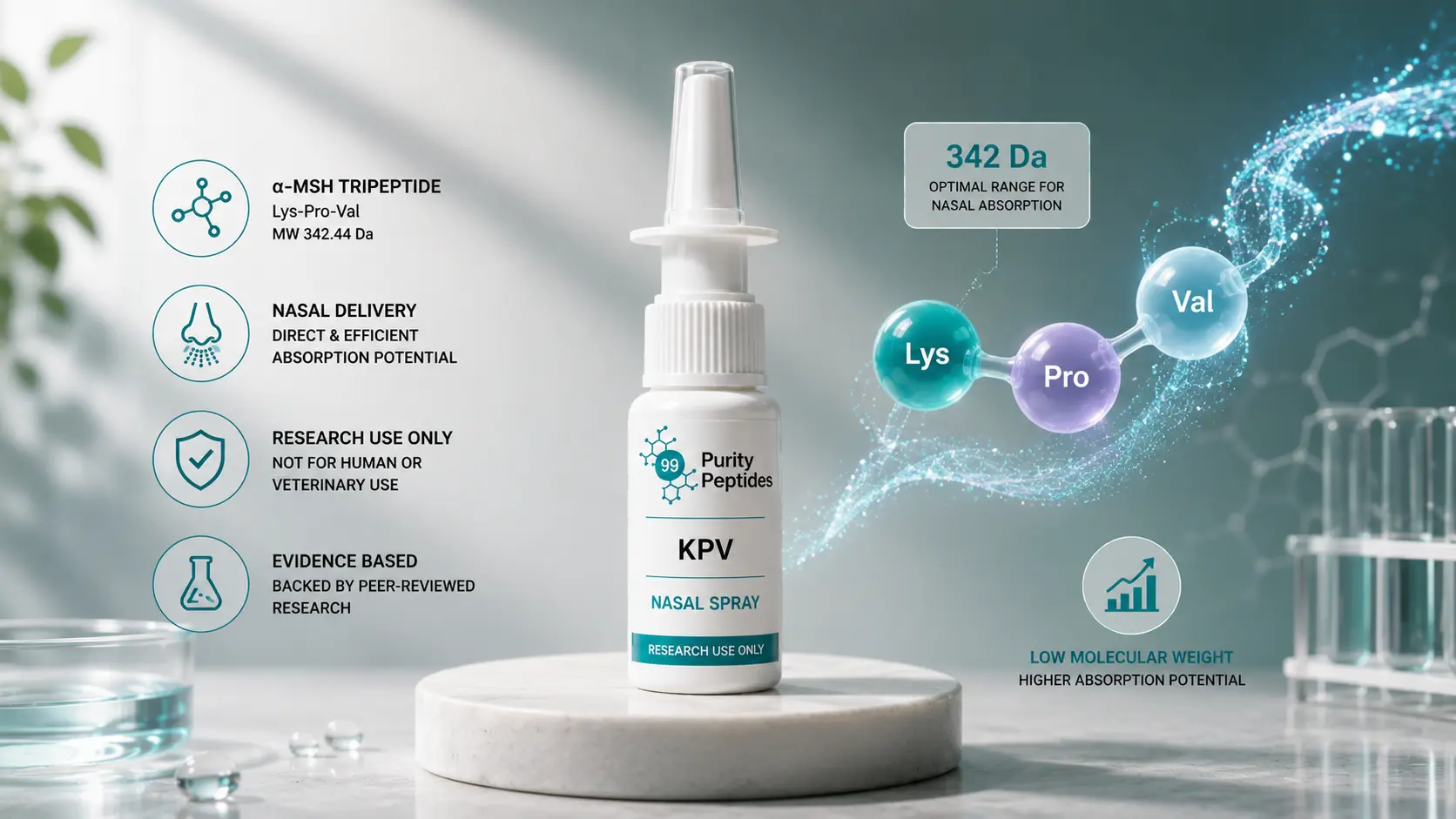
KPV is the C-terminal tripeptide of alpha-melanocyte-stimulating hormone (α-MSH), a three-residue sequence of lysine, proline and valine with a molecular weight of roughly 342 Da. A KPV peptide nasal spray supplies that tripeptide pre-dissolved in solution inside a metered pump bottle, rather than as a lyophilized powder needing reconstitution. On the evidence itself, one point deserves emphasis: no published pharmacokinetic or absorption study has measured intranasal KPV in any species. Its small size places it in a molecular-weight range that peptide delivery research associates with efficient nasal absorption, but that is a structural inference drawn from other molecules, not a measurement of this one.
Research Use Only. KPV and every compound referenced here are supplied strictly for laboratory research. Nothing on this page is medical, dosing, therapeutic or administration guidance. These materials are not for human or veterinary use, ingestion, injection, diagnosis or treatment.
Key Takeaways
- KPV is α-MSH(11-13), sequence Lys-Pro-Val, molecular formula C₁₆H₃₀N₄O₄, molecular weight 342.44 Da, CAS 67727-97-3, PubChem CID 125672.
- At roughly 342 Da, KPV is among the smallest compounds offered in a spray format anywhere on this site, and it sits far below the ~1,000 Da point where nasal absorption efficiency drops sharply in published datasets.
- No published study has measured intranasal KPV pharmacokinetics, bioavailability or nasal mucosal transport. The molecular-weight argument is an inference from peptide delivery research, not KPV-specific data.
- The published KPV literature used oral and in vitro routes. The best-known work, Dalmasso et al. in Gastroenterology, delivered KPV in the drinking water of mice. That route is not the nasal route.
- Systemic nasal bioavailability and nose-to-brain delivery are separate measurements. Almost every published bioavailability percentage describes the systemic figure.
- KPV does not bind the known melanocortin receptors, because it lacks the His-Phe-Arg-Trp core motif those receptors require. Sources describing it as a melanocortin receptor agonist are incorrect on this point.
- Spray and lyophilized vial are different research formats with different trade-offs in concentration control, documentation and stability, not different grades of the same thing.
- For a tripeptide, counterion content consumes a much larger share of vial mass than it does for a larger peptide, so net peptide content on the COA matters more here than usual.
What Is KPV, Briefly?
KPV is the last three residues of α-MSH. The parent hormone is a tridecapeptide (SYSMEHFRWGKPV) derived from proopiomelanocortin, and KPV corresponds to positions 11 through 13 at its C-terminus. Researchers also index it as α-MSH(11-13). Its molecular formula is C₁₆H₃₀N₄O₄ and its molecular weight is 342.44 Da, values confirmed against PubChem CID 125672 and CAS 67727-97-3.
Two structural details drive most of the interest. The central proline imposes a rigid kink on the backbone, and the lysine side chain carries a positive charge at physiological pH. Investigators study the isolated tripeptide because reviews of α-MSH biology attribute a substantial share of the parent hormone's anti-inflammatory signaling to this C-terminal motif.
One correction worth stating plainly: KPV lacks the His-Phe-Arg-Trp sequence that known melanocortin receptors require for binding. It is therefore studied as a melanocortin-receptor-independent entity rather than as a receptor agonist, a distinction Hiltz and Lipton drew as early as 1989.
That is the whole recap. For mechanism depth, signaling detail and the gut, skin and immune literature, the compound guide at KPV: Gut, Skin and Immune Health carries it properly, and this page does not attempt to repeat it.
Why Does Molecular Weight Matter So Much for the Nasal Route?
Molecular weight is the single strongest predictor of how much of a compound crosses the nasal mucosa. Among the physicochemical properties governing nasal absorption, molecular size dominates, and the relationship is inverse: as molecular weight climbs, the absorbed fraction falls.
The foundational dataset comes from McMartin and colleagues, who pooled nasal absorption data across roughly thirty compounds. They reported that molecules up to 1,000 Da achieved good availability without absorption enhancers, averaging about 70% across fifteen compounds, with a clear decline above that value. Within the same work, an octapeptide of 800 Da reached 73% nasal bioavailability in rats, while horseradish peroxidase at 34,000 Da managed 0.6%.
Fisher and colleagues found the same inverse relationship using water-soluble model compounds spanning 200 to 70,000 Da. Absorption approached completeness at the low end, fell to roughly 15.5% at 5,200 Da, and reached 2.3% at 70,000 Da.
Above the threshold, the picture is consistent and unflattering. Reviews of nasal macromolecule delivery place bioavailability for compounds larger than 1,000 Da in the 0.5% to 5% range, and note that hydrophilic peptides and proteins administered nasally without enhancement usually land below 1%.
Where Does KPV Sit in the Absorption Bands?
KPV sits well inside the favorable band, with roughly 650 Da of headroom before the threshold where the published curve turns.
Molecular weight band | Reported nasal absorption behavior | Representative compounds |
|---|---|---|
Under ~1,000 Da | Efficient absorption without enhancers; mean ~70% across 15 compounds in the McMartin dataset | KPV ~342 Da, GHK-Cu ~340 Da, an 800 Da octapeptide at 73% |
~1,000–3,500 Da | Falls into the low single digits; enhancement usually required for meaningful uptake | Desmopressin ~1,070 Da, salmon calcitonin ~3,432 Da |
~3,500–10,000 Da | Typically 0.5–5%, and rarely above 10% regardless of other properties | Insulin ~5,800 Da |
Above ~10,000 Da | Approaches the detection floor without enhancement | Horseradish peroxidase 34,000 Da at 0.6% |
Read this table for what it is. It describes how molecules of a given size have behaved in published nasal absorption studies. It places KPV by size alongside those molecules. It does not report a measurement of KPV, because no such measurement has been published.
Is There Published Research on Intranasal KPV?
No. A search of the published literature returns no pharmacokinetic study, no bioavailability measurement and no nasal mucosal transport study for KPV administered intranasally, in humans or in any animal model.
That absence deserves stating without cushioning, because the molecular-weight argument above is persuasive enough to be mistaken for evidence. It is not evidence about KPV. It is a structural inference: KPV shares a size range with molecules that absorbed well nasally, and size is the dominant variable in those datasets. Inference from a well-supported general relationship is a reasonable basis for hypothesis. It is not a substitute for measuring the compound.
Several factors specific to KPV remain genuinely unquantified by the nasal route:
- Peptidase exposure. KPV is a short, unprotected linear peptide, and free KPV degrades rapidly in the presence of peptidases. Much recent work encapsulates it in nanoparticles or hydrogels specifically to keep it intact. The nasal mucosa carries its own proteolytic enzyme activity, and no study has characterized how KPV fares against it.
- Mucociliary clearance. The nasal cavity clears its contents continuously, and residence time limits uptake for every compound administered there. KPV's residence behavior has not been measured.
- Solution stability. Published stability data for KPV concerns the lyophilized powder. How the tripeptide behaves in an aqueous spray formulation over a bottle's working life is not documented in the literature.
The closest published work to the airway is in vitro rather than intranasal. Land examined KPV in immortalized human bronchial epithelial cells (16HBE14o-) and found that it suppressed NF-κB signaling by interfering with the importin-α3 binding site on p65RelA, blocking nuclear import, alongside stabilization of IκBα. That work used respiratory epithelium, which makes it the nearest tissue analogue available. It was still a cell culture experiment, not nasal administration, and it measured signaling rather than absorption.
How Do Systemic Absorption and Nose-to-Brain Delivery Differ?
They are two different measurements, and vendor copy across this category routinely treats them as one.
Systemic nasal bioavailability describes the fraction of an administered compound that reaches the bloodstream after crossing the nasal mucosa into the rich vasculature beneath it. That is what the McMartin and Fisher datasets measured, and it is what almost every published bioavailability percentage refers to.
Nose-to-brain delivery describes something narrower: the fraction travelling directly into the central nervous system along the olfactory and trigeminal nerve pathways, bypassing the bloodstream and the blood-brain barrier entirely. That direct fraction is a separate and considerably smaller number. The distinction is not academic. Intranasal insulin studies in humans have shown central effects without raising circulating insulin levels, which demonstrates that the two routes can dissociate completely.
So a figure such as "70% nasal bioavailability" describes plasma exposure. It says nothing about how much of a compound reaches brain tissue. Any page that quotes a systemic percentage and then discusses central effects has silently swapped one measurement for the other. The route science is covered properly in the intranasal peptide delivery research guide, which this page defers to rather than rebuilds.
For KPV specifically, neither number has been measured.
What Does the Published KPV Research Actually Cover?
The literature is preclinical, reasonably consistent, and delivered by routes other than the nasal one.
Cellular uptake via PepT1. Dalmasso and colleagues demonstrated that KPV enters intestinal epithelial and immune cells through PepT1, the di/tripeptide transporter. Using radiolabelled KPV and competition assays, they characterized the uptake kinetics directly. PepT1 expression rises in inflamed colonic tissue, which is what makes the transporter interesting as a targeting mechanism.
NF-κB and MAP kinase suppression. The same work found that nanomolar concentrations of KPV inhibited activation of both NF-κB and MAP kinase inflammatory signaling, with reduced pro-inflammatory cytokine secretion in Caco2-BBE and HT29-Cl.19A intestinal epithelial cells and Jurkat T cells. Land's bronchial epithelial work later localized part of the mechanism to blockade of p65RelA nuclear import.
Colitis models. Dalmasso et al. assessed KPV in DSS-induced and TNBS-induced murine colitis, scoring inflammation histologically and by cytokine mRNA expression.
Delivery system engineering. Because free KPV degrades quickly, a substantial thread of later work focuses on protecting it. Xiao and colleagues built hyaluronic acid-functionalized nanoparticles for orally targeted colonic delivery, and subsequent groups have continued in that direction.
Why Does the Route Mismatch Matter?
Because a compound's behavior is route-dependent, and this specific mismatch is easy to gloss over.
In the Dalmasso colitis experiments, KPV was added to the drinking water of mice. That is oral administration, into a gastrointestinal tract where PepT1 is abundantly expressed and upregulated by inflammation. The mechanism that makes the finding interesting, transporter-mediated uptake into inflamed gut epithelium, is a property of that tissue and that route.
Nasal epithelium is a different tissue with a different transporter profile, different enzymatic environment and different residence time. Findings from oral administration in a colitis model do not transfer to the nasal route by default, and no published work has tested whether they do. A page that cites the colitis literature as support for a nasal format is borrowing credibility across a gap the evidence has not closed.
Study | Model system | Route used | Is it nasal? |
|---|---|---|---|
Dalmasso et al. 2008 | DSS and TNBS colitis, mice | Oral, in drinking water | No |
Dalmasso et al. 2008 | Caco2-BBE, HT29-Cl.19A, Jurkat cells | In vitro | No |
Land 2012 | 16HBE14o- bronchial epithelial cells | In vitro | No |
Xiao et al. 2017 | Ulcerative colitis, mice | Oral, nanoparticle-encapsulated | No |
Nasal Spray or Lyophilized Vial: How Do the Formats Compare?
Neither format is superior. They differ in what they hand the investigator and what they ask in return, and the right choice follows the study design.
Consideration | Nasal spray (solution) | Lyophilized vial (powder) |
|---|---|---|
Preparation required | None; supplied in solution | Reconstitution with a chosen diluent and volume |
Concentration control | Fixed by the manufacturer at fill | Set by the investigator; any working concentration within solubility |
Per-actuation amount | Depends on fill volume and metered actuation volume; not derivable from the bottle figure alone | Not applicable; volume measured directly |
Documentation trail | COA covers the peptide; formulation specifics vary by supplier | COA covers the peptide; investigator records the reconstitution |
Stability profile | Solution-phase; shorter working life, no freeze-thaw tolerance | Solid-phase; longer storage life when kept dry and cold |
Suits studies of | Formulation behavior, spray consistency, delivery-device performance | Concentration-response work, analytical characterisation, protocol flexibility |
Reproducibility risk | Dependent on device consistency and undocumented formulation variables | Dependent on accurate reconstitution and record-keeping |
The practical difference is where the uncertainty sits. A vial moves preparation onto the investigator, which adds work but keeps every variable documented in the lab notebook. A spray removes preparation, which is convenient, but transfers concentration control to the supplier and introduces device-dependent variables the investigator cannot see.
What Does a Bottle Figure Like 5mg Actually Mean?
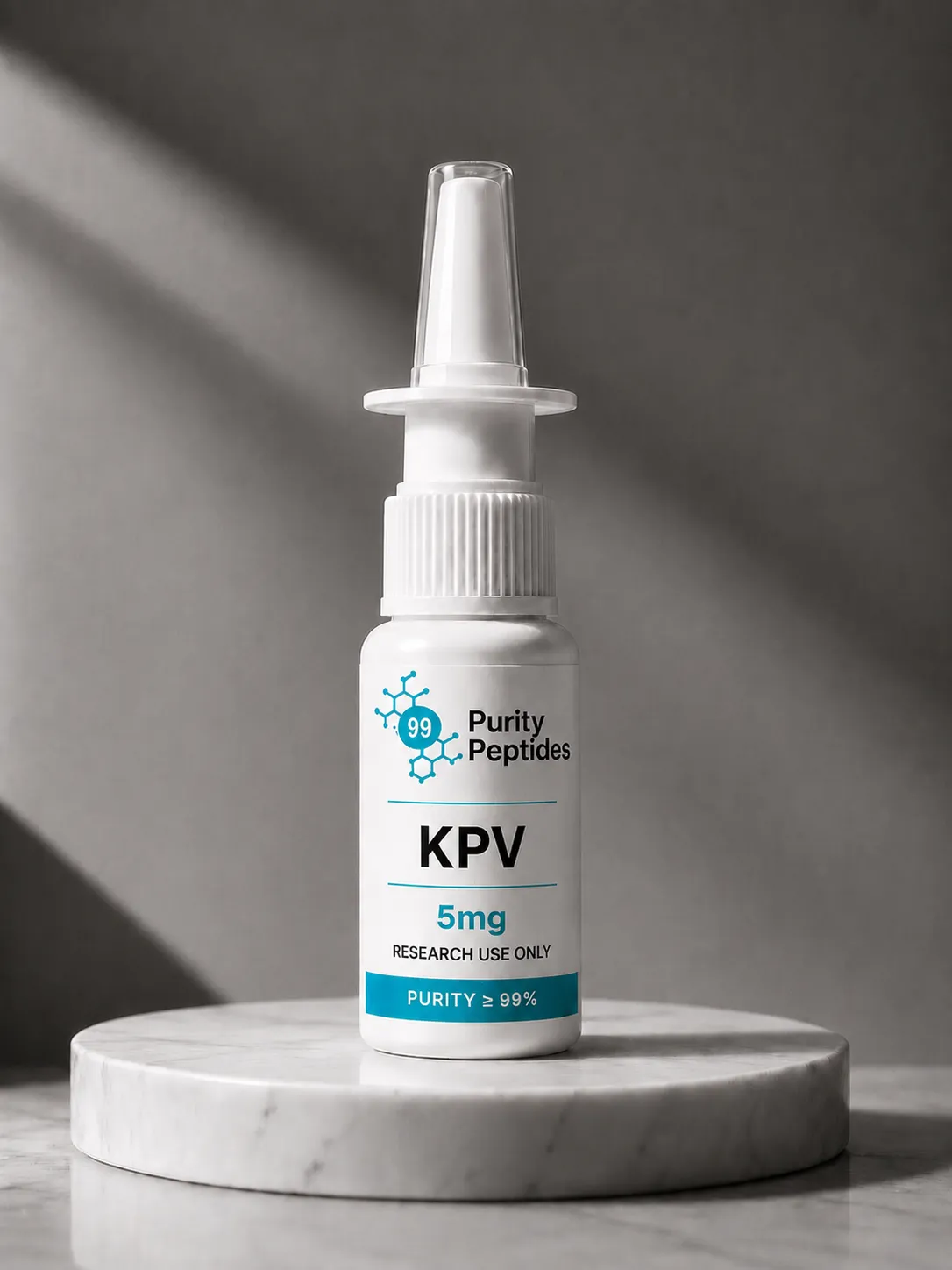
It states the total quantity of peptide in the bottle. It does not state how much leaves the nozzle per actuation, and it cannot be converted into that number without two additional values.
Converting a bottle total into a per-actuation amount requires the total fill volume of solution and the metered volume the pump delivers per press. Concentration is total peptide divided by fill volume; per-actuation amount is concentration multiplied by actuation volume. Both inputs are properties of the specific bottle and pump assembly, and neither can be inferred from the milligram figure.
Nasal pumps in general use commonly meter somewhere in the range of 50 to 140 µL per actuation, and the nasal cavity itself holds only about 100 to 200 µL per nostril. Those are general device and anatomy figures. They are not specifications for this or any particular SKU.
Neither the fill volume nor the metered actuation volume is published for the KPV Spray SKU. Any per-actuation figure calculated from the bottle strength alone would therefore be an estimate presented as a specification. This page does not publish one. Investigators needing that number should request the fill volume and metered actuation volume from the supplier and record both alongside their lot number.
How Should a KPV Spray Be Stored and Handled?
Stability rules for a tripeptide follow from what it is: a short, unprotected linear peptide with no disulfide bridges or structural scaffolding to protect it.
Factor | Lyophilized powder | Solution (spray) |
|---|---|---|
Long-term storage | -20°C, sealed and desiccated | Not suited to long-term storage |
Short-term storage | Room temperature tolerable for limited periods when dry | Refrigerated, 2–8°C |
Light | Protect from light | Protect from light; amber or opaque packaging preferred |
Moisture | Critical; desiccate, and warm to room temperature before opening to avoid condensation on the cake | Already in solution; the concern shifts to microbial ingress and hydrolysis |
Freeze-thaw | Not applicable while dry | Avoid; cycling degrades peptides in solution |
Working life after opening | Long, if the seal and desiccant hold | Limited; track it from first actuation |
Two handling points matter more for KPV than for larger peptides. The peptide is proteolytically labile, so anything that introduces contamination into a solution shortens its usable life. And because the molecule is small, hydrolytic cleavage of a single peptide bond destroys the sequence rather than merely trimming it.
General storage practice across formats is covered in the peptide storage guidelines, and volume and concentration arithmetic for lyophilized material is handled in the peptide reconstitution chart.
How Do You Verify Purity for a Tripeptide Specifically?
The same three checks apply as for any peptide, but one of them carries far more weight at this molecular size.
Identity by mass spectrometry. ESI-MS or MALDI-TOF should return a measured mass matching the theoretical 342.44 Da for C₁₆H₃₀N₄O₄. For a three-residue sequence the theoretical mass is unambiguous, which makes this an unusually clean check. A deletion sequence missing a single residue would shift the mass by more than 90 Da, far outside instrument tolerance.
Purity by HPLC. Reversed-phase HPLC separates the intended peptide from synthesis by-products and degradation species, reported as a percentage of total peak area. Note what this figure describes: the proportion of peptide-related material that is the target sequence. It says nothing about how much of the vial's mass is peptide at all.
Net peptide content. Here is where a tripeptide differs sharply from a larger one. Peptides purified by reversed-phase HPLC carry counterions, commonly trifluoroacetate or acetate, and those counterions occupy vial mass alongside water and residual salts. KPV has two protonatable sites: the N-terminal α-amino group and the lysine side chain.
Run the arithmetic. If both sites carry trifluoroacetate at 114.02 Da each, the salt form totals roughly 570 Da, of which the peptide itself is about 60%. As acetate at 60.05 Da each, the total is roughly 463 Da and the peptide fraction is near 74%. Apply the same two counterions to a 4,000 Da peptide and the peptide fraction stays above 94%.
That contrast is the point. The identical counterion burden costs a tripeptide a third of its vial mass and a mid-sized peptide almost nothing. A vial labelled 10mg with 99% HPLC purity may still contain substantially less than 10mg of KPV, and only net peptide content on the COA resolves the difference. Those figures above are illustrative arithmetic for the fully-loaded case, not lot values; actual counterion content varies by lot and by purification method, and must come from the certificate.
Field-by-field guidance on reading these documents is in the certificate of analysis guide, and lot documentation is published at certificates.
Where This Leaves the Intranasal KPV Question
KPV's molecular weight is genuinely favorable for nasal absorption, and that is worth saying clearly. At 342 Da it sits far below the threshold where published absorption data turns against a molecule, with more headroom than almost any other peptide offered in a spray format.
It is equally worth saying that this remains an inference. The peptide has been studied in intestinal epithelium, in immune cells, in bronchial epithelial culture and in rodent colitis models, by oral and in vitro routes. It has not been studied intranasally. Until someone measures nasal uptake of this tripeptide directly, the honest position is that the structural case is strong and the compound-specific evidence is absent.
Investigators comparing formats can find the current KPV Spray specifications on the KPV Spray product page, and the full mechanism and research background in the KPV gut, skin and immune health guide. Related comparative work covers KPV against BPC-157, combined BPC-157 and KPV research, and the four-component blend guide.
Frequently Asked Questions
What is a KPV nasal spray?
It is the tripeptide KPV (Lys-Pro-Val), the C-terminal fragment of α-MSH, supplied pre-dissolved in an aqueous solution inside a metered pump bottle rather than as a lyophilized powder. The format removes the reconstitution step and fixes concentration at the point of manufacture. It is supplied for laboratory research only, not for human or veterinary use.
Is there any published research on intranasal KPV?
No. No pharmacokinetic study, bioavailability measurement or nasal mucosal transport study for intranasally administered KPV has been published, in humans or animal models. The published KPV literature used oral and in vitro routes. Claims about nasal absorption of KPV rest on molecular-weight inference from general peptide delivery research, not on measurements of this compound.
Why does KPV's molecular weight matter so much for the nasal route?
Molecular size is the dominant variable in nasal absorption. Pooled data across roughly thirty compounds showed molecules under 1,000 Da averaging about 70% nasal bioavailability without enhancers, with a sharp decline above that point. KPV at 342.44 Da sits well inside the favorable range, with substantial headroom before the threshold where absorption efficiency falls away.
How much KPV does each actuation deliver?
That figure cannot be derived from the bottle strength alone. Calculating it requires the total fill volume and the metered volume the pump delivers per press, neither of which is published for this SKU. Any per-actuation number circulating without both inputs is an estimate. Investigators needing it should request both values from the supplier directly.
Does a KPV nasal spray deliver the peptide to the brain?
Unknown, and the question is separate from systemic absorption. Nose-to-brain transport along olfactory and trigeminal pathways is a distinct and much smaller fraction than systemic uptake into the bloodstream. Published bioavailability percentages almost always describe the systemic figure. Neither number has been measured for KPV, so no claim either way is currently supportable.
Is a nasal spray better than a lyophilized KPV vial?
Neither is better; they suit different study designs. A spray removes preparation work but fixes concentration at the supplier and adds device-dependent variables. A vial requires reconstitution but gives the investigator full concentration control and a documented preparation record. Choose based on whether the study needs formulation convenience or parameter control.
What does the milligram figure on a KPV spray bottle refer to?
It refers to the total quantity of peptide contained in the bottle, not the amount delivered per actuation. Converting between the two requires fill volume and metered actuation volume. Treating the bottle figure as a per-spray quantity overstates the delivered amount by a wide and unpredictable margin, depending on how many actuations the bottle contains.
How should a KPV nasal spray be stored?
Solutions require refrigeration at 2–8°C, protection from light, and avoidance of freeze-thaw cycling. Lyophilized KPV differs: it stores at -20°C sealed and desiccated, and should reach room temperature before opening to prevent condensation. Solution working life after first opening is limited and considerably shorter than the powder's, so track it from first actuation.
Does KPV activate melanocortin receptors?
No. KPV lacks the His-Phe-Arg-Trp core motif that known melanocortin receptors require for binding, a distinction identified by Hiltz and Lipton in 1989. It is studied as a melanocortin-receptor-independent compound acting through NF-κB and MAP kinase signaling. Sources describing KPV as an MC1R or MC4R agonist are incorrect on this specific point.
What route did the main KPV colitis research use?
Oral. In the Dalmasso et al. 2008 *Gastroenterology* study, KPV was added to the drinking water of mice in DSS-induced and TNBS-induced colitis models. The mechanism involved PepT1, a di/tripeptide transporter abundant in intestinal tissue and upregulated during inflammation. That transporter-mediated gut uptake does not transfer to nasal epithelium by default.
What should a certificate of analysis show for KPV?
Three things: identity by mass spectrometry matching the theoretical 342.44 Da, purity by reversed-phase HPLC as a percentage of peak area, and net peptide content. For a tripeptide the third is unusually important. The certificate should be lot-specific and match the lot number on the vial or bottle received.
Why does net peptide content matter more for KPV than for larger peptides?
Because counterions consume a far larger share of vial mass at this size. KPV has two protonatable sites, and fully loaded with trifluoroacetate the peptide accounts for roughly 60% of the salt mass. The identical counterion burden on a 4,000 Da peptide leaves the peptide fraction above 94%. HPLC purity does not capture this difference.
Can results from a KPV spray be compared with results from a KPV vial?
Only with care. Concentration, formulation excipients and delivered volume differ between the two, and spray formulation details are often not disclosed in the same depth as a reconstitution the investigator performed. Comparing across formats requires documenting what is actually known about each, and recording what is not.
Is KPV stable once it is in solution?
Less stable than in lyophilized form, and published stability data mostly covers the powder. KPV is a short unprotected linear peptide that degrades readily in the presence of peptidases, which is why much recent research encapsulates it in nanoparticles or hydrogels. Because the molecule is only three residues, cleaving one bond destroys the sequence entirely.