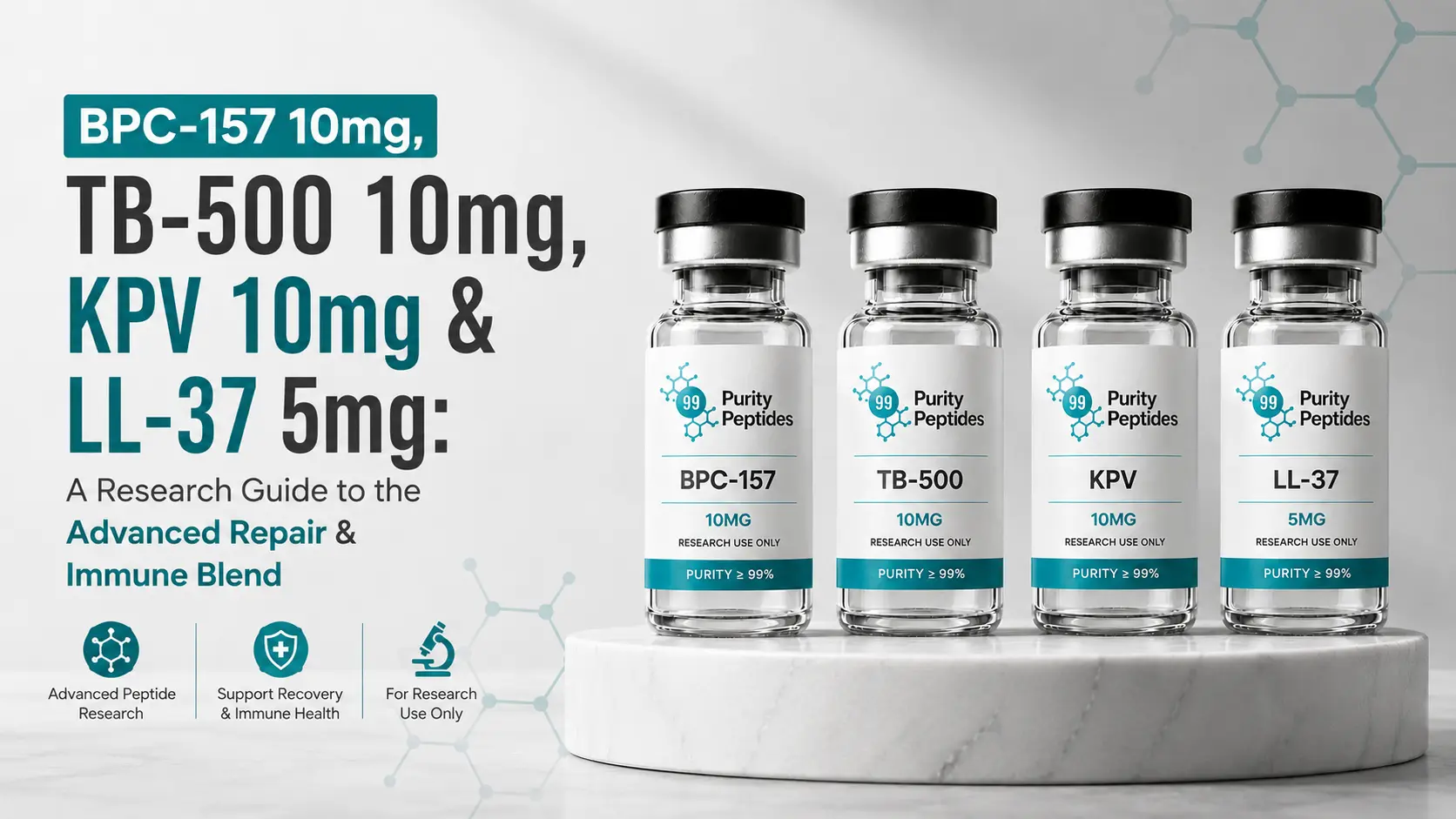
Four peptides in one kit raise two separate questions before any protocol starts. Does pairing a tissue-repair combination with an immune-signaling combination make mechanistic sense? And once the answer is yes, how do you handle four different molecules in a single vial without guessing at the numbers?
Anyone evaluating the Advanced Repair & Immune blend runs into both questions early. The kit combines BPC-157 (10mg) and TB-500 (10mg), two peptides studied for tissue-repair signaling, with KPV (10mg) and LL-37 (5mg), two peptides studied through very different innate-immune pathways.
This BPC-157 TB-500 KPV LL-37 research guide walks through what each compound does on its own, why the four were paired this way, how the reconstitution math works, and what a certificate of analysis should show before a vial enters a research protocol. By the end, you should be able to explain the blend without reaching for the product page.
Quick Answer: What Is the Advanced Repair & Immune Blend?
The Advanced Repair & Immune blend combines four research peptides in a single kit: BPC-157 (10mg), TB-500 (10mg), KPV (10mg), and LL-37 (5mg). BPC-157 and TB-500 target tissue-repair signaling, including angiogenesis and cell migration. KPV and LL-37 target innate-immune signaling, from NF-κB suppression to antimicrobial host defense. All four compounds are supplied for laboratory research use only (RUO) and are not approved for human use.
The Four Compounds at a Glance
Before comparing signaling axes, it helps to see the raw profile of each compound side by side. The table below lists classification, approximate molecular weight, the vial strength supplied in this kit, and the primary research axis each compound serves.
Compound | Classification | Approx. MW | Vial Strength (Kit) | Primary Research Axis |
|---|---|---|---|---|
BPC-157 | Synthetic gastric pentadecapeptide (15 aa) | ~1,419 Da | 10mg | Tissue-repair signaling |
TB-500 | Synthetic thymosin beta-4 fragment or full-sequence analogue | ~818 Da (fragment) to ~4,963 Da (full) | 10mg | Tissue-repair signaling |
KPV | Alpha-MSH C-terminal tripeptide (Lys-Pro-Val) | ~358 Da | 10mg | Innate-immune signaling |
LL-37 | Human cathelicidin antimicrobial peptide (37 aa) | ~4,493 Da | 5mg | Innate-immune signaling |
A naming note worth flagging: “TB-500” is sometimes used for the synthetic Ac-LKKTETQ actin-binding fragment of thymosin beta-4 (roughly 818 Da) and sometimes for the full 43-amino-acid thymosin beta-4 sequence (roughly 4,963 Da), depending on the supplier. The two are not interchangeable for research purposes. Confirm the exact sequence on the lot's certificate of analysis before designing a protocol around it.
Two Signaling Axes, One Kit
Tissue-Repair Signaling: BPC-157 & TB-500
BPC-157 is a synthetic pentadecapeptide derived from a partial sequence identified in human gastric juice. Laboratory work on tendon fibroblasts has linked BPC-157 exposure to increased VEGF receptor 2 (VEGFR2) phosphorylation, which feeds downstream MAPK/ERK signaling tied to endothelial cell proliferation and tube formation — the cellular building blocks of new blood vessel growth. Separate in-vitro work on Achilles tendon fibroblasts found that BPC-157 upregulated growth hormone receptor expression and increased fibroblast proliferation in a dose-dependent manner.
TB-500 research centers on a different mechanism. The compound is tied to thymosin beta-4's actin-binding domain, the seven-residue LKKTETQ motif that governs how the peptide interacts with G-actin inside the cell. Studies using this isolated actin-binding fragment found it retained close to the full peptide's angiogenic activity in endothelial migration and vessel-sprouting assays, pointing to actin regulation — not growth-factor signaling — as the operative mechanism.
The two mechanisms are frequently described as complementary in the literature: one drives new vessel formation through a growth-factor receptor, the other drives cell migration through cytoskeletal regulation. That complementary framing is a hypothesis about how the two might work together in the same injury site, not a finding from a trial that combined them. No published study has tested BPC-157 and TB-500 together as a single intervention.
Innate-Immune Signaling: KPV & LL-37
KPV is the three-residue C-terminal fragment of alpha-melanocyte-stimulating hormone (alpha-MSH). Research published in Gastroenterology traced KPV's anti-inflammatory activity to a specific transport route: the peptide enters intestinal epithelial and immune cells through PepT1, a di/tripeptide transporter that is upregulated in colonic tissue during inflammatory bowel disease. Once inside the cell, KPV inhibits NF-κB and MAP kinase signaling, which are upstream drivers of pro-inflammatory cytokine production. In DSS- and TNBS-induced colitis models, orally administered KPV reduced disease severity and colonic inflammation.
LL-37 is the only cathelicidin-family antimicrobial peptide produced by humans, a 37-residue fragment released from the precursor protein hCAP-18. Its antimicrobial activity works through a physical mechanism — disrupting bacterial cell membranes — rather than the biochemical pathway-blocking used by conventional antibiotics. Review literature on LL-37 also documents chemotactic, angiogenic, and wound-closure activity, alongside a role in regulating the broader innate immune response.
The nuance that matters for protocol design: KPV's effect on NF-κB is fairly consistently suppressive across the models studied. LL-37's immune effect is concentration- and context-dependent — the same peptide can support antimicrobial clearance and wound repair at one concentration while behaving differently at another. Researchers combining the two should not assume they act in the same direction on the same readout.
Why Combine These Four Compounds?
Real tissue injury rarely involves repair signaling in isolation. Inflammation and repair phases overlap, and a wound site that fails to clear pathogens or resolve inflammation on schedule typically shows delayed healing as well. Pairing a tissue-repair combination with an immune-signaling combination maps a research kit onto that overlapping biology, giving a lab a single, purity-matched source for compounds addressing both sides of the process.
Honest Evidence Note
|
Advanced Repair & Immune Blend vs. the Repair Trio Kit
99 Purity Peptides offers more than one tissue-repair-adjacent kit, and the two most frequently compared are the Repair Trio and the Advanced Repair & Immune blend. Both include BPC-157 and TB-500. The difference is what completes the kit and which research question it is built to support.
Feature | Repair Trio | Advanced Repair & Immune |
|---|---|---|
Compounds | BPC-157, TB-500, GHK-Cu | BPC-157, TB-500, KPV, LL-37 |
BPC-157 / TB-500 strength | 5mg each | 10mg each |
Signaling focus | Tissue repair across three phases (inflammation, proliferation, remodeling) | Tissue repair plus innate-immune signaling (two axes) |
Copper peptide included | Yes (GHK-Cu, 50mg) | No |
Immune-targeted compound | No | Yes (KPV and LL-37) |
A lab studying remodeling and matrix support alongside repair signaling has more reason to reach for the Repair Trio and its copper peptide. A lab studying how repair and immune signaling interact at an injury site — or specifically interested in host-defense and anti-inflammatory pathways — has more reason to reach for the Advanced Repair & Immune blend.
Premixed Blend vs. Separate Vials
Both formats show up across 99 Purity Peptides' catalog, and each has a different tradeoff for protocol design.
- Premixed blend: one vial, a fixed compound ratio, simpler reconstitution math, and a single certificate of analysis covering the mixed lot.
- Separate vials: independent dosing control for each compound, the ability to omit or substitute one peptide without discarding the rest of the kit, and an individual COA per compound.
- Choose premixed when the four-compound ratio in this kit matches the protocol as designed.
- Choose separate vials when the study needs to isolate one compound's contribution, or when the protocol calls for a ratio other than 10mg / 10mg / 10mg / 5mg.
Reconstitution: Step-by-Step Guide
Reconstitution math follows the same core process across all four compounds in this kit, though exact volumes should always be calculated for the specific vial strength being used. For a full walkthrough with a built-in calculator, see the peptide reconstitution and storage guide referenced below.
- Gather materials: the lyophilized vial, bacteriostatic water (not sterile water alone), an alcohol swab, and an appropriately sized syringe.
- Swab the vial's rubber stopper with the alcohol wipe and let it air-dry.
- Draw the calculated volume of bacteriostatic water into the syringe.
- Insert the needle at an angle and let the water run gently down the inside wall of the vial — do not inject it directly onto the lyophilized powder.
- Swirl the vial gently to dissolve the powder. Do not shake; agitation can damage the peptide's structure.
- Once fully dissolved, label the vial with the reconstitution date and store it per the compound's storage requirements.
Vial Strength | Illustrative BW Range | Resulting Concentration |
|---|---|---|
10mg (BPC-157, TB-500, or KPV) | 2 mL | 5 mg/mL |
10mg (BPC-157, TB-500, or KPV) | 5 mL | 2 mg/mL |
5mg (LL-37) | 1 mL | 5 mg/mL |
5mg (LL-37) | 2.5 mL | 2 mg/mL |
These figures are reconstitution-math illustrations, not a dosing recommendation. Bacteriostatic water volume should be selected based on the specific research protocol and confirmed with the peptide calculator linked below.
Storage & Stability
Lyophilized (freeze-dried) peptide holds its structure far longer than reconstituted peptide in solution, which is why vials ship and store in powder form until just before use.
Form | Recommended Storage | General Stability Window |
|---|---|---|
Lyophilized (unreconstituted) | -20°C freezer, protected from light and moisture | Longest stability; degrades fastest at room temperature or with repeated freeze-thaw cycles |
Reconstituted | Refrigerated at 2–8°C | Shorter window; consult the compound-specific guidance below before extended storage |
Temperature swings during shipping, repeated freeze-thaw cycles, and light exposure are the three most common causes of premature peptide degradation. The full storage and handling guide referenced below covers degradation mechanisms — oxidation, hydrolysis, deamidation, and aggregation — in more depth.
Purity Verification: Reading the COA
A certificate of analysis (COA) is the primary document tying a specific vial to specific lab-tested data. Two tests matter most:
- HPLC (High-Performance Liquid Chromatography): measures purity as a percentage, separating the target peptide from synthesis byproducts and degradation fragments.
- LC-MS (Liquid Chromatography-Mass Spectrometry): confirms identity by matching the molecule's mass to the expected sequence, distinct from a purity percentage.
A COA showing a high purity percentage but no mass-spec identity confirmation only tells half the story. Before a vial enters a protocol, confirm the COA lists a lot number matching the vial, a purity percentage, and an identity-confirmation method — not just one or the other.
Regulatory Snapshot: Where These Four Peptides Stand in 2026
Regulatory status has moved for all four compounds in this blend over the course of 2026, and the two tracks are easy to conflate.
- On April 15, 2026, HHS Secretary Robert F. Kennedy Jr. confirmed the removal of 12 peptides from the FDA's Category 2 restricted-substances list, including BPC-157, TB-500, KPV, and cathelicidin LL-37 — all four compounds in this blend.
- On July 23–24, 2026, the FDA's Pharmacy Compounding Advisory Committee (PCAC) voted 8–6, with one abstention, to recommend BPC-157, KPV, and TB-500 for the Section 503A Bulk Drug Substances List. LL-37 was not part of that July voting batch.
- The 503A Bulks List, if the FDA formally adopts it, governs prescription-based compounding at licensed pharmacies — a separate track from research-use (RUO) sourcing. PCAC's recommendation is nonbinding, and formal rulemaking is still pending.
None of this changes the RUO framing of compounds sold for laboratory research: FDA drug approval requires a different, much larger body of clinical evidence than either a Category 2 delisting or a PCAC recommendation. Researchers should treat both developments as regulatory context, not as a change in what a research-use peptide is legally represented to be.
Common Research-Design Mistakes to Avoid
- Assuming “TB-500” always means the same molecule across suppliers without checking the COA.
- Skipping COA review and relying on a supplier's purity claim alone.
- Reconstituting with sterile water instead of bacteriostatic water, or shaking rather than swirling the vial.
- Storing reconstituted peptide at room temperature between sessions.
- Citing four-compound synergy as an established finding rather than a research hypothesis.
- Confusing a 503A compounding-pathway recommendation with FDA drug approval.
Key Takeaways
At a Glance
|
Frequently Asked Questions
What compounds are included in the Advanced Repair & Immune blend?
The kit includes four research peptides: BPC-157 (10mg), TB-500 (10mg), KPV (10mg), and LL-37 (5mg).
What is the dosage strength of each peptide in the blend?
BPC-157, TB-500, and KPV are each supplied at 10mg per vial. LL-37 is supplied at 5mg per vial.
Is the Advanced Repair & Immune blend the same as the Repair Trio kit?
No. Both kits include BPC-157 and TB-500, but the Repair Trio pairs them with GHK-Cu at 5mg strength each, while the Advanced Repair & Immune blend pairs them with KPV and LL-37 at 10mg strength each. The two kits target different research questions.
How do I reconstitute the Advanced Repair & Immune peptide blend?
Each vial reconstitutes with bacteriostatic water using standard peptide-handling technique: swab the stopper, add water gently along the vial wall, and swirl — never shake — until the powder fully dissolves. See the reconstitution guide above for a full step-by-step walkthrough.
How much bacteriostatic water is needed per vial?
The volume depends on the target concentration for the specific protocol. A 10mg vial reconstituted with 2 mL yields roughly 5 mg/mL; with 5 mL, roughly 2 mg/mL. Use the peptide reconstitution calculator to confirm exact volumes.
What is the recommended storage temperature for this blend?
Store lyophilized vials at -20°C, protected from light. Once reconstituted, refrigerate at 2–8°C and avoid repeated freeze-thaw cycles.
Is a certificate of analysis (COA) provided with each order?
99 Purity Peptides issues lot-specific certificates of analysis; researchers should confirm the COA lists both an HPLC purity percentage and a mass-spec identity confirmation before use.
Can I order the peptides in separate vials instead of premixed?
Yes. BPC-157 and TB-500 are available as a separate combination vial, and KPV and LL-37 are available individually elsewhere in the catalog, for protocols that need independent dosing control.
What is the difference between BPC-157 and TB-500 in this blend?
BPC-157 is studied primarily through VEGFR2-driven angiogenesis and fibroblast signaling. TB-500 is studied through its actin-binding domain, which governs cytoskeletal regulation and cell migration. The two mechanisms are considered complementary, not identical.
How does KPV relate to inflammatory-signaling research?
KPV research centers on suppressing NF-κB signaling by entering cells through the PepT1 transporter, an effect studied extensively in colitis and other inflammatory bowel disease models.
What role does LL-37 play in host-defense research?
LL-37 is studied for its antimicrobial, wound-healing, and immune-modulating activity as the only human cathelicidin. Its immune effects are concentration- and context-dependent.
Can BPC-157, TB-500, KPV, and LL-37 be studied together?
They can be studied together, but no published trial has tested all four in combination. Any combined-effect claim should be treated as a research hypothesis rather than an established finding.
Is this blend compliant with RUO labeling requirements?
The blend is supplied and labeled for laboratory research use only (RUO) and is not approved or intended for human use, diagnostic use, or in vitro diagnostic use.
What is the 2026 regulatory status of these four peptides?
All four compounds were removed from FDA's Category 2 restricted list on April 15, 2026. On July 23–24, 2026, BPC-157, KPV, and TB-500 also received a nonbinding PCAC recommendation for the 503A Bulks List, a separate compounding-pharmacy pathway. LL-37 was not part of that July vote.
Who can purchase research peptides from 99 Purity Peptides?
Research peptides are sold to qualified laboratory and research buyers for research use only, consistent with the site's RUO terms.