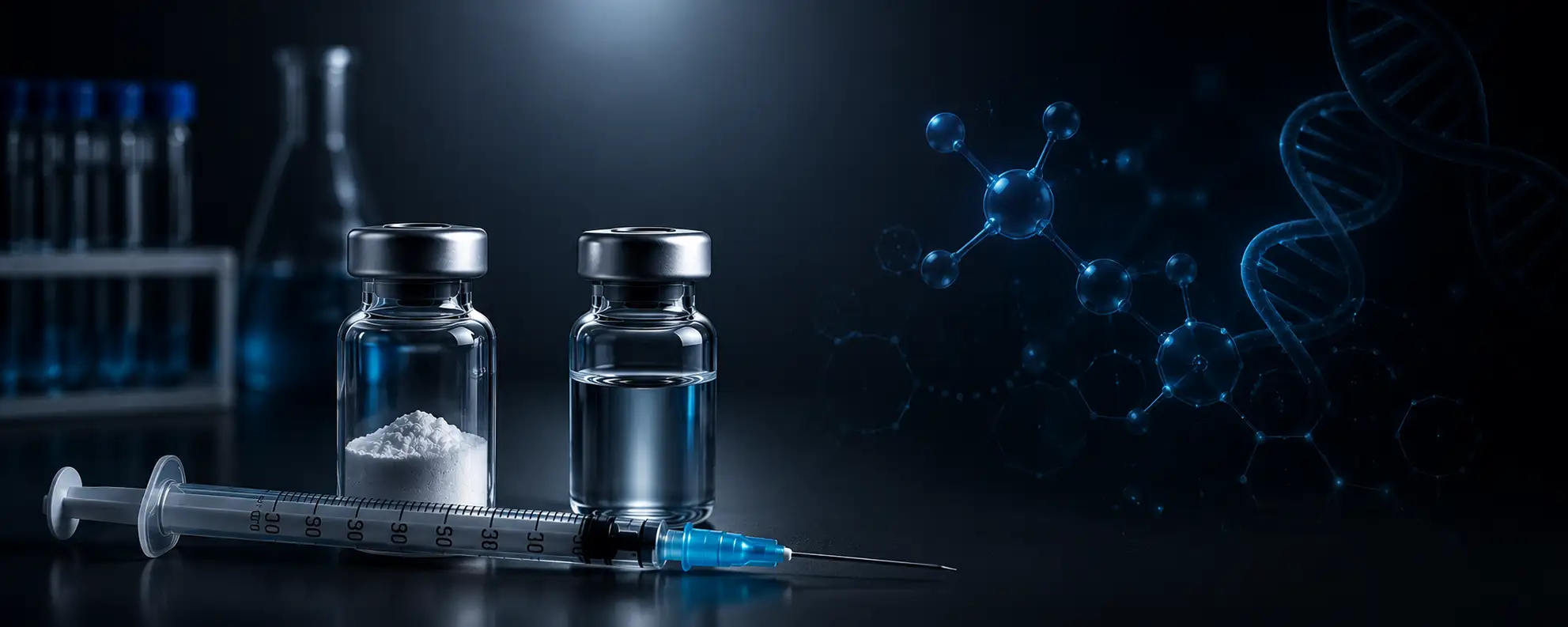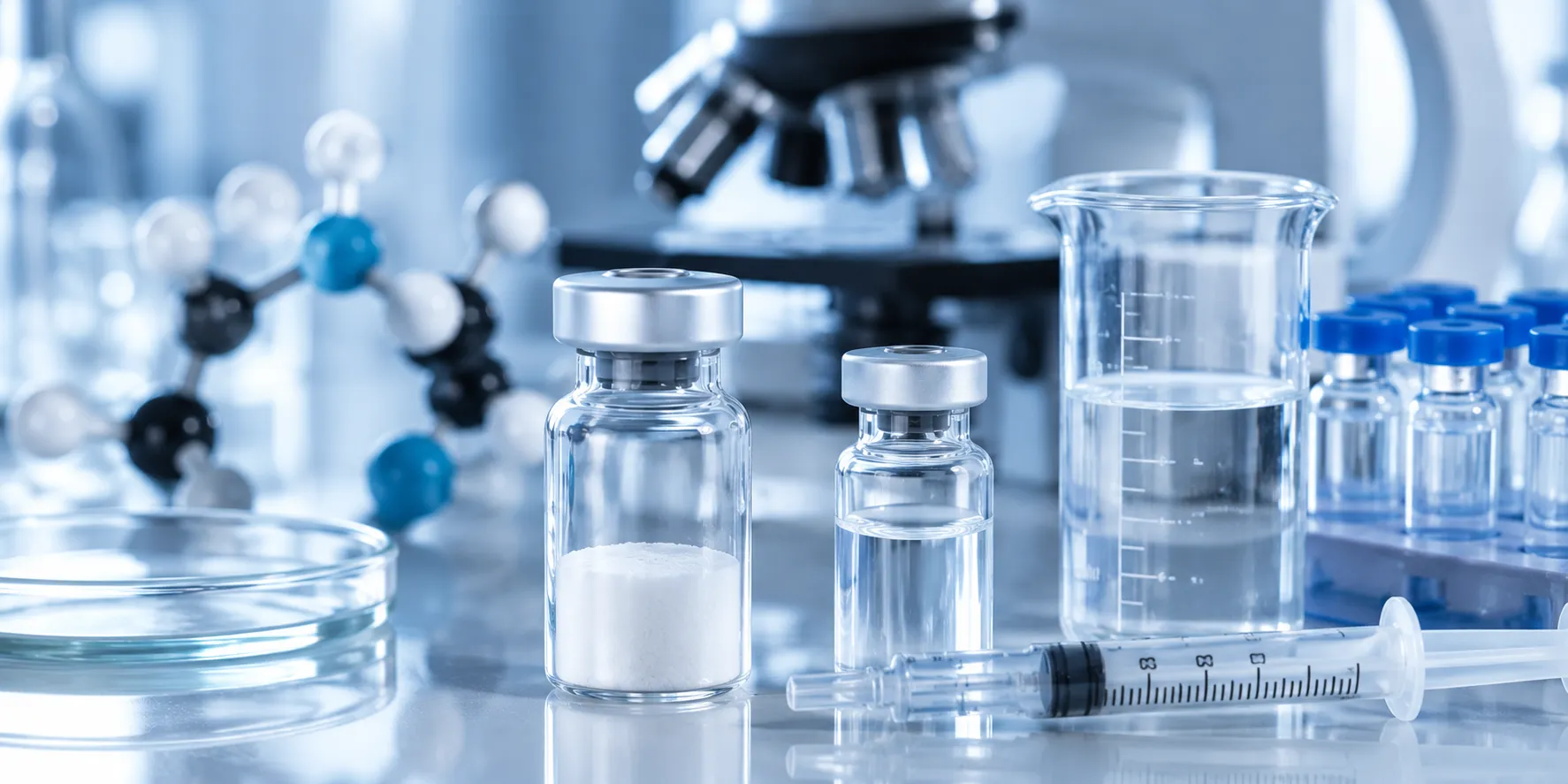
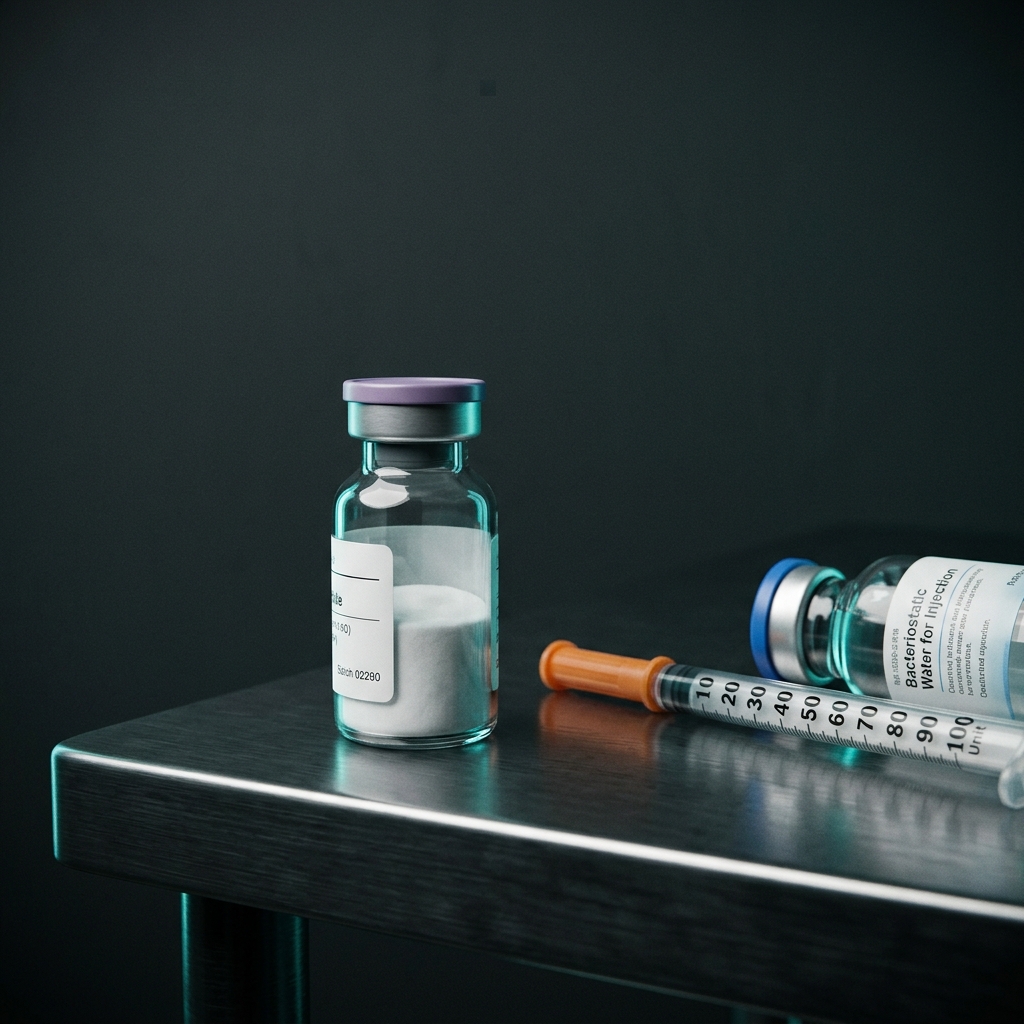
To reconstitute a lyophilized research peptide, add bacteriostatic water to the vial and read the concentration as milligrams of peptide ÷ millilitres of water. A 10 mg vial dissolved in 2 mL gives 5 mg/mL. On a U-100 insulin syringe, 1 mL = 100 units, so 2 mL fills the syringe to 200 units.
More water lowers the concentration and improves measurement resolution; less water does the opposite. The chosen volume is a research-handling decision, not a fixed rule — so verify it with the peptide calculator. For a larger grid covering 2 mg to 80 mg vials, download the printable reconstitution chart (PDF).
Quick answer — the 15-second version
To reconstitute a lyophilized research peptide, add bacteriostatic water to the vial and read the concentration as milligrams of peptide ÷ millilitres of water. A 10 mg vial dissolved in 2 mL gives 5 mg/mL. On a U-100 insulin syringe, 1 mL = 100 units, so 2 mL fills the syringe to 200 units. More water lowers the concentration and improves measurement resolution; less water does the opposite. The chosen volume is a research-handling decision, not a fixed rule — so verify it with a calculator.
1. What "reconstitution" actually means
Research peptides ship as a lyophilized cake or film at the bottom of a sealed vial. Manufacturers remove the water so the peptide stays stable in transit and storage. Consequently, the powder is not usable for any laboratory measurement until it returns to solution.
Reconstitution does two jobs at once. First, it makes the peptide measurable, because you cannot pipette a dry film accurately. Second, it fixes a concentration, so every later draw maps to a precise mass. Therefore the volume of water you add is the single most important choice in the whole process.
2. Bacteriostatic vs sterile vs acetic acid water
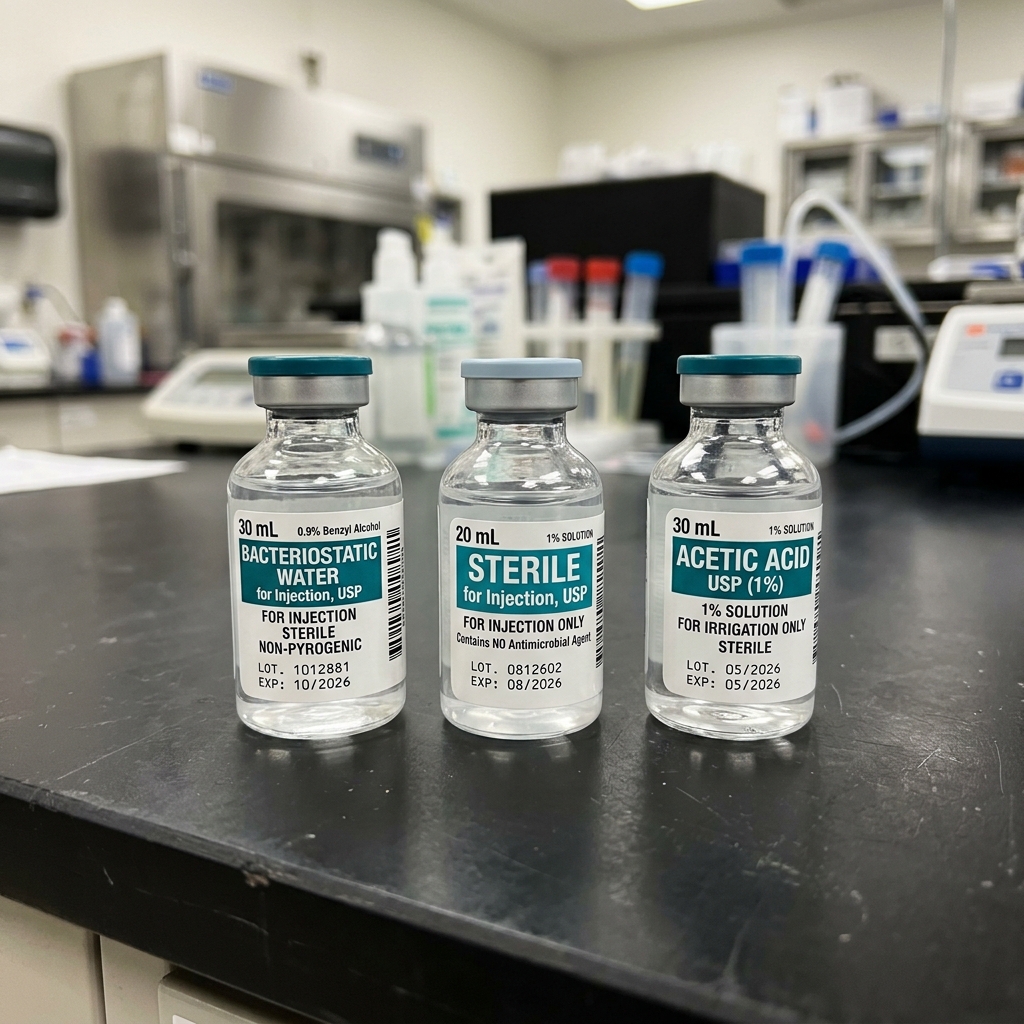
Not all solvents behave the same way. The right choice depends on solubility and how long the solution will sit. Here is the practical comparison researchers rely on.
| Solvent | What it is | Best for | Notes |
|---|---|---|---|
| Bacteriostatic water | Sterile water with 0.9% benzyl alcohol as a preservative | The default for most peptides that dissolve readily | Benzyl alcohol suppresses microbial growth, so multi-draw vials stay usable longer |
| Sterile water for injection | Sterile water, no preservative | Single-use preparations | No bacteriostatic protection, so it is less suited to vials opened repeatedly |
| Acetic acid water (0.6%) | Dilute acetic acid in water | "Sticky" or poorly soluble peptides that resist plain water | Mild acidity helps break up aggregates that will not dissolve otherwise |
When a peptide clouds, foams, or leaves undissolved specks in plain bacteriostatic water, acetic acid water is the usual next step. GHK-Cu and certain long-chain peptides are common candidates. You can source both solvents directly rather than improvising.
3. The three numbers behind every reconstitution
Every reconstitution reduces to three linked values. Master these and the charts below become obvious.
Number 1 — Peptide mass (mg)
This is the amount of peptide in the vial, printed on the label: 5 mg, 10 mg, 15 mg, and so on. It never changes when you add water. You are simply dissolving that fixed mass.
Number 2 — Solvent volume (mL)
This is how much bacteriostatic water you add. You choose it. Because it is the only free variable, it sets the concentration and the measurement resolution for everything that follows.
Number 3 — Concentration (mg/mL)
Concentration is simply mass divided by volume. It tells you how much peptide sits in each millilitre — and, therefore, in each syringe unit.
Example: 10 mg ÷ 2 mL = 5 mg/mL
Example: 5 mg ÷ 1 mL = 5 mg/mL (same concentration, half the volume)
4. The master reconstitution chart
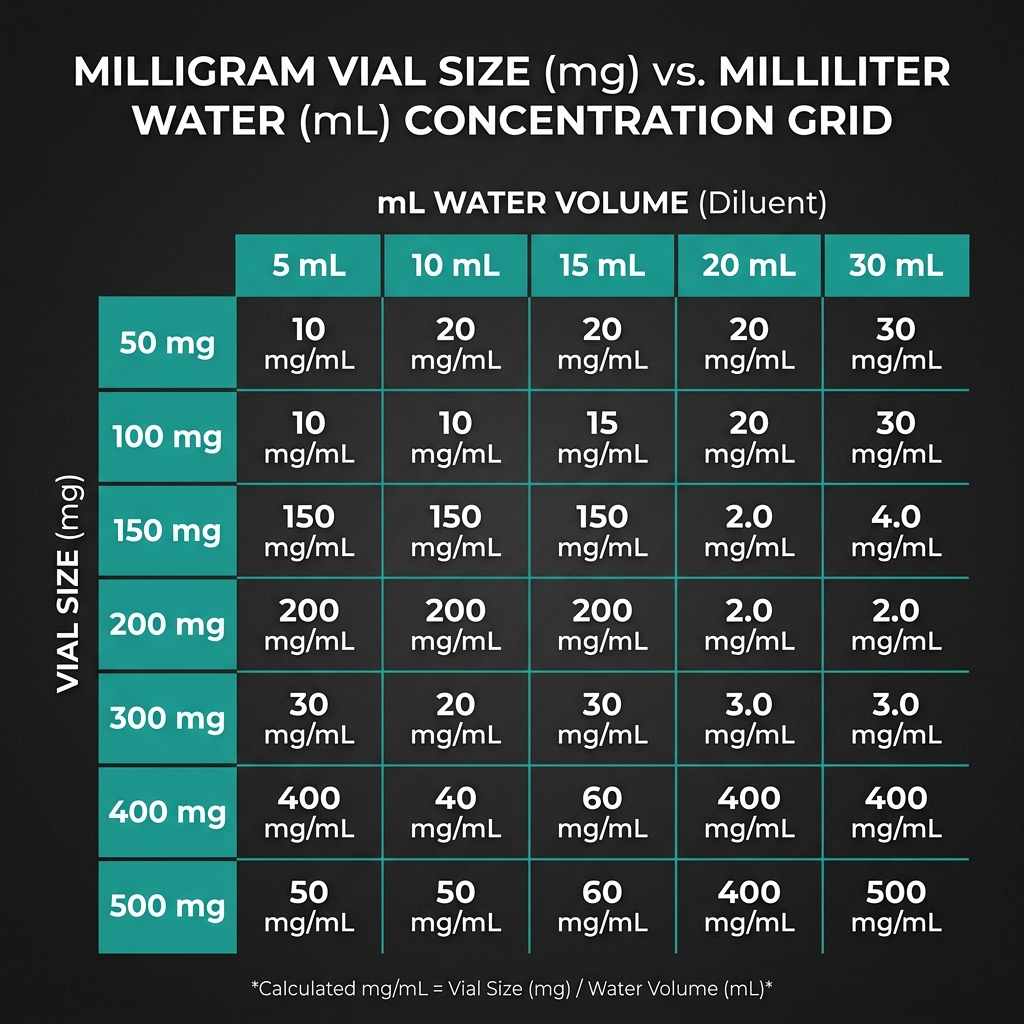
This is the reference the rest of the article builds toward. Read across from your vial size, down from your chosen water volume, and the cell gives the resulting concentration. Every value is mass ÷ volume — nothing more.
| Water added ↓ / Vial → | 5 mg | 10 mg | 15 mg | 20 mg | 30 mg |
|---|---|---|---|---|---|
| 1 mL | 5.0 | 10.0 | 15.0 | 20.0 | 30.0 |
| 2 mL | 2.5 | 5.0 | 7.5 | 10.0 | 15.0 |
| 3 mL | 1.67 | 3.33 | 5.0 | 6.67 | 10.0 |
| 5 mL | 1.0 | 2.0 | 3.0 | 4.0 | 6.0 |
5. How many units is 1 mL, 2 mL & 3 mL of BAC water?
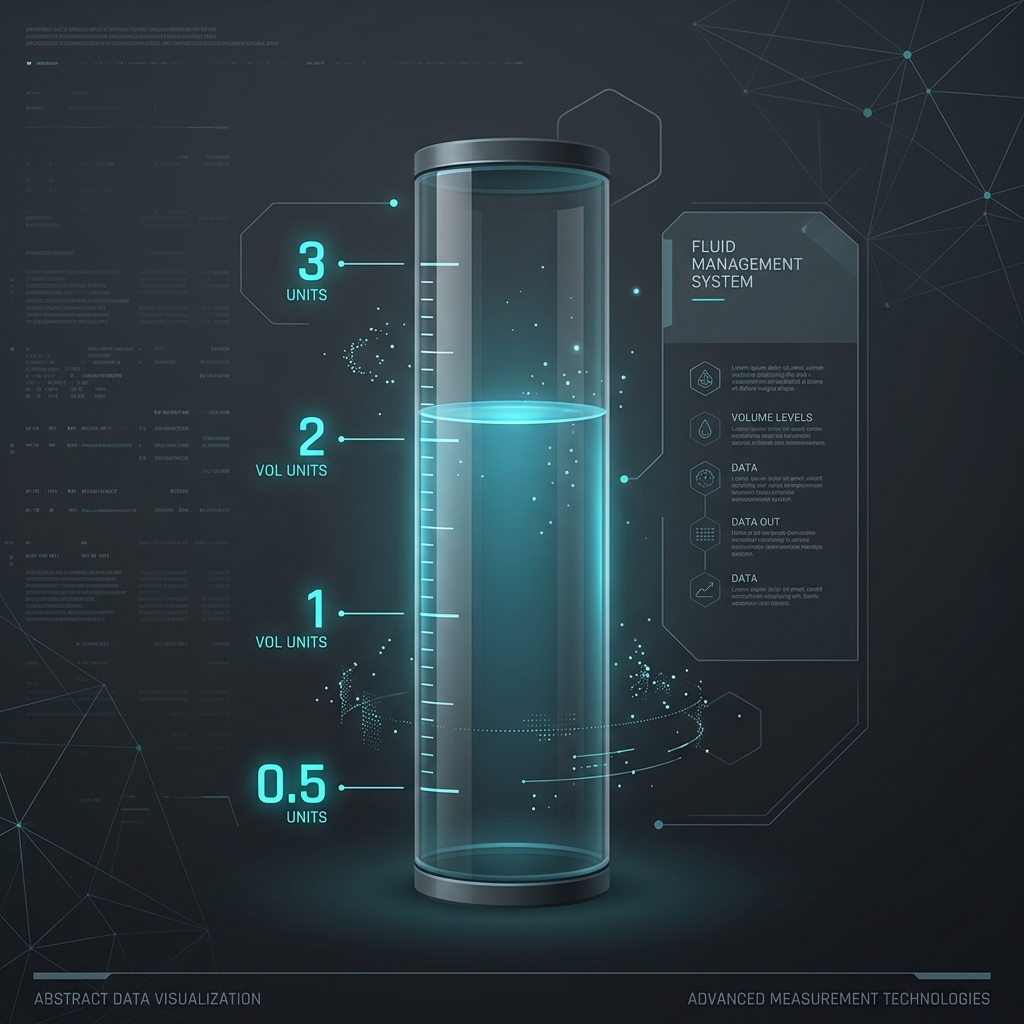
This single question appears in your search data in dozens of forms. The answer is fixed by the syringe scale, independent of which peptide is inside.
| Bacteriostatic water | U-100 syringe units | As a fraction of a 1 mL syringe |
|---|---|---|
| 0.25 mL | 25 units | One quarter |
| 0.5 mL | 50 units | One half |
| 1 mL | 100 units | Full 1 mL syringe |
| 1.5 mL | 150 units | One and a half syringes |
| 2 mL | 200 units | Two full syringes |
| 3 mL | 300 units | Three full syringes |
| 5 mL | 500 units | Five full syringes |
6. Choosing your reconstitution volume
Because water volume is the free variable, the choice comes down to a trade-off between resolution and vial capacity. Two principles guide it.
More water = finer resolution
Adding more solvent spreads the same peptide mass across more units. Each unit then holds less peptide, so small measurements become more precise. Researchers working with tiny target masses often prefer this.
Less water = higher concentration
Adding less solvent concentrates the peptide. Each unit holds more, which suits larger target masses and keeps the total liquid volume within a small vial. However, resolution drops, so very small measurements get harder.
7. How much water can a peptide vial hold?
Vial capacity caps how much water you can add. A standard 3 mL peptide vial comfortably holds up to about 3 mL, and many so-called "10 mL" vials are only partially filled by design to leave headspace. Always leave a small air gap so pressure stays balanced when you withdraw samples.
| Vial size (nominal) | Practical working fill | Comment |
|---|---|---|
| 3 mL vial | Up to ~2.5–3 mL | Most common research peptide vial |
| 5 mL vial | Up to ~4–5 mL | Useful when high resolution is needed |
| 10 mL vial | Up to ~8–10 mL | Often over-specified; leave headspace |
8. The reconstitution procedure, step by step
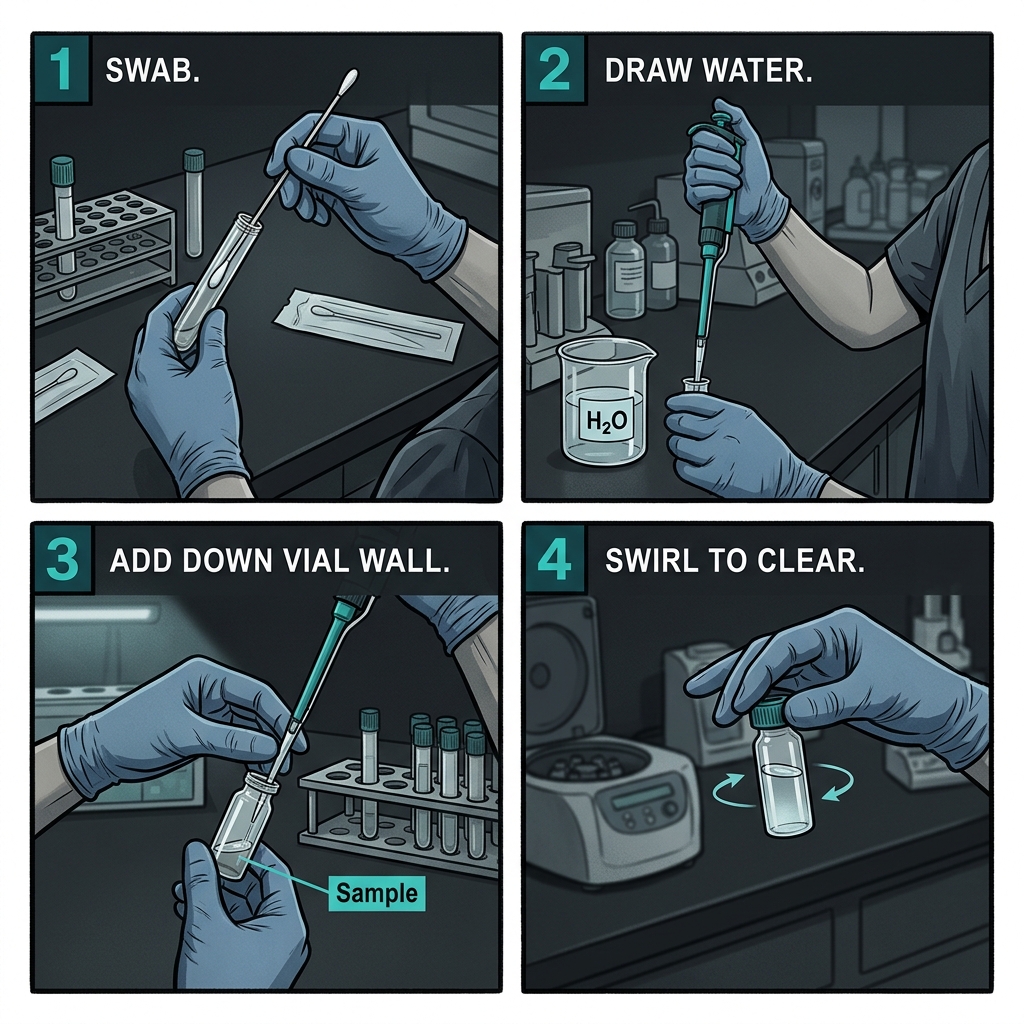
This is standard aseptic laboratory handling for a lyophilized reference material — see the full peptide reconstitution guide for extended technique notes. Work on a clean surface with clean hands and fresh supplies.
- Bring both vials to room temperature. Cold vials can cause condensation and slow dissolution.
- Wipe both stoppers with an alcohol swab. Clean the peptide vial and the bacteriostatic water vial before piercing either.
- Draw your measured water volume. Use the chart above to fix the volume, then draw it from the bacteriostatic water vial.
- Add water slowly down the vial wall. Aim the stream at the glass, not directly onto the peptide cake. This protects fragile peptide chains from shear.
- Let it dissolve — do not shake. Swirl gently or leave it to sit. Vigorous shaking can denature or foam the peptide.
- Confirm a clear solution. A properly reconstituted vial is clear and particle-free. Cloudiness or specks signal a solubility issue — consider acetic acid water.
- Label and refrigerate. Record concentration and date, then store cold. See the stability section next.
Prefer to have the numbers run for you? Our step-by-step reconstitution guide covers entering your own vial size, water volume and target dose.
9. Storage & stability after reconstitution
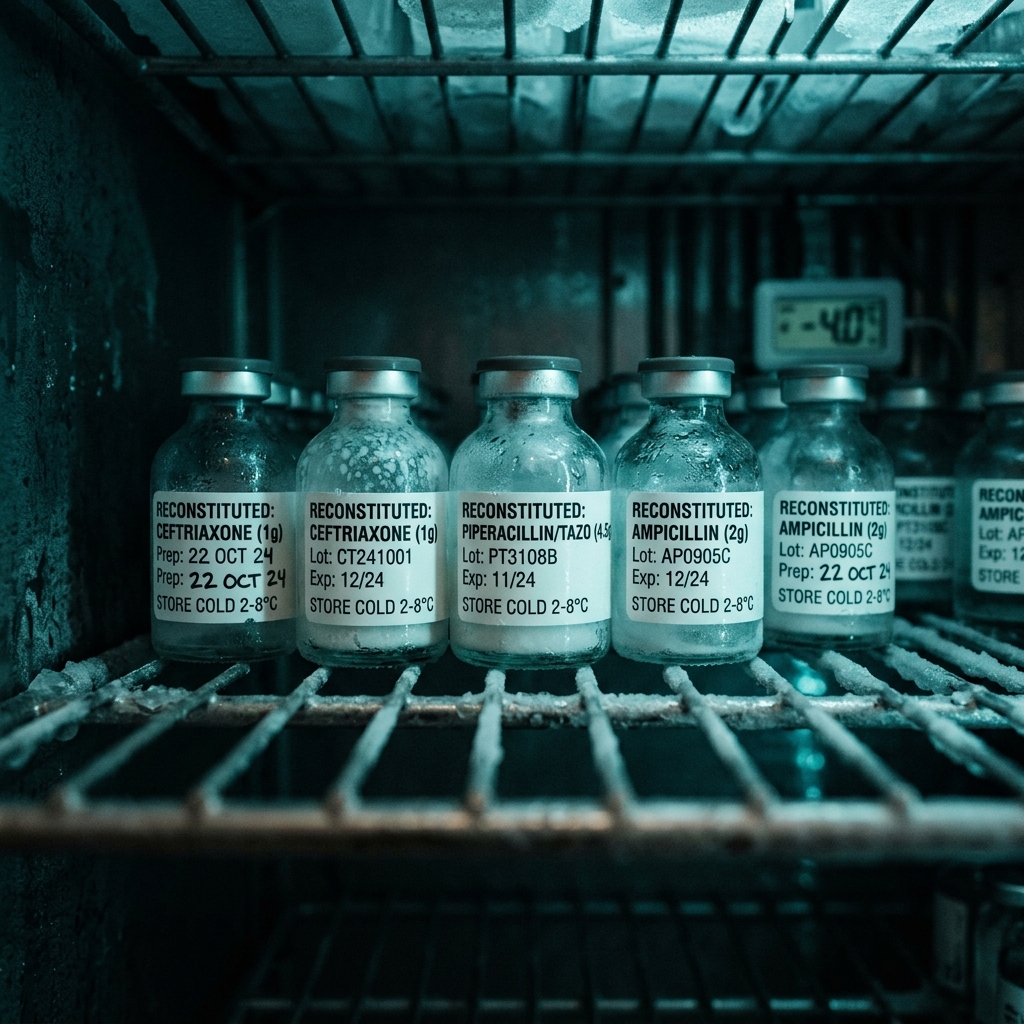
Once in solution, a peptide is far less stable than the dry powder. Handling from here decides how long the material stays usable for research.
- Refrigerate reconstituted vials. Cold storage slows degradation dramatically compared with room temperature.
- Bacteriostatic water buys time. Its preservative is why reconstituted vials tolerate repeated sampling over weeks rather than days.
- Protect from light and heat. Both accelerate breakdown of many peptide chains.
- Freeze only when appropriate. Some peptides tolerate a single freeze; repeated freeze-thaw cycles damage most. Verify per compound.
For the full protocol — temperatures, timelines, and freeze-thaw specifics — see the dedicated storage guide and our storage best practices reference, backed by peptide stability research in the peer-reviewed literature.
10. Compound-specific reconstitution examples
Different research peptides ship in different vial sizes and have different solubility quirks. The table below shows example preparations — vial size, an example water volume, and the resulting concentration. These are measurement examples only; they are not administration guidance.
| Compound (RUO) | Common vial | Example water | Resulting conc. | Handling note |
|---|---|---|---|---|
| Retatrutide | 5–15 mg | 2 mL | 2.5–7.5 mg/mL | Investigational triple-agonist; dissolves readily in BAC water |
| Tesamorelin | 5–10 mg | 2 mL | 2.5–5 mg/mL | Standard BAC water reconstitution |
| GHK-Cu | 50 mg | 5 mL | 10 mg/mL | May need acetic acid water if it will not clear |
| BPC-157 | 5–10 mg | 2 mL | 2.5–5 mg/mL | Dissolves cleanly; swirl, do not shake |
| KLOW blend | ~80 mg total | 3–5 mL | ~16–27 mg/mL | Multi-peptide blend; use larger volume for resolution |
| SS-31 (elamipretide) | 50 mg | 5 mL | 10 mg/mL | Standard BAC water reconstitution |
11. Common reconstitution mistakes
- Shaking instead of swirling. The single most damaging habit — it shears peptide chains.
- Squirting water onto the cake. Aim at the glass wall to protect the peptide.
- Guessing the volume. Eyeballing wrecks concentration accuracy. Use the calculator.
- Confusing units with dose. "Units" measure liquid volume, not peptide mass. Only concentration links the two.
- Using plain water for a sticky peptide. If it will not clear, switch to acetic acid water.
- Storing warm. Reconstituted peptides degrade fast at room temperature.
12. Key takeaways
Remember these six
- ▸ Concentration (mg/mL) = peptide mass ÷ water added. That one equation runs everything.
- ▸ 1 mL of bacteriostatic water = 100 units on a U-100 syringe. Volume, not dose.
- ▸ More water = finer resolution; less water = higher concentration. You choose.
- ▸ Bacteriostatic water is the default; acetic acid water rescues sticky peptides.
- ▸ Swirl, never shake — and add water down the glass wall.
- ▸ Refrigerate after reconstitution, and verify every number with the calculator.
Conclusion
Reconstitution is not guesswork — it is arithmetic. Once you see a vial as a fixed mass and the water as your one free variable, the charts above answer almost any "how much" or "how many units" question in seconds. Choose your volume, add it gently, store it cold, and record the concentration.
Run your exact numbers
Skip the mental math. Enter your vial size and target mass into the 99 Purity Peptides peptide calculator and reconstitution calculator — they return the precise water volume and syringe units instantly, in millilitres or units. Then explore the research catalog for third-party-tested, 99%-purity compounds and the correct bacteriostatic and acetic-acid water.
Frequently Asked Questions
How much bacteriostatic water do I use to reconstitute a 10 mg peptide?
It depends on the concentration you want. Adding 1 mL gives 10 mg/mL, and adding 2 mL gives 5 mg/mL. The mass stays fixed at 10 mg; the water volume you choose sets the concentration. Use a peptide calculator to match your target measurement.
How many units is 1 mL of bacteriostatic water?
On a standard U-100 insulin syringe, 1 mL equals 100 units. This ratio is fixed by the syringe scale and does not depend on which peptide is in the vial.
How many units is 2 mL of bacteriostatic water?
2 mL equals 200 units on a U-100 insulin syringe, or two full 1 mL syringes drawn and added to the vial.
How many units is 3 mL of bacteriostatic water?
3 mL equals 300 units on a U-100 insulin syringe — three full syringes. "Units" here describe the liquid volume, not the peptide mass.
What is bacteriostatic water?
Bacteriostatic water is sterile water containing 0.9% benzyl alcohol, a preservative that slows microbial growth. That property makes it the preferred solvent for peptide vials that will be sampled repeatedly over several weeks.
What is the difference between bacteriostatic and sterile water?
Sterile water has no preservative, while bacteriostatic water contains 0.9% benzyl alcohol. The preservative lets bacteriostatic water resist contamination during repeated draws, so it suits multi-use research vials better.
When should I use acetic acid water instead?
Use acetic acid water (typically 0.6%) when a peptide will not fully dissolve in plain bacteriostatic water. Its mild acidity helps break up aggregates in "sticky" peptides such as some GHK-Cu preparations.
How do I calculate peptide concentration?
Divide the peptide mass by the water volume: concentration (mg/mL) = mg ÷ mL. For example, 10 mg dissolved in 2 mL gives 5 mg/mL.
What does mg/mL mean in peptide reconstitution?
It is the concentration — how many milligrams of peptide sit in each millilitre of solution. It links the fixed peptide mass to any volume you later measure.
How do I convert millilitres to insulin units?
Multiply millilitres by 100 on a U-100 syringe. So 0.1 mL is 10 units, 0.5 mL is 50 units, and 1 mL is 100 units.
Should I shake the vial to dissolve the peptide?
No. Shaking can shear delicate peptide chains and introduce foam. Swirl gently or let the vial sit until the solution turns clear.
Where should I add the water in the vial?
Aim the stream down the inside glass wall rather than directly onto the peptide cake. This gentler contact protects the peptide during reconstitution.
How much water can a peptide vial hold?
A common 3 mL vial holds up to roughly 2.5–3 mL; larger vials hold more. Always leave a small headspace so pressure stays balanced during withdrawal.
How long do reconstituted peptides last?
Stability varies by compound, but reconstituted peptides degrade faster than dry powder. Refrigeration and the preservative in bacteriostatic water extend usable life to weeks for many peptides. Check compound-specific guidance.
Do I need to refrigerate reconstituted peptides?
Yes. Cold storage slows degradation significantly compared with room temperature. Keep vials cold, dark, and protected from heat.
Can I freeze reconstituted peptides?
Some peptides tolerate a single freeze, but repeated freeze-thaw cycles damage most. Verify per compound before freezing any reconstituted solution.
What happens if I add too much water?
Nothing is ruined — you simply get a lower concentration. Each unit then holds less peptide, which improves measurement resolution but fills more of the vial.
What happens if I add too little water?
You get a higher concentration, so each unit holds more peptide. Resolution drops, making very small measurements harder to read accurately.
Is bacteriostatic water the same as saline?
No. Saline is a salt solution; bacteriostatic water is preservative-containing sterile water. They are not interchangeable for peptide reconstitution.
Why is my reconstituted peptide cloudy?
Cloudiness or visible specks usually mean the peptide has not fully dissolved. Try gentle swirling, and if it persists, switch to acetic acid water.
How much bacteriostatic water for a 5 mg peptide?
Adding 1 mL gives 5 mg/mL and adding 2 mL gives 2.5 mg/mL. Choose the volume that makes your target measurement land on a round number of units.
How much bacteriostatic water for a 15 mg peptide?
1 mL gives 15 mg/mL, 2 mL gives 7.5 mg/mL, and 3 mL gives 5 mg/mL. The larger the volume, the finer the resolution.
How much bacteriostatic water for a 20 mg peptide?
1 mL gives 20 mg/mL, 2 mL gives 10 mg/mL, and 5 mL gives 4 mg/mL. Pick a volume within your vial capacity that suits your measurement.
Does the peptide amount change when I add water?
No. The peptide mass printed on the label is fixed. Water only changes the concentration and the volume, never the total milligrams.
What syringe is used for peptide reconstitution?
A standard U-100 insulin syringe, marked in units where 100 units equal 1 mL, is typical for measuring small research volumes precisely.
What does "units" mean on an insulin syringe?
Units are a volume scale: 100 units equal 1 mL on a U-100 syringe. They measure how much liquid you move, not how much peptide it contains.
How do I reconstitute GHK-Cu?
A 50 mg GHK-Cu vial dissolved in 5 mL yields 10 mg/mL. If it will not clear in plain bacteriostatic water, acetic acid water often helps.
How do I reconstitute retatrutide?
As a laboratory reference material, a 5–15 mg retatrutide vial in 2 mL of bacteriostatic water gives 2.5–7.5 mg/mL. Retatrutide is investigational and not approved for human use.
How do I reconstitute the KLOW blend?
KLOW is a multi-peptide blend of roughly 80 mg total, so a larger volume of 3–5 mL improves measurement resolution across the blend. See the KLOW research guide for composition.
Can I use tap or distilled water?
No. Only sterile solvents such as bacteriostatic water, sterile water for injection, or acetic acid water are appropriate. Tap and distilled water are not sterile.
Is reconstitution the same as dosing?
No. Reconstitution prepares a solution of known concentration; it does not determine any dose. This guide covers laboratory preparation only, under research-use-only terms.
How do I know the peptide fully dissolved?
A properly reconstituted vial is completely clear and free of particles. Any haze, film, or floating specks indicates incomplete dissolution.
What is the shelf life of unopened peptide powder?
Lyophilized powder stored cold and sealed is stable for months to years depending on the compound — far longer than the reconstituted solution.
Why do peptides come as powder?
Freeze-drying removes water so the peptide stays stable during shipping and storage. Reconstitution simply returns it to a usable liquid state.
How much peptide is in 10 units of a 5 mg/mL solution?
10 units equal 0.1 mL, and at 5 mg/mL that contains 0.5 mg of peptide. Concentration is what converts volume into mass.
Can I reconstitute two peptides in one vial?
Only pre-formulated blends are designed for that. Combining separate single peptides risks solubility and stability problems and is not advised.
Does bacteriostatic water expire?
Yes. It carries an expiry date, and an opened vial has a limited in-use period. Use in-date, uncontaminated solvent for every reconstitution.
What purity should a research peptide be?
Reputable suppliers publish third-party certificates of analysis confirming purity, commonly 99%. Always check the COA before reconstituting.
Is a peptide calculator accurate?
A calculator applies the exact concentration equation, removing arithmetic error. Enter vial size, target mass, and water volume, and it returns the precise units to measure.
Why does my peptide foam when I mix it?
Foaming comes from shaking or agitation, which whips air into the solution and can damage the peptide. Swirl gently and let it settle instead.