Research Use Only (RUO): 99 Purity Peptides supplies research compounds for laboratory and analytical use only. Nothing on this page is intended for human or veterinary consumption, administration, diagnosis, treatment, or prevention of disease. The calculations below are preparation arithmetic for laboratory reference, not a dosing chart and not an administration schedule. No dosing frequency, mg-per-day recommendation, or administration protocol is provided.
Quick Answer: Retatrutide Reconstitution Math at a Glance
For laboratory arithmetic, concentration is simply peptide mass divided by diluent volume. A 30 mg vial with 3 mL of bacteriostatic water gives 10 mg/mL, which corresponds to 1 mg per 0.1 mL. A 10 mg vial with 2 mL gives 5 mg/mL, or 0.5 mg per 0.1 mL. The same formula works for any vial size: concentration (mg/mL) = peptide mass (mg) ÷ diluent volume (mL).
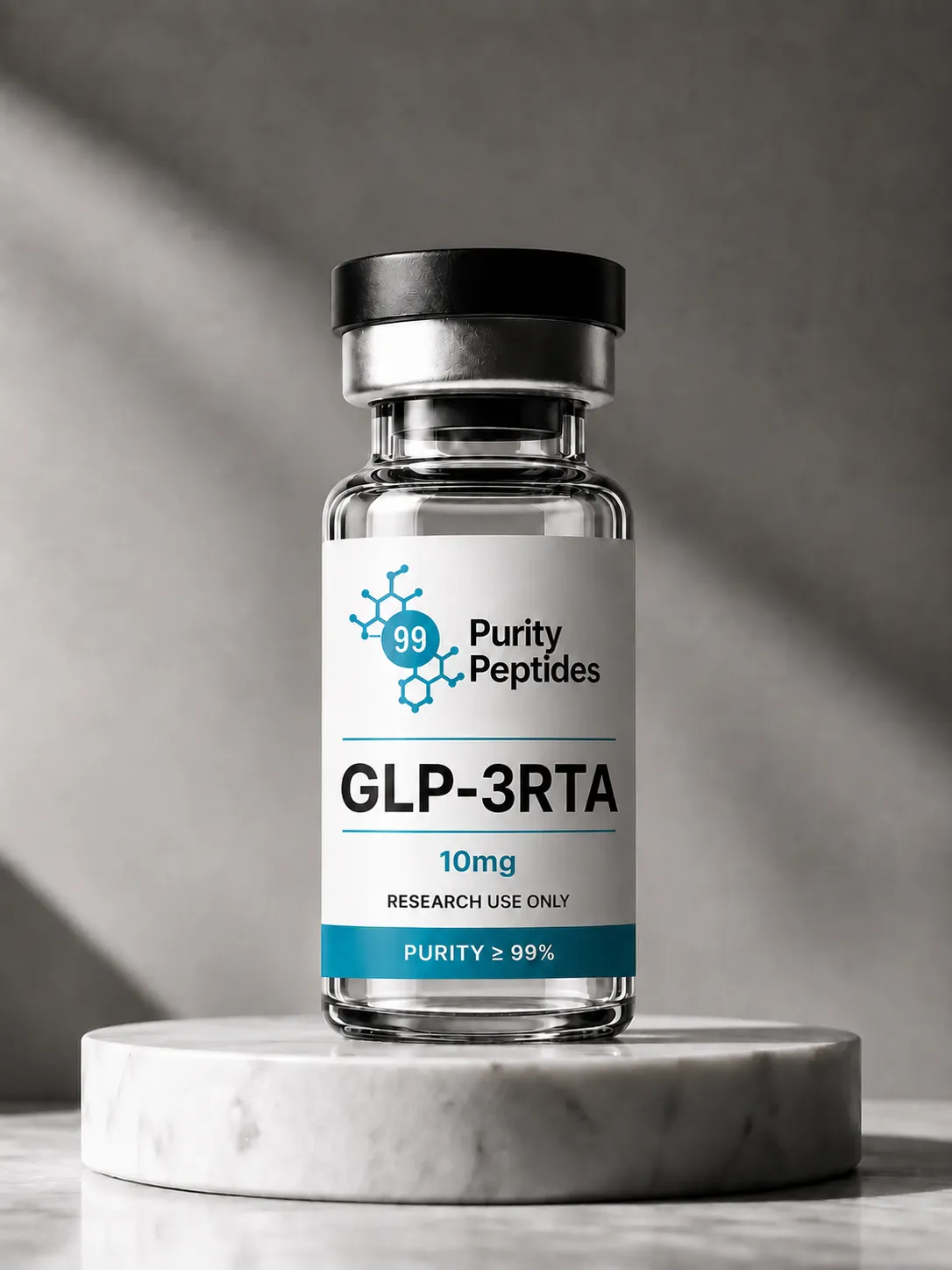
This page is specifically about the arithmetic involved in reconstituting a lyophilized research sample. It is not a dosing tool. For the currently listed 99 Purity Peptides product, the live Glp-3RTA page lists 10 mg, 20 mg, 30 mg, and 60 mg single-vial variants; the older /product/retatrutide URL currently redirects to the site homepage. [1] The site's current page title describes the presentation as a 3 mL research-peptide product, so a 5 mL column below is a mathematical scenario, not an instruction that 5 mL fits the stocked vial. [1]
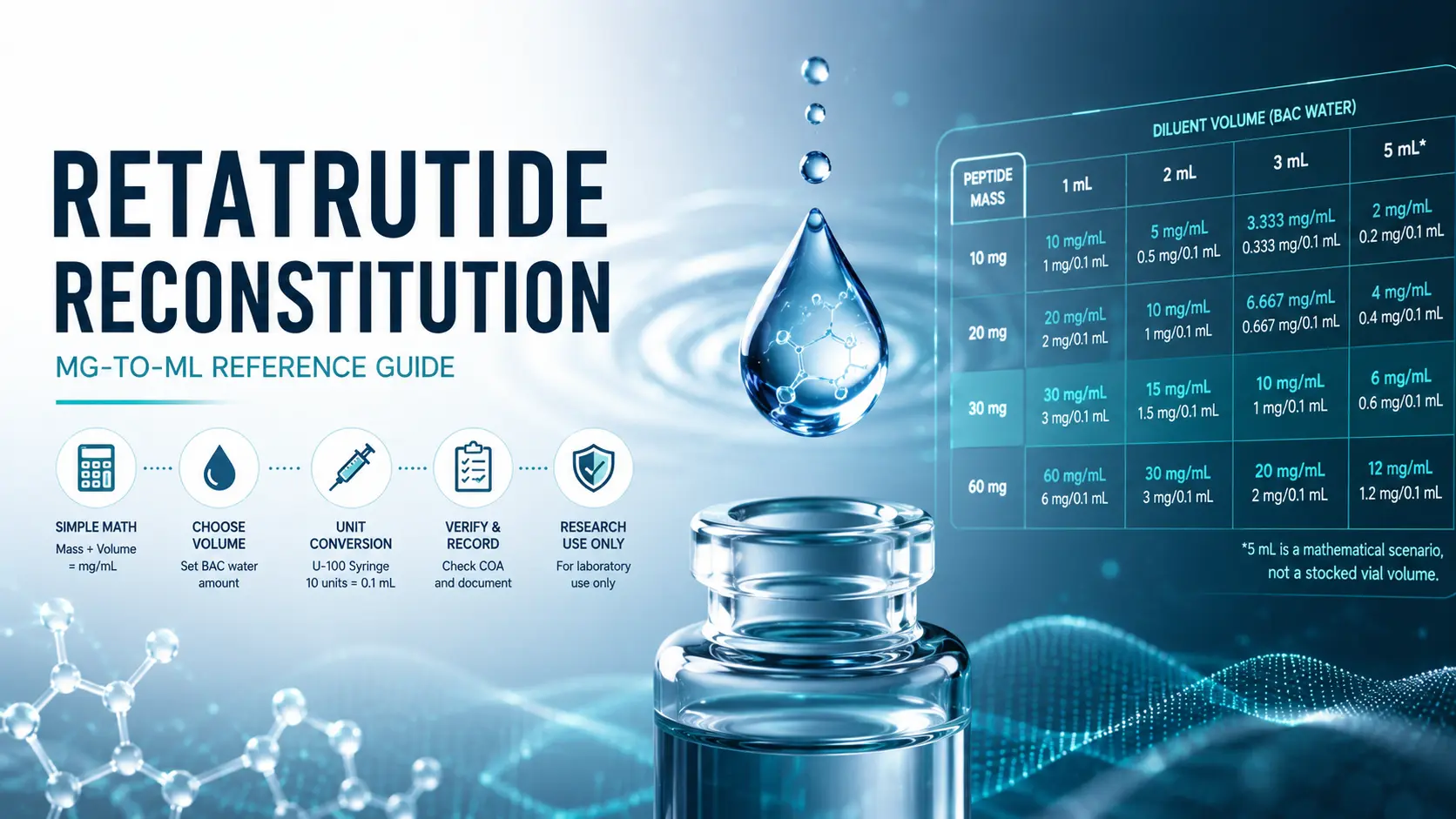
The Master Retatrutide Reconstitution Table
The most useful comparison is the concentration change caused by changing only the diluent volume. Every value below assumes the nominal peptide mass on the label. The per-0.1 mL figure is arithmetic only.
Retatrutide vial | 1 mL BAC water | 2 mL BAC water | 3 mL BAC water | 5 mL BAC water* |
|---|---|---|---|---|
10 mg | 10 mg/mL; 1 mg/0.1 mL | 5 mg/mL; 0.5 mg/0.1 mL | 3.333 mg/mL; 0.333 mg/0.1 mL | 2 mg/mL; 0.2 mg/0.1 mL |
20 mg | 20 mg/mL; 2 mg/0.1 mL | 10 mg/mL; 1 mg/0.1 mL | 6.667 mg/mL; 0.667 mg/0.1 mL | 4 mg/mL; 0.4 mg/0.1 mL |
30 mg | 30 mg/mL; 3 mg/0.1 mL | 15 mg/mL; 1.5 mg/0.1 mL | 10 mg/mL; 1 mg/0.1 mL | 6 mg/mL; 0.6 mg/0.1 mL |
60 mg | 60 mg/mL; 6 mg/0.1 mL | 30 mg/mL; 3 mg/0.1 mL | 20 mg/mL; 2 mg/0.1 mL | 12 mg/mL; 1.2 mg/0.1 mL |
* 5 mL is a search-driven arithmetic example only. The live product page currently lists 10, 20, 30 and 60 mg variants, and its presentation is described as 3 mL. [1] Do not read the 5 mL column as proof that a particular vial can physically accept 5 mL.
There are two patterns worth keeping in view. First, doubling the diluent halves the concentration. Second, the mass of peptide does not disappear when the volume changes; only the amount of peptide represented by a fixed liquid volume changes. That is why a 30 mg sample is 15 mg/mL in 2 mL but 10 mg/mL in 3 mL.
The current 10 mg, 20 mg, 30 mg and 60 mg variants are the relevant stocked strengths for this page. A 5 mg or 100 mg example may still appear in search results, but neither should be interpreted as a currently listed single-vial SKU on the live product page. [1] The arithmetic for those sizes is still easy to derive, and a search-only reference appears later in the article.
How Much Bacteriostatic Water for a 30mg Retatrutide Vial?
For the highest-demand 30 mg search case, the arithmetic depends on the volume selected. The common choices produce very different concentrations:
- 1 mL: 30 mg ÷ 1 mL = 30 mg/mL; every 0.1 mL represents 3 mg.
- 2 mL: 30 mg ÷ 2 mL = 15 mg/mL; every 0.1 mL represents 1.5 mg.
- 3 mL: 30 mg ÷ 3 mL = 10 mg/mL; every 0.1 mL represents 1 mg.
For a laboratory calculation, 3 mL is the cleanest whole-number example because 30 ÷ 3 = 10. It also aligns with the 3 mL presentation described on the current Glp-3RTA product page. [1] That alignment should not be mistaken for an administration recommendation; it simply makes the arithmetic easy to audit.
A useful way to write the calculation in a lab notebook is:
30 mg nominal peptide ÷ 3.0 mL diluent = 10.0 mg/mL
10.0 mg/mL × 0.1 mL = 1.0 mg per 0.1 mL
The 2 mL option creates a higher concentration, while 1 mL creates an even higher one. Higher concentration is not automatically better. The appropriate laboratory concentration depends on the experiment, the validated solubility of the formulation, assay requirements, and physical vial limits. General peptide literature shows that formulation and reconstitution conditions can change aggregation and the amount of monomer recovered, so a volume should not be selected only because it produces a convenient number. [5]
Search-only 5 mg and 100 mg arithmetic
Search queries also include 5 mg and 100 mg retatrutide vial language. Those are included here as mathematical references, not as claims about current inventory.
Search-only example | 1 mL | 2 mL | 3 mL | 5 mL |
|---|---|---|---|---|
5 mg | 5 mg/mL; 0.5 mg/0.1 mL | 2.5 mg/mL; 0.25 mg/0.1 mL | 1.667 mg/mL; 0.167 mg/0.1 mL | 1 mg/mL; 0.1 mg/0.1 mL |
100 mg | 100 mg/mL; 10 mg/0.1 mL | 50 mg/mL; 5 mg/0.1 mL | 33.333 mg/mL; 3.333 mg/0.1 mL | 20 mg/mL; 2 mg/0.1 mL |
These numbers are simple mass-volume arithmetic. They do not establish that a 5 mg or 100 mg retatrutide presentation exists at 99 Purity Peptides, nor that a particular physical vial can hold the listed volume.
How Much BAC Water for a 10mg Retatrutide Vial?
The 10 mg case is the second major search cluster, and it is even easier to audit because the common volumes divide cleanly in two of the most useful scenarios:
- 1 mL: 10 mg ÷ 1 mL = 10 mg/mL; 0.1 mL represents 1 mg.
- 2 mL: 10 mg ÷ 2 mL = 5 mg/mL; 0.1 mL represents 0.5 mg.
- 3 mL: 10 mg ÷ 3 mL = 3.333 mg/mL; 0.1 mL represents about 0.333 mg.
For pure laboratory arithmetic, the 2 mL example is especially easy to check because 10 ÷ 2 = 5 exactly. The 3 mL example is still valid, but it creates a repeating decimal. When precision matters, keep the extra digits in the laboratory worksheet rather than rounding too early.
A compact worked example looks like this:
10 mg ÷ 2 mL = 5 mg/mL
5 mg/mL × 0.1 mL = 0.5 mg per 0.1 mL
The phrase “how to mix 10mg retatrutide with bac water” often hides a second question: what concentration will the resulting solution have? The answer is determined mathematically by the volume, not by the words “BAC water.” Bacteriostatic Water for Injection is Water for Injection containing one or more antimicrobial preservatives, and USP distinguishes it from plain Sterile Water for Injection. [3]
That distinction matters when reading a laboratory worksheet or product documentation. A diluent is not interchangeable merely because both containers contain water. The formulation, preservation system, intended use, and compatibility all belong in the documented preparation method.
What Is the Formula for Retatrutide Reconstitution?
The basic formula is:
Concentration (mg/mL) = peptide mass (mg) ÷ diluent volume (mL)
If you already know the target concentration, the reverse form is more useful:
Required volume (mL) = peptide mass (mg) ÷ target concentration (mg/mL)
For example, suppose a lab has a nominal 20 mg peptide sample and a project specification calls for a target concentration of 4 mg/mL. The arithmetic is:
20 mg ÷ 4 mg/mL = 5 mL
That does not mean 5 mL belongs in the vial. It only means that 5 mL is the mathematical volume needed to reach that target if the entire 20 mg nominal mass were present and the container could accommodate the volume. Physical vial capacity is a separate constraint, discussed below.
The reverse form is therefore the better planning equation. Instead of picking a water volume first and discovering the concentration afterward, the researcher can start with a required analytical concentration and calculate the theoretical volume. The next step is to check whether that volume is physically compatible with the vial, the formulation, and the validated method.
There is another reason to avoid false precision. A “10 mg” label is not automatically equivalent to 10.000 mg of active peptide. Lyophilized peptide material can contain water, counterions, residual solvents, salts, and other formulation components. Net peptide content is the analytical measure that separates actual peptide mass from the gross lyophilized material. [7][8]
Bacteriostatic Water to Syringe Units: Compact Reference
For unit conversion only, U-100 means 100 units per mL, so 1 U-100 unit = 0.01 mL. FDA-cleared U-40 and U-100 syringe descriptions distinguish the two scales because U-40 corresponds to 40 units/mL while U-100 corresponds to 100 units/mL. [4]
U-100 marking | Liquid volume |
|---|---|
1 unit | 0.01 mL |
10 units | 0.10 mL |
25 units | 0.25 mL |
50 units | 0.50 mL |
75 units | 0.75 mL |
100 units | 1.00 mL |
The mismatch risk is straightforward: a “unit” mark is not a universal volume unit across syringe calibrations. U-40 and U-100 use different unit densities, so copying a unit number from one scale onto the other changes the volume represented. [4]
This page intentionally keeps the conversion section compact. For the complete reference, use 99 Purity Peptides' BAC water and insulin-syringe unit conversion chart. That page is the better source when you need a broader U-40/U-100 lookup rather than the five-row summary here.
Why Can't You Put 5 mL Into a 3 mL Vial?
Because nominal vial capacity and peptide mass are two different measurements. A label reading 30 mg describes the amount of material assigned to the vial. A 3 mL presentation describes the nominal container capacity. Neither number implies that the other can be converted into the same unit.
This is a common source of error in online reconstitution calculators. A calculator may happily return a concentration for “30 mg + 5 mL,” because the equation is mathematically valid. The calculator is not checking the glass dimensions, stopper geometry, overfill, headspace, or the actual fill volume that the vial can accommodate.
The current product page is especially useful here because it describes Glp-3RTA as a 3 mL presentation while listing 10, 20, 30 and 60 mg variants. [1] The safe way to interpret the 5 mL column in this article is therefore: valid arithmetic, not proof of physical compatibility.
Headspace also has practical value. A vial is not designed to be filled right to the brim. The usable working volume can be lower than the nominal internal volume because the stopper, neck, meniscus, withdrawal geometry, and required headspace all occupy space. A preparation method should therefore be based on the documented vial and formulation, not on the largest number that can be entered into a calculator.
There is a second physical limit: solubility. More liquid does not guarantee better or faster dissolution, and less liquid does not guarantee that a concentrated solution will remain physically stable. Peptide solubility depends strongly on sequence and solvent conditions. [7]
Does Net Peptide Content Change the Numbers?
Yes. It can change them materially, and the correction is simple once the net peptide content is known.
A lyophilized peptide cake is not necessarily 100% peptide by dry mass. Analytical literature describes net peptide content as the percentage of actual peptide in a measured sample after excluding associated water and counterions. Some peptide lyophilizates have reported net contents in the 60% to 90% range, although that range is not a retatrutide specification and should not be used as a substitute for lot data. [11] The variation depends on sequence, purification, salt form, and formulation.
Counterions matter because peptides are often isolated as salts, and residual water also contributes to the gross mass of the lyophilized material. Research on peptide formulations shows that counterion loss during lyophilization can alter pH after reconstitution and affect aggregation behavior. [8]
A real 99 Purity Peptides COA provides a useful example of why the label mass and measured peptide content should be kept separate. One retatrutide 5 mg COA lists a 5 mg specification and a measured quantity of 4.544 mg, with HPLC purity reported at 99.731%. [2] The measured quantity is therefore 90.88% of the nominal 5 mg.
If that measured quantity were the basis of a 2 mL laboratory preparation, the corrected concentration would be:
4.544 mg ÷ 2 mL = 2.272 mg/mL
The nominal calculation would have been:
5 mg ÷ 2 mL = 2.500 mg/mL
Those are not the same number. The difference is about 9.1%. This is why purity and net content should not be collapsed into a single “99%” label. HPLC purity describes the chromatographic purity result; it does not, by itself, prove that 99% of the gross lyophilized mass is peptide.
For a lot-specific worksheet, the better sequence is: nominal label mass → measured net peptide content if provided → chosen laboratory volume → corrected concentration. If the COA does not report net peptide content, do not invent a correction factor.
What Storage and Stability Information Actually Supports
The strongest defensible statement is that lyophilized and reconstituted peptide stability are different problems, and there is no single universal post-reconstitution shelf-life for retatrutide that can be imported from an unrelated peptide.
Material state | Storage principle | Practical horizon for this reference |
|---|---|---|
Lyophilized research peptide | Follow the lot-specific label, COA and supplier storage statement; protect the dry material from moisture and unnecessary environmental exposure. | No universal retatrutide timeframe assigned here. |
Reconstituted peptide solution | Use only within a formulation-specific, experimentally supported stability window. Concentration, temperature, pH, excipients and container conditions can change physical and chemical stability. | No validated retatrutide horizon established by the sources used here. |
During repeated freeze-thaw exposure | Minimize avoidable cycles because freeze-drying and subsequent reconstitution can alter higher-order structure and aggregation behavior in peptides. [6] | Treat freeze-thaw history as a stability variable, not a neutral handling detail. |
Light exposure | Protect light-sensitive formulations from unnecessary light; oxidation is one documented chemical degradation pathway for peptides. [10] | Use the formulation's validated light-protection requirement when one exists. |
A study of lyophilized teriparatide illustrates why “reconstituted = stable for X weeks” is not a valid generic rule. The investigators found that physical stability after reconstitution varied with peptide concentration and temperature, with precipitation developing within two to four weeks in some formulations. [6] That is evidence for formulation dependence, not a retatrutide shelf-life number.
A separate review of aqueous peptide stability documents common degradation pathways including oxidation, deamidation, hydrolysis, isomerization and aggregation. [9] The exact dominant pathway depends on the peptide sequence and formulation. For that reason, this article does not assign a made-up 7-, 14-, 28-, or 30-day horizon to reconstituted retatrutide.
Bacteriostatic water deserves the same caution. USP defines Bacteriostatic Water for Injection as sterile Water for Injection containing suitable antimicrobial agents, while Sterile Water for Injection is a sterile water preparation without the same preservative system. [3] A preservative does not make an otherwise unvalidated peptide solution automatically stable. The antimicrobial system and the chemical/physical stability of the peptide are different questions.
What Are the Most Common Retatrutide Reconstitution Mistakes?
Treating vial capacity as the instructed volume. A 3 mL vial presentation does not mean 3 mL is mandatory, and it does not make 5 mL physically possible. Capacity is a container property; concentration is an arithmetic property.
Shaking instead of using a validated gentle reconstitution method. Reconstitution procedure can affect protein and peptide stability, including monomer content and subvisible particle formation. [5] The practical rule is to follow the validated method for the formulation instead of assuming that more agitation is better.
Substituting sterile water for bacteriostatic water without documentation. USP distinguishes the two preparations by composition and intended use. [3] Use the diluent named in the validated laboratory method rather than relying on the generic word “water.”
Skipping the net-content correction. A 5 mg nominal label does not guarantee 5 mg of net peptide. Net content, water and counterions can materially change the actual concentration. [7][11]
Mixing up mg/mL and mcg/mL. The conversion is 1 mg = 1,000 mcg. A concentration of 5 mg/mL is therefore 5,000 mcg/mL. This is a unit-conversion issue, not a change in the underlying amount of peptide.
Rounding too early. For 10 mg in 3 mL, the exact quotient is 3.333333... mg/mL. If the downstream calculation requires precision, retain sufficient decimal places until the final reporting step.
How Should You Verify the Arithmetic Against Your Own Lot?
The COA is where the abstract calculator stops and the actual batch begins. The fields worth checking are the stated mass, net peptide content if reported, HPLC purity, and identity confirmation. A certificate can also show a batch number and analytical date, which are useful when reconciling a worksheet with a specific vial.
99 Purity Peptides currently maintains a COA library and states that batches are independently tested for purity, identity and composition. [12] A published retatrutide COA example identifies the material as a lyophilized peptide vial, reports the nominal 5 mg quantity, measures 4.544 mg, and reports 99.731% HPLC purity. [2]
That example highlights a crucial distinction: purity is not the same thing as net content. HPLC can show that the chromatographic profile is highly pure, while the gross vial mass can still include water, counterions, or other non-peptide material.
For a lot-specific worksheet, record the lot number first. Then copy the mass and any net-content result exactly as reported. Calculate the concentration from the corrected peptide mass rather than assuming the nominal label mass is exact. Finally, compare the resulting theoretical concentration with the concentration actually required by the laboratory method.
For the broader certificate-reading workflow, see How to Read a Certificate of Analysis and the COA library.
Related Retatrutide and Reconstitution References
This page is intentionally narrow. For mechanism and broader compound context, use the site's Retatrutide Peptide Research Guide. For comparisons, use Retatrutide vs. Tirzepatide and the Retatrutide mechanism comparison. For the site's broader arithmetic framework, use the Peptide Reconstitution Chart.
For calculations, the Peptide Calculator and Peptide Reconstitution Calculator can handle repeated mass-volume arithmetic. Use the dedicated BAC Water and Insulin-Syringe Unit Conversion Chart when a complete U-40/U-100 reference is needed.
Frequently Asked Questions
How much BAC water for a 30mg retatrutide calculator?
For arithmetic, the volume determines the concentration. A 30 mg retatrutide sample with 1 mL gives 30 mg/mL, 2 mL gives 15 mg/mL, and 3 mL gives 10 mg/mL. The corresponding amount per 0.1 mL is 3 mg, 1.5 mg, and 1 mg. These are preparation calculations, not dosing or administration guidance.
How much BAC water for a 10mg retatrutide calculator?
A 10 mg retatrutide sample gives 10 mg/mL with 1 mL, 5 mg/mL with 2 mL, and about 3.333 mg/mL with 3 mL. Per 0.1 mL, those concentrations correspond to 1 mg, 0.5 mg, and about 0.333 mg. The correct laboratory volume must also be physically compatible with the vial and formulation.
How much BAC water for 10mg retatrutide?
There is no single arithmetic answer because different volumes produce different concentrations. For 10 mg, 1 mL produces 10 mg/mL; 2 mL produces 5 mg/mL; 3 mL produces 3.333 mg/mL. The calculation is always mass divided by volume. This page does not turn those concentrations into a human or veterinary administration schedule.
How to mix 10mg retatrutide with BAC water?
For laboratory documentation, express the task as a mass-volume calculation first: 10 mg divided by the chosen volume equals the resulting mg/mL concentration. The actual preparation technique should follow the validated method for the specific formulation, because reconstitution conditions can affect peptide stability and aggregation. No administration procedure is provided here.
How to reconstitute 10mg retatrutide?
Start with the laboratory method and calculate the theoretical concentration from 10 mg divided by the documented diluent volume. For example, 10 mg in 2 mL is 5 mg/mL. Then check the lot-specific COA, vial capacity, diluent identity, and formulation requirements. The arithmetic is universal; the physical preparation method is formulation-specific.
How to mix reta 10mg with BAC water?
“Reta” is commonly used as shorthand for retatrutide in search queries. The arithmetic does not change with the name: 10 mg divided by 1, 2, or 3 mL gives 10, 5, or 3.333 mg/mL. Treat those as laboratory reference concentrations only, and verify the selected volume against the actual vial and documented method.
How many mL of BAC water for 10mg of retatrutide?
The answer depends on the target concentration and physical vial limits. The reverse formula is volume = peptide mass ÷ target concentration. For example, 10 mg divided by a target of 5 mg/mL equals 2 mL mathematically. That result is not an instruction to exceed the vial's capacity or a recommendation for administration.
Reta 10mg: how much BAC water?
For quick arithmetic, 1 mL with 10 mg produces 10 mg/mL, 2 mL produces 5 mg/mL, and 3 mL produces 3.333 mg/mL. A 5 mL calculation would produce 2 mg/mL, but the live product presentation is described as 3 mL, so the 5 mL result should be treated as a search-only mathematical example.
How to reconstitute 5mg retatrutide?
A 5 mg research sample is a useful search-only arithmetic example, not a current stocked single-vial strength on the live Glp-3RTA page. Mathematically, 5 mg in 1 mL is 5 mg/mL, in 2 mL is 2.5 mg/mL, and in 3 mL is 1.667 mg/mL. Physical compatibility and lot documentation must be checked separately.
Retatrutide 10mg: how much water to add?
There is no universal volume independent of the desired laboratory concentration. The equation is concentration = mass ÷ volume. For 10 mg, 2 mL gives 5 mg/mL, while 3 mL gives approximately 3.333 mg/mL. The chosen volume should come from the validated research method and confirmed vial capacity, not from a generic internet rule.
For 10mg of retatrutide, how much BAC water?
Using common arithmetic examples, 1 mL gives 10 mg/mL, 2 mL gives 5 mg/mL, and 3 mL gives 3.333 mg/mL. If a specific target concentration is known, calculate the theoretical volume by dividing 10 mg by that target in mg/mL. This remains preparation math and does not establish any administration quantity or schedule.
How much bacteriostatic water to mix with retatrutide 10mg?
Bacteriostatic Water for Injection is not simply “water with a different label.” USP defines it as sterile Water for Injection containing a suitable antimicrobial agent. For a 10 mg sample, the resulting concentration still depends on volume: 2 mL gives 5 mg/mL and 3 mL gives 3.333 mg/mL. Follow the documented formulation method for diluent compatibility.
What does 0.1 mL equal on a U-100 syringe for retatrutide math?
For U-100 calibration, 100 units correspond to 1 mL, so 0.1 mL corresponds to 10 U-100 units. This is a volume conversion only. U-40 and U-100 scales are not interchangeable because they represent different unit densities. For complete conversion work, use the dedicated syringe-unit chart rather than copying a unit marking from another scale.
What is a retatrutide 100mg vial calculation?
A 100 mg example is included because it appears in search queries, not because the live product page currently lists a 100 mg single vial. Mathematically, 100 mg in 1 mL is 100 mg/mL, in 2 mL is 50 mg/mL, in 3 mL is 33.333 mg/mL, and in 5 mL is 20 mg/mL. Physical vial capacity remains a separate constraint.