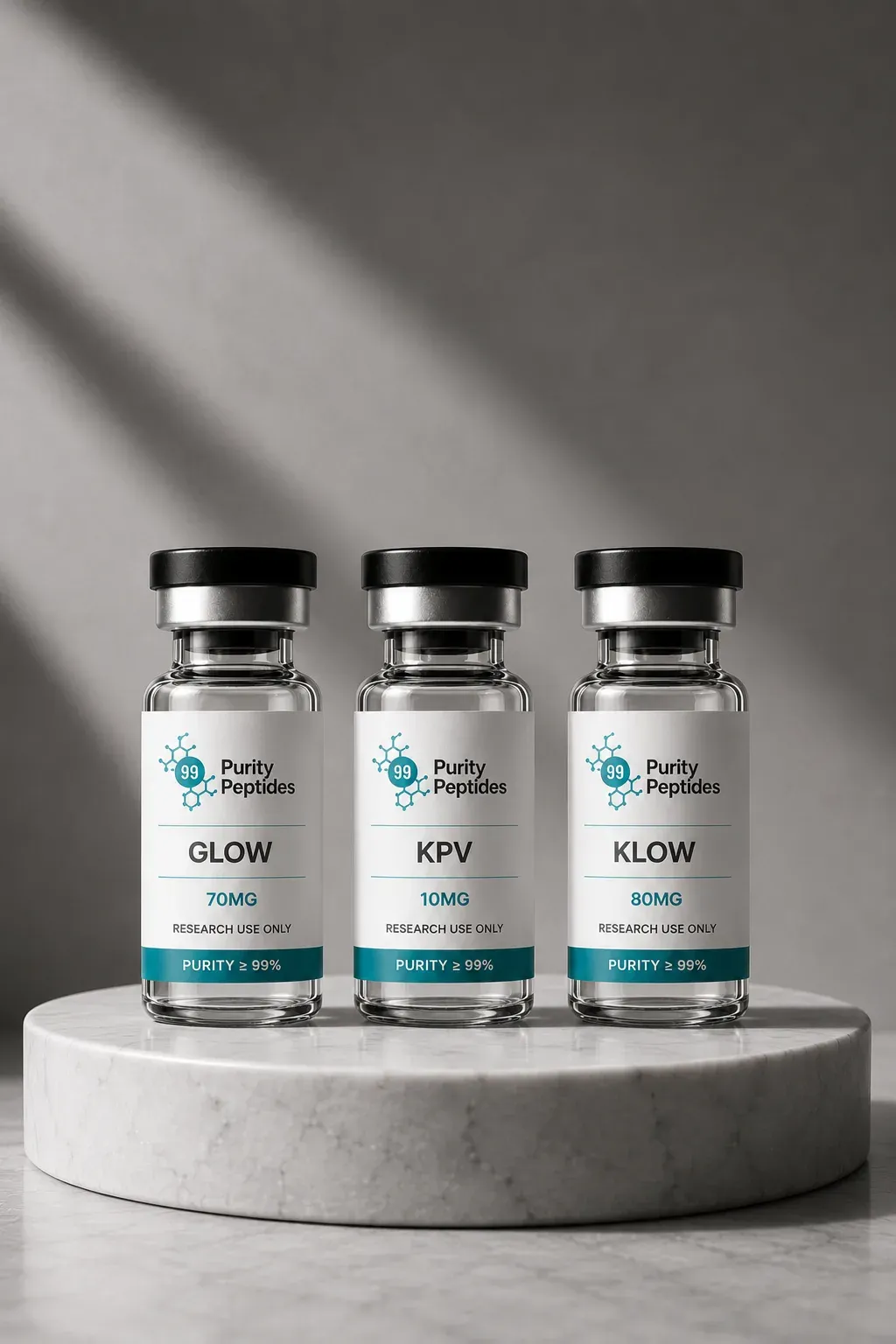
The KLOW Component-Control Set supplies three research vials: GLOW at 70 mg, KPV at 10 mg, and KLOW at 80 mg. GLOW is the three-component base, KLOW is that base plus KPV, and the standalone KPV vial isolates the compound that separates them. All three reconstitute to matching concentrations at a single volume. Supplied lyophilized for laboratory use. For research use only.
HPLC certified
Independent analysis
Highest standard
Full traceability
The KLOW Component-Control Set is a three-vial research set built around a single compositional variable. GLOW contains GHK-Cu, BPC-157 and TB-500 at 70 mg total. KLOW contains those same three compounds at the same individual masses, plus KPV, at 80 mg total. The third vial supplies KPV alone at 10 mg — the same mass it carries inside KLOW.
The structure is deliberate. A comparison between GLOW and KLOW alone establishes that the two preparations differ by KPV, but it cannot separate an independent contribution from one that depends on the surrounding components. An isolated KPV arm makes that distinction available.
The arithmetic supports the design without adjustment. Reconstituted to the same volume, GHK-Cu, BPC-157 and TB-500 reach identical concentrations in GLOW and KLOW, while KPV reaches the same concentration in the standalone vial as it does within KLOW. A single volume matches every arm.
KPV is a tripeptide corresponding to the C-terminal residues of α-melanocyte-stimulating hormone, examined in inflammatory-signalling research including NF-κB pathway modulation and peptide-transporter-mediated uptake. It is the only compound in this set absent from GLOW.
All three vials are supplied lyophilized with batch documentation. No published study has compared these preparations.
For Research Use Only. Not intended for human consumption, therapeutic use, veterinary use, or diagnostic applications.
The KLOW Component-Control Set is a three-vial research set containing GLOW (70 mg, three components), KPV (10 mg, isolated), and KLOW (80 mg, the same three components plus KPV). The set supplies a base preparation, the single compound that distinguishes the two blends, and the combined blend — the three arms required to attribute an observed difference to KPV rather than to the preparation as a whole.
| Vial | Total mass | Components | Role in the set |
|---|---|---|---|
| GLOW | 70 mg | GHK-Cu 50 mg, BPC-157 10 mg, TB-500 10 mg | Three-component base — the control arm |
| KPV | 10 mg | KPV 10 mg | Isolated variable — the single-compound arm |
| KLOW | 80 mg | GHK-Cu 50 mg, BPC-157 10 mg, TB-500 10 mg, KPV 10 mg | Base plus variable — the combined arm |
All three vials are supplied as lyophilized powder with batch documentation. Component masses should be confirmed against the certificate of analysis for each lot received, since published specifications for these blends vary between suppliers.
The set contains three vials because two are not enough to attribute a result.
GLOW and KLOW differ by one compound. Comparing them establishes that a difference exists between a three-component preparation and a four-component one. Adding the isolated KPV vial supplies the arm needed to determine what that difference should be assigned to.
A GLOW-versus-KLOW comparison produces one measurement: how the four-component preparation behaves relative to the three-component one. Two quite different situations produce that same measurement.
In the first, KPV contributes something on its own, and the blend result reflects that contribution added to the base. In the second, KPV’s contribution depends on the presence of the other three compounds, and it would behave differently in isolation.
A two-arm comparison cannot tell those apart. Both yield the same answer.
KPV adds 10 mg of a melanocortin-derived tripeptide to the three compounds already present in GLOW. It is the only compositional difference between the two blends — no component is removed, substituted or re-weighted.
What KPV contributes functionally within the blend has not been established in published work. The KLOW Component-Control Set supplies the three arms needed to investigate that question. It does not answer it, and no claim of interaction between KPV and the other components is made or implied here.
Be the first to share your experience with this product and help other researchers!
KLOW peptide dosage chart and reconstitution reference for the 80 mg 50/10/10/10 blend. Concentration tables, syringe unit math, and laboratory storage data.
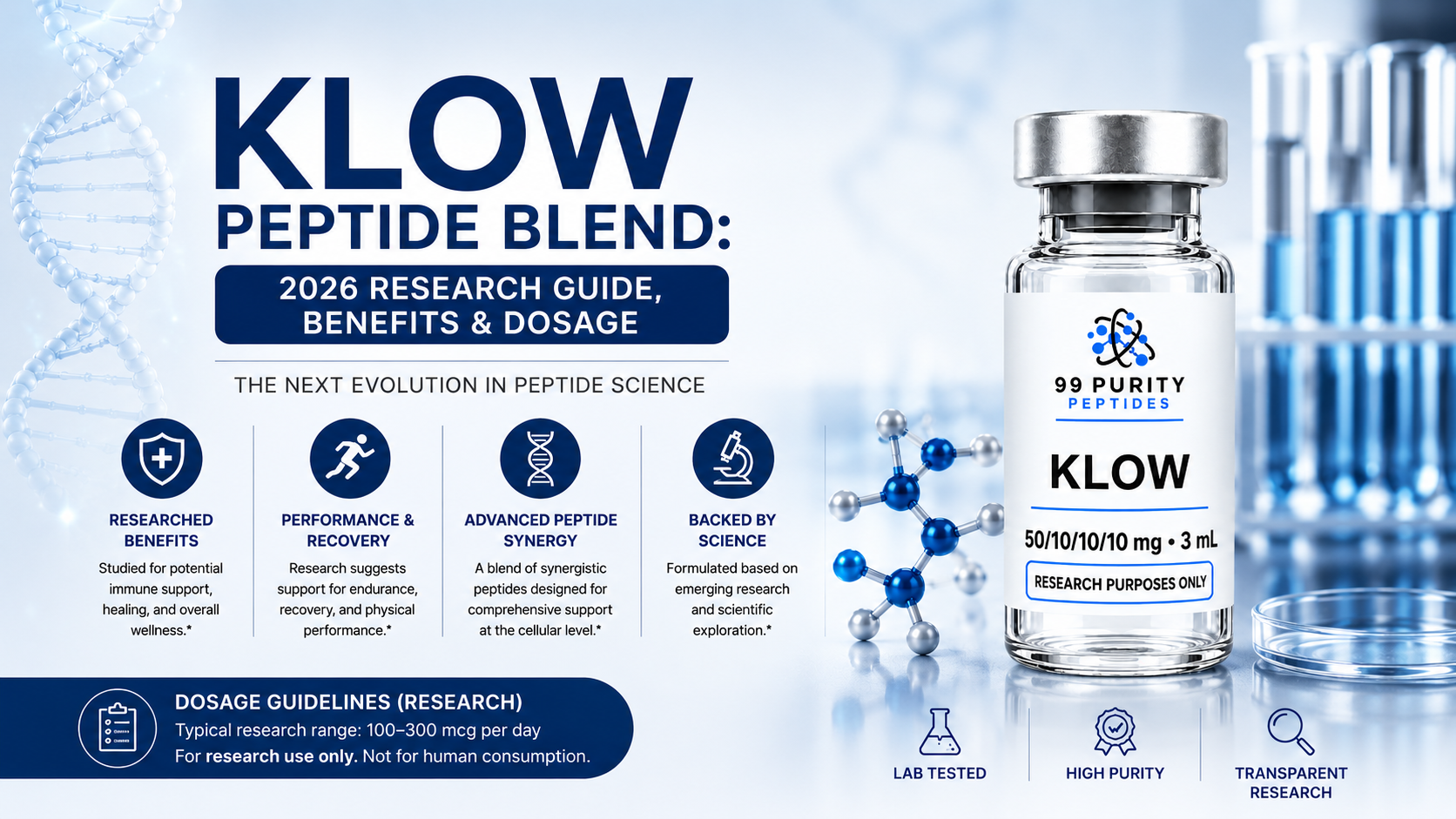
KLOW peptide blend: verified 50/10/10/10mg composition, BPC-157, TB-500, KPV, GHK-Cu. Research benefits, dosage chart, KLOW vs GLOW comparison. 2026 reference.

Research peptide bundles price check: divide by total milligrams, compare single vials on the same date, then read the COA. Worked examples, Oct 2026.
(faqs)