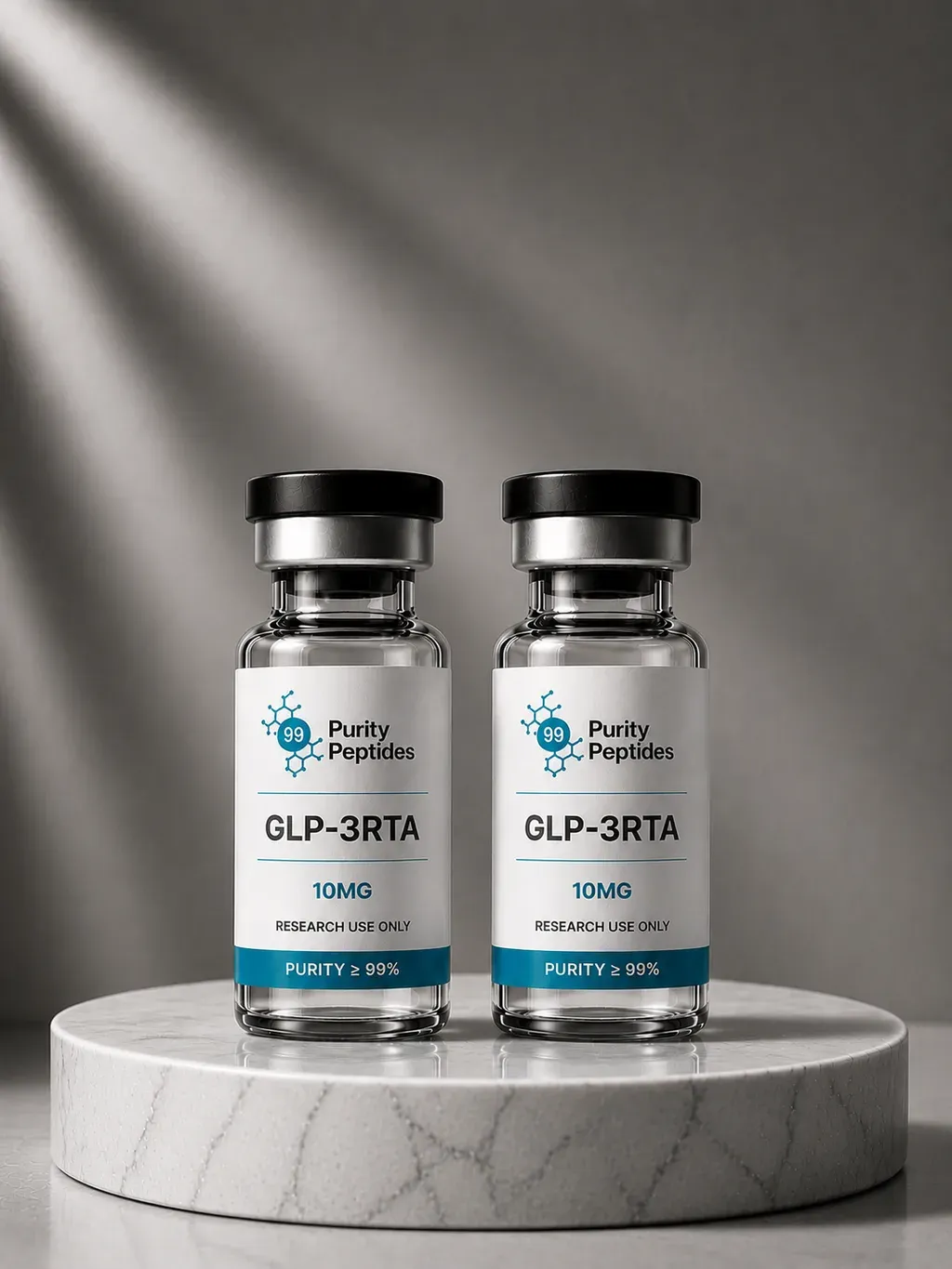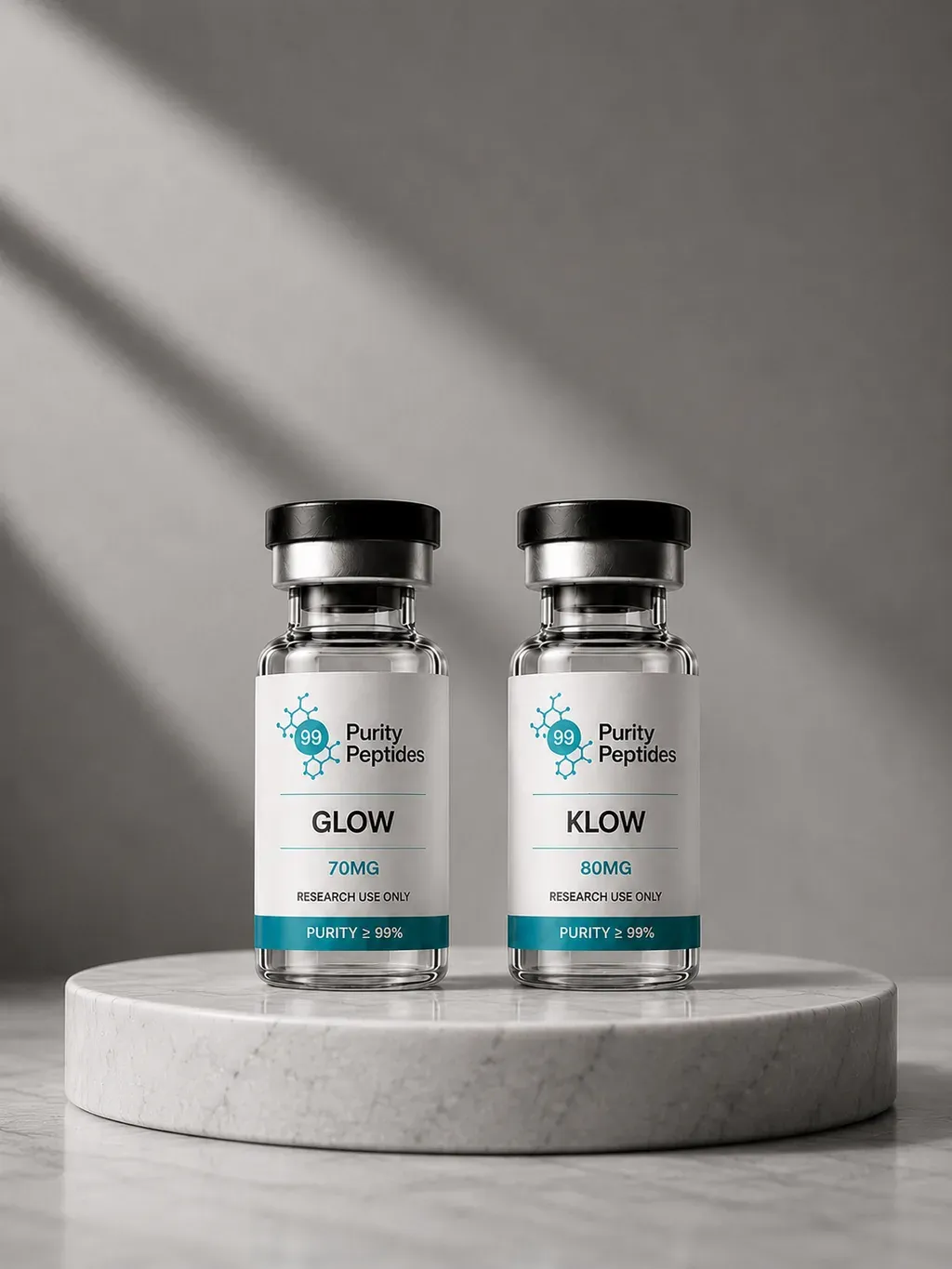
The GLOW / KLOW Comparative Pair supplies both blends as matched research vials — GLOW at 70 mg across three compounds, and KLOW at 80 mg across four. KLOW contains the same components as GLOW with KPV added, at the same base masses. That makes KPV the only compositional variable between the two vials. Supplied lyophilized for laboratory reconstitution. For research use only.
HPLC certified
Independent analysis
Highest standard
Full traceability
The GLOW / KLOW Comparative Pair brings together two related multi-compound research blends in a single set. GLOW contains GHK-Cu, BPC-157 and TB-500, totalling 70 mg. KLOW contains those same three compounds at the same individual masses, plus KPV, totalling 80 mg.
Because the shared components are present at identical absolute masses, the two vials differ by one compound rather than by overall composition. Reconstituted to the same volume, GHK-Cu, BPC-157 and TB-500 reach the same concentration in each. Only KPV changes. This matters for study design: a researcher comparing blends that differ in several respects at once cannot attribute an observation to any single component.
The blends span three distinct areas of peptide research. GHK-Cu is studied as a copper-binding tripeptide in matrix and tissue-remodelling contexts. BPC-157 is a synthetic pentadecapeptide examined in cytoprotective and angiogenic preclinical models. TB-500 is a fragment of thymosin β-4 investigated for actin-binding behaviour. KPV, present only in KLOW, is a C-terminal fragment of α-MSH studied in inflammatory-signalling research.
Both vials are supplied lyophilized with batch documentation. This pair is intended for comparative laboratory investigation of blend composition, not for any form of administration.
For Research Use Only. Not intended for human consumption, therapeutic use, veterinary use, or diagnostic applications.
The GLOW / KLOW Comparative Pair is a two-vial research set containing GLOW (70 mg: GHK-Cu, BPC-157, TB-500) and KLOW (80 mg: the same three compounds plus KPV). Both vials carry the shared compounds at identical masses, so KPV is the only compositional difference between them. The pair supports comparative laboratory investigation of a four-component blend against its three-component base.
The pair contains two lyophilized vials. The table below gives the composition of each.
| Compound | GLOW 70 mg | KLOW 80 mg | Research category | Why it is included |
|---|---|---|---|---|
| GHK-Cu | 50 mg | 50 mg | Copper-binding tripeptide | Present in both blends at the same mass; forms part of the shared base |
| BPC-157 | 10 mg | 10 mg | Synthetic pentadecapeptide | Present in both blends at the same mass; forms part of the shared base |
| TB-500 | 10 mg | 10 mg | Thymosin β-4 fragment | Present in both blends at the same mass; forms part of the shared base |
| KPV | — | 10 mg | α-MSH C-terminal fragment | Present only in KLOW; the single compositional variable between the two vials |
| Total | 70 mg | 80 mg |
Both vials are supplied as lyophilized powder with batch documentation. Component masses should be confirmed against the certificate of analysis supplied with the specific lot received, since published specifications for these blends vary between suppliers.
GLOW and KLOW are grouped because KLOW is compositionally GLOW plus one compound. Both contain GHK-Cu, BPC-157 and TB-500 at the same individual masses. KLOW adds KPV at 10 mg. No component is removed, substituted or re-weighted between the two blends, which makes the pair a matched set rather than two independent products.
Most multi-compound research blends differ from one another in several respects at once — different components, different ratios, different total loads. Comparing two such blends produces a result that cannot be attributed to any one factor.
GLOW and KLOW do not have that problem. Their shared components are identical in both identity and mass. A researcher holding both vials therefore holds a four-component preparation and its own three-component compositional control, with a single defined difference between them.
That relationship is what the pair is for. It does not establish that KPV produces any particular effect, and no published study has evaluated these two branded blends against each other. The pair supplies the materials for such a comparison; it does not supply its conclusion.
The 10 mg difference between a 70 mg GLOW vial and an 80 mg KLOW vial is entirely KPV. That has a direct practical consequence at the bench.
Reconstitute both vials to the same volume, and GHK-Cu, BPC-157 and TB-500 arrive at the same concentration in each preparation. Only KPV differs. The comparison is clean by construction, with no adjustment needed to equalise the base.
This is not automatically true of these blend names elsewhere. Some suppliers formulate GLOW at roughly 40% of KLOW’s base load — a 20 / 5 / 5 mg GLOW against a 50 / 10 / 10 / 10 mg KLOW. Two vials of that kind differ in every component simultaneously, and a difference observed between them cannot be assigned to KPV.
Researchers comparing blends should confirm base masses on both certificates of analysis before assuming the pair is matched.
Be the first to share your experience with this product and help other researchers!
KLOW peptide dosage chart and reconstitution reference for the 80 mg 50/10/10/10 blend. Concentration tables, syringe unit math, and laboratory storage data.
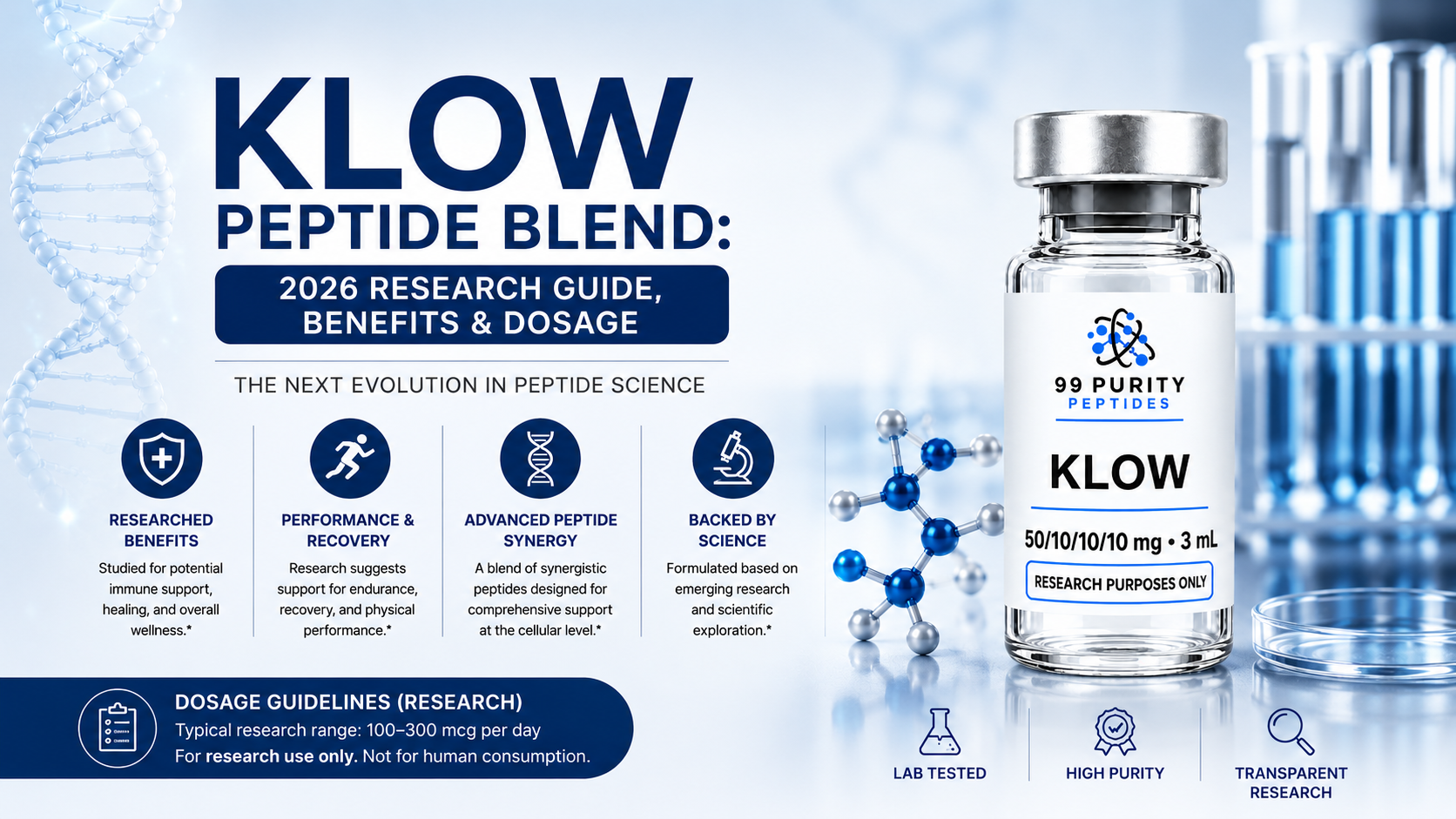
KLOW peptide blend: verified 50/10/10/10mg composition, BPC-157, TB-500, KPV, GHK-Cu. Research benefits, dosage chart, KLOW vs GLOW comparison. 2026 reference.

GHK-Cu nasal spray research reviewed: three mouse studies from one lab, no human data, and what is still unknown about absorption and tolerability.
(faqs)