
GHK-Cu nasal sprays are widely discussed, often in language implying a settled evidence base. The literature tells a narrower story: GHK-Cu has been studied for over fifty years, but research using the nasal route is recent, small and entirely preclinical.
Featured Products
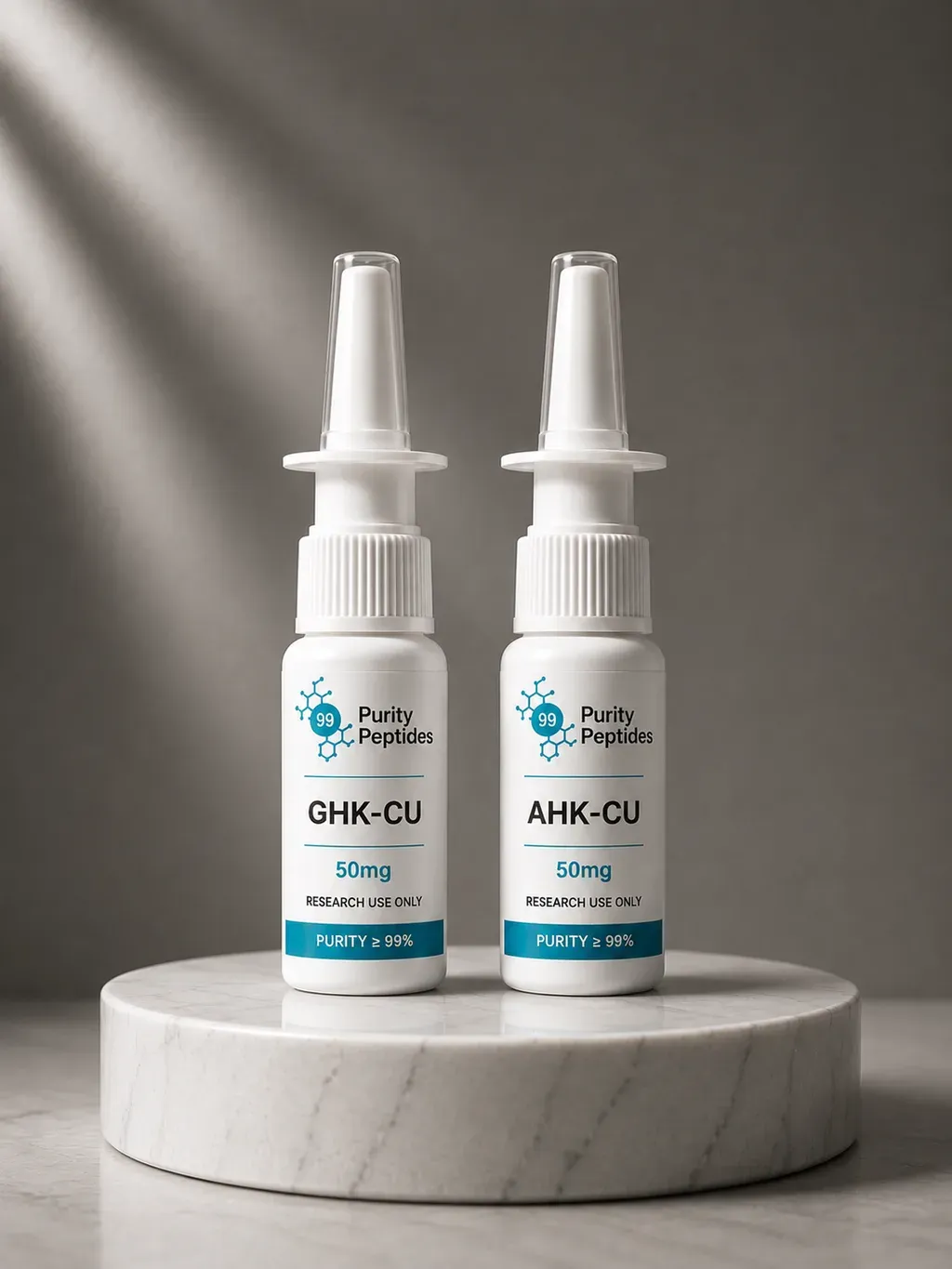
This article reviews what has been published on intranasal GHK-Cu, separating direct intranasal research from work using other routes, identifying which records are peer-reviewed and which are preprints, and stating where evidence is absent. The governing principle: evidence that a compound does something when applied to skin, injected or added to a cell culture is not evidence about what a nasal spray does.
Research use only. The compounds described on this page are laboratory research materials. They are not medicines, dietary supplements, cosmetics or foods, and they are not for human or veterinary use. This page reviews published research and is not medical advice.
What Is GHK-Cu?
GHK is the tripeptide glycyl-L-histidyl-L-lysine; our complete GHK-Cu research guide covers it more broadly. It occurs naturally in human plasma, saliva and urine, and plasma concentrations decline with age — roughly 200 ng/mL around age 20 and roughly 80 ng/mL by age 60 [1]. It was isolated in 1973 as an activity in human albumin that caused aged liver tissue to synthesise proteins like younger tissue.
GHK binds copper(II) with high affinity, and most research concerns the complex rather than the free peptide. Copper is coordinated by the imidazole nitrogen of histidine, the alpha-amino nitrogen of glycine, and the deprotonated amide nitrogen of the glycine–histidine peptide bond, with a binding constant comparable to the high-affinity copper transport site on plasma albumin — which is why GHK can take copper from albumin under physiological conditions. The sequence appears in the alpha-2(I) chain of type I collagen and in the glycoprotein SPARC, released when proteases break those proteins down at injury sites.
Established findings versus proposed mechanisms
Activities attributed to GHK-Cu span wound healing, collagen turnover, metalloproteinase regulation, antioxidant and anti-inflammatory signalling, and broad gene-expression changes — documented in cell culture and animal models, far less so in humans.
A 2026 systematic evidence-mapping review in Pharmaceutics examined that gap directly [3]. Searching PubMed/MEDLINE, Europe PMC, publisher platforms, ClinicalTrials.gov and official regulatory sources through 12 August 2026, the authors identified only five human records across the entire GHK-Cu literature — all involving topical application, one of them an ongoing trial registration rather than a completed study. They concluded that preclinical data consistently support effects on matrix remodelling and repair, but that clinical evidence remains sparse and does not meet contemporary standards for defining an active entity. Human pharmacokinetics for the intact complex, they reported, have not been published for any route.
Why Is Intranasal GHK-Cu a Separate Research Question?
Route determines what tissue a compound contacts, in what chemical state, at what concentration, and for how long. The general mechanics — olfactory and trigeminal pathways, and the way bioavailability falls as molecular weight rises — are covered in our guide to intranasal peptide delivery. Three features of GHK-Cu make the nasal route a genuinely distinct question.
The molecule is highly hydrophilic. Preformulation work measured distribution coefficients in octanol–phosphate buffered saline at log D between −2.38 and −2.49 across pH 4.5–7.4 [2]. Strongly hydrophilic peptides do not readily cross lipid membranes unaided, hence the interest in carrier systems.
The complex is not guaranteed to survive as a complex. The same study found GHK-Cu stable in water and pH 4.5–7.4 buffers for at least two weeks at 60 °C, but susceptible to hydrolytic cleavage under basic and oxidative stress, with histidine among the degradation products. The Pharmaceutics review goes further: copper speciation depends on pH, stoichiometry and competing ligands, so a nominal 1:1 label does not establish what a product contains, and most delivery studies report neither molar copper occupancy nor labile copper — a safety question as much as an efficacy one, since loosely bound copper can catalyse damaging redox chemistry.
Rodent and human nasal anatomy differ substantially. This is the key caveat for the existing intranasal studies, all in mice. A 2025 review in Translational Neurodegeneration reports that olfactory epithelium covers roughly 40–50% of the total nasal surface in rats and mice but less than 10% in humans [4]. They cite a computational model predicting that nasally administered nanomaterials would reach the mouse brain in quantities around two orders of magnitude greater than the human brain, and conclude that extrapolating pharmacokinetics from animals to humans has limited validity. They describe the olfactory and trigeminal routes as proposed rather than fully characterised, and note that mucociliary clearance — about 6 mm per minute in humans — limits nasal residence time, solutions clearing faster than viscous gels.
Nasal delivery to the brain is not impossible in principle — midazolam and diazepam nasal sprays are approved for acute seizures, a sumatriptan nasal powder for migraine — but the same review records no approved nose-to-brain product for Alzheimer's or Parkinson's disease.
What Does the Direct Research on Intranasal GHK-Cu Show?
As of October 2026, a PubMed search for intranasal GHK-Cu returns four records. Two are the same study — a 2023 bioRxiv preprint and its 2024 peer-reviewed publication — so counting them separately overstates the evidence. There are three unique studies, all in mice, all from one group at the University of Washington.
Study or source | Model | Route and methods | Main findings | Key limitations |
|---|---|---|---|---|
Tucker et al., 2023 — bioRxiv preprint; no journal version indexed | C57BL/6 mice, 20 months, both sexes | 15 mg/kg in 20 µL saline daily for 8 weeks, custom atomiser; saline control | Higher Y-maze alternation at 8 weeks; shorter escape latency by trial 4; lower MCP-1 (females) and NFL-1 (both sexes) in frontal cortex; IBA-1 not significant | Preprint; group sizes not stated; t-tests across multiple markers without stated correction; no pharmacokinetics |
Tucker et al., 2024 — Aging Pathobiology and Therapeutics, peer-reviewed (2023 bioRxiv preprint = same study) | 5xFAD Alzheimer's-model mice and wild-type, 4 to 7 months, both sexes | 15 mg/kg 3× weekly for 3 months, droplets under isoflurane to 20 µL; saline control | Higher Y-maze alternation from week 8 (females), week 4 (males); fewer Congo red–stained plaques; lower MCP-1 staining in frontal cortex and hippocampus | Group and effect sizes not stated; disease model, not normal ageing; nasal epithelium not assessed |
Mazzola et al., 2026 — Research Square preprint, not peer-reviewed | C57BL/6J mice, 50 male and 50 female in total, reported as 20–21 months at treatment | Intranasal 15 mg/kg in 20 µL daily for 8 weeks vs intraperitoneal 15 mg/kg daily for 5 days; volume-matched saline controls | Intranasal improved escape latency on trials 2–4, both sexes (p < 0.05); intraperitoneal improved males on trial 2 only. Intranasal raised synaptophysin in females (p < 0.001) and altered GFAP (p < 0.01); RNA-seq showed suppressed oxidative phosphorylation (male NES −5.44, female −4.20, FDR < 0.0001) | Preprint; brain concentrations not measured; route and duration differed simultaneously; per-arm behavioural group sizes not stated; bulk RNA-seq cannot resolve cell types |
The ageing-mice study
The earliest tested whether intranasal GHK-Cu could slow normal cognitive ageing. Twenty-month-old mice received daily treatment for eight weeks through a purpose-built atomiser designed to mist the dose across the superior nasal cavity. Cognition was assessed by Y-maze alternation and a Box Maze navigation task; brains were stained for MCP-1 (inflammation), IBA-1 (microglia) and neurofilament light chain (axonal damage).
Treated mice of both sexes showed higher alternation at eight weeks, though at four weeks only males did, and escape latency improved by the fourth trial. MCP-1 fell significantly in the frontal cortex of females with only a non-significant trend in males; neurofilament light chain fell in both sexes; microglial staining showed no significant change, which the authors called surprising. Their reading — that GHK-Cu attenuates axonal damage in brain ageing — fits the data, but the outcomes were histological markers and maze performance, not clinically meaningful endpoints. The record remains a preprint, with no peer-reviewed version indexed as of October 2026.
The Alzheimer's model study
The second study is the only peer-reviewed one. It used 5xFAD mice, which carry five familial Alzheimer's mutations and develop amyloid plaques from three to four months; treatment ran from four to seven months, as droplets timed to inhalation under isoflurane. Transgenic mice given GHK-Cu showed higher Y-maze alternation than saline-treated transgenic mice — from the second month in females, the first in males — reaching levels the authors described as comparable to wild-type animals. Congo red staining showed fewer plaques, and MCP-1 staining was lower in frontal cortex and hippocampus.
Two limitations bear directly on nasal-spray claims. First, the authors state explicitly that assessing inflammation and inflammatory cell infiltration of the nasal epithelium would be needed to validate the safety of intranasal GHK-Cu: the study did not establish local tolerability, it flagged that work as outstanding. Second, the three-times-weekly schedule was chosen partly to avoid daily anaesthesia and local irritation — a design constraint, not a dosing finding.
The route-comparison preprint
The most recent record compared routes directly, giving aged mice either short-term intraperitoneal or longer-term intranasal GHK-Cu. The intranasal arm improved escape latency across trials 2–4 in both sexes; the intraperitoneal arm produced only a transient improvement in males. Hippocampal immunohistochemistry and bulk RNA sequencing then showed the routes engaging different molecular programmes: intranasal treatment suppressed oxidative phosphorylation and MYC targets, while intraperitoneal treatment activated oxidative phosphorylation, DNA repair and MYC targets.
The authors are candid about the limits. Brain concentrations were not measured, leaving it unresolved whether the differences reflect route, exposure duration, or both — the arms differed on both at once. Bulk sequencing cannot separate real transcriptional change from shifts in cell composition, profiling used a single time point, and no young reference cohort was included.
How Strong Is the Evidence?
Independence and replication. There is none. All three studies come from the same group, use the same 15 mg/kg dose from the same supplier, and share overlapping author lists. Consistency within one laboratory is not reproducibility across laboratories; a single group's findings are the normal starting point for a research programme, not its conclusion.
Human evidence. There is none. No published study has given GHK-Cu intranasally to human participants, and every human record listed by the 2026 evidence map — which searched trial registries as well as the literature — is topical. The only registered human GHK-Cu trial located, NCT07437586, is a phase 2 topical gel study in acute skin wounds, still recruiting with no efficacy results.
Outcomes measured. Rodent maze performance, staining intensity and pathway scores — informative laboratory markers, not clinical endpoints.
Reporting and design. Per-group sample sizes are absent from the accessible text of all three; only the route-comparison preprint reports sequencing numbers. None measured drug concentration in brain or plasma, none assessed nasal tolerability, and none varied the dose: every study used 15 mg/kg.
One distinction matters: this is an absence of evidence, not evidence of absence. Nothing in the literature suggests intranasal GHK-Cu fails to do what these studies indicate in mice. The question is open, examined by one laboratory in one species.
What Can Broader GHK-Cu Research Tell Us?
The wider literature supplies biological plausibility, not route-specific evidence.
Injected administration in the same research line. A 2023 study from the same laboratory gave aged mice 15 mg/kg GHK by injection for five days; treated animals did not show the acute learning impairment seen in sleep-deprived saline controls, alongside lower hippocampal MCP-1 and nitrotyrosine [8]. This motivated the intranasal programme, but a different route and short exposure establish nothing about nasal absorption.
Topical and cell-based research. Most GHK-Cu research concerns skin: collagen and glycosaminoglycan synthesis, metalloproteinase regulation, restored replicative capacity in irradiated fibroblasts, and gene-expression changes identified through Connectivity Map analysis [1]. All of it involves keratinised skin, where the stratum corneum is the rate-limiting barrier — a different absorption problem from nasal mucosa.
The human topical record is itself thin. Of the five human records in the 2026 evidence map, a 13-participant randomised study following CO2 laser resurfacing found no significant objective advantage for a copper-tripeptide regimen despite higher participant satisfaction; the reviewers judged it underpowered with uncharacterised active content. An 18-participant split-face study reported improved eyebrow hair count and diameter over 12 weeks, but did not define speciation or local exposure. Our comparison of GHK-Cu and AHK-Cu examines that record further.
What Remains Unknown About GHK-Cu Nasal Sprays?
Human pharmacokinetics. Nothing is published on intranasal absorption, systemic exposure or CNS penetration in humans, and pharmacokinetics for the intact complex are unreported for any route. Our peptide half-life chart, which compiles published values by species and route, likewise records no human value for GHK-Cu.
Brain exposure even in animals. The route-comparison preprint states that brain concentrations were not measured in any arm, leaving it unknown how much compound reached the brain, or by what path.
Nasal tolerability. No published study has assessed inflammation or cellular infiltration of the nasal epithelium after repeated exposure; the peer-reviewed study named this as outstanding.
Formulation and dose-response. What a nasal product contains chemically — intact GHK-Cu, free peptide, labile copper, or a mixture shifting with pH and storage — is not established by a purity figure. And every intranasal study used 15 mg/kg in mice: no other dose has been tested, and scaling a rodent nasal cavity to a human one is the extrapolation the literature warns against.
Closing these gaps would require formulation characterisation with resolved speciation, animal pharmacokinetics measuring plasma and brain concentrations, nasal tolerability studies, independent replication, and only then phase 1 human safety work. None of these steps appears in the published record.
How to Evaluate GHK-Cu Nasal Spray Research Claims
Does the cited source use the nasal route? Most citations offered for nasal-spray claims are topical, injected or cell-culture studies, and a different route cannot support a route-specific claim.
What kind of record is it, and is it counted twice? Two of the three intranasal studies are preprints — legitimate to cite, provided they are described as such. And the 2023 bioRxiv Alzheimer's preprint and the 2024 journal article report one experiment, so claims resting on "multiple studies" should be checked against the number of distinct experiments.
Does the model match the claim, and did the study measure it? 5xFAD mice model familial Alzheimer's amyloid pathology, and improved maze alternation in a mouse is not improved cognition in a person. Claims about absorption, bioavailability or nasal safety need studies that measured them — none of the intranasal studies did.
A certificate of analysis and a purity figure address the identity and contamination of a supplied substance — which is why we publish batch certificates of analysis. They say nothing about whether a compound works, is absorbed by a given route, or is safe to administer. Everything in our peptide nasal spray range is supplied for laboratory use only; our research use only explainer sets out what that designation does and does not mean.
On regulatory status, GHK-Cu appears on FDA's list of bulk drug substances nominated for compounding under section 503A, as "GHK-Cu (except for injectable routes of administration)" in Category 1 as of the list's 14 May 2026 update. Category 1 denotes a nomination under evaluation; FDA states it does not intend to act against compounders using such substances under specified conditions pending a final rule, and is explicit that this is not approval and not a finding that the substance presents no safety risk. Our peptide regulatory status tracker follows how that status changes.
Conclusion — What Can We Reasonably Conclude?
Three mouse studies have administered GHK-Cu intranasally, reporting improved maze performance, fewer amyloid plaques in a disease model, lower inflammatory and axonal-damage staining, and route-dependent differences in gene expression. One is peer-reviewed; two are preprints. All come from a single group at one dose, and none measured how much compound reached the brain or whether repeated dosing irritated the nasal epithelium.
The broader literature is substantial and biologically interesting, but it concerns skin, cell culture and injection. It supports the hypothesis that motivated the intranasal work without transferring to nasal delivery — and anatomical differences between rodent and human nasal cavities mean even the mouse results transfer to humans only weakly.
What remains uncertain is nearly everything one would want to know about a nasal spray: whether it is absorbed in humans, how much reaches the brain, whether repeated use is locally tolerated, and whether the findings replicate elsewhere. These questions separate an early preclinical signal from a usable intervention, and the quality of evidence matters more than the number of claims made about a compound.
This article reviews published research. It is not medical advice and does not provide dosing or administration guidance.
References
- Pickart L, Vasquez-Soltero JM, Margolina A. GHK Peptide as a Natural Modulator of Multiple Cellular Pathways in Skin Regeneration. BioMed Research International. 2015;2015:648108. PMID: 26236730. DOI: 10.1155/2015/648108
- Badenhorst T, Svirskis D, Wu Z. Physicochemical characterization of native glycyl-l-histidyl-l-lysine tripeptide for wound healing and anti-aging: a preformulation study for dermal delivery. Pharmaceutical Development and Technology. 2016;21(2):152-160 (published online 11 Nov 2014). PMID: 25384620. DOI: 10.3109/10837450.2014.979944
- Mateescu DM, Gavrilescu DM, Mincioaga RI, et al. GHK-Cu as a Bioactive Metallopeptide and Drug-Delivery Cargo: Coordination Chemistry, Formulation Science, Therapeutic Evidence, and a Translational Roadmap. Pharmaceutics. 2026;18(9):1077. PMID: 42797253. DOI: 10.3390/pharmaceutics18091077
- Drath I, Richter F, Feja M. Nose-to-brain drug delivery: from bench to bedside. Translational Neurodegeneration. 2025;14(1):23. PMID: 40390100. DOI: 10.1186/s40035-025-00481-w
- Tucker M, Keely A, Park JY, Rosenfeld M, Wezeman J, Mangalindan R, Ratner D, Ladiges W. Intranasal GHK peptide enhances resilience to cognitive decline in aging mice. bioRxiv [preprint]. 2023 Nov 17. PMID: 38014118. DOI: 10.1101/2023.11.16.567423
- Tucker M, Liao GY, Keely A, Park JY, Rosenfeld M, Wezeman J, Mangalindan R, Ratner D, Darvas M, Ladiges W. Behavioral and neuropathological features of Alzheimer's disease are attenuated in 5xFAD mice treated with intranasal GHK peptide. Aging Pathobiology and Therapeutics. 2024;6(3):102-108. PMID: 40766919. DOI: 10.31491/apt.2024.09.148 — Preprint version of the same study: bioRxiv 2023 Nov 21. PMID: 38045355. DOI: 10.1101/2023.11.20.567908
- Mazzola J, Rosenfeld M, Tucker M, Wezeman J, Ladiges W, Liao G. Middle-aged mice treated with GHK-Cu peptide administered intraperitoneally or intranasally show behavioral rescue but divergent hippocampal aging programs. Research Square [preprint]. 2026 May 26. PMID: 42245779. DOI: 10.21203/rs.3.rs-9520102/v1
- Rosenfeld M, Nickel K, Ladiges W. GHK peptide prevents sleep-deprived learning impairment in aging mice. Aging Pathobiology and Therapeutics. 2023;5(1):33-35. PMID: 37035833. DOI: 10.31491/apt.2023.03.109
- U.S. Food and Drug Administration. Bulk Drug Substances Nominated for Use in Compounding Under Section 503A of the Federal Food, Drug, and Cosmetic Act. Updated 14 May 2026. https://www.fda.gov/media/94155/download
- U.S. Food and Drug Administration. Interim Policy on Compounding Using Bulk Drug Substances Under Section 503A of the Federal Food, Drug, and Cosmetic Act: Guidance for Industry. https://www.fda.gov/media/174456/download
Source attribution: bibliographic records for items 1–8 were retrieved from PubMed.
Frequently Asked Questions
Has GHK-Cu nasal spray been studied in humans?
No. No published study has given GHK-Cu intranasally to human participants, and every human record listed by a systematic evidence map searching the literature and trial registries through August 2026 is topical.
Can topical GHK-Cu research establish the effects of nasal delivery?
No. Topical studies concern absorption across the stratum corneum of keratinised skin — a different barrier from nasal mucosa — and measure skin outcomes. They establish nothing about nasal absorption, tolerability or brain exposure.
Why does it matter that the intranasal studies were done in mice?
Olfactory epithelium covers roughly 40–50% of the nasal surface in rats and mice but under 10% in humans. Reviews of nose-to-brain delivery conclude that extrapolating pharmacokinetics from rodents to humans has limited validity, with one model predicting around a hundredfold difference in brain delivery between species.
What is known about intranasal GHK-Cu absorption or bioavailability?
Nothing is published for humans, and the most recent animal study states explicitly that brain concentrations were not measured. No nasal bioavailability figure exists in the literature.
Does a certificate of analysis mean a nasal spray is safe or effective?
No. It addresses the identity and purity of a supplied substance, not efficacy, route-specific absorption or safety — and it does not resolve copper speciation, meaning whether a formulation holds intact GHK-Cu rather than free peptide and loosely bound copper.
Is GHK-Cu approved for nasal use?
No GHK-Cu product is approved as a drug for any route. It appears in Category 1 of FDA's 503A list of nominated bulk drug substances, denoting a nomination under evaluation. FDA states that Category 1 placement is not approval and not a finding that a substance presents no safety risk.