Last reviewed: September 2026
Quick Answer
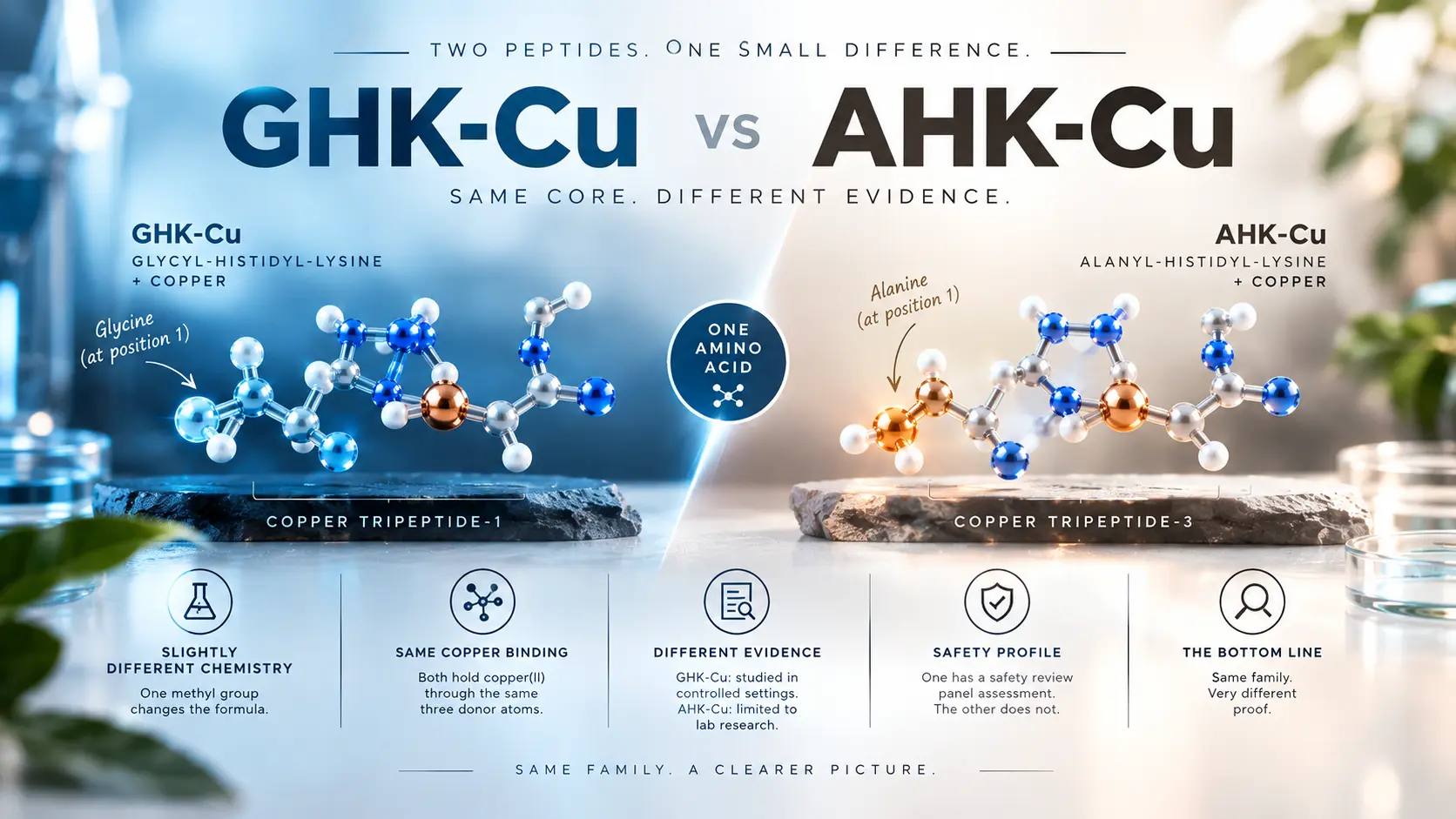
The real difference in GHK-Cu vs AHK-Cu is not chemistry, it is paperwork. The two tripeptides differ by one methyl group — glycine at position one in GHK-Cu, alanine in AHK-Cu — and both hold copper(II) through the same three donor atoms, so the substitution does not abolish copper binding. GHK-Cu has been through randomized human trials, and the two best-controlled ones failed on their objective endpoints. AHK-Cu has never been tested in a human trial by any route; its published record is essentially one 2007 paper using cultured cells and excised human follicles, in which the headline anti-apoptotic result was not statistically significant.
Key Takeaways
- The only structural difference is a methyl group on residue one: free GHK is C14H24N6O4 at 340.38 g/mol, free AHK is C15H26N6O4 at 354.41 g/mol, a gap of 14.03 Da [1,2].
- Copper(II) in GHK is held by three donors — the N-terminal amine, the deprotonated glycyl-histidyl amide nitrogen, and the histidine imidazole nitrogen — with the fourth equatorial position taken by a labile oxygen donor, reported as a carboxylate in the solid-state structure [6]. All three donors survive the glycine-to-alanine swap.
- The best-controlled human GHK-Cu study, Miller 2006, randomized patients after carbon dioxide laser resurfacing; 13 completed, and blinded evaluators plus computer image analysis found no significant difference in erythema, wrinkles or skin quality. Only the patients' own questionnaire favoured GHK-Cu, at P = .04 [7].
- A larger 1992 randomized, evaluator-blinded trial in 86 evaluable patients tested a 0.4% tripeptide-copper cream against placebo and silver sulfadiazine. The copper cream was indistinguishable from placebo [8].
- The single AHK-Cu paper, Pyo 2007, used excised human hair follicles and cultured dermal papilla cells at picomolar to nanomolar concentrations. Follicle elongation and cell proliferation were reported; the flow-cytometry reduction in apoptotic cells was not statistically significant [9].
- The famous "31.2% of genes" figure comes from three Connectivity Map expression profiles in PC3 prostate and MCF7 breast cancer cell lines, expressed as a share of the 13,424 genes represented on that array — not of the human genome [10,11].
- The Cosmetic Ingredient Review panel judged copper tripeptide-1 safe as used and stated that typical use concentrations are under 10 ppm. There is no equivalent CIR assessment of copper tripeptide-3, the INCI name for AHK-Cu [18].
- No head-to-head study of GHK-Cu against AHK-Cu has ever been published, in any model, at any ratio.
Research Use Only. Everything described here is laboratory research. Compounds referenced are supplied strictly for in-vitro and preclinical research use and are not for human or veterinary consumption. Nothing on this page is medical, dosing or health advice, and none of the findings below establish a human outcome.
How We Graded the Evidence
Every claim below is tagged with the model that produced it, using a fixed order of strength: randomized controlled human trial, then uncontrolled or open-label human work, then live animal studies, then ex-vivo human tissue, then cell culture, then computational analysis of existing datasets. Two additional rules apply. A result reported only in a conference abstract, a trade journal or a manufacturer-linked report is treated as unverifiable rather than positive, because the methods cannot be inspected. And a finding the authors themselves flagged as non-significant is recorded as non-significant, no matter how often it is quoted otherwise. The same grading is used across the site, including the evidence ranking in our longevity peptide evidence review.
What Is the Difference Between GHK-Cu and AHK-Cu?
One methyl group, and nothing else. GHK is glycyl-L-histidyl-L-lysine; AHK is L-alanyl-L-histidyl-L-lysine. Alanine is glycine with a methyl group on the alpha carbon, so the entire chemical distinction between these two molecules is a single CH2 unit at residue one.
Property | GHK / GHK-Cu | AHK / AHK-Cu |
|---|---|---|
Full name | Glycyl-L-histidyl-L-lysine | Alanyl-L-histidyl-L-lysine |
Sequence | Gly-His-Lys | Ala-His-Lys |
INCI name of the copper complex | Copper Tripeptide-1 | Copper Tripeptide-3 |
Free peptide formula | C14H24N6O4 | C15H26N6O4 |
Free peptide mass | 340.38 g/mol | 354.41 g/mol |
PubChem CID (free peptide) | 73587 | 7408502 |
PubChem CID (copper form) | 139035031, C14H21CuN6O4− [3] | 168431292, hydrochloride, C15H24ClCuN6O4− [4] |
Occurrence | Endogenous; isolated from human plasma | Synthetic only; no endogenous source reported |
The 14.03 Da difference is the number to hold onto, because it is the one thing a mass spectrometer can settle without argument.
Whether that methyl group should matter chemically depends on which atoms are doing the work. In GHK, copper(II) sits in a distorted square-planar site formed by the N-terminal amino group of glycine, the deprotonated amide nitrogen of the glycyl-histidyl peptide bond, and a nitrogen from the histidine imidazole ring, with the fourth equatorial position occupied by a labile oxygen donor rather than by the peptide itself — a carboxylate, in the solid-state structure [6]. The X-ray and solution structures published by Hureau and colleagues in 2011 also showed that copper exchange is fast in GHK compared with the tetradentate albumin-derived peptide DAHK, which they attribute to the formation of a bis complex, [Cu(II)(GHK)2] [6].
Substituting glycine for alanine adds a methyl branch to the alpha carbon of residue one. It does not remove the N-terminal amine, the amide nitrogen or the imidazole. On structural grounds the chelation site is preserved, which is why AHK forms a stable copper complex at all. What is missing is the confirmation: we were unable to locate a published stability constant, X-ray structure or spectroscopic characterisation for AHK-Cu comparable to the GHK work. The claim that the two complexes behave identically in copper handling is a reasonable inference, not a measured result — and vendor catalogues cannot settle it, since they do not even agree on a CAS number for AHK-Cu.
There is one more naming trap worth flagging. PubChem carries several distinct entries under GHK-Cu-adjacent names, including the anionic complex at CID 139035031 and a separate two-to-one entry at CID 133697840. A certificate of analysis quoting a CID is not by itself proof that a supplier and a buyer mean the same species. Mass is the arbiter.
AHK-Cu vs GHK-Cu: Which One Has Real Evidence?
GHK-Cu, and by a wide margin — though the direction of that evidence is not what the marketing implies. The honest summary is that the better-studied peptide is the one whose controlled human trials came back negative, while the less-studied one has no controlled human data to come back at all.
Evidence dimension | GHK-Cu | AHK-Cu |
|---|---|---|
Randomized controlled human trials, indexed in PubMed | Two identified: Miller 2006 (n = 13 completers) and Bishop 1992 (n = 86 evaluable) [7,8]. A third, Badenhorst 2016, is described as randomized and double-blind but appeared in a low-visibility title outside PubMed indexing [20] | None identified |
Result of those trials | Both null on objective endpoints [7,8] | Not applicable |
Live animal in-vivo work | Multiple rodent and rabbit wound models; intranasal mouse neurology work [17] | None identified |
Ex-vivo human tissue | Skin penetration and follicle work reported in secondary literature | Excised human hair follicles, Pyo 2007 [9] |
Cell culture | Extensive, from Maquart 1988 onward [15] | Cultured dermal papilla cells, Pyo 2007 [9] |
Computational | Connectivity Map reanalysis, PC3 and MCF7 lines [10,11] | None identified |
Pharmacokinetics by any injected route | None identified | None identified |
Strongest null result | No objective benefit after laser resurfacing [7]; no benefit over placebo in chronic wounds [8] | Apoptosis reduction not statistically significant [9] |
Read that table row by row and the asymmetry is stark in both directions. GHK-Cu has a fifty-year literature, and the parts of it that were designed to be falsifiable came out negative. AHK-Cu has almost nothing to falsify. Vendors treat the second condition as if it were an open question and the first as if it were settled in favour. It is the reverse.
What Does the GHK-Cu Human Research Actually Show?
It shows that when GHK-Cu was tested against a control with blinded assessors, it did not beat the control. Two trials matter here, and neither appears on the pages currently ranking for this comparison.
Miller and colleagues, publishing in Archives of Facial Plastic Surgery in 2006, randomized patients undergoing circumoral carbon dioxide laser resurfacing to post-treatment skin regimens with or without GHK-Cu. Thirteen patients completed. Erythema was scored by computer image analysis and by blinded evaluators, with wrinkles and overall skin appearance assessed at twelve weeks. Every patient improved, which is what laser resurfacing does. Between the groups there was no statistically significant difference in erythema resolution, wrinkles or skin quality. The one endpoint that reached significance was the patients' own questionnaire, at P = .04 [7]. A study in which objective measures find nothing and self-report finds something is a study about satisfaction, not about tissue.
Fourteen years earlier, Bishop and colleagues ran a larger test in the Journal of Vascular Surgery: a prospective randomized, evaluator-blinded trial in patients with venous stasis ulcers, with 86 evaluable completers. A 0.4% biologically active tripeptide-copper cream was compared against an inert vehicle placebo and against 1% silver sulfadiazine. Silver sulfadiazine reduced ulcer size significantly. The copper complex and the placebo were indistinguishable from each other [8]. One caveat belongs on the record: the published abstract names a biologically active tripeptide copper complex rather than GHK-Cu specifically, so the identification rests on that description and on the trial's own citation of the Maquart GHK-Cu collagen work.
What about the cosmetic studies everyone quotes? Trace them. The twelve-week facial cream study in 71 women and the eye cream study in 41 women both appear in the literature as papers presented at the American Academy of Dermatology 60th Annual Meeting in New Orleans in February 2002 [13]. They are conference presentations. They are not indexed trials, the protocols are not retrievable, and they are cited as proceedings even by the reviews that lean on them hardest. Treating them as clinical confirmation is a category error.
For the mechanism literature behind all of this — collagen, matrix metalloproteinases, glycosaminoglycans — our GHK-Cu skin, collagen and wound-healing guide covers the cell-culture work in depth, and the GHK-Cu copper peptide research guide covers the chemistry and handling.
Is There Any Human Research on AHK-Cu?
No. There is no published human clinical trial of AHK-Cu by any route, and as of September 2026 we could find no registered one either.
What exists is Pyo and colleagues, Archives of Pharmacal Research, 2007, out of the dermatology department at Seoul National University [9]. The design used two systems: human hair follicles in ex-vivo organ culture, and cultured human dermal papilla cells. Neither is an animal and neither is a patient. At concentrations from 10⁻¹² to 10⁻⁹ M, AHK-Cu stimulated follicle elongation and dermal papilla cell proliferation. The authors then looked at apoptosis by Annexin V-FITC and propidium iodide labelling with flow cytometry. AHK-Cu at 10-9 M reduced the number of apoptotic cells — and the paper states plainly that this decrease was not statistically significant. The protein-level findings, an elevated Bcl-2 to Bax ratio and reduced cleaved caspase-3 and PARP, were reported alongside it.
That is the whole foundation. One paper, one laboratory, one year, no in-vivo animal work, no pharmacokinetics, no human endpoint. When a product page tells you AHK-Cu "reduces follicle cell death," it is quoting a result the original authors declined to call significant. Our AHK-Cu research peptide overview carries the same reading of the source.
Recency does not rescue it. A 2026 review of short peptides for hair loss in Biomedicines, surveying the field across dozens of compounds, noted that, apart from agents in active clinical development such as PP405 and pyrilutamide, the cosmetic-additive peptides it surveyed are not classified as medicines [19].
Which Copper Peptide Is Studied More for Hair?
AHK-Cu has the more specific hair paper; GHK-Cu has the more voluminous literature about everything else. Neither has a hair outcome demonstrated in living humans for the peptide on its own: the one placebo-controlled human trial in this space gave 45 men a complex of 5-aminolevulinic acid and GHK for six months and reported a significant increase in hair count but no significant change in hair length or thickness [21]. Because the active was a two-component complex, it cannot tell you what the peptide did by itself.
The AHK-Cu follicle work is Pyo 2007, described above: excised follicles in culture, plus dermal papilla cells [9]. Ex-vivo organ culture is a genuinely useful model — it uses real human follicles rather than an immortalised line — but a follicle in a dish has no blood supply, no androgen signalling from a living scalp, no immune system and no hair cycle beyond the days it survives. Elongation in that system is a proliferation signal, not regrowth.
Then there is the claim, printed on a remarkable number of product pages, that copper peptides perform comparably to minoxidil. Follow it back and it lands on a single 1993 symposium paper by Uno and Kurata in the Journal of Investigative Dermatology, which is mostly about macaque models of androgenetic alopecia. What it says about copper is one sentence: a copper-binding peptide designated PC1031 produced follicular enlargement on the back skin of fuzzy rats covering the vellus follicles, and the effect was similar to that of topical minoxidil [14]. Rat back skin, not scalp. A compound identified by an internal code, not as GHK-Cu or AHK-Cu. And no percentage of any kind — which means the "40% increase in follicle size" and "50% increase" figures circulating in this niche have no home in the source they are attributed to, and contradict each other besides.
Can GHK-Cu and AHK-Cu Be Used Together?
No published study has ever combined them, compared them, or tested a ratio between them. That is the complete answer, and it is worth stating flatly because the blended-serum market is built on the assumption that someone, somewhere, worked this out.
The "1:1 optimal ratio" is the clearest example. There is no ratio-optimisation study in the literature — no dose-response surface, no isobologram, no head-to-head arm. A one-to-one blend is a formulation decision, not a finding. The same applies to the widespread claim that AHK-Cu was purpose-designed to target hair follicles while GHK-Cu handles skin: we could locate no design paper, no structure-activity study, and no rationale published by whoever first made AHK-Cu. The division of labour is a marketing schema imposed after the fact on two molecules that were characterised decades apart for unrelated reasons.
If the two do differ functionally, the most plausible mechanism is not receptor selectivity but something duller: slightly different lipophilicity from that extra methyl, and therefore slightly different partitioning. No one has measured it.
What About Injected or Intranasal Copper Peptides?
Essentially all human GHK-Cu work is topical cosmetic work. There is no controlled human trial of injected or intranasal copper peptide administration, and for AHK-Cu by those routes there is no data of any kind — no pharmacokinetics, no tissue distribution, no measurement of what happens to the copper load.
The intranasal literature that does exist is rodent. Tucker and colleagues gave intranasal GHK-Cu to 5xFAD transgenic mice from four to seven months of age and reported delayed cognitive impairment, reduced amyloid plaques and lower MCP1-mediated inflammation in the frontal cortex and hippocampus [17]. That is a mouse model of a neurodegenerative disease. It is interesting preclinical work and it says nothing about human intranasal use, which our copper tripeptide nasal spray research page sets out in the same terms.
There is also a persistent confusion worth clearing up. Search the literature for injectable copper peptides and you will find papers with "injectable" in the title. Read the methods and most are injectable hydrogels and biomaterial scaffolds — copper-peptide-loaded matrices placed into a wound bed as a dressing. They are materials-science papers about a delivery vehicle. They are not studies of systemic peptide administration, and citing them as evidence for injection is a misreading of the word.
What Do the Claims You See Online Actually Rest On?
Four claims dominate this SERP. Each traces to a source that does not support the weight placed on it.
Claim as marketed | What it actually rests on | Model |
|---|---|---|
"GHK-Cu improved collagen in 70% of women, vs 50% for vitamin C and 40% for retinoic acid" | A 1998 pilot clinical, histologic and ultrastructural study in Disease Management & Clinical Outcomes, a journal not indexed in PubMed [12] | Small pilot, unverifiable methods |
"GHK resets 4,000+ genes" / "31% of the human genome" | Reanalysis of three Broad Institute Connectivity Map profiles, two in PC3 prostate cancer cells and one in MCF7 breast cancer cells [10,11] | In silico, cancer cell lines |
"AHK-Cu was designed to target hair follicles" | No design, synthesis-rationale or structure-activity paper located | None |
"AHK-Cu penetrates better and is stronger for hair" | No comparative penetration study and no head-to-head trial located | None |
"GHK-Cu reduced wrinkle volume by 55.8%" | A 2016 report in Journal of Aging Science, a low-visibility title outside the main dermatology literature [20]. The figure is against a control serum; against a Matrixyl 3000 comparator the reported difference was 31.6% | Small human study, limited external scrutiny, and the headline number is the flattering comparison |
The gene figure deserves unpacking, because the arithmetic is public and nobody does it. The 2014 source paper describes converting 22,277 Affymetrix probe sets to 13,424 genes, then counting genes whose expression shifted by at least 50% [10]. Summing the 2018 review's own table gives 2,687 genes stimulated and 1,513 suppressed: 4,200 in total, which is where "4,000+ genes" comes from, and 4,200 out of 13,424 is the 31.2% figure the same authors report [11]. So the two famous numbers are the same number said twice. And the denominator is the set of genes on that array, not the roughly 20,000 protein-coding genes in the human genome. "31% of the human genome" is a misdescription of the authors' own calculation.
One more point belongs here, and it is a matter of record rather than interpretation. The 2018 review that popularised these figures was written by GHK's original discoverer and a colleague, both listing an affiliation with a commercial copper-peptide skin care operation on the paper's own front page, and it carries the statement that the authors declare no conflict of interest [11]. Readers can weigh that themselves. What they should not do is treat a narrative review by the molecule's discoverer as an independent replication of his own data.
How Do You Verify a Copper Peptide Lot?
Identity first, purity second, content third — and treat colour as worthless. Copper(II) complexes are blue, so a blue powder tells you there is copper in the vial and nothing else. GHK-Cu and AHK-Cu both look correct.
Test | What it actually establishes | Where it fails |
|---|---|---|
Mass spectrometry against theoretical mass | Identity. 340.38 for free GHK, 354.41 for free AHK — the 14.03 Da gap is unambiguous [1,2] | Cannot tell you how much copper is bound |
HPLC purity | The proportion of chromatographable material that is the target peak | Reported as area percent; says nothing about counter-ions, water or residual salts |
Net peptide content | How much of the vial mass is peptide rather than acetate and moisture | Frequently absent from certificates entirely |
Copper stoichiometry | Whether the complex is loaded as specified | Rarely measured; an underloaded lot still looks blue |
Visual inspection | Almost nothing | Colour is a copper indicator, not an identity test |
The practical consequence is that for a copper peptide, a certificate showing only HPLC area percent leaves the two questions that matter — which peptide, and how much copper — unanswered. Our guide on how to read a certificate of analysis sets out what a complete document contains, and per-lot documents are published on our certificates page.
Regulatory status is part of verification too, and it is narrower than most pages suggest. The Cosmetic Ingredient Review expert panel assessed copper tripeptide-1 in 2018 and concluded it is safe in the present practices of use and concentration, noting that typical use concentrations of these ingredients are under 10 ppm, with the surveyed range running from 0.0000001% up to 0.002% [18]. That conclusion is explicitly bounded by those concentrations. It is a statement about parts-per-million in a face cream. It is not a safety clearance for any other concentration, any other route, or any other purpose. And it does not cover copper tripeptide-3: we found no dedicated CIR assessment of AHK-Cu.
What the Evidence Does Not Establish
Stated plainly, because this is the section most pages on this topic leave out.
The literature does not establish that GHK-Cu improves wrinkles, skin quality or erythema in humans — the two randomized, blinded tests we identified found no objective benefit [7,8]. It does not establish that AHK-Cu does anything in a living organism, human or animal, because no such study has been published [9]. It does not establish that either peptide, on its own, grows hair on a human head; the single placebo-controlled human trial in this space tested GHK inside a two-component complex with 5-aminolevulinic acid [21]. It does not establish that they are safe or effective by injection or intranasally, because there is no controlled human data for either route. It does not establish that combining them helps, or that any particular ratio is optimal, because no combination study exists. It does not establish that AHK-Cu is "stronger for hair," because the head-to-head comparison that would settle it has never been run.
It also does not establish the opposite. Null results in two small trials with cosmetic endpoints do not prove a molecule inert, and a peptide with one paper behind it is under-studied rather than disproven. The distinction between "tested and failed," "tested at the wrong endpoint," and "never tested" is the whole content of this page. GHK-Cu is in the first two categories. AHK-Cu is in the third.
Where to Go Next
For the mechanism literature and the full chemistry, start with the GHK-Cu copper peptide research guide. Research materials with per-lot documentation are listed on the GHK-Cu product page and the AHK-Cu product page, both supplied strictly for in-vitro and preclinical laboratory research and not for human or veterinary use.
References
- National Center for Biotechnology Information. PubChem Compound Summary for CID 73587, Glycyl-L-histidyl-L-lysine. https://pubchem.ncbi.nlm.nih.gov/compound/glycyl-L-histidyl-L-lysine
- National Center for Biotechnology Information. PubChem Compound Summary for CID 7408502, L-Alanyl-L-histidyl-L-lysine. https://pubchem.ncbi.nlm.nih.gov/compound/7408502
- National Center for Biotechnology Information. PubChem Compound Summary for CID 139035031, Copper tripeptide. https://pubchem.ncbi.nlm.nih.gov/compound/Copper-tripeptide
- National Center for Biotechnology Information. PubChem Compound Summary for CID 168431292, AHK-Cu hydrochloride. https://pubchem.ncbi.nlm.nih.gov/compound/AHK-Cu
- Trapaidze A, Hureau C, Bal W, et al. Thermodynamic study of Cu2+ binding to the DAHK and GHK peptides by isothermal titration calorimetry (ITC) with the weaker competitor glycine. J Biol Inorg Chem. 2012;17(1):37-47. PMID: 21898044. https://pubmed.ncbi.nlm.nih.gov/21898044/
- Hureau C, Eury H, Guillot R, et al. X-ray and solution structures of Cu(II) GHK and Cu(II) DAHK complexes: influence on their redox properties. Chemistry. 2011;17(36):10151-10160. doi:10.1002/chem.201100751. PMID: 21780203. https://pubmed.ncbi.nlm.nih.gov/21780203/
- Miller TR, Wagner JD, Baack BR, et al. Effects of topical copper tripeptide complex on CO2 laser-resurfaced skin. Arch Facial Plast Surg. 2006;8(4):252-259. doi:10.1001/archfaci.8.4.252. PMID: 16847171. https://pubmed.ncbi.nlm.nih.gov/16847171/
- Bishop JB, Phillips LG, Mustoe TA, et al. A prospective randomized evaluator-blinded trial of two potential wound healing agents for the treatment of venous stasis ulcers. J Vasc Surg. 1992;16(2):251-257. PMID: 1495150. https://pubmed.ncbi.nlm.nih.gov/1495150/
- Pyo HK, Yoo HG, Won CH, et al. The effect of tripeptide-copper complex on human hair growth in vitro. Arch Pharm Res. 2007;30(7):834-839. doi:10.1007/BF02978833. PMID: 17703734. https://pubmed.ncbi.nlm.nih.gov/17703734/
- Pickart L, Vasquez-Soltero JM, Margolina A. GHK and DNA: resetting the human genome to health. Biomed Res Int. 2014;2014:151479. doi:10.1155/2014/151479. PMID: 25302294. https://pubmed.ncbi.nlm.nih.gov/25302294/
- Pickart L, Margolina A. Regenerative and protective actions of the GHK-Cu peptide in the light of the new gene data. Int J Mol Sci. 2018;19(7):1987. doi:10.3390/ijms19071987. PMID: 29986520. https://www.mdpi.com/1422-0067/19/7/1987
- Abdulghani A, Sherr A, Shirin S, et al. Effects of topical creams containing vitamin C, a copper-binding peptide cream and melatonin compared with tretinoin on the ultrastructure of normal skin — a pilot clinical, histologic, and ultrastructural study. Dis Manag Clin Outcomes. 1998;1:136-141. Cited in reference 11; not indexed in PubMed.
- Leyden J, Stephens T, Finkey M, et al. Skin care benefits of copper peptide containing facial cream, and Skin care benefits of copper peptide containing eye creams. Papers presented at: American Academy of Dermatology 60th Annual Meeting; February 22-27, 2002; New Orleans, LA. Conference proceedings; cited in references 7 and 11.
- Uno H, Kurata S. Chemical agents and peptides affect hair growth. J Invest Dermatol. 1993;101(1 Suppl):143S-147S. PMID: 8326148. https://pubmed.ncbi.nlm.nih.gov/8326148/
- Maquart FX, Pickart L, Laurent M, et al. Stimulation of collagen synthesis in fibroblast cultures by the tripeptide-copper complex glycyl-L-histidyl-L-lysine-Cu2+. FEBS Lett. 1988;238(2):343-346. PMID: 3169264. https://pubmed.ncbi.nlm.nih.gov/3169264/
- Campbell JD, McDonough JE, Zeskind JE, et al. A gene expression signature of emphysema-related lung destruction and its reversal by the tripeptide GHK. Genome Med. 2012;4(8):67. doi:10.1186/gm367. PMID: 22937864. https://pubmed.ncbi.nlm.nih.gov/22937864/
- Tucker M, Liao GY, Keely A, et al. Behavioral and neuropathological features of Alzheimer's disease are attenuated in 5xFAD mice treated with intranasal GHK peptide. Aging Pathobiol Ther. 2024;6(3):102-108. doi:10.31491/apt.2024.09.148. PMID: 40766919. https://pmc.ncbi.nlm.nih.gov/articles/PMC12323558/
- Johnson W Jr, Bergfeld WF, Belsito DV, et al. Safety assessment of Tripeptide-1, Hexapeptide-12, their metal salts and fatty acyl derivatives, and Palmitoyl Tetrapeptide-7 as used in cosmetics. Int J Toxicol. 2018;37(3 Suppl):90S-102S. doi:10.1177/1091581818807863. https://journals.sagepub.com/doi/10.1177/1091581818807863
- Fan C, Chen Y, Huang Q, et al. Overview of short peptides for hair loss. Biomedicines. 2026;14(4):864. doi:10.3390/biomedicines14040864. PMID: 42072405. https://www.mdpi.com/2227-9059/14/4/864
- Badenhorst T, Svirskis D, Merrilees M, et al. Effects of GHK-Cu on MMP and TIMP expression, collagen and elastin production, and facial wrinkle parameters. J Aging Sci. 2016;4:166. doi:10.4172/2329-8847.1000166. Cited in reference 11.
- Lee WJ, Sim HB, Jang YH, et al. Efficacy of a complex of 5-aminolevulinic acid and glycyl-histidyl-lysine peptide on hair growth. Ann Dermatol. 2016;28(4):438-43. PMID 27489425. https://pubmed.ncbi.nlm.nih.gov/27489425/
Frequently Asked Questions
What is the difference between GHK-Cu and AHK-Cu?
One amino acid at position one: glycine in GHK-Cu, alanine in AHK-Cu. Chemically that is a single methyl group, making free AHK 14.03 Da heavier than free GHK — 354.41 versus 340.38 g/mol. Both complex copper(II). The meaningful difference is in the literature behind them, not in the molecules: GHK-Cu has randomized human trials, AHK-Cu has none.
Is AHK-Cu just GHK-Cu with one amino acid changed?
Structurally, yes. AHK-Cu is the alanine analogue of GHK-Cu, and the three atoms that grip copper — the N-terminal amine, the deprotonated first amide nitrogen and the histidine imidazole nitrogen — are present in both. The difference is that GHK occurs naturally in human plasma and has been characterised by X-ray crystallography, while AHK is synthetic and has no comparable published structural data.
Which is better studied for hair, GHK-Cu or AHK-Cu?
AHK-Cu has the one paper that is specifically about hair — Pyo 2007, using excised human follicles and cultured dermal papilla cells. GHK-Cu has a much larger literature, but little of it is hair-focused, and the one placebo-controlled human hair trial involving GHK used it inside a complex with 5-aminolevulinic acid, so it cannot attribute the result to the peptide. Neither peptide has a demonstrated hair outcome in living people on its own, so "better studied for hair" still means better studied in a dish.
Which is better studied for skin and collagen?
GHK-Cu, clearly. Its collagen work goes back to fibroblast cell culture in 1988 and includes glycosaminoglycan and matrix metalloproteinase studies through the 1990s and 2000s. AHK-Cu has essentially nothing comparable. But the human skin trials that were properly controlled did not show objective benefit, so a larger literature here does not mean a positive one.
Can GHK-Cu and AHK-Cu be used together?
No published study has combined them. Blended formulations exist and are sold widely, but there is no experiment testing whether the combination outperforms either peptide alone, no additivity or synergy data, and no comparative safety work. Anyone describing a blend as research-backed is describing the two ingredients separately, not the blend.
Is there an optimal GHK to AHK ratio?
No ratio-optimisation study exists. The 1:1 figure that circulates in this niche has no published source — no dose-response work, no comparison of ratios, no head-to-head arm. It appears to be a formulation convention that acquired the appearance of a finding through repetition.
Is AHK-Cu natural or synthetic?
Synthetic. GHK was isolated from human plasma and is released during tissue breakdown from collagen and from the SPARC protein. AHK has no reported endogenous source; it is a laboratory analogue of GHK. This matters for interpretation, because arguments that begin "the body already makes this" apply to GHK and do not transfer to AHK.
Does AHK-Cu have any human studies?
No human clinical trial of AHK-Cu has been published by any route, and we found no registered one as of September 2026. The single substantive paper, Pyo 2007, used human tissue — excised follicles and cultured dermal papilla cells — but no living participants. Human cells in culture are not a human study, and the distinction is the single most abused point on this topic.
Is AHK-Cu the same as copper tripeptide-3?
Yes. Copper Tripeptide-3 is the INCI cosmetic-labelling name for the alanyl-histidyl-lysine copper complex. Copper Tripeptide-1 is the equivalent name for GHK-Cu. The two names are frequently swapped on ingredient lists and vendor pages, so the INCI number is worth checking against the stated sequence rather than trusted on its own.
Has GHK-Cu ever been tested in a controlled human trial?
Yes, at least twice, and both came back null on objective endpoints. Miller 2006 randomized laser-resurfacing patients, with 13 completing; blinded evaluation found no significant difference in erythema, wrinkles or skin quality. Bishop 1992 tested a 0.4% tripeptide-copper cream in 86 evaluable patients with chronic wounds and found it no better than placebo.
What does the research on injected copper peptides show?
Nothing, in humans. There is no controlled human trial of injected GHK-Cu or AHK-Cu, and no pharmacokinetic or distribution data for injected AHK-Cu at all. Papers with "injectable" in the title are usually about copper-peptide-loaded hydrogels and biomaterial scaffolds placed into wound beds, which is a materials-science question rather than a systemic administration question.
What about copper peptide nasal sprays?
The intranasal data is rodent. The clearest example gave intranasal GHK-Cu to a transgenic mouse model of neurodegeneration and reported reduced amyloid plaques and delayed cognitive decline. That is a mouse result in a disease model, and it does not establish anything about human intranasal use. For AHK-Cu intranasally, there is no published data of any kind.
Do copper peptides raise copper levels in the body?
No one has measured it for these compounds outside topical cosmetic contexts. There is no published human study of systemic copper load after GHK-Cu or AHK-Cu administration by any non-topical route. Copper is an essential trace element with a narrow tolerable range, which is exactly why the absence of copper-load measurement in this niche is worth noticing.
Are copper peptides FDA-approved for anything?
No. Neither GHK-Cu nor AHK-Cu holds drug approval for any indication. They appear in cosmetics as ingredients, which is a different regulatory category with no pre-market approval requirement. A 2026 review of hair-loss peptides made the same observation across the whole class: apart from one compound then in Phase II trials, none of these peptides is classified as a medicine.
How should a copper peptide lot be verified?
Identity by mass spectrometry against the theoretical mass, since the 14.03 Da gap between GHK and AHK is unambiguous; HPLC for purity, remembering that area percent excludes counter-ions and water; and net peptide content, which tells you how much of the vial is actually peptide. Ignore colour — every copper(II) complex is blue, so appearance confirms nothing about which peptide is present or how much copper is bound.