Peptide suppliers have multiplied fast over the last few years, and copper-complexed tripeptides like AHK-Cu are a good test case for telling the serious ones apart from the ones just reselling unverified powder. The compound itself isn't complicated. The paperwork trail behind a given vial, however, is where quality actually gets decided.
Featured Product
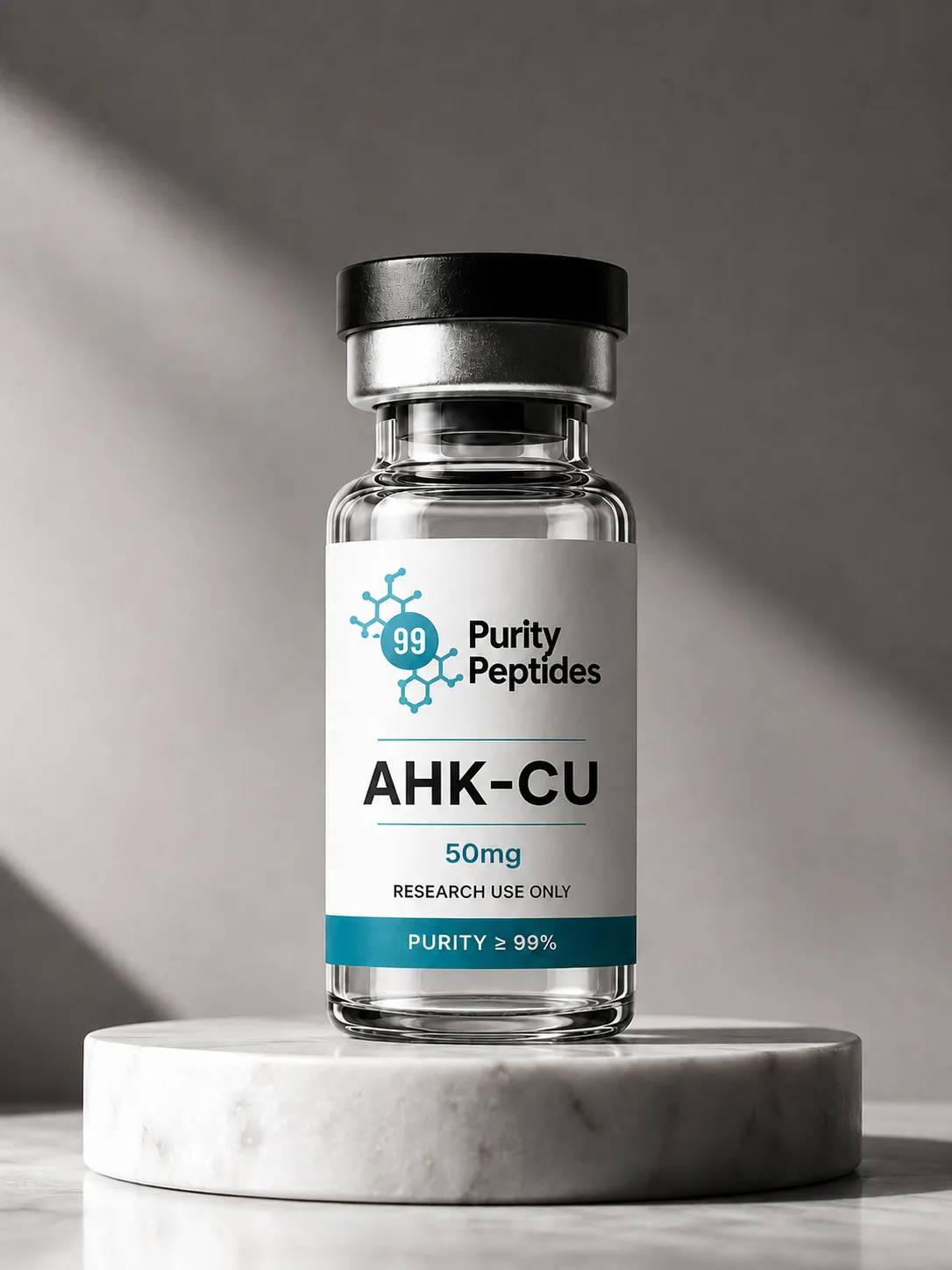
This guide covers what AHK-Cu research peptide is, how its identity and purity get verified, what documentation should arrive with every order, and how to evaluate a USA-based supplier before committing a purchase order. Everything here addresses AHK-Cu strictly as a research chemical — sourcing, identity, purity, documentation, and lab handling — not as a health, cosmetic, or supplement product.
Important scope note: AHK-Cu (also marketed as Copper Tripeptide-3) shows up in cosmetic-ingredient and consumer skincare contexts under related naming. This article does not address cosmetic formulation, dosing, or any human-use application. It covers AHK-Cu specifically as a research-use peptide standard: chemistry, documentation, and laboratory handling.
What Is AHK-Cu? A Chemical Overview
AHK-Cu is short for a copper complex of the tripeptide alanine-histidine-lysine (Ala-His-Lys). Commercially, it's also listed as Copper Tripeptide-3. The peptide backbone binds a copper(II) ion, which is why solutions and lyophilized powder of this compound often carry a characteristic blue tint — the color is a direct visual cue of copper coordination, and a batch that looks noticeably off-color from prior lots is worth flagging to your supplier before use.
Because AHK-Cu is a peptide-metal complex rather than a simple small molecule, its analytical profile is a bit more involved than a straightforward organic compound. Labs working with it typically want documentation covering both the peptide identity (via HPLC and mass spec) and confirmation that copper is properly complexed rather than present as a separate contaminant.
CAS Number, Molecular Data, and Identity Verification
This is one area where AHK-Cu buyers need to pay closer attention than usual. Different suppliers and chemical registries list different CAS numbers depending on which salt form or complex configuration is being described — the hydrochloride salt, the free base, and various naming conventions across vendor catalogs don't always align on a single number. Rather than treating any one CAS number as universal, confirm the exact number printed on your specific lot's COA and cross-check it against the supplier's own product documentation.
A general identity reference table, useful as a starting point rather than a final answer:
Property | Typical Reference Range (varies by salt form/source) |
|---|---|
Common Name(s) | AHK-Cu, Copper Tripeptide-3, Ala-His-Lys-Cu |
Amino Acid Sequence | Alanine – Histidine – Lysine (copper-complexed) |
Molecular Formula | Reported variably as ~C15H24CuN6O4 or with added HCl/hydrate groups |
Molecular Weight | Reported variably in the ~340–455 g/mol range by salt form |
Appearance | Lyophilized powder, often pale to distinct blue |
Because of this variability, the single most reliable practice is to request the CAS number, formula, and molecular weight directly on the COA for the lot you're purchasing, and treat that document — not a general web listing — as the source of truth for your specific order.
What "Research Grade" and "98% Purity" Actually Mean
"Research grade" isn't a formally regulated term, so it's worth being specific about what it should mean in practice for a peptide like AHK-Cu:
- Batch-specific testing. Each lot should be tested individually rather than relying on a purity figure established once for the whole product line.
- Verification by HPLC, ideally with mass spec confirmation. Purity alone doesn't confirm identity — a peptide-specific mass spectrum or LC-MS/MS trace is what confirms you actually have AHK-Cu and not a related fragment or a different salt form.
- A documented number, not a marketing claim. "98% purity" should be traceable to an actual chromatogram, not just a percentage printed on a listing page.
For a copper-peptide complex specifically, ask whether the supplier's purity figure refers to the peptide portion alone or the complex as a whole — this distinction can matter for method development work where exact molar concentrations are important.
Reading an AHK-Cu Certificate of Analysis (COA)
A COA is the core document behind any legitimate peptide purchase. For AHK-Cu, a properly constructed COA should include:
- Product name and CAS number — matching the specific salt form and label.
- Lot/batch number — unique to the shipment received.
- Test date and method — typically HPLC, ideally paired with mass spectrometry for identity confirmation.
- Purity result — as a percentage, with the underlying chromatogram available on request.
- Molecular weight and formula — specific to the tested lot's salt form.
- Appearance description — including expected color, since copper complexation gives a visual identity cue.
- Storage recommendation — tied to the specific lot's stability data.
- Signature or lab authorization.
A quick verification habit:
Match the lot number on the COA to the lot number printed on the vial before logging the material into inventory. For a compound where CAS numbers vary across sources, this lot-matching step matters even more than usual — it's your confirmation that the paperwork actually belongs to what's in your hand.
If a supplier can't produce a lot-matched COA before or immediately after purchase, treat that as a legitimate reason to look elsewhere.
How HPLC Purity Testing Works for Peptides
HPLC separates a sample's components based on how strongly they interact with a stationary phase versus a mobile solvent phase moving through a column under pressure. For a peptide-copper complex like AHK-Cu, the general workflow looks like this:
- A precisely measured sample is dissolved in a compatible solvent system.
- The sample is injected into the HPLC system and carried through the column.
- The peptide complex and any impurities or degradation fragments separate based on retention time.
- A detector — commonly UV, sometimes paired with mass spec detection for peptide work — measures each peak, and the area under the target peak relative to total peak area gives the purity percentage.
For peptides specifically, a single HPLC purity number is less informative on its own than it is for a small organic molecule, because peptide impurities are often truncated or modified versions of the target sequence that can co-elute closely. This is exactly why pairing HPLC with mass spectrometry — confirming the correct molecular weight for the intact complex — gives a more complete identity picture than purity percentage alone.
Safety Data Sheet (SDS): What It Covers
An SDS is standard, non-optional documentation for handling any research chemical safely. For AHK-Cu, the SDS should address:
- Hazard identification and classification
- Handling and storage precautions
- Recommended personal protective equipment (PPE)
- First-aid measures
- Physical and chemical properties relevant to safe handling
- Stability and reactivity information
- Disposal considerations
Every legitimate order should come with an SDS, either included in the shipment or downloadable from the supplier's site. A supplier unwilling to provide one is asking your lab to accept a compliance gap that isn't yours to accept.
Storage Conditions and Stability
Lyophilized copper-peptide complexes are generally most stable when stored:
- Frozen, typically at or below -20°C, protected from light
- In a tightly sealed original container to limit moisture exposure
- Without repeated freeze-thaw cycling, since that stresses peptide stability more than steady cold storage
Once reconstituted in solution, peptide stability windows are considerably shorter than the lyophilized form — refrigerated storage (roughly 2–8°C) is a common recommendation for short-term use of a reconstituted solution, but the exact window should come from your supplier's lot-specific documentation rather than a general assumption. If your supplier doesn't specify a storage timeline for reconstituted material, ask directly rather than guessing.
Solubility and Reconstitution in the Lab
For labs preparing AHK-Cu solutions for assay work, solubility behavior depends on the exact salt form and buffer system in use. General practice for peptide-copper complexes involves testing solubility empirically in your specific solvent — commonly water, dilute acetic acid, or a buffered aqueous system — since a copper complex's behavior in solution can be sensitive to pH. Confirm your supplier's recommended reconstitution solvent and pH range before assuming a generic peptide protocol will transfer directly, and validate visually: a properly dissolved solution should retain the expected blue tint without visible precipitate.
Sourcing AHK-Cu From a USA Supplier: What to Check
Before placing an order, a practical checklist:
- Does the supplier provide a lot-specific COA before or with shipment?
- Is the CAS number clearly listed and does it match the specific salt form being sold?
- Is an SDS available for download or included with the order?
- Is the purity method disclosed (HPLC, with or without mass spec confirmation)?
- Are storage conditions specified for both lyophilized and reconstituted forms?
- Is the product clearly labeled for research use only?
- Does the supplier have a verifiable track record — institutional customers, transparent contact information, responsive technical support?
- Are shipping conditions described (cold-chain packaging, protection from heat/light in transit)?
A supplier checking every box here is meeting the baseline standard a lab should expect from a peptide-complex product. Missing documentation is a real red flag, not paperwork friction.
Applications of AHK-Cu in Research Settings
Within laboratory and analytical contexts, AHK-Cu research peptide is commonly used for:
- Reference standard work — calibrating HPLC or LC-MS instruments against a known, characterized peptide-copper complex.
- Method validation — confirming an analytical method can reliably detect and quantify AHK-Cu in a sample matrix.
- Peptide-metal complex research — as a model compound for studying copper-binding tripeptide behavior.
- Comparative chromatography studies — using AHK-Cu's known retention behavior as a benchmark against related copper-peptide complexes such as GHK-Cu.
These are laboratory and analytical applications. Any cosmetic, dermatological, or human-use application of copper-peptide compounds sits outside the scope of a research-chemical purchase and outside the scope of this article.
Common Myths About Research-Grade AHK-Cu
Myth: There's one universal CAS number for AHK-Cu.
Not accurate. Different salt forms and vendor naming conventions produce different CAS numbers across chemical registries. Always confirm the number against your specific lot's COA rather than a general web listing.
Myth: "98% purity" means the same thing across every supplier.
Not necessarily, and especially not for peptides. Purity by HPLC alone doesn't confirm correct sequence identity — mass spec confirmation matters more for peptide-complex products than for simple small molecules.
Myth: Research chemical and cosmetic-ingredient grade are interchangeable.
They're not. Research-grade material is manufactured, tested, and labeled for laboratory and analytical use — a different category with different documentation standards than a cosmetic raw material, even when the underlying chemistry overlaps.
Myth: A COA guarantees the product is verified.
A COA is only as reliable as the lab that issued it and whether the lot number actually matches what you received. Cross-checking lot numbers, and requesting the underlying chromatogram where possible, is what turns a COA into real verification rather than a formality.
Conclusion
Sourcing AHK-Cu research peptide comes down to the same discipline that applies to any peptide-complex compound: don't assume a single CAS number applies universally, insist on a lot-specific Certificate of Analysis backed by HPLC and ideally mass spec data, confirm an SDS is included, and follow storage guidance specific to your batch rather than generic advice. A supplier willing to produce that documentation without pushback is showing you exactly how seriously they take quality control — and for a compound where naming and salt-form variation cause real confusion across the market, that transparency is what actually separates a reliable AHK-Cu research peptide source from one that isn't.
Looking for AHK-Cu research peptide with a verifiable lot-specific COA, HPLC and mass spec data, and full SDS documentation? Browse the AHK-Cu listing on the 99 Purity Peptides research chemical catalog, or reach out to our technical team with any sourcing or documentation questions before you order.
For laboratory and research use only. Not for human consumption or topical use.
Frequently Asked Questions
What is AHK-Cu research peptide used for?
It's used in laboratory and analytical settings — primarily as a reference standard for HPLC/LC-MS calibration, method validation, and research into copper-binding tripeptide chemistry. It is not intended for human consumption or topical use.
What is the CAS number for AHK-Cu?
CAS numbers vary depending on the salt form and how a given registry lists the compound. Confirm the exact CAS number on your specific lot's Certificate of Analysis rather than relying on a single universal figure.
What does "98% purity" mean for a peptide research chemical?
It means HPLC testing has confirmed that approximately 98% of the sample, by peak area, corresponds to the target compound. For peptides, pairing this with mass spectrometry gives a more complete identity picture than a purity percentage alone.
What should be included in an AHK-Cu Certificate of Analysis?
Product name, CAS number matched to the salt form, lot number, test date and method, purity result, molecular weight/formula, appearance description, storage recommendation, and an authorizing signature or lab reference.
Is an SDS required when purchasing AHK-Cu research peptide?
Yes, as standard practice. An SDS covers hazard information, handling, storage, PPE, first aid, and disposal considerations, and a legitimate supplier should provide one with every order.
How is AHK-Cu purity tested?
Primarily through HPLC, ideally paired with mass spectrometry to confirm the intact peptide-copper complex's identity rather than relying on purity percentage alone.
How should AHK-Cu research peptide be stored?
Lyophilized powder is generally most stable frozen (typically -20°C or below), protected from light, and free of repeated freeze-thaw cycling. Reconstituted solutions have a shorter stability window and should follow your supplier's lot-specific guidance.
Is AHK-Cu soluble in water?
Solubility behavior depends on the salt form and solution pH. Labs should confirm the supplier's recommended reconstitution solvent and validate solubility empirically for their specific protocol.
What is the difference between AHK-Cu and GHK-Cu?
Both are copper-complexed peptides used in research and cosmetic-ingredient contexts, but they involve different amino acid sequences (Ala-His-Lys versus Gly-His-Lys) and are chemically distinct compounds, even though they're sometimes discussed together.
How do I verify a supplier's COA is legitimate?
Match the lot number on the COA to the lot number on the physical vial, and where possible, request the underlying HPLC chromatogram and mass spec data rather than relying on a stated percentage alone.
Can AHK-Cu research peptide be shipped within the USA with cold-chain packaging?
Reputable suppliers typically ship lyophilized peptides with appropriate packaging to limit heat exposure in transit. Ask specifically about cold-chain handling if your protocol requires strict temperature control on arrival.
What red flags suggest a supplier isn't reliable?
No lot-specific COA, no SDS available, a CAS number that isn't clearly tied to the specific salt form sold, generic (non-lot-specific) storage instructions, and unwillingness to answer direct technical questions.
Is AHK-Cu research peptide the same as AHK-Cu sold as a cosmetic ingredient?
They may share the same underlying chemistry, but research-grade and cosmetic-ingredient-grade products are different categories with different manufacturing, testing, labeling, and intended-use standards. This article addresses the research-chemical category specifically.
What documentation should arrive with an AHK-Cu order?
At minimum: a lot-specific COA and an SDS. Ideally also access to the underlying HPLC chromatogram and mass spec data on request.
Who typically purchases AHK-Cu research peptide?
Academic and industry laboratories, contract research organizations, and analytical chemistry facilities conducting peptide-metal complex research, method development, or instrument calibration work.