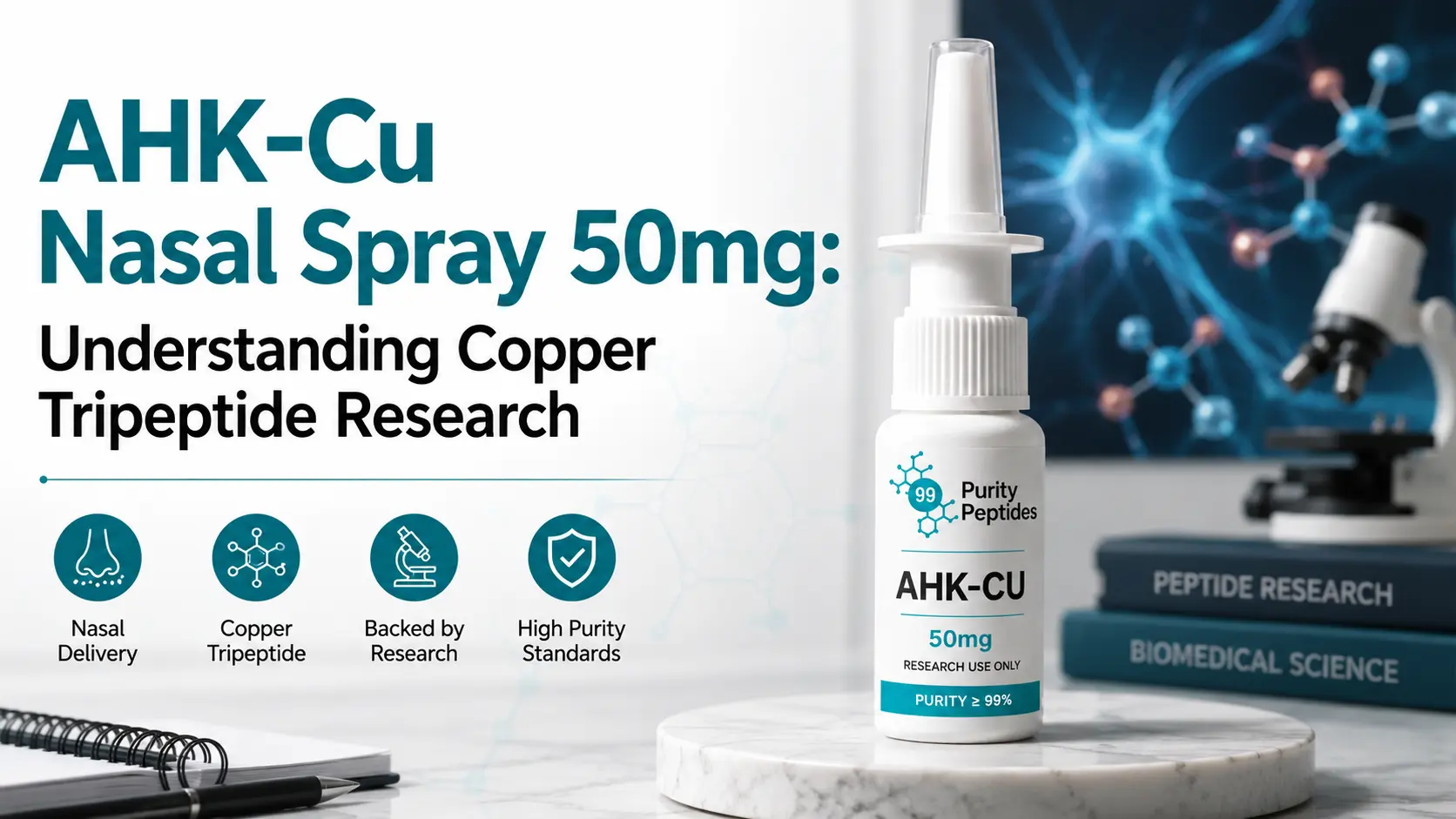
AHK-Cu Nasal Spray 50mg: What Copper Tripeptide-3 Research Actually Shows
Search for AHK-Cu and most of what comes back is really about GHK-Cu. The two share a name family, a copper ion, and a great deal of borrowed language. They are not the same molecule, and the evidence behind them is not the same depth.
That confusion has a cost. Researchers plan work around findings that were never produced with the compound in the vial, and vendor pages quietly attribute Copper Tripeptide-1 results to Copper Tripeptide-3 without ever saying so. Anyone sourcing AHK-Cu deserves a clearer starting point than that.
This guide separates the two. It covers what AHK-Cu is chemically, how the single-residue difference changes its research profile, what the dermal papilla and extracellular matrix literature reports, and why a 50mg nasal spray format raises a question worth answering plainly rather than skipping. It also covers the practical side: reconstitution arithmetic, stability behaviour, why copper peptide solutions change colour, and what a certificate of analysis should show before any of it matters.
Every compound discussed here is supplied for laboratory research use only.
Quick answer: what is AHK-Cu? AHK-Cu is a copper-bound tripeptide made of alanine, histidine and lysine coordinated to a divalent copper ion. Its INCI name is Copper Tripeptide-3. It is studied mainly in follicular biology and extracellular matrix models, and it is supplied strictly for research use. |
What Is AHK-Cu?
AHK-Cu is a metal-peptide complex. Three amino acids — alanine, histidine and lysine, in that order — form a short tripeptide chain, and a copper(II) ion sits coordinated to that chain rather than loosely mixed with it. The histidine imidazole ring does most of the coordination work, which is why histidine appears in the middle of every copper tripeptide of this family.
The chelation matters. A copper peptide is not a peptide with copper added; it is a single coordinated species whose behaviour in solution, whose stability, and whose colour all depend on that copper being bound where it should be. When the coordination breaks down, the compound stops being AHK-Cu in any meaningful sense.
What Does the AHK in AHK-Cu Stand For?
AHK is the single-letter amino acid code for the sequence: A for alanine, H for histidine, K for lysine. The Cu suffix denotes the coordinated copper(II) ion. Written in full it is Ala-His-Lys copper complex, sometimes shortened to alanine-histidine-lysine copper in supplier documentation.
Why Is AHK-Cu Called Copper Tripeptide-3?
Copper Tripeptide-3 is the INCI name — the standardised cosmetic ingredient nomenclature maintained by the Personal Care Products Council. INCI numbering distinguishes members of the same structural family in the order they entered the register, not by potency or importance. GHK-Cu holds Copper Tripeptide-1. AHK-Cu holds Copper Tripeptide-3.
This is the single most useful naming fact on the page, because "copper peptide" as a search entity resolves to GHK-Cu almost everywhere. Any page, dataset or supplier record that names Copper Tripeptide-3 explicitly is unambiguous. Any that says only "copper peptide" is not.
Is AHK-Cu a Natural Peptide?
The three amino acids are all proteinogenic and copper is an essential trace element, but AHK-Cu as supplied is a synthetic product. Research-grade material is produced by solid-phase peptide synthesis, purified by preparative reversed-phase HPLC, complexed with copper, and lyophilised into a stable powder. Its origin is a synthesiser, not an extraction.
AHK-Cu Specifications at a Glance
The table below is the compact reference version. Confirm every value against the lot certificate of analysis before treating it as authoritative for a given vial.
Property | Detail |
|---|---|
Common name | AHK-Cu |
INCI name | Copper Tripeptide-3 |
Amino acid sequence | Ala-His-Lys (A-H-K) coordinated to Cu(II) |
Reported molecular formula | C15H24CuN6O4 — verify against lot COA |
Approximate molecular weight | ~416 Da — verify against lot COA |
Compound class | Chelated copper tripeptide / metal-peptide complex |
Closest structural analogue | GHK-Cu (Copper Tripeptide-1) |
Supplied format | Lyophilised powder or pre-formulated 50mg nasal spray |
Typical research purity target | ≥99% by RP-HPLC, confirmed by LC-MS identity |
Primary research areas | Follicular biology, ECM remodelling, dermatology research |
Regulatory status | Research use only — not for human or veterinary use |
AHK-Cu vs GHK-Cu: How Copper Tripeptide-3 and Copper Tripeptide-1 Differ
One residue separates them. GHK-Cu begins with glycine; AHK-Cu begins with alanine. Everything downstream — histidine, lysine, the copper coordination — is shared. Alanine adds a single methyl group where glycine has a hydrogen atom, which is about as small as a structural change gets in peptide chemistry.
That small change is why the two compounds are so often conflated, and why conflating them is still a mistake. Their research literatures diverged early and have not converged since.
Attribute | AHK-Cu | GHK-Cu |
|---|---|---|
Sequence | Ala-His-Lys + Cu(II) | Gly-His-Lys + Cu(II) |
INCI name | Copper Tripeptide-3 | Copper Tripeptide-1 |
N-terminal residue | Alanine | Glycine |
Approximate MW | ~416 Da | ~340 Da |
Primary research focus | Hair follicle and dermal papilla models | Wound healing, ECM, broad dermatology |
Published evidence depth | Thin — limited primary literature | Substantial — decades of primary work |
Common research format | Topical serum; nasal spray offered commercially | Topical serum, spray, and blend components |
Solution stability profile | Copper-typical: pH and light sensitive | Copper-typical: pH and light sensitive |
Which Copper Peptide Has More Research Behind It?
GHK-Cu, by a wide margin. It has been studied since the 1970s across wound healing, tissue remodelling and gene expression models, and it appears in far more independent laboratories' work. AHK-Cu is the narrower, later, hair-follicle-directed sibling with a much smaller body of primary literature.
This is worth stating directly because most comparison content implies parity. Parity does not exist here. Choosing AHK-Cu over GHK-Cu for a research programme should follow from the specific follicular question being asked, not from an assumption that the evidence bases are equivalent.
Can AHK-Cu and GHK-Cu Be Studied Together?
In principle yes, and combined copper peptide work appears in the literature. Two practical cautions apply. First, structurally similar analogues complicate attribution — an observed effect cannot easily be assigned to one compound. Second, running both raises total copper load in the model, which introduces the cumulative exposure problem discussed below. A single-compound arm alongside the combination is the usual answer to both.
How Does AHK-Cu Work? Mechanism in Research Models
In published and vendor-cited research, AHK-Cu is described as acting on dermal papilla cells at the base of the hair follicle, where reports point to increased cell proliferation, prolongation of the anagen growth phase in ex vivo follicle models, elevated VEGF expression, downregulation of TGF-beta1, and a shifted Bcl-2/Bax ratio consistent with reduced apoptotic signalling. Separately, copper coordination places it within the group of copper-dependent enzyme contexts that includes lysyl oxidase.
Each of those threads is worth unpacking, with one caveat carried throughout: much of this framework was established with GHK-Cu and extended to AHK-Cu by structural analogy. The next four subsections describe what is reported. The limitations section describes how firmly it is established.
Dermal Papilla Cells and Follicle Elongation
The dermal papilla is a cluster of specialised mesenchymal cells sitting in the follicle bulb, and it governs follicle cycling. Research interest in AHK-Cu centres on reports of increased dermal papilla cell proliferation in culture and increased hair shaft elongation in ex vivo human hair follicle organ culture — a model where isolated follicles are maintained in medium and measured over several days.
These are cell and tissue models. They describe what happens to isolated follicles in a dish, not what happens in a person.
VEGF and Angiogenic Signalling
Vascular endothelial growth factor supports the microvasculature that supplies the follicle. Reports of increased VEGF expression following copper peptide exposure fit a broader pattern in which copper participates in angiogenic signalling. In follicular research this is the vascular-support hypothesis: better perfusion around the bulb, longer sustained growth phase.
TGF-beta1 and the Bcl-2/Bax Ratio
TGF-beta1 is one of the signals associated with catagen entry, the regression phase that ends active growth. Reported downregulation therefore sits opposite the anagen-prolongation finding rather than beside it. The Bcl-2/Bax ratio measures the balance between anti-apoptotic and pro-apoptotic proteins; a shift toward Bcl-2 indicates cells in the model are less prone to programmed death.
Together these give the mechanism section a coherent shape: proliferation up, vascular signalling up, regression signalling down, apoptosis signalling down. Coherent is not the same as confirmed.
Lysyl Oxidase, Collagen Crosslinking and the Extracellular Matrix
Lysyl oxidase is a copper-dependent enzyme that crosslinks collagen and elastin fibres, giving connective tissue its tensile properties. Because AHK-Cu delivers copper in a chelated form, extracellular matrix research treats copper peptides as a route to studying crosslinking, fibroblast activation and glycosaminoglycan synthesis. This is the skin-research thread that runs parallel to the follicular one, and it overlaps heavily with the much larger GHK-Cu literature.
Why Is AHK-Cu Supplied as a Nasal Spray When the Literature Is Topical?
This deserves a direct answer, because no competitor page gives one.
Essentially all published and commercial AHK-Cu literature describes topical application. The compound is reconstituted into a serum and applied to the scalp, frequently alongside microneedling. There is no published AHK-Cu intranasal pharmacokinetic dataset. A nasal spray format is therefore a delivery route with no compound-specific absorption data behind it, and any page claiming otherwise is claiming something that has not been measured.
What can be said is narrower and more defensible. Nasal absorption of peptides is strongly stratified by molecular weight, and AHK-Cu at roughly 416 Da sits in the favourable band.
Nasal Absorption by Molecular Weight
Molecular weight band | Reported systemic nasal absorption | Example compound |
|---|---|---|
Under ~1,000 Da | Materially higher; small peptides in this band have reported figures in the tens of percent | AHK-Cu ~416 Da; GHK-Cu ~340 Da |
~1,000–3,500 Da | Low single-digit percentages | Desmopressin ~1,070 Da |
Above ~3,500 Da | Typically below 1–2% without absorption enhancement | Larger peptide hormones |
AHK-Cu is smaller than several copper-adjacent spray SKUs already in the catalogue, and comfortably inside the favourable band. The honest framing is this: the molecular profile is favourable for nasal research formats, but no AHK-Cu-specific intranasal study has been published, so route-specific conclusions cannot be drawn.
Systemic Nasal Absorption Is Not Nose-to-Brain Delivery
These two figures get conflated constantly, including in vendor copy. Systemic nasal bioavailability measures how much compound reaches plasma after nasal administration. The nose-to-brain fraction measures the much smaller share reaching the central nervous system directly via the olfactory and trigeminal pathways, bypassing systemic circulation.
Published nasal bioavailability numbers almost always describe the first. Quoting them as if they described the second overstates central delivery by a wide margin. For a compound studied in follicular and dermal contexts, neither figure has been established.
What the Evidence Actually Shows — and What It Does Not
AHK-Cu's evidence base is thinner than GHK-Cu's. A substantial share of what is claimed for AHK-Cu is extrapolated from GHK-Cu by structural analogy rather than demonstrated with AHK-Cu itself, and no AHK-Cu-specific human clinical trial or intranasal pharmacokinetic study has been published. That is the accurate summary, and it should inform how any AHK-Cu research programme is designed.
Five specific limitations are worth naming.
- Thin primary literature. The number of independent studies using AHK-Cu specifically is small, and several widely repeated claims trace back to a limited set of sources.
- Extrapolation from GHK-Cu. Mechanistic language is frequently borrowed from Copper Tripeptide-1 work without disclosure, which makes the AHK-Cu evidence base look larger than it is.
- No human clinical data. Findings come from cell culture and ex vivo follicle models. Those models are informative about mechanism and uninformative about human outcomes.
- Cumulative copper exposure. Copper is biologically active in its own right. Repeated or combined copper peptide exposure raises total copper load in a model, and copper overload is a genuine confounder that is rarely controlled for in vendor-cited work.
- Route mismatch. The literature is topical. Commercial nasal formats have no compound-specific absorption or stability data behind them.
Some published copper peptide work also reports biphasic dose responses, where higher concentrations produce weaker effects than moderate ones, and irritation in topical models at elevated concentrations. Both argue for concentration ranging rather than assuming more is more.
Where AHK-Cu fits — and where to source it If a research question is genuinely follicle-specific, AHK-Cu is the targeted choice and the limitations above are the design constraints. If the question is broader ECM or tissue-remodelling work, GHK-Cu carries far more supporting literature. Either way, the compound is only as good as its documentation — every 99 Purity Peptides copper peptide ships against a lot certificate of analysis. View the AHK-Cu Nasal Spray 50mg specification and COA, or compare the full copper peptide range before selecting. |
Laboratory Reference: Reconstituting a 50mg AHK-Cu Vial
This section is laboratory preparation reference for handling a lyophilised research compound. It is not a use protocol, and nothing here is intended for human or veterinary application.
- Bring the vial to room temperature before opening. Introducing solvent into cold lyophilised powder encourages condensation and uneven dissolution.
- Select the solvent. Bacteriostatic water is standard for multi-draw laboratory work; sterile water suits single-use preparation. Record which was used.
- Calculate the target concentration before drawing solvent. The volume determines the concentration, so decide it first rather than filling to a convenient mark.
- Add solvent slowly down the inner wall of the vial. Direct streams onto the powder cake cause foaming and mechanical stress on the peptide.
- Swirl gently until dissolved. Never shake or vortex a copper peptide solution.
- Inspect the solution. It should be clear and free of particulates. Note the colour — copper peptides are characteristically blue in solution.
- Label with compound, lot, solvent, concentration and reconstitution date, then move to cold storage protected from light.
What Concentration Does 50mg Give?
The arithmetic is straightforward: total mass divided by solvent volume. The table below shows the common reference points.
Solvent volume added | Resulting concentration | Per 0.1 mL |
|---|---|---|
1 mL | 50 mg/mL | 5 mg |
2 mL | 25 mg/mL | 2.5 mg |
3 mL | 16.67 mg/mL | 1.67 mg |
5 mL | 10 mg/mL | 1 mg |
10 mL | 5 mg/mL | 0.5 mg |
AHK-Cu Storage and Stability
Copper peptides are less forgiving than plain peptides. The copper that makes them interesting also makes them redox-active, which means oxidation, pH drift and light exposure all register as visible changes.
Condition | Lyophilised powder | Reconstituted solution |
|---|---|---|
Temperature | Freezer storage; stable long-term when sealed and dry | Refrigerated; never re-frozen after reconstitution |
Light | Protect from light; amber or violet glass preferred | Protect from light — solution phase is more sensitive |
Moisture | Critical. Warm before opening to avoid condensation | Not applicable |
Working duration | Long, under sealed cold storage | Short. Track from the reconstitution date on the label |
Agitation | Not applicable | Swirl only. Shaking promotes degradation |
Why Does AHK-Cu Turn Green or Brown?
Colour is the most useful diagnostic a copper peptide gives you, because the copper coordination environment absorbs light differently as it changes. A correctly reconstituted copper peptide solution is blue. Departures from blue are information.
Colour observed | What it typically indicates | Response |
|---|---|---|
Clear blue | Copper coordination intact — expected appearance | Proceed; record observation |
Pale or fading blue | Dilution, or early loss of coordination | Verify concentration; check storage conditions |
Green | Shift in copper coordination environment, often pH-related | Do not assume integrity; check pH and solvent choice |
Brown or amber | Oxidation and degradation | Discard; degraded copper peptide cannot be salvaged |
Cloudy or particulate | Precipitation or aggregation | Discard; do not filter and continue |
Degraded copper peptide cannot be recovered. Colour change means the material in the vial is no longer the material described on the certificate of analysis, and any data generated from it is unattributable.
What pH Range Is AHK-Cu Most Stable At?
Copper peptide coordination is pH-dependent, and both strongly acidic and strongly alkaline conditions destabilise it. Mildly acidic to near-neutral conditions are generally used for copper peptide formulations. Because exact stability windows vary by formulation and buffer, confirm the range that applies to a specific lot with the supplier rather than assuming a published figure transfers.
Verifying Purity: What an AHK-Cu Certificate of Analysis Should Show
A purity claim without a linked, lot-specific certificate of analysis is a marketing statement. Every field below should be present and legible on the document itself, not summarised in a badge.
- Compound identity and INCI name — should read Copper Tripeptide-3, not simply "copper peptide"
- Lot or batch number, matching the number printed on the vial
- HPLC purity percentage, with the chromatogram included rather than described
- Net peptide content, reported separately from HPLC purity
- Identity confirmation by mass spectrometry, with observed mass against theoretical mass
- Molecular formula and molecular weight
- Appearance, water content and any residual solvent testing
- Test date, testing laboratory, and accreditation status of that laboratory
HPLC Purity vs Net Peptide Content
These two numbers answer different questions, and suppliers who report only the first are reporting the flattering one.
HPLC purity | Net peptide content |
|---|---|
Measures what share of the peptide material present is the target peptide | Measures what share of the total vial mass is peptide at all |
Excludes counter-ions, residual water and salts from the calculation | Includes them, so the figure is always lower |
Answers: how clean is the peptide? | Answers: how much peptide am I actually weighing out? |
A ≥99% figure here is a purity claim | This figure is what determines real concentration |
In plain terms: HPLC purity tells you the peptide is clean, and net peptide content tells you how much of it you have. Concentration calculations depend on the second. A vial reporting 99% HPLC purity with no net peptide content figure leaves the concentration question unanswered.
How to Verify an AHK-Cu Supplier in Ten Minutes
- Confirm the product page names Copper Tripeptide-3 explicitly, not just "copper peptide".
- Open the COA. If a badge appears without a linked file, treat the claim as unsupported.
- Check the lot number on the COA against the number on the vial.
- Confirm both HPLC purity and net peptide content are reported.
- Check for LC-MS identity confirmation, not purity alone.
- Confirm the testing laboratory is named and independently accredited.
- Check the COA date is recent relative to the lot.
- Confirm a visible research use only statement appears near purchase.
- Check that molecular weight and formula on the page match the COA.
- Look for cold-chain and light-protected shipping for copper peptides specifically.
Sourcing Research-Grade AHK-Cu in the United States
For US-based laboratories, domestic sourcing removes two variables that matter for a copper peptide: transit time and temperature control. Copper peptides degrade visibly under heat and light, so a shorter, temperature-managed domestic route protects material integrity in a way that international shipping frequently does not.
The questions worth asking a supplier are the same regardless of location. Is the compound named as Copper Tripeptide-3? Is there a lot-matched COA with both purity figures? Is the research use only status stated plainly rather than buried? A supplier that answers those three clearly is usually consistent on the rest.
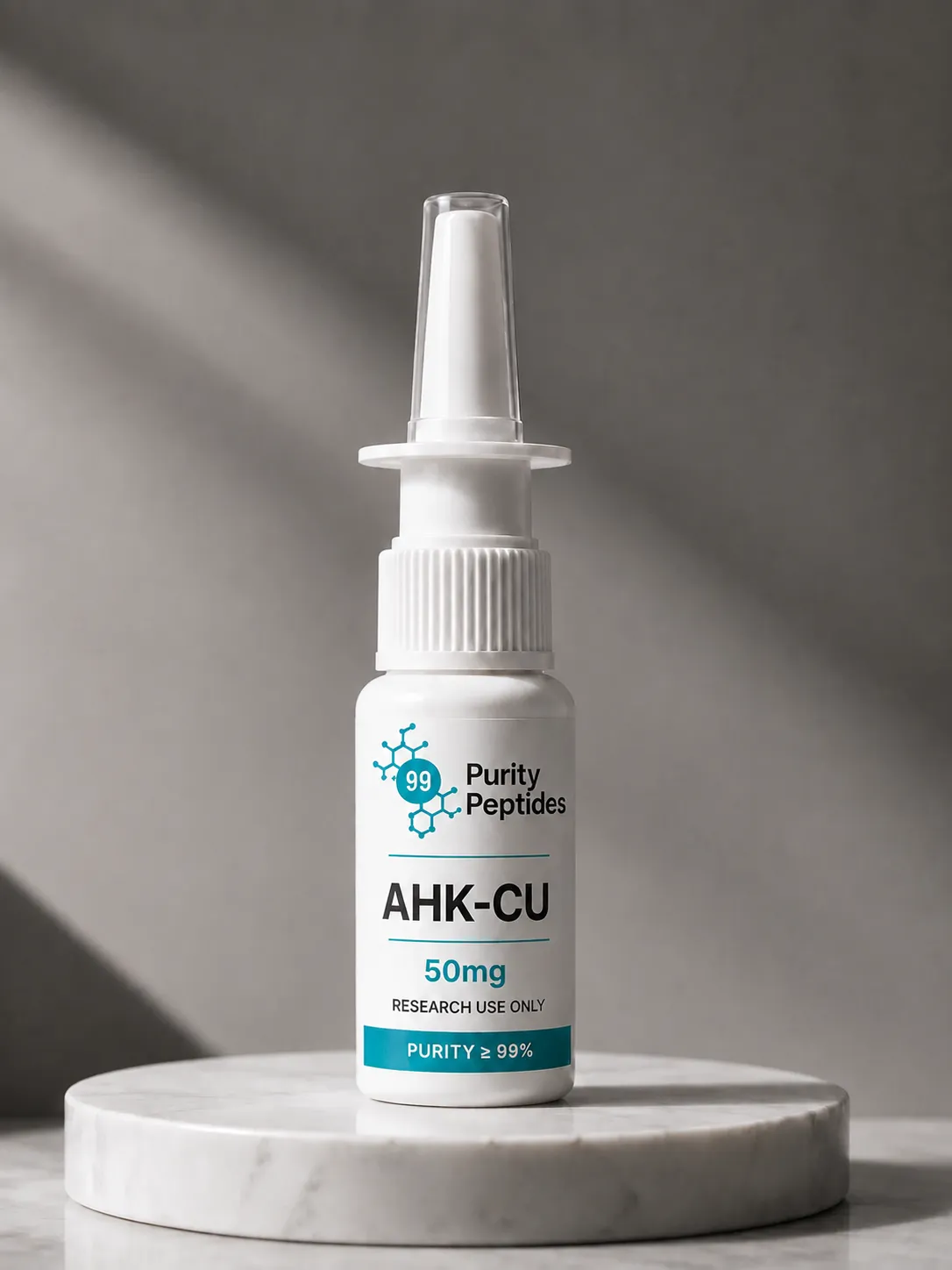
Review the specification and documentation AHK-Cu Nasal Spray 50mg is supplied by 99 Purity Peptides for laboratory research use only. Review the full specification, the lot certificate of analysis, and the wider copper peptide range before selecting material for a study. Not for human or veterinary use. |
Key Takeaways
- AHK-Cu is Ala-His-Lys coordinated to copper(II), registered under the INCI name Copper Tripeptide-3.
- It differs from GHK-Cu (Copper Tripeptide-1) by one residue — alanine in place of glycine — and by a much smaller evidence base.
- Research interest centres on dermal papilla cell proliferation, anagen phase prolongation, VEGF, TGF-beta1, the Bcl-2/Bax ratio, and copper-dependent ECM enzymes including lysyl oxidase.
- Much of the mechanistic framing is extrapolated from GHK-Cu by structural analogy. No AHK-Cu human clinical trial has been published.
- The published literature is topical. No AHK-Cu intranasal pharmacokinetic study exists, though at roughly 416 Da the compound sits inside the favourable molecular weight band for nasal absorption.
- Systemic nasal bioavailability and the nose-to-brain fraction are different measurements and should never be quoted interchangeably.
- Copper peptide solutions are blue. Green indicates a coordination shift; brown indicates oxidation and the material should be discarded.
- HPLC purity and net peptide content answer different questions. Concentration work depends on the second.
- Cumulative copper exposure is a real confounder in repeated or combined copper peptide research.
- All compounds referenced are supplied for research use only and are not for human or veterinary use.
Frequently Asked Questions
What is AHK-Cu?
AHK-Cu is a copper-bound tripeptide composed of alanine, histidine and lysine coordinated to a divalent copper ion. Its INCI name is Copper Tripeptide-3. It is studied in follicular biology and extracellular matrix research models and is supplied for laboratory research use only.
Is AHK-Cu the same as Copper Tripeptide-3?
Yes. Copper Tripeptide-3 is the INCI name for AHK-Cu — the standardised ingredient nomenclature entry for the same compound. AHK-Cu is the sequence-based shorthand used in research and supplier contexts. Both refer to Ala-His-Lys coordinated to copper(II).
What is the difference between AHK-Cu and GHK-Cu?
They differ by one N-terminal residue: AHK-Cu begins with alanine, GHK-Cu with glycine. AHK-Cu is Copper Tripeptide-3 and is studied mainly in hair follicle models. GHK-Cu is Copper Tripeptide-1 and carries a far larger body of published research across wound healing and tissue remodelling.
What is the amino acid sequence of AHK-Cu?
The sequence is Ala-His-Lys — alanine, histidine, lysine — coordinated to a divalent copper ion. In single-letter code it is written A-H-K, which is where the name comes from. The histidine imidazole ring performs most of the copper coordination.
What is the molecular weight of AHK-Cu?
AHK-Cu is reported at approximately 416 Da, with the molecular formula commonly given as C15H24CuN6O4. Confirm both figures against the lot certificate of analysis before relying on them, since supplier sources vary and specification tables should reflect tested material.
Why does AHK-Cu contain copper?
The copper is coordinated to the peptide, not added alongside it. Copper serves as a cofactor for enzymes such as lysyl oxidase and superoxide dismutase, and the chelated form is what makes copper peptides distinct from either free copper or an uncomplexed tripeptide.
What research areas is AHK-Cu studied in?
Reported research areas include follicular biology and dermal papilla cell models, hair follicle elongation in ex vivo culture, extracellular matrix remodelling and collagen crosslinking, fibroblast activation, angiogenic signalling, and coordination chemistry of peptide-metal complexes.
Is AHK-Cu approved for human use?
No. AHK-Cu is supplied strictly for laboratory research use only. It is not approved as a drug, it is not intended for human or veterinary use, and it should not be used for diagnosis, treatment or consumption of any kind.
Has AHK-Cu been tested in human clinical trials?
No published human clinical trial of AHK-Cu is available. The existing evidence comes from cell culture and ex vivo tissue models. Claims implying demonstrated human outcomes are not supported by the published record.
Is there published research on intranasal AHK-Cu?
No. There is no published AHK-Cu intranasal pharmacokinetic dataset. The compound's literature is overwhelmingly topical. Its molecular weight sits in a band associated with favourable nasal absorption, but that is an inference from peptide delivery research, not an AHK-Cu-specific finding.
Why is AHK-Cu supplied as a nasal spray if the literature is topical?
The nasal format reflects commercial supply rather than published research. At roughly 416 Da, AHK-Cu falls within the molecular weight band associated with higher nasal absorption of peptides. No AHK-Cu-specific intranasal study has been published, so route-specific conclusions cannot be drawn.
How should AHK-Cu be stored?
Store lyophilised AHK-Cu frozen, sealed and protected from light. After reconstitution, keep it refrigerated, shielded from light, and never re-freeze it. Copper peptides are light and oxidation sensitive, so amber or violet glass and cold-chain handling are standard.
How long does reconstituted AHK-Cu remain usable?
Reconstituted copper peptides have a considerably shorter working window than lyophilised powder, and the exact period depends on solvent, storage temperature and light exposure. Label every vial with its reconstitution date and treat visible colour change as the endpoint regardless of elapsed time.
Why did my AHK-Cu solution change colour?
A stable copper peptide solution is blue. Green usually indicates a shift in the copper coordination environment, often pH-related. Brown or amber indicates oxidation and degradation. Cloudiness indicates precipitation. Degraded copper peptide cannot be salvaged and should be discarded.
How do I reconstitute a 50mg AHK-Cu vial?
Warm the vial to room temperature, decide the target concentration first, add the calculated solvent volume slowly down the vial wall, swirl gently until dissolved, inspect for clarity and blue colour, then label with lot, solvent, concentration and date before cold storage.
What concentration does 50mg in 5ml give?
Fifty milligrams reconstituted in 5 mL gives 10 mg/mL, which is 1 mg per 0.1 mL. For a pre-filled nasal spray, 50mg describes total bottle content rather than a per-actuation amount; converting to per-spray figures requires the fill volume and metered actuation volume.
What should an AHK-Cu certificate of analysis show?
A complete COA shows compound identity as Copper Tripeptide-3, the lot number, HPLC purity with the chromatogram, net peptide content reported separately, mass spectrometry identity confirmation, molecular formula and weight, appearance and water content, and the accredited testing laboratory with test date.
What is the difference between HPLC purity and net peptide content?
HPLC purity measures what share of the peptide material is the target compound. Net peptide content measures what share of the total vial mass is peptide at all, including counter-ions, salts and residual water. The second figure is always lower and is what concentration calculations depend on.
Can AHK-Cu and GHK-Cu be studied together?
Combined copper peptide work appears in the literature, but two cautions apply: structurally similar analogues make effects difficult to attribute to one compound, and running both raises total copper load in the model. Single-compound control arms alongside the combination address both problems.
What are the known limitations of the AHK-Cu evidence base?
The primary literature is thin, much of the mechanistic framing is extrapolated from GHK-Cu by structural analogy, no human clinical trial exists, cumulative copper exposure is rarely controlled for, and the published route of application is topical rather than intranasal.