Last reviewed: September 2026
Quick Answer
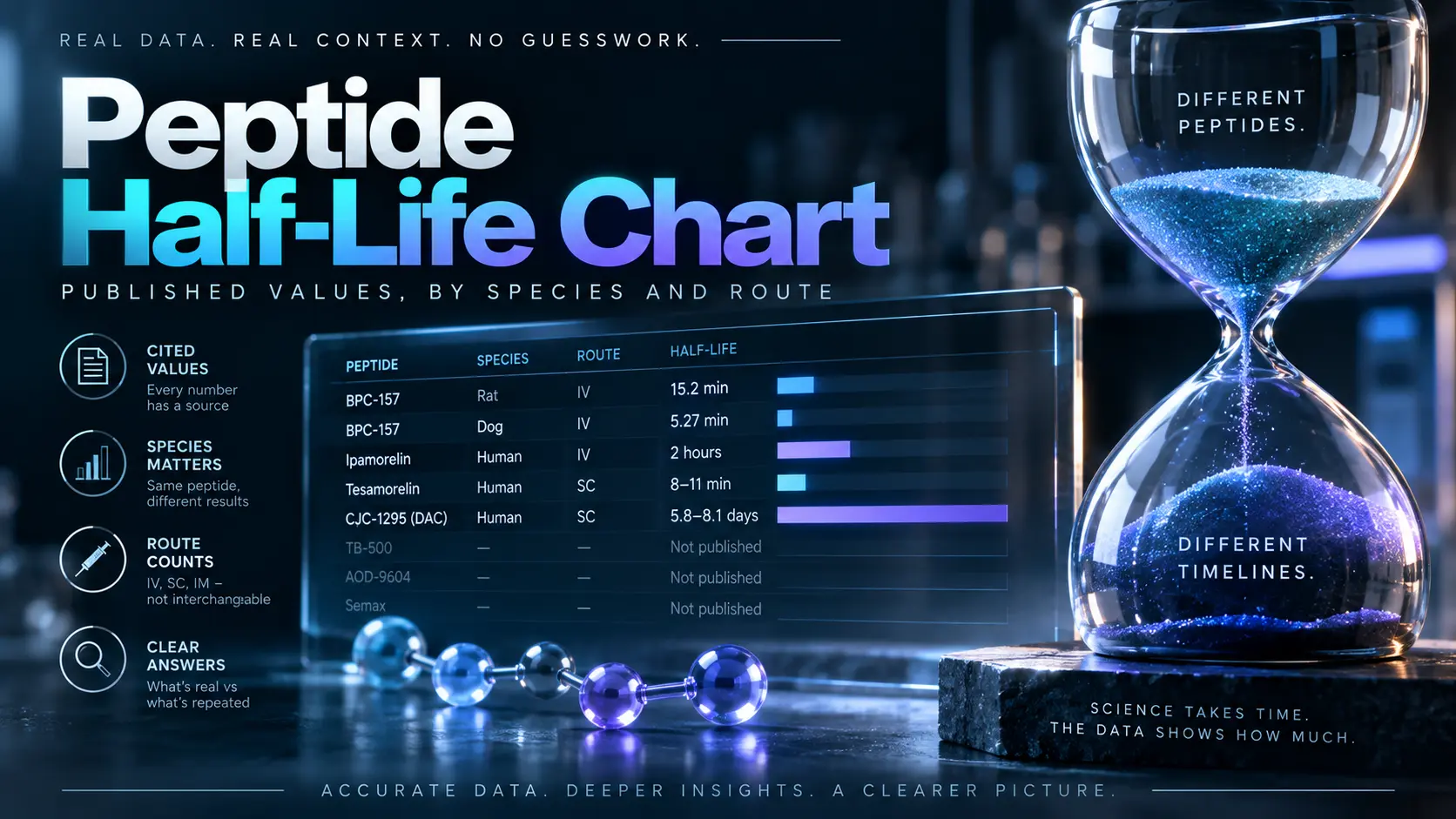
A peptide half-life chart is only useful when every row names the species and the route the number came from, because the same compound clears at different rates in different animals. Published elimination half-lives for the peptides researchers ask about span four orders of magnitude: BPC-157 measures 15.2 minutes after intravenous administration in rats and 5.27 minutes in beagle dogs, while CJC-1295 with DAC measures 5.8 to 8.1 days in humans after subcutaneous injection. Most compounds sold as research peptides have no published human pharmacokinetic study at all. The hour-scale figures that appear on vendor charts for BPC-157, TB-500 and AOD-9604 do not trace back to any primary measurement we could locate.
Key Takeaways
- The only published pharmacokinetic study of BPC-157 reports an elimination half-life under 30 minutes in both rats and beagle dogs, with the parent compound undetectable four hours after administration [1]. No human study exists.
- CJC-1295 with DAC has the longest verified value in this class: 5.8 to 8.1 days in healthy human adults given a single subcutaneous injection [2].
- Ipamorelin does have human pharmacokinetic data, contrary to a common claim that it does not. A 1999 Novo Nordisk dose-escalation study in 40 healthy men reported a terminal half-life of 2 hours after intravenous infusion, clearance of 0.078 L/h/kg and a steady-state volume of distribution of 0.22 L/kg [3].
- Tesamorelin, an FDA-approved growth hormone-releasing factor analog, carries a label half-life of 8 minutes for one formulation and 11 minutes for another, both single-dose values in healthy subjects by subcutaneous injection [4][5]. The 26 and 38 minute figures that circulate elsewhere are also label values, but from the original formulation after 14 consecutive days of dosing, in healthy subjects and HIV-infected patients respectively — multiple-dose numbers, not single-dose ones [6].
- Absorption, not elimination, dominates several of these numbers. Tesamorelin's absolute subcutaneous bioavailability is under 4% [6].
- BPC-157's intramuscular bioavailability was 14 to 19% in rats and 45 to 51% in beagle dogs within the same experiment [1]. Species differences in this class are large enough to change conclusions.
- Plasma half-life is not duration of effect. Omeprazole's plasma half-life is under one hour, yet acid inhibition remains near 50% of maximum at 24 hours and secretory activity takes three to five days to return [8].
- Epitalon, Semax, Selank, DSIP, MOTS-c, KPV, GHK-Cu, HGH fragment 176-191 and IGF-1 LR3 have no published human half-life value we could verify against a primary source.
Research Use Only. Every compound discussed on this page is supplied for laboratory research use only. Nothing here is medical, veterinary, dosing or health advice, and nothing described is intended for human or animal consumption. Study doses are named only where necessary to describe what an experiment measured. They are not recommendations.
What Does Peptide Half-Life Actually Mean?
Plasma half-life is the time taken for the concentration of a compound in plasma to fall by half, measured over the terminal phase of the concentration-time curve. That definition contains a trap worth naming immediately: terminal half-life is the time required to halve the plasma concentration after pseudo-equilibrium has been reached, and it is not the time required to eliminate half the administered dose [9]. Those two things coincide only in a one-compartment system, and almost nothing behaves as a one-compartment system in a living animal.
Most peptides follow first-order kinetics, which means a fixed fraction is removed per unit time rather than a fixed amount. The practical consequence is that clearance is proportional to concentration, and the same half-life applies whether the starting concentration is 10 ng/mL or 1,000 ng/mL. It also means elimination is asymptotic rather than finite. A useful convention holds that roughly 99.9% of a compound has left the body after ten terminal half-lives [9].
Two further distinctions matter and are collapsed on almost every chart currently ranking for this topic.
Terminal half-life (t½,z or t½λz) is the slope of the final log-linear segment of the curve. It is what most published values report.
Effective or operational half-life describes the half-life that actually governs accumulation on repeat administration. These diverge, sometimes badly. Sahin and Benet demonstrated that accumulation at steady state can be markedly over-predicted by terminal half-life, and reported that an apparent multiple-dosing half-life ran significantly shorter than the reported terminal value for eight orally dosed drugs whose terminal half-life exceeded one day [10].
Notation is inconsistent across the literature as well. t1/2, t½, t½β and t½λz are used loosely and are not always the same parameter. Where a source distinguishes them, this page follows the source.
How We Graded the Evidence
Every row in the chart below carries a grade describing what kind of measurement stands behind it.
Grade | What it means | What we required |
|---|---|---|
A | Human pharmacokinetic data | A published human PK study or an FDA-approved product label reporting a half-life in humans |
B | Animal pharmacokinetic data | A peer-reviewed study reporting a measured half-life in a named species by a named route |
C | Cited but unverified | The value appears in reviews or secondary sources, but we could not locate a primary measurement |
— | No published value | No primary measurement located in PubMed, PMC, or an approved product label |
A grade of C is not a claim that a number is wrong. It is a statement that the number could not be traced to anyone who measured it.
Peptide Half-Life Chart: Published Values by Compound
The rule for this table is simple and it is the reason the table is shorter than a competitor's. Where a primary source reports a half-life, the row names the value, the species and the route. Where no primary source could be located, the row says so. No value has been imported from a vendor chart, a supplement retailer, or a database that does not cite its measurement.
Compound | Published half-life | Species | Route | Grade | Source |
|---|---|---|---|---|---|
Growth hormone axis | |||||
CJC-1295 with DAC | 5.8–8.1 days | Human | Subcutaneous | A | [2] |
CJC-1295 without DAC (Mod GRF 1-29) | No published value found | — | — | — | — |
Ipamorelin | 2 h (terminal) | Human (40 healthy men) | IV, 15-min infusion | A | [3] |
GHRP-2 (pralmorelin) | 0.55 ± 0.14 h | Human (10 children) | IV bolus | A | [11] |
GHRP-6 | 2.5 ± 1.1 h (elimination); 7.6 ± 1.9 min (distribution) | Human (9 healthy men) | IV bolus | A | [21] |
Sermorelin (GHRH 1-29) | 11–12 min (reported in a review; primary source not retrieved) | Human | IV | C | [7] |
Tesamorelin | 8 min | Human | Subcutaneous (2 mg/vial formulation) | A | [4] |
Tesamorelin | 11 min | Human | Subcutaneous (11.6 mg/vial formulation) | A | [5] |
HGH fragment 176-191 | No published value found | — | — | — | — |
AOD-9604 | No verified value; "~4 min" widely repeated | — | — | C | See below |
Healing and cytoprotective | |||||
BPC-157 | 15.2 min | Rat | IV, 20 µg/kg | B | [1] |
BPC-157 | 7.87 / 17.1 / 29.7 min (ascending doses) | Rat | Intramuscular | B | [1] |
BPC-157 | 5.27 ± 2.25 min | Beagle dog | IV, 6 µg/kg | B | [1] |
BPC-157 | 20.0 / 25.5 / 29.3 min (ascending doses) | Beagle dog | Intramuscular | B | [1] |
BPC-157 | No published value | Human | — | — | — |
Thymosin β4 | Dose-dependent; no numeric value published | Human (40) | IV, 42–1,260 mg | C | [12] |
TB-500 (as sold) | No published value found | — | — | — | — |
KPV | No published value found | — | — | — | — |
GHK-Cu | No published human value found | — | — | — | — |
Immune and neuro | |||||
Thymosin α1 | No primary source verified | — | — | C | — |
Semax | No published value found | — | — | — | — |
Selank | No published value found | — | — | — | — |
DSIP | No published value found | — | — | — | — |
Epitalon | No published value found | — | — | — | — |
MOTS-c | No published value found | — | — | — | — |
Melanocortin | |||||
Bremelanotide (PT-141) | 2.7 h | Human | Subcutaneous | A | [13] |
Reference comparators | |||||
Somatostatin | A few minutes | Human | — | C (review) | [14] |
Octreotide | 1.5 h | Human | — | C (review) | [14] |
Semaglutide | ~1 week | Human | Subcutaneous | A | [15] |
IGF-1 (free) | 10 min | Human | Endogenous | C (secondary) | [16] |
IGF-1 (IGFBP-3/ALS ternary complex) | >12 h | Human | Endogenous | C (secondary) | [16] |
IGF-1 LR3 | No verified human value | — | — | — | — |
Reading the numbers back out in prose, because tables are hard to quote: BPC-157's elimination half-life is 15.2 minutes in rats by the intravenous route and 5.27 minutes in beagle dogs. CJC-1295 with DAC is 5.8 to 8.1 days in humans by subcutaneous injection. Ipamorelin's terminal half-life is 2 hours in humans after a 15-minute intravenous infusion. GHRP-2's beta-phase half-life is about 33 minutes in children after an intravenous bolus. Sermorelin is 11 to 12 minutes in humans by either intravenous or subcutaneous administration, and tesamorelin is 8 or 11 minutes in humans by subcutaneous injection depending on which formulation the label describes. Bremelanotide is 2.7 hours in humans subcutaneously.
The blanks are the most honest part of this chart. Thirteen of the compounds above have no published half-life value that we could trace to a measurement.
Why Is BPC-157 Listed as Hours Everywhere When the Study Says Minutes?
Because the hour-scale figures were never measured. The single published pharmacokinetic study of BPC-157, a 2022 preclinical program conducted to investigational-new-drug standards at Air Force Medical University, reports an elimination half-life of less than 30 minutes across every dose and both species tested, and states that the parent compound could not be detected four hours after administration [1].
The specific numbers are worth having. In Sprague-Dawley rats given 20 µg/kg intravenously, mean elimination half-life was 15.2 minutes, steady-state volume of distribution 36.4 mL/kg and clearance 50.1 mL/min/kg. In beagle dogs given 6 µg/kg intravenously, half-life was 5.27 ± 2.25 minutes with clearance of 90.8 ± 40.1 mL/min/kg. Intramuscular half-lives rose with dose, from 7.87 minutes at 20 µg/kg to 29.7 minutes at 500 µg/kg in rats, and from 20.0 to 29.3 minutes in dogs. Peak plasma concentration arrived at 3 minutes in rats and between 6.33 and 8.67 minutes in dogs [1].
Competitor charts list BPC-157 at 1 to 4 hours, 4 to 6 hours, or 6 to 8 hours. None of those ranges overlaps the measured data at any dose in either species.
There is a plausible origin for the confusion, and it is instructive. The same study also ran a tritium-labeled arm, following total radioactivity rather than intact BPC-157. Total radioactivity in rat plasma had a half-life of 102 ± 32 hours [1]. That number describes tritium distributed into proline and eventually into tritiated water entering normal amino acid metabolism. One hour after administration, tritiated proline made up 86.65% of plasma radioactivity. Following the label is not following the peptide. Anyone quoting a long half-life for BPC-157 on the strength of a radiolabel study is quoting the metabolic fate of a hydrogen atom.
What the study does not provide is any human data. There is no published human pharmacokinetic study of BPC-157. Any half-life figure presented as a human subcutaneous value is an inference, and it should be labeled as one.
Which Published Half-Life Numbers Have No Source?
Several, and the pattern is consistent: the number is specific enough to sound measured, and it appears without a citation on page after page.
Circulating claim | What the primary literature shows |
|---|---|
BPC-157 "4–6 hours" | Measured value is under 30 min in rats and dogs; no human study exists [1] |
TB-500 "2–3 hours" in one chart, "2–3 days" in another | Neither is cited. The 2010 human study of thymosin β4 describes half-life as increasing with dose and publishes no single value in its abstract [12] |
AOD-9604 "~4 minutes" | No peer-reviewed primary source identified, despite the compound having reached human trials |
Ipamorelin "2–3 hours" | Partly right, wrongly framed. The measured value is 2 hours terminal, in humans, after intravenous infusion, not subcutaneous [3] |
Semaglutide "~160 hours" | The cited source says only "approximately one week"; the hour figure is not in it [15] |
Selank "4–6 minutes IV" | No primary measurement located |
IGF-1 LR3 "lasts longer because it binds IGFBPs less" | Mechanistically backwards, see below |
The ipamorelin entry deserves emphasis, because the correction runs in an unusual direction. It is sometimes asserted that ipamorelin has no published pharmacokinetic data and that the "2 to 3 hours" figure is invented. That assertion is wrong. Gobburu and colleagues published a dose-escalation pharmacokinetic and pharmacodynamic study in Pharmaceutical Research in 1999: forty healthy male volunteers, eight per dose level, five 15-minute intravenous infusions spanning a 33-fold dose range, with dose-proportional kinetics, a terminal half-life of 2 hours, clearance of 0.078 L/h/kg and a steady-state volume of distribution of 0.22 L/kg [3]. Growth hormone peaked at 0.67 hours and declined exponentially. The number circulating on vendor charts is roughly correct and almost always mislabeled as a subcutaneous value.
The IGF-1 LR3 claim is the one worth correcting hardest, because it inverts the biology. Native IGF-1's long circulating presence comes from binding, not from escaping it. Free IGF-1 has a half-life of about 10 minutes, while in the 150 kDa ternary complex with IGFBP-3 and the acid-labile subunit it exceeds 12 hours [16]. Reduced binding-protein affinity should shorten circulating half-life, not extend it. Until someone publishes a measured value for IGF-1 LR3, that row stays blank. The comparison between analogs is covered on our IGF-1 LR3 vs IGF-1 DES page.
Why Do Peptides Clear So Quickly?
Two mechanisms, working simultaneously and reinforcing each other.
The first is proteolysis. Blood, liver and kidney carry a full complement of endo- and exopeptidases, and an unmodified linear peptide presents free N- and C-termini to aminopeptidases and carboxypeptidases as soon as it enters circulation [14]. Cleavage specificity is not random. Dipeptidyl peptidase-4 removes the first two residues from substrates with the right N-terminal pattern, which is why growth hormone-releasing hormone analogs are cleaved between Ala2 and Asp3 and why protecting that end of the molecule is a common first move in GHRH analog design. Tesamorelin takes a different route to the same end, carrying an acyl group on the N-terminal tyrosine rather than a substitution at position 2.
The second is renal filtration. Glomerular pores measure approximately 8 nm, and hydrophilic peptides with molecular weights below roughly 2 to 25 kDa are subject to rapid filtration [18]. Almost everything on the chart above sits inside that window. BPC-157 has a molecular weight of 1,419 Da [1]. Thymosin β4 is around 5 kDa. Sermorelin and tesamorelin are roughly 3.3 and 5.1 kDa. None of them is large enough to be retained by size alone.
The BPC-157 metabolite data shows the two mechanisms in sequence. Intact BPC-157 was the dominant plasma radioactive species at 3 minutes; within the next seven minutes it had been cut into a series of smaller fragments, and by one hour free proline accounted for 86.65% of plasma radioactivity [1]. Urinary excretion was the dominant elimination route, with bile secondary.
This is a distinct subject from what happens to a peptide sitting in a vial. Degradation in solution follows different chemistry on a different timescale, and it is covered separately in our guide to telling whether peptides have gone bad and in the peptide storage guidelines. A compound can be perfectly stable in a freezer for a year and gone from plasma in fifteen minutes. The two facts are unrelated.
How Is a Peptide's Half-Life Extended?
Every long half-life on the chart above is engineered. None of it is native behavior.
Strategy | Mechanism | Worked example |
|---|---|---|
Albumin binding | Ties the peptide to a 67 kDa carrier that is too large to filter and is recycled rather than degraded | CJC-1295 with DAC: 5.8–8.1 days in humans [2] |
FcRn recycling | Salvages albumin and IgG from endosomal degradation, returning them to circulation | Basis of Fc-fusion half-life extension [19] |
D-amino acid substitution and shortening | Removes recognisable protease cleavage sites | Octreotide at 1.5 h versus somatostatin at a few minutes [14] |
Cyclisation and C-terminal amidation | Eliminates free termini that exopeptidases attack | Widely applied across the peptide drug class [14] |
PEGylation | Increases hydrodynamic volume above the filtration threshold | A PEG 40 kDa interferon conjugate showed a 330-fold prolongation [14] |
DPP-4-resistant substitution | Blocks the specific N-terminal cleavage | Position 2 substitution in GHRH analogs [17] |
Albumin binding is the mechanism responsible for the single largest jump on the chart. Albumin and IgG fragments have half-lives of 19 to 21 days in humans, a consequence of their molecular weight of 67 to 150 kDa and their binding to the neonatal Fc receptor, which rescues them from pinocytotic degradation [18]. Attaching a peptide covalently to that system borrows its clearance profile.
CJC-1295 with DAC is the cleanest worked example available. The drug affinity complex is a maleimide group, which forms a covalent bond with albumin after injection. In two randomized, placebo-controlled, double-blind ascending-dose trials in healthy adults aged 21 to 61, a single subcutaneous injection produced an estimated half-life of 5.8 to 8.1 days, with mean plasma growth hormone elevated two- to tenfold for six days or more and IGF-1 elevated 1.5- to threefold for 9 to 11 days [2]. Remove the DAC and the same tetrasubstituted GHRH fragment loses the tether entirely. The structural difference between the two forms is covered in CJC-1295 no DAC vs with DAC, and the comparison with the unmodified 1-29 fragment in sermorelin vs CJC-1295.
The magnitude is worth stating plainly: the same peptide backbone goes from a molecule nobody has published a value for to one measured in days, on the strength of one covalent linkage.
Does a Longer Half-Life Mean a Longer Effect?
No, and this is the single most consequential error on every chart currently ranking for this query.
Plasma half-life describes how long a molecule persists in blood. Duration of effect describes how long a biological response persists. They are related through the binding kinetics at the target, and when binding is covalent or the downstream response is slow to reverse, they decouple completely.
Proton pump inhibitors give the cleanest demonstration, because the numbers are in an FDA label. Omeprazole's plasma half-life is under one hour. Its antisecretory effect reaches maximum within two hours, remains at about 50% of maximum at 24 hours, and lasts up to 72 hours; when treatment stops, secretory activity returns gradually over three to five days [8]. Shin and Sachs put the mechanism directly: because these compounds bind covalently to cysteines on the gastric H,K-ATPase, their inhibitory effects last much longer than their plasma half-life [20]. The drug is long gone. The enzyme is still inhibited.
Peptides show the same decoupling for a different reason. A secretagogue that clears in two hours can trigger a hormone pulse whose downstream consequences run for days. Teichman's CJC-1295 data illustrates this within a single trial: the peptide's half-life was 5.8 to 8.1 days, but IGF-1 remained elevated for 9 to 11 days after one injection and stayed above baseline for up to 28 days after multiple injections [2]. The IGF-1 response outran even the long half-life that produced it.
The general point: a half-life tells you about the molecule. It tells you nothing about the receptor's residence time, nothing about how long a transcriptional response takes to decay, and nothing about whether a covalent bond was formed. Any chart that pairs a half-life column with a "dose this often" column is asserting a relationship it has not demonstrated.
Does Route Change the Half-Life?
Route does not change how fast the body eliminates a compound. It can change the number you measure and call the half-life, which is a different thing and is the source of most cross-chart disagreement.
Intravenous administration is the only route that measures elimination cleanly, because the entire dose enters circulation at once and nothing about absorption contaminates the terminal slope. Every other route introduces an absorption process running in parallel.
Subcutaneous and intramuscular administration create a depot. The peptide leaves that depot at a rate set by local blood flow, tissue binding and local protease activity, and a meaningful fraction never reaches circulation at all. Bioavailability figures for this class are low and highly variable. Tesamorelin's absolute subcutaneous bioavailability is under 4% [6]. BPC-157's intramuscular bioavailability was 14 to 19% in rats and 45 to 51% in dogs [1].
That last pair is worth sitting with. Same peptide, same study, same protocol, roughly a threefold difference in how much reached circulation, purely on species.
Intranasal delivery adds another absorption barrier and its own set of enzymes, along with the possibility of direct nose-to-brain transport that plasma sampling will not detect at all. That subject has its own treatment in the intranasal peptide delivery research guide.
When absorption is slower than elimination, the terminal slope stops reflecting elimination and starts reflecting absorption. This is flip-flop pharmacokinetics [9], and it means a depot formulation can show a long apparent half-life while the molecule itself is cleared as fast as it ever was.
What Terminal Half-Life Does Not Tell You
Three things, each of which is routinely assumed.
It does not tell you how long half the dose takes to leave the body. Terminal half-life is the time to halve the plasma concentration after pseudo-equilibrium, which is not the same quantity [9].
It does not reliably predict accumulation. Sahin and Benet showed that terminal half-life can markedly over-predict steady-state accumulation, and that an apparent multiple-dosing half-life, derived from peak and trough ratios, ran significantly shorter than the reported terminal value for eight orally dosed drugs whose terminal half-life exceeded one day [10].
It does not always describe elimination. Under flip-flop conditions, the terminal phase reflects the rate and extent of absorption instead [9]. For any depot or long-acting format, that possibility has to be excluded before the number means what it appears to mean.
There is a fourth item specific to peptides. If the assay measures a radiolabel rather than the intact molecule, the reported half-life describes the label's fate. BPC-157 is the worked example: 15.2 minutes for the parent compound, 102 hours for total radioactivity, in the same animals [1].
What the Published Record Does Not Establish
Most of it. That is the honest summary, and stating it is more useful than filling the gaps.
Of the compounds on this page, human pharmacokinetic data exists for CJC-1295 with DAC, ipamorelin, GHRP-2, sermorelin, tesamorelin, bremelanotide, semaglutide, octreotide and thymosin β4 in qualitative form. That is ten, counting GHRP-6. For BPC-157 the only data is preclinical. For Epitalon, Semax, Selank, DSIP, MOTS-c, KPV, GHK-Cu, HGH fragment 176-191, GHRP-6, CJC-1295 without DAC and IGF-1 LR3, we located no published half-life value in any species that we could verify against a primary source.
Several further limits apply to the values that do exist. The GHRP-2 figure comes from ten prepubertal children with short stature, not adults [11]. The ipamorelin figure comes from forty healthy men receiving intravenous infusions, which is not the route researchers typically model [3]. The BPC-157 figures come from a single research group at a single institution, published in 2022, with no independent replication. Where primary literature is old, small, from one group, or in a population that differs from the one being reasoned about, that limitation travels with the number.
None of these compounds is approved by the FDA for any indication other than tesamorelin, bremelanotide, semaglutide and octreotide, and the approved uses of those four have no bearing on what an unapproved compound does. Pharmacokinetic data describes where a molecule goes. It establishes nothing about whether it works.
Where to Read Next
Terminology used on this page, including t½, AUC, Cmax, Tmax, volume of distribution and clearance, is defined in the research peptide glossary. If you are new to the category itself, start with what are research peptides.
For the separate question of how compounds behave in the vial rather than in plasma, see the peptide storage guidelines and the guide to recognising degraded material. Lot-specific analytical documentation, including purity and identity data, accompanies research material and is the correct place to check what a given vial actually contains.
References
- He L, Feng D, Guo H, et al. Pharmacokinetics, distribution, metabolism, and excretion of body-protective compound 157, a potential drug for treating various wounds, in rats and dogs. Front Pharmacol. 2022;13:1026182. PMID 36588717. https://pmc.ncbi.nlm.nih.gov/articles/PMC9794587/
- Teichman SL, Neale A, Lawrence B, et al. Prolonged stimulation of growth hormone (GH) and insulin-like growth factor I secretion by CJC-1295, a long-acting analog of GH-releasing hormone, in healthy adults. J Clin Endocrinol Metab. 2006;91(3):799-805. PMID 16352683. https://pubmed.ncbi.nlm.nih.gov/16352683/
- Gobburu JVS, Agersø H, Jusko WJ, et al. Pharmacokinetic-pharmacodynamic modeling of ipamorelin, a growth hormone releasing peptide, in human volunteers. Pharm Res. 1999;16(9):1412-1416. PMID 10496658. https://link.springer.com/article/10.1023/A:1018955126402
- US Food and Drug Administration. EGRIFTA SV (tesamorelin for injection) prescribing information, section 12.3. https://dailymed.nlm.nih.gov/dailymed/drugInfo.cfm?setid=3d783378-b02d-4f19-99dd-0fc91a042224
- US Food and Drug Administration. EGRIFTA WR (tesamorelin for injection) prescribing information, section 12.3. https://dailymed.nlm.nih.gov/dailymed/drugInfo.cfm?setid=839334d3-8c1d-4c26-9036-2ab524a6ea75
- US Food and Drug Administration. EGRIFTA (tesamorelin for injection) prescribing information, 2010. https://www.accessdata.fda.gov/drugsatfda_docs/label/2010/022505s000lbl.pdf
- Ishida J, Saitoh M, Ebner N, et al. Growth hormone secretagogues: history, mechanism of action, and clinical development. JCSM Rapid Commun. 2020;3(1):25-37. https://onlinelibrary.wiley.com/doi/full/10.1002/rco2.9
- US Food and Drug Administration. PRILOSEC (omeprazole) delayed-release capsules prescribing information, Antisecretory Activity section, NDA 19-810/S-085. https://www.accessdata.fda.gov/drugsatfda_docs/label/2007/019810s085lbl.pdf
- Toutain PL, Bousquet-Mélou A. Plasma terminal half-life. J Vet Pharmacol Ther. 2004;27(6):427-439. PMID 15601438. https://pubmed.ncbi.nlm.nih.gov/15601438/
- Sahin S, Benet LZ. The operational multiple dosing half-life: a key to defining drug accumulation in patients and to designing extended release dosage forms. Pharm Res. 2008;25(12):2869-2877. PMID 19015955. https://pubmed.ncbi.nlm.nih.gov/19015955/
- Pihoker C, Kearns GL, French D, et al. Pharmacokinetics and pharmacodynamics of growth hormone-releasing peptide-2: a phase I study in children. J Clin Endocrinol Metab. 1998;83(4):1168-1172. PMID 9543135. https://pubmed.ncbi.nlm.nih.gov/9543135/
- Ruff D, Crockford D, Girardi G, et al. A randomized, placebo-controlled, single and multiple dose study of intravenous thymosin β4 in healthy volunteers. Ann N Y Acad Sci. 2010;1194:223-229. https://nyaspubs.onlinelibrary.wiley.com/doi/abs/10.1111/j.1749-6632.2010.05474.x
- US Food and Drug Administration. VYLEESI (bremelanotide injection) prescribing information, 2019. https://www.accessdata.fda.gov/drugsatfda_docs/label/2019/210557s000lbl.pdf
- Werle M, Bernkop-Schnürch A. Strategies to improve plasma half life time of peptide and protein drugs. Amino Acids. 2006;30(4):351-367. PMID 16622600. https://link.springer.com/article/10.1007/s00726-005-0289-3
- Australian Prescriber. Semaglutide for type 2 diabetes. Aust Prescr. 2020;43(4):136-137. https://www.ncbi.nlm.nih.gov/pmc/articles/PMC7450779/
- Poyrazoğlu Ş, Hwa V, Baş F, et al. A novel homozygous mutation of the acid-labile subunit (IGFALS) gene in a male adolescent. J Clin Res Pediatr Endocrinol. 2019;11(4):432-438. PMID 30717585. https://pmc.ncbi.nlm.nih.gov/articles/PMC6878349/
- Deacon CF. Peptide degradation and the role of DPP-4 inhibitors in the treatment of type 2 diabetes. Peptides. 2018;100:150-157. PMID 29412814. https://pubmed.ncbi.nlm.nih.gov/29412814/
- Di L. Strategic approaches to optimizing peptide ADME properties. AAPS J. 2015;17(1):134-143. PMID 25366889. https://pubmed.ncbi.nlm.nih.gov/25366889/
- Kontermann RE. Half-life extended biotherapeutics. Expert Opin Biol Ther. 2016;16(7):903-915. PMID 26967759. https://pubmed.ncbi.nlm.nih.gov/26967759/
- Shin JM, Sachs G. Pharmacology of proton pump inhibitors. Curr Gastroenterol Rep. 2008;10(6):528-534. PMID 19006606. https://pubmed.ncbi.nlm.nih.gov/19006606/
- Cabrales A, Gil J, Fernández E, et al. Pharmacokinetic study of growth hormone-releasing peptide 6 (GHRP-6) in nine male healthy volunteers. Eur J Pharm Sci. 2013;48(1-2):40-46. PMID 23099431. https://pubmed.ncbi.nlm.nih.gov/23099431/
Frequently Asked Questions
What is a peptide's half-life?
It is the time taken for the concentration of that peptide in plasma to fall by half, measured during the terminal phase after administration. For most peptides the process is first-order, so a constant fraction is removed per unit time rather than a constant amount. The value is meaningless without knowing the species it was measured in and the route the compound was given by, because both change the number.
How is peptide half-life measured?
By giving a known dose, drawing serial blood samples over time, quantifying the intact peptide in plasma, and fitting the concentration-time curve. Quantification is usually by validated LC-MS/MS or radioimmunoassay. Intravenous administration gives the cleanest measurement because the full dose enters circulation at once. Assays that track a radiolabel rather than the intact molecule measure the label's fate, not the peptide's.
Why do some peptides last minutes and others days?
Unmodified peptides are attacked by circulating proteases and filtered by the kidney, where glomerular pores of roughly 8 nm let small hydrophilic peptides through quickly. Peptides that last days have been engineered to avoid both: covalent albumin binding, PEGylation, cyclisation, D-amino acid substitution or protease-resistant residue swaps. No native research peptide has a half-life measured in days.
What is the half-life of BPC-157?
Under 30 minutes in every published measurement. In rats it was 15.2 minutes intravenously and 7.87 to 29.7 minutes intramuscularly across ascending doses. In beagle dogs it was 5.27 minutes intravenously and 20.0 to 29.3 minutes intramuscularly. The parent compound was undetectable four hours after administration. Charts listing BPC-157 at four to eight hours do not match any measured value.
Is there human pharmacokinetic data for BPC-157?
No. The only published pharmacokinetic study of BPC-157 was conducted in Sprague-Dawley rats and beagle dogs and was published in 2022. No human pharmacokinetic study has been published. Any half-life figure presented as a human subcutaneous value for BPC-157 is an extrapolation from animal data, and the two species in that study already differed substantially from each other.
What is the half-life of CJC-1295 with DAC?
5.8 to 8.1 days in healthy human adults after a single subcutaneous injection, from two randomized placebo-controlled ascending-dose trials published in 2006. The same trials found growth hormone elevated two- to tenfold for six days or more and IGF-1 elevated for 9 to 11 days after one injection. This is the longest verified half-life among the compounds commonly grouped as research peptides.
Why does DAC extend the half-life?
The drug affinity complex is a reactive group that forms a covalent bond with circulating albumin after injection. Albumin is 67 kDa, far above the glomerular filtration threshold, and its own half-life in humans is 19 to 21 days because the neonatal Fc receptor rescues it from degradation. Tethering the peptide to albumin means it inherits albumin's clearance behavior instead of its own.
Does a longer half-life mean a stronger effect?
No. Half-life describes how long the molecule stays in plasma, not how strongly it binds its target or how large a response it produces. Potency, receptor affinity and efficacy are separate properties measured separately. A compound with a two-hour half-life can produce a larger response than one with a two-day half-life, and frequently does.
Does the route of administration change the half-life?
Route does not change elimination, but it changes the number you measure. After subcutaneous or intramuscular injection the compound leaves a tissue depot slowly, and if absorption is slower than elimination the terminal slope reflects absorption instead. This is flip-flop kinetics. Route also changes how much reaches circulation at all: tesamorelin's subcutaneous bioavailability is under 4%.
How long do peptides stay in your system?
For the parent compound, roughly ten half-lives removes about 99.9% of it. For a peptide with a 15-minute half-life that is around two and a half hours; for one with a seven-day half-life it is around ten weeks. Metabolites are a separate question and can persist far longer, since amino acid fragments enter normal metabolic pools rather than being excreted intact.
What is the difference between terminal and effective half-life?
Terminal half-life is the slope of the final segment of the concentration-time curve and is what most publications report. Effective or operational half-life describes what actually governs accumulation when a compound is given repeatedly. Published work has shown that terminal half-life can markedly over-predict steady-state accumulation, so the two values can differ substantially for the same compound.
Why do vendor half-life charts disagree with each other?
Because most of them copy each other rather than the literature, and because the underlying values genuinely differ by species, route and assay. A figure measured intravenously in rats and a figure inferred for subcutaneous use in humans are not comparable, but charts rarely say which they are quoting. When a chart omits species and route, disagreement between charts is unresolvable by design.
Are rodent half-life values valid for humans?
Not by default. Rodents have higher mass-specific clearance and shorter half-lives than humans for most compounds, and protease profiles differ between species. The BPC-157 study makes the point within its own data: intramuscular bioavailability was 14 to 19% in rats and 45 to 51% in beagle dogs. If two non-human species differ that much, extrapolating either to humans is guesswork.
What does steady state mean?
Steady state is the condition where the amount entering circulation over a dosing interval equals the amount cleared, so peak and trough concentrations stop changing between intervals. It is approached after roughly four to five half-lives of repeated administration. It is a pharmacokinetic description of concentration behavior, not a statement that any biological effect has stabilised.
Does the effect stop when the peptide has cleared?
Often not. Omeprazole has a plasma half-life under one hour, yet acid inhibition remains near half of maximum at 24 hours and takes three to five days to fully reverse, because the drug binds its target covalently. Peptides decouple for a related reason: a signal that triggers hormone release or a transcriptional change sets off a cascade that outlasts the molecule that started it.