Last reviewed: September 2026
Quick Answer
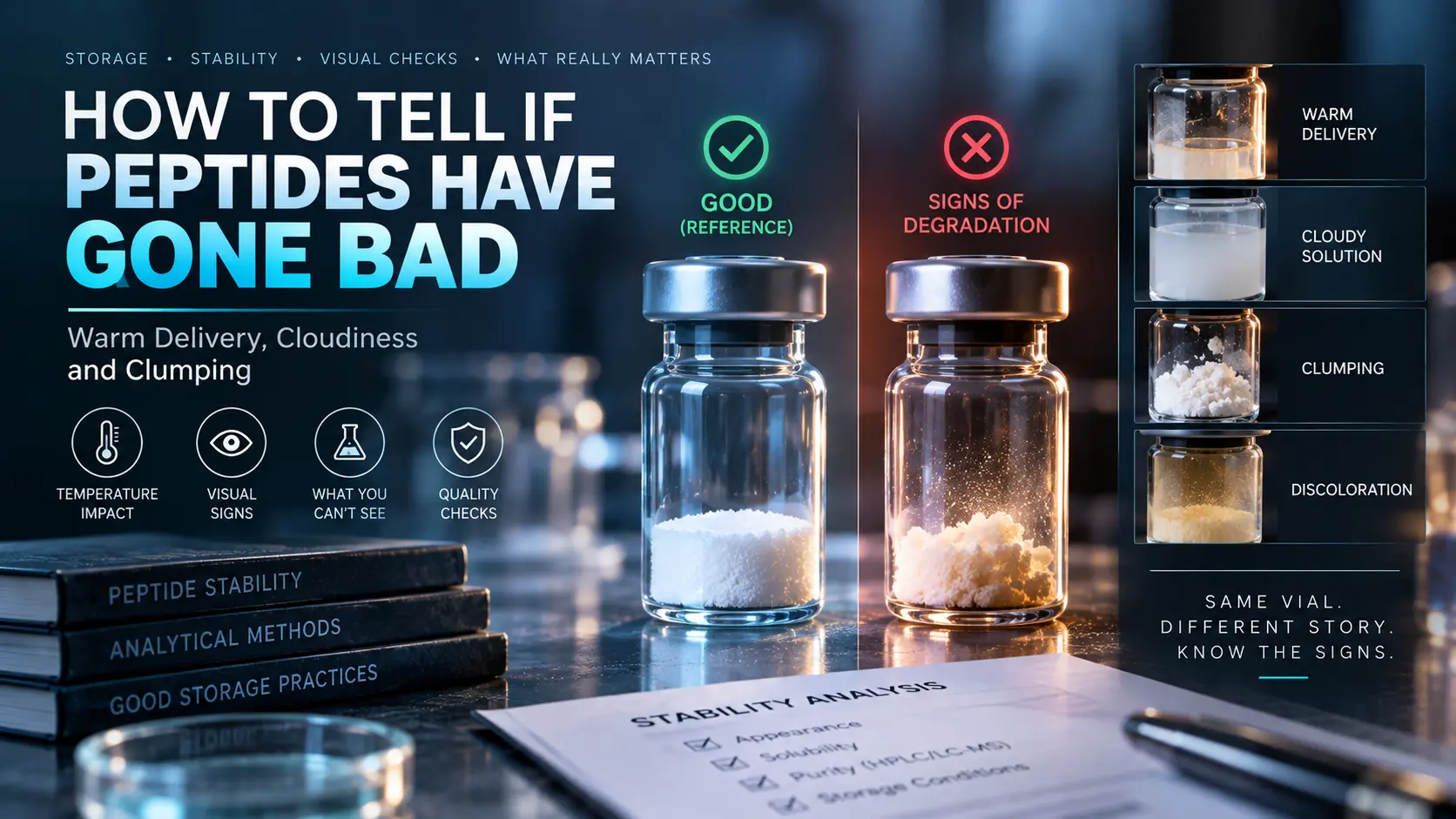
How to tell if peptides have gone bad begins with separating what you can see from what you can only measure. A sealed lyophilised vial that arrived warm is very unlikely to be compromised, because solid-state degradation needs water and molecular mobility, and peptide manufacturers ship dry material at ambient temperature as routine practice [2]. The findings that genuinely warrant stopping are a loose or damaged crimp, a cake that has gone sticky, syrupy or discoloured, and a solution that will not clarify. Nothing visible rules out the two commonest chemical changes, since deamidation shifts mass by only 0.984 Da [3] and oxidation by 16 Da, so only HPLC or LC-MS against the lot certificate answers the purity question.
Key Takeaways
- Deamidation adds 0.984 Da [3] and oxidation adds 16 Da to a peptide's mass. Neither is visible, and neither changes how a solution looks.
- ICH Q1A(R2) treats 40 °C / 75% relative humidity as an accelerated stability condition and states explicitly that accelerated data can be used to evaluate short-term excursions such as those during shipping [4].
- A 2026 solid-state study of semaglutide found the peptide held its native conformation up to 60 °C, but α-helical content still fell from 49.07% to 43.75% at that temperature and collapsed to roughly 0.2% at 80 °C, with temperature-dependent impurity formation detected by LC-HRMS [5].
- Water acts as a plasticiser in amorphous solids, lowering the glass transition temperature and raising molecular mobility, which is why moisture is at least as important as temperature in solid-state degradation, and the two interact [6].
- Moisture-induced aggregation of lyophilised insulin tracked water uptake by the powder rather than storage temperature in isolation [7].
- A model hexapeptide containing an Asn-Gly sequence deamidated with a half-life of about 1.4 days at 37 °C and pH 7.4 in solution. Replacing the glycine slowed the reaction 33- to 50-fold [8].
- Bachem states that peptides containing Asn, Gln, Met, Cys or Trp have limited shelf lives, and that peptides may be shipped at ambient temperature [2].
- FDA describes visual detection of particulates as a probabilistic process, not a pass/fail test [9].
Research Use Only
Everything sold by 99 Purity Peptides is supplied strictly for laboratory research use. It is not a drug, supplement, cosmetic or food, and it is not for human or veterinary consumption. This article is a laboratory quality-control guide. It contains no medical, dosing or health advice, and no instructions for preparing material for administration to any person or animal.
How We Graded the Evidence
Three tiers run through this article. Direct evidence means published measurements on peptides in the solid or solution state, with the conditions stated. Read-across means measurements on proteins or on a different peptide, where the chemistry is shared but the compound is not, and every read-across is labelled as such in the text. Mechanism means a well-established chemical pathway with no compound-specific number attached. Where a claim circulating online has no traceable source at all, we say so rather than repeat it with a hedge.
My Peptides Arrived Warm — Are They Ruined?
Almost certainly not, if what arrived was sealed dry powder. Chemical reactions in the solid state proceed far more slowly than the same reactions in solution, because many of the reactions that destroy peptides are hydrolytic or otherwise moisture-dependent, and need enough molecular mobility to proceed [1]. A lyophilised cake sitting in a sealed vial has very little of either. Bachem's published handling guidance states directly that peptides may be shipped at ambient temperature, and recommends deep-frozen conditions for long-term storage rather than for transit [2].
Two claims dominate this topic online and both are wrong. The first is that heat ruins peptides, which ignores the solid-state chemistry entirely. The second is the overcorrection: that a dry peptide is completely safe no matter how hot the package got. Neither survives contact with the stability literature.
For a real yardstick, use the conditions that regulators actually defined. ICH Q1A(R2) sets out the temperature and humidity combinations used for formal stability testing, and says in its own text that accelerated data can be used to evaluate the effect of short-term excursions such as those occurring during shipping [4].
ICH Q1A(R2) condition | Temperature / humidity | What it is used for |
|---|---|---|
Long-term | 25 °C ± 2 °C / 60% RH ± 5%, or 30 °C ± 2 °C / 65% RH ± 5% | Establishing shelf life and label storage statements |
Intermediate | 30 °C ± 2 °C / 65% RH ± 5% | Used when significant change occurs at accelerated conditions, and only when long-term testing is run at 25 °C / 60% RH. If 30 °C / 65% RH is the long-term condition, there is no intermediate condition |
Accelerated | 40 °C ± 2 °C / 75% RH ± 5% | Predicting longer-term behaviour and evaluating short excursions, including shipping |
A parcel that sat in a delivery van for an afternoon sits inside the range that ICH built accelerated testing to model. That is the honest framing, and it is more useful than a reassuring adjective.
Structure retained is not purity retained, though, and the headline finding of a recent paper on this is easy to over-read. A 2026 solid-state study of semaglutide did report that the native α-helical conformation was retained up to 60 °C. It also reported that α-helical content fell from 49.07% to 43.75% at 60 °C and to roughly 0.2% at 80 °C, that the material remained amorphous under all conditions tested, with a glass transition of 169 °C resolved only by modulated DSC, and that RP-HPLC and LC-HRMS showed temperature-dependent degradation and impurity formation [5]. Two limits matter when reading across from it. The abstract describes solid semaglutide with no excipients, not a research vial with excipients and residual moisture. And it tested one lipidated 31-residue peptide, which tells you nothing specific about a four-residue tetrapeptide.
As for a parcel that did not arrive on ice: lyophilised peptides are routinely shipped at ambient temperature across the industry, and Bachem's handling guidance says so directly [2]. What matters on arrival is whether the vial is sealed and the powder is dry. If anything about a delivery concerns you, note the lot number from the vial label and contact the supplier. For storage once material is in your hands, the peptide storage guidelines cover conditions in detail.
What Should a Healthy Lyophilised Vial Look Like?
A healthy vial looks less impressive than most people expect. A few milligrams of lyophilised powder in a vial much larger than it is a small quantity of very low-density solid, so a thin film, a loose scatter of white flakes, or what looks like an almost empty vial is normal rather than alarming. Lyophilised cakes are mechanically fragile amorphous solids and they break. A cake that travelled 2,000 miles and arrived as powder rather than a neat puck has usually just been shaken.
Observation | Normal variation | Genuine warning sign |
|---|---|---|
Cake integrity | Crumbled, cracked, or shifted to one side after transit | Shrunken and pulled away from the glass, or glassy and fused |
Appearance of the solid | Flat white to off-white; visually "almost empty" vial | Yellow, brown, grey or patchy discolouration |
Texture | Dry and free-moving when tilted | Sticky, tacky, or adhering to the wall in a wet-looking smear |
Closure | Seated crimp, intact septum, no puncture marks | Loose crimp, lifted or dented seal, visible septum puncture |
Vial body | Minor scuffs on the outer glass | Cracks, chips, or any breach of the glass |
The colour column carries an exception worth naming. Copper-complexed peptides such as GHK-Cu are intrinsically blue, and that colour is the compound rather than a defect.
Why Is the Powder Clumped, Shrunken or Glassy?
Clumping, shrinkage and a glassy appearance almost always mean the cake has taken on water. Peptides are hygroscopic, which is why Bachem's guidance instructs users to let a container reach ambient temperature in a desiccator before opening it, so that atmospheric moisture does not condense onto cold solid [2]. Skipping that step is a common cause of a clumped vial.
The mechanism is well characterised. Water acts as a plasticiser in amorphous solids, lowering the glass transition temperature and increasing molecular mobility, so a cake that has absorbed moisture becomes chemically livelier at any given temperature than a dry one [6]. In lyophilised insulin, moisture-induced aggregation tracked the amount of water the powder took up [7]. In a lyophilised model hexapeptide, degradation at an aspartyl residue was governed by residual moisture content alongside temperature [10]. Taken together, moisture is at least as important as temperature, and the two interact, although in the hexapeptide study the type of bulking agent was the largest single factor [10].
A cake that has collapsed, pulled away from the glass, or gone visibly glassy has passed through its glass transition, which for a moisture-laden lyophilisate can be far below the 169 °C measured for excipient-free semaglutide powder [5]. That is a physical change you can see, and it is a reasonable trigger to stop and ask the supplier for the lot certificate before using the vial.
A loose or lifted crimp deserves separate treatment. It looks cosmetic and is not. The seal is what keeps oxygen and water vapour away from the solid, and once it is compromised that protection is gone regardless of how the powder looks. Set that vial aside. The research peptide storage best practices guide covers the handling side of this in more depth.
Why Is My Peptide Solution Cloudy?
Most cloudy peptide solutions are not degraded and not contaminated. They are suspensions. Sigma-Aldrich's peptide handling guidance is blunt about this: material that remains cloudy, gelled or particulate after sonication has not dissolved, and the correct reading is that the peptide is suspended rather than in solution [11]. That single distinction resolves a large share of "peptide cloudy after mixing" queries.
Four physical factors drive the rest, and they interact. Solubility falls sharply when the solution pH sits near the peptide's isoelectric point, where net charge approaches zero and electrostatic repulsion between molecules is lost. Concentration matters, because aggregation is concentration-dependent. Ionic strength matters, because added salt screens charges and can either help or hurt depending on the peptide. And sequence matters, because hydrophobic and β-sheet-prone sequences aggregate readily. These are the factors identified as governing physical stability and aggregation in peptide therapeutics [12], and the same variables recur in the broader literature on aggregation in aqueous protein solutions [16]. Gelation is the extreme end of the same phenomenon: an aggregated network rather than a discrete precipitate.
Preservative chemistry is the one area where the honest answer is that the peptide-specific data does not exist. Benzyl alcohol has documented aggregation-promoting effects on several proteins. It induced aggregation of recombinant human interleukin-1 receptor antagonist by shifting conformational equilibrium [13], caused pH-dependent aggregation of recombinant human granulocyte colony-stimulating factor [14], and promoted unfolding and aggregation of interferon α-2a [15]. All three are proteins, all three are read-across, and no peptide-specific study of the same effect was found during the preparation of this article. Treat preservative incompatibility as a plausible mechanism that has not been measured for research peptides, not as an established cause.
Contamination is genuinely possible. It is simply not the default explanation, and the claim that cloudy always means contaminated is repeated far more often than the evidence supports.
Cloudy When Cold, Clear When Warm?
The widely circulated explanation for cold haze does not have an authoritative source behind it. Search "peptide cloudy when cold" and you will find confident accounts of a harmless, fully reversible cold haze that vanishes on warming. We could not trace that claim to a peer-reviewed study or a manufacturer technical note, and we are not going to repeat it as though we could.
What is established is narrower. Solubility is temperature-dependent, so a solution held near its solubility limit at room temperature can exceed it when chilled, and material coming out of solution will scatter light. Separately, freezing a peptide solution concentrates the solutes into a shrinking liquid fraction as ice forms, a process called cryoconcentration, alongside pH shifts from selective buffer crystallisation and the creation of a large ice-water interface. These are recognised freezing-induced stresses [30].
That is also the correct answer to the "never freeze a solution" claim. Manufacturer guidance is the opposite: Bachem recommends aliquoting solutions and freezing them [2], and JPT Peptide Technologies warns that repeated freeze-thaw cycles degrade peptides through microcondensation, and recommends storage under vacuum or an inert atmosphere such as nitrogen to prevent oxidative damage [17]. Repeated freeze-thaw is the real hazard, not the first freeze. For solution-state handling in detail, see reconstituted peptide stability and storage.
Can You See Whether a Peptide Has Degraded?
No, and this is the most important sentence in the article. The two most common chemical degradation routes produce mass changes far too small to have any visible consequence. Deamidation of an Asn or Gln residue adds 0.984 Da, a shift small enough that a 2026 tandem mass spectrometry study flags it as easy to overlook even in mass spectrometry data [3]. Oxidation of Met, Cys or Trp adds 16 Da. Even a vial that had lost, say, a sixth of its intact peptide to either pathway would look exactly like a vial that had not.
Even the things you can see, you see imperfectly. FDA's draft guidance on inspection of injectable products for visible particulates describes visual detection of a particulate as "a probabilistic process that depends on, among other things, the product and the size and shape of the particulate", rather than a clean threshold [9]. That guidance is cited here only for that characterisation of visual inspection.
Question | Answerable by eye? | What actually answers it |
|---|---|---|
Did the cake absorb moisture? | Partly. Clumping, stickiness and collapse are real signals | Karl Fischer titration for residual water |
Is the seal intact? | Yes. A loose crimp or punctured septum is visible | Visual inspection is the correct method here |
Did the peptide dissolve? | Yes. Clarity after adequate mixing is a valid readout | Visual inspection, supported by filtration if needed |
Are there visible particles? | Probabilistically, at best [9] | Light obscuration or microscopic particle counting |
Has the peptide deamidated? | No. A 0.984 Da shift has no visible signature [3] | LC-MS, or RP-HPLC against the reference chromatogram |
Has it oxidised? | No. A 16 Da shift has no visible signature | LC-MS or RP-HPLC |
Has it aggregated at sub-visible scale? | No | Size-exclusion chromatography, DLS |
What is the purity now? | No | RP-HPLC with the lot certificate as the comparator |
The practical consequence: visual inspection is a triage tool for deciding whether to proceed, retest or stop. It is not a purity assay. If purity is the question, understanding peptide purity and how peptide labs ensure purity cover what the analytical methods actually measure.
Which Peptides Are Most Vulnerable to Degradation?
Vulnerability is written into the sequence. Five pathways account for most peptide degradation: hydrolysis of the peptide backbone, deamidation of Asn and Gln, oxidation of Met, Cys and Trp, diketopiperazine formation at the N-terminus, and physical aggregation [18,19]. Deamidation is strongly sequence-dependent, and the classic demonstration is a model hexapeptide with an Asn-Gly sequence that deamidated with a half-life of roughly 1.4 days at 37 °C and pH 7.4, where replacing that glycine with a bulkier residue slowed the reaction by 33- to 50-fold [8]. Rates also vary sharply with pH, temperature and buffer species [20]. Diketopiperazine formation, a cyclisation at the first two residues, is favoured when proline occupies the second position [21].
Those half-lives are solution-state numbers at physiological pH and temperature. They are not shelf lives for dry powder, and anyone quoting them as such has skipped a step.
Bachem's guidance says peptides containing Asn, Gln, Met, Cys or Trp have limited shelf lives [2]. The table below turns that sentence into something you can apply to a specific vial. Every sequence has been checked against a primary paper or a public chemical database.
Compound | Sequence | Liability residues and bonds | Practical reading |
|---|---|---|---|
BPC-157 | Gly-Glu-Pro-Pro-Pro-Gly-Lys-Pro-Ala-Asp-Asp-Ala-Gly-Leu-Val (GEPPPGKPADDAGLV) [31,22] | Two adjacent Asp residues; no Met, Cys, Trp, Asn or Gln | Free of every oxidation and deamidation hot spot on Bachem's list. The Asp residues can isomerise in solution, but there is no Asp-Gly bond |
KPV | Lys-Pro-Val (the compound name is the sequence) | None of the liability residues | Chemically about as simple as a peptide gets |
GHK-Cu | Gly-His-Lys, as a copper(II) complex | Histidine; bound copper is redox-active | A different stability problem from the rest of this list: metal-catalysed oxidation chemistry. The blue colour is intrinsic, not a defect |
Epitalon (AEDG) | Ala-Glu-Asp-Gly [23] | Asp-Gly bond | The textbook isomerisation and succinimide hot spot, sitting in a four-residue peptide. Of everything here, the sequence most exposed to that specific pathway |
Semax | Met-Glu-His-Phe-Pro-Gly-Pro (MEHFPGP) [24] | N-terminal Met; His | The thioether side chain of an N-terminal methionine is the obvious oxidation target. Light and oxygen exposure matter more for this one |
Selank | Thr-Lys-Pro-Arg-Pro-Gly-Pro (TKPRPGP) [25] | None of the standard liability residues | Structurally similar to Semax but without the methionine, and correspondingly less exposed |
DSIP | Trp-Ala-Gly-Gly-Asp-Ala-Ser-Gly-Glu (WAGGDASGE) [26] | N-terminal Trp; Asp5 | Tryptophan oxidises and is photosensitive, which is why vendor claims that DSIP is highly resistant to degradation are not well supported |
TB-500 fragment | Ac-Leu-Lys-Lys-Thr-Glu-Thr-Gln (Ac-LKKTETQ), thymosin β4 residues 17-23 [27] | C-terminal Gln; N-acetyl blocks the N-terminus | Comparatively robust. Note that suppliers differ on what they sell under this name, and full-length thymosin β4 adds a methionine at position 6 |
MOTS-c | Met-Arg-Trp-Gln-Glu-Met-Gly-Tyr-Ile-Phe-Tyr-Pro-Arg-Lys-Leu-Arg (MRWQEMGYIFYPRKLR) [28] | Met1, Trp3, Gln4, Met6 | Carries three of Bachem's five flagged residues (Met, Trp and Gln), as four separate instances, in the first six positions. The most liability-dense sequence on this list |
Ipamorelin | Aib-His-D-2-Nal-D-Phe-Lys-NH2 [29] | None of the standard liabilities; two D-amino acids, a non-natural Aib residue and a C-terminal amide | The instructive contrast. This is what a sequence looks like when chemical liabilities have been designed out deliberately |
Two peptides frequently described as fragile turn out not to be, and one marketed as robust turns out to carry the heaviest liability load in the set. That is the practical value of reading a sequence rather than a marketing page. Where those impurities originate in the first place is covered in peptide synthesis methods.
How to Tell If Peptides Have Gone Bad: The Diagnostic Table
Everything above collapses into one decision. Grades are Cosmetic, meaning proceed; Watch, meaning proceed but verify against the lot certificate; and Stop, meaning set the vial aside and contact the supplier before use.
What you see | Most likely cause | Grade | What to do |
|---|---|---|---|
Parcel arrived warm, vial sealed and dry | Ambient transit, which is standard for lyophilised material [2] | Cosmetic | Proceed. Store per the storage guidelines |
Powder crumbled or loose in the vial | Mechanical shock in transit; lyophilised cakes are brittle | Cosmetic | Proceed |
Vial looks nearly empty | Low-density solid at a small fill weight | Cosmetic | Proceed. Confirm the fill weight on the certificate |
Cake shrunken or pulled from the glass wall | Moisture uptake and cake collapse [6,7] | Watch | Verify against the lot COA before use; consider a purity retest |
Cake glassy, fused or melted in appearance | Passage through the glass transition, moisture-assisted [6] | Stop | Set aside and contact the supplier |
Powder clumped or sticky | Absorbed water, often from condensation on a cold vial [2] | Watch | Equilibrate to ambient in a desiccator before opening; verify against the COA |
Yellow, brown or patchy discolouration | Oxidation or an unidentified degradation product | Stop | Set aside and contact the supplier. Exception: intrinsic colour, such as blue GHK-Cu |
Loose crimp, lifted seal or punctured septum | Closure failure; the seal no longer excludes air and moisture | Stop | Set aside and contact the supplier, regardless of powder appearance |
Cracked or chipped glass | Transit damage | Stop | Set aside and contact the supplier |
Slow or incomplete dissolution | Wrong solvent, pH near the isoelectric point, or concentration above solubility [11,12] | Watch | Reassess the solvent your assay requires. A COA does not guarantee solubility in your system |
Cloudy or hazy solution | Suspension rather than solution, most often [11] | Watch | Confirm complete dissolution first. If it persists after adequate mixing, treat as an aggregation question |
Gel formation | Aggregation network, concentration and sequence driven [12] | Stop | Do not use. Retain the vial and contact the supplier |
Visible particles | Undissolved material, aggregate, or foreign particulate [9] | Watch | Detection is probabilistic. Distinguish undissolved peptide from foreign matter before concluding |
Haze only when cold, clearing on warming | Temperature-dependent solubility; the reversible cold haze explanation is unsourced | Watch | Do not assume it is harmless. Check concentration against known solubility |
What Can a Certificate of Analysis Tell You About a Suspect Vial?
A certificate of analysis tells you what a specific lot was at release, and nothing else. It records identity, typically by mass spectrometry, and purity, typically by RP-HPLC with the chromatogram attached, measured on the date stated. That is a real and useful anchor, and it is also the boundary of what the document covers.
Three things a COA does not tell you. It does not describe what happened to the vial afterwards, through storage, transit or your own handling. It does not predict whether the peptide will dissolve clear in the particular solvent and at the particular concentration your assay requires, because solubility is a property of the system rather than of the purity figure. And it does not certify the vial in your hand unless the lot number on the label matches the lot number on the document, which is worth checking before anything else.
What to ask for, and when: if a vial scores Watch on the table above, request the lot COA and compare the chromatogram to what you observe. If it scores Stop, ask the supplier directly about a retest or replacement, and retain the vial rather than discarding it, since the material is the evidence. How to read a certificate of analysis walks through the document field by field, and current lot documents are published at certificates.
What the Evidence Does Not Establish
There are no published compound-specific time and temperature thresholds for most research peptides. No study has established how many hours of 45 °C a vial of Epitalon or Selank tolerates before a measurable purity loss occurs. The stability literature is built on model peptides, on pharmaceutical proteins and on a handful of approved peptide drugs. Everything else is read-across, and read-across is an argument rather than a measurement.
Which makes several widely repeated rules unsupportable. "Safe at room temperature for exactly 24 hours" has no source; the precision is the tell, since real stability data comes with conditions, methods and error bars. Specific multipliers such as hydrolysis being 10 to 100 times faster with moisture, or a solution losing potency within 12 to 48 hours, circulate without traceable citations. And the rule that reaction rate doubles for every 10 °C rise is a general chemical approximation, not a peptide-specific law, and it fails exactly where it would be most useful, in the solid state.
Visual inspection has hard limits that no amount of care overcomes [3,9]. And the semaglutide solid-state data, useful as it is, was generated on excipient-free solid semaglutide, a single lipidated 31-residue peptide [5]. Treating it as a shelf-life rule for a tetrapeptide in a lyophilised research vial reads more into it than the authors claimed.
Where to Go Next
If a vial passed the diagnostic table, the next question is keeping it that way, which the peptide storage guidelines address directly. If it scored Watch or Stop, the lot documentation is the next stop: current certificates of analysis for research materials are published at certificates, each tied to a specific lot number, and matching that number to the vial label is the first check worth making.
References
- Lai MC, Topp EM. Solid-state chemical stability of proteins and peptides. J Pharm Sci. 1999;88(5):489-500. PMID 10229638. https://pubmed.ncbi.nlm.nih.gov/10229638/
- Bachem. Handling and Storage Guidelines for Peptides, and Peptide Solubility technical note. https://www.bachem.com/knowledge-center/peptide-handling/
- Erckes V, Rendueles LC, Misiek A, Steuer C. Revealing deamidation and isoaspartate formation during peptide analysis, purification and storage by tandem mass spectrometry. RSC Med Chem. 2026;17(2):1144-1154. doi:10.1039/d5md01025j. PMID 41541711. https://pubmed.ncbi.nlm.nih.gov/41541711/
- International Council for Harmonisation. ICH Q1A(R2): Stability Testing of New Drug Substances and Products. Step 4 version, 6 February 2003. https://database.ich.org/sites/default/files/Q1A(R2)%20Guideline.pdf
- Akbar S, et al. Thermally stressed solid-state stability of semaglutide: understanding the influence of temperature on protein content, secondary structure, phase transition, and chemical degradation. Pharm Res. 2026;43:1579-97. PMID 42086873. DOI 10.1007/s11095-026-04094-4. https://link.springer.com/article/10.1007/s11095-026-04094-4
- Hancock BC, Zografi G. The relationship between the glass transition temperature and the water content of amorphous pharmaceutical solids. Pharm Res. 1994;11(4):471-7. PMID 8058600. https://pubmed.ncbi.nlm.nih.gov/8058600/
- Costantino HR, Langer R, Klibanov AM. Moisture-induced aggregation of lyophilized insulin. Pharm Res. 1994;11(1):21-9. PMID 8140052. https://pubmed.ncbi.nlm.nih.gov/8140052/
- Geiger T, Clarke S. Deamidation, isomerization, and racemization at asparaginyl and aspartyl residues in peptides. J Biol Chem. 1987;262(2):785-94. PMID 3805008. https://pubmed.ncbi.nlm.nih.gov/3805008/
- US Food and Drug Administration. Inspection of Injectable Products for Visible Particulates: Guidance for Industry (Draft). December 2021. https://www.fda.gov/media/154868/download
- Oliyai C, Patel JP, Carr L, Borchardt RT. Chemical pathways of peptide degradation. VII. Solid state chemical instability of an aspartyl residue in a model hexapeptide. Pharm Res. 1994;11(6):901-8. PMID 7937533. https://pubmed.ncbi.nlm.nih.gov/7937533/
- Sigma-Aldrich (Merck KGaA). Solubility Guidelines for Peptides. https://www.sigmaaldrich.com/US/en/technical-documents/technical-article/research-and-disease-areas/cell-and-developmental-biology-research/solubility-guidelines
- Zapadka KL, Becher FJ, Gomes dos Santos AL, Jackson SE. Factors affecting the physical stability (aggregation) of peptide therapeutics. Interface Focus. 2017;7(6):20170030. PMID 29147559. https://pubmed.ncbi.nlm.nih.gov/29147559/
- Zhang Y, Roy S, Jones LS, et al. Mechanism for benzyl alcohol-induced aggregation of recombinant human interleukin-1 receptor antagonist. J Pharm Sci. 2004;93(12):3076-89. PMID 15514986. https://pubmed.ncbi.nlm.nih.gov/15514986/
- Thirumangalathu R, Krishnan S, Brems DN, et al. Effects of pH, temperature, and sucrose on benzyl alcohol-induced aggregation of recombinant human granulocyte colony stimulating factor. J Pharm Sci. 2006;95(7):1480-97. PMID 16729274. https://pubmed.ncbi.nlm.nih.gov/16729274/
- Bis RL, Singh SM, Cabello-Villegas J, et al. Role of benzyl alcohol in the unfolding and aggregation of interferon α-2a. J Pharm Sci. 2015;104(2):407-15. PMID 25100180. https://pubmed.ncbi.nlm.nih.gov/25100180/
- Chi EY, Krishnan S, Randolph TW, Carpenter JF. Physical stability of proteins in aqueous solution: mechanism and driving forces in nonnative protein aggregation. Pharm Res. 2003;20(9):1325-36. PMID 14567625. https://pubmed.ncbi.nlm.nih.gov/14567625/
- JPT Peptide Technologies. Peptide handling and storage recommendations. https://www.jpt.com/blog/how-to-store-peptides/
- Manning MC, Patel K, Borchardt RT. Stability of protein pharmaceuticals. Pharm Res. 1989;6(11):903-18. PMID 2687836. https://pubmed.ncbi.nlm.nih.gov/2687836/
- Manning MC, Chou DK, Murphy BM, et al. Stability of protein pharmaceuticals: an update. Pharm Res. 2010;27(4):544-75. PMID 20143256. https://pubmed.ncbi.nlm.nih.gov/20143256/
- Patel K, Borchardt RT. Chemical pathways of peptide degradation. II. Kinetics of deamidation of an asparaginyl residue in a model hexapeptide. Pharm Res. 1990;7(7):703-11. PMID 2395797. https://pubmed.ncbi.nlm.nih.gov/2395797/
- Goolcharran C, Borchardt RT. Kinetics of diketopiperazine formation using model peptides. J Pharm Sci. 1998;87(3):283-8. PMID 9523979. https://pubmed.ncbi.nlm.nih.gov/9523979/
- Stupnisek M, Kokot A, Drmic D, et al. Pentadecapeptide BPC 157 reduces bleeding and thrombocytopenia after amputation in rats treated with heparin, warfarin, L-NAME and L-arginine. PLoS One. 2015;10(4):e0123454. DOI 10.1371/journal.pone.0123454. PMCID PMC4405609. https://www.ncbi.nlm.nih.gov/pmc/articles/PMC4405609/
- Khavinson V, Diomede F, Mironova E, et al. AEDG peptide (Epitalon) stimulates gene expression and protein synthesis during neurogenesis: possible epigenetic mechanism. Molecules. 2020;25(3):609. PMID 32019204. DOI 10.3390/molecules25030609. https://pubmed.ncbi.nlm.nih.gov/32019204/
- PubChem Compound Summary CID 9811102, Semax. National Center for Biotechnology Information. https://pubchem.ncbi.nlm.nih.gov/compound/9811102
- PubChem Compound Summary CID 11765600, Selank. National Center for Biotechnology Information. https://pubchem.ncbi.nlm.nih.gov/compound/11765600
- UniProtKB entry P01158, delta sleep-inducing peptide. https://www.uniprot.org/uniprotkb/P01158/entry
- UniProtKB entry P62328, thymosin beta-4 (Homo sapiens); the LKKTETQ motif corresponds to residues 17-23 of the mature chain (18-24 in the UniProt sequence, which retains the initiator methionine). https://www.uniprot.org/uniprotkb/P62328/entry
- Lee C, Zeng J, Drew BG, et al. The mitochondrial-derived peptide MOTS-c promotes metabolic homeostasis and reduces obesity and insulin resistance. Cell Metab. 2015;21(3):443-54. PMID 25738459. DOI 10.1016/j.cmet.2015.02.009. https://www.cell.com/article/S1550-4131(15)00061-3/fulltext
- Raun K, Hansen BS, Johansen NL, et al. Ipamorelin, the first selective growth hormone secretagogue. Eur J Endocrinol. 1998;139(5):552-61. PMID 9849822. DOI 10.1530/eje.0.1390552. https://pubmed.ncbi.nlm.nih.gov/9849822/
- Bhatnagar BS, Bogner RH, Pikal MJ. Protein stability during freezing: separation of stresses and mechanisms of protein stabilization. Pharm Dev Technol. 2007;12(5):505-23. PMID 17963151. https://pubmed.ncbi.nlm.nih.gov/17963151/
- PubChem Compound Summary CID 9941957, BPC-157. National Center for Biotechnology Information. https://pubchem.ncbi.nlm.nih.gov/compound/9941957
Frequently Asked Questions
Are peptides ruined if they get hot during shipping?
Usually not, when the material is sealed dry powder. Solid-state degradation needs water and molecular mobility, and a lyophilised cake in a sealed vial has little of either. Peptide manufacturers ship dry material at ambient temperature as standard practice. Heat is not harmless in principle, but a warm parcel is a much weaker signal than a broken seal or a sticky, discoloured cake.
My peptides arrived without ice packs — are they still good?
Very likely, provided the vial is sealed and the powder is dry. Lyophilised peptides are routinely shipped at ambient temperature across the industry, because solid-state degradation needs water and molecular mobility, and a sealed dry cake has little of either. What matters on arrival is an intact seal and a dry, free-moving powder, not whether the parcel felt cold. If anything about the delivery concerns you, note the lot number and contact the supplier.
How long can lyophilised peptides sit at room temperature?
There is no published compound-specific answer for most research peptides, and anyone quoting an exact number is guessing. What exists is the ICH framework, which treats 25 °C at 60% relative humidity as a long-term storage condition and 40 °C at 75% as accelerated. Days at ambient are ordinary. Weeks or months without desiccation is a different question, and moisture matters at least as much as temperature.
Why is my peptide cloudy after dissolving it?
Most often because it has not actually dissolved. Cloudy, gelled or particulate material after adequate mixing indicates a suspension rather than a solution. The usual causes are a solvent that does not suit the peptide, a pH close to the isoelectric point where net charge approaches zero, or a concentration above the solubility limit. Confirm complete dissolution before drawing any conclusion about degradation.
Does a cloudy peptide solution mean it is contaminated?
No. Contamination is one possible cause among several, and it is not the most likely one. Incomplete dissolution accounts for most cloudiness, followed by aggregation driven by pH, concentration and ionic strength. The claim that cloudy always means contaminated circulates widely and is not supported. Establish whether the peptide dissolved before treating microbial contamination as the explanation.
Why is my peptide solution cloudy when it is cold?
Solubility is temperature-dependent, so a solution sitting near its solubility limit at room temperature can exceed it when chilled, and material coming out of solution scatters light. The commonly repeated claim that cold haze is always harmless and fully reversible could not be traced to any authoritative source. Treat cold haze as a signal that the concentration is near its limit, not as a non-event.
Why did my peptide turn into a gel?
Gelation is aggregation that has gone far enough to form a network rather than discrete particles. It is driven by concentration, sequence hydrophobicity, pH near the isoelectric point and ionic strength. Unlike simple cloudiness, it is not resolved by more mixing and it is not a dissolution problem. A gelled vial should not be used. Retain it and contact the supplier with the lot number.
Why won't my peptide powder dissolve?
Almost always a solvent mismatch rather than a defective vial. Solubility depends on the peptide's charge at the pH of your solvent, which is why peptides dissolve poorly near their isoelectric point, and on the concentration you are targeting. Hydrophobic sequences are harder. A certificate of analysis confirms purity at release and says nothing about whether a given solvent and concentration will work.
Why is the powder clumped or stuck to the side of the vial?
Clumping means the cake has taken up water. The commonest cause is opening a cold vial, which lets atmospheric moisture condense onto the solid. Manufacturer guidance is to let the container reach ambient temperature in a desiccator before opening it for exactly this reason. Clumping is a warning worth acting on, since absorbed water raises molecular mobility and accelerates degradation.
Why does the powder cake look shrunken or glassy?
A shrunken, collapsed or glassy cake has passed through its glass transition, which moisture lowers substantially. It is a physical change rather than a cosmetic one, and it indicates the solid has been warmer or wetter than intended. This differs from a cake that simply crumbled in transit, which is mechanical and harmless. Verify a glassy cake against the lot certificate before using it.
Can you tell if a peptide has degraded just by looking at it?
No. Deamidation changes a peptide's mass by 0.984 Da and oxidation by 16 Da, and neither has any visible signature. A vial that has lost a substantial fraction of intact peptide looks identical to one that has not. Even visible particle detection is probabilistic rather than definitive, according to FDA's own characterisation. Only HPLC or LC-MS against the lot certificate answers the purity question.
Do freeze-thaw cycles damage peptides?
Repeated cycles are the problem, not freezing itself. Manufacturer guidance is to aliquot solutions and freeze them, precisely so that each aliquot is thawed once. Freezing concentrates solutes into a shrinking liquid fraction as ice forms, shifts pH through selective buffer crystallisation, and creates an ice-water interface. Repeated freeze-thaw also degrades peptides through microcondensation, and opening a cold vial before it reaches ambient temperature lets atmospheric moisture condense inside.
Can a preservative such as benzyl alcohol make a peptide solution cloudy?
Possibly, but the honest answer is that the peptide-specific data does not exist. Benzyl alcohol has documented aggregation-promoting effects on several proteins, including interleukin-1 receptor antagonist, granulocyte colony-stimulating factor and interferon α-2a, with the effect being pH-dependent in at least one case. No equivalent study on research peptides was found. Treat it as a plausible mechanism, not an established cause.
Does a certificate of analysis guarantee a peptide will dissolve clear?
No. A COA records identity and purity for a specific lot on a specific date at release. Solubility is a property of the system, meaning the peptide plus your solvent, pH and concentration, and it is not measured on a purity certificate. A 99% pure peptide can look cloudy in the wrong solvent. Check that the lot number on the document matches the vial label.
What should I do if I think a vial has gone bad?
Do not discard it, because the material is your evidence. Record what you observed, photograph the vial and note the lot number from the label. Compare your observation against the diagnostic grades above: proceed, verify against the lot certificate, or stop. For anything in the stop category, contact the supplier with the lot number and request the certificate of analysis or a retest.