Peptide Synthesis: An Introduction to Modern Research Methods
An experiment fails to replicate. The buffer was right, the cell line was right, the protocol had not changed — and yet the numbers moved. Before blaming the biology, experienced researchers check the vial.
Peptides are not commodity reagents. Two vials carrying the same sequence and the same nominal purity can behave differently because they were assembled, cleaved, purified, and stored differently. That variability starts at the bench where the peptide was built.
This guide explains the peptide synthesis methods used in modern laboratories, from solid phase peptide synthesis and Fmoc chemistry through purification, RP-HPLC verification, and certificate of analysis review. It is written for laboratory researchers, procurement staff, and CRO teams who need to evaluate synthesis quality rather than simply accept it.
By the end, you will be able to read a COA critically, explain why net peptide content differs from purity, choose between in-house synthesis and outsourced custom peptide synthesis, and identify the documentation a legitimate research peptide supplier in the USA should provide.
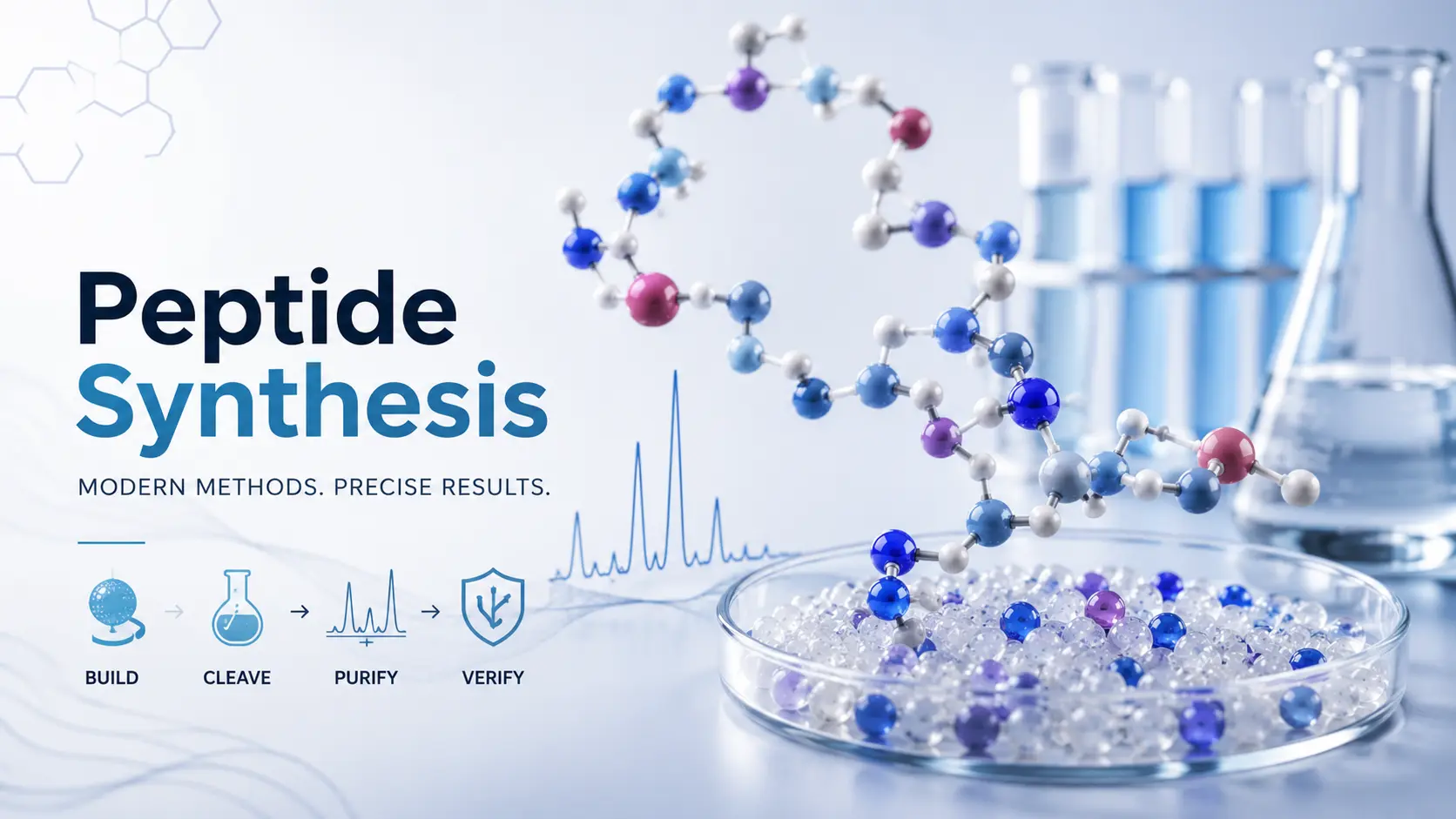
Quick answer — what is peptide synthesis? Peptide synthesis is the chemical assembly of amino acid residues into a defined sequence through repeated amide coupling reactions. Modern laboratories build the chain one residue at a time on a solid support, then cleave, purify by chromatography, and confirm the product by mass spectrometry before release. |
What Peptide Synthesis Actually Means
Peptide synthesis builds a chain of amino acid residues linked by peptide bonds. Each bond forms when the carboxyl group of one residue joins the amino group of the next, releasing water. Chemists call this amide coupling, and every synthesis method is essentially a strategy for controlling it.
Control is the hard part. Amino acids carry reactive side chains, and left unprotected they react with everything. So synthesis depends on protecting groups that mask reactivity until each specific coupling step is due. Remove the wrong group at the wrong moment and you get branching, truncation, or a scrambled sequence.
That is why direction matters too. Chemical synthesis runs from the C-terminus toward the N-terminus, the opposite of ribosomal translation. The distinction becomes practical when comparing synthesis routes with recombinant expression.
Peptide Synthesis vs Protein Expression
Chemical synthesis suits sequences up to roughly fifty residues, tolerates non-natural amino acids, and gives absolute control over modifications. Recombinant expression suits larger proteins but restricts you to what a biological system can encode and fold.
For most research peptides — short signalling sequences, fragments, and analogues — chemistry wins on speed, purity control, and the ability to install labels, cyclisations, or D-amino acids that no expression system will produce.
The Two Core Peptide Synthesis Methods: SPPS and LPPS
Modern laboratories use two families of methods. Solid phase peptide synthesis (SPPS) anchors the growing chain to an insoluble resin. Liquid phase peptide synthesis (LPPS), sometimes called solution phase, keeps every intermediate dissolved. Nearly all research-scale work uses SPPS; LPPS survives where scale and cost dominate.
Solid Phase Peptide Synthesis (SPPS)
Bruce Merrifield introduced solid support synthesis in 1963 and earned the 1984 Nobel Prize in Chemistry for it. The insight was simple and transformative: attach the first residue to a bead, and every purification step collapses into a filtration.
Because the peptide stays bound to the resin, excess reagents can be driven far past stoichiometry to push coupling efficiency toward completion, then simply washed away. Repeat the deprotect-couple-wash cycle for each residue, and you have automated chemistry.
Liquid Phase Peptide Synthesis (LPPS)
Solution phase synthesis isolates and characterises each intermediate. That is slower and far more labour-intensive per residue, but it removes the resin cost entirely and scales to kilogram quantities more economically.
LPPS also supports convergent synthesis and fragment condensation, where separately built segments are joined. For very long targets, building three fragments and condensing them can outperform a single linear assembly.
SPPS vs LPPS: Which Method to Use
Factor | Solid Phase (SPPS) | Liquid Phase (LPPS) |
|---|---|---|
Purification between steps | Filtration and washing | Isolation and characterisation of each intermediate |
Practical sequence length | Routine to ~50 residues | Best for short peptides and fragments |
Automation | Fully automatable | Largely manual |
Reagent consumption | High — excess reagents drive completion | Lower — closer to stoichiometric |
Cost at large scale | Resin and reagent cost dominate | More economical per kilogram |
Intermediate control | Chain is not isolated until cleavage | Every intermediate can be verified |
Typical research use | Default for custom peptide synthesis | Bulk manufacture of short sequences |
How a Peptide Is Synthesized Step by Step
The workflow below describes a standard Fmoc SPPS run. Each cycle adds exactly one residue, and the cycle repeats until the sequence is complete.
- Resin loading. The C-terminal residue is attached to a functionalised solid support. Loading is measured, not assumed — it sets the theoretical yield for the entire run.
- Deprotection. The temporary N-terminal protecting group is removed, exposing a free amine ready to react. In Fmoc chemistry, piperidine in DMF does this in minutes.
- Washing. Solvent flushes away reagents and by-products. Incomplete washing is a common and avoidable source of side products.
- Coupling. The next protected amino acid is activated by coupling reagents and joined to the free amine, forming the new peptide bond.
- Monitoring. A colourimetric test or automated UV monitoring checks whether coupling reached completion. Incomplete couplings are repeated before moving on.
- Cycle repetition. Steps two through five repeat for every residue in the sequence, moving from C-terminus to N-terminus.
- Cleavage and deprotection. A trifluoroacetic acid cleavage cocktail with scavengers releases the peptide from the resin and strips the side-chain protecting groups simultaneously.
- Precipitation. Cold ether precipitates the crude peptide, which is then collected and dried.
- Purification. Preparative RP-HPLC separates the target sequence from deletion sequences, truncations, and other closely related impurities.
- Lyophilization and release testing. The purified fractions are freeze-dried, then analysed by RP-HPLC and mass spectrometry before a certificate of analysis is issued.
Expert tip Coupling efficiency compounds. At 99 percent per step, a 30-residue peptide retains about 74 percent of full-length chains. At 98 percent, that drops to roughly 55 percent. Small per-cycle losses become the dominant purification problem on long sequences — which is why chain length drives both price and lead time. |
Fmoc vs Boc Peptide Synthesis
Two protecting group strategies dominate SPPS. Fmoc/tBu chemistry uses a base-labile temporary group with acid-labile side-chain protection. Boc/Bzl chemistry uses acid for the temporary group and requires much stronger acid for final cleavage.
The distinction is orthogonality: the temporary and permanent protecting groups must be removable under conditions that do not touch each other. Fmoc achieves that with base versus acid, which is why it became the research standard.
Attribute | Fmoc Peptide Synthesis | Boc Peptide Synthesis |
|---|---|---|
Temporary group removal | Base — typically piperidine in DMF | Acid — trifluoroacetic acid |
Final cleavage | Trifluoroacetic acid cocktail | Hydrogen fluoride or equivalent strong acid |
Specialised equipment | Standard laboratory glassware | HF-resistant apparatus and dedicated handling |
Orthogonality | Base/acid — fully orthogonal | Acid/stronger acid — graded, not orthogonal |
Acid-sensitive modifications | Well tolerated | Often incompatible |
Aggregation-prone sequences | Can stall; needs optimisation | Repeated acid treatment can reduce aggregation |
Prevailing use | Default for research and custom synthesis | Specialist and difficult sequences |
For most laboratories the answer is straightforward: use Fmoc unless the sequence demands otherwise. Boc chemistry remains valuable for hydrophobic or strongly aggregating targets, but the hydrogen fluoride requirement puts it outside the reach of most research settings.
The Role of Protecting Groups
Side-chain protecting groups do quiet, essential work. They prevent lysine side chains from branching the peptide, keep cysteine thiols from oxidising mid-synthesis, and stop arginine and histidine from participating in unwanted reactions.
They also protect stereochemistry. Activation can epimerise the alpha carbon, particularly at cysteine and histidine, producing diastereomers that co-elute closely with the target. Epimerization control is one of the least visible but most consequential aspects of synthesis quality.
Coupling Reagents and Resin Selection
Peptide Coupling Reagents
Coupling reagents activate the carboxyl group so it will react with the incoming amine. The chemistry has evolved toward reagents that couple faster while suppressing racemization.
- Carbodiimides such as DIC, usually paired with an additive to suppress side reactions.
- Additives such as HOBt, which improve coupling rates and reduce racemization risk.
- Uronium and phosphonium salts such as HBTU, which give fast, clean couplings on difficult residues.
- Base — typically a hindered tertiary amine — to maintain the conditions activation requires.
Reagent choice is not cosmetic. Sterically hindered residues and beta-branched amino acids often need a more aggressive activator or a double coupling to reach completion.
Resin Selection in Solid Phase Synthesis
The resin determines the C-terminal functionality of the finished peptide and the acid strength needed to release it. Choosing wrongly means the peptide either will not cleave or comes off prematurely during synthesis.
- Acid-labile linkers release a free C-terminal acid under standard TFA cleavage.
- Amide-forming resins deliver a C-terminal amide, common in signalling peptides.
- Highly acid-sensitive resins release protected fragments for convergent assembly.
- Resin loading in millimoles per gram controls scale and influences aggregation — lower loading gives chains more room and often improves difficult sequences.
Automated Peptide Synthesizers
An automated peptide synthesizer performs the deprotect-couple-wash cycle under programmed control. Reagent delivery, timing, mixing, and washing all run to a defined method, and many instruments monitor deprotection in real time by UV absorbance.
Automation improves reproducibility more than it improves chemistry. The instrument does not invent a better coupling; it removes operator variance between cycle one and cycle forty. Microwave-assisted systems add controlled heating, which speeds up couplings on aggregation-prone sequences.
The economics still favour outsourcing for most laboratories. A synthesizer, its reagent stream, purification capacity, and analytical infrastructure represent a serious capital and staffing commitment — justified only when synthesis is a continuing programme rather than an occasional need.
Common Peptide Synthesis Problems and How to Troubleshoot Them
Low yield rarely has a single cause. The table below maps the most frequent failure modes to their usual origin.
Observed problem | Likely cause | Practical response |
|---|---|---|
Low crude yield | Incomplete couplings accumulating across cycles | Double couple difficult residues; extend coupling time |
Deletion sequences in HPLC | A residue failed to couple in one or more chains | Add capping steps so failed chains stop growing |
Chain stalls mid-synthesis | On-resin aggregation and beta-sheet formation | Lower resin loading; use chaotropic solvent or elevated temperature |
Diastereomer peaks near target | Racemization during activation | Change coupling reagent and additive; reduce base exposure |
Mass 16 Da above expected | Oxidation, commonly at methionine | Add scavengers to cleavage cocktail; store under inert conditions |
Poor solubility after lyophilization | Hydrophobic sequence or aggregation | Adjust counterion; screen alternative solvent systems |
Broad or split HPLC peaks | Conformational isomers or residual protecting groups | Confirm complete deprotection; run analysis at elevated temperature |
Purification and Peptide Purity Testing
Crude peptide is a mixture. Purification separates the target sequence from deletions, truncations, oxidation products, and residual reagents, and analytics prove that the separation worked.
Crude Peptide vs Purified Peptide
Crude peptide | Purified peptide | |
|---|---|---|
Typical purity range | Highly variable, often well below 90 percent | Commonly 95 to 99 percent or higher |
Purification performed | None beyond precipitation | Preparative RP-HPLC, sometimes multiple passes |
Appropriate use | Screening, non-quantitative work | Quantitative assays and reproducible research |
Relative cost | Lowest | Higher — purification drives most of the price |
RP-HPLC Peptide Analysis
Reversed-phase HPLC separates peptides by hydrophobicity. The sample passes over a nonpolar stationary phase while a gradient of acetonitrile in acidified water elutes components in order of increasing hydrophobicity.
Detection is normally at 214 nm, where the peptide bond itself absorbs. Purity is then reported as the target peak area divided by total peak area. That percentage is the number quoted on most certificates of analysis.
How to Interpret an HPLC Chromatogram for Peptides
- Locate the main peak and confirm it dominates total peak area.
- Check peak shape — sharp and symmetrical suggests a single well-behaved species; tailing or shoulders suggest co-eluting impurities.
- Examine peaks immediately adjacent to the target, since deletion sequences and diastereomers elute closest to it.
- Read the method conditions: column, gradient, flow rate, and detection wavelength. A shallow gradient resolves impurities a steep one hides.
- Confirm the integration baseline is drawn sensibly. Generous baseline placement can inflate a reported purity figure.
Mass Spectrometry Peptide Verification
HPLC tells you how much of the sample is one component. It does not tell you which component. Mass spectrometry answers that by measuring molecular weight and comparing it to the calculated value for the intended sequence.
LC-MS combines both in one run, coupling separation with mass detection. MALDI-TOF handles larger or less soluble peptides well. Either way, purity without identity confirmation is an incomplete result.
Question | RP-HPLC | LC-MS / MALDI-TOF |
|---|---|---|
What it answers | How much of the sample is the main component | Whether the main component is the intended sequence |
Reported as | Chromatographic purity percentage | Observed versus calculated molecular weight |
Detects | Deletions, truncations, co-eluting species | Mass shifts from oxidation, incomplete deprotection, wrong residues |
Limitation | Cannot confirm identity | Not a quantitative purity measure on its own |
Net Peptide Content vs Purity
This distinction separates informed buyers from the rest. Chromatographic purity describes the proportion of peptide material that is the target sequence. Net peptide content (NPC) describes how much of the total vial mass is peptide at all.
The rest is counterion — usually trifluoroacetate from cleavage and purification — plus residual water and salts. A vial can be 98 percent pure by HPLC and still be only 70 to 80 percent peptide by mass.
Common mistake Weighing out a peptide as though the vial contains pure peptide. If net peptide content is 75 percent, a 10 mg weighing delivers roughly 7.5 mg of actual peptide — a 25 percent concentration error carried silently through every downstream calculation. Amino acid analysis is the definitive way to establish NPC. |
How to Read a Peptide Certificate of Analysis
A certificate of analysis is the primary evidence that a synthesis went as intended. Treat it as a document to interrogate, not a formality to file.
COA field | What to check |
|---|---|
Sequence | Single-letter or three-letter code matching your order exactly, including terminal modifications |
Molecular weight | Calculated and observed values, and whether they agree within instrument tolerance |
Lot or batch number | Matches the vial label — a generic COA covering multiple lots is a red flag |
Chromatographic purity | Percentage with the method stated, not a bare number |
Analytical methods | Named techniques and conditions for both purity and identity |
Attached raw data | Actual chromatogram and mass spectrum, not just a summary table |
Counterion / salt form | Usually TFA salt; affects net peptide content and solubility |
Appearance and storage | Physical description and recommended storage conditions |
Test date and signatory | A dated document with a named analyst or accredited laboratory |
One caution worth stating plainly: a certificate of analysis documents what was tested on a specific lot. It is not a guarantee that the vial in front of you was handled correctly in transit or in storage. Laboratories running high-stakes work often verify critical batches on arrival.
Research-Grade vs Pharmaceutical-Grade Peptides
The grades differ in the quality system behind them, not simply in a purity number.
Dimension | Research-grade (RUO) | Pharmaceutical / GMP-grade |
|---|---|---|
Intended use | Laboratory research only | Clinical and manufacturing applications |
Quality framework | Supplier QC, often ISO/IEC 17025 accredited testing | Formal cGMP quality management system |
Documentation | Certificate of analysis and safety data sheet | Full batch records, validation, and regulatory files |
Additional testing | Purity and identity; endotoxin and residual solvents on request | Extensive release panel as specified by monograph |
Relative cost | Substantially lower | Significantly higher |
Labelling | Research use only, not for human consumption | Regulated pharmaceutical labelling |
Note that cGMP is not legally required for research use only materials. What matters more for a research buyer is whether the testing laboratory is accredited, whether the data is lot-specific, and whether the supplier will release it on request.
Peptide Storage, Stability, and Reconstitution
A well-synthesised peptide can still fail if it degrades before use. Degradation follows predictable chemistry: oxidation at methionine, cysteine, and tryptophan; hydrolysis at acid-sensitive bonds; deamidation at asparagine and glutamine; and aggregation in hydrophobic sequences.
Storage Best Practices for Lyophilized Peptides
- Store lyophilized material desiccated and frozen — typically -20 degrees Celsius for routine holding, -80 degrees Celsius for long-term stability.
- Keep vials sealed and protected from light and atmospheric moisture.
- Allow frozen vials to reach room temperature before opening, so condensation does not enter the vial.
- Aliquot reconstituted solutions to avoid repeated freeze-thaw cycles.
- Record lot numbers and receipt dates so stability questions can be traced later.
Reconstituting a Peptide for Laboratory Use
- Equilibrate the sealed vial to room temperature and inspect the lyophilized cake.
- Select a solvent appropriate to the sequence — sterile or bacteriostatic water for many peptides, with a co-solvent screen for hydrophobic sequences.
- Add solvent slowly down the vial wall rather than directly onto the powder.
- Swirl gently until dissolved. Do not vortex aggressively — shear and foaming promote aggregation.
- Aliquot into working volumes, label with lot and date, and store according to the supplier’s stated conditions.
Cold-chain shipping matters for the same reason. Packaging that maintains low temperature and vial integrity in transit protects the purity you paid for.
Custom Peptide Synthesis: When Outsourcing Makes Sense
In-house synthesis makes sense when a laboratory runs peptide chemistry continuously and has the analytical capacity to verify its own output. For everyone else, custom peptide synthesis converts a capital and staffing problem into a line item.
The variables that drive quote and lead time are consistent across suppliers: sequence length, hydrophobicity, aggregation tendency, modifications, purity grade, and scale. Long, cyclic, or heavily modified peptides require optimisation and repeated purification, and both cost and turnaround reflect that.
What to Provide When Requesting a Custom Synthesis Quote
- Full sequence in single-letter code, N-terminus to C-terminus.
- Terminal modifications — acetylation, amidation, or free termini.
- Internal modifications — labels, cyclisation, non-natural residues, isotopic labelling.
- Required purity grade and the analytical documentation you need.
- Quantity, preferred salt form, and target delivery timeframe.
- Any solubility or handling constraints known from previous work.
Procurement, Bulk Orders, and Institutional Accounts
Procurement teams tend to focus on different variables than the bench: minimum order quantity, bulk pricing tiers, purchase order handling, payment terms, and whether recurring account-based ordering is available.
For multi-phase studies, batch consistency matters more than a single low price. Ask whether a supplier can reserve material from one lot across a project timeline — that single question removes a whole class of reproducibility problems.
Choosing a Research Peptide Supplier in the United States
Supplier evaluation is where synthesis knowledge becomes commercially useful. If you understand how peptides are made and verified, you can tell in about ten minutes whether a vendor is serious.
A Ten-Minute Supplier Vetting Checklist
- Request a lot-specific certificate of analysis before ordering, not after.
- Confirm raw HPLC chromatograms and mass spectra are attached, not just summarised.
- Check whether the testing laboratory is named and independent of the manufacturer.
- Verify that research use only labelling appears clearly on products and near purchase points.
- Confirm safety data sheets are available for the products you intend to buy.
- Ask where synthesis and final testing occur, and whether domestic shipping preserves cold chain.
- Look for batch-to-batch consistency data or a willingness to discuss it.
- Confirm the supplier will support institutional purchase orders and documentation requirements.
- Test responsiveness with a technical question — the quality of the answer is itself a signal.
- Treat any dosing guidance, health claims, or human-use language as a disqualifying compliance risk.
Compliance note Research use only means exactly that. RUO peptides are supplied for laboratory investigation by qualified personnel. They are not drugs, supplements, or dietary products, and they are not for human or veterinary consumption. Any supplier marketing them for personal use is operating outside the boundary that FDA drug-marketing rules define. |
Where Synthesis Quality Shows Up in Your Data
Every topic in this guide converges on one point: reproducibility. A deletion sequence you never saw becomes an unexplained dose-response shift. An unaccounted counterion becomes a systematic concentration error. An oxidised methionine becomes a batch that behaves differently from the last one.
None of those failures announce themselves. They appear as noise, as irreproducibility, as a result that will not survive review. Understanding peptide synthesis methods is, in practical terms, a way of protecting the integrity of your own experiments.
Key Takeaways
- Peptide synthesis assembles amino acid residues into a defined sequence through repeated amide coupling, running from the C-terminus toward the N-terminus.
- Solid phase peptide synthesis is the research default because filtration replaces purification at every step; liquid phase synthesis remains useful for short peptides at scale.
- Fmoc chemistry dominates research synthesis because base and acid deprotection are genuinely orthogonal and no hydrogen fluoride handling is required.
- Coupling efficiency compounds across cycles, which is why sequence length drives both price and lead time on custom peptide synthesis.
- RP-HPLC measures how much of a sample is the main component; mass spectrometry confirms that the component is the intended sequence. You need both.
- Net peptide content is not the same as chromatographic purity — counterions and residual water can account for 20 to 30 percent of vial mass.
- A certificate of analysis should be lot-specific, method-transparent, and accompanied by raw chromatograms and spectra.
- Store lyophilized peptides desiccated and frozen, aliquot after reconstitution, and avoid repeated freeze-thaw cycles.
- cGMP is not legally required for RUO peptides; accredited third-party testing and lot-level transparency matter more to research buyers.
- All research peptides are supplied for laboratory use only and are not for human consumption.
Frequently Asked Questions
What is peptide synthesis?
Peptide synthesis is the chemical assembly of amino acid residues into a defined sequence through repeated amide coupling reactions. Modern laboratories build peptides one residue at a time on a solid support, then cleave, purify, and verify the product by RP-HPLC and mass spectrometry before releasing it for research use.
What does "research use only" mean on peptide products?
A research use only (RUO) label means the material is supplied for laboratory investigation only. It is not a drug, not a supplement, and not for human or veterinary consumption. RUO peptides are intended for in vitro studies, assay development, and other controlled laboratory applications by qualified personnel.
How is peptide purity measured and verified?
Chromatographic purity is measured by RP-HPLC, usually with UV detection at 214 nm, and reported as the percentage of total peak area attributable to the target peptide. Identity is confirmed separately by LC-MS or MALDI-TOF, which matches the observed mass to the calculated peptide molecular weight.
What is included in a certificate of analysis?
A complete peptide certificate of analysis lists the sequence, calculated and observed molecular weight, batch or lot number, chromatographic purity percentage, the analytical methods used, appearance, storage conditions, test date, and the analyst or laboratory responsible. Strong COAs attach the raw HPLC chromatogram and mass spectrum.
How should research peptides be stored before use?
Store lyophilized peptides desiccated and frozen, typically at -20 degrees Celsius for routine holding and -80 degrees Celsius for long-term stability. Keep vials sealed, protected from light and moisture, and allow them to reach room temperature before opening to prevent condensation inside the vial.
How long is a peptide stable after reconstitution?
Stability depends on sequence, solvent, and temperature. Reconstituted peptides are generally handled as short-term working solutions held refrigerated, with aliquoting recommended to avoid repeated freeze-thaw cycles. Sequences containing methionine, cysteine, or tryptophan degrade faster because they are prone to oxidation.
What is the difference between SPPS and LPPS?
Solid phase peptide synthesis anchors the growing chain to an insoluble resin so excess reagents are removed by filtration. Liquid phase peptide synthesis keeps everything in solution and requires isolation after each step. SPPS suits most research sequences; LPPS suits short peptides made at large scale.
What is the difference between Fmoc and Boc synthesis?
Fmoc chemistry removes the temporary protecting group with a mild base such as piperidine and cleaves the final peptide with trifluoroacetic acid. Boc chemistry uses acid for each deprotection and requires hydrogen fluoride for final cleavage. Fmoc dominates research synthesis because it avoids specialised HF handling equipment.
How do I know a peptide supplier’s products are third-party tested?
Ask for the lot-specific COA and confirm the testing laboratory is named and independent of the manufacturer. Verify that the lot number on the vial matches the document, that raw chromatograms are attached, and that the supplier will release testing records for any batch on request.
What documentation ships with a research peptide order?
A compliant research peptide order should include a lot-matched certificate of analysis, a safety data sheet, clear research use only labelling, and packing documentation identifying the batch. Suppliers serving institutions typically also provide purchase order references and any import or export paperwork required.
Can I order custom peptide sequences?
Yes. Custom peptide synthesis lets a laboratory specify the exact sequence, scale, purity grade, salt form, and any modifications such as amidation, acetylation, labelling, or cyclisation. Providing the sequence in single-letter code with modifications noted at each terminus speeds up quoting considerably.
What is the typical turnaround time for custom peptide synthesis?
Turnaround depends on length, difficulty, purity grade, and scale. Short unmodified sequences at research purity move fastest, while long, hydrophobic, cyclic, or heavily modified peptides take substantially longer because they require optimisation, repeated purification passes, and additional analytical work.
What is net peptide content and how does it differ from purity?
Chromatographic purity describes how much of the peptide material is the target sequence. Net peptide content describes how much of the total vial mass is actually peptide rather than counterions, residual water, and salts. A vial can be 98 percent pure and still be only 75 percent peptide by mass.
How is peptide identity confirmed, mass spectrometry or HPLC?
Both, and they answer different questions. HPLC separates the sample and quantifies how much of it is the main component. Mass spectrometry measures molecular weight and confirms that the main component is the intended sequence. Purity without identity confirmation is an incomplete result.
Are research peptides regulated by the FDA?
Research use only materials are not FDA-approved drugs and cannot be marketed with therapeutic claims, dosing guidance, or human-use instructions. Suppliers must keep labelling and marketing anchored to laboratory research. Buyers should treat any vendor implying personal use as a compliance risk.