Research Use Only This reference covers blend composition, reconstitution mathematics, and laboratory handling. It contains no dosing guidance, no protocols, and no medical or therapeutic recommendations. Materials described here are not for human or veterinary use. |
Quick Answer: What does KLOW 80 mg (50/10/10/10) mean?
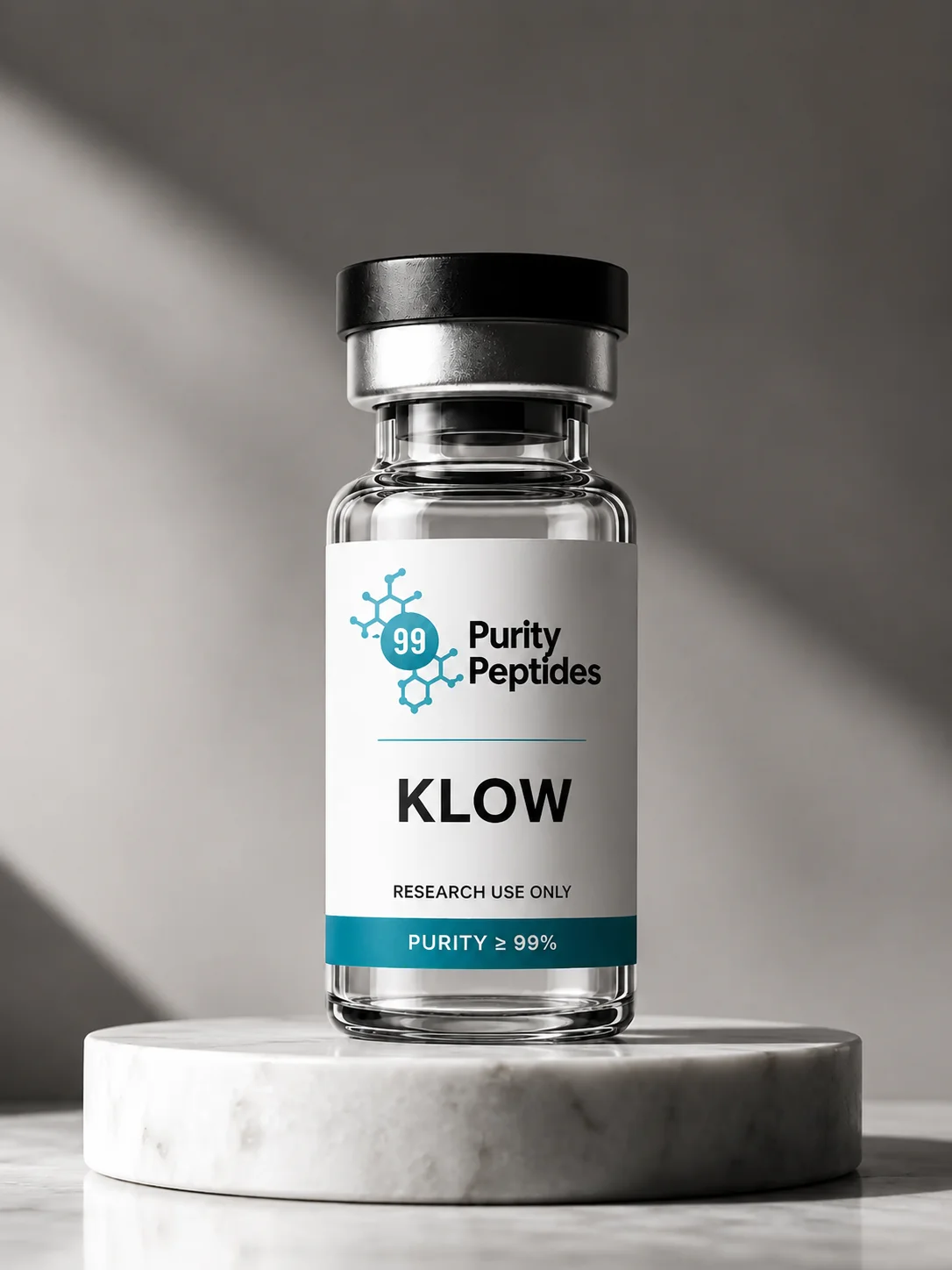
KLOW 80 mg refers to a single lyophilized vial containing four research peptides in a fixed 50/10/10/10 milligram ratio: BPC-157 at 50 mg, GHK-Cu at 10 mg, KPV at 10 mg, and TB-500 at 10 mg. Reconstituting the vial with 5 mL of bacteriostatic water produces a total concentration of 16 mg/mL.
Featured Product
Definition
KLOW is a four-component lyophilized research peptide blend containing BPC-157, GHK-Cu, KPV, and TB-500 in a fixed 50:10:10:10 milligram ratio, supplied as a single 80 mg vial for laboratory reconstitution. The four peptides share one vial and one solvent volume, so every aliquot withdrawn after reconstitution carries all four compounds at that same locked 5:1:1:1 ratio.
What is in KLOW? The 80 mg composition table
KLOW contains four peptides: BPC-157 (50 mg), GHK-Cu (10 mg), KPV (10 mg), and TB-500 (10 mg). Together they total 80 mg of lyophilized material per vial. BPC-157 makes up 62.5% of the blend by mass, and the three remaining components each contribute 12.5%.
The name is a component acronym, and researchers encounter several spellings of it — KLOW, KLOW 80, and "KLOW blend" all describe the same 80 mg specification.
Component | Amount (mg) | % of blend | Research context |
|---|---|---|---|
BPC-157 | 50 mg | 62.5% | Pentadecapeptide (GEPPPGKPADDAGLV, MW ≈ 1,419 Da) derived from a gastric juice protein sequence. Studied preclinically for cytoprotection, angiogenesis, and connective-tissue repair models. Notably stable in acidic conditions.¹ ² |
GHK-Cu | 10 mg | 12.5% | Copper-complexed tripeptide (glycyl-L-histidyl-L-lysine, MW ≈ 340 Da for the free peptide). Investigated since 1973 for extracellular matrix signalling, collagen synthesis, and antioxidant behaviour in fibroblast models.³ ⁴ |
KPV | 10 mg | 12.5% | C-terminal tripeptide of α-MSH (Lys-Pro-Val, α-MSH 11–13, MW ≈ 342 Da). Studied for receptor-independent anti-inflammatory activity without the pigmentary effects of the parent hormone.⁵ ⁶ |
TB-500 | 10 mg | 12.5% | Synthetic peptide corresponding to the actin-binding region of thymosin β4. Studied in cell-migration and angiogenesis models.⁷ ⁸ |
Total | 80 mg | 100% | Single-vial fixed-ratio blend |
One point of terminology worth getting right
TB-500 and thymosin β4 are frequently treated as synonyms. They are not identical. Thymosin β4 is a 43-amino-acid, roughly 5 kDa polypeptide.⁹ TB-500, as supplied by most research vendors, is a short synthetic fragment corresponding to the actin-binding motif within that larger sequence — the region shown to carry much of the peptide's angiogenic activity in endothelial migration assays.⁷
The distinction matters when you calculate on a molar rather than a mass basis. Ten milligrams of a seven-residue fragment contains far more molecules than ten milligrams of the full 43-residue peptide. Check your Certificate of Analysis for the exact identity and molecular weight of the material in your vial before performing any molar calculation.
Why the 50/10/10/10 ratio cannot be adjusted
In a pre-blended vial, the four components dissolve into the same solvent volume. Withdrawing a smaller or larger aliquot changes the absolute mass of every component simultaneously, but the ratio between them stays locked at 5:1:1:1. No reconstitution volume alters that relationship.
This is the single most important concept in multi-component blend work, and it is where most calculation errors originate.
Consider what happens across three different reconstitution volumes:
Reconstitution volume | BPC-157 : GHK-Cu : KPV : TB-500 |
|---|---|
2 mL | 5 : 1 : 1 : 1 |
5 mL | 5 : 1 : 1 : 1 |
10 mL | 5 : 1 : 1 : 1 |
What reconstitution volume actually controls is resolution, not proportion. A larger volume spreads the same 80 mg across more millilitres, which lowers concentration and lets you measure smaller mass increments accurately on a graduated syringe. A smaller volume concentrates the material and makes fine measurement harder.
Researchers who need to vary one component independently cannot do so from a blend. That requires single-compound vials — BPC-157, GHK-Cu, KPV, and TB-500 sourced separately and combined at the bench. Our comparison of the KLOW and GLOW blend architectures covers when a fixed-ratio format suits a study design and when it does not.
The KLOW reconstitution reference table
Reconstituting an 80 mg KLOW vial with 5 mL of bacteriostatic water yields 16 mg/mL total peptide concentration, comprising BPC-157 at 10 mg/mL and GHK-Cu, KPV, and TB-500 at 2 mg/mL each. The table below gives the equivalent figures across every commonly used solvent volume.
BAC water volume | Total concentration | BPC-157 | GHK-Cu | KPV | TB-500 | Laboratory notes |
|---|---|---|---|---|---|---|
1 mL | 80 mg/mL | 50 mg/mL | 10 mg/mL | 10 mg/mL | 10 mg/mL | Very high concentration. Dissolution may be slow; verify the solution is fully clear before use. Fine measurement is difficult at this density. |
2 mL | 40 mg/mL | 25 mg/mL | 5 mg/mL | 5 mg/mL | 5 mg/mL | Compact working volume. Suits small aliquot workflows where syringe resolution is not limiting. |
2.5 mL | 32 mg/mL | 20 mg/mL | 4 mg/mL | 4 mg/mL | 4 mg/mL | Produces whole-number component concentrations, which simplifies arithmetic. |
3 mL | 26.67 mg/mL | 16.67 mg/mL | 3.33 mg/mL | 3.33 mg/mL | 3.33 mg/mL | Common default. Note the repeating decimals — round only at the final step. |
4 mL | 20 mg/mL | 12.5 mg/mL | 2.5 mg/mL | 2.5 mg/mL | 2.5 mg/mL | Clean total concentration. Good balance of density and measurement resolution. |
5 mL | 16 mg/mL | 10 mg/mL | 2 mg/mL | 2 mg/mL | 2 mg/mL | Recommended reference volume. Every component resolves to a whole number, which minimises arithmetic error. |
6 mL | 13.33 mg/mL | 8.33 mg/mL | 1.67 mg/mL | 1.67 mg/mL | 1.67 mg/mL | Lower density improves fine measurement. Confirm vial capacity first. |
8 mL | 10 mg/mL | 6.25 mg/mL | 1.25 mg/mL | 1.25 mg/mL | 1.25 mg/mL | Requires a 10 mL vial. Total concentration lands on a clean 10 mg/mL. |
10 mL | 8 mg/mL | 5 mg/mL | 1 mg/mL | 1 mg/mL | 1 mg/mL | Maximum practical dilution for a 10 mL vial. Highest measurement resolution; shortest working margin before the solution is exhausted. |
Before you choose a volume, check three things
Vial capacity. Lyophilized peptide vials are commonly 2 mL, 3 mL, 5 mL, or 10 mL. Adding 10 mL of solvent to a 3 mL vial is not possible, and attempting it risks losing material. Confirm the vial size on your packaging or COA.
Measurement resolution. A U-100 graduated syringe resolves to roughly one unit, or 0.01 mL. At 80 mg/mL, one unit carries 800 µg of total peptide. At 8 mg/mL, one unit carries 80 µg. Higher dilution therefore gives finer control over the mass in each aliquot.
Working timeline. A larger reconstitution volume spreads the same material over more aliquots, which extends the period the solution sits in storage. Reconstituted peptides degrade over time, so match your volume to how quickly the vial will actually be consumed.
The concentration formula, worked through
Peptide concentration follows one equation: concentration equals mass divided by volume. For a blend, apply it once to the total and once per component, since each component has its own mass but shares the same solvent volume.
The three equations you need
1. Total concentration
C_total = M_total ÷ V
Where M_total is 80 mg and V is your reconstitution volume in millilitres.
2. Per-component concentration
C_component = m_component ÷ V
Where m_component is 50 mg for BPC-157 and 10 mg for each of the other three.
3. Volume required for a target component mass
V_draw = m_target ÷ C_component
Multiply the result by 100 to convert millilitres into U-100 syringe units.
Why per-component math matters more than total concentration
Total concentration tells you how dense the solution is. It does not tell you how much of any individual peptide sits in a given aliquot. Because BPC-157 represents 62.5% of the blend and the other three represent 12.5% each, a calculation performed on the 80 mg total will overstate the minor components by a factor of eight.
Run the arithmetic per component. It takes one extra step and removes the most common source of error in blend work.
Concentration examples at common volumes
Each example below is a pure unit-conversion exercise. Nothing here constitutes a protocol, a recommendation, or guidance of any kind.
Example 1 — Reconstituting at 5 mL
An 80 mg vial reconstituted with 5 mL of bacteriostatic water gives:
- Total: 80 mg ÷ 5 mL = 16 mg/mL
- BPC-157: 50 mg ÷ 5 mL = 10 mg/mL
- GHK-Cu, KPV, TB-500: 10 mg ÷ 5 mL = 2 mg/mL each
Withdrawing 0.1 mL (10 units on a U-100 syringe) therefore delivers 1.6 mg total: 1,000 µg of BPC-157 alongside 200 µg each of GHK-Cu, KPV, and TB-500.
Example 2 — Solving backwards from a target component mass
Suppose a study design calls for an aliquot containing 500 µg of BPC-157, and the vial was reconstituted with 3 mL.
- BPC-157 concentration: 50 mg ÷ 3 mL = 16.67 mg/mL = 16,667 µg/mL
- Volume required: 500 µg ÷ 16,667 µg/mL = 0.03 mL
- Syringe units: 0.03 mL × 100 = 3 units
Now check what else that aliquot carries. GHK-Cu sits at 10 mg ÷ 3 mL = 3,333 µg/mL, so 0.03 mL delivers 100 µg — and the same applies to KPV and TB-500.
That result illustrates the fixed-ratio principle in practice. Targeting a BPC-157 mass automatically fixes the other three at one-fifth of it. There is no way to decouple them.
Example 3 — Planning aliquot count before you reconstitute
Working backwards from the number of aliquots you need is often more useful than working forwards from a volume.
If a protocol requires eight equal aliquots from one vial:
- 80 mg ÷ 8 = 10 mg total peptide per aliquot
- At 5 mL reconstitution (16 mg/mL): 10 mg ÷ 16 mg/mL = 0.625 mL, or 62.5 units
- At 8 mL reconstitution (10 mg/mL): 10 mg ÷ 10 mg/mL = 1.0 mL, or 100 units — a full syringe
The 8 mL figure gives a cleaner draw. Small choices at the reconstitution stage compound across an entire study.
Syringe unit conversion table
On a U-100 graduated syringe, 100 units equals 1 mL, so one unit equals 0.01 mL. That relationship is fixed and independent of what the syringe contains. The mass in each unit depends entirely on the concentration of the solution.
Reconstitution volume | Total per unit | BPC-157 per unit | GHK-Cu / KPV / TB-500 per unit |
|---|---|---|---|
1 mL | 800 µg | 500 µg | 100 µg each |
2 mL | 400 µg | 250 µg | 50 µg each |
2.5 mL | 320 µg | 200 µg | 40 µg each |
3 mL | 266.7 µg | 166.7 µg | 33.3 µg each |
4 mL | 200 µg | 125 µg | 25 µg each |
5 mL | 160 µg | 100 µg | 20 µg each |
6 mL | 133.3 µg | 83.3 µg | 16.7 µg each |
8 mL | 100 µg | 62.5 µg | 12.5 µg each |
10 mL | 80 µg | 50 µg | 10 µg each |
Reading the graduations correctly
U-100 syringes are marked in insulin units, not millilitres. The numbers printed on the barrel measure volume only — they carry no information about concentration. A syringe drawn to 20 units always holds 0.2 mL, whether that 0.2 mL contains 1.6 mg of peptide or 16 mg.
Two habits prevent most misreadings. First, confirm the syringe is genuinely U-100 rather than U-40 or U-50, since the scales differ. Second, record the reconstitution volume on the vial label at the moment you reconstitute. A vial with no recorded volume is a vial of unknown concentration, and there is no way to recover that figure later.
For faster verification of any of these conversions, our peptide reconstitution calculator performs the same arithmetic across arbitrary vial sizes and solvent volumes.
Laboratory storage and reconstituted stability
Lyophilized KLOW should be stored frozen at −20 °C or below, protected from light and moisture. Once reconstituted with bacteriostatic water, the solution requires refrigeration at 2–8 °C and should be kept away from light, since the GHK-Cu component is a copper complex and sensitive to photodegradation.
Lyophilized storage
Freeze-dried peptides are stable because water has been removed. Hydrolysis, oxidation, and aggregation all require moisture to proceed at any meaningful rate.
- Long-term: −20 °C or colder, sealed, desiccated, dark
- Short-term transit: ambient temperatures are generally tolerated by lyophilized material for short periods, though cold-chain shipping remains preferable
- Critical habit: allow the vial to reach room temperature before opening. Introducing warm laboratory air to a cold vial condenses moisture directly onto the powder.
Reconstituted storage
Once solvent enters the vial, the stability clock starts.
- Temperature: 2–8 °C, refrigerated, upright
- Light: protect from light. Reconstituted GHK-Cu produces a characteristic blue tint from the copper(II) complex, and that chromophore is exactly what makes it light-sensitive.
- Freeze-thaw: avoid repeated cycles. Each freeze-thaw introduces mechanical and osmotic stress that can drive aggregation. If long-term frozen storage is required, divide into single-use aliquots first and thaw each once.
- Working window: bacteriostatic water contains 0.9% benzyl alcohol as a preservative, which suppresses microbial growth but does not prevent chemical degradation. Laboratory convention treats roughly 28 days at 2–8 °C as a reasonable working window for a preserved multi-dose vial, though the appropriate figure for any specific study should be established by the researcher against their own stability data.
Solvent selection
Solvent | Preservative | Typical use |
|---|---|---|
Bacteriostatic water | 0.9% benzyl alcohol | Multi-draw vials over an extended working period |
Sterile water for injection | None | Single-use preparations; no bacteriostatic protection after the first entry |
Acetic acid (dilute) | None | Occasionally used for poorly soluble peptides; not typically required for this blend |
Most laboratories select bacteriostatic water for a blend of this size, since an 80 mg vial is rarely consumed in a single draw. We stock bacteriostatic water alongside the compounds themselves.
Handling notes specific to a four-component blend
Introduce the solvent slowly, directing the stream down the inner vial wall rather than onto the powder cake. Swirl gently to dissolve. Do not shake. Vigorous agitation generates shear forces and an air-liquid interface that promote peptide aggregation, and it produces foam that traps material away from the solution.
Dissolution should be complete within a few minutes and yield a clear solution, faintly blue from the copper complex. Visible particulate, cloudiness, or an unexpected colour shift warrants stopping and reviewing storage history before proceeding.
Purity verification and what the COA actually tells you
Research-grade peptide purity is verified by reverse-phase HPLC, which separates the target peptide from synthesis-related impurities and reports the target as a percentage of total peak area. Mass spectrometry confirms molecular identity. A blend requires verification of each component individually before combination.
Why blend verification is harder than single-compound verification
A single-compound vial needs one chromatogram. A four-component blend needs four, because a combined chromatogram of KLOW would show four principal peaks and no straightforward way to attribute an impurity to a particular component.
Ask for per-component certificates, not a single blend certificate. Each of the four should carry its own purity figure, identity confirmation, and batch identifier.
Reading a Certificate of Analysis
COA field | What it establishes |
|---|---|
HPLC purity (%) | Target peptide as a percentage of total peak area. ≥99% indicates a well-purified synthesis. |
Mass spec / MW confirmed | The material is the peptide it claims to be, not a similarly named sequence. |
Net peptide content | Actual peptide mass after counterion and residual water are subtracted. Distinct from purity — a 99% pure peptide might be only 80% peptide by mass. |
Counterion (TFA / acetate) | Salt form. Affects mass calculations and can matter in cell-based assays. |
Batch / lot number | Traceability. A COA without a lot number that matches your vial certifies nothing. |
Test date | Recency. A certificate several years old describes a different production run. |
The distinction most buyers miss
Purity and net peptide content are not the same measurement. Purity describes the proportion of peptide-related material that is the correct sequence. Net peptide content describes how much of the total vial mass is peptide at all, once trifluoroacetate salt and residual moisture are excluded.
Both figures matter for concentration work. A vial labelled 80 mg with 80% net peptide content contains roughly 64 mg of actual peptide, and every concentration in this reference would shift accordingly. Reputable suppliers report both.
Our full batch documentation is published at 99 Purity Peptides Certificates, with lot-matched HPLC and mass spectrometry results for each component. For a deeper treatment of testing methodology, see our guide to how to choose high-purity research peptides.
Using the peptide calculator for blend work
The 99 Purity Peptides reconstitution calculator computes concentration from vial mass and solvent volume, then converts the result into U-100 syringe units. For a fixed-ratio blend, run it once per component rather than once for the vial total.
How to run a blend through a single-compound calculator
Enter each component's individual mass against the shared reconstitution volume:
- BPC-157: enter 50 mg, then your solvent volume
- GHK-Cu: enter 10 mg, same volume
- KPV: enter 10 mg, same volume
- TB-500: enter 10 mg, same volume
Four passes produce four concentrations, all sharing one denominator. Entering 80 mg once would give you the total concentration only, which — as Section 4 explains — will mislead you about the three minor components by a factor of eight.
The calculator is a verification tool rather than a substitute for understanding the arithmetic. Researchers who can derive the numbers by hand catch input errors that a calculator will happily propagate.
Conclusion
Blend work is arithmetic before it is anything else. The 50/10/10/10 specification defines a fixed 5:1:1:1 relationship that no reconstitution volume can alter, and the practical consequence is that solvent volume controls measurement resolution rather than proportion. Choose a volume that gives you clean numbers and comfortable syringe graduations, record it on the vial, and calculate each component separately.
The quality of the underlying material determines whether any of that arithmetic means anything. A concentration calculation assumes the vial contains what the label claims, at the purity stated, in the mass stated. That assumption is only as good as the documentation behind it — which is why per-component certificates, lot matching, and net peptide content reporting matter more in blend work than anywhere else.
Every 99 Purity Peptides batch ships with lot-matched HPLC and mass spectrometry documentation, published openly at our certificates library. You can review the KLOW 80 mg blend specification directly, verify any figure in this reference using the peptide reconstitution calculator, or read the full KLOW research guide for the background on each component.
References
- Sikiric P, Seiwerth S, Rucman R, et al. Stable gastric pentadecapeptide BPC 157-NO-system relation. Curr Pharm Des. 2014;20(7):1126–1135. PubMed 23755725
- Sikiric P, Rucman R, Turkovic B, et al. Novel cytoprotective mediator, stable gastric pentadecapeptide BPC 157: vascular recruitment and gastrointestinal tract healing. Curr Pharm Des. 2018. PubMed 29879879
- Pickart L, Vasquez-Soltero JM, Margolina A. The human tripeptide GHK-Cu in prevention of oxidative stress and degenerative conditions of aging. Oxid Med Cell Longev. 2012. PMC3359723
- Pickart L, Margolina A. Regenerative and protective actions of the GHK-Cu peptide in the light of the new gene data. Int J Mol Sci. 2018;19(7):1987. doi:10.3390/ijms19071987
- Brzoska T, Luger TA, Maaser C, Abels C, Böhm M. α-MSH related peptides: a new class of anti-inflammatory and immunomodulating drugs. Ann Rheum Dis. 2007. PubMed 17934097
- Getting SJ, Christian HC, Lam CW, et al. Dissection of the anti-inflammatory effect of the core and C-terminal (KPV) α-melanocyte-stimulating hormone peptides. J Pharmacol Exp Ther. 2003. PubMed 12750433
- Philp D, Huff T, Gho YS, Hannappel E, Kleinman HK. The actin binding site on thymosin β4 promotes angiogenesis. FASEB J. 2003;17(14):2103–2105. PubMed 14500546
- Goldstein AL, Hannappel E, Kleinman HK. Thymosin β4: actin-sequestering protein moonlights to repair injured tissues. Trends Mol Med. 2005;11(9):421–429. PubMed 16099219
- Mora CA, Baumann CA, Paino JE, Goldstein AL, Badamchian M. Biodistribution of synthetic thymosin β4 in the serum, urine, and major organs of mice. Int J Immunopharmacol. 1997. PubMed 9226473
Methodology. Composition figures reflect the 80 mg 50/10/10/10 specification as supplied. All concentration values were derived arithmetically from that specification (C = m ÷ V) and independently verified. Mechanistic descriptions of each component cite peer-reviewed primary literature and reviews indexed in PubMed. Concentration tables are mathematical conversions and involve no experimental measurement.
Editorial policy. 99 Purity Peptides content is reviewed prior to publication and updated when new peer-reviewed literature or product specifications warrant revision. Corrections are logged with the update date.
Research Use Only. All materials referenced are supplied for laboratory research purposes. They are not drugs, foods, cosmetics, or medical devices, and are not for human or veterinary use.
Frequently Asked Questions
What is in KLOW?
KLOW contains four research peptides in a single lyophilized vial: BPC-157 at 50 mg, GHK-Cu at 10 mg, KPV at 10 mg, and TB-500 at 10 mg. Total mass is 80 mg. The components are supplied pre-blended at a fixed ratio and cannot be separated after manufacture.
What are the KLOW ingredients by percentage?
BPC-157 accounts for 62.5% of the blend by mass. GHK-Cu, KPV, and TB-500 each account for 12.5%. That produces a 5:1:1:1 ratio, which stays constant regardless of how much bacteriostatic water is used for reconstitution.
What peptides are in KLOW versus GLOW?
KLOW contains BPC-157, GHK-Cu, KPV, and TB-500. GLOW omits KPV and contains BPC-157, GHK-Cu, and TB-500 in a 50/10/10 configuration totalling 70 mg. KPV is the sole compositional difference between the two blends.
What does 50/10/10/10 mean?
The four numbers list the milligram quantity of each component in the vial, in the order BPC-157, GHK-Cu, KPV, TB-500. They sum to the 80 mg total. The notation describes composition only and carries no dosing implication.
How much bacteriostatic water should be used to reconstitute KLOW?
Reconstitution volume is a measurement-resolution decision, not a fixed rule. Common volumes range from 1 mL to 10 mL. Five millilitres is a practical reference point because it produces whole-number concentrations: 16 mg/mL total, 10 mg/mL BPC-157, and 2 mg/mL for each remaining component.
Does KLOW need to be refrigerated?
Lyophilized KLOW should be stored frozen at −20 °C or below. After reconstitution, the solution requires refrigeration at 2–8 °C, protected from light. The GHK-Cu component is a copper complex and photosensitive, which makes light protection particularly relevant for this blend.
How long is reconstituted KLOW stable?
Bacteriostatic water contains 0.9% benzyl alcohol, which inhibits microbial growth without preventing chemical degradation. Laboratory convention treats roughly 28 days refrigerated as a working window for preserved multi-dose vials. Researchers requiring precise figures should establish stability against their own analytical data.
What concentration does 3 mL of bacteriostatic water produce?
Three millilitres yields 26.67 mg/mL total concentration. Individually, that is 16.67 mg/mL BPC-157 and 3.33 mg/mL each for GHK-Cu, KPV, and TB-500. The repeating decimals are why many laboratories prefer 2.5 mL, 4 mL, or 5 mL instead.
How many syringe units equal 1 mL?
On a U-100 graduated syringe, 100 units equals 1 mL, so a single unit equals 0.01 mL. Confirm the syringe is U-100 rather than U-40 or U-50, since those scales are calibrated differently and produce different volumes per unit.
Can the ratio between KLOW components be adjusted?
No. All four peptides share one vial and one solvent volume, so the 5:1:1:1 ratio is fixed at manufacture. Studies requiring independent variation of a single component need separate single-compound vials combined at the bench rather than a pre-blended format.
Why calculate each component separately?
Total concentration describes solution density, not individual component mass. Because BPC-157 represents 62.5% of the blend and the others 12.5% each, calculating from the 80 mg total overstates the three minor components eightfold. Per-component arithmetic eliminates that error.
Is TB-500 the same as thymosin beta-4?
No. Thymosin β4 is a 43-amino-acid polypeptide of approximately 5 kDa. TB-500, as supplied by most research vendors, is a short synthetic fragment corresponding to the actin-binding region within that sequence. Confirm the exact identity and molecular weight on your Certificate of Analysis before any molar calculation.
What does ≥99% purity certify?
It states that at least 99% of peptide-related material in the sample is the target sequence, as measured by reverse-phase HPLC peak area. It does not describe net peptide content, which accounts for counterion salt and residual water. Both figures should appear on a complete COA.
Should KLOW be shaken to dissolve it?
No. Direct the solvent stream down the inner vial wall and swirl gently. Shaking generates shear stress and an air-liquid interface that promote peptide aggregation, and the resulting foam traps material out of solution. Full dissolution normally takes a few minutes.
Why is reconstituted KLOW faintly blue?
The colour comes from the GHK-Cu component, a copper(II) complex with a characteristic blue chromophore. A faint blue tint in a clear solution is expected. Cloudiness, visible particulate, or a marked colour change indicates a problem and warrants review before proceeding.
Can a single vial be split into aliquots?
Yes, and dividing into single-use aliquots is preferable to repeated freeze-thaw cycles when frozen storage is required. Reconstitute, divide into sterile vials, then freeze. Each aliquot should be thawed once, since repeated cycling drives aggregation.
What size vial does KLOW ship in?
Vial capacity varies by supplier and determines the maximum reconstitution volume available to you. Confirm the size on your packaging or COA before selecting a volume — an 8 mL or 10 mL reconstitution is not possible in a 3 mL vial.
Is there guidance on KLOW dosing per day or for muscle growth?
No. KLOW is supplied strictly for laboratory research use, and 99 Purity Peptides does not publish human dosing schedules, protocols, or performance guidance for any compound. This reference covers composition, reconstitution mathematics, concentration, and laboratory handling only.