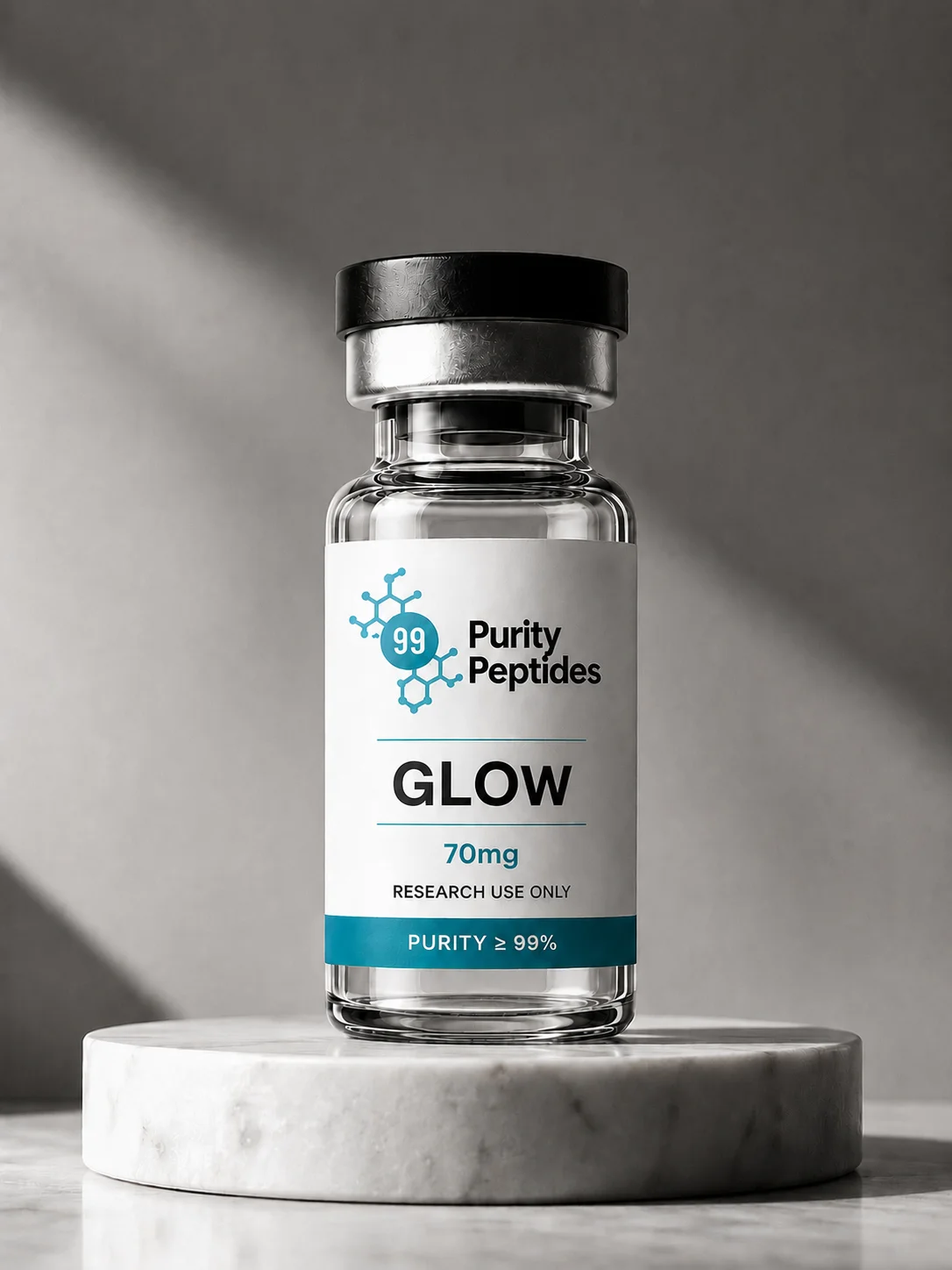

Two vials, three shared ingredients, and one compound that changes everything. That is the KLOW vs GLOW question in a sentence — and it is the question that trips up more researchers than any other blend comparison in the 99 Purity Peptides catalog.
Featured Products
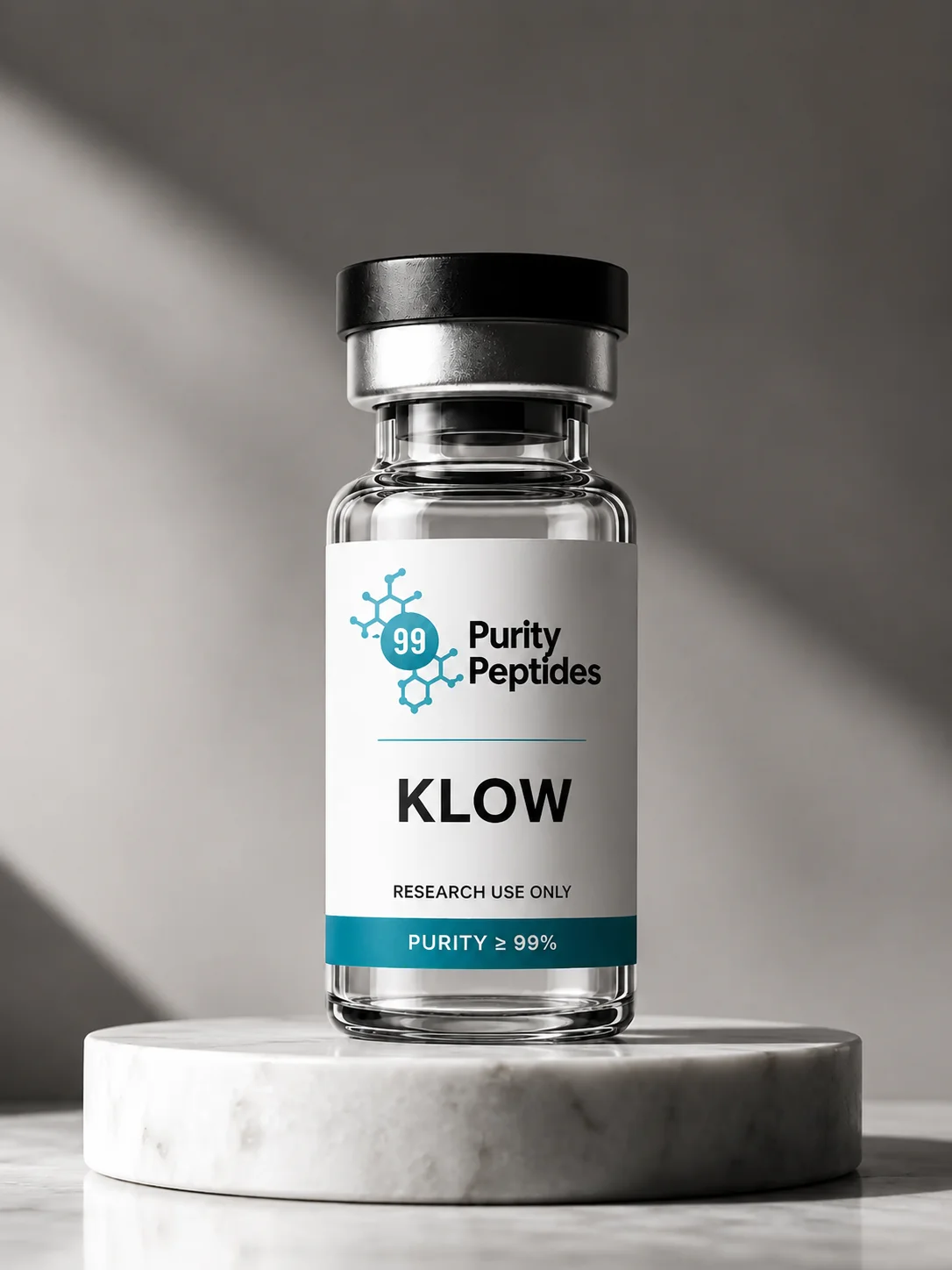
If you have spent time comparing the KLOW blend and the GLOW blend, you already know they look almost identical on paper. Both combine GHK-Cu, BPC-157, and TB-500. The difference is a single tripeptide, KPV, and whether your protocol needs it depends entirely on what you are studying.
This guide breaks down the KLOW peptide blend and the GLOW peptide blend side by side: exact ingredient lists, what each compound is thought to contribute in preclinical models, which blend fits which research application, and how the two compare on cost, purity documentation, and handling. By the end, you should be able to match the blend to the model instead of guessing.
QUICK ANSWER The KLOW blend combines GHK-Cu, KPV, BPC-157, and TB-500 in a single four-peptide vial. The GLOW blend uses three of those same compounds — GHK-Cu, BPC-157, and TB-500 — without KPV. KPV is the one formulation difference, and it shifts the blend's anti-inflammatory profile in preclinical models. Both are sold strictly for laboratory research use (RUO) and are not intended for human or animal consumption. |
What Is the KLOW Peptide Blend?
The KLOW peptide blend is a four-compound research formulation built around skin, connective tissue, and inflammation research. It combines GHK-Cu, KPV, BPC-157, and TB-500 in one lyophilized vial rather than requiring a researcher to source and combine four separate peptides.
Because the compounds arrive pre-combined at a standardized ratio, KLOW is commonly used in research designs that call for consistent, single-vial dosing across replicate samples — anywhere a lab wants to avoid the variability that comes from measuring and mixing four powders by hand.
KLOW Blend Ingredients
- GHK-Cu — copper tripeptide, studied for extracellular matrix and collagen-related research
- KPV — Lys-Pro-Val tripeptide, studied in anti-inflammatory and gut-skin axis models
- BPC-157 — pentadecapeptide, studied in tissue repair and angiogenesis research
- TB-500 — Thymosin Beta-4 fragment, studied in cell migration and wound-healing models
What Is the GLOW Peptide Blend?
The GLOW peptide blend is the three-compound counterpart to KLOW. It keeps GHK-Cu, BPC-157, and TB-500 in the same pre-combined format but leaves out KPV, producing a simpler formulation focused on skin and tissue-repair pathways without the added anti-inflammatory tripeptide.
Researchers who want the core skin-and-repair profile of KLOW without the inflammation-pathway variable that KPV introduces often start with GLOW, since fewer active compounds means fewer interacting variables to control for in a preclinical model.
GLOW Blend Ingredients
- GHK-Cu — copper tripeptide, shared with the KLOW formulation
- BPC-157 — pentadecapeptide, shared with the KLOW formulation
- TB-500 — Thymosin Beta-4 fragment, shared with the KLOW formulation
Every ingredient in GLOW also appears in KLOW. Nothing in GLOW is unique to it — which is exactly why the comparison keeps coming back to one compound.
KLOW vs GLOW: Side-by-Side Comparison Table
Featured Snippet Answer: KLOW contains four peptides (GHK-Cu, KPV, BPC-157, TB-500) while GLOW contains three (GHK-Cu, BPC-157, TB-500). KLOW's added KPV gives it a stronger anti-inflammatory and gut-skin axis research profile, while GLOW offers a simpler, lower-cost formulation for core skin and tissue-repair research.
Attribute | KLOW Blend | GLOW Blend |
|---|---|---|
Peptide count | 4 compounds | 3 compounds |
Core compounds | GHK-Cu, KPV, BPC-157, TB-500 | GHK-Cu, BPC-157, TB-500 |
Compound unique to this blend | KPV | None — all shared with KLOW |
Primary research focus | Skin repair + anti-inflammatory + gut-skin axis | Skin repair + tissue recovery |
Typical cost tier | Higher (4-peptide formulation) | Lower (3-peptide formulation) |
Best suited for | Inflammation-heavy or gut-skin axis models | Simpler, repair-focused models |
Format | Lyophilized powder, single vial | Lyophilized powder, single vial |
Intended use | Research Use Only (RUO) | Research Use Only (RUO) |
What Does Each Compound Contribute?
Understanding what each compound is studied for makes the KLOW vs GLOW decision easier, since the blends are really just different combinations of the same four building blocks.
GHK-Cu (Copper Tripeptide)
GHK-Cu is a naturally occurring copper-binding tripeptide studied extensively in dermal and extracellular matrix research. It appears in both KLOW and GLOW and is generally treated as the shared foundation of both blends' skin-research applications, including work on collagen type I synthesis and fibroblast proliferation.
KPV (Lys-Pro-Val Tripeptide)
KPV is the C-terminal fragment of alpha-melanocyte stimulating hormone and is the single compound that separates KLOW from GLOW. It is studied primarily in anti-inflammatory and gut-skin axis research, which is why KLOW is positioned as the broader, inflammation-inclusive option between the two blends.
BPC-157 (Pentadecapeptide)
BPC-157 is a synthetic pentadecapeptide derived from a protective protein found in gastric juice, studied widely in tissue-repair and angiogenesis research models. It is present in both blends and contributes to the shared repair-focused backbone that KLOW and GLOW have in common.
TB-500 (Thymosin Beta-4 Fragment)
TB-500 is a synthetic fragment of Thymosin Beta-4, studied for its role in actin regulation and cell migration during wound-healing research. Like BPC-157, it appears in both blends and supports the same repair-oriented research use case regardless of which formulation a lab chooses.
KLOW vs GLOW for Specific Research Applications
The right blend often comes down to the research model rather than a general preference. Here is how the two compare across the applications researchers ask about most.
Skin Barrier Research
Both blends are studied in skin barrier models because GHK-Cu, BPC-157, and TB-500 are common to each formulation. GLOW is frequently the starting point for skin-focused designs that do not need an inflammation variable, while KLOW is chosen when the study also examines inflammatory signaling alongside barrier repair.
Hair Follicle Research
Hair follicle studies typically lean on the same shared compounds as skin barrier research. Researchers comparing KLOW and GLOW for hair-focused models generally select based on whether inflammatory pathway data is part of the study design, not on hair-specific differences between the two.
Anti-Inflammatory Pathway Studies
This is where the two blends diverge most clearly. KLOW's inclusion of KPV makes it the more relevant option for anti-inflammatory pathway research, since GLOW's three-compound formulation does not include a peptide specifically associated with that mechanism.
Gut-Skin Axis Research
Gut-skin axis models — which examine the relationship between gut inflammation and dermal outcomes — are a KPV-dependent use case. KLOW is the blend built for this research angle; GLOW does not carry the compound most associated with gut-skin axis study designs.
Angiogenesis Research
Angiogenesis-focused research draws primarily on BPC-157, which both blends share. Neither formulation has a clear advantage here, so the choice usually comes down to whether the broader study also touches inflammation.
Which Peptide Blend Should Researchers Choose?
Comparison Snippet: choose KLOW when a study involves inflammation, immune signaling, or gut-skin axis research. Choose GLOW when a study is limited to skin barrier or tissue-repair research and does not require an inflammation-specific compound.
Research goal | Recommended blend | Why |
|---|---|---|
Inflammation or immune-signaling models | KLOW | Only KLOW includes KPV |
Gut-skin axis research | KLOW | KPV is the compound most linked to this pathway |
Core skin barrier repair | GLOW | Simpler formulation, fewer variables |
Tissue or wound-healing models | GLOW or KLOW | Both share BPC-157 and TB-500 |
Cost-constrained pilot studies | GLOW | Lower cost, three-compound formulation |
Broad, exploratory dermal research | KLOW | Covers a wider mechanistic range |
Cost Comparison: KLOW vs GLOW
As a four-peptide formulation, KLOW generally sits in a higher cost tier than GLOW's three-peptide formulation, reflecting the added compound and manufacturing step. GLOW's simpler formulation typically makes it the lower-cost entry point for labs comparing blended options against sourcing all peptides individually.
Either blend is generally positioned below the combined cost of purchasing GHK-Cu, KPV, BPC-157, and TB-500 as separate vials, since blending reduces per-unit packaging, testing, and shipping overhead. Researchers weighing a blend against individual compounds should factor in study design flexibility as well as price — a blend locks in a fixed ratio, while individual vials allow custom ratios.
Purity, Certificates of Analysis, and Third-Party Testing
Every batch of KLOW and GLOW sold for research use should ship with a Certificate of Analysis (COA) confirming identity and purity through methods such as HPLC and mass spectrometry verification. A COA is the fastest way to confirm that a blend's labeled ratio matches what is actually in the vial.
- Request the COA for the specific batch or lot number you are purchasing, not a generic reference COA
- Confirm purity testing method — HPLC and mass spectrometry are the current standard for peptide blend verification
- Check that the vendor discloses the exact peptide-to-peptide ratio, not just the ingredient list
- Favor vendors offering batch-specific, third-party lab testing over in-house-only results
Reconstitution and Storage Guidelines for Laboratory Use
Both KLOW and GLOW ship as lyophilized powder and are reconstituted with bacteriostatic water before laboratory use, following standard peptide-handling protocols. General storage and handling practices for lyophilized peptide blends include:
- Store unreconstituted vials refrigerated or frozen, protected from light, until ready for lab use
- Reconstitute using bacteriostatic water and standard sterile technique in a controlled lab environment
- Refrigerate reconstituted vials and use within the vendor's stated post-reconstitution window
- Avoid repeated freeze-thaw cycles, which can degrade peptide structure over time
- Label vials with reconstitution date and batch number for traceability across a study
These are general laboratory handling practices, not dosing or administration instructions. Specific reconstitution ratios and handling steps should follow the documentation provided with each batch and your institution's laboratory protocols.
Common Mistakes When Comparing Blended Peptides
- Assuming GLOW is simply a "weaker" KLOW — it is a different formulation for a different research scope, not a diluted version
- Choosing a blend based on price alone without checking whether the study needs KPV's research profile
- Skipping the COA check because the vendor is already familiar or previously trusted
- Treating individual-peptide research on GHK-Cu, KPV, BPC-157, or TB-500 as directly transferable to blend-specific outcomes
- Overlooking storage and reconstitution consistency when comparing results across replicate samples
Key Takeaways
- KLOW = GHK-Cu + KPV + BPC-157 + TB-500 (4 compounds); GLOW = GHK-Cu + BPC-157 + TB-500 (3 compounds)
- KPV is the only compound that separates the two blends, and it is the reason KLOW is positioned for anti-inflammatory and gut-skin axis research
- GLOW covers the same skin-repair foundation as KLOW at a lower cost and with fewer research variables
- Choose based on research goal first — inflammation and gut-skin axis studies favor KLOW; simpler skin or tissue-repair studies favor GLOW
- Both blends are sold strictly for laboratory research use (RUO) and require batch-specific COA verification before use
Frequently Asked Questions
Is the KLOW blend the same as the GLOW blend?
No. Both share GHK-Cu, BPC-157, and TB-500, but KLOW adds a fourth compound, KPV, that GLOW does not contain.
What's the exact ingredient list for KLOW vs GLOW?
KLOW contains GHK-Cu, KPV, BPC-157, and TB-500. GLOW contains GHK-Cu, BPC-157, and TB-500.
How many peptides are in KLOW compared to GLOW?
KLOW has four peptides. GLOW has three. The extra compound in KLOW is KPV.
Why does KLOW include KPV and GLOW does not?
KPV is studied for anti-inflammatory and gut-skin axis research, so it is included in KLOW to broaden the blend's research scope beyond GLOW's core repair-focused formulation.
Which blend is better for skin barrier research, KLOW or GLOW?
Both work for skin barrier research since they share GHK-Cu, BPC-157, and TB-500. GLOW is often preferred when a study wants fewer active variables, while KLOW is used when inflammation is also part of the model.
Which blend is better for gut-skin axis research?
KLOW, because KPV is the compound most closely associated with gut-skin axis research models.
Does the KLOW blend cost more than the GLOW blend?
Generally yes. KLOW's four-compound formulation typically sits in a higher cost tier than GLOW's three-compound formulation.
Can the individual peptides in KLOW or GLOW be purchased separately?
Yes, GHK-Cu, KPV, BPC-157, and TB-500 are each available as individual research compounds in addition to the pre-combined blends.
How is a KLOW or GLOW vial reconstituted for lab use?
Both are lyophilized powders reconstituted with bacteriostatic water using standard sterile laboratory technique, following the documentation provided with each batch.
How should KLOW and GLOW vials be stored before use?
Store unreconstituted vials refrigerated or frozen and protected from light. After reconstitution, refrigerate and use within the vendor's stated window, avoiding repeated freeze-thaw cycles.
What does a Certificate of Analysis show for a peptide blend?
A COA documents the batch's identity and purity, typically verified through HPLC and mass spectrometry testing, along with the peptide-to-peptide ratio.
Are KLOW and GLOW intended for human or animal use?
No. Both are sold strictly for laboratory research use only (RUO) and are not intended for human or animal consumption.
Is KLOW more potent than GLOW?
"Potency" is not the right frame — KLOW simply includes an additional compound, KPV, that broadens its research applications rather than making it a stronger version of GLOW.
Can KLOW and GLOW be studied in the same research model?
Some labs do run both blends in parallel research designs to compare outcomes with and without KPV, though study design should follow each lab's own protocol requirements.
Where can I find the Certificate of Analysis for a specific KLOW or GLOW batch?
Request the batch-specific or lot-specific COA directly from the vendor at the time of purchase rather than relying on a general reference document.