Research Use Only. KLOW is supplied for laboratory research. Not for human or veterinary use. No dosing protocol is provided. |
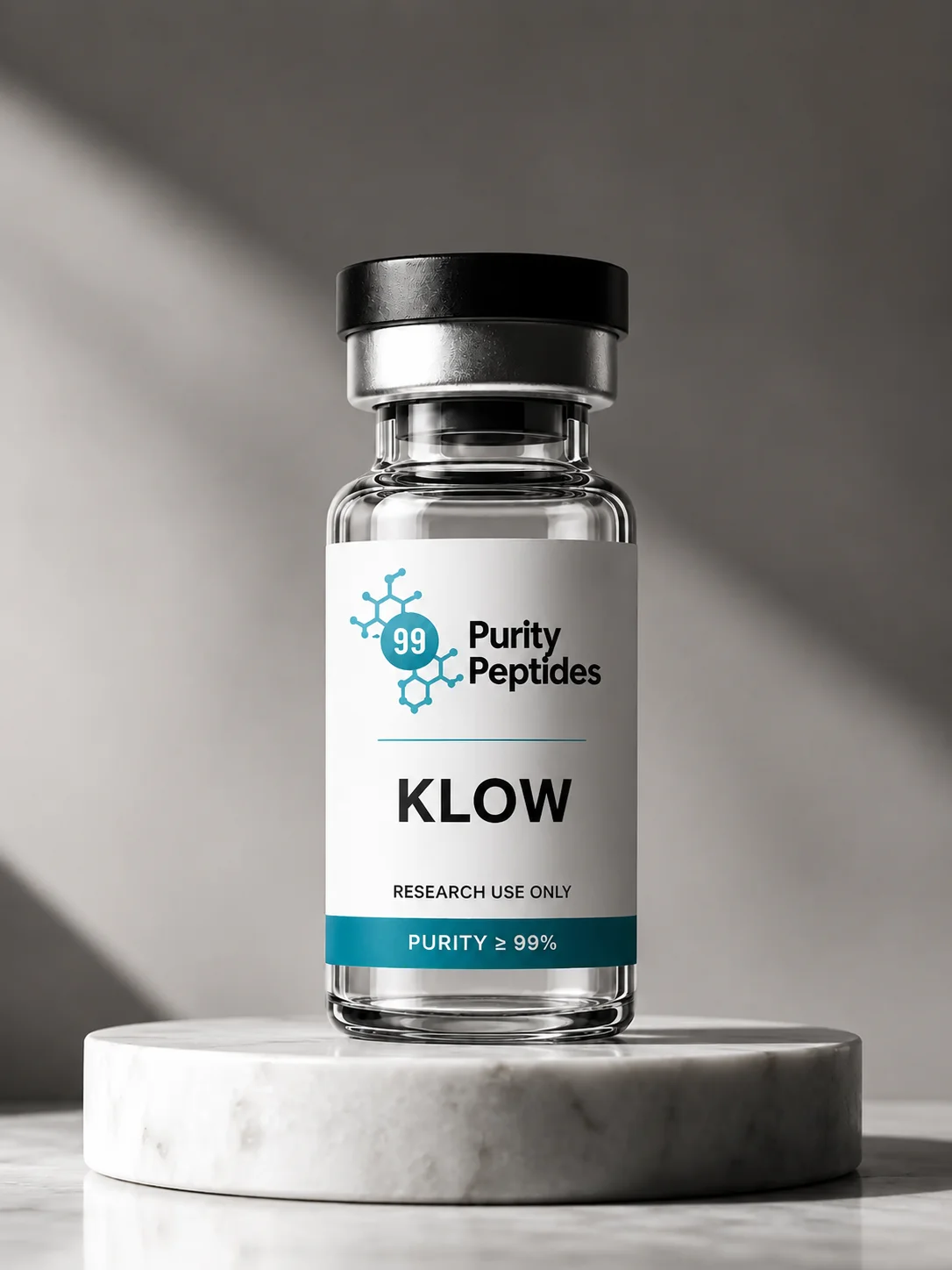
KLOW is a lyophilised research peptide blend containing four peptides in a single vial: GHK-Cu (a copper-binding tripeptide), KPV (a tripeptide fragment of α-MSH), BPC-157 (a fifteen-amino-acid peptide), and TB-500 (a fragment of thymosin β-4). The vial holds 80 mg total across all four. KLOW differs from the GLOW blend by the inclusion of KPV. It is supplied as a research-use-only material.
Quick answer
Four peptides, one vial, 80 mg total. GHK-Cu, KPV, BPC-157 and TB-500 are combined at a fixed ratio and freeze-dried together. BPC-157 carries 50 mg and the other three carry 10 mg each — verify the per-component mass on your own lot's certificate of analysis before calculating anything, since published specifications for this blend vary between suppliers.
Key takeaways
- KLOW contains four peptides. GLOW contains three. KPV is the difference.
- "80 mg" is the combined mass of all four — not the amount of any single one, and not a dose.
- The ratio is 50 / 10 / 10 / 10, with BPC-157 making up 62.5% of the vial by mass.
- Each component has its own preclinical literature. The blend itself has not been studied as a formulation.
- Every component is available individually if your work needs one in isolation.
What's actually in the vial
KLOW isn't a compound. It's four separate peptides that were combined at fixed masses and freeze-dried into a single cake.
Component | Mass per vial | Molecule type | Share of total |
|---|---|---|---|
BPC-157 | 50 mg | Pentadecapeptide (15 aa) | 62.5% |
GHK-Cu | 10 mg | Copper-bound tripeptide | 12.5% |
KPV | 10 mg | Tripeptide | 12.5% |
TB-500 | 10 mg | Thymosin β-4 fragment | 12.5% |
Total | 80 mg | — | 100% |
Three of the four sit at 10 mg. One sits at 50 mg and dominates the vial. That asymmetry is deliberate — a blend built around one primary component with three supporting ones — and it's the number that matters most, because it drives every concentration you'll calculate after reconstitution.
Published KLOW specifications vary between suppliers. Some list GHK-Cu as the 50 mg component; others, including our own lot documentation, list BPC-157. These are not interchangeable — they describe blends with a different primary component and completely different concentration maths. Check the per-component mass on your own lot's certificate of analysis rather than assuming a market standard. If a supplier can't produce a COA stating each component's mass separately, that answers a different question you should be asking.
What each component is
Short identity notes. For mechanism, pathway detail and the literature behind each one, that's in the full KLOW research guide.
BPC-157
A fifteen-amino-acid synthetic peptide, sequence GEPPPGKPADDAGLV, derived from a partial sequence of a protein found in gastric juice. Around 1,420 Da — by far the largest of the four by molecular weight. Has the deepest preclinical animal literature of any component here, and is the dominant component in our blend at 50 mg.
GHK-Cu
A tripeptide — glycine, histidine, lysine — bound to a copper(II) ion. It occurs naturally in human plasma and was first isolated in 1973. The copper is what gives reconstituted KLOW its faint blue tint. Appears in preclinical work on tissue remodelling and collagen-related processes.
KPV
Three amino acids: lysine, proline, valine. It's the tail end of α-melanocyte-stimulating hormone — the C-terminal fragment. Small, at roughly 342 Da. Appears in preclinical literature on inflammatory signalling and epithelial models. This is the component that separates KLOW from GLOW.
TB-500
A synthetic fragment corresponding to an active region of thymosin β-4, a peptide found in most mammalian cells. Worth knowing: TB-500 and thymosin β-4 are not the same molecule. Thymosin β-4 is a 43-amino-acid protein at roughly 4,960 Da. TB-500 is the shorter fragment. Suppliers use the names interchangeably; they shouldn't.
Why "80 mg" doesn't mean what people think
This trips up more people than anything else about KLOW.
80 mg is the sum of all four peptides, not a dose of anything. If you enter "80 mg" into a peptide calculator, you'll get the combined concentration — a real number, but not one you can use for any individual component.
Each peptide has its own concentration after reconstitution, proportional to its own mass. The 50 mg component ends up five times more concentrated than each of the 10 mg ones — in the same liquid, in the same syringe draw. Every aliquot carries all four at that locked ratio.
To get per-component figures, run the calculation four times, once per component mass, against the same diluent volume.
KLOW 80 mg concentration reference →
KLOW vs GLOW: what's actually different
KLOW | GLOW | |
|---|---|---|
Components | 4 | 3 |
GHK-Cu | ✓ | ✓ |
BPC-157 | ✓ | ✓ |
TB-500 | ✓ | ✓ |
KPV | ✓ | ✗ |
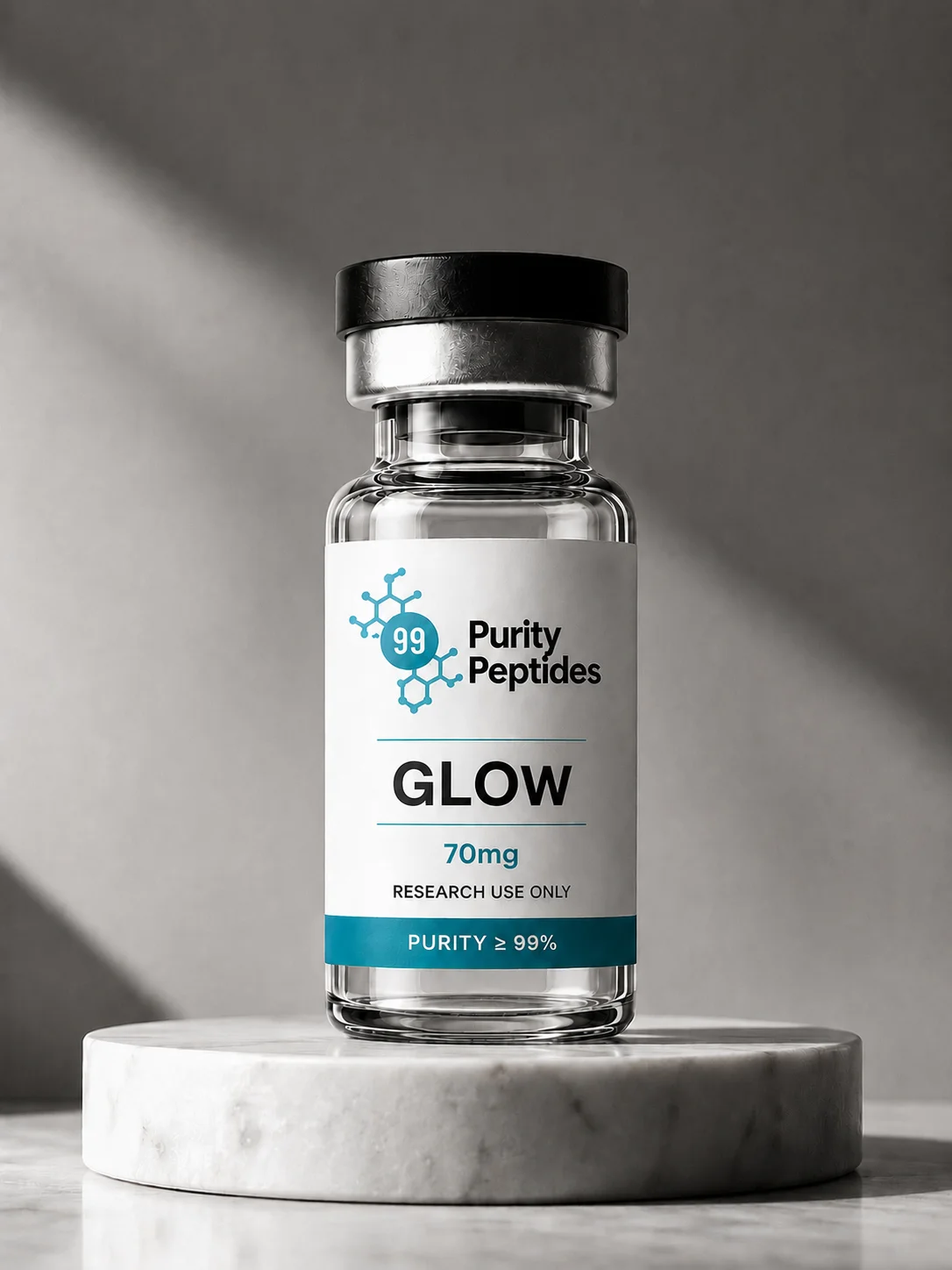
Total mass | 80 mg | 70 mg |
KPV is the only compositional difference. GLOW is the same three regenerative peptides without it. That's the whole answer — everything else people say about choosing between them follows from whether KPV's research context matters to what they're studying.
Full KLOW vs GLOW comparison →
What KLOW is used for in research
Each of the four components has its own body of preclinical literature — GHK-Cu in tissue remodelling models, KPV in inflammatory and epithelial models, BPC-157 in soft-tissue repair models, TB-500 in cell migration and angiogenesis models.
The blend exists so all four can be handled as one preparation instead of four. That's a practical convenience, not a scientific claim.
Be clear about what the evidence covers. The individual components have independent preclinical literature, almost entirely in animal and cell models. The KLOW formulation itself — these four peptides, at this ratio — has not been characterised in published peer-reviewed research. Anything you read about "KLOW's effects" is describing the components separately and inferring the combination. That inference may be reasonable. It is not the same as evidence.
Handling and storage
Lyophilised KLOW is stored cold, typically frozen for longer-term retention. Once reconstituted it needs refrigeration — peptides in solution are considerably less stable than freeze-dried ones.
One blend-specific note: each component degrades on its own schedule, and the least stable one sets the practical limit for the whole solution. With a copper-containing component in the mix, oxidation is worth paying attention to. Follow the storage conditions on your product documentation rather than a general rule.
Reconstitution itself follows the same principles as any lyophilised peptide. How much bacteriostatic water to add →
No dosing protocol is provided here or anywhere on this site. KLOW is a research material. The concentration reference page covers the mathematics of what's in a given volume — that's a measurement question, and it's answerable. What quantity anyone should take is not a question we answer.
How to verify what's in your vial
- Request the lot-matched COA — not a generic sample certificate, the one matching the lot number on your vial.
- Confirm per-component mass is stated separately for all four peptides, not just a total.
- Confirm the HPLC chromatogram resolves four peaks, not one composite purity figure.
- Confirm LC-MS identity data for each peak, so molecular weight verifies what each peak actually is.
View certificates of analysis →
In short
Four peptides, 80 mg total, one of them (BPC-157) at 50 mg and three at 10 mg. KPV is what makes it KLOW rather than GLOW. The components have their own research literature; the blend doesn't have its own.
And check the per-component mass on your COA. Published specifications for this blend genuinely disagree with each other, and every calculation you make afterwards depends on getting that right.
View KLOW 80 mg (Research Use Only) →
References
- Sikiric P, et al. Stable gastric pentadecapeptide BPC 157: novel therapy in gastrointestinal tract. Curr Pharm Des.
- Pickart L, Margolina A. Regenerative and protective actions of the GHK-Cu peptide. Int J Mol Sci. 2018.
- Goldstein AL, et al. Thymosin beta 4: a multi-functional regenerative peptide. Ann N Y Acad Sci.
Methodology. Composition figures on this page reflect the per-component mass stated on our own current lot certificates of analysis, cross-checked against our published KLOW research guide and reconstitution reference for consistency. Published third-party specifications for blends carrying the KLOW name vary; we report what our own documented material contains.
Editorial policy. 99 Purity Peptides content is reviewed before publication and updated when analytical standards or specifications change. Corrections are logged with the update date.
Research transparency. Lot-matched certificates for all current material, including per-component mass and identity data, are published in our certificate library.
A note on this page. This is an educational overview, not individualized guidance. We source the figures above from our own lot documentation, and we encourage you to verify any composition claim — ours included — against the certificate of analysis for the specific lot you receive.
Research Use Only. KLOW and its components are supplied for laboratory research purposes. They are not drugs, foods, cosmetics, or medical devices, and are not for human or veterinary use.
Frequently Asked Questions
What is in KLOW?
KLOW contains four peptides in a single lyophilised vial: BPC-157, GHK-Cu, KPV and TB-500. The vial holds 80 mg of peptide in total. Three components are present at 10 mg each and one, BPC-157, at 50 mg. The exact split is stated on your lot's certificate of analysis.
What peptides are in KLOW?
Four: BPC-157, a fifteen-amino-acid peptide; GHK-Cu, a copper-bound tripeptide; KPV, a tripeptide fragment of α-MSH; and TB-500, a fragment of thymosin β-4. They are combined at fixed masses and freeze-dried together in one vial.
How many peptides are in KLOW?
Four. That's what distinguishes it from GLOW, which contains three of the same peptides and omits KPV. Both are supplied as single lyophilised vials rather than as separate components to be combined by the researcher.
How much of each peptide is in KLOW?
BPC-157 is present at 50 mg, and GHK-Cu, KPV and TB-500 are each present at 10 mg, totalling 80 mg. Published specifications differ between suppliers as to which component carries the 50 mg. Verify the per-component mass on your own lot's certificate of analysis before calculating anything.
Why do KLOW specifications differ between suppliers?
Different suppliers publish different per-component masses for what they each call KLOW. The name is a product designation rather than a standardised formulation, so no regulatory body enforces a single specification. This is why the COA, not the product name, is the source of truth.
How much GHK-Cu is in KLOW?
In our material, GHK-Cu is present at 10 mg per 80 mg vial, one of three components at that mass. Some suppliers publish specifications listing GHK-Cu as the 50 mg component instead — confirm the figure against your own lot's certificate of analysis, since that difference changes every downstream concentration calculation.
How much BPC-157 is in KLOW?
In our material, BPC-157 is the dominant component at 50 mg per 80 mg vial — 62.5% of total mass. This is stated on the lot certificate of analysis. Some third-party specifications list a different component as dominant, which is why verifying against your own COA matters.
How much KPV is in KLOW?
KPV's mass is stated on the lot certificate of analysis. It is one of the three components present at 10 mg. KPV is present in KLOW and absent from GLOW, which is the sole compositional difference between the two blends.
What does 80 mg mean on a KLOW vial?
It's the combined mass of all four peptides, not the amount of any single one and not a dose. Each component contributes its own portion of that total. Entering 80 mg into a peptide calculator gives you the combined concentration, not a per-component figure.
Is 80 mg the dose?
No. It's the total peptide content of the vial before any diluent is added. Concentration only exists once you've added a specific volume. KLOW is a research-use-only material and no dosing guidance is provided here or elsewhere on this site.
What does the K in KLOW stand for?
The name is a product designation assembled from component references rather than a scientific term. KLOW does not appear in chemical nomenclature or in peer-reviewed literature. Researchers writing for publication would name the four component peptides individually instead.
Is KLOW a single peptide?
No. It's four distinct peptides supplied together in one vial. Each keeps its own identity, molecular weight and separate research literature. The vial's 80 mg figure is the sum of all four, not a property of a single compound.
What is GHK-Cu?
A tripeptide made of glycine, histidine and lysine, bound to a copper(II) ion. It occurs naturally in human plasma and was first isolated in 1973. The copper content is what gives reconstituted KLOW its faint blue colour.
What is KPV?
A tripeptide of lysine, proline and valine, corresponding to the C-terminal fragment of α-melanocyte-stimulating hormone. At roughly 342 daltons it's the smallest component in the blend. KPV is the component that distinguishes KLOW from GLOW.
What is BPC-157?
A synthetic fifteen-amino-acid peptide with the sequence GEPPPGKPADDAGLV, derived from a partial sequence of a protein found in gastric juice. At around 1,420 daltons it's the largest of the four components by molecular weight, and the dominant component by mass in our blend.
What is TB-500?
A synthetic fragment corresponding to an active region of thymosin β-4, a peptide found in most mammalian cells. It appears in preclinical research on cell migration and tissue remodelling, and is supplied for research use only.
Is TB-500 the same as thymosin beta-4?
No, though suppliers often use the names interchangeably. Thymosin β-4 is a 43-amino-acid protein of roughly 4,960 daltons. TB-500 is a shorter synthetic fragment of it. They are related molecules with different molecular weights, and the distinction matters for any calculation.
Why is reconstituted KLOW blue?
The faint blue tint comes from the copper(II) ion in GHK-Cu. Copper complexes are characteristically blue in solution. A light blue colour after reconstitution is expected in a blend containing GHK-Cu, not a sign of contamination.
What is the difference between KLOW and GLOW?
GLOW contains GHK-Cu, BPC-157 and TB-500 at 70 mg total. KLOW contains those three plus KPV at 80 mg total. The presence of KPV is the only compositional difference. Component masses within each blend differ, so check both specifications separately.
Can the KLOW components be bought separately?
Yes. GHK-Cu, KPV, BPC-157 and TB-500 are each available as individual research peptides. A blend is supplied for convenience of handling. Researchers investigating a single mechanism in isolation, or needing to attribute an effect to one component, typically use individual peptides instead.
Has the KLOW blend itself been studied?
The four components have their own independent preclinical literature, largely in animal and cell models. The blend as a specific four-component formulation has not been characterised in published peer-reviewed research. Any described research context refers to the components individually.
Is KLOW research use only?
Yes. KLOW is supplied strictly for laboratory research and is not intended for human or veterinary use, diagnostic procedures, or any therapeutic application. No dosing protocol is provided and none should be inferred from composition information.