Research Use Only. KLOW and all materials referenced on this page are supplied strictly for laboratory research. They are not drugs, foods, cosmetics, or medical devices. They are not for human or veterinary use and are not intended for ingestion, injection, or any form of administration. Nothing on this page is medical advice, and no amount, frequency, or duration of administration to a person or animal is described, recommended, or implied.
Quick Answer: How Is a KLOW 80mg Vial Reconstituted?
Quick Answer
A KLOW 80mg vial is reconstituted by adding bacteriostatic water down the inner wall of the vial and swirling gently until the powder dissolves. Total concentration equals 80 mg divided by the volume added, so 2 mL yields 40 mg/mL and 3 mL yields approximately 26.7 mg/mL. Because KLOW is a four-component 50/10/10/10 blend, each peptide carries its own concentration — that component's mass divided by the same volume. Store the sealed lyophilized vial cold and protected from light, and keep the reconstituted solution refrigerated.
Key Takeaways
- The math is division, not a lookup. Concentration in mg/mL equals total peptide mass divided by the volume of diluent added. Nothing else changes it.
- KLOW is 80 mg split 50/10/10/10 across four peptides. One component carries 50 mg; the other three carry 10 mg each.
- A blend has four concentrations, not one. The total blend figure is almost never the number a protocol actually needs.
- Supplier specifications disagree on which component carries the 50 mg. Verify against the lot documentation for the vial in hand rather than against any published guide, including this one.
- "80 mg" is a label mass, not necessarily 80 mg of peptide. Net peptide content shifts every concentration downward.
- Equal mass does not mean equal molarity. The four components differ in molecular weight by more than an order of magnitude.
- The lyophilized vial and the reconstituted vial are two different stability problems. Cold and dry is stable for a long time; cold and wet is not.
- A sterility and endotoxin report is not a purity certificate. They answer different questions and both are worth having.
What This Page Covers — and What It Does Not
This page covers preparation chemistry: diluent volume, resulting concentration, molecular weight, storage temperature, and lot verification. Those are properties of the material in the vial.
This page does not publish amounts, frequencies, cycle lengths, or administration schedules. That omission is deliberate, and the reason is straightforward.
KLOW's components have no established human dosing profile. BPC-157 and TB-500 have never completed a pivotal human efficacy trial for tissue repair. Neither has KPV. Published protocol figures for all four come overwhelmingly from rodent and cell-culture work, expressed as µg/kg or mg/kg against a specific model, species, and route. No published study has tested this four-peptide combination at these ratios in any species.
Converting rodent mass-normalized figures into a volume drawn from an 80 mg vial requires assumptions that the literature does not support. A page that published such a table would be inventing it. So this page gives the preparation math, which is real, and stops where the evidence stops.
Researchers designing a protocol should derive target concentrations from their own model, their own institutional review, and the primary literature for the specific endpoint under study.
What Is Actually in a KLOW 80mg Vial?
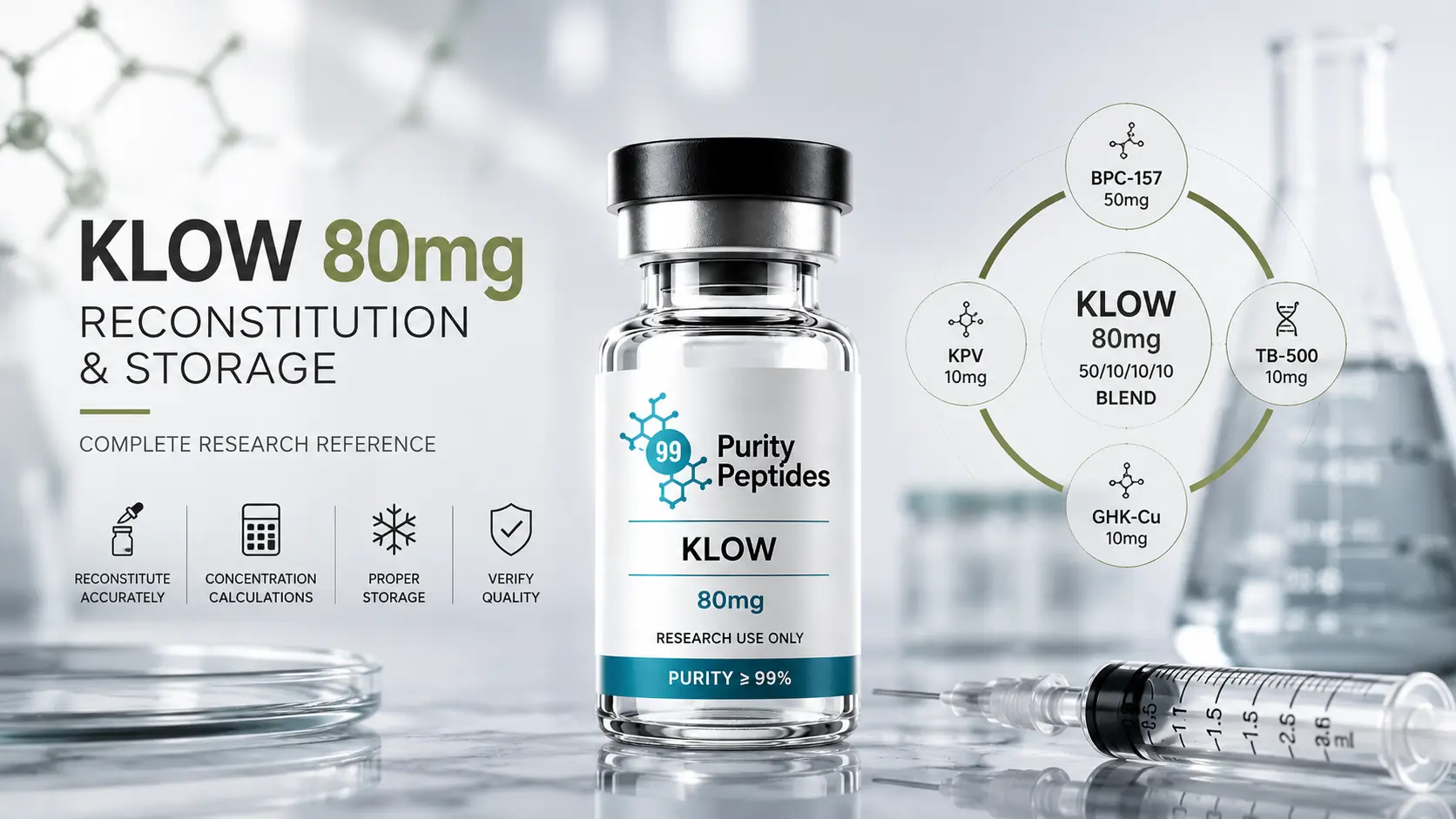
KLOW is a co-lyophilized blend of four synthetic research peptides in a single vial:
- BPC-157 — a 15-residue peptide, sequence GEPPPGKPADDAGLV, molecular weight approximately 1,419 Da
- TB-500 — a synthetic fragment related to thymosin beta-4
- GHK-Cu — the tripeptide glycyl-L-histidyl-L-lysine bound to copper(II)
- KPV — the tripeptide L-lysyl-L-prolyl-L-valine
Total labeled mass is 80 mg, distributed in a 50/10/10/10 ratio. One peptide carries 50 mg. The remaining three carry 10 mg each. The blend arrives pre-mixed and cannot be separated after manufacture.
For the full composition breakdown, including how KLOW differs from the three-component GLOW blend, see what is in KLOW peptide blend.
Which Component Carries the 50 mg?
Supplier specifications disagree, and the disagreement is worth knowing about before running any calculation.
Some sources assign the 50 mg to BPC-157 and 10 mg to GHK-Cu. Others assign 50 mg to GHK-Cu and 10 mg to BPC-157. Both specifications circulate widely, and both are published as fact.
The ratio itself is not in dispute. Every source describes one 50 mg component and three 10 mg components. Only the identity of the 50 mg component varies.
Note: This ambiguity does not affect total blend concentration, which depends only on the 80 mg total. It changes per-component concentration by fivefold for two of the four peptides. Any protocol that depends on BPC-157 or GHK-Cu concentration specifically must confirm the assignment against the lot documentation for the vial in hand.
The practical response is to treat the ratio as known and the assignment as lot-specific. The tables below are built that way — they report concentrations for "the 50 mg component" and "each 10 mg component," so they remain correct regardless of how a given lot resolves the question.
How Do You Calculate KLOW Concentration After Reconstitution?
The formula is a single division:
Concentration (mg/mL) = peptide mass (mg) ÷ diluent volume (mL)
Work it in three steps.
Step 1 — Identify the mass that matters. For total blend concentration, use 80 mg. For a single component, use that component's mass: 50 mg or 10 mg.
Step 2 — Choose the diluent volume. This is the researcher's decision. The vial does not specify it. More volume produces a lower concentration and a larger measurable draw; less volume produces a higher concentration in a smaller volume.
Step 3 — Divide. A 10 mg component reconstituted in 2 mL gives 10 ÷ 2 = 5 mg/mL. Multiply by 1,000 to convert to µg/mL: 5,000 µg/mL.
Run the calculation once per component. A single-vial peptide calculator assumes one peptide per vial, so entering 80 mg returns the total blend concentration only. To get per-component figures, enter each mass separately against the same volume.
The site's peptide reconstitution calculator handles this directly — run it four times, once per component mass, holding the volume constant.
KLOW 80mg Reconstitution Reference Table
The following table reports resulting concentrations across common diluent volumes. All figures are the label mass divided by the stated volume.
Bacteriostatic water added | Total blend (80 mg) | 50 mg component | Each 10 mg component | Each 10 mg component (µg/mL) |
|---|---|---|---|---|
1.0 mL | 80.0 mg/mL | 50.0 mg/mL | 10.0 mg/mL | 10,000 µg/mL |
1.5 mL | 53.3 mg/mL | 33.3 mg/mL | 6.67 mg/mL | 6,670 µg/mL |
2.0 mL | 40.0 mg/mL | 25.0 mg/mL | 5.00 mg/mL | 5,000 µg/mL |
2.5 mL | 32.0 mg/mL | 20.0 mg/mL | 4.00 mg/mL | 4,000 µg/mL |
3.0 mL | 26.7 mg/mL | 16.7 mg/mL | 3.33 mg/mL | 3,330 µg/mL |
5.0 mL | 16.0 mg/mL | 10.0 mg/mL | 2.00 mg/mL | 2,000 µg/mL |
Two notes on reading this table.
First, the "3 mL" that appears in some KLOW product listings describes the vial's nominal capacity, not a required diluent volume. Filling a 3 mL vial to 3 mL leaves almost no headspace, which makes swirling and withdrawal awkward. Many laboratories use less.
Second, these are label-mass figures. The next section explains why the true concentration is usually slightly lower.
For a cross-check on any figure here, see the KLOW reconstitution and concentration reference.
Does Net Peptide Content Change These Numbers?
Yes, and it is the most commonly skipped correction in blend work.
A vial labeled 80 mg contains 80 mg of lyophilized solid. That solid is not pure peptide. It also contains counterions from purification — typically acetate or trifluoroacetate — along with residual water and bound salts.
Net peptide content is the fraction of that solid mass that is actually peptide. It commonly falls between 70% and 85% for synthetic peptides, and it is reported separately from HPLC purity. The two figures answer different questions. Purity describes what fraction of the peptide present is the correct sequence. Net peptide content describes what fraction of the powder is peptide at all.
If a lot reports 80% net peptide content, an 80 mg vial holds roughly 64 mg of peptide. Every figure in the table above then shifts down by the same 20%. At 2 mL, the total is closer to 32 mg/mL than 40 mg/mL.
Note: Net peptide content and HPLC purity are independent. A lot can report ≥99% purity and 78% net peptide content simultaneously, and both figures can be accurate. Protocols that require a known absolute concentration should apply the net peptide correction before use.
Why Equal Mass Does Not Mean Equal Molarity
Three of KLOW's components carry the same 10 mg. They do not deliver the same number of molecules, because they differ sharply in molecular weight.
Component | Approximate molecular weight | Relative molar amount at equal mass |
|---|---|---|
KPV (Lys-Pro-Val) | ~342 Da | Highest |
GHK (tripeptide alone) | ~340 Da | Highest |
GHK-Cu (copper complex) | ~400 Da | High |
BPC-157 | ~1,419 Da | Moderate |
TB-500 (Ac-LKKTETQ fragment) | ~889 Da | Moderate |
Thymosin beta-4 (full 43-residue peptide) | ~4,963 Da | Lowest |
At an identical 10 mg/mL, KPV delivers roughly four times the molar concentration of BPC-157 and more than fourteen times that of full-length thymosin beta-4. Assays that depend on receptor occupancy, binding stoichiometry, or molar ratio need the molar figure, not the mass figure.
The TB-500 Identity Problem
This matters most for TB-500, because the name refers to two different molecules depending on the supplier.
Some suppliers define TB-500 as the acetylated heptapeptide Ac-LKKTETQ, corresponding to residues 17–23 of thymosin beta-4 — the actin-binding domain, around 889 Da. Others supply full-length thymosin beta-4, a 43-residue peptide of roughly 4,963 Da.
The mass difference is more than fivefold. A vial containing 10 mg of the heptapeptide holds over five times the molar quantity of a vial containing 10 mg of the full-length peptide. Mass-based reconstitution math cannot detect the difference.
Most published thymosin beta-4 research used the full-length peptide, not the short fragment. Papers describing actin sequestration, including the foundational work by Sanders, Goldstein and Wang (PNAS 1992; PMID 1584803), studied the intact 43-residue molecule. Protocols derived from that literature and applied to a heptapeptide vial are not measuring the same compound.
Confirm the format on the lot documentation before converting mass to molarity.
Which Diluent Should Be Used for KLOW?
Bacteriostatic water is the standard choice for a multi-withdrawal vial. It is sterile water containing 0.9% benzyl alcohol as a preservative, which suppresses microbial growth across repeated septum punctures.
Sterile water for injection contains no preservative. It is appropriate for a single-withdrawal preparation but offers no protection once the septum has been entered more than once.
Some peptides require an acidic diluent for solubility. Dilute acetic acid is the usual option. KLOW's components dissolve readily in aqueous solution, so an acidic diluent is not normally required — but pH is worth attention for a copper-containing blend, for reasons covered below.
Whichever diluent is used, record it. Diluent identity and pH affect degradation rate, and a protocol that does not record them cannot explain an anomalous result later.
How Should a KLOW Vial Be Reconstituted?
Technique matters more for a co-lyophilized blend than for a single peptide, because four compounds must go into solution together without shear or local pH excursions.
- Let the vial reach room temperature before opening. Opening a cold vial pulls in warm, humid air that condenses onto the powder. Moisture restarts the hydrolytic pathways that lyophilization was meant to stop.
- Disinfect the septum. Wipe with 70% isopropyl alcohol and allow it to dry.
- Add diluent down the inner wall. Angle the needle so the stream runs down the glass rather than striking the powder cake directly. Direct impact drives foaming and localized shear.
- Swirl — do not shake. Rotate the vial gently. Shaking generates an air-liquid interface that promotes aggregation and surface denaturation.
- Allow full dissolution before withdrawal. Most of the cake dissolves within a minute or two. Leave the vial upright until the solution is completely clear.
- Inspect before use. A properly reconstituted blend is clear. Persistent cloudiness, visible particulates, or floccules indicate a problem worth investigating before the material enters an experiment.
- Label immediately. Record the lot number, diluent, volume added, resulting concentrations, date, and time.
For general technique across all vial formats, see the peptide storage and handling guide.
Does KLOW Need to Be Refrigerated?
Yes — and the answer differs depending on whether the vial is still lyophilized.
Lyophilized (unopened, dry). Sealed lyophilized peptide is comparatively robust. Published formulation work reports that most lyophilized peptides remain stable for years at −20 °C when protected from light and moisture. Refrigeration at 2–8 °C is acceptable for shorter horizons, and short periods at ambient temperature during shipping do not generally compromise dry material. Lot documentation for KLOW commonly specifies refrigerated storage on that basis.
Reconstituted (in solution). Once water is present, the picture changes. Hydrolysis, deamidation, and oxidation all proceed in solution and all accelerate with temperature. Refrigerate the reconstituted vial at 2–8 °C, keep it dark, and treat its usable window as short.
Condition | Storage | Practical horizon |
|---|---|---|
Lyophilized, sealed | −20 °C, dark, dry | Long-term; years for most peptides |
Lyophilized, sealed | 2–8 °C, dark, dry | Medium-term |
Lyophilized, in transit | Ambient | Short exposure generally tolerated |
Reconstituted | 2–8 °C, dark | Short; days to a small number of weeks |
Reconstituted, aliquoted | Frozen aliquots | Extends usable life; avoids repeat thaw |
Three handling rules apply across all of these.
Avoid repeated freeze-thaw. Each cycle drives aggregation and accelerates oxidation. Aliquot into single-use volumes rather than thawing a stock vial repeatedly.
Protect from light. Aromatic residues undergo photochemical degradation, and light also drives metal-catalyzed pathways.
Minimize septum punctures. Every entry introduces air and a contamination opportunity, even with a preservative present.
Why Does a Copper-Containing Blend Need Extra Care?
This is the consideration most specific to KLOW, and most reconstitution guides omit it.
GHK-Cu is not simply a peptide. It is a tripeptide bound to copper(II), and copper is redox-active. In a co-lyophilized blend, that copper sits in the same vial as three other peptides — and enters the same solution when the vial is reconstituted.
Metal-catalyzed oxidation is a well-characterized degradation pathway. Copper(II) in the presence of oxygen and a reducing agent generates reactive oxygen species that attack susceptible residues. Histidine is a primary target, converting to 2-oxo-histidine and, in some systems, forming cross-links and multimers. Methionine, cysteine, and tryptophan are also vulnerable.
Two of KLOW's components carry residues in that category. GHK contains histidine. Full-length thymosin beta-4 contains a methionine at position 6 — the acetylated heptapeptide fragment does not, which is another reason the TB-500 format question matters.
Work by Khossravi and Borchardt on metal-catalyzed oxidation of histidine in model peptides found that degradation proceeded faster at pH 7.4 than at pH 5.3 (PMID 9688066). A mildly acidic environment slows the reaction. Bacteriostatic water sits near neutral.
Note: No published stability study has characterized this specific four-peptide blend in solution. The chemistry above describes documented degradation pathways for the residue types present, not measured degradation of KLOW. The practical implication is conservative: treat a reconstituted copper-containing blend as less stable than a single-peptide solution, keep it cold and dark, and prefer shorter working windows.
What Are the Most Common KLOW Reconstitution Mistakes?
Treating the total blend concentration as each component's concentration. Entering 80 mg into a calculator returns the blend figure. At 2 mL that is 40 mg/mL — but no single component in the vial is at 40 mg/mL. Three of them are at 5 mg/mL.
Reading "3 mL" as an instruction. The figure describes the vial. Diluent volume is a protocol decision.
Assuming the 50 mg component's identity. Sources conflict. Confirm against lot documentation.
Skipping the net peptide content correction. Label mass and peptide mass are different numbers.
Confusing biological stability with storage stability. BPC-157 is widely described as stable in human gastric juice for over 24 hours. That is a finding about proteolytic resistance in a specific biological fluid. It says nothing about how the peptide behaves in a warm vial on a bench.
Shaking the vial. Foaming creates an air-liquid interface that promotes aggregation. Swirl instead.
Repeated freeze-thaw of the working vial. Aliquot once, then draw from aliquots.
Assuming purity figures transfer to the blend. A "≥99% purity" claim for a four-component product should be read as a per-component specification. Confirm the lot document reports each component separately.
How Do You Verify a KLOW Lot Before Use?
Lot verification is what makes a reconstitution calculation trustworthy. The arithmetic is only as good as the mass figure it starts from.
Check that the documentation for the specific lot reports the following:
- Lot number matching the vial label. A certificate for a different lot describes different material.
- HPLC purity, per component. For a blend, a single aggregate purity figure is less informative than four component figures.
- Mass spectrometry identity confirmation. Purity says how much of one thing is present. Identity confirms it is the right thing. Observed mass should match theoretical mass for the stated sequence — and for TB-500, this is where the fragment-versus-full-length question is settled.
- Net peptide content. Required for any absolute-concentration work.
- Component masses. The document should state which peptide carries which mass.
- Testing laboratory and date. A named, verifiable laboratory with a report date.
Note: A sterility test and a bacterial endotoxin test are microbiological results. They confirm the absence of viable organisms and pyrogens. They do not report purity, identity, or peptide content. Both classes of testing are useful, and neither substitutes for the other. If a certificate reports only microbiological results, the purity and identity questions remain open.
Batch documentation for current lots is published in the certificates library. For a fuller walkthrough of analytical release testing and what each method establishes, see how peptide labs ensure purity.
What Have the Individual Components Been Studied For?
Each component has its own literature. None of it addresses the blend, and all of it is preclinical unless otherwise noted.
BPC-157 has been studied in rodent models for cytoprotective and tissue-healing endpoints, with reported effects on gastrointestinal mucosal integrity, tendon and muscle injury, and vascular responses. The research program is associated primarily with Sikiric and colleagues at the University of Zagreb (PMC11053547).
Thymosin beta-4 has been studied as the principal intracellular G-actin sequestering protein in mammalian cells, and subsequently for roles in cell migration, angiogenesis, and dermal and corneal repair models (PMID 1584803).
GHK-Cu has been studied for tissue remodeling and gene-expression effects, including reported influence on collagen and extracellular matrix signaling in fibroblast and wound models (PMC6073405).
KPV, the C-terminal tripeptide of α-MSH, has been studied for anti-inflammatory signaling in intestinal and epithelial models, reported to act through NF-κB modulation and without the pigmentary activity of the parent hormone (PMID 18061177).
For background on how these four compounds are grouped and compared, see the KLOW peptide blend research guide.
Closing
Reconstitution is the point where a documented material becomes an experimental variable. The arithmetic is simple — one division, repeated per component — but the inputs deserve scrutiny. Label mass is not peptide mass. Equal mass is not equal molarity. A blend has four concentrations, and published specifications do not fully agree on which peptide carries which.
Verify the lot, record the diluent and volume, and store the dry vial and the reconstituted vial as the two different problems they are.
Full product specifications and current lot documentation are available on the KLOW product page.
Frequently Asked Questions
Can sterile water be used instead of bacteriostatic water?
Yes, but only for a single-withdrawal preparation. Sterile water for injection contains no preservative, so it offers no protection against microbial growth once the septum has been punctured. Bacteriostatic water contains 0.9% benzyl alcohol and is the appropriate choice for any vial that will be entered more than once. Record which diluent was used either way.
Why is the reconstituted solution blue or blue-tinted?
The color comes from GHK-Cu. Copper(II) complexes absorb in the visible range, giving the lyophilized powder a white-to-pale-blue appearance and the reconstituted solution a blue tint. This is expected for any GHK-Cu-containing blend and is not a defect. A sudden color change during storage, however, is worth investigating as a possible degradation signal.
My vial arrived at room temperature after shipping. Is it compromised?
Probably not, if it is still lyophilized and sealed. Dry peptide is comparatively tolerant of short ambient exposure, which is why cold-chain shipping is a precaution rather than a strict requirement for lyophilized material. Move it to refrigerated or freezer storage on arrival. Extended exposure to heat, or a vial that arrives already in solution, is a different situation.
How long does reconstituted KLOW remain usable?
Shorter than most researchers assume. Peptide solutions are generally handled on a days-to-weeks horizon at 2–8 °C, and no published stability study has characterized this specific blend in solution. The copper content argues for the conservative end of that range. Aliquoting and freezing extends usable life while avoiding repeated freeze-thaw of a single stock vial.
Can a reconstituted vial be re-dried and stored as powder?
Not in a general laboratory setting. Lyophilization is a controlled process involving freezing, primary drying under vacuum, and secondary drying, typically with a cryoprotectant present. Attempting to evaporate a reconstituted vial concentrates salts, exposes the peptides to prolonged solution-phase stress, and produces material of unknown composition. Reconstitute only the amount that will be used.
Why has the powder not fully dissolved?
Give it more time before intervening — a co-lyophilized cake can take a minute or more. If material remains after that, check whether the diluent stream struck the cake directly and compacted it, whether the vial was shaken rather than swirled, or whether the volume added is too small for the mass present. Gentle warming to room temperature and continued swirling usually resolves it.
Does the standard peptide calculator work for a blend?
It works, but it must be run once per component. A single-vial calculator assumes one peptide per vial, so entering 80 mg returns the total blend concentration rather than any individual component's concentration. Enter 50 mg and 10 mg separately against the same diluent volume to obtain the four figures a blend protocol actually needs.
What does "net peptide content" mean on a certificate?
It reports what fraction of the lyophilized powder is peptide rather than counterion, residual water, or bound salt. A vial labeled 80 mg at 78% net peptide content holds roughly 62 mg of peptide. It is reported separately from HPLC purity and answers a different question — purity describes sequence correctness, net content describes how much peptide is in the powder.
The vial looks like it holds less powder than expected. Is that a problem?
Not by itself. Lyophilized cake volume depends on fill volume, freezing rate, and drying conditions, so an 80 mg cake can look surprisingly small or partially collapsed. Cake appearance is a poor proxy for mass. A cake that has visibly melted, discolored, or become sticky is a different matter and suggests a temperature or moisture excursion.
Can reconstituted KLOW be frozen?
Yes, and freezing in single-use aliquots is generally preferable to refrigerating one stock vial that will be entered repeatedly. The rule is to avoid repeated freeze-thaw cycles, not freezing itself. Each cycle promotes aggregation and accelerates oxidation. Aliquot immediately after reconstitution, before any material has been withdrawn.
What does a "≥99% purity" figure mean for a four-component blend?
It should mean each component was independently tested and met that specification before blending. Read it as a per-component claim, not a property of the mixture, and confirm the lot document reports four separate figures. A single aggregate number for a blend is difficult to interpret, since it does not indicate which component any impurity belongs to.
Does the order of peptides on the label indicate which one carries the 50 mg?
No, and assuming so is a common error. Label ordering is a naming convention and varies between suppliers, as does the order in the "50mg/10mg/10mg/10mg" notation. The only reliable source for the mass assignment is lot documentation that names each peptide alongside its mass. If the certificate does not state it, request it.
Two sources give different component masses for KLOW. Which is correct?
Neither can be assumed correct for the vial in hand. Published specifications conflict on whether BPC-157 or GHK-Cu carries the 50 mg, and the conflict persists across many suppliers. The 50/10/10/10 ratio is consistent; only the assignment varies. Resolve it against documentation for the specific lot, and record the answer in the laboratory notebook alongside the calculation.
Does mass spectrometry on the certificate resolve the TB-500 format question?
Yes, and it is the most useful thing a blend certificate can report. The acetylated heptapeptide Ac-LKKTETQ has an observed mass near 889 Da, while full-length thymosin beta-4 sits near 4,963 Da. Those are not close enough to confuse. If the certificate reports observed masses per component, the format is settled without further inquiry.