Last reviewed: September 2026
Quick Answer
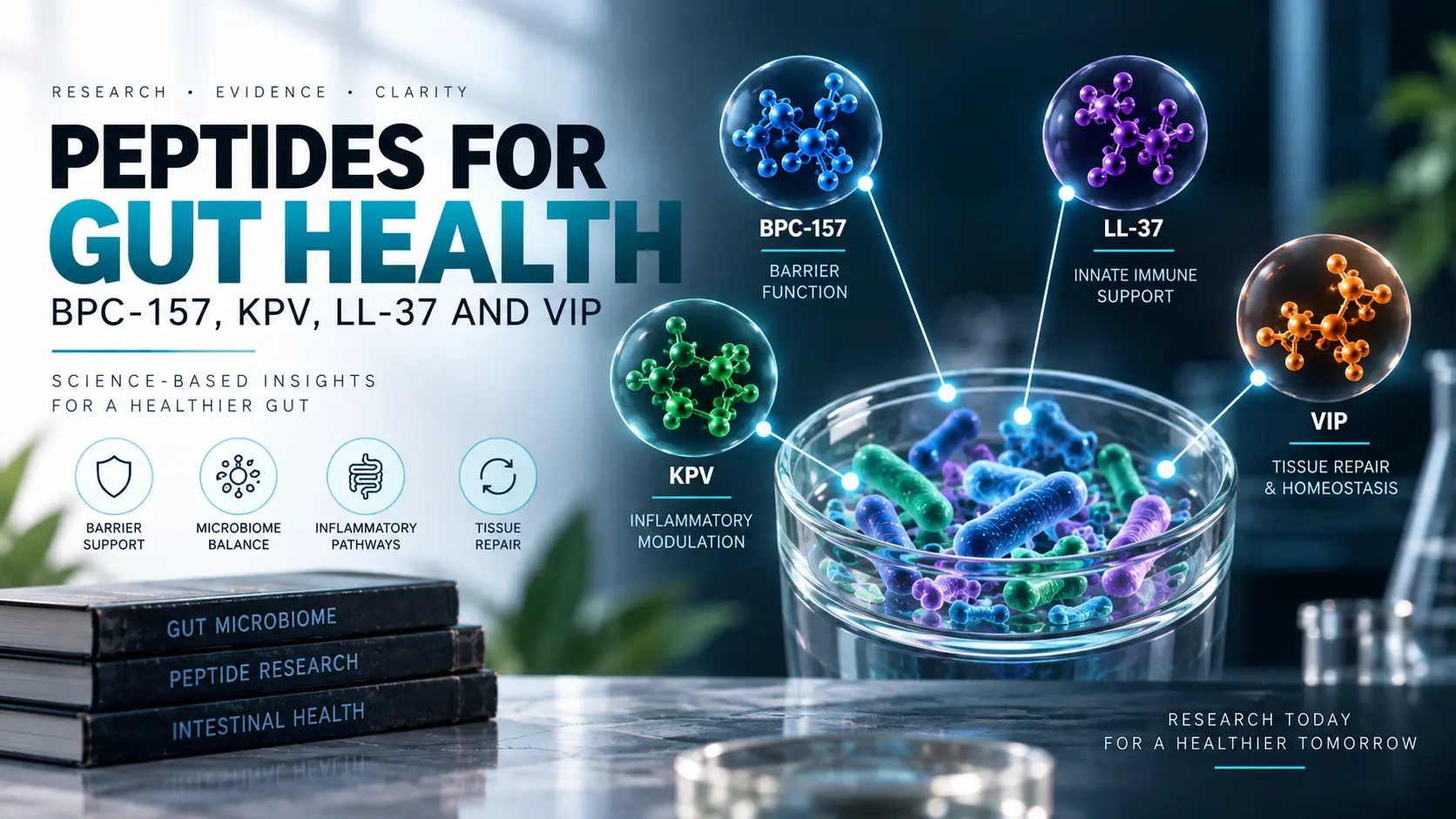
The four compounds most often promoted as peptides for gut health, BPC-157, KPV, LL-37 and VIP, have no completed, published human trial for any gastrointestinal condition between them. Their gut evidence is rodent colitis models and cell culture, and in the studies that produced it the compounds were injected into the abdominal cavity, delivered by enema, given as a plasmid into the rectum, or infused intravenously. Four peptide drugs for gut conditions have cleared randomized human trials and hold FDA approval: teduglutide, linaclotide, plecanatide and octreotide. None of them is any of the four peptides above.
Key Takeaways
- No human trial of BPC-157 for a gut condition has ever been published in full. The only human gastrointestinal data exist as two conference abstracts from 2003 and 2005 that were never published in full.
- FDA's own bulk-substances review states it has identified no human exposure data for KPV by any route of administration [1].
- FDA's review of cathelicidin LL-37 cites nonclinical findings pointing to harm to male reproduction and to protumorigenic activity in some tissues [1]. It is not a gut-repair supplement.
- On 23 July 2026 the Pharmacy Compounding Advisory Committee voted 8 to 6 with 1 abstention to recommend BPC-157 and KPV for the 503A Bulks List, against the written recommendation of FDA's own reviewers, who had advised against all seven peptides under consideration [2][3]. The vote is advisory. Neither compound is an approved drug.
- Excess VIP causes disease rather than treating it. VIPoma produces high-volume watery diarrhoea and potassium depletion, and octreotide, one of the four approved gut peptide drugs, is used to oppose it.
- Larazotide is the only tight-junction peptide to reach Phase 3 for a gut condition. Its Phase 3 trial, targeting 525 patients, was stopped on 21 June 2022 after an interim analysis concluded the number of additional patients needed was too large to justify continuing [4]. It is not under FDA review.
- KPV is the one compound here whose oral route makes mechanistic sense: as a three-residue peptide it is a substrate for PepT1, the intestinal di- and tripeptide transporter, which is induced in the colon during inflammatory bowel disease [5]. That is a mechanistic argument from mouse and cell studies; no human data exist for KPV by any route.
- Across all four compounds, human oral bioavailability has never been measured.
Research Use Only
Everything sold by 99 Purity Peptides is supplied for laboratory research use only. Nothing on this page is medical advice, dosing guidance or a treatment recommendation, and none of these compounds is approved for human or veterinary use. This article describes what has been studied, in what model, with what result.
Which Peptides Are Studied for Gut Health, and How Strong Is the Evidence?
Four compounds carry essentially all of the online attention, and all four sit in the lower half of any honest evidence hierarchy. What separates them is not whether human trials exist, because for gut endpoints none do, but how much animal work stands behind each one and how many independent groups produced it.
How we graded the evidence
Grades below reflect the strongest published evidence for a gastrointestinal outcome, not the volume of literature or the enthusiasm of its authors.
Level 1: More than one completed, published randomized controlled trial in humans with a gastrointestinal endpoint. Level 2: One such trial. Level 3: Published human data that is observational, uncontrolled, or from a different organ system. Level 4: Published animal-model data replicated across more than one model. Level 5: Animal or cell-culture data from a single group, or physiological inference with no interventional study.
A compound does not earn a higher grade for having more papers at the same level. Fifty rat studies are still rat studies.
Compound | Best human gut evidence | Best animal gut evidence | Models used | Route in those studies | Grade |
|---|---|---|---|---|---|
BPC-157 | Two conference abstracts (2003, 2005), never published in full | Rat trinitrobenzene sulfonic acid (TNBS) colitis; colocutaneous fistula; colitis with anastomosis; short bowel | Rat | Intraperitoneal and in drinking water in the rodent work (intracolonic dosing did not significantly reduce damage in the one study that compared routes); enema in the human abstract | Level 4, qualified: nearly all of it from one laboratory |
KPV | None. No trial registered, no publication | Mouse dextran sulfate sodium (DSS) and TNBS colitis; nanoparticle-delivered follow-up | Mouse; human intestinal epithelial and T-cell lines | Drinking water; colon-targeted nanoparticles in hydrogel | Level 4, qualified: principal gut work from one laboratory |
LL-37 | Observational expression studies in inflammatory bowel disease mucosa; one randomized efficacy trial, topical, venous leg ulcers, not gut | Mouse colitis: cathelicidin-knockout mice fare worse, and restoring mouse cathelicidin locally reverses it | Mouse; human biopsy tissue | Intracolonic bacterial DNA and an intrarectal plasmid expressing mouse cathelicidin; no study gave LL-37 itself | Level 3 for observation, Level 5 for gut intervention |
VIP | Intravenous infusion physiology in four volunteers (1978); endogenous excess documented as a disease state | Mouse TNBS Crohn's model | Mouse | Intraperitoneal | Level 5 for gut intervention |
Ranking these against each other is less useful than noticing what they share. Every one of them is a preclinical story, and in each case the delivery method that produced the result differs from the delivery method the compound is sold in. BPC-157 has the deepest animal file and the weakest independence, since the great majority of its gastrointestinal literature traces to a single research group in Zagreb. KPV has the cleanest mechanism and the smallest total body of work. LL-37 has the most human data and the least favourable safety picture. VIP has the most established physiology and the least reason to be given exogenously. The site's head-to-head comparison of KPV and BPC-157 for gut inflammation and barrier repair goes deeper on the first two, and research on BPC-157 and KPV used together covers the combination work.
Which Gut Peptides Are Actually FDA-Approved?
Four peptide drugs are FDA-approved for gastrointestinal indications: teduglutide, linaclotide, plecanatide and octreotide. This is the fact that reframes the entire topic. The gut is not a field where peptide drugs are speculative. It is one of the few organ systems where peptide drugs have repeatedly cleared Phase 3 and reached pharmacy shelves. The compounds promoted online simply are not among them.
Substance | Molecular target | Tested and approved for | Best human evidence | US regulatory status |
|---|---|---|---|---|
Teduglutide (Gattex, NDA 203441) | GLP-2 receptor | Short bowel syndrome in adults dependent on parenteral support | Randomized placebo-controlled Phase 3 | Approved 21 December 2012 [6] |
Linaclotide (Linzess, NDA 202811) | Guanylate cyclase-C | Irritable bowel syndrome with constipation; chronic idiopathic constipation | Randomized placebo-controlled Phase 3 | Approved 30 August 2012 [6] |
Plecanatide (Trulance, NDA 208745) | Guanylate cyclase-C, uroguanylin analogue | Chronic idiopathic constipation, with constipation-predominant IBS added later | Randomized placebo-controlled Phase 3 | Approved 19 January 2017 [6] |
Octreotide (Sandostatin, NDA 019667) | Somatostatin receptors | Includes watery diarrhoea associated with VIP-secreting tumours | Randomized and open-label clinical trials | Approved 21 October 1988 [6] |
BPC-157 | Not definitively established | Nothing, in humans | Two unpublished conference abstracts | Not approved; 8-6-1 advisory vote July 2026 [2][3] |
KPV | PepT1-mediated uptake, NF-κB and MAPK inhibition | Nothing, in humans | None identified by FDA [1] | Not approved; 8-6-1 advisory vote July 2026 [2][3] |
LL-37 | Membrane disruption; formyl peptide receptor signalling | Nothing gastrointestinal, in humans | One topical randomized trial, venous leg ulcers [7] | Not approved |
VIP | VPAC1 and VPAC2 receptors | Nothing, in humans | Intravenous physiology studies [8] | Not approved |
A specific confusion is worth clearing up, because people search for it constantly: GLP-1 and GLP-2 are not interchangeable. Both are cut from the same precursor protein, proglucagon, and then go in opposite directions. GLP-1 acts on the pancreas and the brain, driving insulin secretion and appetite suppression, which is why semaglutide and tirzepatide are metabolic drugs. GLP-2 acts on the intestine itself, promoting crypt cell proliferation, mucosal growth and nutrient absorption, which is why teduglutide is prescribed for short bowel syndrome. Someone searching for a peptide that rebuilds intestinal lining is looking for the GLP-2 story, not the GLP-1 one.
What Does BPC-157 Research Show for the Gut?
BPC-157 improves outcomes in rat models of gastrointestinal injury, and that is the entire extent of the credible claim. The compound is a 15-amino-acid sequence described by Sikirić and colleagues as a partial sequence of a protein found in human gastric juice, which is where the name "body protection compound" originates [9]. That origin story is often retold online as though it made BPC-157 a natural gut healer. It does not. A fragment of a protein found in gastric juice is a fragment, and its parent protein's function in the stomach is not its function as an administered compound.
The rodent file is genuinely substantial. BPC-157 has been tested in rat TNBS colitis [10], in a colocutaneous fistula model [11], in colitis combined with intestinal anastomosis [12], and in a short bowel model [13]. Across these the reported pattern is faster closure of defects, less mucosal damage and improved healing of surgical joins. One detail from the earliest colitis study is rarely repeated: when that group compared routes, BPC-15 given intraperitoneally reduced colonic damage, while the intracolonic dose tested did not significantly reduce damage or inflammatory enzyme activity [10]. For a compound marketed on the idea of acting locally in the gut, that is worth knowing.
Then the file stops. Human gastrointestinal data on BPC-157 exists as two conference abstracts, one in healthy volunteers presented in 2003 and one describing an enema formulation designated PL 14736 in ulcerative colitis presented in 2005. Neither was published in full. Conference abstracts are not peer-reviewed in the way journal articles are, their numerical results cannot be independently checked, and a study that never reaches full publication two decades later is a study whose results should be treated with caution rather than quoted. Claims elsewhere that BPC-157 has been "studied in small human series" rest on these two abstracts and on nothing else.
FDA's own assessment, in its catalogue of bulk substances that may present significant safety risks, is blunt about the gap. The agency records that compounded BPC-157 may carry immunogenicity risk for certain routes and that it has identified no or only limited safety information for the proposed routes of administration [1].
In July 2026 the Pharmacy Compounding Advisory Committee considered BPC-157 for ulcerative colitis and voted 8 yes, 6 no, 1 abstention to recommend both the free base and the acetate form for the 503A Bulks List [2][3]. Two details matter more than the headline. First, the committee voted against its own agency's reviewers, who had recommended that none of the seven peptides under review be included [3]. Second, an advisory vote is advice. Addition to the 503A Bulks List requires FDA to accept the recommendation and complete notice-and-comment rulemaking, and BPC-157 remains an unapproved drug substance in the meantime. The full regulatory position on BPC-157 covers the procedural detail; the BPC-157 tissue repair research guide covers the wider preclinical literature.
How Does KPV Work in the Gut?
KPV is taken into intestinal cells through PepT1, a proton-coupled transporter, and once inside it suppresses NF-κB and MAPK inflammatory signalling. Dalmasso and colleagues demonstrated this in human intestinal epithelial lines and in a human T-cell line, and showed that blocking or removing PepT1 abolished the effect, which is a properly controlled mechanistic result rather than an association [5].
The transporter detail is the interesting part, and almost nobody covering this topic explains it. PepT1 is normally a small-intestinal transporter, evolved to absorb the di- and tripeptides left over from protein digestion. During inflammatory bowel disease it becomes induced in the colon, where it is not usually active [5]. A three-residue peptide arriving in an inflamed colon therefore meets a transporter that inflammation itself has put there.
In the same work, KPV given in drinking water reduced disease severity in both DSS and TNBS mouse colitis. A follow-up from the same laboratory loaded KPV into colon-targeted nanoparticles suspended in a polysaccharide hydrogel and reduced colitis in mice with far less peptide [14].
KPV is the C-terminal tripeptide of α-melanocyte-stimulating hormone, which is where its anti-inflammatory character comes from. Its gut file is small, coherent and, like BPC-157's, concentrated in one laboratory.
What does not exist is any human study. No KPV trial appears on ClinicalTrials.gov for any indication, and FDA's own review states plainly that it has identified no human exposure data for KPV by any route [1]. At the July 2026 meeting KPV was reviewed for wound healing and inflammatory conditions rather than for inflammatory bowel disease specifically, and received the same 8-6-1 vote as BPC-157 [2][3]. The main KPV research guide covers its work outside the intestine.
One claim circulating on clinic pages deserves correction here: KPV does not "promote microbial balance." The published work describes anti-inflammatory signalling through a transporter. It does not describe microbiome composition, and presenting it that way invents a mechanism the data never tested.
Is LL-37 Good or Bad for the Gut?
Both, depending entirely on whether it is the body's own or someone else's, which is why marketing LL-37 as a gut-healing supplement inverts what the research actually shows. LL-37 is the only cathelicidin humans produce, a 37-residue peptide released from the precursor hCAP-18, and it is part of innate mucosal defence rather than a repair signal.
The human picture is messier than the marketing suggests. Cathelicidin expression in inflammatory bowel disease is heterogeneous: one biopsy study found it significantly increased in ulcerative colitis mucosa, inflamed and uninflamed, and unchanged in Crohn's disease [15], while colonic mucosa from patients with Crohn's disease shows reduced antimicrobial activity overall [16]. In mice, animals lacking cathelicidin develop worse experimental colitis [17], and restoring the mouse version locally with an intrarectal plasmid reversed that exacerbated colitis [23]. Read quickly, that chain looks like a case for supplementation: a defence peptide that matters in disease, and that helps when restored in mice.
The chain breaks in two places. Human expression is not uniformly low, and in ulcerative colitis it rises [15], so "topping up a deficiency" misreads the biology. And the mouse experiments restored the animal's own cathelicidin in the tissue where it belongs, by genetic rescue or plasmid-driven local expression [17][23]; that is not the same intervention as introducing human LL-37 from outside at an arbitrary concentration. And in tissues where cathelicidin is over-abundant, it drives pathology rather than healing, which is the established story in rosacea and in psoriasis, where LL-37 functions as an autoantigen.
The regulatory read is harsher still. In its bulk-substances safety catalogue FDA records that it lacks sufficient safety information on cathelicidin LL-37 and that nonclinical findings suggest detrimental effects on male reproduction along with protumorigenic potential in some tissues [1]. That is not a footnote. It is the agency's stated reason for treating the substance as a safety concern.
Human efficacy data for LL-37 amounts to one randomized trial, and it was topical treatment of venous leg ulcers [7]. Nothing gastrointestinal, and nothing systemic. The LL-37 host defence peptide guide covers the antimicrobial literature in more detail.
What Does VIP Do in the Digestive System?
VIP drives intestinal secretion and relaxes gastrointestinal smooth muscle, and it does this as a neurotransmitter released by enteric neurons acting on VPAC1 and VPAC2 receptors. In the gut it contributes to the descending relaxation ahead of a peristaltic wave, to sphincter relaxation, and to the secretion of water and electrolytes into the lumen.
That last function is where the popular framing collapses. When the body produces too much VIP, from a VIP-secreting tumour, the result is Verner-Morrison syndrome: high-volume watery diarrhoea, potassium depletion and low stomach acid [18]. The clinical picture is severe enough to be life-threatening, and the approved drug used to oppose it is octreotide. One of the four FDA-approved gut peptide drugs exists in part to block what excess VIP does to the intestine.
There is a mouse study in which VIP reduced severity in a TNBS model of Crohn's-like colitis [19], and it is a real result in a real model. It sits beside the physiology rather than overturning it.
Pharmacokinetics close the argument. When VIP was infused intravenously into four volunteers in 1978, its average disappearance half-time was about one minute [8]. A molecule cleared that fast is built to act locally and stop, which is exactly what a neurotransmitter should do. The VIP research guide covers its investigation outside the digestive tract.
Can Peptides Fix Leaky Gut?
No peptide has been shown in humans to reduce intestinal permeability as a treatment, and the one that came closest failed in Phase 3. The underlying biology is real even though the popular term is not a diagnosis. Intestinal permeability describes paracellular passage of molecules between epithelial cells, governed by tight junction complexes built from occludin, the claudin family and scaffolding proteins such as ZO-1. Zonulin is a proposed endogenous regulator of that machinery, though its molecular identity and the assays used to measure it remain contested. Increased permeability is measurable, by sugar-probe ratios and by confocal endomicroscopy, and it is documented in celiac disease and Crohn's disease. What it is not is a standalone condition with an agreed definition, which is part of why no trial has ever set out to treat it in isolation.
For BPC-157, KPV, LL-37 and VIP, human permeability data does not exist. Not weak data, not preliminary data. None.
Larazotide is the case study that should govern expectations. It is a synthetic eight-amino-acid peptide designed specifically to act on tight junctions, and it was developed for celiac disease patients who still had symptoms on a gluten-free diet. Its Phase 2b trial, published in Gastroenterology in 2015, was randomized and placebo-controlled and reported a symptom benefit, although only at the lowest of the three amounts tested, with the two higher ones showing no effect [20]. A dose-response curve that runs backwards is a warning sign, and it was read at the time as encouraging.
The Phase 3 trial, CedLara, targeted 525 patients. On 21 June 2022 the sponsor announced that a pre-specified interim analysis by an independent statistician had re-estimated the group size needed to detect a statistically significant effect, and that the additional patients required were too many to support continuing [4]. The trial was discontinued. Pages still describing larazotide as "under FDA review" are more than four years out of date.
The lesson generalizes. Larazotide had a defined molecular target, a specific patient population, a randomized positive Phase 2b and a pharmaceutical sponsor, and it still did not survive contact with a properly powered trial. The four compounds in this article have none of those things.
Does the Route Change Anything? Oral, Injected and Nasal
Route is the single most under-discussed weakness in peptide gut marketing, because in almost every case the study that produced the headline used a delivery method nobody is selling.
Compound | Route in the key gut studies | How it is typically marketed | Does the evidence transfer? |
|---|---|---|---|
BPC-157 | Intraperitoneal injection and intragastric administration in rats; enema in the 2005 human abstract | Oral capsules, injectable, nasal spray | Not established. Human oral bioavailability has never been measured |
KPV | Drinking water; colon-targeted nanoparticles | Oral, topical, nasal spray | Not established in humans. Oral uptake has a defined transporter mechanism, shown in mice and human cell lines |
LL-37 | Intrarectal plasmid expressing mouse cathelicidin, in knockout mice | Injectable, nasal spray | No. Plasmid-driven local expression is not administration of the peptide |
VIP | Intraperitoneal in mice; intravenous in the human physiology work | Nasal spray, injectable | No. One-minute plasma half-life constrains any systemic route |
Oral peptide delivery is hard for reasons that have nothing to do with product quality. A peptide taken by mouth meets gastric acid, then pepsin, then pancreatic proteases in the small intestine, then brush-border peptidases on the epithelial surface, and whatever survives still has to cross the epithelium. The scale of the problem is visible in the best-known oral peptide drug to solve it commercially: oral semaglutide required a dedicated absorption enhancer and still delivers only around one percent of the administered dose to circulation.
KPV is the genuine exception, and it deserves a careful explanation rather than a hand-wave. At three amino acids it is small enough to be a PepT1 substrate, and PepT1 exists precisely to move di- and tripeptides across the intestinal wall after protein digestion [5]. Oral KPV working in mouse colitis is not a lucky result; it is what the transporter biology predicts. Whether it carries over to humans has never been tested. That argument covers KPV specifically and does not extend to 15-residue BPC-157, to 37-residue LL-37 or to 28-residue VIP, none of which is a PepT1 substrate.
The claim that oral BPC-157 is "delivered directly to the site of injury" deserves particular scepticism. It sounds mechanistic and is in fact an assumption: that the compound survives digestion, that it reaches the target tissue intact, and that it does so in a meaningful quantity. None of those three steps has been measured in humans.
What About Collagen Peptides and Glutamine?
Glutamine has better evidence than collagen peptides for a gut outcome, and the gap between the two studies most often cited is a useful lesson in reading trials.
Collagen peptides | Glutamine | |
|---|---|---|
Study design | Open-label, single arm, no control group | Randomized, double-blind, placebo-controlled |
Population | Healthy women with BMI over 25, not selected for any diagnosis | Adults with post-infectious irritable bowel syndrome |
Completers | 14, of 40 recruited | 106 |
Outcome measure | Self-reported symptoms | Symptom severity score plus measured intestinal permeability |
Published | JMIR Formative Research, 2022 [21] | Gut, 2019 [22] |
What it can establish | Feasibility and tolerability | A treatment effect in this population |
A single-arm study with 14 completers and no placebo arm cannot separate a treatment effect from expectation, regression to the mean or seasonal variation in symptoms, and the authors of that study did not claim otherwise. The glutamine trial is a different class of evidence: randomized, controlled, with both a symptom endpoint and an objective permeability measure. Its own authors called for larger confirmatory trials, and that caveat still stands, since one positive single-centre trial is a reason for interest rather than a settled conclusion.
Neither result has anything to do with BPC-157, KPV, LL-37 or VIP. They are included because the same pages promoting those four compounds frequently present collagen and glutamine as equivalent options, and they are not equivalent to each other, let alone to the research compounds.
What the Evidence Does Not Establish
Several claims repeated across the pages ranking for this topic are wrong, and the corrections are more useful than another summary.
Claim in circulation | What the evidence shows |
|---|---|
BPC-157 seals the gut lining or heals leaky gut in humans | No human permeability data exists. The gut evidence is rat models [10][11][12][13] |
BPC-157 has been studied in small human series | Two conference abstracts, 2003 and 2005, neither published in full |
Oral BPC-157 reaches the site of injury directly | Human oral bioavailability has never been measured |
Larazotide is under FDA review | Its Phase 3 was discontinued on 21 June 2022 [4] |
KPV promotes microbial balance | The published work shows anti-inflammatory signalling via PepT1, not microbiome effects [5] |
LL-37 is a gut-healing peptide | FDA cites nonclinical evidence of reproductive harm and protumorigenic potential [1] |
More VIP supports digestion | Excess VIP produces severe secretory diarrhoea and potassium depletion [18] |
The July 2026 FDA vote made BPC-157 legal | The vote was advisory and the committee overrode its own agency's reviewers [2][3] |
Beyond the specific corrections, four structural limits apply to everything above.
Independence is thin. The great majority of BPC-157's gastrointestinal literature comes from one research group, and the core KPV gut work comes from one laboratory. Replication by unrelated investigators is the mechanism by which preclinical findings earn confidence, and it has largely not happened here.
The models are not the diseases. DSS and TNBS colitis are chemically induced injuries in rodents that follow a predictable course and often resolve. They are useful screening tools. They are not ulcerative colitis or Crohn's disease, which are chronic, relapsing, immunologically complex human conditions, and the history of drug development is full of compounds that worked in those models and failed in patients.
Human pharmacokinetics are absent. For none of the four compounds is there a published human study measuring absorption, distribution or clearance by an oral route.
Identity and purity are separate questions from efficacy. A compound cannot do in a laboratory what the literature describes if the material is not what the label says, which is why third-party analysis matters as much as the study list. How to read a certificate of analysis explains what the documents should contain, and current lot certificates are published for reference.
Where to Go Next
For readers working through the underlying literature, the combined BPC-157, TB-500, KPV and LL-37 research guide is the most relevant next step, and the KPV and BPC-157 head-to-head goes further into the mechanistic comparison summarised above.
99 Purity Peptides supplies these compounds as research materials with lot-specific third-party analysis: BPC-157, KPV, LL-37 and VIP. All are for laboratory research use only and are not for human or veterinary use.
References
- U.S. Food and Drug Administration. Certain Bulk Drug Substances for Use in Compounding that May Present Significant Safety Risks. Content current as of 22 April 2026. https://www.fda.gov/drugs/human-drug-compounding/certain-bulk-drug-substances-use-compounding-may-present-significant-safety-risks
- U.S. Food and Drug Administration. July 23-24, 2026: Meeting of the Pharmacy Compounding Advisory Committee. https://www.fda.gov/advisory-committees/advisory-committee-calendar/july-23-24-2026-meeting-pharmacy-compounding-advisory-committee-07232026
- American Journal of Managed Care. FDA Panel Backs 6 Peptides for Compounding. 2026. https://www.ajmc.com/view/fda-panel-backs-6-peptides-for-compounding
- 9 Meters Biopharma, Inc. Interim Analysis of Phase 3 Study of Larazotide for Celiac Disease Does Not Support Trial Continuation. Press release, 21 June 2022. https://www.sec.gov/Archives/edgar/data/1551986/000155198622000046/ex-991pressreleasedated621.htm
- Dalmasso G, Charrier-Hisamuddin L, Nguyen HT, et al. PepT1-mediated tripeptide KPV uptake reduces intestinal inflammation. Gastroenterology. 2008;134(1):166-78. PMID 18061177. https://pubmed.ncbi.nlm.nih.gov/18061177/
- U.S. Food and Drug Administration. Drugs@FDA: FDA-Approved Drugs. Teduglutide NDA 203441; linaclotide NDA 202811; plecanatide NDA 208745; octreotide NDA 019667. https://www.accessdata.fda.gov/scripts/cder/daf/
- Grönberg A, Mahlapuu M, Ståhle M, et al. Treatment with LL-37 is safe and effective in enhancing healing of hard-to-heal venous leg ulcers: a randomized, placebo-controlled clinical trial. Wound Repair Regen. 2014;22(5):613-21. PMID 25041740. https://pubmed.ncbi.nlm.nih.gov/25041740/
- Domschke S, Domschke W, Bloom SR, et al. Vasoactive intestinal peptide in man: pharmacokinetics, metabolic and circulatory effects. Gut. 1978;19(11):1049-53. PMID 730072. https://pubmed.ncbi.nlm.nih.gov/730072/
- Sikiric P, Seiwerth S, Rucman R, et al. Stable gastric pentadecapeptide BPC 157: novel therapy in gastrointestinal tract. Curr Pharm Des. 2011;17(16):1612-32. PMID 21548867. https://pubmed.ncbi.nlm.nih.gov/21548867/
- Veljaca M, Lesch CA, Pllana R, et al. BPC-15 reduces trinitrobenzene sulfonic acid-induced colonic damage in rats. J Pharmacol Exp Ther. 1995;272(1):417-22. PMID 7815358. https://pubmed.ncbi.nlm.nih.gov/7815358/
- Klicek R, Sever M, Radic B, et al. Pentadecapeptide BPC 157, in clinical trials as a therapy for inflammatory bowel disease (PL14736), is effective in the healing of colocutaneous fistulas in rats: role of the nitric oxide-system. J Pharmacol Sci. 2008;108(1):7-17. PMID 18818478. https://pubmed.ncbi.nlm.nih.gov/18818478/
- Klicek R, Kolenc D, Suran J, et al. Stable gastric pentadecapeptide BPC 157 heals cysteamine-colitis and colon-colon-anastomosis and counteracts cuprizone brain injuries and motor disability. J Physiol Pharmacol. 2013;64(5):597-612. PMID 24304574. https://pubmed.ncbi.nlm.nih.gov/24304574/
- Sever M, Klicek R, Radic B, et al. Gastric pentadecapeptide BPC 157 and short bowel syndrome in rats. Dig Dis Sci. 2009;54(10):2070-83. PMID 19093208. https://pubmed.ncbi.nlm.nih.gov/19093208/
- Laroui H, Dalmasso G, Nguyen HT, et al. Drug-loaded nanoparticles targeted to the colon with polysaccharide hydrogel reduce colitis in a mouse model. Gastroenterology. 2010;138(3):843-53. PMID 19909746. https://pubmed.ncbi.nlm.nih.gov/19909746/
- Schauber J, Rieger D, Weiler F, et al. Heterogeneous expression of human cathelicidin hCAP18/LL-37 in inflammatory bowel diseases. Eur J Gastroenterol Hepatol. 2006;18(6):615-21. PMID 16702850. https://pubmed.ncbi.nlm.nih.gov/16702850/
- Nuding S, Fellermann K, Wehkamp J, Stange EF. Reduced mucosal antimicrobial activity in Crohn's disease of the colon. Gut. 2007;56(9):1240-7. PMID 17456510. https://pubmed.ncbi.nlm.nih.gov/17456510/
- Koon HW, Shih DQ, Chen J, et al. Cathelicidin signaling via the Toll-like receptor protects against colitis in mice. Gastroenterology. 2011;141(5):1852-63. PMID 21762664. https://pubmed.ncbi.nlm.nih.gov/21762664/
- Helbing A, Menon G, Sandhu S, Jialal I. VIPoma. StatPearls. Treasure Island (FL): StatPearls Publishing. PMID 29939520. https://www.ncbi.nlm.nih.gov/books/NBK507698/
- Abad C, Martinez C, Juarranz MG, et al. Therapeutic effects of vasoactive intestinal peptide in the trinitrobenzene sulfonic acid mice model of Crohn's disease. Gastroenterology. 2003;124(4):961-71. PMID 12671893. https://pubmed.ncbi.nlm.nih.gov/12671893/
- Leffler DA, Kelly CP, Green PH, et al. Larazotide acetate for persistent symptoms of celiac disease despite a gluten-free diet: a randomized controlled trial. Gastroenterology. 2015;148(7):1311-9. PMID 25683116. https://pubmed.ncbi.nlm.nih.gov/25683116/
- Abrahams M, O'Grady R, Prawitt J. Effect of a daily collagen peptide supplement on digestive symptoms in healthy women: 2-phase mixed methods study. JMIR Form Res. 2022;6(5):e36339. PMID 35639457. https://pubmed.ncbi.nlm.nih.gov/35639457/
- Zhou Q, Verne ML, Fields JZ, et al. Randomised placebo-controlled trial of dietary glutamine supplements for postinfectious irritable bowel syndrome. Gut. 2019;68(6):996-1002. PMID 30108163. https://pubmed.ncbi.nlm.nih.gov/30108163/
- Tai EK, Wu WK, Wang XJ, et al. Intrarectal administration of mCRAMP-encoding plasmid reverses exacerbated colitis in Cnlp(-/-) mice. Gene Ther. 2013;20(2):187-93. PMID 22378344. https://pubmed.ncbi.nlm.nih.gov/22378344/
Frequently Asked Questions
What are the best peptides for gut health?
If "best" means best evidenced, the answer is the approved drugs: teduglutide, linaclotide, plecanatide and octreotide, each backed by randomized human trials. Among research compounds, none has a completed published human gut trial. BPC-157 has the largest animal file, KPV has the clearest mechanism, and neither has been tested in people for a gut outcome.
Do peptides actually heal leaky gut?
No peptide has been shown to reduce intestinal permeability as a treatment in humans. Larazotide was designed specifically to act on tight junctions, showed a signal in Phase 2b, and its Phase 3 trial was stopped in June 2022 when an interim analysis found the required sample size was infeasible. For BPC-157, KPV, LL-37 and VIP, no human permeability data exists at all.
What does BPC-157 do for the gut?
In rats, BPC-157 has been reported to reduce mucosal damage in chemically induced colitis, improve healing of intestinal anastomoses, close colocutaneous fistulas and improve outcomes in a short bowel model. Those are animal results from a small number of investigators. What BPC-157 does in a human gut has not been established by any published trial.
Are there human studies on BPC-157 for ulcerative colitis?
Only two conference abstracts, from 2003 and 2005, describing an enema formulation designated PL 14736. Neither was ever published in full in a peer-reviewed journal, which means their methods and numbers cannot be independently checked. Two decades later, no full publication has appeared. Descriptions of BPC-157 as having been "studied in humans" rest entirely on these abstracts.
Does oral BPC-157 get absorbed?
Human oral bioavailability of BPC-157 has never been measured. Claims that it survives digestion intact come from rodent work, not from human pharmacokinetic studies. At 15 amino acids it is too large to use the PepT1 transporter that handles di- and tripeptides, so the mechanistic argument available for KPV does not apply to it.
Is KPV or BPC-157 studied more for gut inflammation?
BPC-157 has more published gut studies overall, spread across several rat models. KPV has fewer studies but a better-characterised mechanism, since its uptake pathway and signalling targets were demonstrated with proper controls rather than inferred. Neither has human data. Volume of preclinical literature and strength of evidence are not the same measure.
How does KPV work in the intestine?
KPV enters intestinal epithelial cells and T cells through PepT1, a proton-coupled di- and tripeptide transporter, and once inside inhibits NF-κB and MAPK inflammatory signalling. The relevant detail is that PepT1 is normally small-intestinal but becomes induced in the colon during inflammatory bowel disease, so the transport route appears where inflammation is present. This was shown in mice and in human cell lines.
Is LL-37 good or bad for the gut?
It depends on whether it is endogenous or administered. The body's own cathelicidin contributes to mucosal defence, and reduced colonic antimicrobial activity is documented in Crohn's disease. Administered LL-37 is a different proposition: FDA's bulk-substances review cites nonclinical findings of harm to male reproduction and protumorigenic potential in some tissues. It is not a gut supplement.
What does VIP do in the digestive system?
VIP is a neurotransmitter released by enteric neurons that relaxes gastrointestinal smooth muscle and stimulates secretion of water and electrolytes into the intestinal lumen. It acts at VPAC1 and VPAC2 receptors and contributes to the relaxation phase of peristalsis and to sphincter control. Its effects are local and brief by design rather than sustained.
What happens when the body makes too much VIP?
A VIP-secreting tumour causes Verner-Morrison syndrome, also called WDHA syndrome: high-volume watery diarrhoea, severe potassium depletion and reduced stomach acid. The diarrhoea continues even during fasting and can become life-threatening through fluid and electrolyte loss. Octreotide, an FDA-approved somatostatin analogue, is used to oppose the excess secretion.
Which gut peptides are actually FDA-approved?
Four: teduglutide (Gattex), a GLP-2 analogue approved in December 2012 for short bowel syndrome; linaclotide (Linzess), approved August 2012; plecanatide (Trulance), approved January 2017, both guanylate cyclase-C agonists for constipation disorders; and octreotide (Sandostatin), approved October 1988, whose labelled uses include watery diarrhoea from VIP-secreting tumours.
What is the difference between GLP-1 and GLP-2?
Both are cut from the same precursor, proglucagon, then act in different places. GLP-1 acts on the pancreas and brain, driving insulin release and appetite suppression, which is the basis of drugs like semaglutide. GLP-2 acts on the intestine, promoting mucosal growth and nutrient absorption, which is the basis of teduglutide for short bowel syndrome.
What is larazotide, and why did it fail?
Larazotide is a synthetic eight-amino-acid peptide designed to regulate tight junctions, developed for celiac disease patients with persistent symptoms on a gluten-free diet. A 2015 Phase 2b trial reported benefit at the lowest amount tested but not higher ones. The Phase 3 CedLara trial, targeting 525 patients, was discontinued on 21 June 2022 after an interim analysis found the additional enrolment needed was infeasible.
Do collagen peptides help gut health?
The most-cited collagen study for digestive symptoms was open-label with no control group and 14 completers out of 40 recruited, so it cannot separate a real effect from expectation. Glutamine has better evidence: a placebo-controlled randomized trial in post-infectious irritable bowel syndrome with 106 completers reported both symptom improvement and reduced intestinal permeability.
Can pharmacies compound BPC-157 after the July 2026 FDA vote?
Not on the strength of that vote alone. On 23 July 2026 the Pharmacy Compounding Advisory Committee voted 8-6 with one abstention to recommend BPC-157 for the 503A Bulks List, against its own agency reviewers' written advice. Advisory votes are non-binding. FDA must accept the recommendation and complete formal rulemaking before the status changes, and BPC-157 remains unapproved.