Last reviewed: September 2026
Quick Answer
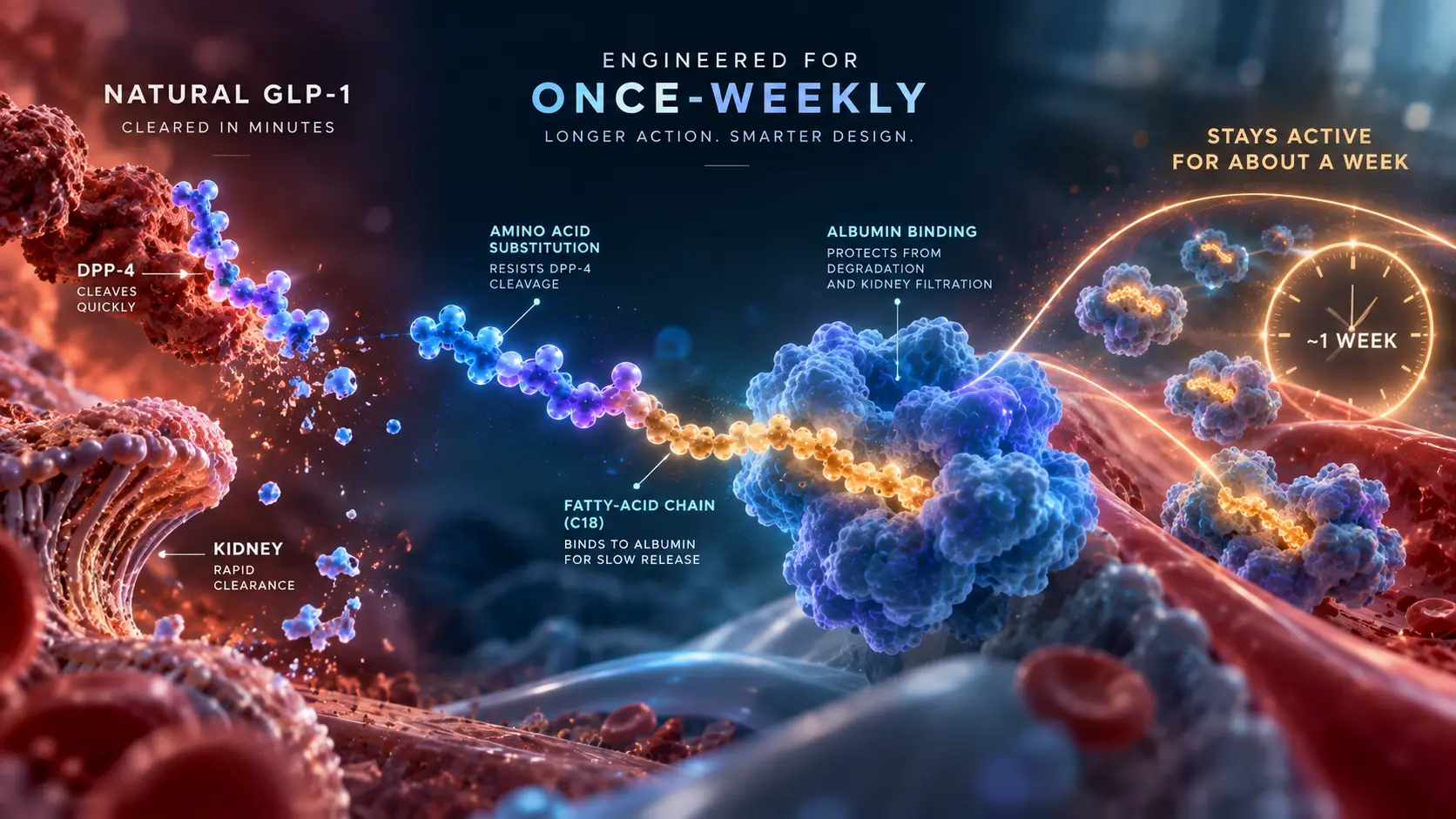
Why does semaglutide last a week? Its designers armored the peptide against the two routes that clear native GLP-1 in minutes. An amino-acid swap at position 8 blocks cleavage by the enzyme DPP-4, and a C18 fatty diacid tail attached at lysine 26 grabs onto serum albumin, which shields the molecule from filtration by the kidneys and releases it slowly [1][2]. The FDA label reports an elimination half-life of approximately one week [2].
Key Takeaways
- Native GLP-1(7-37) has a circulating half-life of 1.5 to 2 minutes in humans because the enzymes DPP-4 (dipeptidyl peptidase-4) and NEP (neutral endopeptidase) degrade it almost immediately [8].
- Semaglutide differs from human GLP-1 by only two amino-acid substitutions, Aib8 and Arg34, plus a C18 fatty diacid attached to lysine 26 through a γGlu-2xOEG linker, according to the 2015 discovery paper by Lau and colleagues [1].
- The Ozempic label states an elimination half-life of approximately one week, steady-state exposure after 4 to 5 weeks of once-weekly administration, and persistence in the circulation for about 5 weeks after the last dose [2].
- In the discovery paper's chain-length screen, the C18 diacid gave the best in-vitro potency (6.2 pM); lengthening to C20 or C22 weakened it (11.5 and 24.4 pM), which is why C18 was chosen [1].
- Across the class, the lipid gets longer as the half-life grows: liraglutide carries a C16 fatty acid (~13 hours), semaglutide a C18 diacid (~1 week), tirzepatide a C20 diacid (~5 days), and the amylin analogues cagrilintide and eloralintide use C20 diacids with half-lives of 159 to 195 hours and 310 to 366 hours respectively [8][2][9][12][14].
- Pages sometimes quote semaglutide at "~160 hours," but that figure does not appear in the cited label. The label says only "approximately one week," a correction this site's peptide half-life chart already documents.
Research Use Only. 99 Purity Peptides sells compounds for laboratory research only, never for human or veterinary use. This article summarizes published pharmacology and is not medical, dosing or health advice. No compound discussed here is recommended for any outcome. Half-lives and dosing schedules below are label or protocol facts, never instructions.
How we graded the evidence. An FDA-approved product label or a peer-reviewed human pharmacokinetic study outranks everything else. Next come primary medicinal-chemistry papers that report measured values. In-vitro and animal data are labeled as such and never presented as human results. Vendor pages, pharmacy blogs and calculators were not used as sources for any number on this page.
Why Does Semaglutide Last a Week?
Semaglutide lasts a week because three small edits to the GLP-1 backbone shut down the two clearance routes that normally remove the hormone in minutes. One edit armors the N-terminus against the enzyme DPP-4. A second edit bolts on a fatty-acid tail that binds albumin, and albumin is too large for the kidneys to filter, so the bound drug circulates as a protected reservoir that releases active peptide slowly [1][2].
The scale of the change is worth stating plainly. Native GLP-1 survives 1.5 to 2 minutes in human circulation [8]. Semaglutide's label half-life is approximately one week [2]. That is a roughly 5,000-fold extension, achieved without changing the peptide's receptor target. No new biology was needed, only better pharmacokinetics.
Two problems had to be solved together, because fixing one would have left the other.
Clearance route | Native GLP-1 | Semaglutide |
|---|---|---|
Enzyme attack by DPP-4 and NEP | Cleaved within 1.5 to 2 minutes in humans [8] | Aib at position 8 resists DPP-4 cleavage [1] |
Kidney filtration of the small free peptide | Rapid renal clearance of the 30-residue hormone | C18 fatty diacid at lysine 26 binds albumin reversibly, shielding the molecule [1][2] |
Reported circulating half-life | 1.5 to 2 minutes [8] | Approximately one week [2] |
Either fix alone would have produced a mediocre drug. A DPP-4-resistant peptide with no albumin binding would still be filtered by the kidneys in well under an hour. An albumin-bound peptide with a native N-terminus would be chewed up at the exposed end. Lau and colleagues say this directly in the discovery paper: the goal was a once-weekly analogue built by increasing albumin affinity, and the team treated it as a design challenge precisely because both problems interact [1].
How Long Does Natural GLP-1 Last, and Why So Briefly?
Natural GLP-1 lasts 1.5 to 2 minutes in human circulation, and two enzyme systems are responsible. The current Victoza label states the figure and the mechanism in one sentence: "GLP-1(7-37) has a half-life of 1.5-2 minutes due to degradation by the ubiquitous endogenous enzymes, dipeptidyl peptidase IV (DPP-IV) and neutral endopeptidases (NEP)" [8]. DPP-4 and DPP-IV are the same enzyme under two naming conventions used across the literature.
The cleavage chemistry was worked out in the 1990s. Kieffer and colleagues showed in 1995 that the serum enzyme DPP-IV degrades GLP-1(7-36) amide into the inactive fragment GLP-1(9-36) amide, removing the N-terminal His-Ala dipeptide [3]. That experiment was an in-vitro serum incubation, not a human measurement, so it establishes the mechanism rather than the speed. Deacon and colleagues then showed that human plasma degrades GLP-1(7-36) amide with a half-life of 20.4 minutes at 37°C in the test tube, and that DPP-IV inhibitors completely prevent the conversion [4]. That 20.4-minute figure is a plasma-incubation number. It is not the circulating half-life.
Human in-vivo data came the same year. Deacon's group gave GLP-1 to 8 healthy subjects and 8 people with type 2 diabetes and found the intact hormone rapidly degraded from the N-terminus in both groups, with only about 20 to 25 percent of circulating GLP-1 remaining intact [5]. Vilsbøll and colleagues later measured intact-GLP-1 clearances of roughly 4 to 9 liters per minute in 6 obese patients and 6 matched healthy subjects, confirming that elimination is extremely fast in living humans [6].
Three numbers, three different experiments. The label's 1.5 to 2 minutes is the circulating half-life in humans [8]. A different experiment produced the 20.4-minute figure: human plasma in a test tube [4]. Rat data in Kieffer's paper describe enzyme action, not human pharmacokinetics [3]. Pages that mix these up are not lying so much as reading carelessly, but the distinction matters for everything that follows: semaglutide's designers were fighting the 1.5-to-2-minute number.
What Three Changes Turned GLP-1 Into Semaglutide?
Semaglutide differs from human GLP-1 by three changes, and the discovery paper names all of them in its abstract: "Semaglutide has two amino acid substitutions compared to human GLP-1 (Aib8, Arg34) and is derivatized at lysine 26" [1]. Each change has a job, and each job maps to one of the clearance routes above.
First, alanine at position 8 became α-aminoisobutyric acid, abbreviated Aib. DPP-4 recognizes the native N-terminus and clips it; the unnatural residue at position 8 does not fit the enzyme's active site. The paper states the rationale plainly: "the N-terminus was substituted to protect against DPP-4 degradation" [1]. This is the same design logic the field had already validated, since DPP-4-resistant analogues were the first step toward every long-acting GLP-1 drug.
Second, lysine 26 was derivatized with a C18 fatty diacid through a γGlu-2xOEG linker, listed in the paper's Table 3 as "Aib8, Arg34 C18 diacid γGlu-2xOEG Lys26" [1]. The diacid end of the chain docks into albumin's fatty-acid binding pockets. Ozempic's label describes the same protraction mechanism in its own words: "The main protraction mechanism of semaglutide is albumin binding, facilitated by modification of position 26 lysine with a hydrophilic spacer and a C18 fatty di-acid," and adds that "semaglutide is modified in position 8 to provide stabilization against degradation by the enzyme dipeptidyl-peptidase 4 (DPP-4)" [2]. Note the label says diacid, not fatty acid. Many secondary pages drop the "di," but the second carboxylic acid group is part of what tunes the albumin interaction, and the primary sources are consistent on the point [1][2].
Third, lysine 34 became arginine. This change exists for manufacturing chemistry rather than pharmacology. Acylation chemistry targets lysine side chains, and native GLP-1 has lysines at both positions 26 and 34; swapping position 34 to arginine leaves lysine 26 as the only site the fatty diacid can attach to. The paper notes that "Arg34 was originally introduced in liraglutide to enable sitespecific acylation of Lys26 and had no apparent effect on binding to the GLP-1R" [1]. Regulators describe it the same way: "A minor modification was made in position 34 to ensure the attachment of only one fatty di-acid" [2].
What Does the Fatty-Acid Chain Actually Do?
The fatty-acid chain turns albumin into a slow-release carrier for the drug. Albumin is the most abundant protein in plasma, and it has dedicated binding pockets for fatty acids. When semaglutide's C18 diacid tail sits in one of those pockets, the whole peptide rides along on a 66-kilodalton protein that the kidneys cannot filter and that proteases cannot easily reach [1][2]. Binding is reversible, so individual molecules constantly hop off, become free and active, and rebind. The circulating pool behaves as a reservoir.
This creates a tuning problem that the discovery paper discusses with unusual candor. Binding too weakly means the peptide spends most of its time free, unprotected, and cleared within hours. Too-strong binding means almost no free peptide is available to activate the receptor, so potency collapses even though the drug lingers. Lau and colleagues write: "One major risk of increasing the albumin binding affinity is that the free active fraction would significantly decrease leading to a diminished in vivo potency and an increased dose needed to achieve acceptable efficacy" [1]. Their summary of the challenge is worth quoting in full: "It therefore became an ambitious design challenge to demonstrate that it was possible to design an analogue that was efficacious at a low dose while still being reversibly bound to albumin with an affinity sufficient to protract the systemic clearance" [1].
Chain length was the tuning dial, and the paper reports the screen that set it. Longer diacids bind albumin more tightly, and exposure rose steadily from C12 through C20, but in-vitro potency peaked at C18 and then fell:
Fatty diacid chain length | In-vitro potency at the GLP-1 receptor | Design read |
|---|---|---|
C12 | 42.5 pM | Weak albumin binding, short exposure [1] |
C18 (semaglutide) | 6.2 pM | Best potency, sufficient albumin affinity [1] |
C20 | 11.5 pM | Potency attenuated despite stronger binding [1] |
C22 | 24.4 pM | Potency attenuated further [1] |
The paper concludes that "C18 diacid is the optimal choice with respect to in vitro potency" [1]. Those C20 and C22 results are the empirical proof of the tuning problem: tighter albumin binding bought longer exposure but cost free active fraction, exactly as the team had feared. These are cell-assay potency numbers from the medicinal-chemistry program, not human efficacy data, and they should be read as chemistry evidence, not clinical evidence.
Independent support comes from the cagrilintide program. Kruse and colleagues observed "an apparent loss of potency" in analogues N-terminally lipidated with C20 diacid, which they attributed to strong albumin binding, and wrote that "the fatty acids bind to albumin which interferes with the receptor interaction and result in an apparent loss of potency" [11]. Two separate Novo Nordisk teams, working on two different hormones, hit the same wall at the same chain length. That convergence is why the tuning principle deserves to be stated as a principle rather than a one-compound anecdote.
Do All GLP-1 Drugs Use the Same Trick?
Most long-acting drugs in this family use the same trick with different tuning, but the details vary in ways that change the numbers. The table below gives the verified lipid modification, the reported half-life with its population, and how often the approved or studied product is given, stated only as a label or protocol fact.
Compound | Verified lipid modification | Reported half-life | Administration frequency in the label or protocol |
|---|---|---|---|
Liraglutide | C16 fatty acid (palmitic acid) with a glutamic-acid spacer on lysine 26; Arg34 [7][8] | Approximately 13 hours in humans [8] | Once daily in the approved label [8] |
Semaglutide | C18 fatty diacid on lysine 26 via γGlu-2xOEG; Aib8, Arg34 [1] | Approximately one week in humans [2] | Once weekly in the approved label [2] |
Tirzepatide | C20 fatty diacid (1,20-eicosanedioic acid) on lysine 20; Aib at positions 2 and 13; 39 amino acids [9][10] | Approximately 5 days in humans (116.7 hours in the discovery paper) [9][10] | Once weekly in the approved label [9] |
Cagrilintide | C20 fatty diacid with a γGlu linker, attached at the N-terminus rather than a lysine [11] | 159 to 195 hours in humans across 0.16 to 4.5 mg [12] | Once weekly in the phase 2 protocol (investigational) [13] |
Eloralintide | 20-carbon fatty diacid on lysine 26 via two gamma-glutamate linkers [14] | 310 to 366 hours in healthy volunteers [14] | Once weekly in the trial protocols (investigational) [14] |
Several patterns in this table deserve commentary. First, chain length tracks half-life across the GLP-1 drugs: C16 gives about 13 hours, C18 about a week, and the C20 diacid on tirzepatide about 5 days [8][2][9]. Tirzepatide's shorter half-life than semaglutide despite the longer chain is a useful reminder that the peptide backbone, the attachment site and the linker all matter; chain length tunes albumin affinity but does not dictate the final number alone [10].
Second, cagrilintide breaks the lysine pattern. Where every GLP-1 drug above acylates a lysine side chain, cagrilintide's C20 diacid is attached at the N-terminus of the peptide [11].
Third, the two amylin analogues show how far the same idea extends. Eloralintide is a 37-residue amylin analogue, not a GLP-1 drug at all, yet Lilly protracted it with the identical strategy: a 20-carbon fatty diacid at lysine 26, albumin binding, and a half-life of 310 to 366 hours in healthy volunteers that supported once-weekly administration in trials [14]. Our eloralintide explainer covers its receptor pharmacology and trial program in full; this article borrows only its lipidation chemistry. Cagrilintide's 159-to-195-hour half-life comes from a phase 1b trial in humans [12], and its phase 2 program tested once-weekly subcutaneous administration over 26 weeks in 706 participants [13].
The honest headline is that albumin-binding lipidation is the dominant protraction strategy in this family, but it is not the only strategy in peptide drug design generally, and no head-to-head human trial has ranked these lipidation chemistries against each other. Every cross-row comparison in the table is cross-study. The evidence is strong for each row individually and thin for any claim that one row's chemistry is "better" than another's.
Readers comparing the GLP-1 drugs directly will also want our semaglutide versus tirzepatide comparison, the tirzepatide dual-receptor agonist guide, and the cagrilintide versus semaglutide comparison. The GLP-1 peptide pipeline for 2026 tracks where the investigational compounds stand.
What Is the Cost of a Long Half-Life?
A long half-life means a long tail, and the label quantifies it: "With an elimination half-life of approximately 1 week, semaglutide will be present in the circulation for about 5 weeks after the last dose" [2]. This follows the standard pharmacokinetic arithmetic. Each half-life removes half of what remains, so the drug fades asymptotically rather than stopping:
Half-lives elapsed | Fraction of drug remaining | Calendar time for a ~1-week half-life |
|---|---|---|
1 | 50% | About 1 week |
2 | 25% | About 2 weeks |
3 | 12.5% | About 3 weeks |
4 | 6.25% | About 4 weeks |
5 | About 3% | About 5 weeks, matching the label [2] |
Three consequences follow, all strictly pharmacokinetic. First, the same reservoir that smooths drug levels between weekly administrations also commits the body to weeks of exposure after the last dose. An adverse effect that appears cannot be switched off by skipping the next administration the way a daily drug can. Second, reaching steady state takes time: the label states that steady-state exposure is achieved after 4 to 5 weeks of once-weekly administration [2]. Any change in exposure needs a month to fully register, in either direction. Third, a longer half-life is not the same as better efficacy or better tolerability. Half-life describes how long the molecule persists, not how strongly it activates its receptor or how the body reacts to that activation. Those are pharmacodynamic questions, and the label's pharmacokinetic section does not answer them [2].
This is the trade-off the popular pages skip. Every "why does it last a week" explainer celebrates the engineering; almost none mentions that the engineering is a commitment. Once-weekly administration is convenient, and the price of that convenience is measured in weeks of washout.
Why Can't You Assume Any Peptide Lasts This Long?
Because duration is a property of the molecule's chemistry, not of its name or its class. A peptide sold or discussed without DPP-4 protection and without an albumin-binding modification behaves like the native hormone: minutes, not days. "It lasts a week" cannot be transferred from semaglutide to another molecule any more than a car's fuel economy can be transferred between models that share a badge.
The site's peptide half-life chart makes this point with data. Its rule is that every row names the species and the route behind the number, and its most honest feature is how many rows are blank: thirteen compounds with no published half-life value traceable to a measurement. The chart also documents how invented numbers propagate, including the "~160 hours" figure for semaglutide that appears on ranking pages but not in the cited label [2]. A related discipline applies to names themselves: our naming article's point is that a name tells you a class, not a behavior, and half-life is behavior.
Consider the contrast the chart draws. BPC-157, a peptide with no protraction chemistry at all, has a measured elimination half-life of 15.2 minutes in rats by the intravenous route and 5.27 minutes in beagle dogs, yet vendor charts list it at hours. CJC-1295 with DAC, which uses a completely different protraction strategy (covalent binding to albumin via a maleimide group, not a fatty acid), measures 5.8 to 8.1 days in humans. Same word "peptide," three different fates, each determined by specific chemistry verified in a specific species by a specific route.
The practical test is simple. When any peptide is claimed to last days or weeks, ask which modification produces that duration and where the number was measured. If the answer is a fatty-acid chain, ask which one: C16, C18 diacid or C20 diacid behave differently, as the table above shows. Where no modification is named and no primary measurement is cited, the claim is marketing. Semaglutide earns its week with two named substitutions and a named diacid, each traceable to a paper and a label [1][2]. Anything less documented deserves less confidence.
What the Evidence Does Not Establish
Several limits deserve plain statement. The Lau 2015 paper is a medicinal-chemistry optimization report: its chain-length and potency data come from cell assays and animal pharmacokinetics, and the human half-life comes from the FDA label, not from that paper [1][2]. Treating the discovery paper as clinical evidence would be a category error.
The albumin-binding model itself rests partly on inference. Nobody has published a direct measurement of semaglutide's free fraction in human plasma over a dosing interval in the sources reviewed here; the reservoir picture is the standard interpretation of the albumin-affinity data plus the observed half-life, and it is well supported, but it is an interpretation [1][2]. The tuning-principle quotes are the authors' own framing of their design problem, which makes them primary evidence of intent rather than independent confirmation of mechanism [1].
Cross-compound comparisons are cross-study comparisons. No randomized trial has tested liraglutide's C16 chemistry against semaglutide's C18 diacid or tirzepatide's C20 diacid in the same population, so any ranking of the lipidation strategies by "quality" is speculation. The half-life differences reflect whole molecules, including backbones, linkers and attachment sites, not chain length alone [1][8][9][10][11].
Finally, nothing here establishes that a longer half-life is clinically preferable. The evidence shows that lipidation extends circulation; it does not show that the longest-lived molecule in the table is the most effective or the best tolerated, because those outcomes were never tested as a function of half-life [2][12][13][14]. Duration is a pharmacokinetic property. Everything else is a separate experiment.
Where the Chart and the Guides Go From Here
This article explained the mechanism; the numbers live next door. The peptide half-life chart lists published half-life values by compound, species and route, with the same grading discipline applied here. For the newest amylin analogue in the table, the eloralintide explainer gives the full discovery story, and the cagrilintide versus semaglutide comparison sets the two Novo Nordisk molecules side by side. Broader context sits in the tirzepatide dual-receptor agonist guide, the semaglutide appetite regulation and glucose control article, and the GLP-1 peptide pipeline for 2026.
For laboratory researchers, 99 Purity Peptides supplies semaglutide and cagrilintide as lyophilized research peptides. Every batch undergoes HPLC purity testing and molecular identity verification, with batch-specific quality control documentation; our guide to reading a certificate of analysis explains what those documents show, and the certificates page hosts them. Both compounds are sold strictly for Research Use Only, never for human or veterinary use.
References
- Lau J, Bloch P, Schäffer L, et al. Discovery of the Once-Weekly Glucagon-Like Peptide-1 (GLP-1) Analogue Semaglutide. J Med Chem. 2015;58(18):7370-7380. PMID 26308095. https://pubmed.ncbi.nlm.nih.gov/26308095/
- Ozempic (semaglutide) prescribing information. U.S. Food and Drug Administration. DailyMed. Section 11 (Description) and Section 12.3 (Pharmacokinetics). https://dailymed.nlm.nih.gov/dailymed/fda/fdaDrugXsl.cfm?setid=adec4fd2-6858-4c99-91d4-531f5f2a2d79
- Kieffer TJ, McIntosh CHS, Pederson RA. Degradation of glucose-dependent insulinotropic polypeptide and truncated glucagon-like peptide 1 in vitro and in vivo by dipeptidyl peptidase IV. Endocrinology. 1995;136(8):3585-3596. PMID 7628397. https://pubmed.ncbi.nlm.nih.gov/7628397/
- Deacon CF, Johnsen AH, Holst JJ. Degradation of glucagon-like peptide-1 by human plasma in vitro yields an N-terminally truncated peptide that is a major endogenous metabolite. J Clin Endocrinol Metab. 1995;80(3):952-957. PMID 7883856. https://pubmed.ncbi.nlm.nih.gov/7883856/
- Deacon CF, Nauck MA, Toft-Nielsen M, et al. Both subcutaneously and intravenously administered glucagon-like peptide I are rapidly degraded from the NH2-terminus in type II diabetic patients and in healthy subjects. Diabetes. 1995;44(9):1126-1131. PMID 7657039. https://pubmed.ncbi.nlm.nih.gov/7657039/
- Vilsbøll T, Agersø H, Krarup T, Holst JJ. Similar elimination rates of glucagon-like peptide-1 in obese type 2 diabetic patients and matched lean healthy subjects. J Clin Endocrinol Metab. 2003;88(1):220-224. PMID 12519856. https://pubmed.ncbi.nlm.nih.gov/12519856/
- Knudsen LB, Nielsen PF, Huusfeldt PO, et al. Potent derivatives of glucagon-like peptide-1 with pharmacokinetic properties suitable for once daily administration. J Med Chem. 2000;43(9):1664-1669. PMID 10794683. https://pubmed.ncbi.nlm.nih.gov/10794683/
- Victoza (liraglutide) prescribing information. U.S. Food and Drug Administration. DailyMed. Section 11 (Description), Section 12.1 (Mechanism of Action) and Section 12.3 (Pharmacokinetics). https://dailymed.nlm.nih.gov/dailymed/lookup.cfm?setid=5a9ef4ea-c76a-4d34-a604-27c5b505f5a4
- Mounjaro (tirzepatide) prescribing information. U.S. Food and Drug Administration. DailyMed. Section 11 (Description), Section 12.1 and Section 12.3 (Pharmacokinetics). https://dailymed.nlm.nih.gov/dailymed/fda/fdaDrugXsl.cfm?setid=d2d7da5d-ad07-4228-955f-cf7e355c8cc0
- Coskun T, Sloop KW, Loghin C, et al. LY3298176, a novel dual GIP and GLP-1 receptor agonist for the treatment of type 2 diabetes mellitus: From discovery to clinical proof of concept. Mol Metab. 2018;18:3-14. PMID 30473097. https://pmc.ncbi.nlm.nih.gov/articles/PMC6308032/
- Kruse T, Hansen JL, Dahl K, et al. Development of Cagrilintide, a Long-Acting Amylin Analogue. J Med Chem. 2021;64(15):11183-11194. DOI 10.1021/acs.jmedchem.1c00565. https://doi.org/10.1021/acs.jmedchem.1c00565
- Enebo LB, Berthelsen KK, Kankam M, et al. Safety, tolerability, pharmacokinetics, and pharmacodynamics of concomitant administration of multiple doses of cagrilintide with semaglutide 2.4 mg for weight management: a randomised, controlled, phase 1b trial. Lancet. 2021;397(10286):1736-1748. PMID 33894838. https://pubmed.ncbi.nlm.nih.gov/33894838/
- Lau DCW, Erichsen L, Francisco AM, et al. Once-weekly cagrilintide for weight management in people with overweight and obesity: a multicentre, randomised, double-blind, placebo-controlled and active-controlled, dose-finding phase 2 trial. Lancet. 2021;398(10317):2160-2172. DOI 10.1016/S0140-6736(21)01751-7. https://doi.org/10.1016/S0140-6736(21)01751-7
- Briere DA, et al. Eloralintide (LY3841136), a novel amylin receptor agonist for the treatment of obesity: From discovery to clinical proof of concept. Mol Metab. 2025;102:102271. PMID 41109426. https://pmc.ncbi.nlm.nih.gov/articles/PMC12640043/
Frequently Asked Questions
Why does semaglutide last a week?
Semaglutide lasts a week because two engineered changes block the clearance routes that remove natural GLP-1 in minutes. An Aib substitution at position 8 resists DPP-4 cleavage, and a C18 fatty diacid at lysine 26 binds serum albumin, which shields the peptide from kidney filtration and releases it slowly. The FDA label reports an elimination half-life of approximately one week.
Why is Ozempic only once a week?
Ozempic's active ingredient is semaglutide, whose label half-life is approximately one week. With that half-life, enough drug remains in circulation between weekly administrations to maintain steady exposure, and the label states steady state is reached after 4 to 5 weeks. The schedule is a pharmacokinetic consequence of the molecule's design, not a property shared by all peptides.
How long does semaglutide stay in the body?
About five weeks after the last dose, according to the FDA label, which states that "with an elimination half-life of approximately 1 week, semaglutide will be present in the circulation for about 5 weeks after the last dose." Each half-life removes half of what remains, so roughly 3 percent is left after five half-lives. This is a pharmacokinetic fact, not guidance about stopping or starting treatment.
What is semaglutide's half-life?
Approximately one week, per the FDA-approved prescribing information. Be wary of pages quoting "160 hours": that figure does not appear in the cited label, which gives only the one-week approximation. Half-life values should always be traced to the label or a primary pharmacokinetic study, with the species and population named, before being repeated.
What is the fatty acid chain on semaglutide for?
It is a protraction device, not part of the pharmacology. The C18 fatty diacid tail docks into albumin's fatty-acid binding pockets, so the peptide circulates hitched to a large plasma protein that the kidneys cannot filter and proteases cannot easily reach. Binding is reversible: molecules continuously detach, act on the GLP-1 receptor, and rebind, which stretches a minutes-long hormone into a week-long drug.
What is a C18 fatty diacid?
It is an 18-carbon chain with a carboxylic acid group at each end. On semaglutide it is attached to lysine 26 through a hydrophilic linker (gamma-glutamate plus two short ethylene-glycol units). The diacid structure matters: in the discovery paper's screen, the C18 diacid gave the best balance of albumin binding and free active fraction, outperforming both shorter and longer chains.
What is the half-life of GLP-1 itself?
Native GLP-1(7-37) has a circulating half-life of 1.5 to 2 minutes in humans, per the Victoza label, because DPP-4 and neutral endopeptidases degrade it almost immediately. Do not confuse this with the 20.4-minute figure from a 1995 study, which measured degradation in human plasma in a test tube, not circulation in a living person. Both numbers are real; they describe different experiments.
What is DPP-4?
DPP-4 (dipeptidyl peptidase-4, also written DPP-IV) is an enzyme that clips two amino acids off the N-terminus of susceptible peptides. It converts active GLP-1(7-36) into the inactive fragment GLP-1(9-36), which is the main reason the native hormone vanishes in minutes. Semaglutide's Aib substitution at position 8 makes the N-terminus unrecognizable to this enzyme.
What does albumin binding do to a drug?
It parks the drug on the most abundant protein in plasma. Albumin is too large for kidney filtration, so the bound fraction escapes renal clearance, and the protein's bulk shields the peptide from degrading enzymes. Because binding is reversible, the albumin pool acts as a reservoir that slowly releases free, active drug. The trade-off: binding that is too tight leaves too little free drug to work.
Do all GLP-1 drugs last a week?
No. Liraglutide uses a shorter C16 fatty acid and its label half-life is about 13 hours, which is why the approved product is given daily. Tirzepatide uses a C20 fatty diacid with a half-life of about 5 days and is given weekly. Semaglutide's C18 diacid gives about a week. Duration follows the specific lipid chemistry of each molecule, not the drug class.
Why does liraglutide last a shorter time than semaglutide?
Liraglutide carries a C16 fatty acid (palmitic acid) on lysine 26, a shorter chain than semaglutide's C18 diacid, so it binds albumin less tightly and clears faster. Its label half-life is approximately 13 hours versus semaglutide's approximately one week. It also lacks semaglutide's Aib8 DPP-4 protection, relying instead on the albumin binding and the Arg34 substitution it shares with its successor.
Does a longer half-life mean a stronger drug?
No. Half-life measures how long a molecule persists in circulation, not how strongly it activates its receptor or how the body responds. In the semaglutide discovery program, lengthening the diacid from C18 to C20 increased albumin binding but weakened in-vitro potency, which is why C18 was selected. Duration and potency are separate properties tuned by separate features of the molecule.
How long does it take semaglutide to leave the body?
Roughly five half-lives, which for a one-week half-life means about five weeks. The FDA label states the drug "will be present in the circulation for about 5 weeks after the last dose." After one week about half remains, after two weeks about a quarter, and after five weeks roughly 3 percent. This long tail is the flip side of once-weekly administration.
Can other peptides be modified to last longer?
Yes, and the same albumin-binding strategy has been applied beyond GLP-1 drugs. The amylin analogues cagrilintide and eloralintide both use C20 fatty diacids to achieve half-lives of 159 to 195 hours and 310 to 366 hours respectively. But the modification must be designed per molecule: chain length, attachment site and linker all affect the balance between albumin affinity and free active fraction, as the semaglutide program's C18 optimum shows.
Is a longer half-life safer or riskier?
Neither, as a general rule. A longer half-life means steadier drug levels between administrations, but it also means a longer washout: effects that arise cannot be ended quickly, and reaching a new steady state takes weeks. Whether that trade-off is favorable depends on the drug, the condition and the patient, which is a clinical judgment. Pharmacokinetics alone does not determine safety.